
Dear Fellow Investors and Friends,
Welcome to my newsletter, where I share my efforts to understand markets and the world around me.
I do appreciate you taking the time to read this. I love getting feedback; feel free to drop me a line. It’s great to start conversations.
Today is Thursday, November 12th, the 316th day of the year. There are 49 days left in the year. Time flies when you’re having fun!
On this day in 1998, TheGlobe.com priced its IPO at $9 per share. At the time, it was the largest IPO in the USA. The following day, 13 November, it began trading on the Nasdaq and closed at $63.50, a first-day gain of 606%. The company provided an online social community where users could publish content and interact with one another. Sounds like a winner, doesn’t it?
By April 2001, the share had been delisted from Nasdaq, and by August of that year, it had sold off its remaining intellectual property for peanuts. Even if you were lucky enough to have gotten in at the IPO price of $9, you would have lost almost all of your money.
Yesterday, Anthropic filed its prospectus for its IPO, which will now be the biggest ever.
It’s always fascinated me that, in the face of overwhelming evidence that an asset class is in a bubble, highly intelligent people continue to act as if it isn’t.
How does this happen?
I can think of three levers that drive this phenomenon.
1. Incentive-driven behaviour
If share prices are rising, why not join the party and make some money? “Free” money has always been a strong incentive for economic agents to ignore reality.
2. Fear of looking foolish
When the counterargument to not participating in the bubble is the eloquent “OK Boomer” retort, the next step is obviously to change your mind. No use being old and foolish.
3. Belief
This is the worst one. You can get people to do just about anything if you couch it in religious terms. You can never say no to God.
Bubbles are not bad per se. They are quite useful for mobilising capital for massive infrastructure buildouts. Bubbles provide cheap capital to entrepreneurs to “build their dreams”. In the process, society benefits and the entrepreneurs get rich. It’s a win-win, isn’t it?
The USA’s ability to create and survive one bubble after another is one reason its economy is so strong. From railroads to electricity to highways to the internet, bubbles have financed massive infrastructure buildouts in the USA, creating tremendous value for its people.
The main beneficiaries of these intermittent infrastructure bubbles have been the founder-entrepreneurs who got rich and the shareholders of companies that monetised the value created by the infrastructure. But mostly, consumers have benefited from better goods and services, delivered faster and cheaper.
It’s not all Kumbaya, though – the system also produces losers. The losers in these bubbles are the investors speculators who provide the cheap capital to finance the infrastructure build-out.
So entrepreneurs need to convince them they won’t be losers. And what better way than to pull on the levers described earlier? Silicon Valley is especially good at this, and especially the third one.
The tech elites in Silicon Valley might or might not believe in the classical God of the Holy Bible, the Torah, or the Quran, but they invoke godlike powers in the products they bring to market.
Arthur Clarke hit the nail on the head when he said, “Any technology which is sufficiently advanced is indistinguishable from magic.”
When confronted with magic, humans have, since time immemorial, turned to religion for explanations. Our tech overlords know this and use it to full effect.
In the US, the frontier labs want investors to believe they are creating God-in-a-box. As such, everything, especially cost, is subordinate to getting there first. Which means they need loads of cheap capital to burn through on the journey. Where better to get it than from the collection plates of the church of AI?
They promote a narrative of long-term benefits for humanity, despite short-term, individual harms. It’s no wonder that “Effective Altruism” (EA) has become one of the most powerful and defining ideologies among Silicon Valley’s elite.
EA is best understood as a modern descendant of utilitarianism. Utilitarianism is a moral theory about what makes actions right or wrong. EA is more of a practical movement about how we can use existing resources to make the world a better place. Importantly, EA attempts to measure everything in terms of rewards and results, something no practical moral code has ever attempted – for good reason.
Effective altruists don’t look at the actions at hand or their consequences today. They focus only on long-term, holistic results, hoping to maximise good outcomes in the aggregate. The problem is that you can use this philosophy to justify almost anything – if there are theoretical benefits and they are far enough in the future.
Persuading people that AI is a panacea for all ills falls under this heading. And taking that a step further, saying yes, it might kill us all, but just give us – the tech elite – the power to control it, and we will make sure it won’t happen.
Just don’t let the competition (aka the Chinese) in, otherwise it will surely kill us all.
Noah Smith, in his column Noahpinion, proposed this thought experiment:
The logical conclusion of applying EA might be to make selling your granny to sex traffickers seem like a rational course of action:
- Granny is old and doesn’t have long to live, so she can’t experience much pleasure even under the best circumstances.
- But the sex traffickers could use Granny to increase the pleasure of loads of their customers.
- The whole system is therefore better off if Granny is sold off to the nearest sex ring.
You’d better hope that, if you’re ever a grandparent, your progeny don’t become Effective Altruists.
Here are some of today’s famous proponents of EA:
- Sam Bankman-Fried, who went to jail for widespread corruption
- Elon Musk, who achieved many great things, but would you want him as an exemplar for your kids?
- Dustin Moscowitz and Mark Zuckerberg – Meta, the company they founded, has been fined billions of dollars for intentionally misleading users about data privacy, building platforms that exploit and endanger children, and engaging in abusive antitrust practices.
- Bill Gates had such close ties with Jeffrey Epstein that Warren Buffett broke off his friendship with him.
- And so on and so forth.
These are not good people. Good engineers and outstanding entrepreneurs, yes – but not good people.
That’s why Silicon Valley scares me. If Granny needs to worry about her future, investors need to worry about the future of their capital.
In The Markets
1. DCFs don’t lie
Partners Group is a Swiss global private markets investment manager. In other words, it’s a listed private equity manager.
As David Swenson’s work, Pioneering Portfolio Management: An Unconventional Approach to Institutional Investment, became popular, institutions demanded more exposure to uncorrelated assets, à la Private Equity.
Businesses like Partners Group sprang up to provide the institutions with what they wanted. After all, one of the oldest sayings in the market is “feed the ducks when they quack”. Partners Group and their ilk took to the feeding task with gusto.
Since the GFC, they also had a tailwind of consistently declining interest rates. And anyone who has ever built a DCF knows that you can come up with any valuation for a stream of cash flows if you make the discount rate (i.e. interest rate) low enough. The period of negative interest rates in Europe post-COVID made Partners Group look like an investment genius.
But all they were really doing was buying small caps with lots of debt and putting them in an illiquid wrapper. But most institutions won’t touch an illiquid small cap with a barge pole, except, apparently, if you dress it up in fancy private equity clothes. The low-interest-rate environment allowed firms like Partners to place increasingly high valuations on their investments, with a commensurate bump in their fees, which are charged on an ad valorem basis.
The only problem was how to exit their leveraged small caps. It seemed that knowledgeable trade buyers baulked at the prices being asked, and stock markets globally are closed to small-cap IPOs. But it’s not for nothing that PE investors are widely regarded as the smart guys in the room. They came up with a brilliant solution – continuation funds.
These were new funds they raised from clients to house exits from the old funds at previously marked-up valuations. This boosted the managers’ income statements further through deal fees.
It’s no wonder stocks like Partners, Blackstone, Apollo, etc. became such popular stocks to own. Some even regarded them as defensive!
But interest rates are now rising globally, to levels not seen in more than a generation. This makes life difficult for firms like Partners, as they can’t even sell into continuation funds anymore. At least not at their previously high marks.
Here is Partners’ share price – lower than it was before the Covid panic:
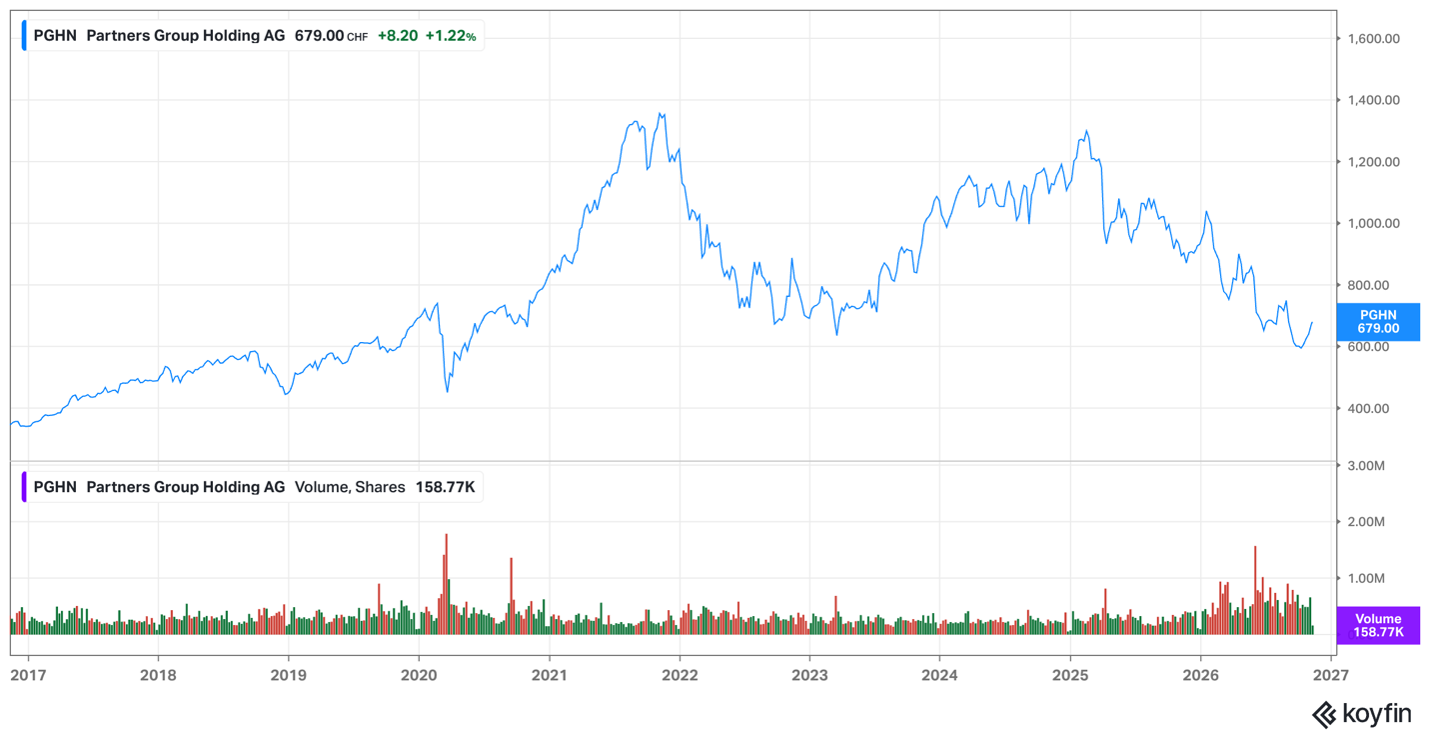
My take: Looking at this chart, investors have started realising that this firm, and others like it, are now a play on the effect of rising interest rates on the valuation of illiquid, leveraged small-cap businesses.
2. The Tyranny of High Expectations
One of the best investment books is Capital Returns: Investing Through the Capital Cycle: A Money Manager’s Reports 2002–15, edited by Edward Chancellor. If you can get hold of it – which isn’t easy – do yourself a favour and read it. It documents Marathon Asset Management’s investment activities over the first part of this century. Marathoin was, and remains, a successful investment manager, and their investment process is based on capital cycle theory.
This theory says long-term profitability and investment returns of an industry are driven primarily by the interaction between capital investment, competition and supply. When an industry earns high returns on capital, it attracts new investment, encouraging existing businesses to expand capacity and new competitors to enter. The resulting increase in supply eventually depresses prices, profitability and returns on capital, often destroying shareholder value.
The upshot is that when analysing any highly profitable industry, it pays to analyse the supply response to the high profitability, not the demand side – which is where most analysts tend to focus.
Today, there is no doubt that the demand for the transformational technology of AI will be enormous. But what about the supply of the physical infrastructure that enables the technology? The energy generation and transmission, the data centres and the chips?
The FT published this chart of the capex (i.e. supply response) of the hyperscalers:
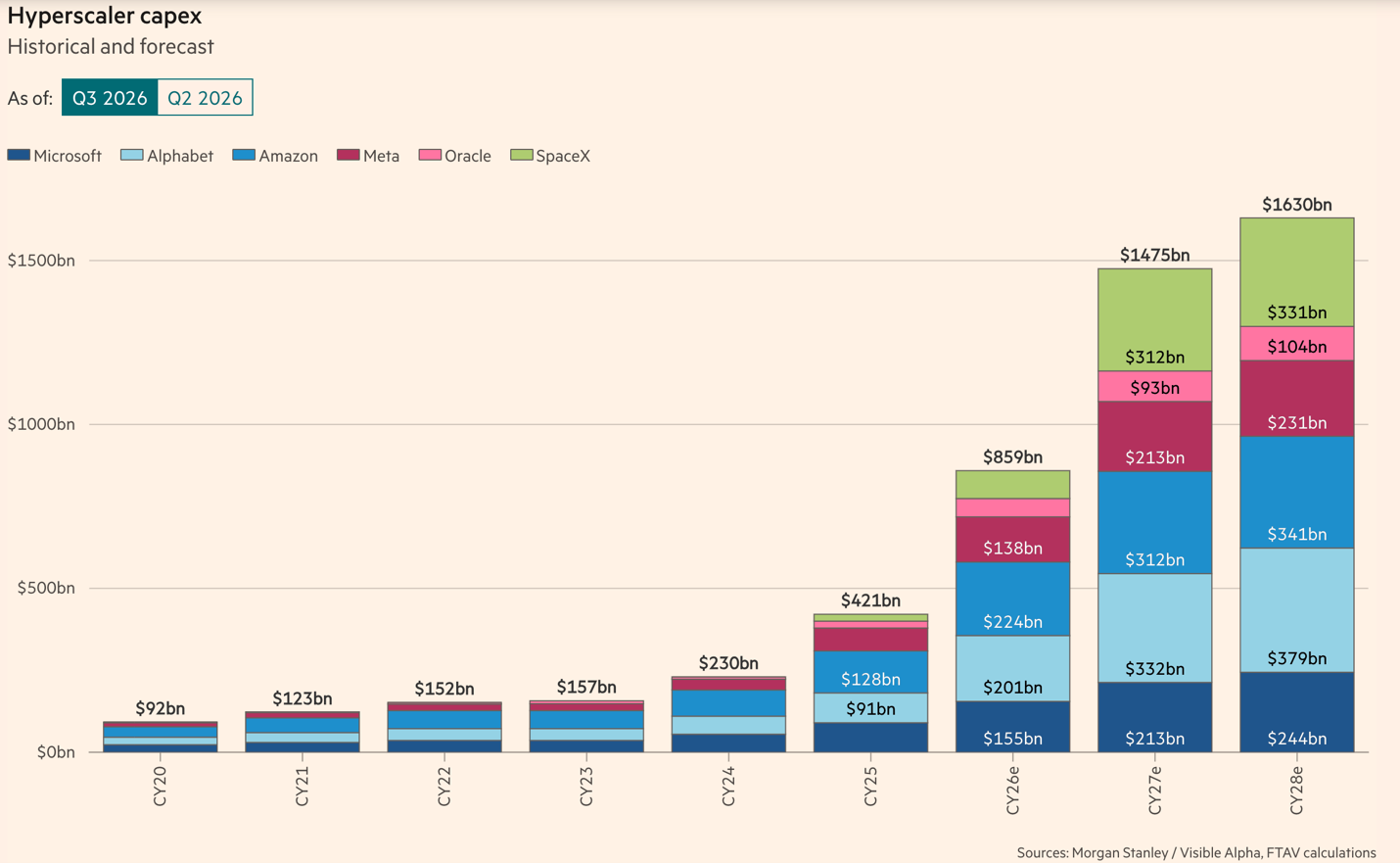
These hyperscalers’ capex is, in turn, the revenue of the AI infrastructure providers. Given this profile, the expectations built into the infrastructure providers’ share prices are not inconsiderable.
But high expectations are an investor’s worst enemy. If this capex fails to materialise, or even slows down, because of, say, a shift in political winds, a scandal involving a key CEO, or the sudden realisation that underlying profitability is simply too low, tailwinds rapidly turn into headwinds. It reduces pricing power, causes revenue to decline and shrinks margins.
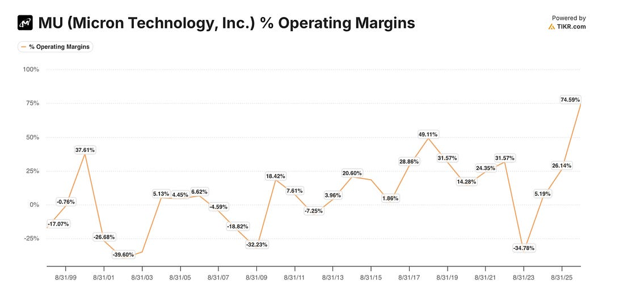
And margins have a long way to potentially fall. Micron is the poster child for AI infrastructure providers. I wrote about it here. Its margins hit 80% last quarter: contrast this with a historical average closer to 10%:
Bulls would point out that memory stocks like Micron currently have single-digit P/E ratios. But I would point out that P/E ratios aren’t a good way to value cyclical stocks, which are almost always most expensive when they have the lowest P/E ratios, as they are probably overearning.
The best way to judge whether these types of companies – i.e. cyclical capital-intensive businesses – are cheap is to look at their price-to-book ratios (PBR). Price-to-book is the market value of a firm’s equity relative to the value of its cumulative capital investment. Analysing this ratio is anathema to “growth investors” – but it works far better than P/E’s.
Here’s Micron’s PBR, close to its highest level ever:
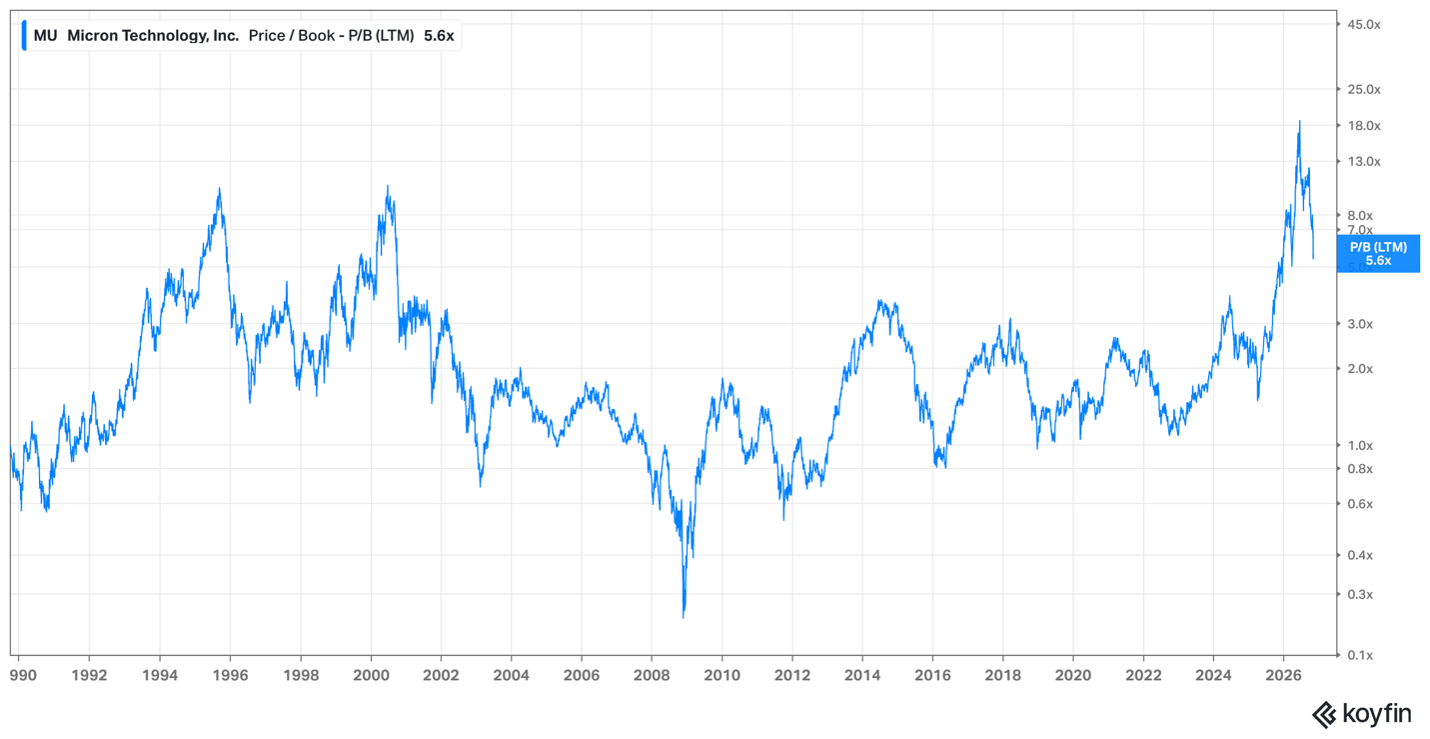
The high PBR clearly illustrates the high expectations built into the share price.
Here’s another low P/E, capital-intensive, cyclical company, which is currently at the centre of a scandal:
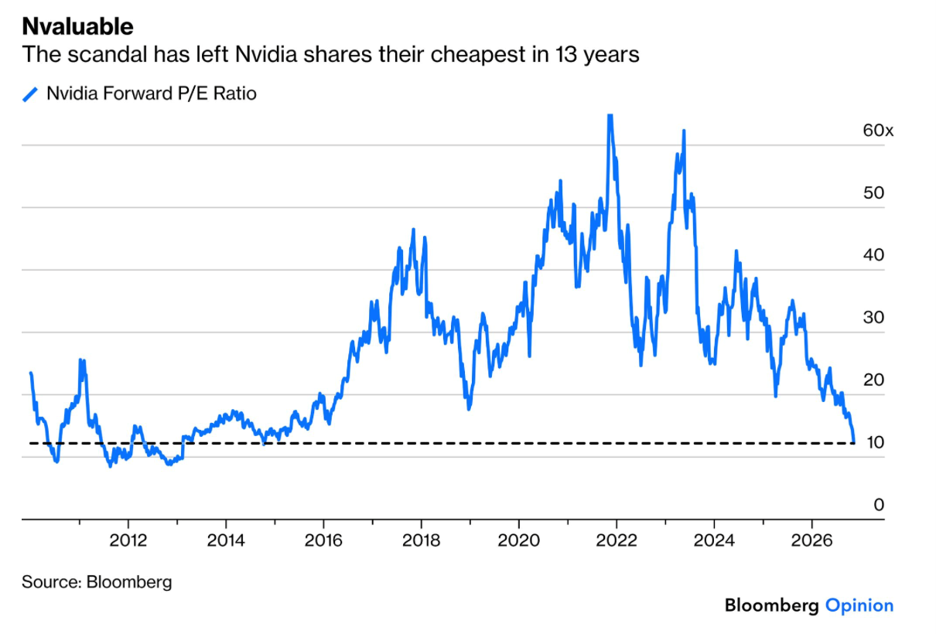
Growth investors are excited by the low P/E on offer. But here’s another view of the expectations built into the share price:
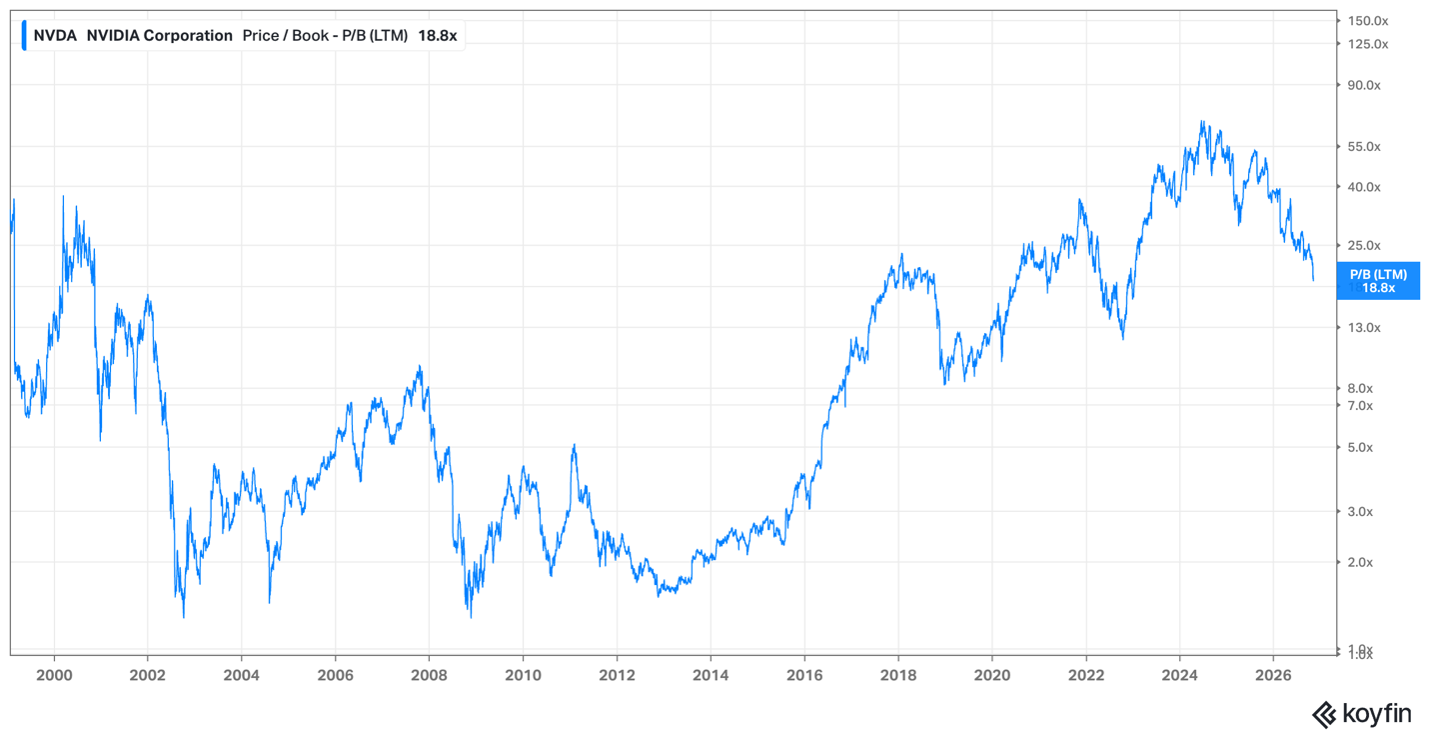
On a price-to-book basis, Nvidia is not far from its most expensive level ever, which doesn’t augur well for the bulls. Especially when you review events since its record P/B ratio valuation in June 2024 (see above chart).
Exhibit 1: Mr Jensen Huang signing the breast of a fan, on 4 June 2024:

That June, Nvidia’s share price closed at $123. Yesterday, it was $169. That’s a 14% CAGR over the period. Not bad, but probably not what Nvidia bulls expected – especially the young lady in the picture.
Another way to think about Nvidia is that high valuations breed hubris, and hubris leads to downfall.
Charlie Munger said, “The first rule of a happy life is low expectations. If you have unrealistic expectations, you’re going to be miserable your whole life. You want to have reasonable expectations and take life’s results, good and bad, as they happen, with a certain amount of stoicism.”
A high PBR is reliable shorthand for unrealistically high expectations. Which eventually and inevitably leads to miserable investors.
My take: The investors’ corollary to Mr Munger’s good advice is that low expectations make for happy investors. One of the assets in the world with the lowest expectations built into it is South African government bonds. No one would trust our inept government even to take care of their pet spider for a day, let alone our national finances. But here’s the thing: over that same period that Nvidia disappointed its bullish investors, the CAGR from owning South African government bonds (in US$ terms) was 28%. Low expectations in action.
3. The Tyranny of High Expectations, part 2
The big news in the market is that Anthropic has filed to go public this month via an IPO. I have been on record many times as saying that one should avoid Initial Public Offerings (IPOs). Most recently, when I discussed the SpaceX IPO in “To The Moon”.
Even though you might miss the one or two stocks that go up a lot, you will also miss out on many, many more stocks that go straight to the toilet. Recently, John Authors of Bloomberg posted this chart showing how IPOs actually underperform:
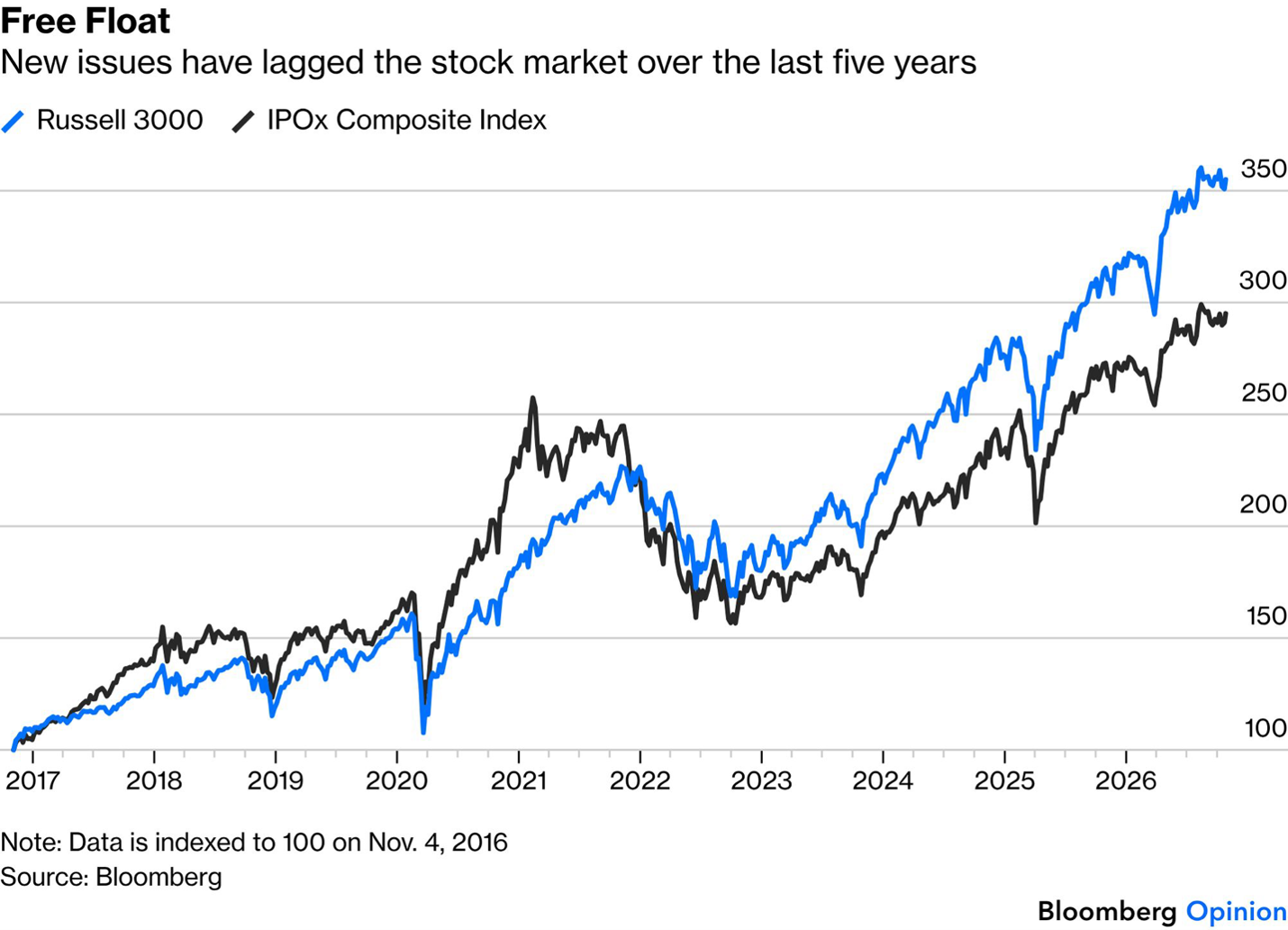
But I do think that it’s important to understand why IPO’s underperform.
Basically, an IPO only happens when the owner of a business – who knows it best – can sell a part of it at a very high valuation.
Owners never sell out of a sense of community, kindness or generosity. They sell because they can either:
- Make a lot of money (by selling at a high price), or
- Raise capital cheaply (by selling at a high price)
Investors are only prepared to pay a high price for an asset when there is a lot of excitement around it. Enter the investment bankers, who receive a commission for successfully placing an initial offering.
They will publish thick tomes on the great prospects for the business, its large tangible addressable market and the brilliance of its CEO. All of which is designed to further fan the flames of excitement, in the interests of selling stock at a high price.
It’s this high price that almost always creates poor future investment returns. The business, no matter how wonderful, can almost never fulfil the high expectations built into the high share price.
There’s one further consideration – the bigger the IPO, the bigger the hype. It’s hard to sell a large amount of highly priced stock. You need a commensurate amount of highly charged hype to do so.
So Anthropic’s mooted IPO promises a great moment of truth, completing arguably the greatest year on record for stock market debuts. The massive sums involved evoke memories of the last great IPO wave, which peaked in 1999, just as the internet bubble was about to burst.
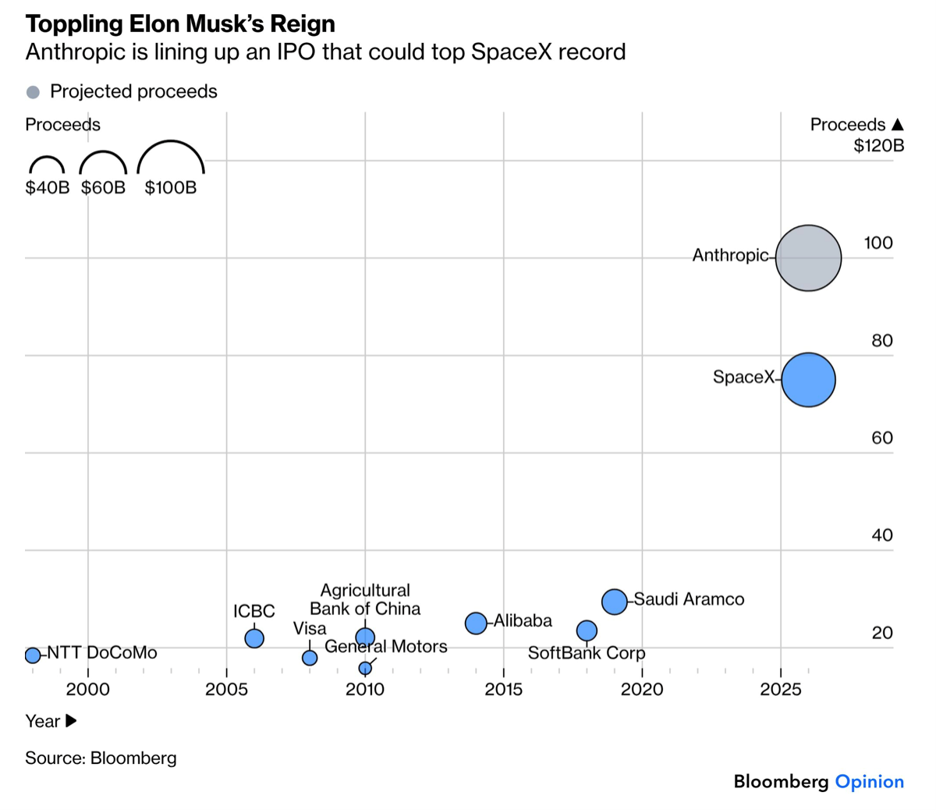
My take: The SpaceX and Anthropic IPOs leave all other IPOs looking like chicken feed. The returns from these IPOs are likely to be proportionally worse. Staying on the sidelines here strikes me as an eminently sensible course of action.
In The Cockroach
No trades again this week in either fund. Despite all the market volatility, the funds have continued to show a stable pattern of returns, due to:
- Having a 25% exposure to the most volatile asset class, equity
- Not owning direct equity exposure to the AI infrastructure space within the equity allocation
The South African cockroach (the MWI Worldwide Flexible Fund*) is up 1.9% (c.1% up in US$ terms) for the quarter-to-date, while the offshore cockroach (the RECM Worldwide Flexible Fund) is down by 1.3%. It performed slightly worse than the local fund because it launched in September, and October carried the cost of initiating its positions.
The only exposure the funds have adjacent to the AI ecosystem is a c.3% holding in Texas Pacific Land (TPL), which is part of their “hard asset” allocation. As a result of TPL being in the process of negotiating contracts for AI infrastructure players to use its land to build data centres on, it has been tainted with that brush. This is what happened to its share price over the past while:
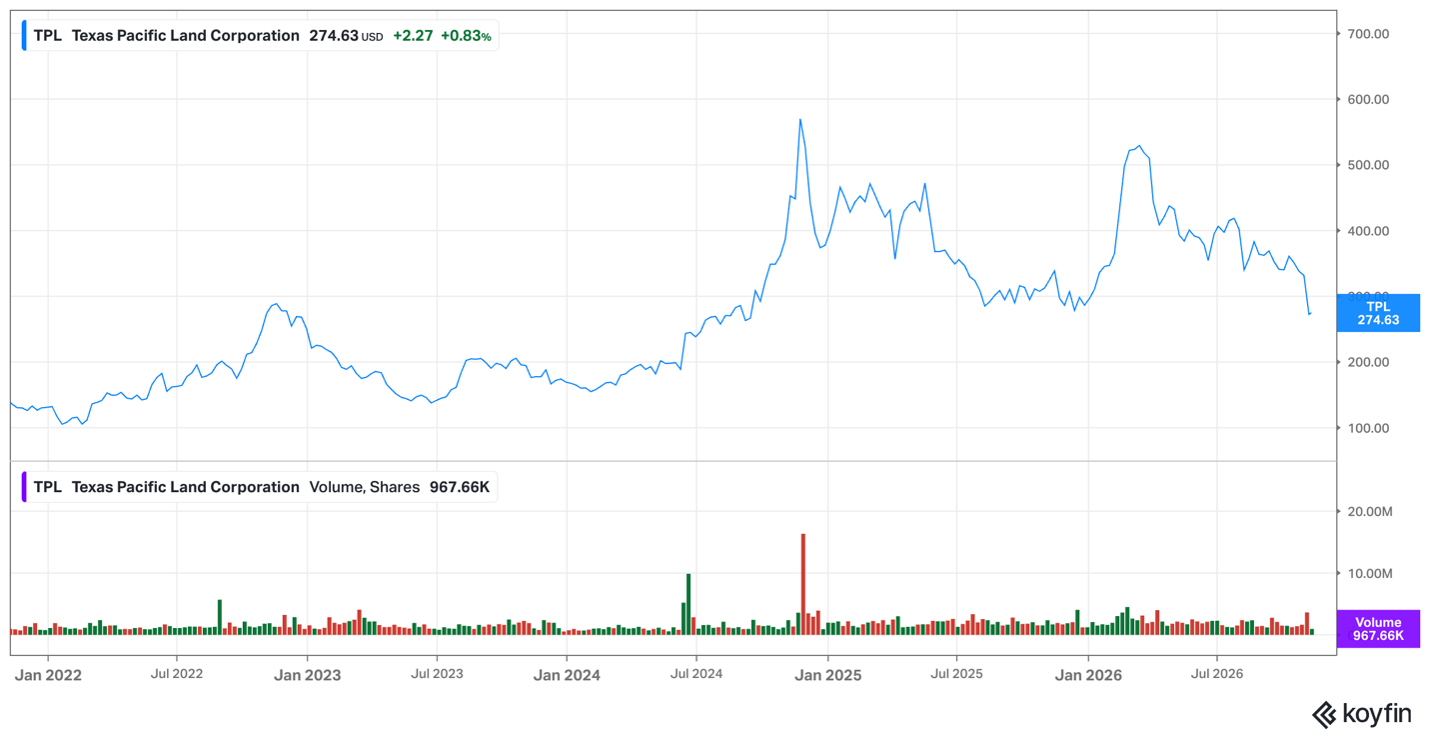
Not pretty!
But I would argue that recent events have strengthened its hand, not weakened it. As this letter is already too long, I will set out my reasoning next week.
* I manage the fund on behalf of Merchant West Investments (Pty) Ltd (FSP 44508)
In The Media
1. Morgan Housel – Getting Rich vs Staying Rich
If I could be granted one wish, it would be to be able to express myself as well as Mr Housel. In this edition of his podcast, he discusses the difference between getting rich and staying rich. I believe every investor should internalise his message – it’s that important.
Housel highlights that getting rich and staying rich are two entirely different skills. People who excel at getting rich often take outsized risks that work in one era, but those same risks frequently lead to a spectacular downfall in a different era or different domain.
You can watch the full podcast on YouTube here.
2. AI will not make you rich
In this episode of Colossus magazine, Jerry Neuman explores what AI means for investors.
In the article, he distinguishes between transformative technological innovations, such as the Bessemer process, electric power, the internal combustion engine, and the microprocessor, and those that just reinforce the status quo. He compares AI to a previous innovation with a similar effect: containerisation. According to Neumann, the greatest beneficiaries are likely to be consumers and businesses that use AI, rather than those that develop it.
Ultimately, the winners will be those who use lower costs to expand markets, not simply increase margins. Neumann points to IKEA and Walmart, which exploited the lower costs made possible by containerisation to reduce prices, increase volumes and take market share.
You can read the full article here. Or listen to it here.
That’s it for this week, which we’ve been spending in Madikwe Game Reserve with some friends. It’s been a joy to slow down and experience nature in all its glory.



Being out here in the wilderness has reminded me once again that caution always pays. So be careful out there.
Piet Viljoen
RECM
12 November 2026