
Dear Fellow Investors and Friends,
Welcome to my newsletter, where I share my efforts to understand markets and the world around me.
I do appreciate you taking the time to read this. I love getting feedback; feel free to drop me a line. It’s great to start conversations.
Today is Thursday, October 15th, the 288th day of the year. There are 77 days left in the year. This week, I saw the first Christmas decorations in the shops.
On this day in 1929, Yale economist Irving Fisher made one of history’s most famously mistaken market forecasts when he proclaimed that “Stock prices have reached what looks like a permanently high plateau.” Just nine days later, the Wall Street crash began in earnest on Black Thursday, 24 October.
Be careful who you listen to, especially when it comes to economists.
Friedrich Hayek was a prominent economist and social philosopher who lived from 1899 to 1992. He won the Nobel Prize in Economics in 1974. I first learned about him when Alec Hogg of BizNews gave me his book, “The Road to Serfdom”, at the first-ever BizNews conference. For an economist of his stature, his views are surprisingly little known. I had always been aware of him, but the book gave me newfound insight into his work.
Hayek understands how the world really works. While most economists assume people are “rational actors”, Hayek argued that human beings are not perfectly rational, that their knowledge is inherently limited, and that they often struggle to anticipate the consequences of their actions. This insight was central to his economic philosophy.
Interestingly, another famous economist, John Maynard Keynes, also thought humans were imperfect, but that’s where their similarity ended. Keynes thought imperfect individuals create collectively undesirable outcomes and therefore sought to impose a “guiding hand” on economic systems. Keynes absolved people of individual responsibility and recommended that governments and central banks step in when things threatened to get out of kilter.
By contrast, Hayek thought that order eventually emerges from the interactions of imperfect individuals, and that Smith’s invisible hand would deliver good outcomes overall. He regarded the free-market system as the best allocator of resources.
In fact, Edward Chancellor, in his book “The Price of Time”, argues that economists such as Hayek, who seemed to have been proven right about what should have been done to avoid the Great Depression, have been “airbrushed” from history. In contrast, those who lost most of their wealth and seemed to champion the policies that led to the Great Depression, such as Keynes, are now celebrated and widely taught in universities.
The current global monetary and fiscal system is built on Keynes’ thinking. Governments worldwide give Hayek’s laissez-faire recommendations short shrift. Conspiracy theorists would argue that unelected bureaucrats can’t afford to let the market do its thing, as it would usurp their power.
Keynes believed that sufficiently intelligent individuals can understand and control complex systems. Bureaucrats rule, right?
This led directly to his policy recommendations: large-scale government spending and cheap money to support aggregate demand. Of course, Keynes thought his policy recommendations should apply only during recessions, not throughout the cycle, as has increasingly happened in Western economies over the past 50 years!
From Chancellor’s book, this is an account of a discussion between a Swiss banker and Keynes, on the eve of the great crash of 1929:
“Keynes asked me what I was advising clients.
‘To insulate themselves as much as possible from the coming crisis, and to avoid the markets’, I replied.
Keynes took the opposite view. ‘We will not have any more crashes in our time’, he insisted, and asked me in detail for my opinions about individual companies.
‘I think the market is very appealing, and prices are low,’ said Keynes. ‘And where is the crash coming from, in any case?’
Nicholas Nassim Taleb has a great moniker for people like Keynes – IYI, or “Intellectuals Yet Idiots”. These people are not stupid at all. They’re just paid to be ignorant. As Munger said, “Whose bread I eat, whose song I sing.”
Is it any wonder the Western world, which has applied Keynesian policies for almost a century, faces such immense financial imbalances? The bureaucrats in power have to plough on, despite all the signs of an impending car crash of epic proportions. To do otherwise would be to admit defeat and give up power.
Hayek argues that recognising the limits of one’s knowledge is essential to sound decision-making. However, people construct explanations for complex events, identify apparent patterns, and become confident they can predict outcomes. This tendency is firmly embedded in human psychology, despite all evidence to the contrary. This week, two neo-Keynesian economists, Bob Hall and Mike Woodford, won the Nobel Prize in Economic Sciences, further substantiating the trend. The establishment does not want people to think for themselves.
Hayek argues that repeated monetary and fiscal interventions, as prescribed by all economists across the Keynesian spectrum, prevent necessary economic restructuring. He would be concerned that cheap credit, government subsidies and repeated bailouts allow low-return businesses to survive, tying up capital and labour that could be employed more productively elsewhere.
Hayek probably would have viewed persistent fiscal deficits as a problem of political incentives as much as of economic policy. Politicians gain immediate political benefits from spending, while shifting the costs to future taxpayers. He would therefore favour stronger institutional constraints, predictable fiscal rules, limits on discretionary intervention, and credible commitments that reduce politicians’ ability to shift costs into the future.
But this is exactly where Hayek’s recommendations run into a roadblock. Expecting unelected bureaucrats to limit their power, while letting a lightly regulated free market allocate resources, is like the frog expecting not to be stung by a scorpion while crossing the river.
Incentives drive behaviour, not reason.
In response to unsustainable debt levels, expect increasing regulation, intervention, and suppression of the free market. The Keynesians are firmly in charge and find the market appealing – just like Keynes did in 1929.
In The Markets
1. It never rains, but it pours
For a long time, Andries van Heerden and his management team at Afrimat were regarded as the best in the business. They could do no wrong, and the company enjoyed a high rating.
But the market has a way of bringing even the best down from time to time. I always say it’s much harder than golf. In golf, at least, a handicap allows you to claw back shots against better opponents. In business, everyone plays off a plus handicap. Even when you are going through a bad patch, you have to give back strokes.
Right now, Afrimat is going through a bad patch, which, like all other bad patches, stems from a combination of bad luck and poor judgement.
What does a management team with a strong reputation and a high rating do? They come to believe the hype and issue highly rated stock (smart) to make increasingly large acquisitions in a short space of time (not smart).
In cyclical industries like those in which Afrimat operates, getting too big too fast creates a whole new set of risks, which even the best management teams can’t anticipate, or struggle to manage. Who knew Transnet would effectively collapse, impacting Afrimat’s ability to deliver iron ore to the port? Who knew the rand-denominated iron ore price would halve in 5 years? Who knew the Ferrochrome industry would collapse, destroying demand for Afrimat’s anthracite?
Who knew all this would happen just as Afrimat bought a struggling cement business?
It never rains, but it pours.
So today, Afrimat’s management team has lost some of its lustre. But only one thing has really changed: the nature of the business. It has become more cyclical after acquiring the Anthracite and Iron Ore mines, and the balance sheet has become somewhat stretched after acquiring the cement business.
I think it was Warren Buffett who said: “When a management team with a great reputation meets an industry with a poor reputation, it’s the reputation of the industry that survives”.
Of course, the momentum jockeys in the market think a share price reflects management skill, so they think management has mysteriously lost the skills previously attributed to them:
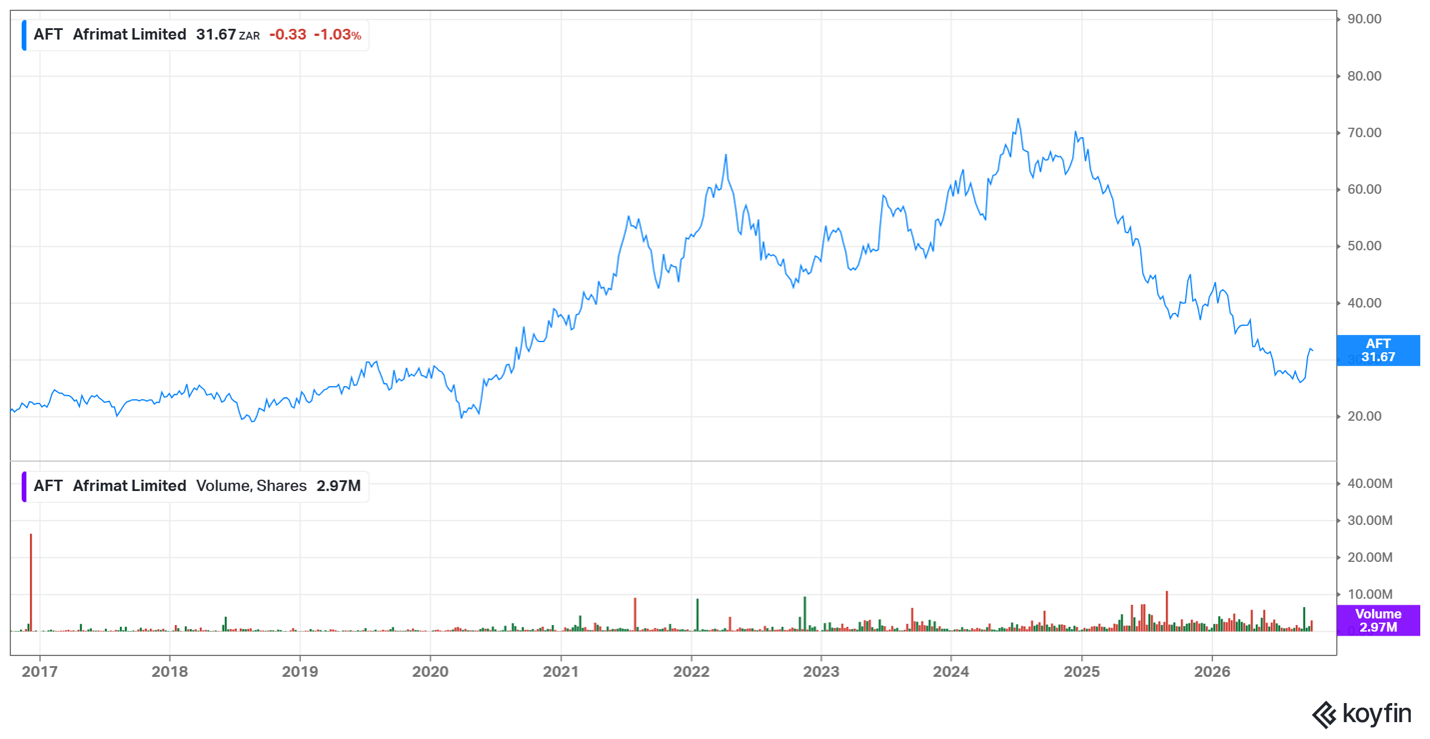
I beg to differ. Management might have made a mistake by being too aggressive in its acquisition strategy, but it remains a highly skilled team. If I were tasked with appointing a team to lead Afrimat back to profitability, I would choose the existing management.
The mistake by investors here was not overrating the management team, but overpaying for their services.
Unlike most businesses, cyclical companies are good bargains when they have a very high P/E, or even a negative one, i.e. when they are struggling or incurring losses. Because cycles are just that: cyclical, they go up when you least expect it, and down when you least expect it.
Afrimat issued a profit warning last week, flagging a headline loss per share of 55-60 cents for the first half of the 2027 financial year. In the second half of 2026, it also recorded a loss of c.6 cents per share. Afrimat is now on a negative P/E of 46.
My take: We have entered that part of the cycle where a good management team’s services come cheap.
2. Are diamonds forever?
Petra Diamonds has disclosed that UK tax authorities have filed a winding-up petition against a wholly owned indirect subsidiary over an unpaid corporation tax liability of approximately £5.65m. This came shortly after Petra launched a strategic review that could lead to asset disposals to repair a stretched balance sheet.
The share price reflects the difficult trading environment for diamond mining:
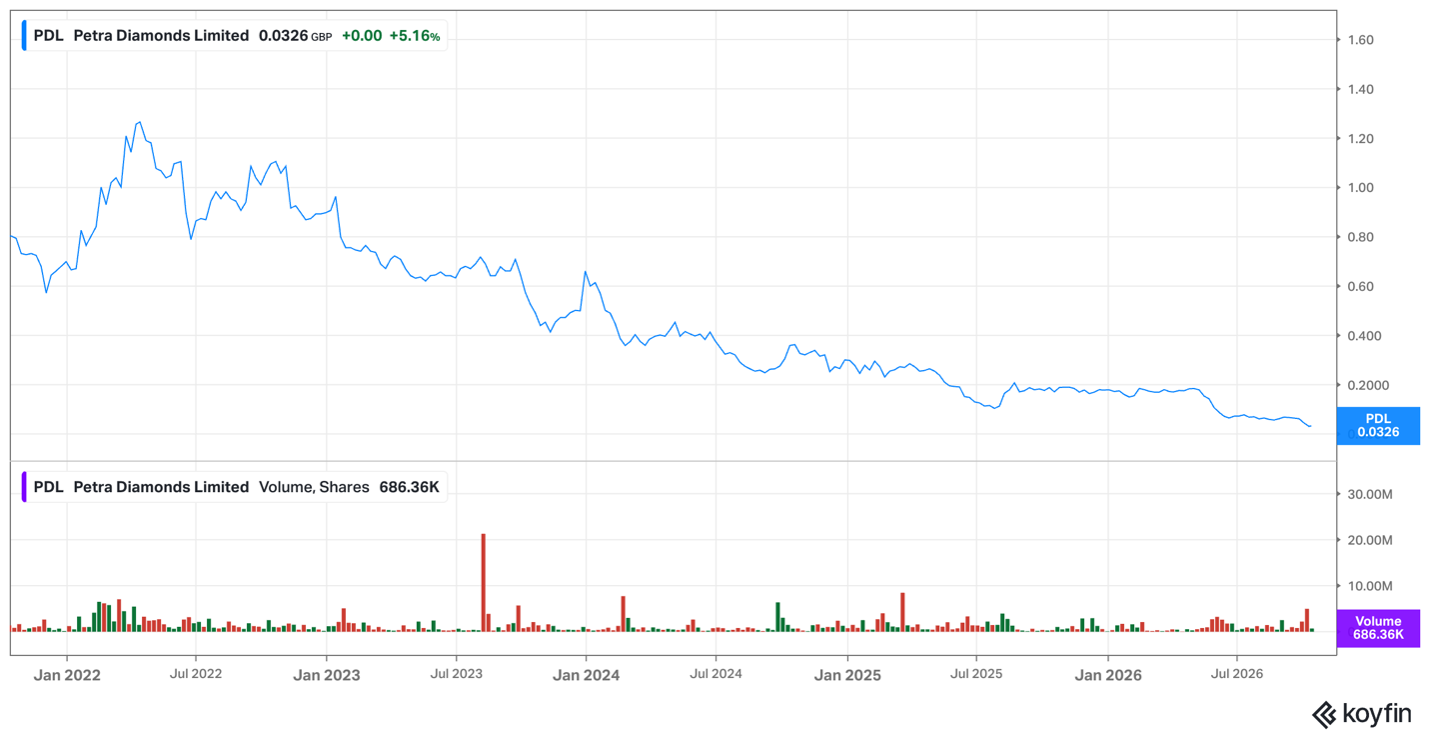
The strategic review follows discussions with first- and second-lien creditors and may include the historic Cullinan mine. Meanwhile, business rescue practitioners have concluded that the Finsch operation is not viable, so it is being closed.
Withdrawing capacity from the market is a rational response, as current diamond prices, devastated by the advent of lab-grown diamonds, show no signs of recovering. I guess we will see many more such announcements in the months and years to come.
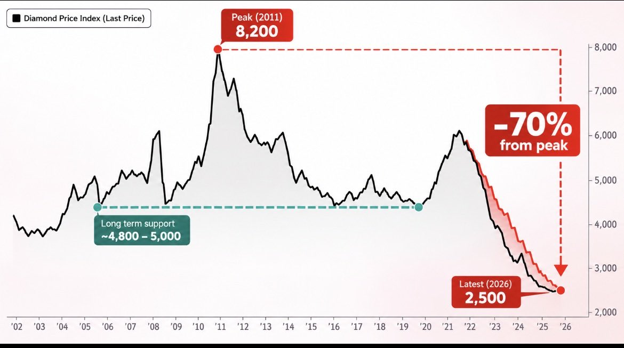
Source: Paul Zimnisky’s Global Rough Diamond Index
Petra now has an equity market value of just £11mn, with debt of £250mn at the end of June. In July, Petra secured an additional £15mn working-capital facility and deferred approximately £4m in cash interest payments until January 2027. I have a feeling the equity holders might have to take a permanent back seat.
My take: I used to be invested in a diamond-mining operation. One of the worst investment decisions I have ever made was to get involved in this industry. Even worse, I did so despite my business partner’s misgivings. One of the better decisions was not recapitalising the business. It once again proved the old market adage: never throw good money after bad.
3. In spite of, not because of
Sygnia is a wonderful business. In a South African asset management industry that has been shrinking, it has grown its Assets under Management and Administration (AUMA) by 12% p.a. over the past 10 years. Revenue has grown even faster.
Founded 20 years ago by its entrepreneurial CEO, Magda Wierzycka, Sygnia has grown by offering clients a low-cost solution to their investment and fund administration needs. It listed in 2015, and over that period its share price has grown by c.14% p.a., while also paying a substantial dividend. This has resulted in a total compound annual return of 17.5% since the IPO.
Here’s the share price, reflecting the success of the business:
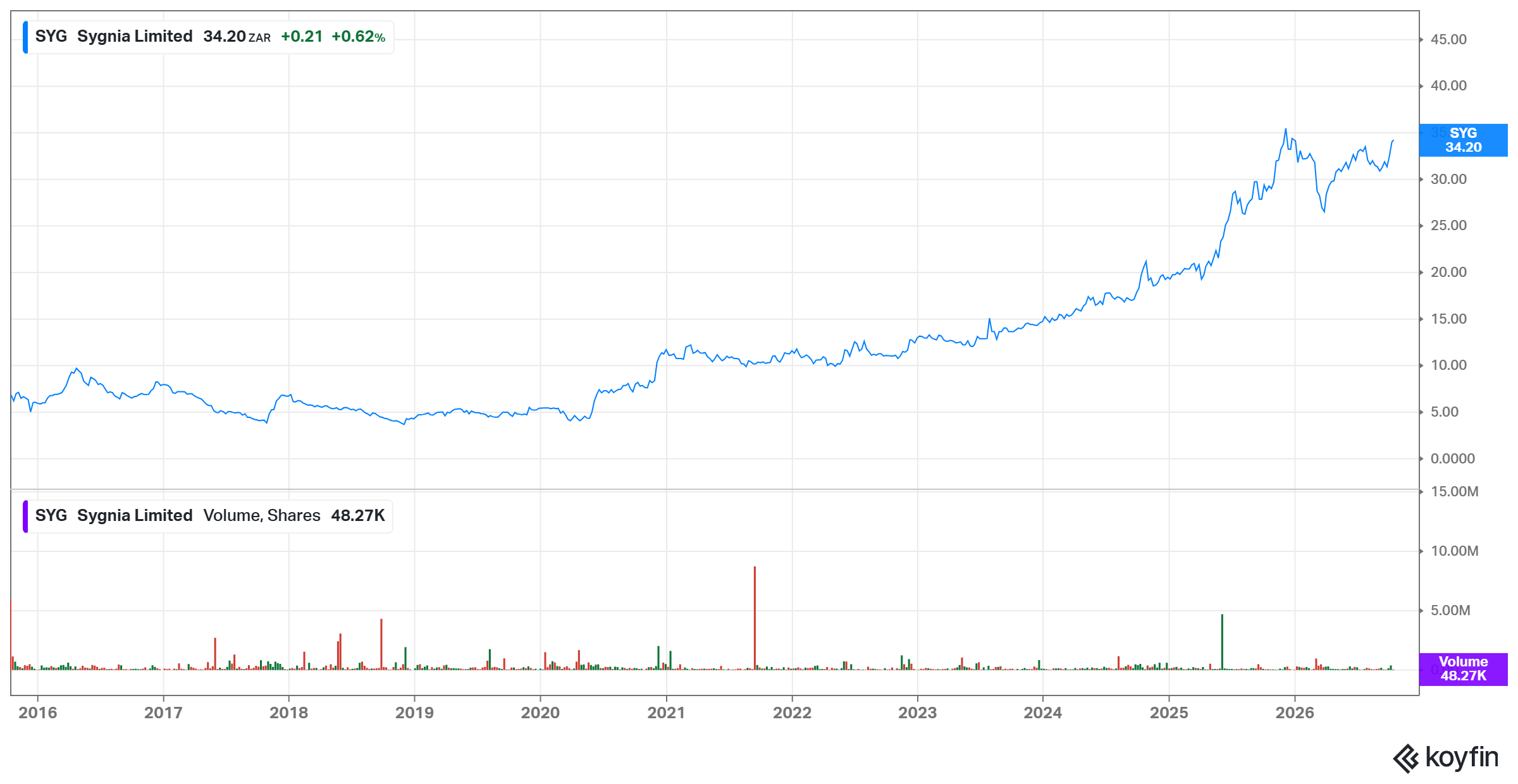
Yes, shareholders have been richly rewarded. Not least the CEO herself, who owns 43% of the company. The increase in the value of this shareholding no doubt contributed to her journey, as described in the promotional material for her autobiography, “The compelling story of how a Polish refugee from a humble background rose to become the richest woman in South Africa.”
However, it seems this is not enough. Shareholders of Sygnia have been asked to vote on a remuneration scheme that offers R600mn in free shares to unnamed Sygnia executives. Even better, there are no performance conditions attached. Apparently, these options are important for “attracting, motivating, rewarding and retaining” executives.
Will Ms Wierzycka be a beneficiary of the proposed largesse?
Why would she require further “motivation” above and beyond her existing shareholding?
Has she possibly fallen behind in the wealth stakes?
Be that as it may, in response to legitimate questions about the scheme, the CEO says, “shareholders must just trust me”, which is fine, but then she goes on to say, “if there is no confidence in my leadership, I would take that to heart in considering whether I should remain or look for other opportunities”. She also issued a not-so-veiled threat that, if she isn’t further incentivised, she could resign tomorrow and sell all her shares.
As a shareholder, I find this anathema to decent corporate governance and fiduciary duty.
Apparently, the scheme is also necessary to attract and retain a Chief Financial Officer. A new CFO will be the fourth in four years and the sixth in the decade since the IPO, excluding one who was appointed but never took up the job. Sygnia has also cycled through three external auditors since 2019. Then there are the related-party issues with property and private equity transactions.
These may be all just one big, interrelated and messy situation. The proposed options bonanza emphasises the issues at hand.
My take: As a shareholder, I’m willing to call the CEO’s bluff and vote against the proposal. I think the business needs a governance overhaul, not a remuneration kicker. Voting with one’s feet might also be a sensible course of action here.
4. There’s always something to do
John Huber writes an insightful investment blog. In his latest piece, he included this chart, which shows the underlying damage in the US market, despite the gains in the headline indices:
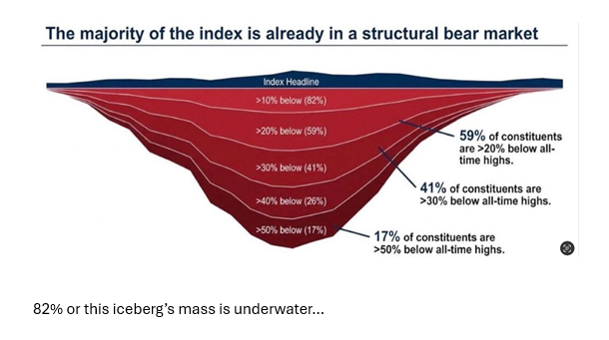
He goes on to point out that this means opportunities are knocking for the active investor. I agree, but then you must look in narrow niches. My view remains that a mixture of indexing plus an allocation to niche, mispriced strategies is a winning combination.
The best niches are found where others fear near-term losses. Huber says the edge found in exploiting those niches is greater today than ever. Technology and the speed of information are increasing that edge’s value.
Here’s another great quote from Huber:
“I think the key to long-term success (in the front office or as a portfolio manager) is not to get caught up in what others consider accepted practice”
My take: To paraphrase Charlie Munger, I have nothing further to add.
You can read the whole interesting piece here.
In The Cockroach
This week, I made the first significant change to the portfolio in a long time. I sold half of the long-held South African government bonds and replaced them with US government inflation-linked bonds.
This is why:
“The cost of debt is not the interest you pay; it’s the independence you forfeit.”
This goes for countries too. If your debt level forces you to pay interest rates you can’t afford, you become beholden to the kindness of strangers. Governments cannot stand that, and will intervene to avoid it.
The recent push above 5.3% in 10-year Treasury yields could eventually prompt a response from Washington, as high rates lead to a debt trap in which borrowing costs outpace nominal growth, spurring a vicious cycle of new borrowing to service existing obligations.
Interestingly, a key decision-maker evidently had little concern about this potential trade-off. The recent Time Magazine interview with President Trump contained this gem of an exchange:
Trump: Okay, and frankly, this [high rates] is hurting our country more than inflation is hurting our country – more than inflation.
Interviewer: Can you tell us about your meeting with…?
Trump: You know, inflation. Certain levels of inflation will also pay off that debt very rapidly. Very rapidly.
Mr Trump is saying the quiet part out loud: high interest rates are the enemy, not inflation. So instead of hiking rates to combat inflation, the most likely policy prescription will be to cap rates via financial repression and let inflation find its own level, one that reduces the debt-to-GDP ratio by inflating the denominator.
With that in mind, the question is: are bonds a good investment at current yields over 5%? If the government caps rates by forcing banks and other regulated institutions to buy bonds, owning bonds has little downside. But if inflation were to rise, due to, say, war, government handouts, high diesel prices, or cost pressures from asphyxiated supply chains, the real return from owning bonds – which is what we are interested in at the Cockroach – would be poor.
Fortunately, inflation-linked bonds are attractively priced at present:
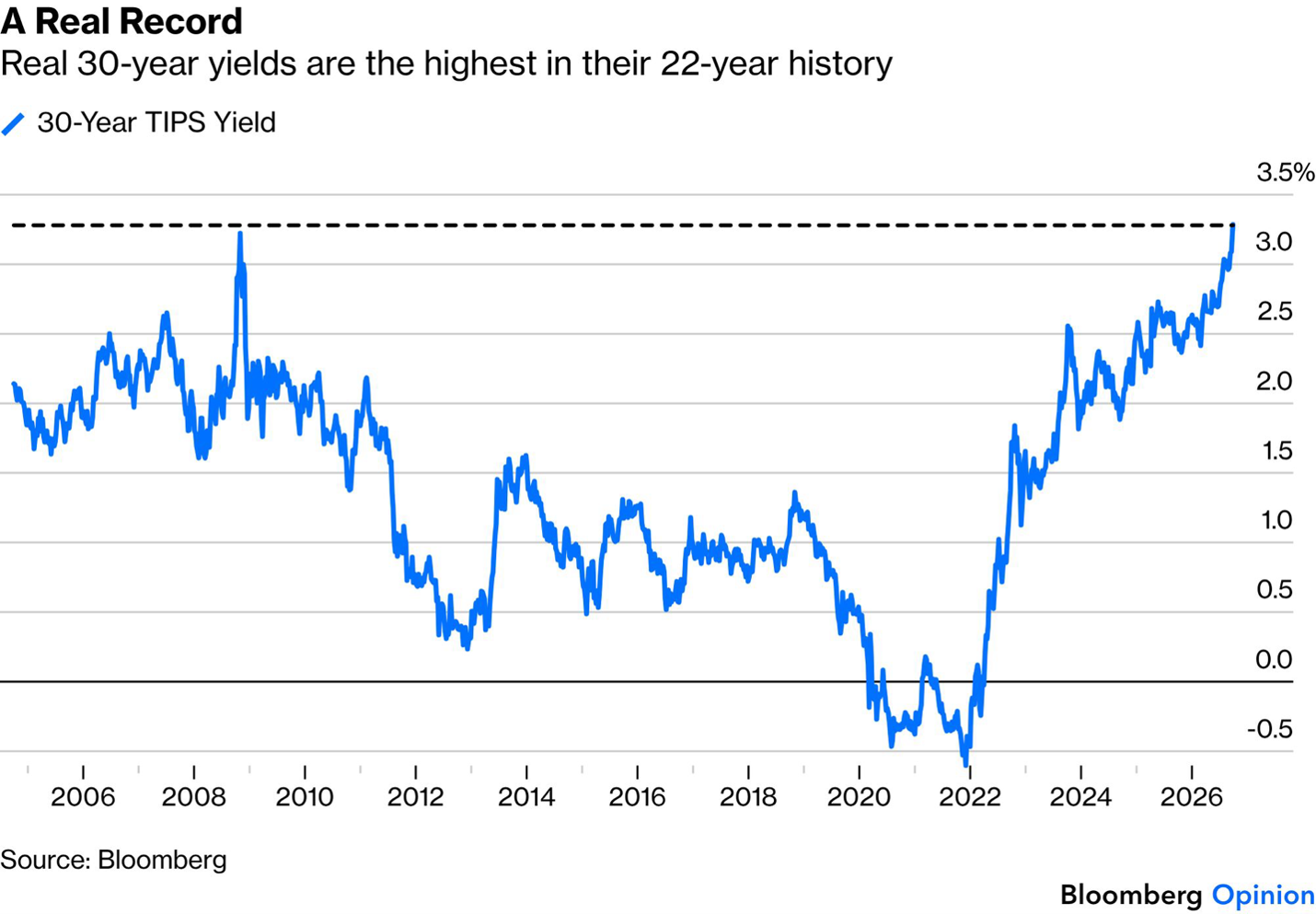
Inflation-linked returns are tightly correlated with nominal bond returns. But TIPS bought at an attractive positive real yield before financial repression begins can preserve a decent real return, even as capped nominal yields erode nominal bondholders’ purchasing power.
In fact, I believe TIPS present a rare win-win opportunity in the bond market today. If there is no repression, you will earn a decent real return, well above historical norms; if there is repression, you still get a decent real return, as the principal of the bond grows with inflation.
In our assumptions about the returns the fund can earn over time, I assumed a long-term real return on bonds of 1% to 1.5%. Buying TIPS with a real yield of 2.5% locks in almost double the assumed return.
The obvious question then is: if TIPS are so good, why not take the full 25% of the fund allocated to bonds and buy TIPS instead?
The one risk that owning TIPS (or any bond) does not address is currency risk. The US$ is currently overvalued and could depreciate substantially under certain circumstances. In such circumstances, holding any US$ assets will turn out poorly.
The last question we need to answer when reallocating our bond exposure is how to fund the additional purchase of US TIPS. Fortunately, South African bonds have been among the world’s best-performing assets over the past few years. This performance has come despite the global uptick in yields, as the spread of South African bonds over US bonds has narrowed substantially:
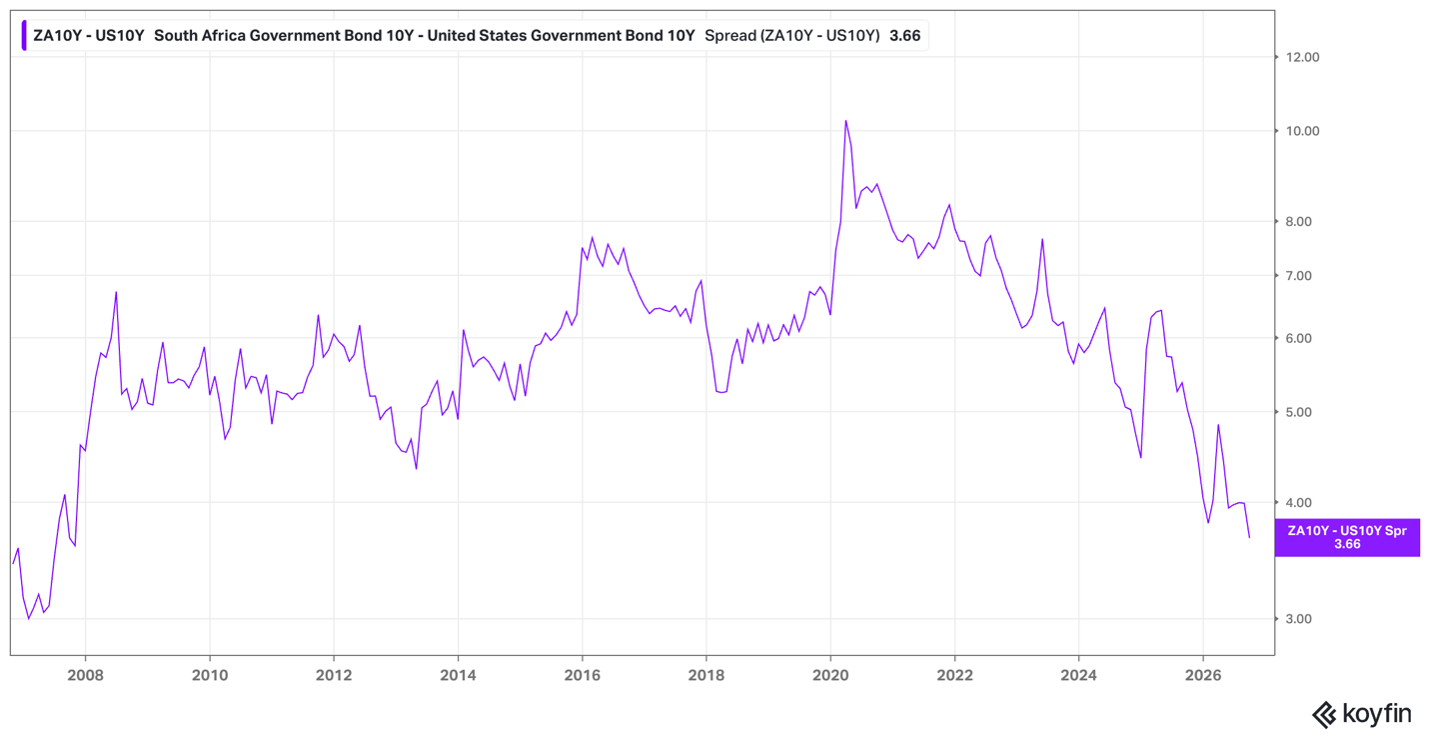
Reducing some exposure to South African government bonds in favour of a more diversified bond portfolio, with a mix of high-yielding emerging-market bonds, inflation-protected US bonds, and a smattering of Yen-denominated Japanese bonds, makes sense.
My take: An increasingly diversified bond portfolio must be a good thing.
* I manage the fund on behalf of Merchant West Investments (Pty) Ltd (FSP 44508)
In The Media
The Rapture is Happening
This week’s letter is already a bit long, so I’ll share only one piece of media. But it is a powerful one.
It’s called “The Rapture is Happening”, by political commentator Noah Smith. The piece is a meditation on why the writer feels he is one of the people “left behind”, with everyone else around him having left for “digital heaven”.
The killer quote: “Short-form video feels to me like anesthesia; the swiping is the point, not the content. As Jerry Seinfeld once said, “Men don’t care what’s on TV. They only care what else is on TV.”
He goes on to wonder whether the global decline in fertility rates is due to the ubiquitous smartphone. Are we busy wiping ourselves out, not via nuclear or biological weapons but simply by swiping up?
You might agree or disagree, but I think you need to read the full piece before engaging in the argument.
You can read it here.
That’s all for this week – except to say bon voyage to Nic, who is off to London for a short while, courtesy of his employer. I hope he finds time to experience the joy of paying R200 for a beer in between work obligations.
Piet Viljoen
RECM
15 October 2026