
Dear Fellow Investors and Friends,
Welcome to my newsletter, where I share my efforts to understand markets and the world around me.
I do appreciate you taking the time to read this. I love getting feedback; feel free to drop me a line. It’s great to start conversations.
Today is Thursday, October 22nd, the 295th day of the year. 70 days remain in the year. Worse, I found out last weekend that the Southern Hemisphere has only 89 days of summer, while the North gets 94. The reason? February, the height of our summer, is only 28 days, while July and August, the height of the Northern summer, both have 31 days. I know, it’s not fair, but there you go.
On this day in 1809, the Croyden Canal opened. The approximately 15 km canal connected Croydon to the Grand Surrey Canal near New Cross and had 28 locks. It was a commercial disappointment. By 1836, it had closed, and its route was acquired for conversion into the London and Croydon Railway.
The lesson? An infrastructure asset can be economically useful, hard to replicate, and still be a terrible investment.
At the centre of every bubble lies a confusion between utility and value. An easy way to distinguish between the two is to define utility as the usefulness of something, while value is what that usefulness is worth.
It’s often the case that something with high utility – like the air we breathe – has little value. On the other hand, there are things in life with little utility on which society places a high value. A Krugerrand, for instance, is pretty useless, yet still has a high value.
It follows that value derives from scarcity, not utility. But if we suddenly found ourselves in a vacuum-sealed room, access to breathable air would become extremely valuable.
In a similar vein, business value derives not from the utility it provides to customers, but from the portion of the value chain of its activity it can capture. The business exists because of the utility it provides to customers, but the value of the business depends on its ability to monetise part of that customer benefit. In turn, this ability depends on the competitive environment for providing that utility. The less competition, i.e. the bigger the barriers to entry (i.e. the “moat” around the business), the more value it can extract.
For example, airlines provide extraordinary utility by transporting people around the world. But the industry has little or no moat, so competition, capital intensity, and operating costs have historically made it difficult for many airlines to convert that utility into consistently attractive shareholder returns, aka “value”.
Conversely, a business supplying a trivial luxury item such as a Birkin bag can capture significant economic value through scarcity, pricing power, and brand strength.
A.I. is an incredible technology – science fiction made real. Many regard it as transformational, potentially as economically important as electricity, the steam engine, and the internet. AI dramatically reduces the cost of intelligence. Previous industrial revolutions reduced the cost of physical effort, transportation, communication or computation. Reducing the cost of something creates space to capture additional value. So, if the cost of the brainpower behind product development declines, surely the entity that reduces that cost is well positioned to capture some of the difference?
The historical analogies with previous transformational technologies might tell us something about who gets to keep the value created by such technology:
- Canals were a transformative transport technology. The cost of transporting goods across long distances plummeted. The canal infrastructure eventually led to the creation of American Express to finance the enormous volume of traffic between New York and the American interior, utilising the canal system. In the end, the aggregate value created by companies and industries enabled by the canals far exceeded the financial returns earned by the canals themselves.
- Four decades later, the railroad bubble saw competing firms build two or three railroads between two cities, with disastrous effects on the value of the businesses. What was once a unique, efficient – and expensive – way to transport goods and people became abundant, efficient, and cheap. When the bubble popped, the tracks remained extremely useful. But having eliminated scarcity, the railroads lost most of their value. New companies such as Sears were the biggest beneficiaries of this infrastructure bonanza. Most railway companies went bankrupt.
- The widespread adoption of the Internet in the early part of this century promised riches to the providers of the “information superhighway”, namely the telecoms companies. Their capex programme fueled the build-out of the fibre that the internet runs on today. Most went bankrupt, though, not before effectively subsidising a whole new range of highly profitable internet-native businesses like Meta and Google.
Today, microchip manufacturers, hyperscalers, and neoclouds are in a massive race to build data centres, which raises some interesting questions. Might some of these businesses become redundant? And which businesses will become dominant, using this transformational technology?
The answers, based on history, are clear: Yes, and we don’t know – because they probably don’t exist yet.
In The Markets
1. Disgrace
South African author JM Coetzee won the 1999 Booker Prize for his novel Disgrace. It’s a bleak, compelling story about power, guilt and survival in post-Apartheid South Africa. Except for the guilt part, it could have featured executive compensation as the main protagonist.
Companies that want to comply with the anti-shareholder King Code must establish a compensation committee to ostensibly oversee key executive remuneration. Most members of such a committee must be non-executive directors, i.e., people with no skin in the game, except for their own remuneration as directors. As such, these people are beholden only to management.
It should therefore come as no surprise that remuneration practices have produced some bizarre outcomes.
I have used Truworths as the poster child for “heads I win, tails you lose” executive compensation practices in the past, most recently in volume 3, nr 36 of my letters. I don’t have time to do that kind of work for all JSE-listed companies, but I think I have found an even more egregious example of a management-captured compensation committee.
It’s Woolworths, the retailer every food shopper loves and clothing shoppers loathe. Here’s the history of how shareholders have fared relative to its series of CEOs:
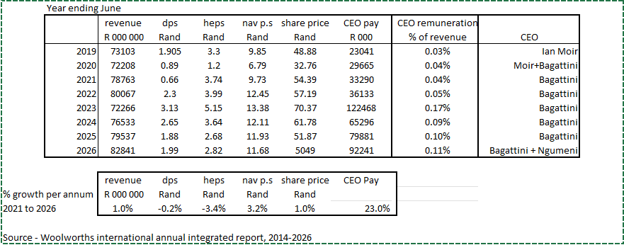
A couple of notes:
- On any fundamental metric, the business has gone sideways for a long time.
- These fundamentals are reflected in a share price that, at year-end, was no higher than in 2019 (7 years ago). Today, it’s even worse, 20% lower!
- However, CEO compensation has ratcheted up by a shocking compound annual growth rate of 23%
- CEO compensation has quadrupled, from 3 basis points of revenue to 11, all while delivering exactly no value to shareholders. In fact, under Mr Moir, shareholders were served by one of the most value-destructive executives ever seen in the South African retail industry.
If I were a member of this remuneration committee, I would hang my head in shame. Alternatively, I would study how things are done at Argent, which has had a very different outcome for shareholders.
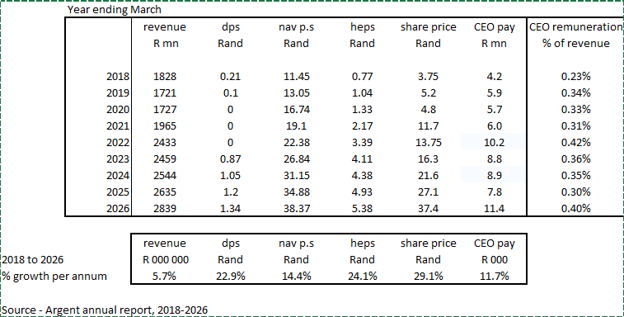
Here, the CEO’s compensation has grown handsomely, by almost 12% p.a. – triple the inflation rate. But look at the fundamentals: shareholder value has grown much more.
The key difference between the two companies? Argent has a shareholder of reference with skin in the game, whereas Woolworths is run by management for management, with no oversight from absentee institutional investors, represented by self-interested non-executive directors.
My take: The MWI Value fund is a (happy) shareholder in value-creating Argent and a (happy) non-shareholder in uninvestable Woolworths.
By the way, I thought Ann Crotty had a great piece in the Financial Mail on this subject, which you can read here (subscription required)
2. CoreWeave
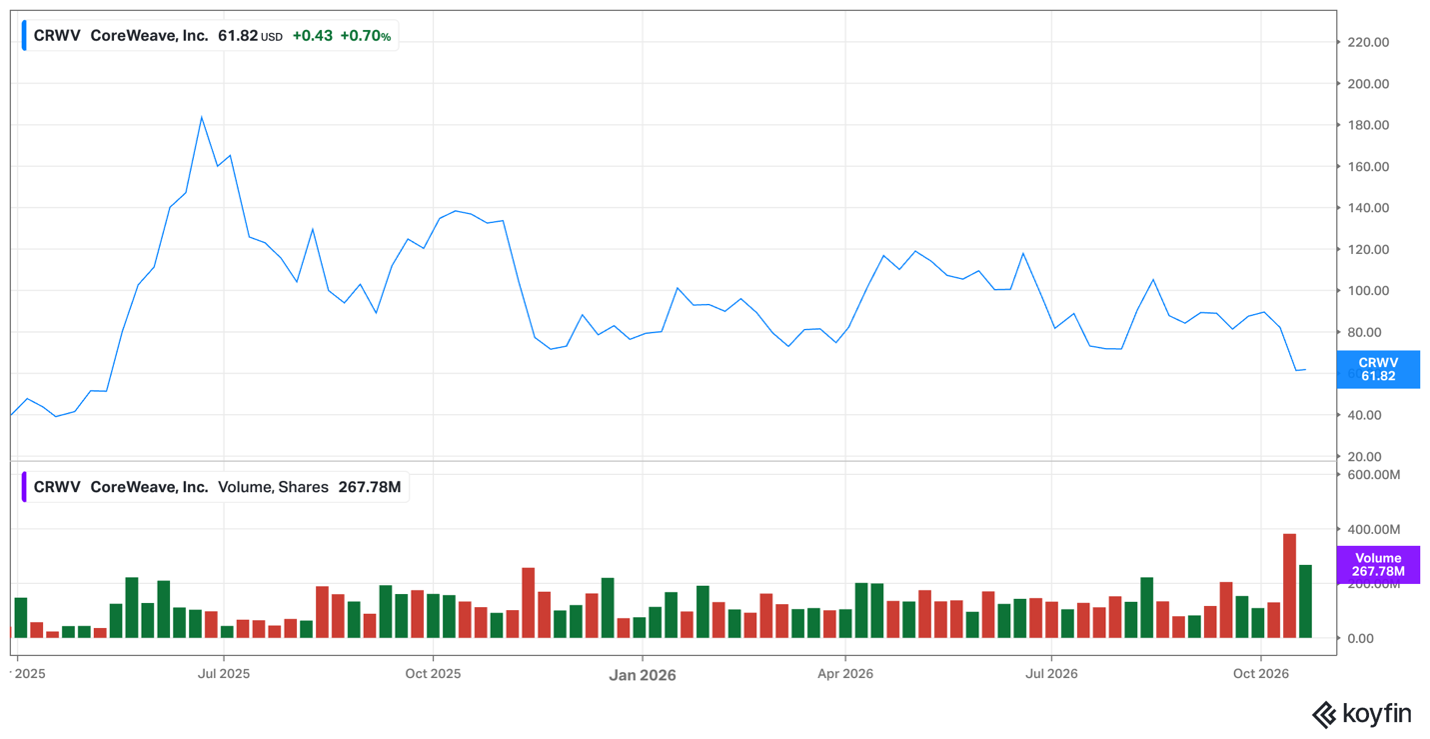
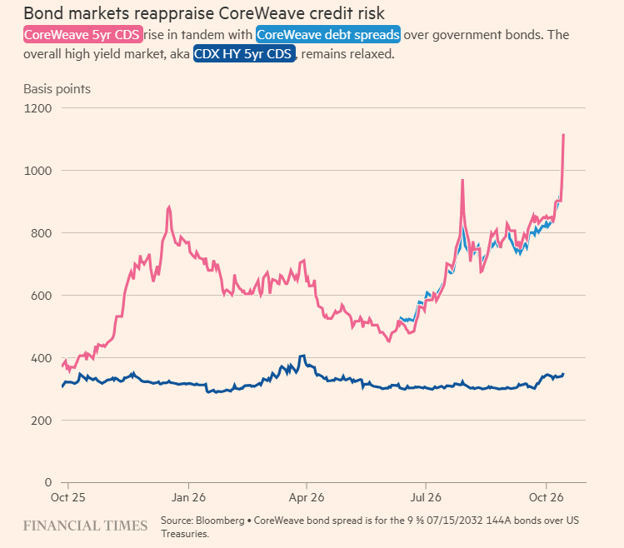
Currently, CoreWeave’s 2032 bonds yield around 15%, placing them in the distressed category. The company had about $35 billion of debt and $16 billion of debt-like lease liabilities at the end of June and reported negative free cash flow of $5.7 billion in its latest quarter.
This company is the poster child for debt-laden AI infrastructure providers, teetering on the brink of bankruptcy. The share price, down by almost 70% from its recent high, reflects this picture:
But you say Anthropic and OpenAI still have to IPO? Yes, that’s why otherwise pretty smart people are saying the stupidest things. At least that’s the only reason I can think of for them to say things like:
- Palantir CTO Shyam Sankar: “So many AI researchers have started smoking as a way of signalling to other researchers how much they believe in AI.” The logic, he said, is: “I believe so much in AI that it’s going to cure cancer. So I’m showing you my chips are all in.”
- On the 13 October episode of Mad Money, Jim Cramer declared CoreWeave the “real deal” and the only neocloud provider he trusted.
- This week, CoreWeave started bouncing back. Apparently, all it took was a little reassurance from the Silicon Sorcerer himself, Jensen Huang, who declared that he was “optimistic” and that “CoreWeave’s strength is improving every day.”
- Adding another hand to the others keeping all the balls in the air, Goldman Sachs upgraded CoreWeave ($CRWV) to buy, citing tight computing capacity and the company’s performance advantage over rival neocloud providers.
Surely these are all serious people? Yes, serious about keeping the bubble inflated, at least until we can have those big IPOs.
To see how financially stressed CoreWeave currently is, let alone whether it can accelerate its capex program, we need to look at the actual numbers, not what the clapping seals industry insiders are saying.
- Last quarter adjusted EBITDA was $1.51 billion, at a 51% margin, covering $640mn of interest almost 2.5 times.
- Depreciation – a non-cash but still very real expense – was $1.4bn, more than double the interest payments. Factor that in, and we have an adjusted operating income of $128 million. That covers interest 0.2 times.
- But let’s do one more step. Adjusted operating income excludes share-based pay, which was $165 million in the quarter. Charge that too, and GAAP operating income is a loss of $49 million.
- After the interest, net loss was $626 million.
That’s not a great picture. And the bond market understands it:
Fortunately, Brannin McBee, a CoreWeave co-founder, has a plan. He’s worked out that if you can secure an investment-grade rating for some form of debt, the universe of potential financiers expands significantly. According to McBee, “insurers’ capital is unlimited. Like, that’s all the money there is in the world that sits in the insurance tranche”.
So the plan is to securitise some debt into a CLO, have some of its tranches rated “investment grade” and sell them to the insurers.
Smart man, our McBee, isn’t he?
Remember the GFC?
My take: These people might delay the inevitable with their ridiculous platitudes. But the thing about inevitability is that it is, like, inevitable.
3. Meta
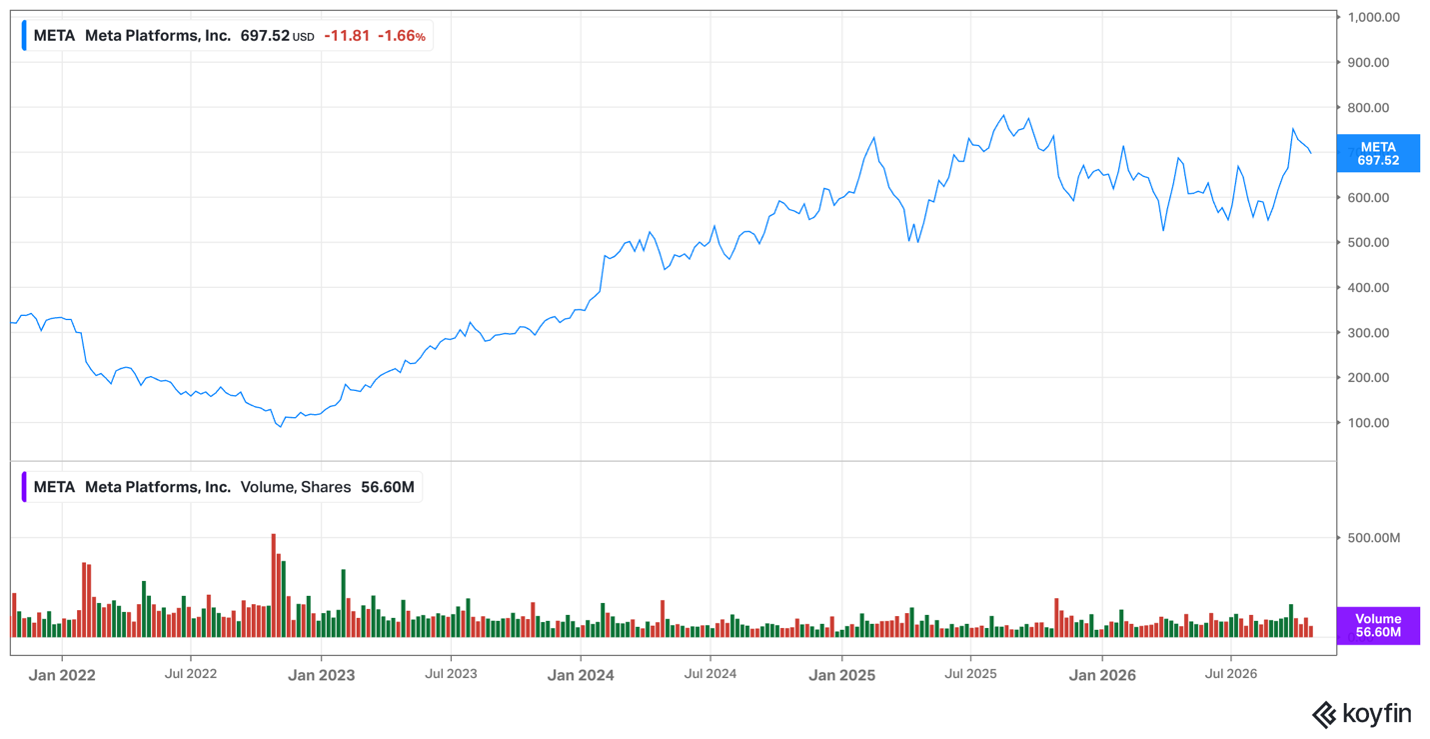
Meta shares are approaching all-time highs after its Muse AI agent app overtook ChatGPT as the top free iOS app in the US, and Wells Fargo is joining in the frenzy by raising its Meta price target to $796:
Over the past 15 years, Zuckerberg explored building a Facebook Phone.
He tried to replace the Android home screen with Facebook Home.
He launched Internet.org and its Free Basics service to deliver Facebook via carrier deals in India, South Africa and other markets where Apple wasn’t dominant.
He tried to build Libra (renamed Diem), a cryptocurrency, to facilitate payments.
He bought Oculus VR, hoping virtual reality headsets would replace the smartphone the way smartphones replaced personal computers.
Each was, at least in part, a tunnel Zuckerberg dug to escape the prison imposed on him by his competitors Apple and Google. To varying degrees, each tunnel collapsed.
“One of my priorities for the next 10 or 15 years is to ensure we can build the fundamental technology on which we’ll build social experiences,” he told Jensen Huang at a conference in 2024, while explaining his investment in building foundational AI models.
He believes they vindicate his bet dating back to 2014, when he acquired Oculus for $2 billion and began working in virtual and augmented reality. That division convinced him to rename the whole thing from Facebook to Meta by 2021, and to date, it has burned through about $90 billion.
The Metaverse, as such, is another of his collapsed tunnels, but Zuckerberg is convinced the glasses are one of the payoffs. They are “the ideal form factor” for an AI that can “see what you see, hear what you hear, talk to you throughout the day,” overlay information on the world, and conduct “agentic live sessions” from ambient context. For example, he says he recently wore them while baking with his daughter, and the glasses, without being asked, told him he was botching the recipe.
This is the company that
- was ordered to pay a $25 billion fine to the state of New Mexico in October 2026 after a court found the company intentionally deceived Facebook users regarding data privacy
- agreed to pay up to $18 billion to settle multi-state claims regarding youth addiction and harm on Facebook and Instagram
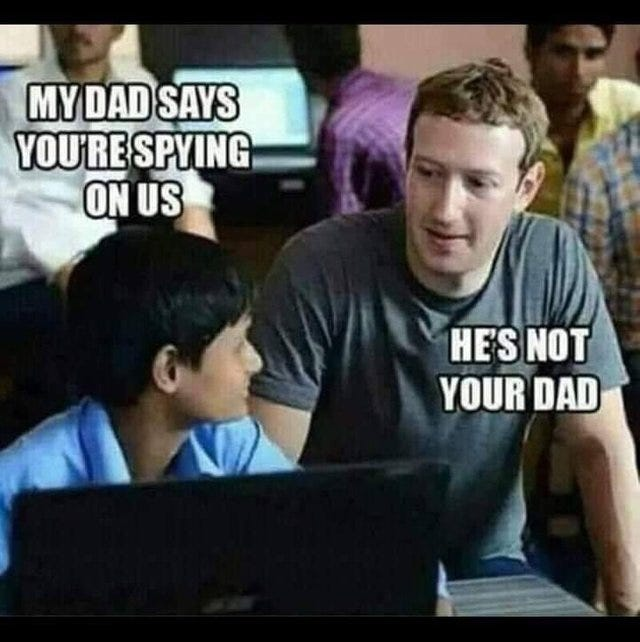
It’s not surprising Zuckerberg/Meta is generally not well liked, as these memes suggest:

But does owning Muse, currently the leading AI model, create a sustainable moat? Not if you look at the history of the leading models over time:
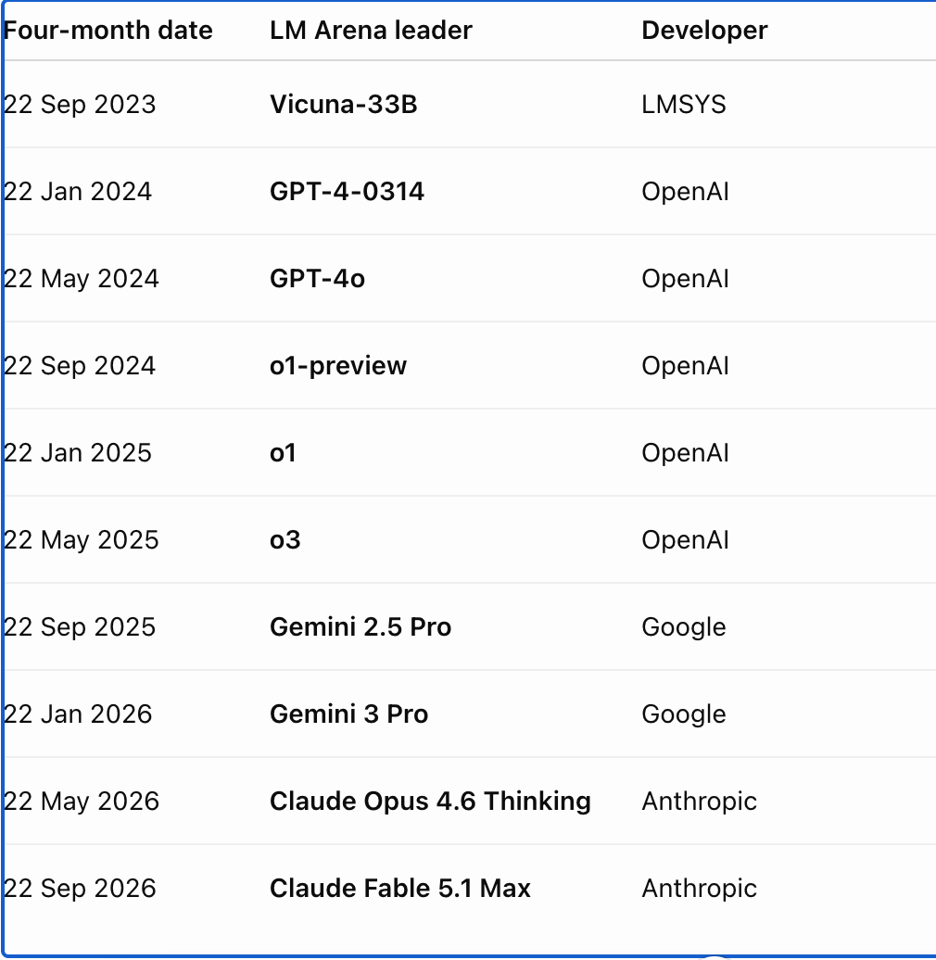
And now it’s expected to be Meta’s Muse. Until someone else spends enough to leapfrog the competition once more.
Maybe spending all this money on AI is just another dead-end tunnel?
My take: In a capital-intensive industry, the one who spends the most wins, but only for a while, and it seems the AI industry is no different. I think the best strategy for long-term investors is to remain on the sidelines and see what’s left once the dust settles.
In The Cockroach
No trades in either the onshore fund* (the MWI Worldwide Flexible Fund) or the “offshore fund” (the RECM Worldwide Flexible Fund) over the past week.
This week, I wanted to look at the “hard asset” portion of the funds.
Hard assets are defined as: “a tangible, economically useful asset whose value is derived primarily from its physical properties and scarcity, rather than from a contractual claim on someone else’s future cash flows.” These assets are effectively the bedrock on which the funds are built.
This is the current allocation, compared to January this year:
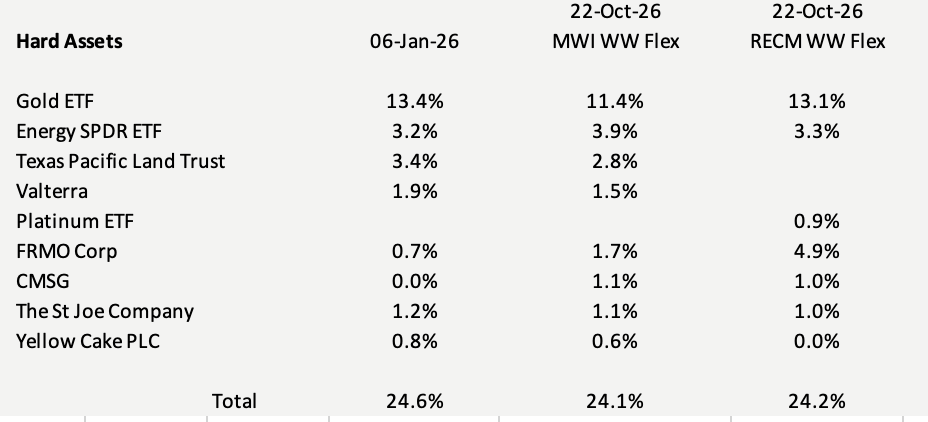
The funds’ exposures differ slightly. The onshore fund (MWI Worldwide Flexible fund) is governed by South African regulations, which do not allow more than 10% (at inception) in precious metals. Because the gold weighting is already above 10% (due to market movements), it cannot own physical platinum. It therefore owns shares in Valterra, the highest-quality platinum mining company.
The offshore fund (the RECM Worldwide Flexible fund) is allowed to own more physical gold, and physical platinum, so it does. It also owns almost 5% of FRMO, an investment holding company whose biggest asset is an investment in Texas Pacific Land (TPL). The onshore fund owns just under 5% exposure to FRMO and TPL combined.
The other difference is that the onshore fund owns a small stake in Yellow Cake PLC, an investment holding company whose only asset is uranium. The fund is in the process of selling this, so the offshore fund has not bought it.
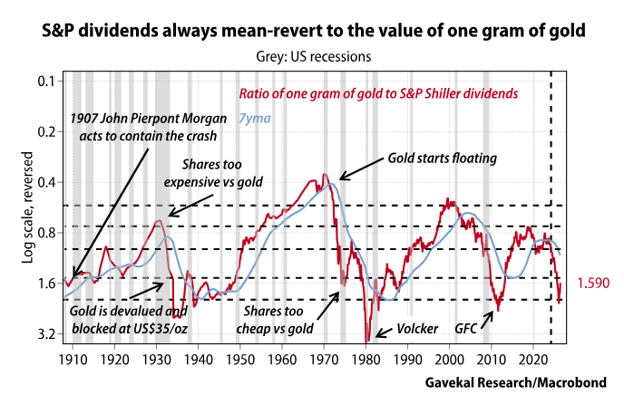
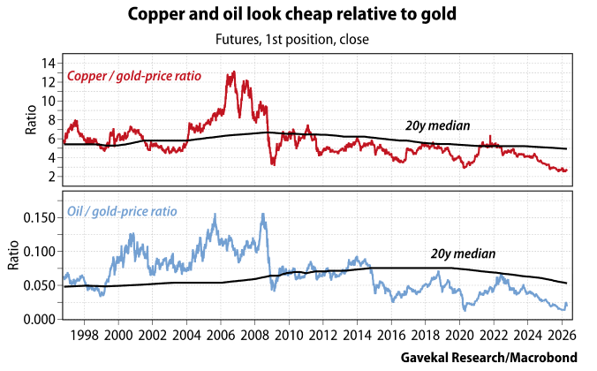
The main point I am considering in this portion of the funds is how much gold to hold. The fund will always have significant exposure to gold, but the question is exactly how much. Especially now, gold seems to be richly priced against both equities:
And commodities:
* I manage the fund on behalf of Merchant West Investments (Pty) Ltd (FSP 44508)
In The Media
1. Municipal election insights
I found this discussion on the upcoming election insightful.
Dr. Frans Cronje is probably the best political and social analyst in South Africa, so his views are always valuable.
2. A discussion with Li Lu
Here’s a talk with Li Lu, at the 36th annual Graham and Dood luncheon. He was the Chinese investor who brought BYD to Charlie Munger’s attention.
The main points covered were:
- Unlike the internet, AI technology will always require incremental costs. Every additional use comes at a cost, unlike many earlier technologies where an upfront investment can be amortized over a long period. That means costs, revenues, profits, capital needs, and financial discipline will keep mattering.
- China’s development has followed a pattern of setting ambitious national goals and paying a heavy price to achieve them. Over the past 50 years, a new set of objectives has emerged roughly every decade. Sometimes, yesterday’s objective becomes tomorrow’s cost. Real estate, for example, was once central to urbanisation and the creation of middle-class wealth. Today, its downturn has taken a heavy toll on household balance sheets and consumption.
- Will China’s stock market become a national priority, or the price paid to achieve other priorities? One audience member raised this fascinating question. Li Lu believes the stock market will eventually become an objective, though not necessarily today. As real estate accounts for a shrinking share of household and national wealth, something must take its place. In his view, equities are uniquely positioned to fill that role because they grow with the economy while also helping drive economic growth.
- What is the value of being human in the age of AI? Li Lu argued that the key is to build knowledge and skills that compound over time. If you focus only on short-term gains, what you do and learn today may become irrelevant tomorrow, leaving little opportunity to accumulate knowledge. If you become increasingly dependent on computers and AI, you will be replaced one day. As he put it, “What is the value of that as a human?”
That’s it for this week. I am writing this to you from the Drakensberg, where Amanda and I are spending a few days with friends from school and university. We all live in different parts of the world, but every year we make time to spend together. And every year it’s a joy!
Piet Viljoen
RECM
22 October 2026