
Dear Fellow Investors and Friends,
Welcome to my newsletter, where I share my efforts to understand markets and the world around me.
I do appreciate you taking the time to read this. I love getting feedback; feel free to drop me a line. It’s great to start conversations.
Today is Thursday, November 5th, the 309th day of the year. There are 56 days left in the year. It’s also Guy Fawkes Day in the UK. On this day in 1605, Catholic conspirators planned to blow up the English Parliament and assassinate the Protestant King James I. The plot failed, and the date became an annual Protestant commemoration in England.
But it was simply part of the wider religious and political struggles, mainly between Catholics and Protestants, that shaped seventeenth-century Europe. I guess religion was merely a smokescreen used by the power-hungry to obtain and maintain control of the population.
Some things never change.
The French Huguenots were a particularly interesting historical group, a product of the protestant reformation in France. They were strongly influenced by John Calvin, a French theologian born in 1509.
Calvin’s religious philosophy emphasised:
- The authority of scripture over church hierarchy.
- Personal responsibility, discipline and moral conduct.
- The importance of education and literacy.
By the mid-16th century, a substantial Protestant minority had emerged in France. Because of their beliefs, they were reasonably well educated and became merchants, artisans, tradesmen, and intellectuals. Over time, these French Protestants became known as Huguenots.
Interestingly, the term Huguenot derives from the Swiss German word Eidgenossen, meaning “confederates” or “people bound together by an oath.” In the early 1500s, a political movement in Geneva opposed the Catholic Duke of Savoy. Its members were called Eidgenossen, which, in local usage, evolved into forms such as Eignots and Huguenots.
Their growing numbers and rejection of centralised Catholic religious authority created serious tensions with the French monarchy. A series of religious and political conflicts between Catholics and Protestants ensued, culminating in the St. Bartholomew’s Day Massacre in 1572. Thousands of Huguenots were massacred across France. To calm things down, Henry IV, the then King of France, issued the Edict of Nantes, granting Huguenots significant religious and civil protections while maintaining Catholicism as France’s dominant religion.
But during the 17th century, the French monarchy steadily eroded the Huguenots’ political independence and religious privileges. Louis XIV’s (“L’État, c’est moi”) reign is a fascinating example of how a powerful, wealthy and economically sophisticated country can progressively undermine its prosperity through excessive government spending, warfare, taxation and economic intervention.
Under Louis XIV, the state increasingly regulated economic activity and prioritised revenue and national power over free enterprise. Louis XIV also moved French political life to the extravagantly gilded palace of Versailles. Not coincidentally, his reign was marked by continuous warfare, which strained government finances.
As a result, the French economy found itself in a difficult position. Seeking a scapegoat, as all politicians do when their short-sighted policies invariably fail to deliver the desired outcome, the Huguenots increasingly faced discrimination, restrictions on worship, and efforts to force their conversion. In 1685, the Edict of Nantes was revoked and replaced by the Edict of Fontainebleau. Protestant worship was outlawed, churches were destroyed, and pastors were ordered to convert or leave the country.
Of course, this led to a mass emigration of the Huguenots, estimated at around 200,000 people. They fled mainly to Protestant countries, including the USA and Southern Africa. Because of their heritage, they possessed commercially valuable skills.
Sometime after 1685 and before the end of the 17th century, a man called John Buffet, a Huguenot fleeing religious persecution in France, fled to Long Island. One of his descendants became ‘the sage of Omaha’.
It also happens that the first documented French Huguenot refugee to settle here at the southern tip was my forefather, François Villion (later Viljoen), who arrived in 1671. Unfortunately, that is where the similarities end.
One Huguenot descendant is one of the richest people on earth, while another is most definitely not.
But that is not the point of this story.
The history of the world is replete with overreach by governments, scapegoating, persecution of minorities, and the flight of the rich and industrious from the clutches of increasingly centralised and impoverished governments. Even today, Donald Trump is building a gilded, ornate ballroom next to the White House, with gold-leaf detailing, massive crystal chandeliers, and expansive glass panels, while waging expensive wars.
Shades of Versailles?
History shows that in times like these, the losers are the countries that push the industrious and entrepreneurial out, while the winners are the places that welcome such refugees with open arms. In many places around the world, this is happening again.
History never repeats, but it rhymes so damn well – every time.
We can – and should – learn from history, rather than listening to forecasts made by incentive-driven agents.
In The Markets
1. Astoria is immigrating to South Africa
Astoria is an investment holding company which RECM historically managed. Astoria originally purchased a portfolio of assets from RAC on 1 December 2020 for $19.3m. On conclusion of the transaction, Astoria’s NAV per share was 40.1¢ (R6.12).
By December 2025, 5 years later, the NAV per share had grown to R12,22. This represented a CAGR of 12.3%, more than double the inflation rate. Despite this, the share price traded at a consistent 40% discount to NAV, and sometimes more. The only conclusion to be reached was that shareholders wanted their money back.
Accordingly, the company made an offer to buy out shareholders at an effective R8,90 per share – a significant premium to the ruling share price of R6,60 on the JSE. Over 36% of shareholders accepted the offer. Astoria unbundled its Goldrush shares to all shareholders, after which it was delisted.
By June of this year, Astoria’s NAV per share had grown to R15,12, an uplift of 24% since year-end.
Astoria’s directors have decided to simplify its structure further.
This will be done in the following steps:
- Shares will be consolidated at a ratio of 1 share for every 5 000 previously held. Shareholders who own fewer than 5 000 shares will receive a cash payment of R14,50 per share. This will make the shareholding register much more manageable.
- All Astoria’s assets will be transferred to its 100% owned South African-domiciled subsidiary, Fortis Maximus. The benefit to an investment holding company of being domiciled in Mauritius has diminished substantially over the past few years. It makes more sense to re-domicile its assets.
- Once this transfer has taken place, all the shares in Fortis Maximus will be unbundled to Astoria’s shareholders, after which Astoria will be liquidated.
As a result of this process, all shareholders of Mauritian-domiciled Astoria who own 5 000 shares or multiples thereof will become shareholders of South African-domiciled Fortis Maximus, which owns the same assets that Astoria previously owned.
We anticipate a bright future for these assets. Since inception, Astoria has grown its NAV per share by a commendable 15.5% p.a., but it lags the All-Share Index Total Return of 18.3% p.a.
The company will do its best to close this gap over the next few years.
2. In memoriam
This week, Jebb McIntosh, the CEO of CMH, passed away at the age of 80. In many ways, he was the doyen of South Africa’s motor vehicle industry. He co-founded Combined Motor Holdings (CMH) in 1976, served as its chief executive for about 50 years, and helped establish it as one of South Africa’s enduring listed motor retail businesses.
CMH is a wonderful business. It has averaged a RoE of 27% over the past 30 years:
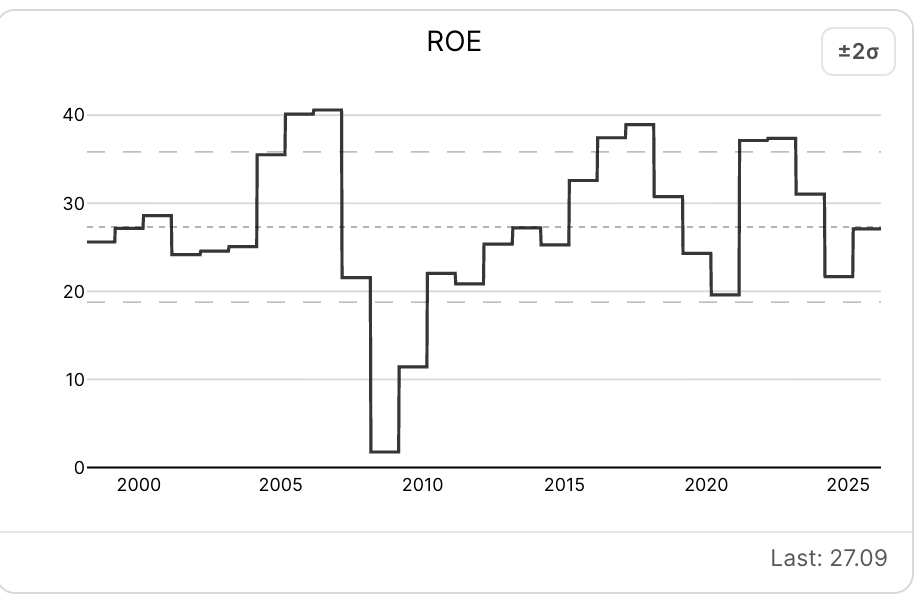
This high return on equity speaks not only to a business that effectively runs local monopolies across different motor vehicle brands, but also to one that, under Mr McIntosh’s leadership, pivoted to Chinese brands in good time and allocated capital responsibly over a very long period.
This has enabled CMH to handsomely outperform the JSE All-Share index by a factor of almost four times over that period:
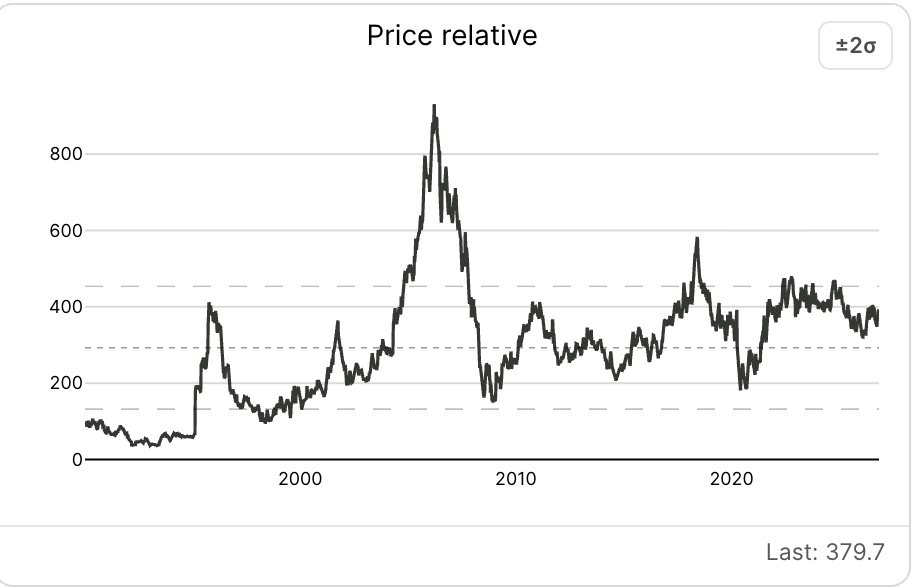
Mr McIntosh will be sorely missed, but his legacy will live on in CMH, one of the best little businesses on the JSE. As a testament to his legacy, CMH is one of the very few small caps in South Africa that is widely held.
My take: I would be surprised if such a high-calibre CEO had neglected his duty to instil a value-creating culture in the business and to groom a successor. The MWI Value fund is one of the 5 largest holders of CMH among collective investment schemes (unit trusts). I also own it personally.
3. Smart Shopper
The discerning grocery shopper always compares the price of goods relative to the value they offer. It seems that shoppers for shares are often less discerning. They seem to be fooled by price movements and base their investment decisions on extrapolating historical moves into the future, with little regard for actual fundamental value.
I recently read an article in the Financial Mail that said, “Measured in Walmart’s valuation terms, Shoprite shares should have gained 200% over five years, comfortably thrashing its US counterpart’s performance.” The author then pointed out that Shoprite’s share price had risen by only 80%.
The message was that Walmart’s share price outperformed Shoprite’s, despite Shoprite dominating the South African grocery retail market and taking market share from almost all its competitors.
The conclusion then drawn is that to achieve better investment results you need to invest in the USA, confirming the priors of all the commission-driven agents who love to blindly schlep their clients’ assets offshore, often with absolutely no underlying proof or even coherent thought as to how and why.
But is it the share price that matters, or how much you earn per unit of investment?
Let’s say you were a businessperson and had the option of buying 100% of Shoprite or 100% of Walmart. Private ownership means there is no daily quoted share price, and no liquidity in your holding. You’re in for the long term, and dependent on the business’s cash flows for returns.
Which would you want to own? Let’s start the decision-making process by looking in the rearview mirror:
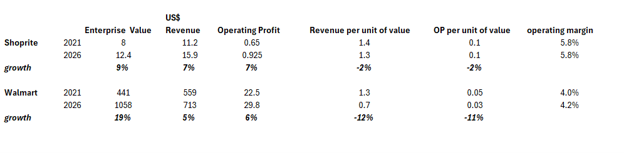
The table is busy, so you can study it in your own time. I will make the following observations:
- Over the past 5 years, Shoprite has grown its revenue and operating profit faster than Walmart (measured in US$ terms).
- Despite Shoprite’s fundamentally better performance, Walmart has been rerated – its enterprise value (the market value of the business) has grown by 19% p.a., 4 times the rate of the business’s fundamental growth. Shoprite’s value grew by only 9% p.a., just about in line with the business’s fundamental growth.
- As a result, while you paid a similar multiple of revenues for both companies 5 years ago, today Walmart’s revenues cost almost double Shoprite’s. You pay triple the value of operating profit per unit of value for Walmart relative to Shoprite.
- Shoprite earns more per unit of revenue than Walmart does. i.e., it’s more profitable to own as a business.
- Walmart’s outperformance has occurred simply because the stock market now places a much higher value on its output than on Shoprite, despite Shoprite delivering more output per unit of value than Walmart.
I can only conclude that a rational businessperson seeking to acquire a good grocery business would prefer Shoprite to Walmart. It’s fundamentally a better business, priced more cheaply. But investors get confused by share price movements over arbitrarily short periods, so much so that they lose sight of the underlying reality.
Shoprite vs Walmart is a classic case in point.
My take: When you invest, you get what happens to you in the future, not what already happened in the past. Extrapolating share price movements into the future, without regard for the business’s fundamentals, invariably leads to poor investment returns. A smart shopper would weigh the price paid against the value received, not simply extrapolate the past share price movement into the future.
4. Hot Potato
A few weeks ago, Elon Musk invested roughly $1 billion in Skydance Corp. Skydance? Who is that, you may well ask.
Let’s start with the share price:
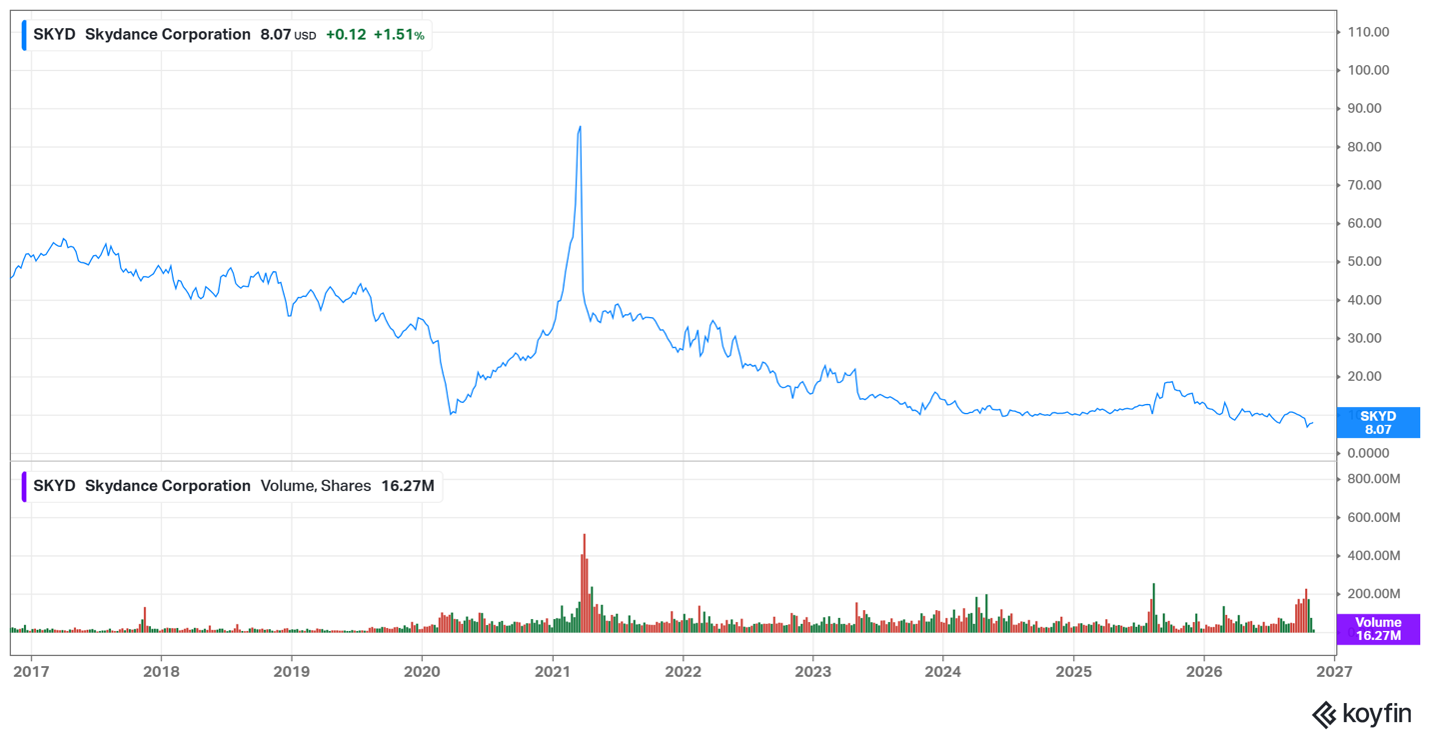
Not a great picture.
And here’s the story:
- Skydance Media was founded in 2006 by Davis Ellison, the son of Larry Ellison, founder of Oracle.
- In August 2025, Skydance acquired National Amusements, the holding company of Viacom and Paramount, in an $8 billion deal. This formed the Paramount Skydance Corporation.
- Subsequently, the merged company acquired Warner Bros/Discovery for $110 billion. The whole conglomerate assumed the Skydance name. It also assumed $80 billion in debt to do the deal.
Voila! A media giant is (re)born.
But Warner has seen this movie before. In 2000, at the peak of the dotcom bubble, AOL acquired Time Warner in an $182 billion merger. Then, in 2018, AT&T bought Time Warner for $65 billion, taking on significant debt to complete the deal. The debt proved too burdensome, and in 2022 AT&T spun off Warner Media and merged it with Discovery Inc.
Now, only 4 years later, Warner is once more being passed around like a hot potato, again with lots of debt. Will the movie end differently this time?
At least Musk’s cash infusion helps Larry Ellison, who personally guaranteed more than $40 billion of Skydance’s debt and also holds a significant ownership stake. Of course, Musk’s help does not come from the goodness of his heart. It’s simply payback for Ellison’s $1 billion purchase of Tesla stock in 2018, shortly after the “funding secured” fiasco, which led to Musk’s compulsory three-year vacation from his chairmanship at the EV firm.
“You scratch my back, I’ll scratch yours” is the Silicon Valley motto. Shareholder value does not enter the equation.
Skydance has three strikes against it:
- Warner has been acquired many times; never successfully.
- The history of absurdly rich people buying media companies is not particularly compelling from a value-creation perspective.
- The history of overleveraged mega-acquisitions is even less compelling.
My take: If you’re holding this hot potato, get rid of it asap. This is one to watch from the nose-bleed section of the stands, far away from the action.
In The Cockroach
There were two trades last week.
The first is a reduction in the local cockroach’s (aka the MWI Worldwide Flexible Fund)* exposure to the iShares Core MSCI Emerging Markets ETF by 1%. The second is the addition of 1% to the offshore cockroach’s (aka the RECM Worldwide Flexible Fund) holding of LSEG (The London Stock Exchange Group).
This is what the equity portion of the respective funds consists of now:
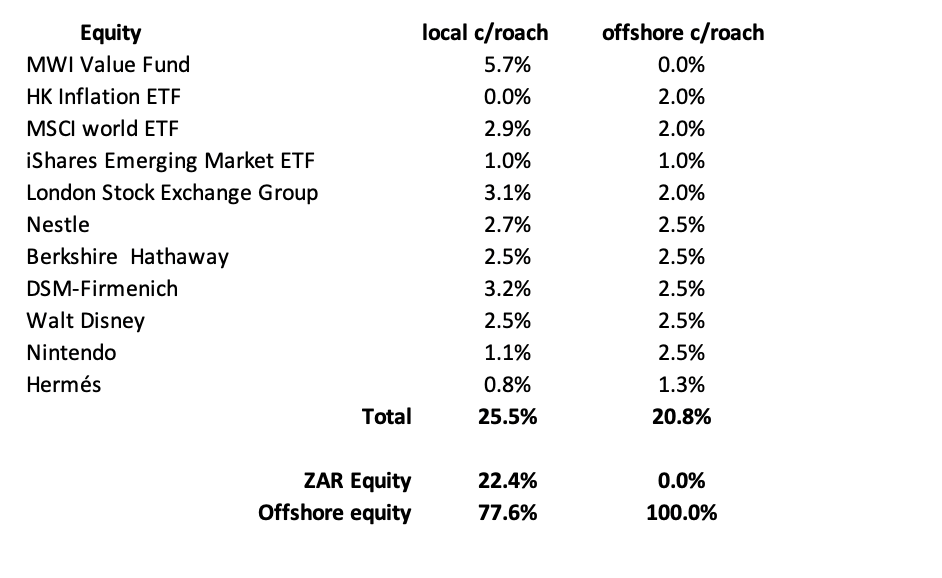
The offshore cockroach is still struggling to get regulatory approval to buy into the MWI Value fund (the best-performing equity fund in its class in South Africa over the past year!).
Once it gets approval, the HK Inflation ETF will be reduced somewhat in favour of the Value fund, taking overall equity exposure in the offshore cockroach up to c.25%.
Some individual equities have risen above their target weight of 2.5% each due to strong share price performance (LSEG, Nestle, DSM-Firmenich). The fund’s policy is to reduce them only if/when overall equity exposure goes meaningfully above 25%. As they say in the classics, water your flowers and pull your weeds. These are not weeds.
Both Nintendo and Hermès are starter positions – they have yet to be built up to full 2.5% positions.
I’m happy to report that the offshore cockroach fund size has now increased to over R50 million. Its reception has been gratifying.
* I manage the fund on behalf of Merchant West Investments (Pty) Ltd (FSP 44508)
In The Media
1. The best music of 2006
In 2006, RECM turned 2. After a couple of strong years, we began to underperform. Our problem was that we didn’t buy into the sell-side’s “Commodity Supercycle” theory. For us, it was just another capital cycle, with abundant capital available to the mining sector on highly favourable terms. Those terms would ultimately leave shareholders out of pocket in a big way, as mines expanded supply to levels far in excess of any reasonable demand.
The clients who stuck with RECM eventually made money in 2008, a year when most investors lost their shirts. So, when I listen to the music of 2006, it reminds me of getting up early in the morning, driving to the airport, and flying to Johannesburg to face back-to-back-to-back meetings with clients who were either so upset they wanted to disinvest, or disappointed with what we were doing. All the meetings were unpleasant, but the disappointed ones hurt the most.
The pleasant meetings of 2008 and 2009 were unimaginable in 2006.
So here are the top 10 albums of the year on Apple Music and Spotify. My number one album for the year – an Afrikaans one! – is Karma by Ryno Velvet, which narrowly beat out Nick Cave’s Grinderman. Grinderman is what I felt like in 2006.
My top 20 songs are available on Apple Music and Spotify, ranked from 20 to 1. And yes, Ryno Velvet are at number one with “Ai My Lam”. When we played the song at our wedding a few years ago, it packed out the dancefloor. And there were probably more English-speaking people at the wedding than Afrikaans speakers!
Finally, here’s the long list of good songs from the year, only on Apple Music.
2. Proudly announcing the RECM TOPP programme
Last month, we received some great news. SAICA has approved RECM to provide a TOPP (Training Outside Public Practice) programme. For those who don’t know, a TOPP programme is an alternative to the programmes typically offered by audit firms to young professionals working towards qualifying as a Chartered Accountant and obtaining the CA(SA) qualification.
The main differentiator of a TOPP programme is the opportunity to focus on the operational and financial aspects of running a business. Traditional TIPP (Training Inside Public Practice) programmes offered by audit firms provide more experience and understanding of independently examining businesses and their financial reporting. Neither is better than the other; they suit different types of candidates.
Completing a TOPP programme with RECM suits those with no interest in traditional audit roles but who aspire to corporate finance, financial management, and eventual management roles in business. It also provides the opportunity to build relationships with operational managers and business leaders.
Our TOPP programme is designed to help us develop the growing cohort of young business leaders across our wider group. Candidates will gain experience and contribute across diverse businesses, including corporate advisory work at Questco, motor vehicle leasing and financing at Flexi Mobility, fund management at RECM, investment holding companies Maximus and Beagle, and a wide range of industrial businesses, including Goldrush and Hero Motorcycles.
We have space for up to three of the right candidates per year.
Contact Dean Schweizer at dean@recm.mu if you’re interested.
That’s it for this week.
I hope you enjoyed voting yesterday as much as I did. But no matter what the outcome of the election, please stay careful out there.
Piet Viljoen
RECM
5 November 2026