
Dear Fellow Investors and Friends,
Welcome to my newsletter, where I share my efforts to understand markets and the world around me.
I do appreciate you taking the time to read this. I love getting feedback; feel free to drop me a line. It’s great to start conversations.
Today is Thursday, October 8th, the 281st day of the year. There are 84 days left in the year. The time to do those things that you’ve been putting off is running out. Fast.
Early October is typically not a good time for markets. The theme is striking: 8 October has historically been a time when leverage, banking stress, currencies and monetary policy collide.
- In 1987, markets were already cracking before Black Monday. On 8 October, the Dow fell 34.4 points to 2,516.6, bringing its weekly loss to 6%.
- In 1998, the LTCM and Asian-crisis turmoil intensified. On 8 October, the dollar experienced an extraordinary reversal against the yen. The Dow fell as much as 273 points intraday, while the Nasdaq fell about 3%. Tokyo had fallen nearly 6%, and the dollar’s two-day fall against the yen was described at the time as its worst in roughly 25 years.
- In 2008, 8 October was one of the extraordinary days of the financial crisis. The Reserve Banks of the USA, the UK, Canada, Sweden and Switzerland all cut policy rates. Britain simultaneously announced a major bank-rescue programme involving government capital injections and guarantees. In the USA, the Fed authorised the New York Fed to lend up to $37.8bn against securities held by AIG’s insurance subsidiaries, continuing the rescue of the world’s largest insurer.
With this backdrop, it seems prudent to cut back on risk in our portfolios and sell some assets to avoid being hurt by market volatility.
Nick Saban would disagree.
Who is Nick Saban?
He is the former head football coach at Alabama, who developed what he called “The Process”, his signature leadership and performance philosophy. Developed with psychiatry professor Dr Lionel Rosen, the philosophy breaks down complex, daunting tasks into manageable, bite-sized pieces. Instead of worrying about an entire game or season, players are trained to focus their attention and effort on a single play and to do their individual jobs at the highest possible level.
A season lasts months, a game lasts hours, but a single set, or play, lasts only a few seconds. The trick is to make the most of each of those seconds. Focus on them, not on the game or the season. When teams do this, they overcome obstacles and eventually reach the top without ever focusing directly on them.
This is the Stoic way – through the obstacle, not around it. I don’t know whether Rassie Erasmus is a Stoic, but what he has done with his Springbok team smacks of a strong process, mixed with a good dollop of Stoicism.
What does such a process look like?
Assemble the right actions in the right order. Execute them one after the other. Repeat until you have mastered it. Then do it again. The key part of the process is that you will be so focused on putting one foot in front of the other that you won’t even notice the obstacles.
Core Principles of Saban’s “Process”:
- Focus on the Present: Do not obsess over the scoreboard or the championship. Focus on the drill, the meeting, or the specific play at hand.
- Control the Controllables: Commit fully to daily discipline, effort, and preparation. You cannot control the opponent or the referees, but you control how you execute your task.
- No Illusion of Choice: Excellence has a demanding price. There are very few ways to be great, and they all require extreme consistency, editing behaviours, and discipline. You have no choice or options here.
- Continuous Improvement: Just because an individual or team was successful in the past does not guarantee future success. You must constantly strive to improve and maintain the standards that led to success in the first place.
These principles apply not only to sport, but also to investing.
In investing, there are many ways to skin the cat, and many cats to skin. Choosing which cat to skin is an important part of the process. Do you want to grow your capital in real terms over a long period of time, be the best in a particular market segment, or be a top asset allocator?
Whichever cat you choose, you must know that cats don’t like being skinned. They will put up a fight with tooth and claw, and it’s not pretty.
So it is with investing. You will go through good and bad periods. Both tend to mess with you. When things are going well, you might think you’ve tamed the cat. You relax, take your eyes off it for one second – and it shreds you. When you’re scratched and bleeding, you start questioning your abilities. You might even change what you do as the pain becomes intolerable.
And so you flip-flop between good and bad times, always tinkering with the portfolio, taking one step forward and two steps back.
There is only one way to control the cat. That way is to develop a sensible, repeatable investment process and apply it consistently. Again, there is no single right way – but a way that is based on a combination of (1) what works in markets, and (2) what works for your own psychological makeup.
The investment firm Tweedy, Browne wrote a booklet called “What has worked in Investing”. You can read it here. This is a good source for the building blocks of your process.
More importantly, you need to understand your own psychological makeup and devise a process that fits it. If you aren’t comfortable with what you are doing, the discipline and execution required over a long period of time will never materialise, no matter how good your intentions.
You will be forever scratched and bleeding, looking to do something different.
In The Markets
1. The beatings will continue until morale improves
Over the past couple of weeks, we have had announcements regarding the potential buyout of minorities – and associated delistings – in two South African companies.
First, Indian-headquartered Solar International announced an offer to Omnia’s shareholders to buy them out at a 35% premium to its market price. Next, Sanlam announced an offer to buy out the shareholders of short-term insurer Santam – of which Sanlam already owns 62% – at a premium of 25%.
What do these offers have in common? They are for high-quality businesses that Mr Market, in his current depressed mood here, systematically undervalues. Both companies were recently trading at multiple-year low P/E ratios, just like many other high-quality South African companies.
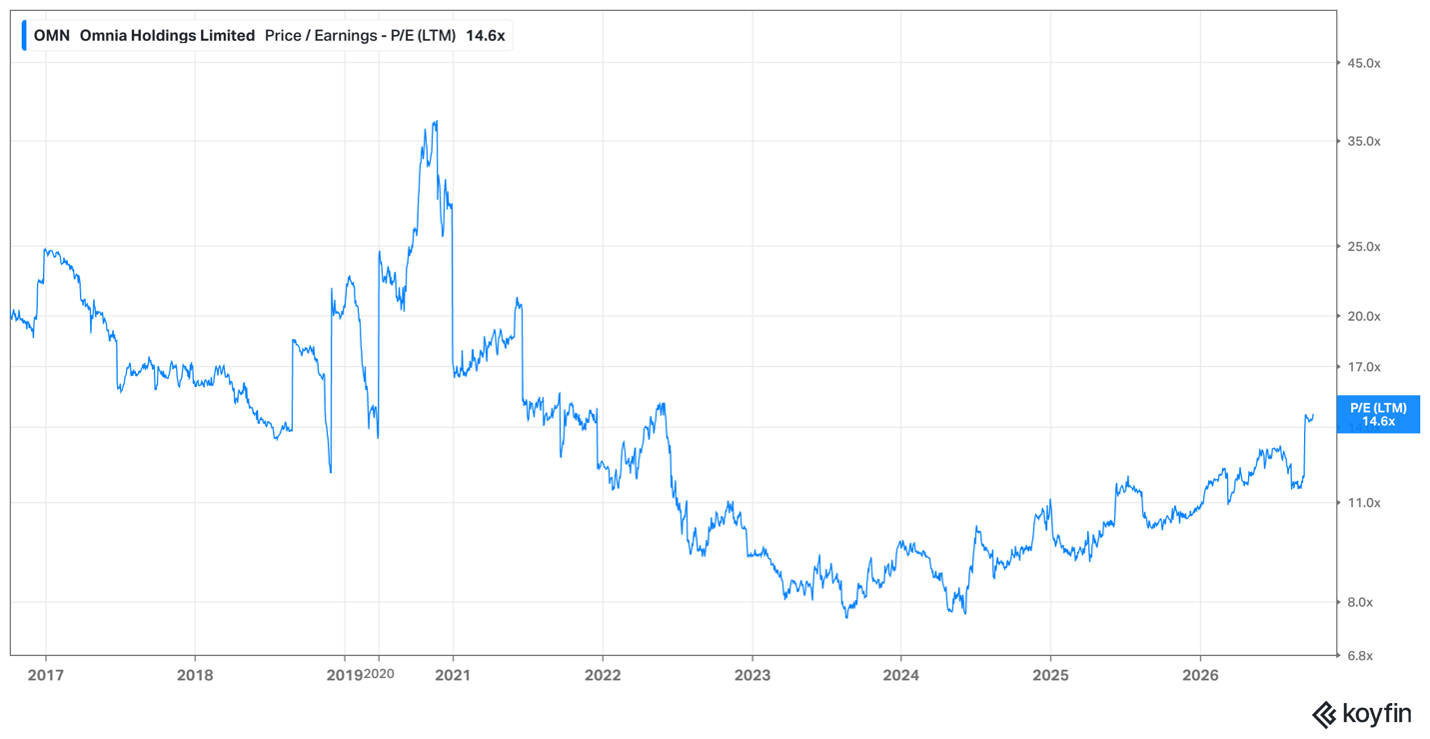
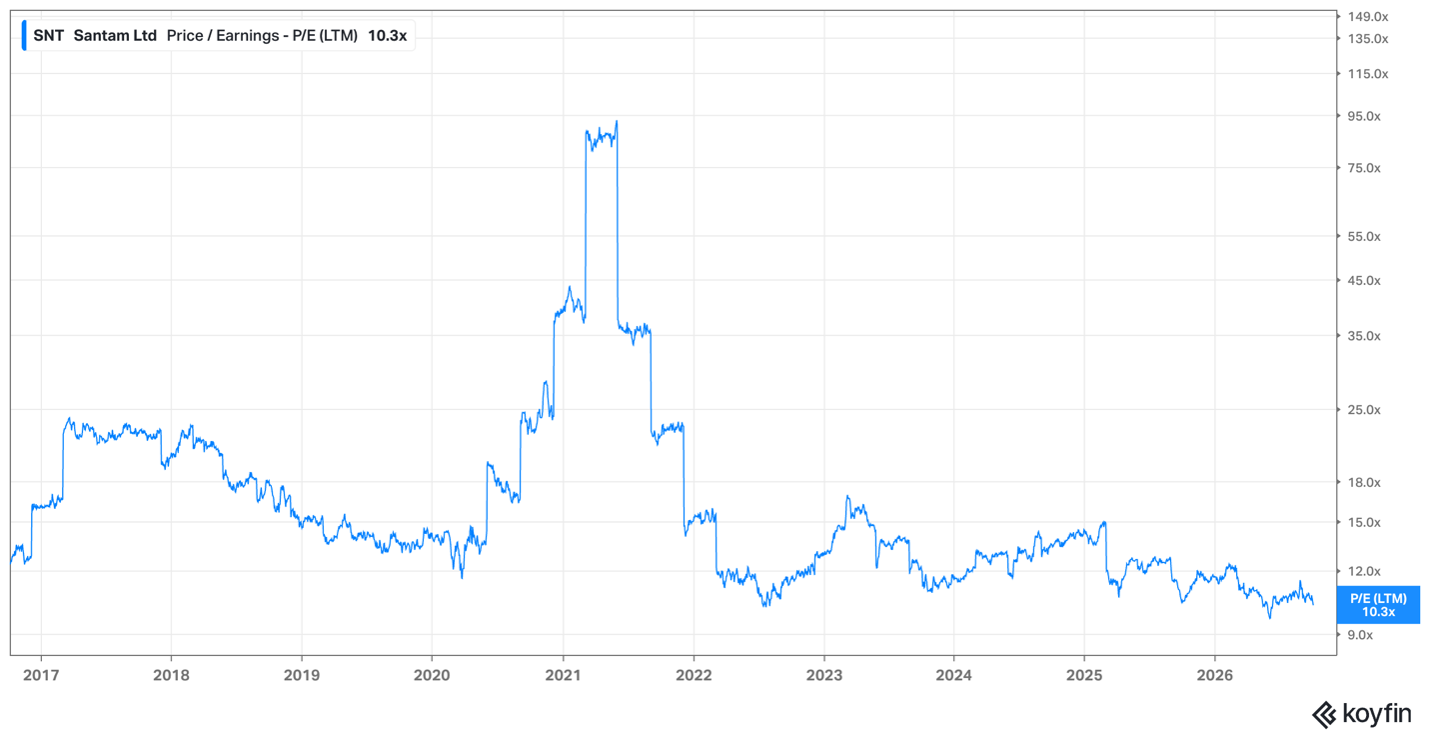
And they’re not rated so poorly because they’re struggling. Both have shown earnings growth over the past decade, despite our incapable government’s best efforts to hamstring business and block growth and job creation.
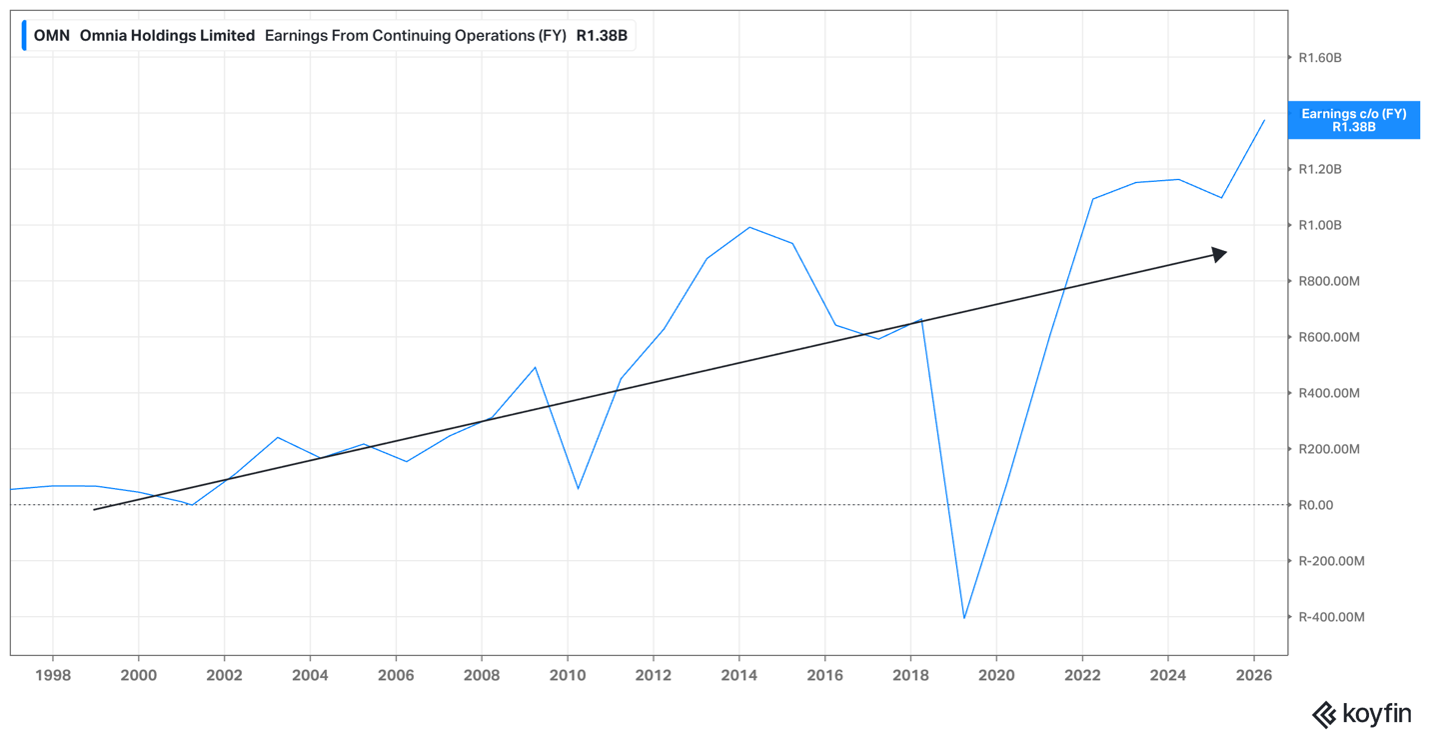
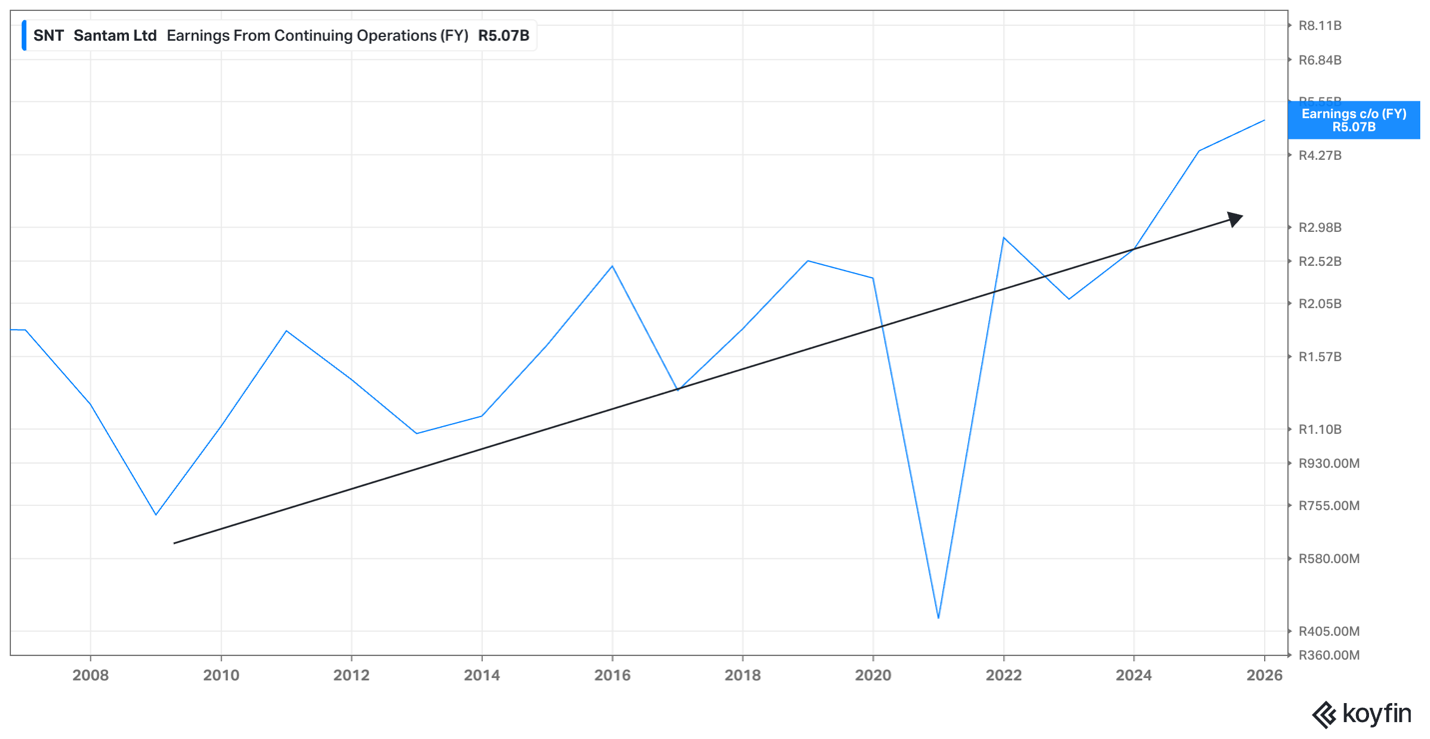
There is good news, though. If you are a minority shareholder in Santam, you can take the proceeds of this sale and buy Sanlam at a P/E of 8 and a dividend yield of 7% – more than you can get on your money at the bank!
My take: When will we realise that simply taking our money offshore to bet on the outcome of a roulette wheel spun by financial “professionals” intoxicated with speculative juices is not a winning strategy? Will it be when we run out of great listed companies?
2. Cold Turkey
Scotland soccer fans may have drunk Boston dry during the recent football World Cup, but beer enthusiasts in general seem to have lost some of their buzz. In the USA, the beer market has been declining for years, but the retreat has recently accelerated, despite the Scottish fans’ best efforts.
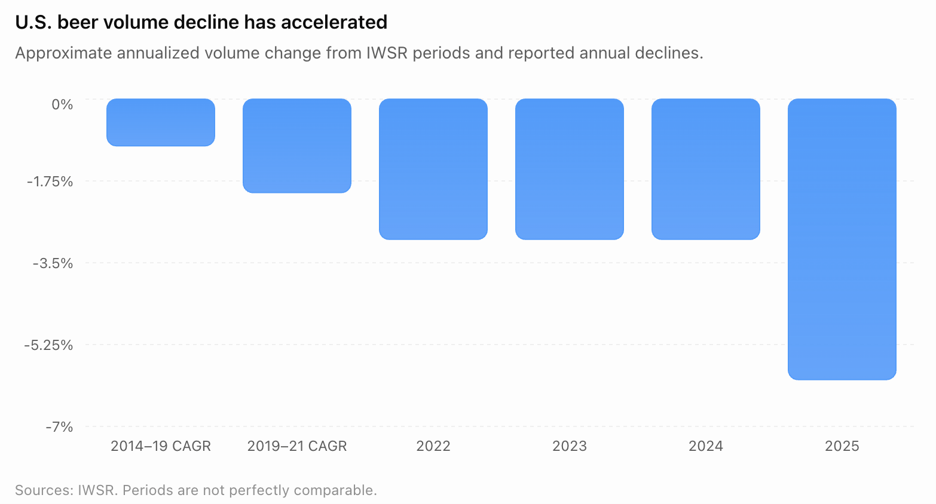
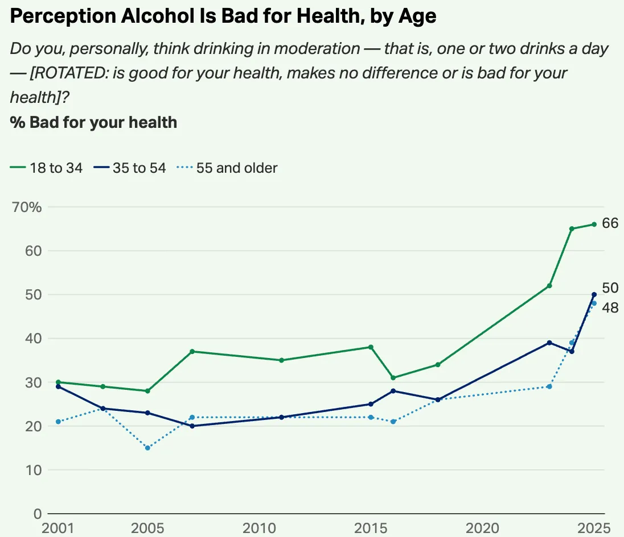
It’s been a difficult few years for beer makers, as a lot of their customers seem to have gone cold turkey. Last year, a Gallup survey found that the share of adults who say they drink alcohol hit an all-time low of 54%. The increased use of GLP1s no doubt plays a role. The same survey found that two-thirds of Americans under 35 think alcohol is harmful in any quantity.
In this tough market, Constellation Brands is a relative winner, gaining market share. Despite this, the maker of Modelo (the number one beer brand in the USA) and the holder of the US licence for Corona (the beer, not the virus) is struggling.
Winning in a declining market looks a lot like losing.
Recent results showed that beer shipments grew 5.5%, but depletions, a closer guide to movement through the distribution chain, fell 0.6%. Modelo Especial and Corona Extra declined, partly offset by stronger demand for Pacifico and Victoria.
On top of that, Berkshire Hathaway disclosed in August that it had sold its remaining Constellation Brands holding during Q2 2026.
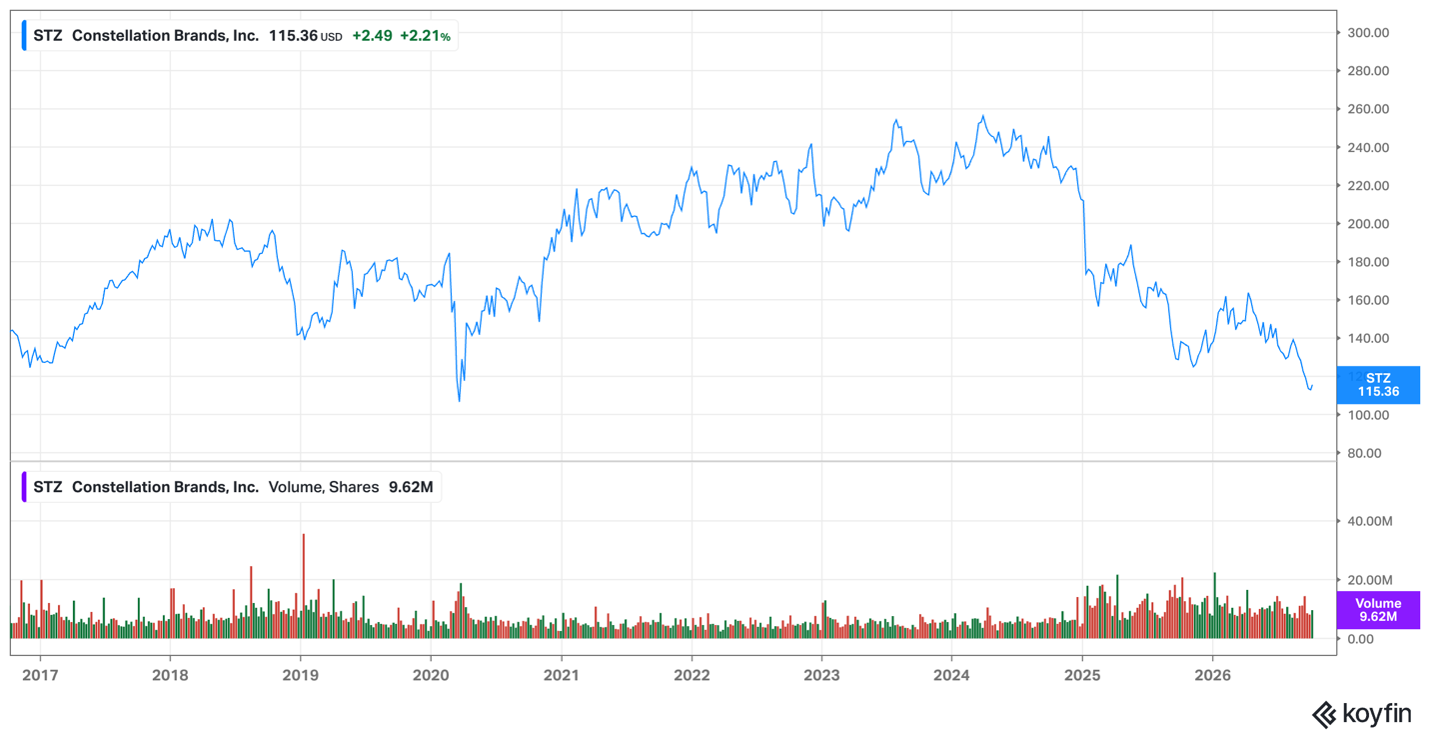
Constellation’s share price is now plumbing COVID-era lows, when beer sales were effectively banned:
Meanwhile, Constellation is cleaning up its balance sheet by reducing debt and simplifying the business by selling non-core assets. It is investing significantly more in marketing and sales. Pacifico and Victoria increasingly appear to be genuine second-wave growth assets rather than immaterial brands. Modelo still has meaningful distribution whitespace – management says roughly 20% versus domestic competitors.
When/if consumers start drinking again, it will be well placed to benefit.
My take: A business once regarded as a steady compounder now faces significant headwinds. When it traded at a P/E of 25 a decade ago, investment risks were skewed to lower returns. Today, at a P/E of less than 10, investment risks are skewed to higher returns.
3. Imagine
Betting on Polymarket shows that it was hard to predict that Flavio Bolsonaro would do quite so well in the first round of presidential voting in Brazil.
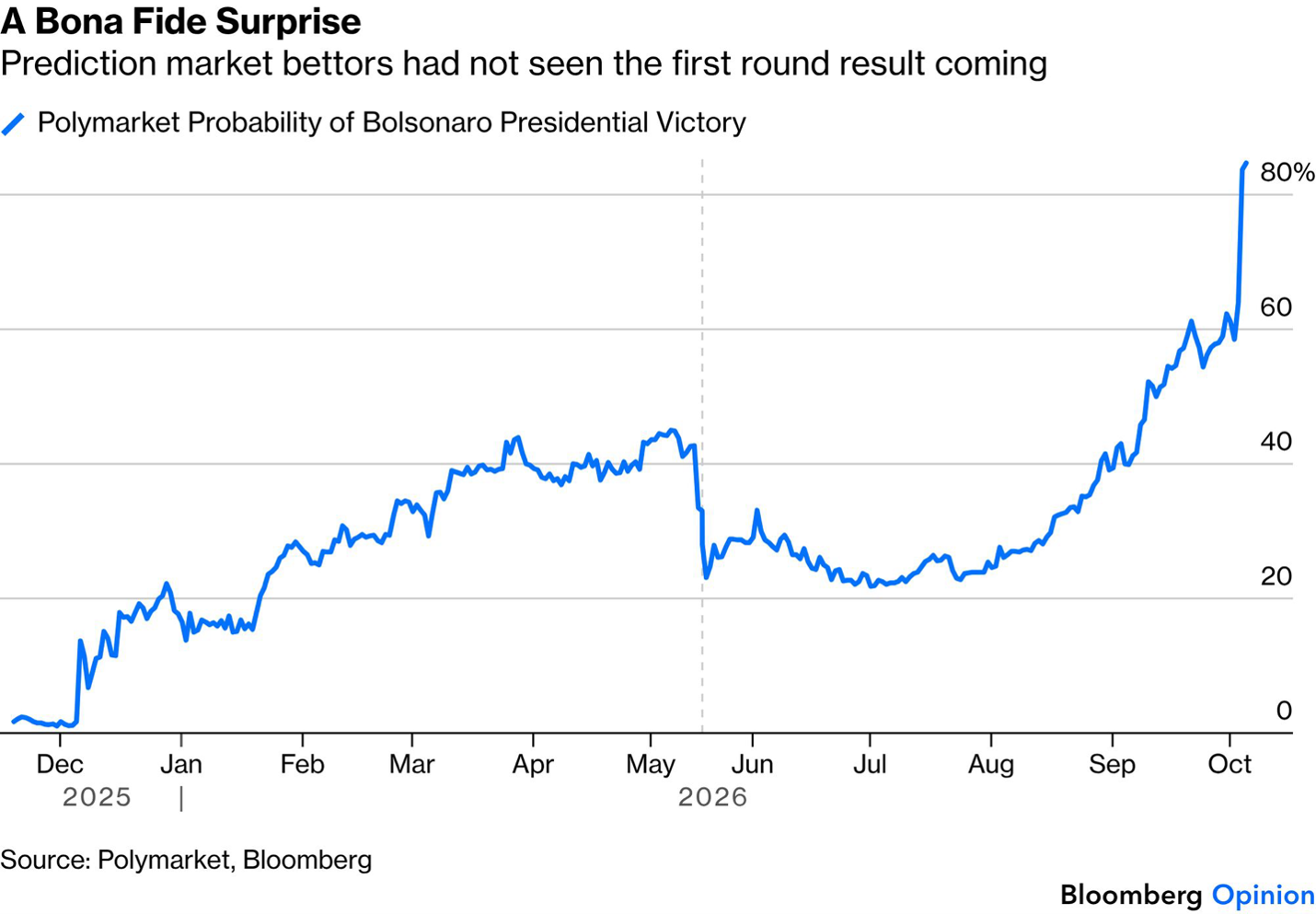
Against expectations, he beat incumbent President Luiz Inácio Lula da Silva into second place and now seems overwhelmingly likely to win the run-off in two weeks.
This is good news for the Brazilian market, as the local index shot up on news of the results:
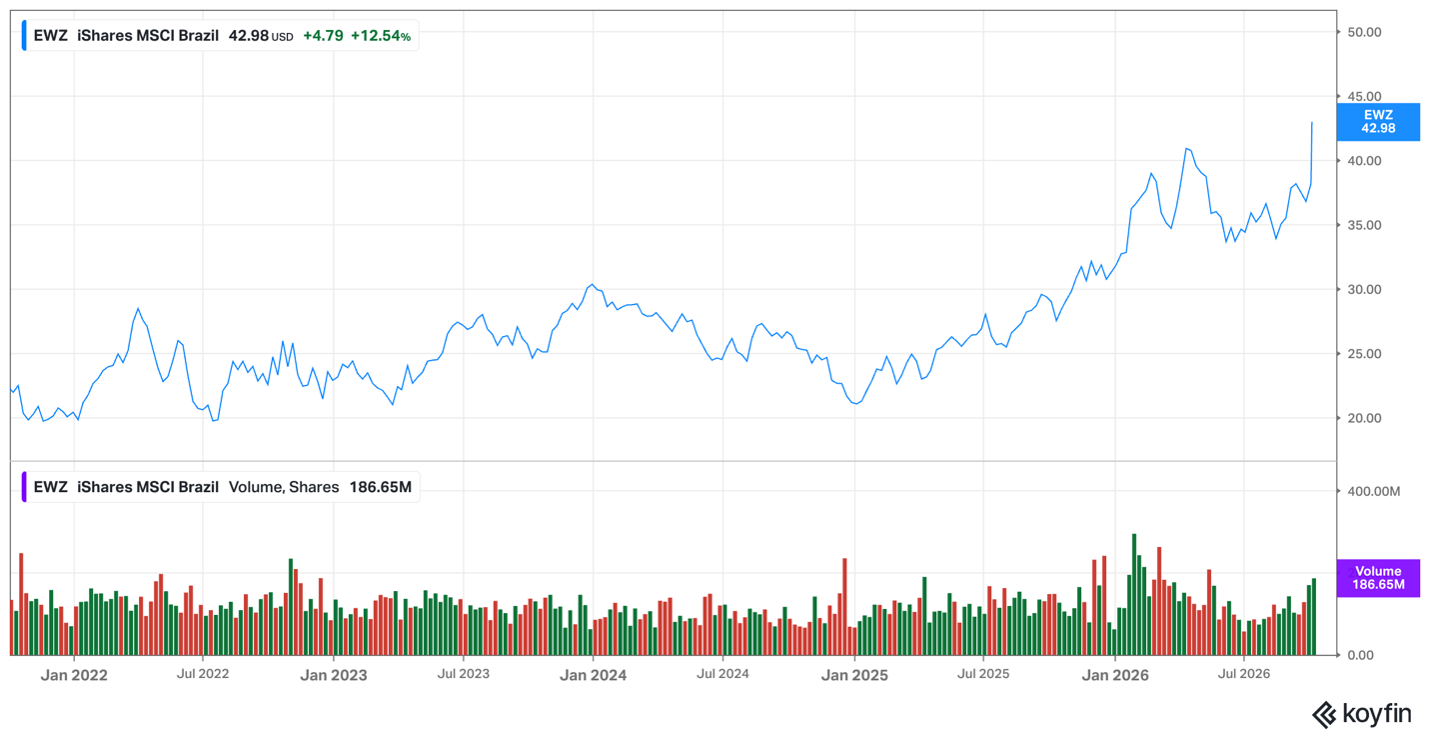
Prospects for fiscal reform have driven the market reaction. With new control over the legislature, Bolsonaro might have a shot at cutting government spending. Brazil’s poor fiscal situation has resulted in interest rates of over 14%(!) before the election:
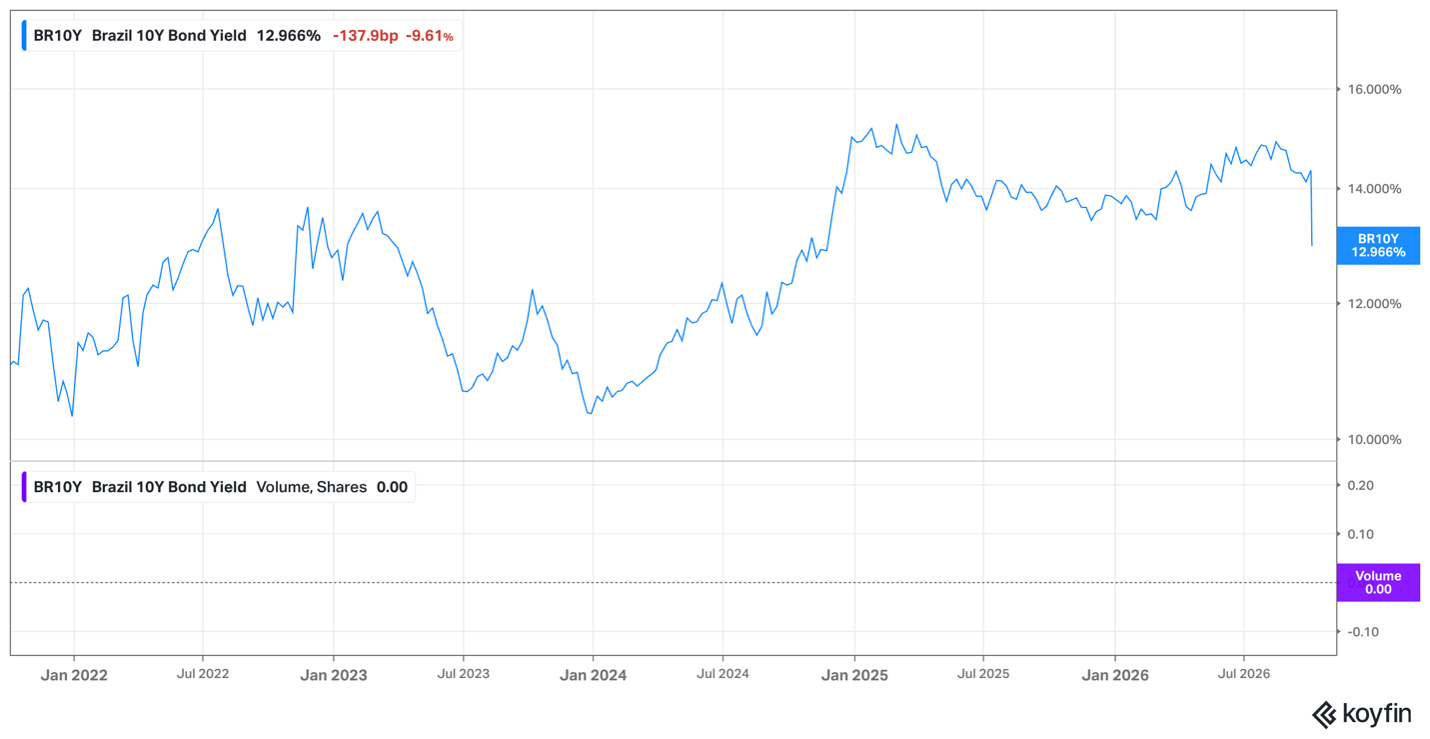
With inflation at 4%, such high bond yields make bonds a compelling investment, leading Brazilian institutional investors to allocate over 80% of their assets to bonds, with only 5-10% to equities. With a less socialist government in charge, the fiscal situation could improve, resulting in significantly lower bond yields.
“The Cockroach” has exposure to these attractive bonds via its 10% allocation to the EM local government bond index, which, in turn, has 10% exposure to Brazil.
My take: Imagine the buying power that will flood into Brazilian equities if their interest rate situation normalises. Imagine the buying power that will flood into South African equities if we experience a similar election surprise.
4. Winner winner, chicken dinner
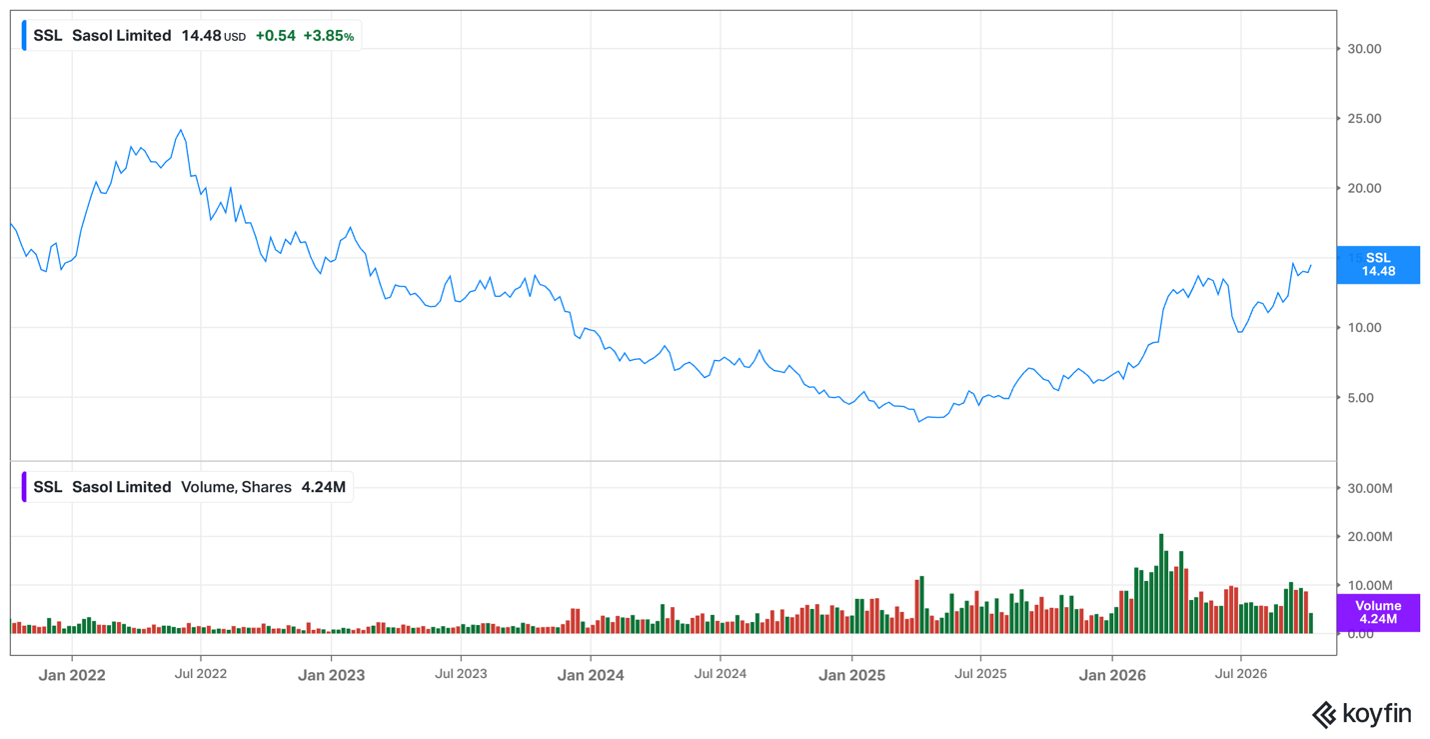
News just out – Sasol is now the top-performing emerging-market stock outside of Asia. Sasol has provided investors with a return of over 100% in US$ this year, on top of last year’s 45% gain. On the chart it doesn’t look like much, but looks can be deceiving. It’s gone from $3 per share to a recent level of $14 – almost, but not quite, a five-bagger in 18 months.
Long term, it is still locked in a downtrend relative to the broad index:
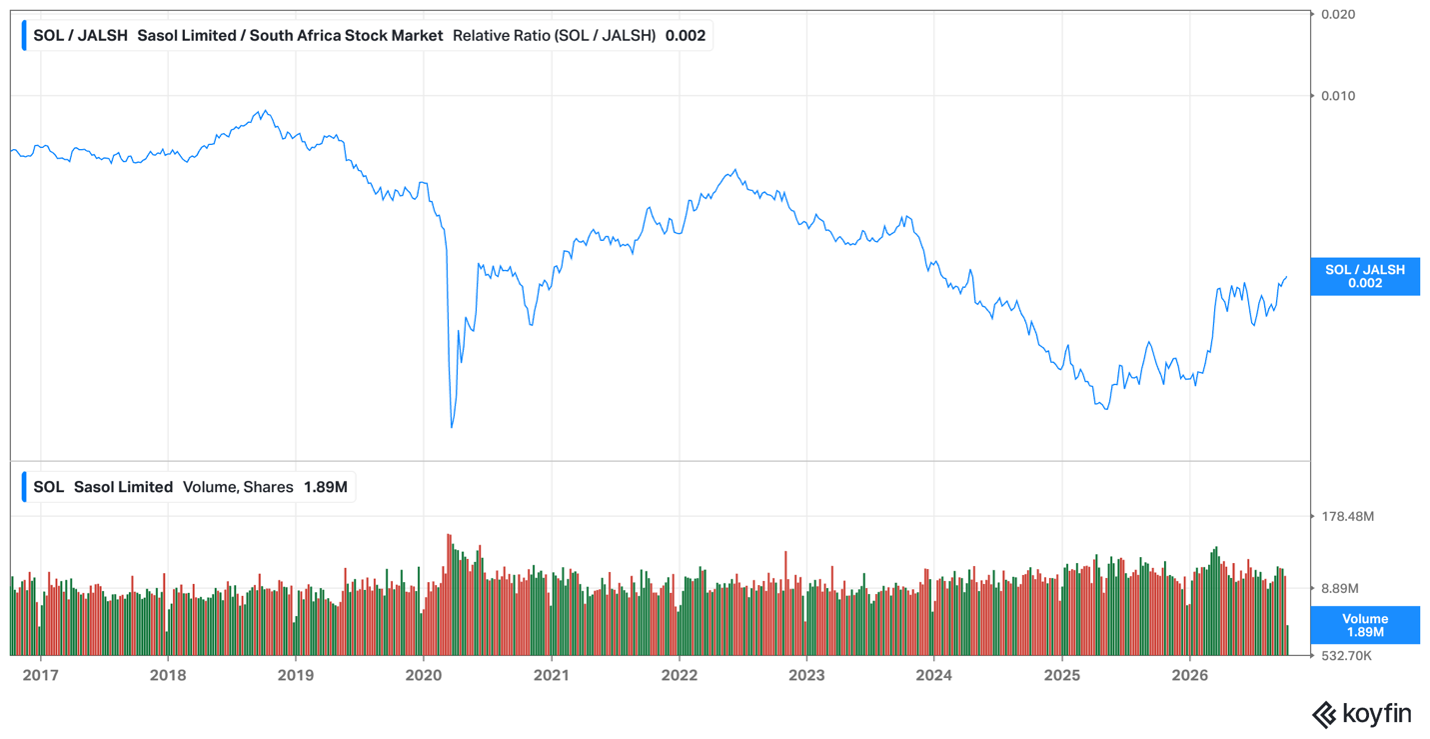
Local fund managers remain underweight the stock. It accounts for just over 1% of the index, so it is an easy choice to avoid, given its long-term historical track record of massive shareholder value destruction caused by overpaid, inept, and hubristic management. Which, I’m happy to say, are no longer present.
On the other hand, the MWI Value fund is the South African general equity fund with the greatest exposure to Sasol, with a 6%+ holding. Sasol has contributed significantly to the fund’s recent outstanding performance.
My take: Sasol is a useful diversifier – it is just about the only large-cap SA stock that gives you exposure to the energy value chain, from mining to refining. It is also a significant Rand hedge should things go wrong. All you need is a steady hand on the tiller – which they might now have in Simon Baloyi. I attended his talk at the BizNews conference in March, and it left me more confident in Sasol’s future than I have been in a very long time.
In The Cockroach
This week, I can finally show you a comparison between the offshore US$-denominated fund and the onshore Rand-denominated fund (the MWI Worldwide Flexible Fund). There are still some differences, which I’ve highlighted in yellow:
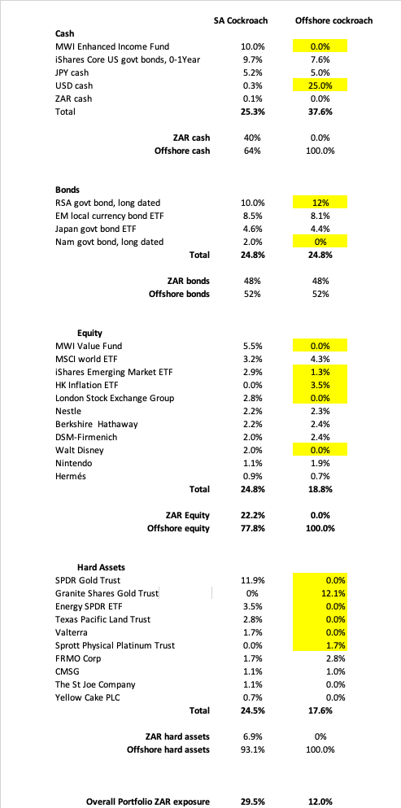
The differences in cash are due to the South African administrator, Sanlam Collective Investments (SCI), being quite obstructive about accepting funds from offshore, which so far has prevented the fund from investing in the MWI Enhanced Income Fund. The large USD cash exposure is there to fund this and some other purchases that have been delayed.
The differences in the bond portion of the portfolio are simply due to the difficulty of buying Namibian bonds from offshore. They have been replaced with additional South African bonds. It’s a pity, because the Namibian bonds yield substantially more, possibly at lower risk, given their willingness to allow oil extraction off their coast.
The differences in the equity portion are due to a few factors:
- SCI’s intransigence in accepting an investment into the MWI Value fund from offshore.
- SCI not allowing the fund to buy the INFL ETF locally, for some bizarre reason.
- Timing issues on buying LSEG and Disney.
(You might well ask why Sanlam plays such a large role in allowing or disallowing investments in the local fund. It’s because the fund sits on their platform and under their license, and they seem to have many unwieldy committees that decide on such matters.)
The differences in the hard-asset portion of the fund stem from local unit trust regulations that prohibit a fund from holding more than 10% in physical precious metals. Apparently, it’s considered too risky.
Go figure!
Instead of buying physical platinum exposure, as in the offshore fund, I have had to buy equity in a platinum-mining company, Valterra, instead. Furthermore, FRMO has been replaced with TPL in the offshore fund.
The key difference between GraniteShares Gold Trust (BAR) and State Street SPDR Gold Trust (GLD) is their expense ratios, with BAR offering a significantly lower annual fee than GLD. Unfortunately, SCI does not include BAR on its buy list in South Africa.
The funds are not substantially different at the moment, but over the next few weeks they will move even closer together as I work through some teething problems with SCI.
* I manage the fund on behalf of Merchant West Investments (Pty) Ltd (FSP 44508)
In The Media
1. The new RECM website
My colleague Jan van Niekerk, with help from his very bright assistant Claude, has redesigned our website. You can have a look here. In my (very) biased opinion, it looks great.
I want to highlight one feel-good story from the new website, which is what our Foundation has achieved with one of the early learning centres it supports, Faith Educare. You can read the full story here.
2. Meet Floyd
My friend Oscar Foulkes is a good writer. He writes an interesting blog, and his free-flowing style is always a pleasure to read. The only problem is that he posts irregularly. But I have discovered why – he was busy writing a novella, which he is now publishing weekly in serial form.
It’s called “Floyd Plunkett’s Diary”, and the Prologue and Chapter 1 are live on his Substack, with forthcoming chapters added every Friday. If you want to dive in right away, the full version is available on Kindle for the price of a cup of coffee (click here for that).
3. Cape Town rules
The FT recently ran an article titled “Cape Town offers best-value winter sun for UK tourists, despite the strength of the Rand(!)” (emphasis mine). The FT ran a survey which put Cape Town ahead of 24 other long- and short-haul destinations.
Unsurprisingly, Tokyo, thanks to the weak Yen, came in third place. Here’s a table from the article:
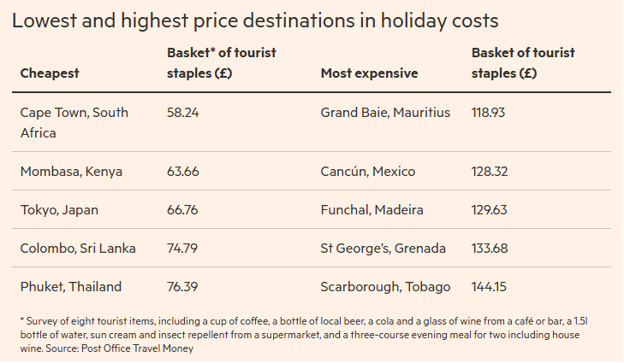
Eat your heart out, Mauritius. You might not have high direct taxes, but you levy implicit taxes in so many other ways. It’s mind-boggling that South Africans would go to Mauritius on holiday.
Living in Cape Town is a constant source of joy for me.
You can read the full article here.
4. Jason Zweig on Buffett
As always, Jason Zweig hits the nail on the head when he puts pen to paper. Last week, Warren Buffett stepped down as chairman of Berkshire Hathaway, and Mr Zweig paid tribute to him in this article.
But this is not the usual puff piece about his investing acumen and great wealth. No, it’s more about the structure he built around himself, which helped drive the outcome. This is what very few people talk about when it comes to Warren Buffett. Structure and process bring lollapalooza investment outcomes.
Most people talk about his outcomes, not what created them.
If you want to emulate one thing about Mr Buffett, it’s the structure and process you need to focus on. Not the outcome.
That’s it for this week. I’m writing to you from beautiful Tulbagh, where Sake-Liga are hosting an insightful conference focused on how we can work together to combat state collapse and make South Africa a better place to do business. We are fortunate to have guests here from the USA, the UK and Europe to network with and learn from. It might surprise you to learn that we are not the only country facing some of these issues. But unlike many Western countries, we are in the fortunate position of having an incapable and inept government, which makes fixing the mess they make just a little bit easier.
This conference reinforced my intention to always be careful out there. I hope you do the same.
Piet Viljoen
RECM
8 October 2026