
Dear Fellow Investors and Friends,
Welcome to my newsletter, where I share my efforts to understand markets and the world around me.
I do appreciate you taking the time to read this. I love getting feedback; feel free to drop me a line. It’s great to start conversations.
Today is Thursday, August 27th, the 239th day of the year. There are 126 days left in the year. Today is also Rock Paper Scissors Day. RPS is considered the oldest hand game in the world. In fact, the game dates to the Chinese Han Dynasty, which ran from 206 BC to 220 AD. The Chinese were onto something here – it’s a great way to settle minor disputes, or make important choices.
Unfortunately, we didn’t learn much about Chinese history at school, so this all came as news to me. History is almost always the best guide to the future, so my lack of exposure to Chinese history also means my views expressed this week are lightly held. Feel free to criticise or point out any errors!
Visiting Shanghai recently, the topic of The Opium Wars came up repeatedly.
The Opium Wars were two mid-19th-century conflicts between China’s Qing dynasty and Western powers (primarily Britain and France). At the time, Western demand for Chinese goods (tea, silk, porcelain) was massive, but China had little interest in Western goods. As a result, China was paid in silver, creating a substantial deficit. The West didn’t like seeing all its silver move to China, so its governments intervened, backing the British East India Company to sell opium to traders who would smuggle it into China.
Yes, the British government was the OG drug dealer. And you thought we had crooks as politicians today!
Britain’s plan was to engage China militarily and then negotiate a peace treaty that would legalise the opium trade, expand foreign access to the Chinese interior, and force diplomatic equality. In their greed to gain access to the Chinese market, France joined Britain in this conflict. So much for the battle of Waterloo – when it comes to sharing out the gains from dealing in drugs, governments swallow their pride with consummate ease.
China was comprehensively defeated by the military and naval superiority of Western forces. A series of “unequal treaties” were subsequently imposed, notably the Treaty of Nanjing and the Treaty of Beijing, which gave the Western powers unfettered access to Chinese products and markets for European and US trade.
China’s defeat in the “Opium Wars” directly led to what was called “The Century of Humiliation in China”, characterised by a loss of sovereignty and internal conflict. It eventually led to the collapse of the Qing dynasty in 1912. This political vacuum was filled by massive internal fighting, with the Communist Party eventually taking over in 1949, which marked the end of the “Century of Humiliation”.
Here I am with Amanda in Shanghai, at the building where the Chinese Communist Party was founded:

Understandably, this period left deep scars on the Chinese psyche and plays a major role in their thinking today. They don’t want to become addicted to “Western products”, nor do they want to expose themselves to Western military action. This has led to the following actions:
- A closed capital account, preventing the Chinese from becoming dependent on the Western drug of speculative capital markets.
- Geographic protection through building alliances around their borders. North Korea, Russia and Myanmar all play this role, with Iran doing so in the Middle East.
With these protections in place, China is once again doubling down on a strategy of strong reliance on exports. Beijing has developed an “industrial policy of everything”: cars, machinery, chemicals, pharma, software, AI chips, you name it. As Gavekal says, “when China enters a room, profits walk out”.
China’s trade surplus reached a record 1% of global GDP last year. No country has ever reached such an imbalanced position in modern economic history.
Communist China is pursuing the same policy of autarky and one-way trade as the Qing Dynasty in the 19th century. In that era, it sucked up the world’s silver. Today it’s sucking up the world’s aggregate demand, and with it, increasingly, gold.
In a throwback to the early 19th century, the West is fighting back. But this time it is doing so with tariffs and other trade barriers, as well as by waging indirect wars against China’s proxies.
Since WW2, the USA’s identity was linked to openness. This was how it displayed its superiority. Open markets, open scientific exchange, open immigration. The free circulation of ideas and talent was evidence of American confidence. A powerful country could afford to remain open because it believed it would gain more from exchange than it would lose. Closed countries that banned foreign products, restricted information, pursued self-sufficiency, and treated outside influence as a threat were regarded as weak, running an inferior system.
Today, the West (and America in particular) are responding to China’s trade superiority by gradually adopting the very characteristics once presented as proof of their inferiority. Everywhere, barriers are going up. The free movement of people, ideas and capital is being curtailed.
I believe this war will be won on the ideological front. Eventually, when it has run its course and the barriers start to be dismantled once again, the winner will be the one who has won the hearts and minds. So this graphic tells a story:
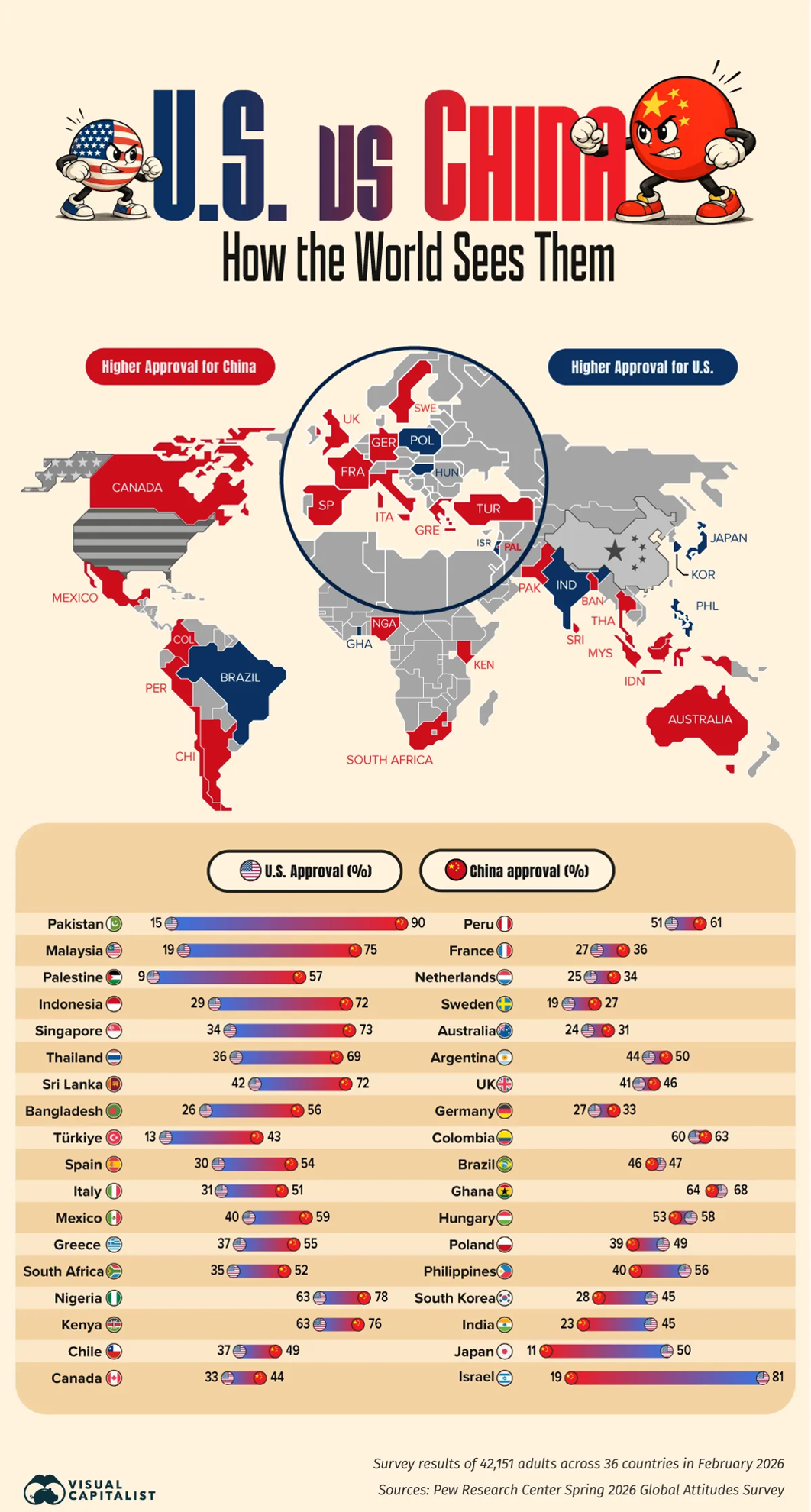
Recently, after the USA imposed 50% tariffs on its neighbour – and ally – Canada, Canada’s Prime Minister Mark Carney said, “we recognised that sometimes the US signature is written in pencil”.
I think that says a lot about the current state of play.
Next week, I will draw more conclusions, and even venture into some possible investment implications. I will also discuss how “The Cockroach” is addressing these issues.
In The Markets
1. Yellow Cake PLC
Yellow Cake PLC is a UK-listed holding company that – surprise! – holds, as its only asset, yellow cake. Before you accuse me of investing in a low-quality, high calorie foodstuff, let me explain.
Yellow cake is not something served at birthday parties. It is the powdered substance (triuranium octoxide, U₃O₈) produced during the early stages of milling uranium ore before it is purified and enriched for nuclear reactors or weapons.
The MWI Worldwide Flexible Fund (aka “The Cockroach”) holds Yellow Cake plc in its hard-asset allocation. It was acquired in anticipation of a “capital cycle” in uranium, where a prolonged period of low uranium prices led to little investment in the uranium mining industry. In fact, many mines have closed.
The low uranium price was caused by two factors:
- A drying up of demand from following the Fukushima disaster, in which a nuclear reactor was destroyed, ultimately causing 1 radiation-attributed death, as well as 2300 evacuation-related deaths – mainly due to stress and loss of access to medical care amongst the elderly. But it was a disaster that caused Japan to halt nuclear operations.
- The disastrous “Energiewende” policy in Germany, in which the government shut down its greenest and cheapest source of power. This led to the closure of all 17 nuclear reactors in Germany, leading to high energy costs and an increasingly non-competitive industrial base.
As a result, the number of operational reactors worldwide has flatlined over the past 30 years:
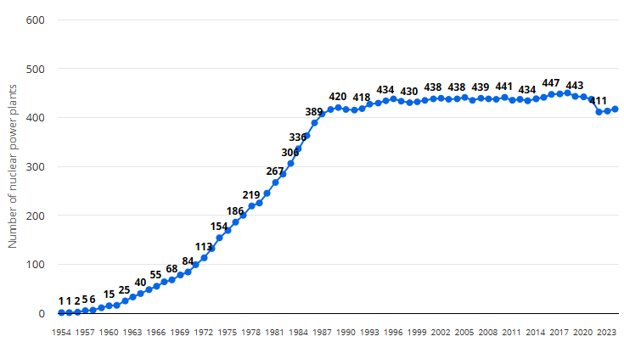
Fewer reactors mean less demand for uranium, leading to lower uranium prices and shuttered mines.
But things are changing. Reactors are starting to be built worldwide, especially in China and India.
Currently, there are 73 reactors under construction:
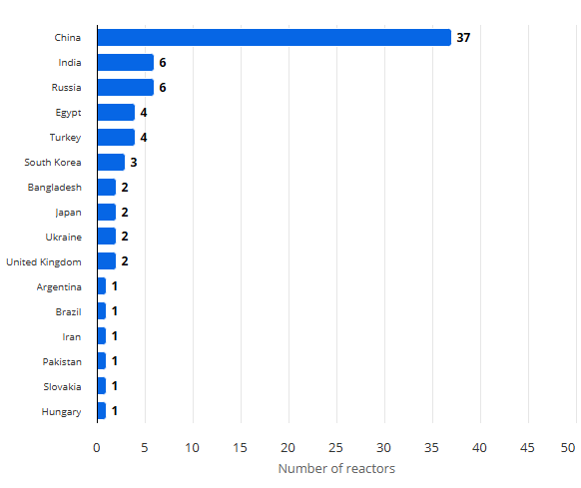
While the supply of uranium is reducing, demand is set to increase – a typical mining capital cycle. This is usually resolved by higher commodity prices, which incentivise miners to build mines again.
Shares in Yellow Cake have done well over the past 5 years:
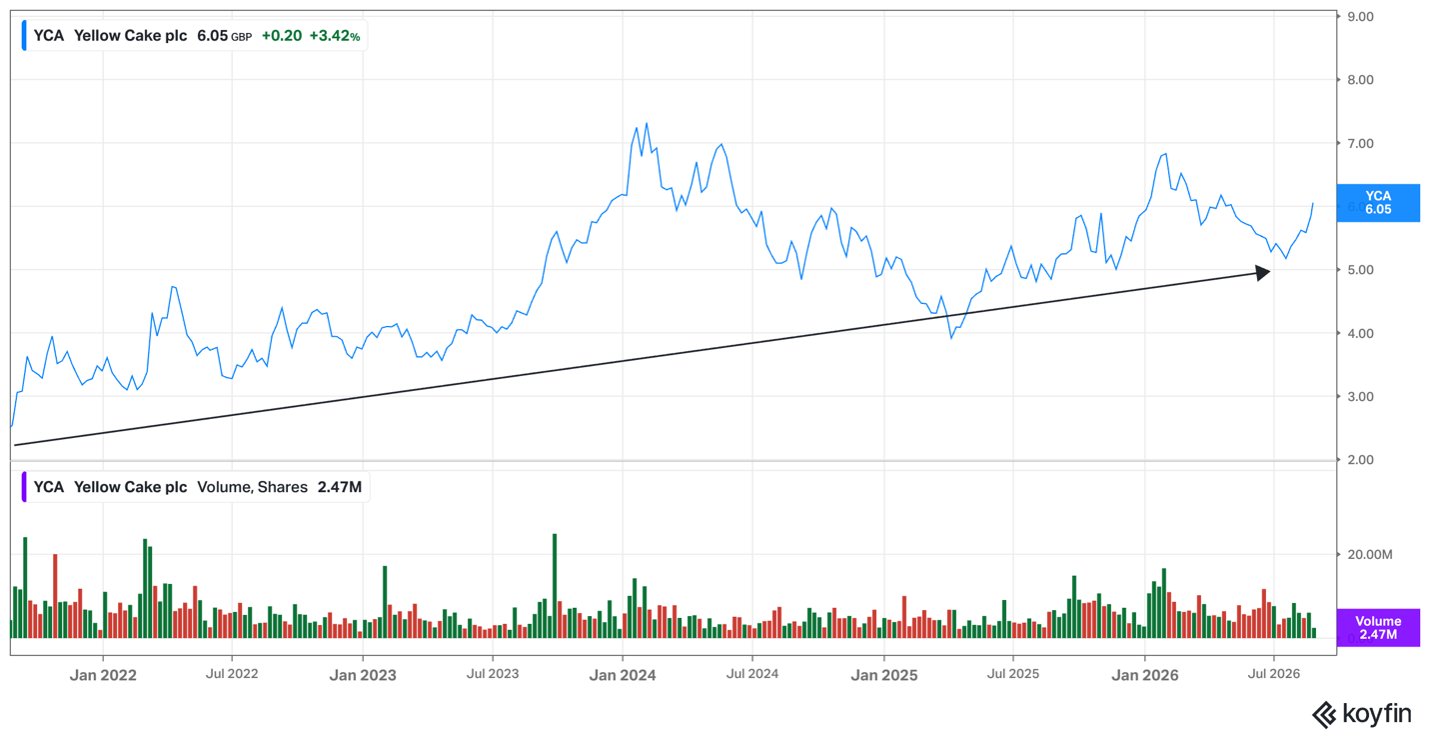
However, there is a problem: Uranium is not a typical hard asset, whose value is primarily determined by scarcity. Uranium is abundant in the Earth’s crust. So it’s not an anti-fragile, or even robust, hard asset. But the time to sell it is not now. Yellow Cake is trading at a wider-than-average discount to its NAV, and the capital cycle is positive.
My take: Owning uranium in the fund’s hard-asset allocation is a mistake. But for now, a case can be made to continue holding it, given the state of the market and the discount at which it trades.
2. Show me the money
Lewis Group is one of the top holdings of the Merchant West Value fund. It has a few things going for it:
- It has a strong, conservative management team that focuses on the business, not the stock market.
- It sticks to its knitting – no “di-worsification” here.
- It’s a relatively small company with a market value of less than R5bn, which means most investors ignore it and don’t try to understand its business model.
- It pays regular, generous dividends, which, among other things, keep in check management’s capital-allocation ambitions. Ambitions that, in many companies, serve management more than shareholders.
The following two charts illustrate this point well.
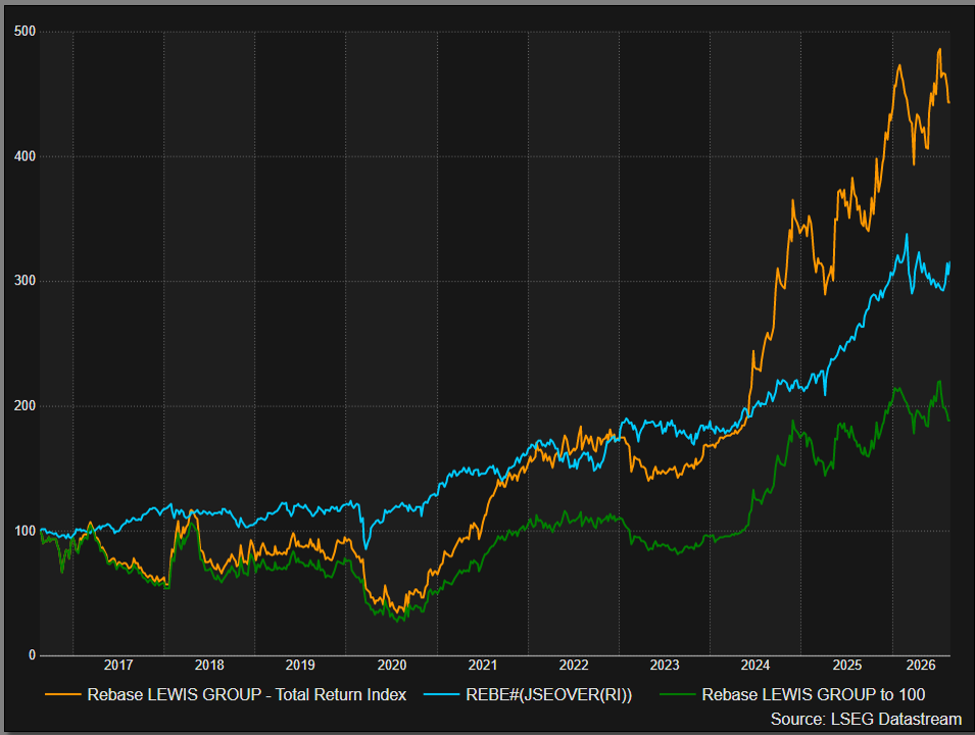
First, we have the share price of Lewis in green, which has underperformed the JSE All Share Index (total return, i.e. including dividends) in blue over the past 10 years. But if we add in Lewis’ dividends, its total return line, in orange, handily outperforms the overall market. Unfortunately, due to its small size, very few fund managers own it, so South African savers have not benefited from this outstanding performance:
The next chart is for the market darling, Naspers. Its share price, in orange, has underperformed the market, in blue. Instead of paying dividends, it has spent the last 10 years on a series of corporate acrobatics, none of which has benefited shareholders – as the chart shows:
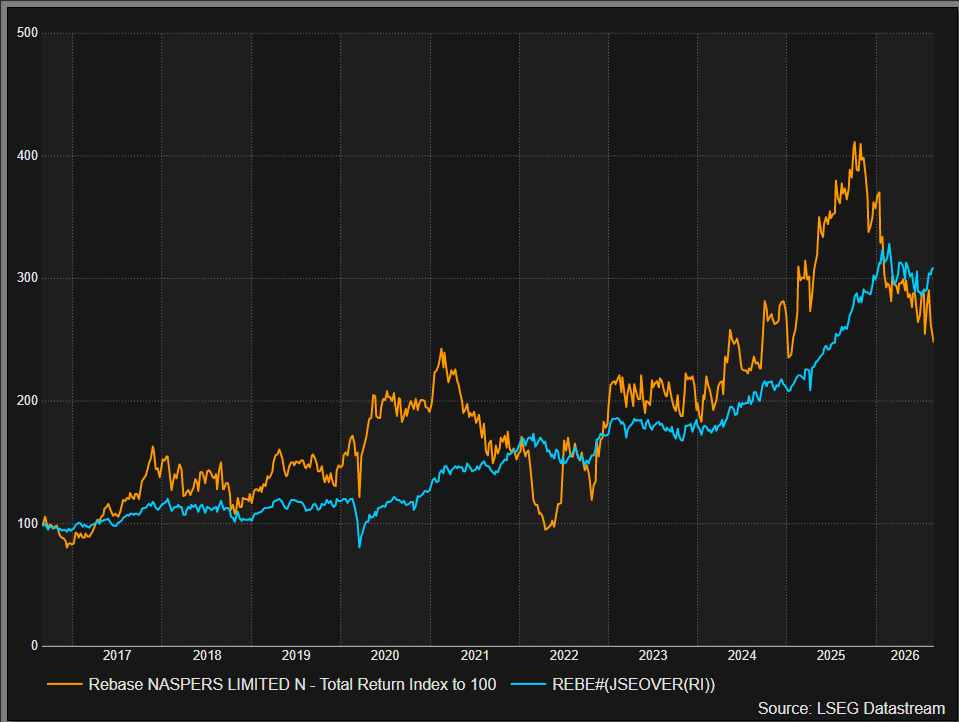
Unlike Lewis, Naspers is a big company, widely held by the fund management industry. So, South African savers have suffered from its self-serving management team.
My take: A sustainable dividend policy often distinguishes genuine value creators from corporate opportunists. Lewis and Naspers illustrate this point beautifully.
3. A cure for pain
One of my working models for investing is called “the inverse bright shiny thing”. It holds that when everyone’s attention is focused on one area, the best investment opportunities invariably lie elsewhere.
The theory is based on the madness of crowds, a danger we readily recognise in real life. In markets, however – for what I can only think are evolutionary reasons – we associate crowds with safety. A safe space that eventually becomes a culling pen.
Investing is an activity that demands – and rewards – individual thinking, single-point responsibility and sometimes going out on a limb. The successful investor is like Groucho Marx, who said, “I don’t want to belong to any club that will accept me as a member.”
The club that everyone wants to belong to today has a bright, shiny centrepiece: AI, and everything that goes along with it – chips, data centres and hype.
On the other hand, there are some deserted clubhouses around today; clubs where no one wants to go because no one else is there. In other words, potentially attractive investment opportunities, according to my “inverse bright shiny thing theory”.
One of those is the healthcare sector. I wrote about it in Vol 4 No 23, where I said, “Wouldn’t it be funny if, by the time analysts had put in all the hours to differentiate between DRAM, HBM, and NAND flash, and had figured out exactly how capital-intensive and cyclical these businesses are, something as mundane and defensive as healthcare stocks started outperforming?”
Right on cue, Moderna and Merck issue a press release announcing that their cancer treatment slowed the return of melanoma and its spread to other parts of the body.
The Moderna share price jumped over 100%, adding $30bn to its market value. A good rule of thumb in biotech is that companies are valued at about five times revenue. Barclays estimated that sales of melanoma treatments might reach $3 billion by 2035. That means this drug might be worth $15 billion if the investment bank is right. Moderna, however, must split profits equally with Merck under their collaboration agreement. Furthermore, it will take years to reach this level of revenue from the drug, which is still in the early stages of development.
Despite this apparent overreaction, the Moderna share price remains well below the Covid-induced levels, when it was the bright shiny thing itself:
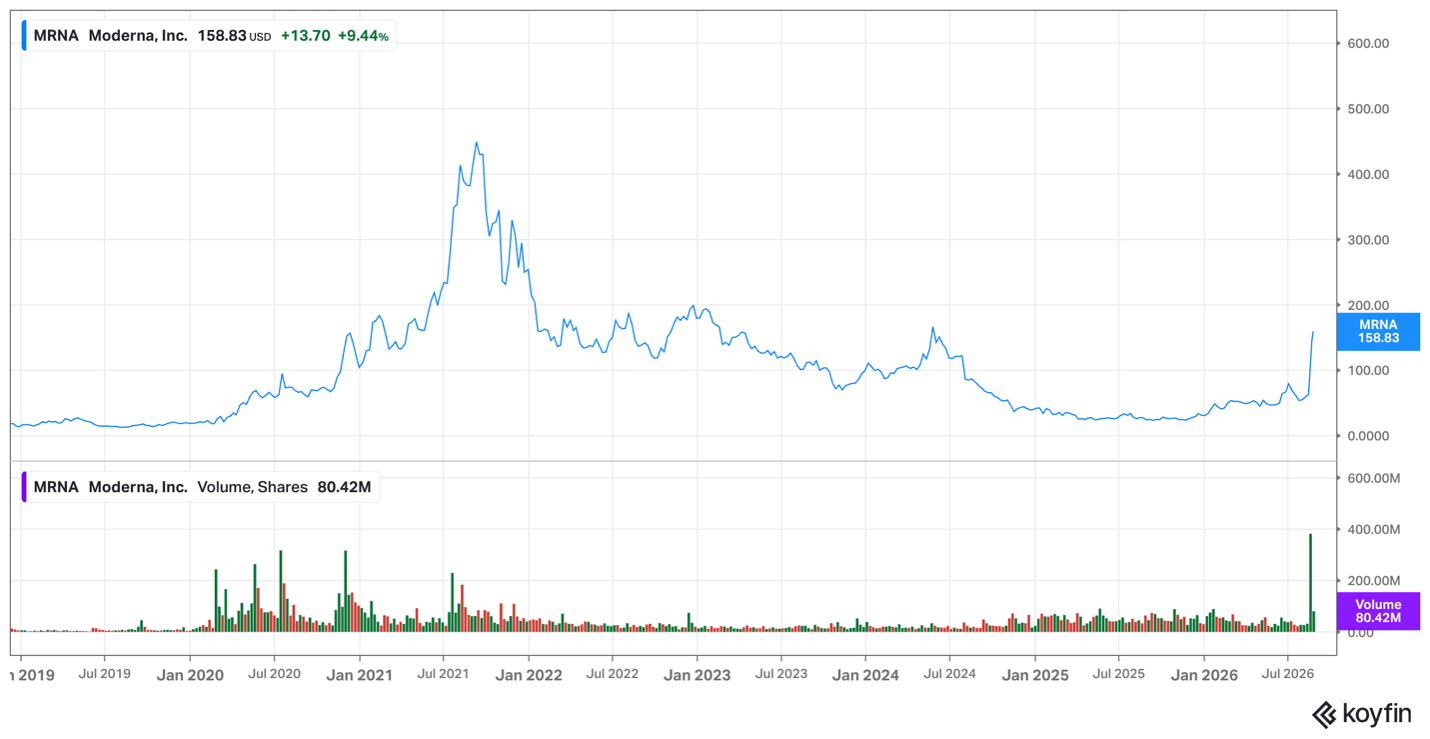
One of two things could be true here – investors could be expecting much more good news from Moderna, or the strong price reaction could indicate how underweight investors are in this sector.
Now that the whole healthcare sector has started to perform well, things could get interesting going forward.
Of course, we know that “new highs are bullish”:
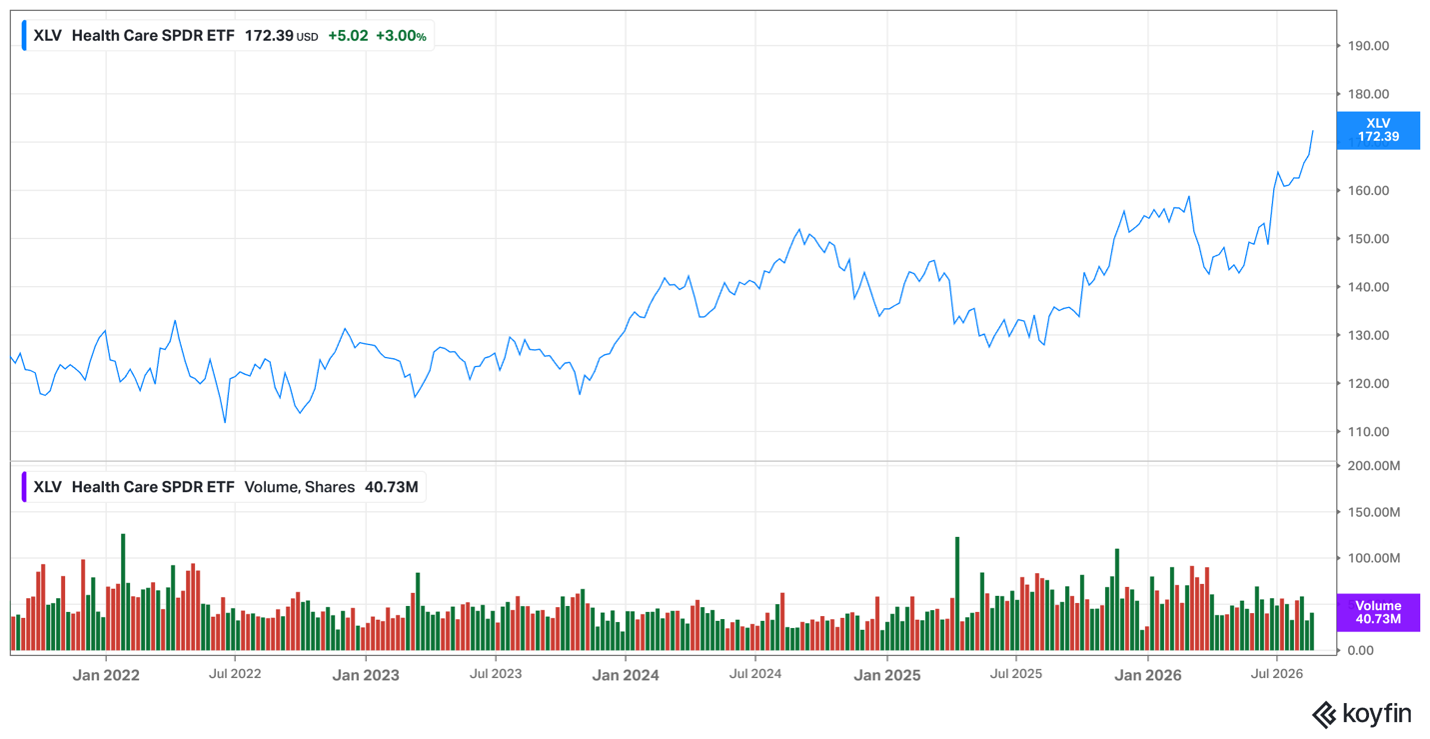
Today, the healthcare sector accounts for only 9% of the US stock market. 20 years ago, it was 15%. For me, the question is what value society places on drugs that can beat cancer, Alzheimer’s, etc. I would argue that capitalising this potential at only 9% of total market value is far too low.
My take: If I were a global stock picker, which, thankfully, I’m not, I would be devoting a lot of my attention here.
4. AI Brain is a real thing
Back in 2001, we used to talk about Covid-brain, a type of brain fog characterised by cloudy thinking and difficulty on paying attention. Then I read this in the FT, and it struck a chord:
“Or maybe there’s a generation of entrepreneurs who’ve caught AI brain. Chatbots are the C-suite’s ultimate yes-men — able to buttress egos by condensing information their users don’t care to fully understand while avoiding questions they don’t want to consider. They’ll never say the plan is dumb.”
What applies to the C-Suite also applies to the investment world. If someone gives me another AI regurgitation dressed up as an original piece of research, I think I’ll throw up.
To outperform, you need to be different, to have a distinct perspective. AI simply regurgitates the hive mind. There is little colour, no variation. Bland ideas for meh portfolios. Indexing will beat it hands down, and maybe even some active managers.
As Ed Zitron so pointedly says, “LLMs can help with lots of small things, but get worse as they try to do real things, and do not need to speak like people. They do not need to be in anything near healthcare, finance, mental health, or, really, people. The anthropomorphism and overpromising about these technologies have suffocated and obfuscated what they can actually do in pursuit of endless growth, and the only reason they can do anything is that OpenAI and Anthropic were allowed to annihilate hundreds of billions of dollars on training, along with very real harms and systemic risks that have emerged as a result.”
He goes on to say, “I’ll concede we’re past the point when “nobody uses these things,” as they have now been pushed non-consensually upon every worker and organisation at scale, predominantly by Business Idiots who demand that workers “do enough AI” because saying “I do AI” is a virtue signal to a certain kind of scumbag.”
My take: Mr Zitron is stretching to make his point, but he is directionally correct. My experience has been similar. But maybe that’s just because I’m part of the permanent underclass and don’t use enough of these stupid tokens. I think AI is dumbing down society – which will create huge opportunity for original thinkers. Especially when it comes to things like writing about investment ideas – and actually investing. Writing is thinking, and the effort you put into it matters.
In The Cockroach
The fund* has seen some inflows over the past few weeks, so I have taken the opportunity to deploy some of that cash into existing assets in order to maintain their weight. Otherwise, there have been no trades.
The big news is that we have received approval to launch a mirror fund to the MWI Worldwide Flexible fund in Mauritius. The fund is called the RECM Worldwide Flexible Fund and shares the nickname “The Cockroach” with its local counterpart. The Mauritian fund targets offshore investors and is US$-denominated, while the local fund targets local investors and is Rand-denominated. Aside from their jurisdiction and pricing currency, both funds hold the same assets. So, when I talk about “The Cockroach,” I mean both funds.
If you want to know more about how “The Cockroach” is managed, you can read about it here and here.
Let me know if you want to invest in either fund.
* I manage the fund on behalf of Merchant West Investments (Pty) Ltd (FSP 44508)
In The Media
1. The best music of 2004
In 2004, I was still in start-up mode with RECM, working far too hard at the expense of my health and personal life. With the benefit of hindsight, I’m not always sure the trade-offs were worth it. At least I was able to pay myself a salary for the first time towards the end of the year.
Before starting the business, I had sold almost everything I owned. To ensure I could pay my colleagues, I lived off the proceeds of those sales, which obviously wouldn’t last forever. So, our first months of positive cash flow came as a relief.
As it happens, I wasn’t the only person starting a business at that time. A guy called Zuckerberg, (Mark, I think) started “The Facebook” in 2004, and Google launched Gmail. It’s safe to say RECM hasn’t done as well as those two. But the music of 2004 will always remind me of long days and nights spent working with some great people and laughing at stupid ideas like “The Facebook”.
The music? Kings of Leon’s gritty Aha Shake Heartbreak was a highlight, as was Wilco’s A Ghost is Born. Nick Cave shot the lights out with his double album Abattoir Blues/The Lyre of Orpheus, while Regina Spektor’s quirky Soviet Kitsch had more than its fair share of interesting moments.
But the album of the year – for me – was Arno Carstens’ Another Universe. It’s the album that brings those early days of building RECM to life most.
Here are the ten best albums, on Apple Music and on Spotify.
As for the songs, this year’s selection was broader than it was deep. For me, there were few classics or bangers, but plenty of interesting songs. The first 8 songs on this list will give you an idea of what I mean.
Here are my pick of the top 20 songs, ranked from 20 to 1. On Apple Music and on Spotify.
Also, the long list of good songs, only on Apple Music.
I hope you find something that brings you joy in these lists!
2. Book Review: How Not to Invest, by Barry Ritholtz (2025)
Investing is famously a loser’s game. In his classic book on investing, Winning the Loser’s Game, Charles Ellis argued that modern stock markets are too smart for anyone to beat consistently. Instead of trying to win by being brilliant, you win by making fewer mistakes.
Ritholtz tells you exactly how to do that. He ticks off the common errors we all fall prey to: ignoring taxes, paying excessive fees, misinterpreting data, overreacting to short-term trends, and trading too much. One way investors fail, writes Ritholtz, is by not understanding that your chances of outperforming worsen as you add more layers. From picking stocks to picking funds to employing fund of funds, you move up the fee curve and down the performance curve.
The late Charlie Munger liked to advise investors to “invert, always invert.” The best way to work out how you can succeed, Mr Munger argued, was to work out how other people have failed. Ritholtz lists examples of failure that investors should internalise to avoid making the same mistakes. He classifies them into three categories:
- Bad ideas, i.e. mistaking randomness for skill, investing based on the news, investing based on forecasts, etc.
- Bad Numbers, i.e. denominator blindness, survivorship bias, and not understanding the power of compounding, etc.
- Bad behaviour, i.e. failing to plan, misunderstanding your own needs, trusting the wrong people, etc.
Ritholtz reels off the mistakes and gives practical examples of each. In the foreword, Morgan Housel says, “What I love about Barry’s work is that he views investing as a game of emotions and behaviour, rather than one driven by intelligence and data.” Controlling your behaviour and emotions is the secret to winning the losers’ game. Ritholtz’s book is a useful compendium of what not to do.
I would recommend this book to everyone interested in investing. More experienced investors can skim some of the examples, making the book a quick read. Inexperienced investors will find the examples illuminating.
That’s it for this week.
Remember to be careful out there. As the Springboks showed last week, sometimes even when you think you’re on top, you’re just below someone else.
Piet Viljoen
RECM
27 August 2026