
Dear Fellow Investors and Friends,
Welcome to my newsletter, where I share my efforts to understand markets and the world around me.
I do appreciate you taking the time to read this. I love getting feedback; feel free to drop me a line. It’s great to start conversations.
Today is Thursday, September 17th, the 260th day of the year. There are 105 days left in the year. It is also the birthday of Ken Kesey, the author of One Flew Over the Cuckoo’s Nest. I saw the film adaptation when I was 13, and it’s one of those films that left an indelible mark on me. It starred Jack Nicholson at his best as an inmate in a psychiatric ward. The film is a powerful allegory against conformity and the crushing power of oppressive authority, and it questions who the truly “crazy” people are – the free-spirited patients or the cold system controlling them.
When it comes to investing, you can’t outperform by conforming. You have to do something very different, which is hard thanks to the “risk committees” and gatekeepers in the industry whose job is to make sure everyone does roughly the same thing.
One of the most intriguing contradictions in financial markets is that Warren Buffett, the guy who tells active managers to give it up, can fill an indoor stadium with 50,000 of them who are there to hear him say it. And for a long time, I was one of them, listening and disagreeing simultaneously.
But over the past few years, I have changed my mind. As a result, I’m now in the Buffett camp – I think that most investors should index.
Why? One word: evidence.
In South Africa, for the 10 years ending July 2026, only 5 out of 100 active equity funds outperformed the All-Share Index. This is not unique to South Africa – the same is happening in the USA. Morningstar’s US Active/Passive Barometer found that, over the 10 years through 2025, only 3.6% of US large-growth active funds and only 8.1% of US large-blend active funds survived and beat the index.
The worse news is that even if you find a fund manager who outperforms, it will likely stop soon. Reversion to the mean never sleeps. The reason is not bad luck, or even worse, bad investment management, but size. Successful, outperforming funds get big. And the bigger you get, the harder an already difficult job becomes.
Here are charts of two of the most famous funds.
- On the left, Peter Lynch’s Fidelity Magellan fund returned 29% p.a. from 1977 to 1990, making it one of the best active management runs in fund management history. It has underperformed ever since.
- On the right, Bill Miller’s Legg Mason Value fund outperformed the S&P 500 for 15 consecutive years from 1991 to 2005, then gave back all that outperformance in the next 10 years.
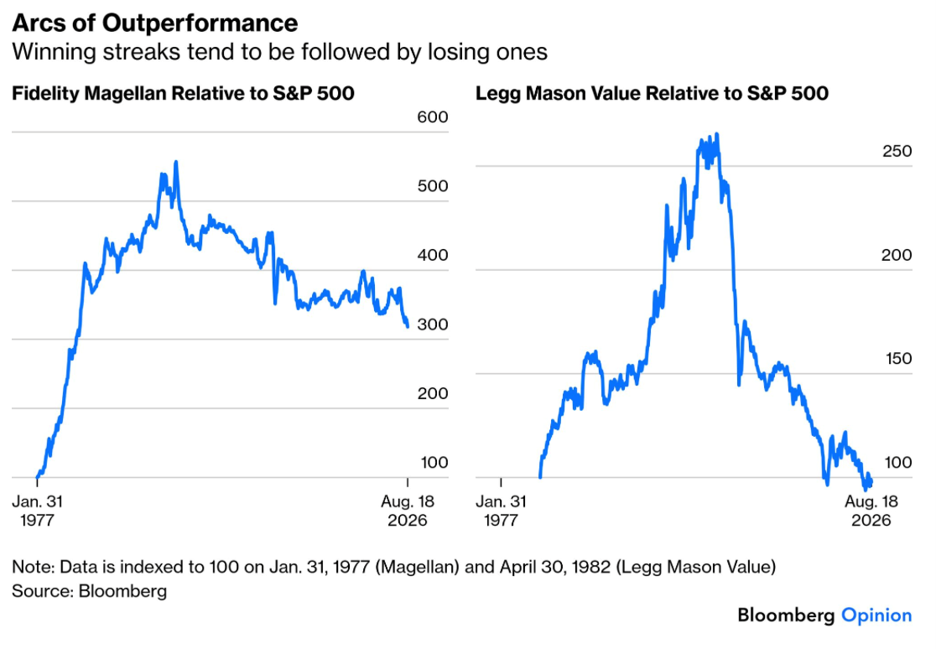
It’s no coincidence these funds started underperforming when they were popular and at their peak. These are just two examples, but this happens to almost every fund out there. For instance, locally, you can ask Allan Gray’s clients how the firm’s size is working out for them.
I don’t have numbers to back it up, but most “stock-picking” individual investors perform even worse. It’s just that they don’t measure themselves properly, so they don’t realise it. A layperson who spends only a small portion of their time on the problem has only a small chance of beating highly incentivised professionals subject to a system of radical Darwinian selection. That chance is indistinguishable from luck.
But we’re all above-average drivers, aren’t we?
Joel Greenblatt, a renowned hedge fund manager, explained why both professionals and lay investors underperform. He put a jar of 1,776 jellybeans in front of a room full of people at Google (i.e. not stupid people) and asked them to guess how many jellybeans were in the jar.
In the first round, everyone wrote their guess in silence. No discussion, exchange of views or any other form of communication was allowed.
In the second round, the same group could justify their guesses out loud and change them after hearing others’ views.
Then, he revealed the results. In round one, the average guess was 1771 – almost a perfect guess. In round two, the average estimate dropped to 850 – way off.
Round one is the index.
Round two is the stock market.
Everyone knows what they know from the news, what the people around them are saying, what research the AI agent has done for them, and what they have seen in the stockbroking reports. The cold, independent, information-less guess of round one was far better. To paraphrase Blaise Pascal, all fund management’s problems stem from their inability to sit quietly in a room alone.
But before you burn me at the stake for heresy, let me be clear: I am not an absolutist about much in life, and definitely not on the subject of active vs passive investment. There is a place for active management – it’s just much smaller than the marketing material from the fund and wealth management industry would have you believe.
My mental model is simple: neglect determines where active management can work. The more liquid, researched, benchmarked, and institutionally traded a market becomes, the harder it is for active managers to earn excess returns, especially after fees. The opposite is true in smaller, less liquid, less intermediated markets.
Investing is a simple problem. What you want to do is buy something for less than the present value of its cash flows. But the market is super smart and generally figures these things out collectively (the wisdom of crowds) much better than we can individually, like the jar of jellybeans example. But sometimes diversity breaks down, and crowds go mad and start doing ridiculous things. That’s where opportunity lies for active management.
Before you start stock picking, answer these questions honestly:
- Are you comfortable making decisions in isolation?
- Are you beholden to some group or committee?
- Do you care what other people think about you?
- Can you insulate yourself from your own emotions when it comes to the market? Have you stopped reading/watching the news or interacting on social media?
- Is there any proof of inefficiency – neglect, disgust, illiquidity, forced selling, regulatory dysfunction – in the market you choose to be active in?
Even more importantly, is your favourite fund manager in a position to do so?
In The Markets
1. You are what you eat
Back in 2015, private equity firm 3G and Warren Buffett sparked widespread excitement in markets when they merged Heinz and Kraft, then applied the 3G playbook: cut costs, underinvest in the brands, and price aggressively. They assumed brands such as Heinz Ketchup and Philadelphia Cream Cheese would carry them through.
For a decade, the company lost market share, and the stock was crushed:
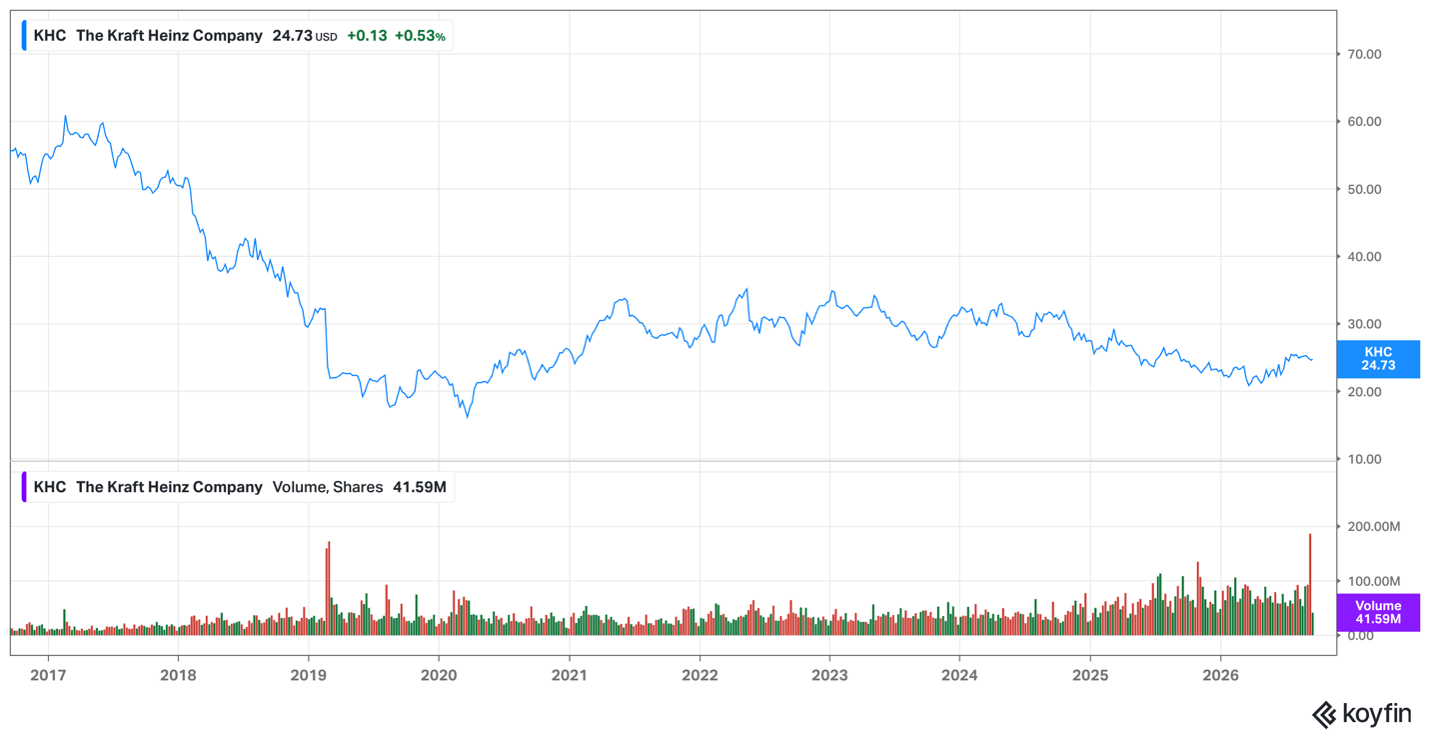
Mr Buffett’s investment strategy has always been to “… purchase, at a rational price, a part interest in an easily understandable business whose earnings are virtually certain to be materially higher five, ten and twenty years from now.” However, KraftHeinz (KHC) brands were weaker than expected, and a black swan in the form of GLP-1 drugs emerged, further undermining the business’s long-term attractiveness.
At one point, management argued that the combined company was too complex, insufficiently focused, and unable to allocate resources effectively. The same scale that had once been presented as an advantage apparently had become an impediment. A demerger was considered to simplify the business and separate weaker brands from stronger ones. Berkshire criticised the initiative.
It’s unclear how the new CEO, Steve Cahillane, was appointed, but he killed the planned breakup and is investing in the brands for the first time in years. Although demand remains weak, KHC could conceivably return to the $3 per-share earnings it achieved in 2018. At today’s price of $25, that is not a demanding multiple.
My take: only 1 out of 22 sell-side analysts call it a buy, and the 6% dividend yield pays you to wait for these analysts to change their mind. It’s the kind of setup contrarians dream about – and AI ignores.
2. Famous last words
Oracle is a big hyperscaler – it’s number 4, behind Amazon Web Services (AWS), Microsoft Azure, and Google Cloud. To refresh, a hyperscaler is a company that runs computing infrastructure (data centres) at enormous, global scale.
As such, Oracle is one of the players providing major plumbing for the AI revolution. For those of you who were around at the turn of the century, an analogy is the telecoms companies that built the fibre networks the Internet runs on. Think Global Crossing, Level 3 Communications and Qwest. And Cisco, which made the switches that connected everything.
It’s instructive to read up on these companies’ history. TL;DR? It’s not pretty.
Be that as it may, Oracle has been in the news:
On 9 July 2026, Standard & Poor’s downgraded Oracle Corporation’s debt to one rung above junk, on “rising business risk and weaker cash flow”.
AND
“On September 10, 2026, Oracle Corporation reported first-quarter fiscal 2027 results that beat Wall Street estimates on both revenue and earnings. Revenue rose 30% to $19.3 billion, above the $19.14 billion analysts expected, and non-GAAP earnings per share came in at $1.92 versus a $1.74 estimate. Cloud revenue jumped 62% to $11.6 billion, with cloud infrastructure growing 121%.”
AND
On September 14, this email reportedly went out to many of Oracle’s employees: “After careful consideration of Oracle’s current business needs, we have made the decision to eliminate your role as part of a broader organisational change; as a result, today is your last working day.”
Not everything seems to be coming up roses in the Oracle garden.
To understand what’s going on, a key sentence in Oracle’s earnings report is worth unpacking. The sentence reads: “Oracle booked more than $30 billion in new AI cloud contracts during the quarter, pushing remaining performance obligations to $664 billion.”
In English, this means Oracle still must build data centres worth almost $700 billion for customers who have signed up to use the compute they contain. To put this sizeable commitment in perspective, Oracle generates around $70 billion in revenue per annum and $20 billion in operating profit.
What the report didn’t say is even more important: a single customer, OpenAI, accounts for roughly half of the $664 billion backlog. OpenAI is a loss-making entity, dependent on the kindness of strangers (i.e., equity funding), and is vulnerable to Chinese competition or a pullback in compute demand, both of which are real threats.
The share price seems to reflect these worries, and ignores the earnings report’s attempt at a positive spin:
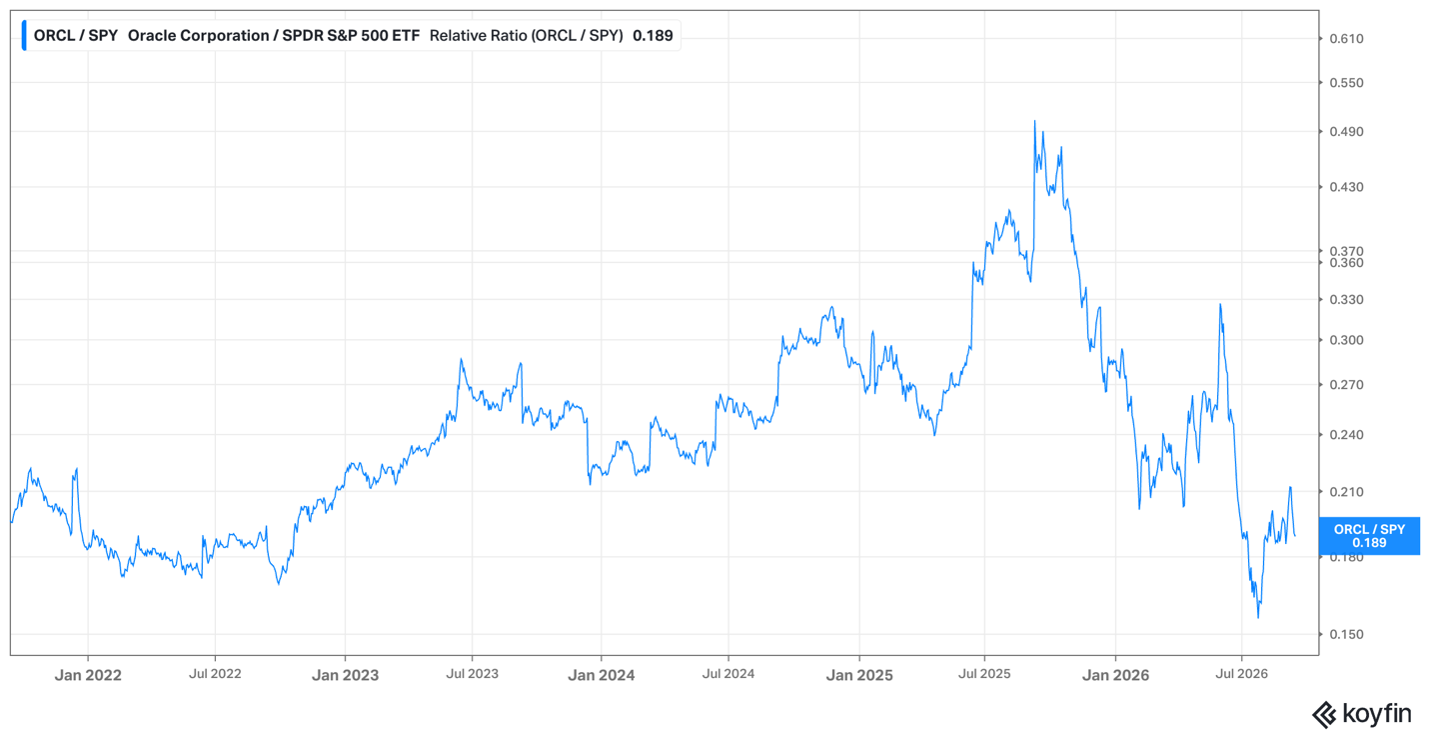
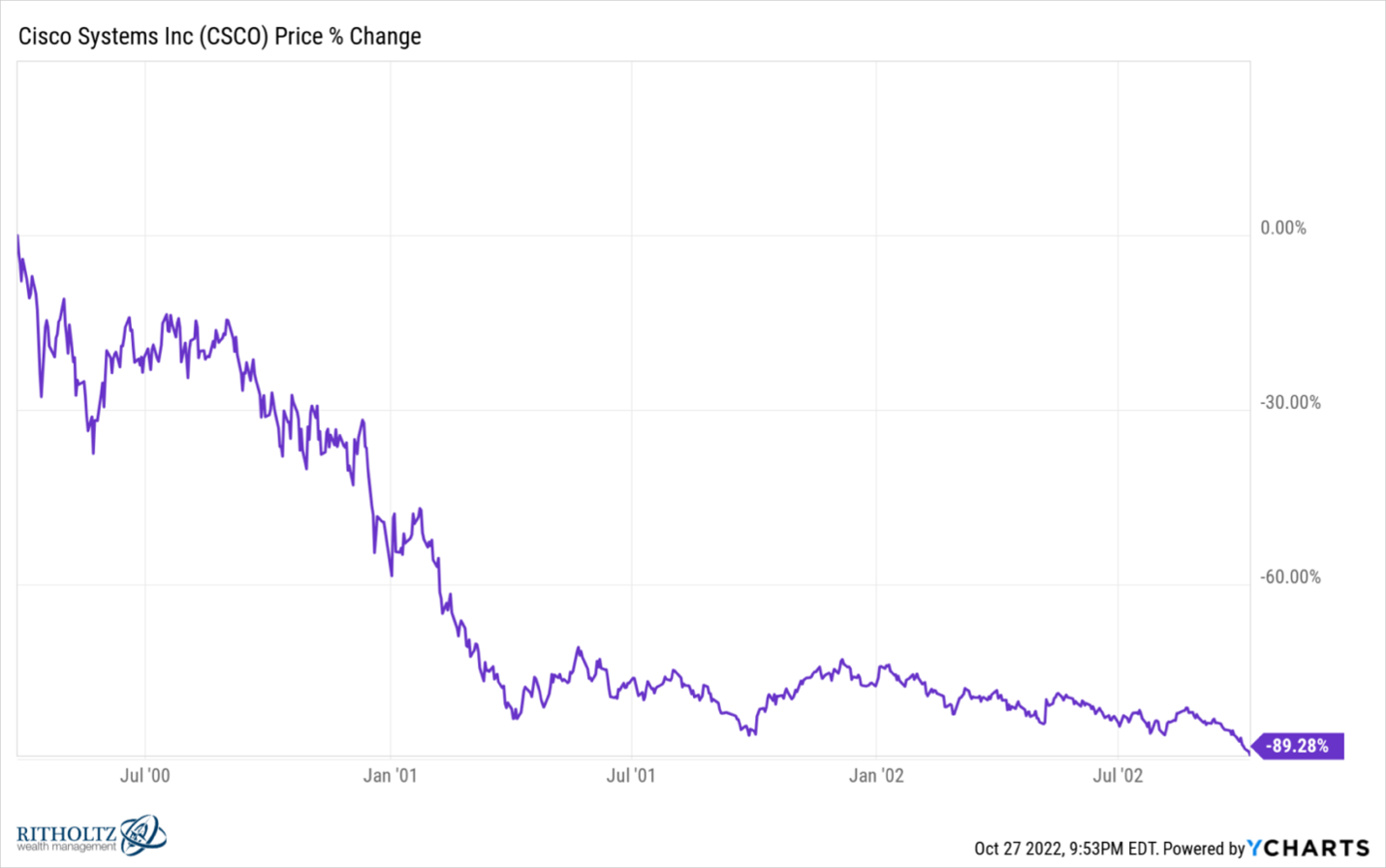
Larry Ellison (Oracle’s CEO) has outlined a highly aggressive, hyper-growth trajectory for Oracle and cites the backlog as proof. Bondholders are much more sensitive to risk than shareholders, so they tend to spot trouble first. Maybe they are hearing echoes of John Chambers, CEO of internet infrastructure firm Cisco, from the cover of Fortune Magazine in May of 2000, when he was quoted as saying: “there is growth as far the eye can see”.
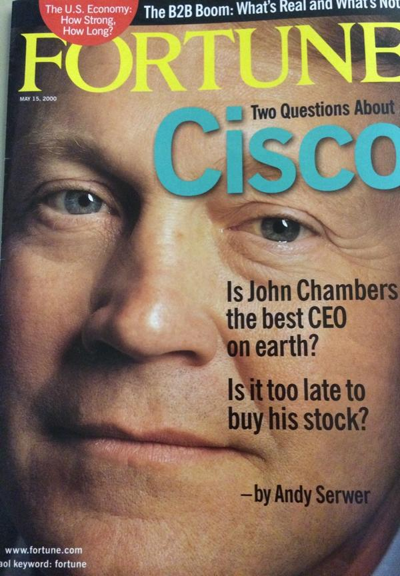
Here’s the Cisco share price following the article – down by 90%:
Dan Rasmussen of Verdad Capital hits the nail squarely on the head:
“Technology development and adoption follow surprising paths. Confident predictions, whether in economics, technology or even science, quite often fail to come true. We see through a glass dimly. The world is too complex and the future too uncertain. It is precisely that complexity and uncertainty that may confound the high-modernist attempt to predict where AI is taking us – and burn investors caught in the same overconfident, model-driven vision of how the future will unfold.”
My take: In every previous infrastructure boom, the losers were those who built the infrastructure, and the winners were those who developed products that could run on the rails of that infrastructure. Oracle is a member of the former club.
3. The Bond market knows, part one
CoreWeave is a closely followed stock because it serves as a major bellwether for artificial intelligence infrastructure spending. It has a simple business model: it buys GPUs (graphics processing units, i.e., chips) from Nvidia and rents them to major tech giants and AI developers, such as Microsoft, Meta, Oracle, and OpenAI for use in their data centres.
Nvidia has long backed CoreWeave and recently invested an additional $2 billion in CoreWeave stock, making it the second-largest shareholder. It bought the equity to fund CoreWeave buying more chips directly from Nvidia. Most Wall Street analysts rate it a buy, so you can’t fault Nvidia, can you?
But the bond market, smelling a rat, sees it differently.
Three months ago, CoreWeave issued senior unsecured 9.625% notes due 2032, at a spread of 5% above risk-free Treasury yields. Last week, the spread approached 10%, a threshold that typically indicates corporate distress.
Equity investors seem to be blissfully ignorant:
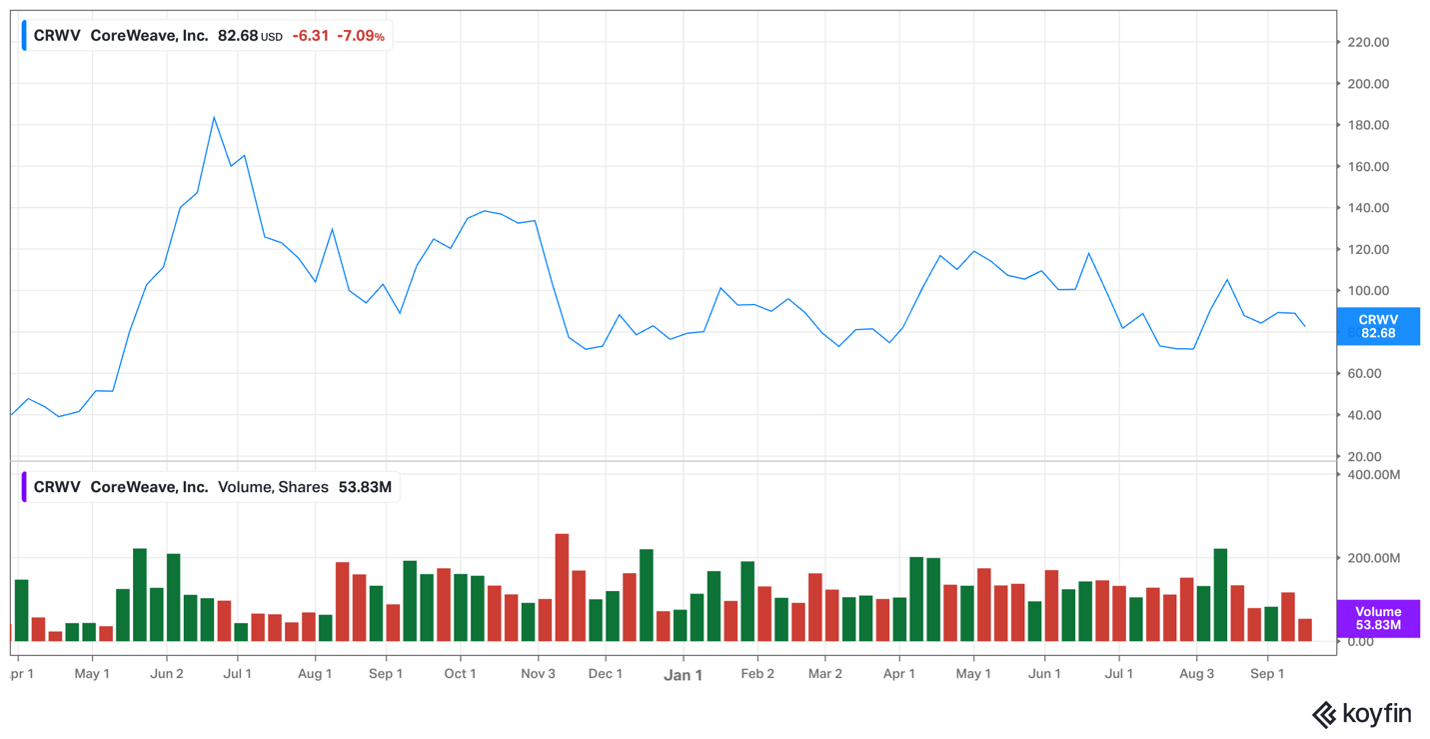
My take: The bond market is smart. It knows a Ponzi when it sees one.
4. I Am the House (or, the bond market knows, part two)
“I am the house” was a statement made by the US Treasury Secretary (i.e. their finance minister) when defending his actions in the bond market. It probably stems from the common saying amongst gamblers, “never bet against the house”.
Bessent is a former hedge fund manager who worked with George Soros when they sank the British pound in 1992. So, he should have a strong sense of who the patsy is in the casino.
In my view, the bond market is “the house”, and even the US finance minister will have problems going against it. In the week after he said this, US bond yields have shot up and breached the psychological 5% level, last seen before the GFC in 2008:
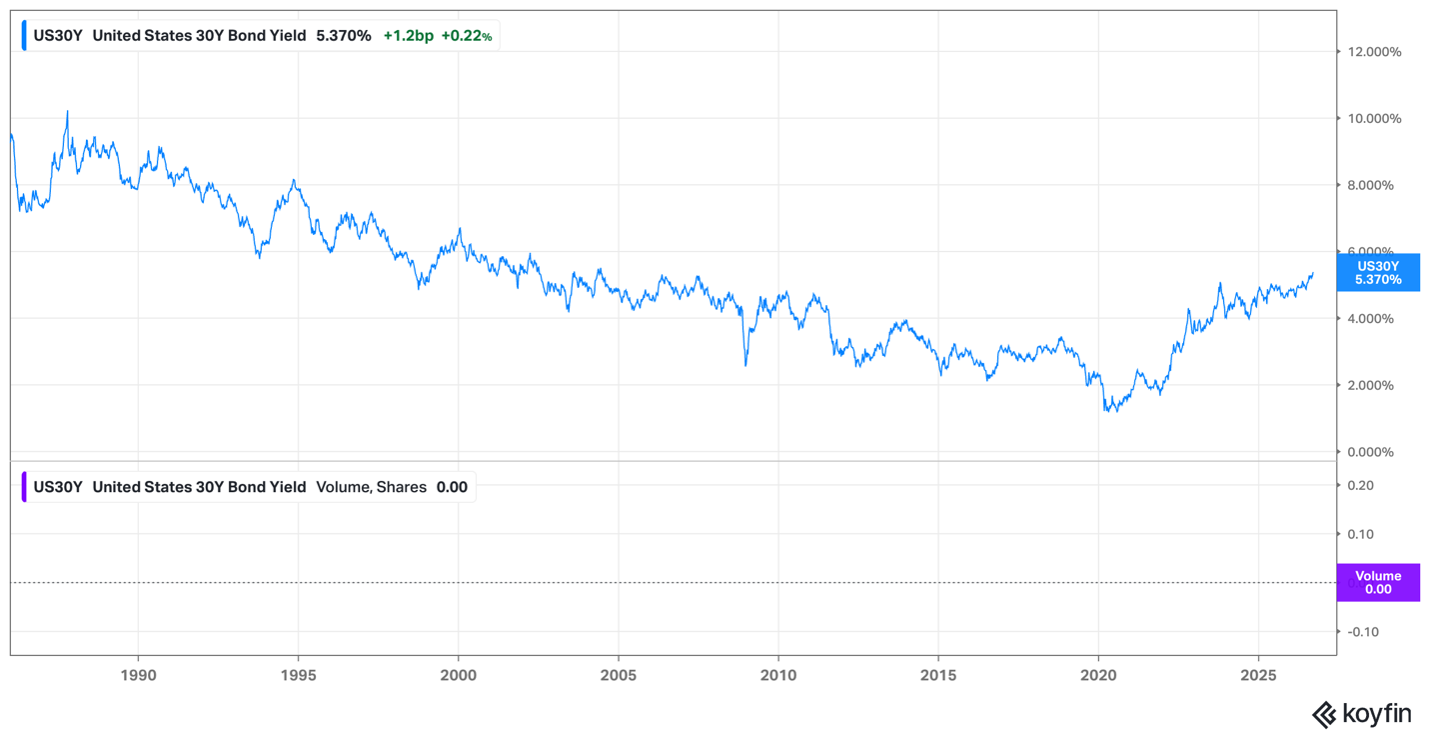
So much for “I am the house”.
I think it’s fair to say the long-term bond bull market in the USA is over. As Lou Reed said, “Stick a fork in its ass and turn it over. It’s done.”
It’s not only in the USA; most developed bond markets are struggling, with Switzerland an exception:
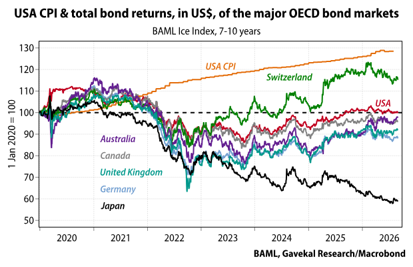
Meanwhile, in Emerging Market Land, bond markets are doing just fine, thank you very much:
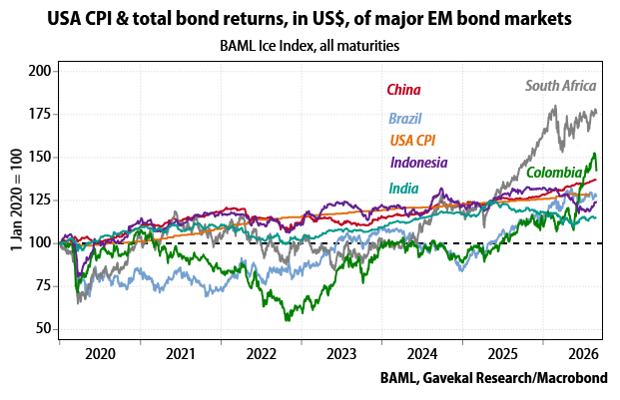
My take: In a world in which policy settings across the Western world reflect profligate fiscal policies and behind-the-curve monetary policies, coupled with diplomacy that favours wars and conflict over peace and compromise, where should investors look to allocate their fixed-income dollars? Two words – emerging markets. Only 5% of the Cockroach is allocated to developed market bonds (the iShares Japanese Government Bond ETF, 2561). But it has 10% in direct SA government bonds and 10% in the VanEck/JP Morgan Local Currency EM bond ETF (EMLC).
In The Cockroach
No trades this week.
I’ve received the first few inflows into the Mauritius-based Cockroach fund (The RECM Worldwide Flexible Fund). Mostly my family’s money, but it’s still nice to see the vote of confidence from other investors. I’ll probably make the first trades in the fund at the start of next week. For now, everything is still in cash.
For now, this is what the cash position in the local Cockroach (the MWI Worldwide Flexible Fund) looks like.
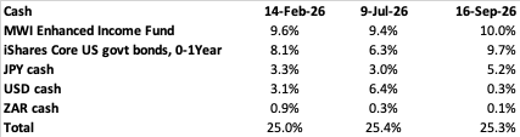
I’ve used some of the US dollar cash to buy a bit more yen, and moved some into the short-term US government bond ETF, which has the duration of a money market asset. I’m happy with the exposure as it stands today – it’s a nice mix of an undervalued currency (the yen), a high-yielding currency (the rand) and some US dollar cash yielding 4% – well above US inflation.
As always, money market assets (cash) make up 25% of the fund.
Someone asked me last week whether I would reduce the cash holding in favour of riskier assets such as equities if a crash left equities offering much better value. The answer is no.
If equity markets crashed by, say, 30%, the fund’s equity holding would fall to around 15%, and cash would rise to around 35%, purely because of market movements. I would then use the 10% excess cash to buy back the equity portion to 25%, taking advantage of the better value on offer.
That is how the cash position acts as an automatic stabiliser in the fund.
* I manage the fund on behalf of Merchant West Investments (Pty) Ltd (FSP 44508)
In The Media
1. In praise of idleness
Bertrand Russell’s 1932 essay, In Praise of Idleness, was published nearly a century ago. It should be required reading today.
Russell’s ideas still seem highly relevant: we’ve never had more tools designed to save us time, but what to do with that extra time?
Surely the answer can’t simply be to build more tools to become even more productive. With AI seemingly able to produce tools for us with ease, I find myself thinking increasingly about this.
You can read his essay here; maybe that will get you thinking about this issue, too. If nothing else, it’s a joy to read Russell’s writing.
2. The Gym Bros were right
I have been on an exercise mission since I turned 40, simply because I was determined to avoid that fate of my father, who died in his forties. Today, exercise is generally accepted as positively correlated not only with longevity (quantity of life) but, importantly, also with health (quality of life).
If you really want to be a long-term investor, you can either rely on your genes, like Warren Buffett, or on exercise. Given my family history, I chose that option.
Now, it turns out, research has shown that stronger muscles can help fight depression. So, the gym bros were right: their view that modern society probably listens too much to depressed doomers or mentally ill socialists who believe “fitness is fascism” has now been substantiated.
Adam Singer has written a great article on this topic, which you can read here.
3. “Buy to Let” – the reality
Buying property to rent out is, in my opinion, one of the worst things you can do with your money. Dealing with inevitable maintenance, recalcitrant tenants, municipal taxes and levies, and greedy letting agents is a nightmare at best. If you actually made money by doing this, it might be worthwhile. But the yield on property is low, even before you consider the costs associated with owning a property.
In any case, here is a thread on X from a guy who bought a few properties to rent out. I am sure his sad tale is shared by many other property “investors”, even if they will never admit it or do the sums properly.
Read this before you ever start thinking about “investing” in property.
That’s all for this week.
Remember to be careful out there.
Piet Viljoen
RECM
17 September 2026