
Dear Fellow Investors and Friends,
Welcome to my newsletter, where I share my efforts to understand markets and the world around me.
I do appreciate you taking the time to read this. I love getting feedback; feel free to drop me a line. It’s great to start conversations.
Today is Thursday, October 29th, the 302nd day of the year. There are 63 days left in the year. On Sunday, I turn 64, which is a shockingly big number.
Where did all those years go?
It seems like yesterday I was a little kid listening to the Beatles album Sgt. Pepper’s Lonely Hearts Club Band on the turntable. I specifically recall thinking while When I’m 64 was playing: “Sjoe! That’s old”, and “I wonder what it feels like to be that ancient?” and “I don’t want to do any gardening”. The Isle of Wight also didn’t sound like a cool place to go to on summer holiday, when you had Buffels or the Kruger.
Well, here we are.
Sans grandchildren, of course – but that’s a whole other story.
Of course, other, much more important things happened on this day. In 1956, the Suez Crisis began. Provoked by militant Egyptian actions, Israeli forces entered the Sinai Peninsula, initiating a war that Britain and France joined in quick succession. The conflict followed Egyptian President Nasser’s nationalisation of the Suez Canal in July 1956.
The resulting disruption to oil supplies and shipping exposed Western Europe’s dependence on Middle Eastern energy and the vulnerability of major trade routes. It vividly illustrated the substantial geopolitical and economic power that control over strategically important infrastructure can confer. The episode also demonstrated the declining influence of Britain’s former imperial position.
As they say in the classics, history never repeats, but it rhymes.
In such volatile times, uncertainty rises, and owning a well-diversified portfolio of assets can pay off. “The Cockroach” is such a portfolio. But what kind of returns should one expect?
Importantly, “The Cockroach” is a stay-rich portfolio. Practically, this means it protects your capital’s value in real, inflation-adjusted terms. The thesis of The Cockroach is that you should at least be able to buy the same stuff in 10 years that you can buy today, regardless of inflation or currency movements. Hopefully, more.
The fund is built to survive tough times and thrive when times are good. Just like…a cockroach. It does so by holding a globally diversified portfolio with a 25% allocation each to cash, bonds, equities, and hard assets.
Each of these asset classes reacts differently to different economic environments, but over time I expect them to earn the following returns in excess of inflation (in US$ terms):
Cash: 0.5% above
Bonds: 1.5% above
Equities: 5% above
These numbers are based on Dimson, Marsh, and Staunton’s long-term returns across asset classes, as documented in their industry-standard publication, the Global Investment Returns Yearbook.
So, from this 75% portion of the cockroach portfolio, one would expect to earn roughly 2.5% p.a. above inflation (25% x 0.5%, plus 25% x 1.5%, plus 25% x 5%). Of course, starting valuations matter, so from today’s levels one might expect a bit more from bonds and a bit less from equity. But that would not change the overall picture much.
The missing ingredient here is what one would expect from the 25% of the portfolio allocated to hard assets. Dimson, Marsh, and Staunton only recently began covering this asset class, and they concluded that hard assets are useful primarily as diversifiers and inflation hedges. This makes owning real assets a key part of the cockroach’s ability to produce satisfactory real returns with low volatility.
To answer what return to expect from hard assets, given the many views on what qualifies, let’s start with a definition. Here goes mine:
“A hard asset is a tangible, economically useful asset whose value is derived primarily from its physical properties and scarcity, rather than from a contractual claim to someone else’s future cash flows.”
That definition immediately excludes most commodities, as they are abundant in the Earth’s crust. Precious metals like PGMs and gold are exceptions, as they are scarce. It also excludes real estate, as property is effectively a liability that requires repairs and maintenance and attracts significant taxes and levies. Property supply also expands consistently. Land is an interesting subset of real estate, as it is low-maintenance and intrinsically scarce.
Dimson, Marsh and Staunton estimate an annual real return of 1.5% from owning gold. The PGM metals are even more scarce in the Earth’s crust, but their supply grows at a slightly higher rate. However, a substantial proportion of PGMs is dispersed or consumed industrially, which counteracts this higher production. Taken together, I would expect a slightly higher real return from them.
Bitcoin also qualifies as a scarce asset. Its supply is fixed at 21 million coins, and less than 1% is added annually. Some previously “mined” Bitcoin has also been lost or destroyed. As a result, I would expect Bitcoin’s real return to be even higher than gold’s.
Here’s a table summarising these findings:
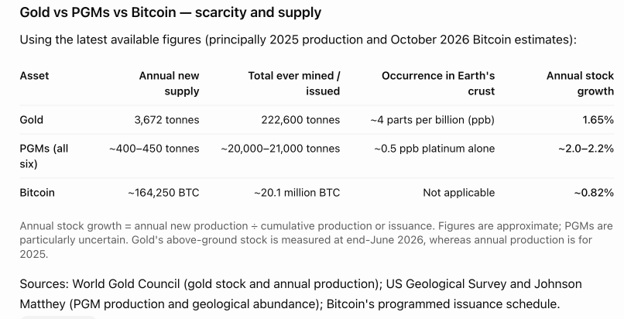
So if gold returns 1.5% real p.a., I would guess the other hard assets would generate returns in the 2-3% p.a. range.
Regarding land, the strongest direct historical evidence for agricultural land comes from Chambers, Spaenjers and Steiner’s 2021 study, “The Rate of Return on Real Estate: Long-Run Micro-Level Evidence”. The researchers examined property-level records from four Oxford and Cambridge colleges for 1901–1983 and found:
- Agricultural real estate: 4.5% annualised real total return, net of costs.
- Residential real estate: 2.3% annualised real total return, net of costs.
- Long-term real rental income growth was approximately zero across property types.
So, I would assume that owning land would return around 3% real per annum.
Other hard assets could include fine wine, art and stamps. But these are hard to invest in, and holding costs erode returns, so for that I will exclude them. It’s useful to look at their estimated real returns, even if only as a sense check.
An academic article published by the Journal of Financial Economics in November 2015, “The Price of Wine”, by Elroy Dimson, Peter Rousseau, and Christophe Spaenjers, found a 5.3% annual real return before carrying costs and 4.1% net of estimated storage and insurance. They also found a 2.8% real return for British stamps and 2.4% for British art from 1900 to 2012.
Attractive returns for sure, but hard to implement in practice.
In summary, I would expect a real return of around 3% (in US$) from owning hard assets. Note: this is an educated guess, not a forecast. But I would be surprised if it differed much over very long time spans.
Putting it all together, the various asset classes owned by The Cockroach portfolio should provide the following real returns in US$ terms:
- Cash around 0.5%
- Bonds around 1.5%
- Equities around 5%
- Hard Assets around 3%
I want to think that I could add value by picking undervalued opportunities in each asset class. But in all honesty, I’m not very confident in my ability to do so. So, let’s ignore any potential contribution from specific asset selections within each asset class.
Overall, The Cockroach portfolio should thus generate real returns of c 2-3% p.a.
Importantly, and this is a key objective, it should do so with low volatility, because the different asset classes are low-to-negatively correlated.
In The Markets
1. Still kissing frogs, 30 years later
At the most recent BizNews conference in the Drakensberg, ex-Naspers director Hans Hawinkels shared how Naspers invested in Tencent, an investment widely regarded as one of the best VC deals the world has ever seen.
The story, which is relevant to the massive discount at which Naspers trades relative to the value of its underlying investments, goes something like this:
It began as a $33 million bet on a loss-making Chinese instant messaging app, QQ, owned by Tencent, a small Chinese tech company. Mr Hawinkels executed the deal. Hong Kong-based PCCW held a stake in Tencent and was a seller. Naspers was seeking further investments in China, so Mr Hawinkels reached out to PCCW. PCCW negotiator Mike Chung gave Naspers an ultimatum: “We will sell our shares to you. The company’s valuation will be $66 million. I’m giving you no time to do any due diligence. Take it or leave it.”
Most Naspers executives opposed the deal after the company burned through $70 million across Asia following the dot-com crash, but CEO Koos Bekker backed the investment. He controlled (and still does) the company through super-voting shares. So, whatever he wants, he gets. Due diligence or not.
In short, Mr Bekker had kissed many frogs and eventually came up with a princess.
Given that background, it’s no wonder that he continues to kiss frogs. Today’s frogs are predominantly unattractive food delivery businesses and a spread of unrelated eCommerce businesses.
For a long time, the market gave Naspers (now the biggest shareholder of investment holding company Prosus) the benefit of the doubt, pricing it as if another princess were just around the corner. But frogs turning into princesses are solely the purview of fairy tales, with Tencent being the exception that proved the rule. That is the view the market is coming around to.
Prosus shareholders have made almost zero money since its listing 7 years ago:
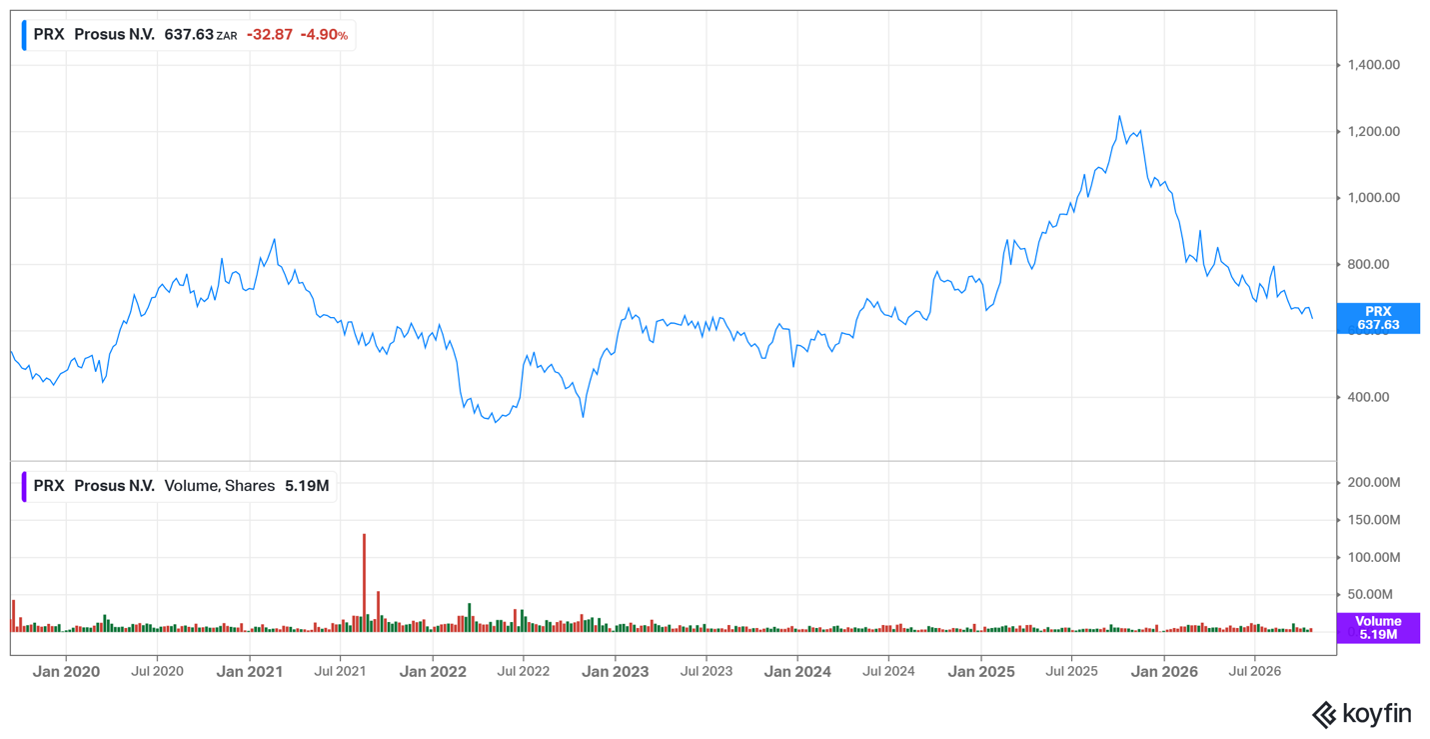
Today, Prosus owns 22.5% of Tencent, worth $100 billion (or R1.7 trillion). Prosus’ market value is only R1.4 trillion, which is surprising, as it also owns some eCommerce businesses worth around $16 billion (R2.6 trillion) and food delivery businesses worth around $15 billion (R2.5 trillion), plus some other rats and mice. In total, Prosus’ assets are worth c.$135 billion (R2.2 trillion).
In other words, the market is applying a 40% discount to these assets through the Prosus share price.
In turn, Naspers owns 43% of Prosus, worth R600 billion at Prosus’ current market price, yet Naspers’s market value is “only” R500 billion. So that’s an additional almost R100 billion discount on top of the R800 billion discount embedded in Prosus.
This discount continues to widen as the market tries to pressure Mr Bekker to stop throwing good money after bad. After reading this article about the proceedings at their AGM, I wouldn’t hold my breath, though. It’s a strong drug, this frog-kissing business. One of the shareholders’ only hopes is that Mr Bloisi, Prosus’s CEO, realises he is unlikely to earn his $100 million “moonshot award”, resigns, and triggers a change in strategy.
My take: Tencent remains one of the best businesses in the world. The value-destructive capital allocation at Prosus/Naspers will reach a limit. The current discount to NAV assumes value destruction far beyond even Mr Bloisi’s highest ambitions. The MWI Value Fund has been building a position in Naspers. Let’s see which way the cookie crumbles here.
2. The little engine that could
“The Little Engine That Could” tells the tale of a long train that needs to be pulled over a mountain. For various reasons, the large locomotives fail. A small locomotive is then asked to do the job and eventually succeeds.
At the risk of pushing the metaphor a bit too far, I think it also applies to investment holding companies. Many large investment holding companies perform poorly: Remgro, Naspers/Prosus. Smaller ones, it seems, have a better chance of doing well: PSG (when it was still listed), HCI and Sabvest.
But with these smaller investment holding companies, cognitive dissonance looms large. Many investors, including the sophisticated managers of large investment funds, won’t touch them because they feel the discount to NAV somehow cheats them. The argument goes that they can’t buy these shares because they can’t see the discount narrowing. The absence of a narrowing discount is somehow equated with poor returns. How this works, of course, is never explained; it’s simply accepted.
But here’s a practical example: Sabvest Capital has grown its NAV per share by 18% p.a. over the past 10 years, from R36.50 to R161 per share. In 2016, the discount to NAV was 15%. At year-end 2025, it was 24%. The discount to NAV widened! Surely that implies that shareholders went backwards?
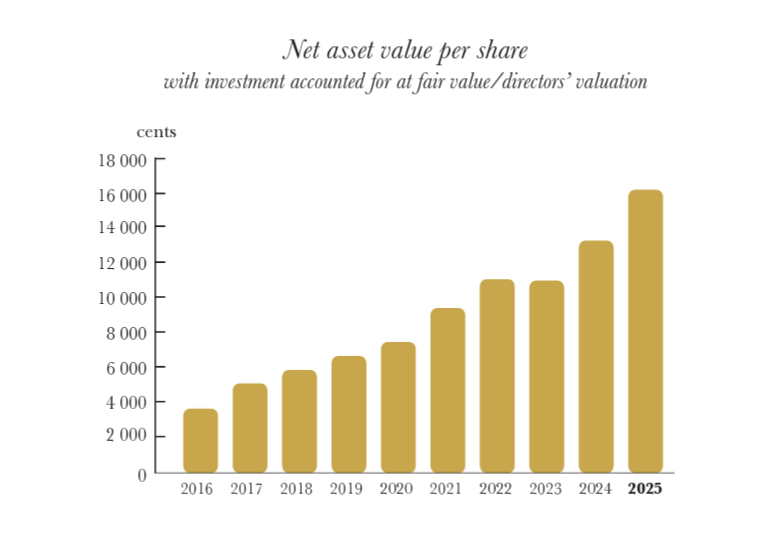
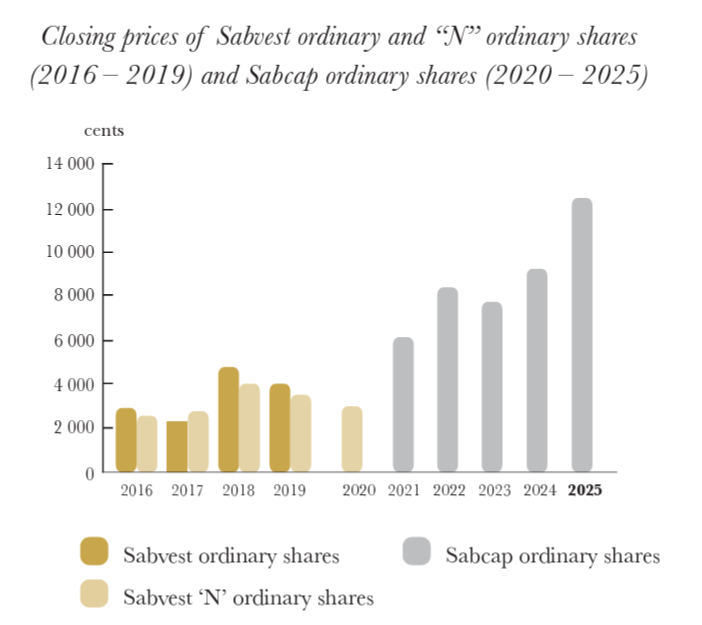
The share price grew by 17% p.a. over those same 10 years, from R31 to R123 per share, about the same as NAV growth, despite the widening discount to NAV.
In the end, shareholders got what management did for them: NAV-per-share growth. They just had to stick around for long enough, which, of course, is the hard part. The discount-to-NAV movement had a negligible effect on their returns.
My take: Over long enough periods, shareholders get the growth in a business’s intrinsic value (good or bad). In Sabvest’s case, it was good. Arguments about “uninvestability”, a discount to NAV, lack of liquidity, or management costs have little or no relevance to investment outcomes.
3. The exception that proves the rule?
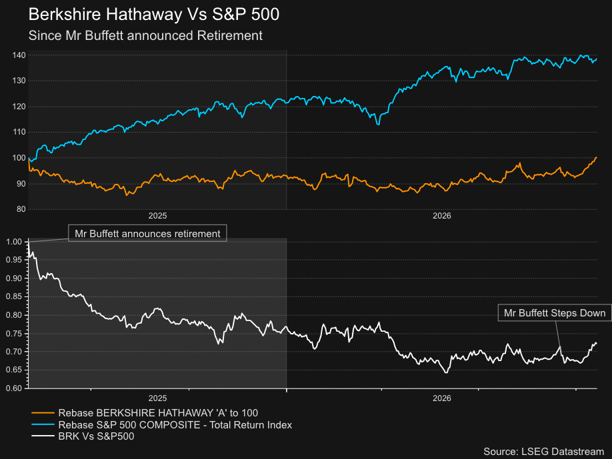
On 1 January of this year, Warren Buffett stepped down as CEO of Berkshire Hathaway (BH). Initially, the share price declined, but has since more than recovered:
Recently, it closed at an all-time high:
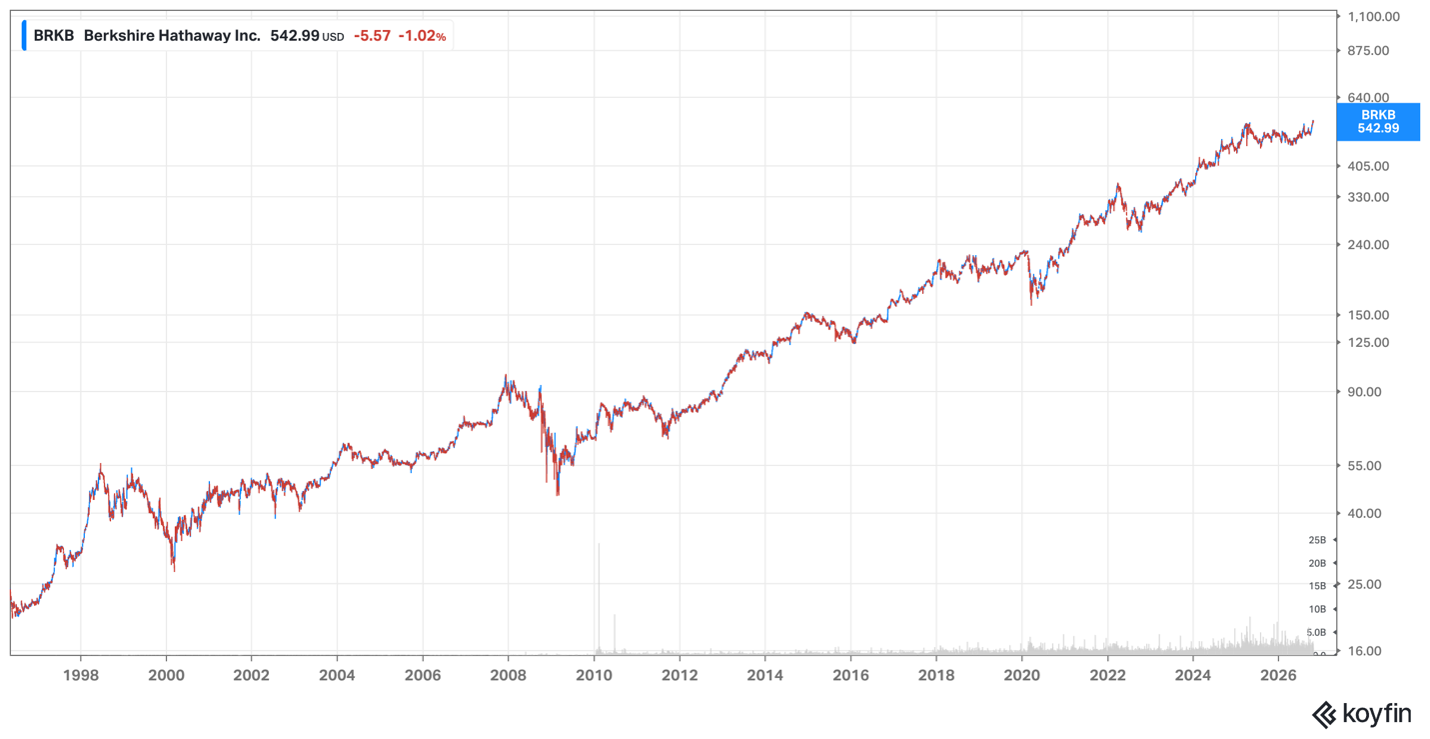
Under Greg Abel, who bought back about $4.5 billion of stock in the second quarter, things seem to be continuing as they left off under Mr Buffett. Which begs the question: does the CEO really matter that much?
I believe culture drives results, and Mr. Buffett instilled such a strong culture in the business that any management changes would take a long time to produce results very different from the past. I’m also of the opinion that building a value-creating culture is one of the key responsibilities of the CEO of any company.
To compound matters – positively – BH is such a large vehicle now that, like an oil tanker, changing direction is not easy at all. Even if a new CEO consciously tried to destroy value, it would take a long time to filter through.
My take: BH remains a good proxy for the US market, minus the occasional excesses. The business’s culture keeps it on the Cockroach’s “10 Stocks, Forever” list. It might be the one large investment holding company that keeps doing well despite its size.
4. Calling her bluff
I wrote last week about a contentious remuneration scheme that Sygnia’s shareholders were asked to vote on.
Before the vote, Sygnia’s founder and CEO, Magda Wierzycka, gave a wide-ranging interview on BizNews, which you can watch here. She said that if shareholders didn’t support the scheme, she would sell her shares and move on to more profitable business ventures. Her exact words were:
“Whether it’s a vote of confidence in the decision-making I’m making or not, I have to look at it very carefully. I obviously will have to look at the percentage of votes. And then I have to consider it, and it’s not a threat; I just don’t want it to come across as if I’m resigning the next day. But I now have to think about it long and hard, which is why the board is doing what they’re doing. No restraint of trade, nothing stopping me launching a competing business, none. And a 30-day termination notice. So I now have to think about it and ask: does it work for me psychologically, or doesn’t it?”
When discussing her potential departure if shareholders rejected the incentive scheme, she also said, “People always go and say, ‘Yeah, she’s bluffing.’ I don’t bluff.”
So, let’s look at the voting.
At the meeting, 82.6% of shareholders voted for the scheme. Somehow, Ms Wierzycka, her family trust, and her ex-husband, who jointly own almost 60% of Sygnia’s shares, were allowed to vote. If you remove their votes, as good corporate governance demands, outside shareholders voted, at best, 58/42 against the scheme. I don’t know whether any other related parties were allowed to vote, but I suspect they were.
My take: Over to you, Ms Wierzycka. Personally, I’m with you. I’m also selling my shares.
In The Cockroach
The quarterly report for the South African-domiciled cockroach portfolio (aka the MWI Worldwide Flexible Fund*) for the period ending 30 September 2026 has been released. You can read the full document here.
Work is still being done on setting up fact sheets and quarterly reports for the offshore-based version of the fund (aka the RECM Worldwide Flexible Fund). The fund is less than 2 months old and still quite small, so I’m not sure the functionality of any reports at this stage is high. The fund largely mirrors the structure and individual holdings of the South African one, so you can read any commentary across to the offshore fund.
The key point from the quarterly report is that the fund has been managed on a “cockroach” basis for exactly six years. During that time, it has returned 9.4% p.a. in ZAR terms, 4.5% above South African inflation. In US$ terms (the fund’s functional currency), it has returned 9.7% p.a., 5.4% ahead of US inflation.
Both numbers are somewhat above the returns I would expect over the long term, so I expect returns to be more subdued at some point. More importantly, the fund has generated this return with class-leading, low volatility, so the ride hasn’t been scary. Even if returns are more subdued in the future, it still shouldn’t be a scary experience.
To summarise, the fund has done what it set out to do 6 years ago: let investors sleep well while increasing the real purchasing power of their capital, with the added benefit that the fund’s structure, not the brilliance of its portfolio manager, has delivered this.
* I manage the fund on behalf of Merchant West Investments (Pty) Ltd (FSP 44508)
In The Media
1. Song of the week
I just have to leave this here.
2. Temba Bavuma and test cricket
Temba Bavuma is probably one of the most underrated players in Test cricket, a format of the game I often regard as a metaphor for life.
So, when I read this article, it brought a smile to my face. If you love Test cricket, you will love this meditation on Bavuma and the game. And even if you don’t like the game, it’s so well written you’ll still enjoy it.
3. The Yeah Yeah Yeahs’ live Concert “Hidden in Pieces”
Karen O and the Yeah Yeah Yeahs are one of my favourite bands. Their brand of music is raw and loud. But their “Hidden in Pieces” tour showed a softer, more acoustic side.
David Lynch is one of my favourite film directors. His style blends eerie surrealism and dreamlike subconscious logic with mundane Americana. In doing so, it exposes the dark, unsettling mysteries underlying the surface of everyday reality. Twin Peaks was a revelation when it first aired and may still be my number one series of all time.
I know, strong words! But true.
This short 22-minute video features parts of the Yeah Yeah Yeahs “Hidden in Pieces” concert, which was officially dedicated to David Lynch, who passed away shortly before the band began the project. The performance opens with an ode to Lynch: a delicate rendition of “In Heaven” from Lynch’s iconic 1977 debut film, Eraserhead.
The video is produced in David Lynch’s style, and for me, it’s a must-watch.
That’s it for this week.
Please be careful out there. You never know what the life and cricket gods will throw at you.
Piet Viljoen
RECM
29 October 2026