
Dear Fellow Investors and Friends,
Welcome to my newsletter, where I share my efforts to understand markets and the world around me.
I do appreciate you taking the time to read this. I love getting feedback; feel free to drop me a line. It’s great to start conversations.
Today is Thursday, May 28th, the 148th day of the year. There are 217 days left until the end of the year.
On this day in 1959, the monkeys (actual monkeys, not the band) Able and Baker travelled 500kms into space aboard a Jupiter missile and returned safely to Earth as the first animals retrieved alive from a space mission. Now, 68 years later, by listing SpaceX, Elon Musk is offering a different set of primates an opportunity for their investments to go to the moon.
The smart corporate financiers (who earn fees on the transaction) say that it is worth up to $2 trillion. Elon Musk is prepared to sell around $75 billion of the company at that valuation. This would make it the largest IPO in history.
Here’s a picture of what SpaceX does, for dummies like me:
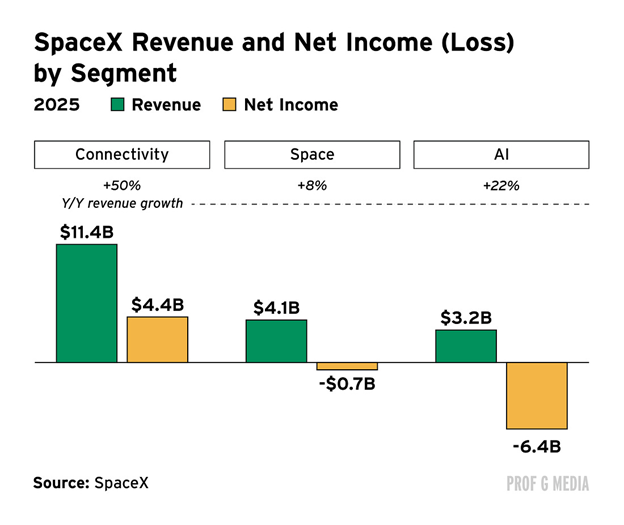
And here’s a piece that explains the different aspects of SpaceX quite well.
To summarise – SpaceX comprises one great business, Starlink (or, as they call it, “connectivity”), and two loss-making, highly capital-intensive businesses, Space and xAI. The prospectus says the TAM (VC-speak for “Total Addressable Market” for the company) is $28 trillion, which is the entire size of the US economy. Most of this TAM sits in the AI part of the business. But it also includes:
- Mars colonisation!
- Rockets in space!
- Orbital compute infrastructure!
Which recalls that great prospectus from the South Sea Bubble period of the early 1700s:
“For carrying on an undertaking of great advantage, but nobody to know what it is.”
Speaking of the South Sea Bubble, the South Sea Company was established in January 1711 to reduce the cost of the UK’s national debt. In 1713, to generate income, the company was granted a monopoly on the supply of enslaved Africans to the islands in the “South Seas” and to South America. “Free” labour was a sought-after commodity in the developing economies of the early 1700s. The “TAM” was unimaginably huge.
Due to the ongoing war between Spain and the UK, with Spain controlling the South American colonies, the originators of the scheme knew there was no realistic expectation of ever having a trade to exploit. Nevertheless, the potential for great wealth was widely publicised at every opportunity to encourage interest in the scheme.
The founders’ objective was to create a company that would enable them to get government contracts, thereby becoming quite wealthy. An early version of our very own “tenderpreneurs”. Just like any good tenderpreneur, very little regard was given to actually running a profitable business. The founders of the scheme were widely known to have engaged in extensive insider trading and paid large bribes to politicians to secure the acts of Parliament necessary for the scheme.
So, to recap, the South Sea bubble was sparked by a group of businessmen with close ties to the government to profit from a highly uncertain undertaking, but one with an extremely large TAM.
Got that? Okay, let’s fast forward 300 years.
SpaceX was founded by Elon Musk in 2002 to lower the cost of space exploration and colonise Mars. It relies heavily on government contracts, with $22 billion in active agreements. Overall, Musk’s diverse businesses have received at least US$38 billion in government contracts, loans, subsidies and tax credits, often at critical moments, according to a Washington Post analysis.
Under international law, outer space and celestial bodies are treated as a “global commons” – similar to international waters – meaning they belong to all humanity and cannot be claimed by any nation, individual, or corporation.
SpaceX is an amalgamation of three firms: X (née Twitter, which was merged with Mr Musk’s AI business to form xAI). This combination was then merged with SpaceX. As mentioned, the business will be valued at $2 trillion for the IPO. This is up from a $1 billion valuation in 2010. Its value has increased by a factor of 2,000 in 15 years, making Mr Musk (by far) the richest man on earth, as he owns over 40% of the business.
Mr Musk has faced numerous high-profile civil lawsuits, SEC regulatory actions, and accusations from disgruntled shareholders regarding market manipulation, but none have resulted in formal insider trading convictions. He has paid fines to settle numerous securities fraud claims brought against him by the SEC. As far as I can establish, he has never bribed a politician.
As I often say, history never repeats – but it sure does rhyme.
When evaluating an investment, it’s always wise to consider the base rate. In other words, how have similar investments performed in the past? The cohort to examine here is previous mega IPOs. Let’s have a look:
- Before SpaceX, the largest IPO was Saudi Aramco’s in 2019, valued at $1.7 trillion. It was priced at 32 Saudi riyals per share (about $8.53). Today, the stock is currently trading around 27.90 riyals ($7.44) per share.
- In 2014, Alibaba went public at $68 per share, valuing the company at over $100 billion – the biggest IPO by a Chinese company to date. On the first day of trading, the price jumped to $93 per share, valuing Alibaba at $230 billion. Today, 12 years later, its price is not much higher.
- In 2011, Glencore was the largest mining company ever to go public and one of the largest ever IPOs on the LSE, valued at $60bn. Glencore was the largest company in Switzerland and the world’s largest commodities trading company. It took a decade after listing to reach its IPO price of £5,30 again.
- NTT Docomo (the Japanese telco) was the largest IPO in history in 1998, when it was valued at $66 billion. It was taken private by its parent company, NTT, in 2020 for $38 billion.
All these large IPOs caused tremendous excitement at the time. The internet! The commodity supercycle! The Chinese growth miracle! And now: Space!
But the facts show that the base success rate for large, exciting IPOs is low. To paraphrase Warren Buffett, excitement is not the investor’s friend.
Also, I have some questions.
- Who owns “space”?
- Who determines property rights in space, and how do they go about doing so?
- Who owns Mars?
- How do you colonise it? Is it first-come, first-served?
- Exactly what human rights do second and third-generation Mars colonists have, and how do these rights get conferred on them?
- Is “colonialism” even legal today? And if it is legal, is it ethical?
I’m not sure discussing valuation is even rational at this point, so I won’t go there. I’ll leave it to Sun Microsystems CEO Scott McNealy. During the dot-com bubble, he highlighted the absurdity of high price-to-sales ratios. He explained that for a company trading at 10 times revenue to achieve a 10-year payback, it would require impossible conditions, including zero expenses, taxes, or R&D costs. McNealy famously concluded by questioning investors who paid high valuations, asking, “What were you thinking?”
SpaceX is coming to market at a price-to-revenue ratio of around 100 times.
To sum up, the SpaceX prospectus is a blend of sci-fi, imagination, manipulation, and some reality (sparingly) sprinkled on top. Like the White Queen in “Alice in Wonderland”, to take a punt on SpaceX (note – I’m not saying, “invest in SpaceX”, because that’s not what you’re doing here), you will need to believe many, many impossible things all at the same time.
But hey, if you say something enough times, it might just be true.
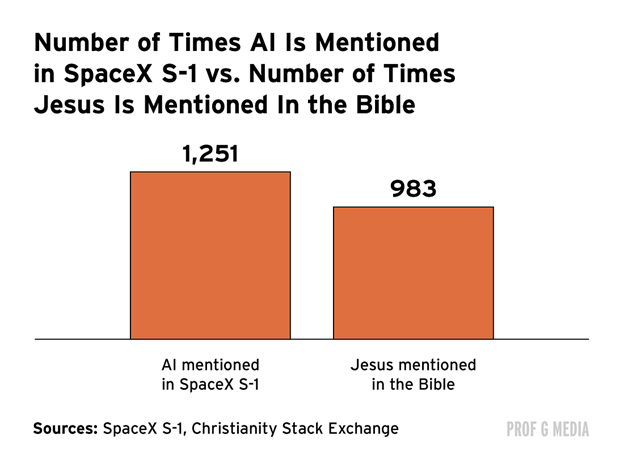
So, will SpaceX “pop” on listing? Unequivocally yes. Will it turn out to be a good long-term investment? Most likely not.
I have two words for you: Caveat Emptor. And be careful of those Handwaving Helpers jumping on the bandwagon to sell you a “product” that gives you “exposure” to SpaceX. For a fee, of course. These people do not have your best interests at heart.
In The Markets
1. Delivery Hero/Prosus
Let’s face it – since Covid, all of us are “ordering in” a lot more, facilitated by a proliferation of last-mile delivery companies like Uber Eats and Mr D here in South Africa. It’s just so convenient!
The problem is that, except for the capital, there are almost no barriers to entry to the business. No network effects, no licensing or regulation (yet), no cheap access to a unique resource. And definitely no sticky customers – the cheapest service wins.
So what you have is an industry where a bunch of players with deep pockets are throwing a lot of capital at the problem, hoping to be the last man standing. Prosus is one of them, with interests in Just Eat, iFood, Delivery Hero and Swiggy.
Since FY ’17, Prosus has invested $14 billion across food delivery businesses, generating an average IRR of 6%. Delivery Hero has been the worst-performing investment in the portfolio, with an IRR of c.-14.5% since the initial investment. As a result of its acquisition of Just Eat, the European Commission is requiring it to sell its stake in Delivery Hero.
The likely buyer? Uber, which has already bought 5% from Prosus, and has also acquired options for more. This, of course, introduces another deep-pocketed competitor into the European space.
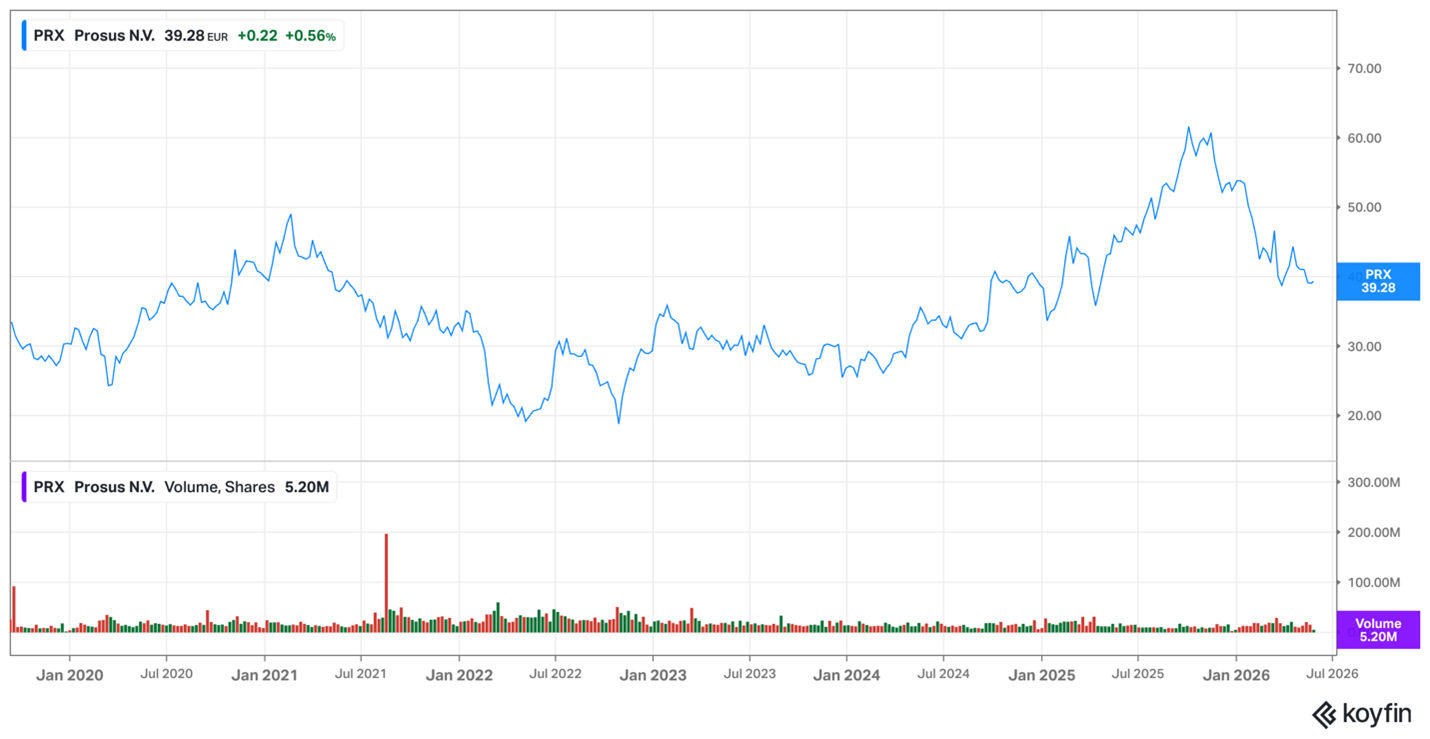
Prosus’ main investment is its 22.7% holding of one of the best companies in the world: Tencent Holdings. This stake is worth just north of €100 billion. Prosus’ market value is €90 billion. The market is effectively assigning less than zero value to Prosus’ investments outside Tencent.
My take: The value Prosus management can create by simply selling its non-core assets and buying back shares is immense. Of course, that would mean huge layers of management would become redundant. Turkeys don’t vote for Christmas, but shareholders are voting with their feet. Since the creation of this Frankenstein 6 years ago, shareholders have almost nothing to show for it:
2. Emerging markets
Despite the Iran war, and the Straits of Hormuz still being closed, emerging markets are performing well:
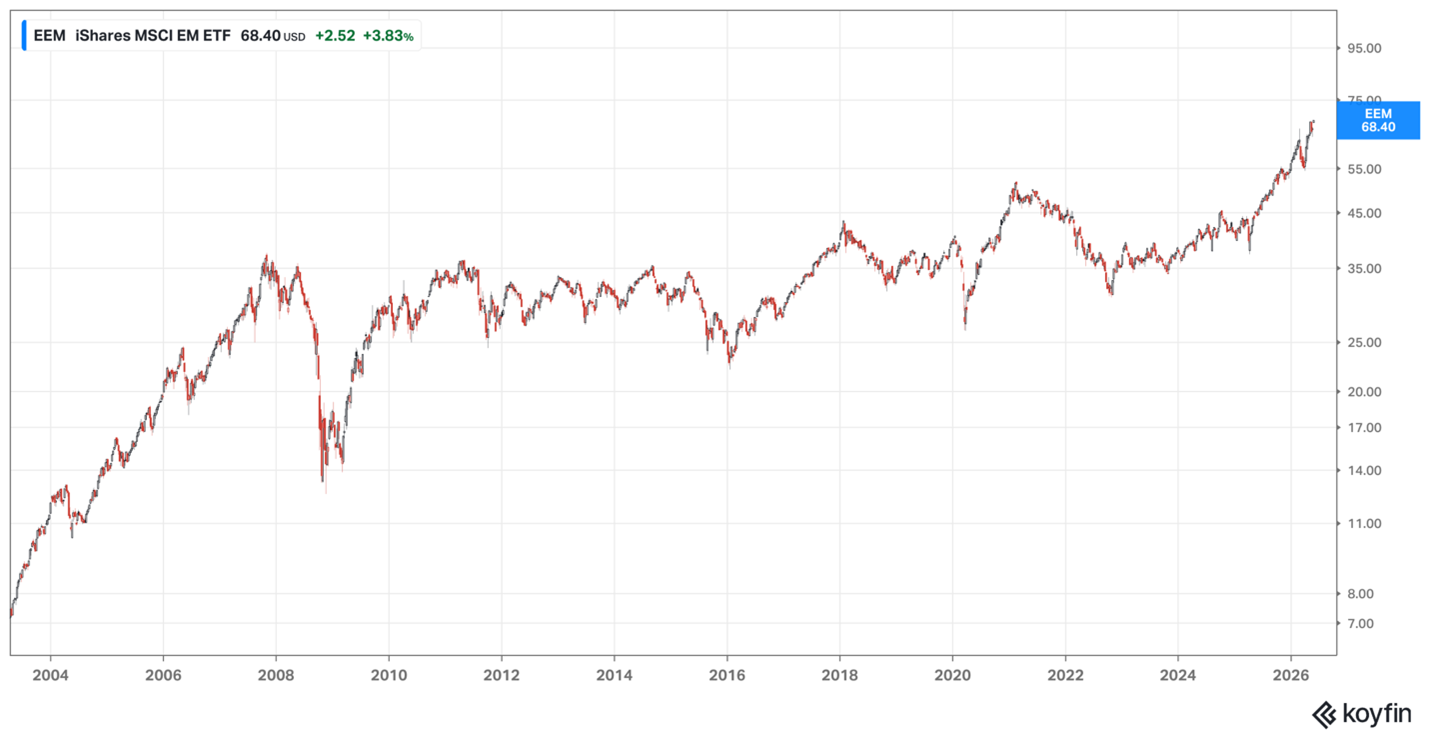
But are they really? In his Bloomberg column, John Authors showed this chart:
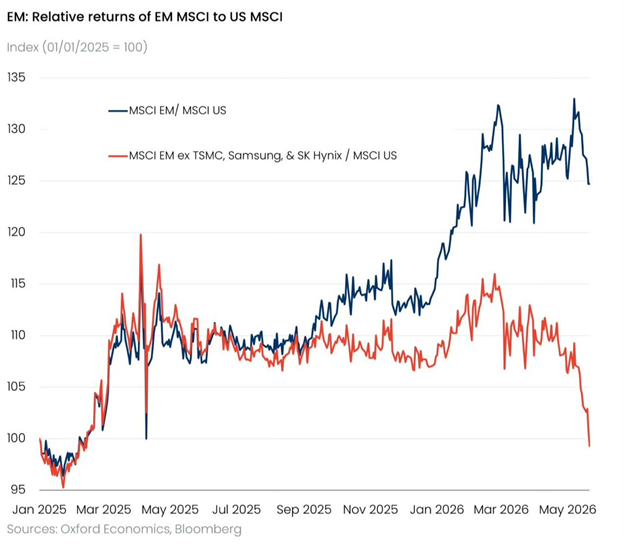
Stripping out the chip-related stocks, emerging is doing particularly poorly. What’s happening here is that indices have become highly skewed. In the MSCI Emerging Markets Index, Taiwan now has a greater weight than China. And the memory chip names Samsung Electronics and SK Hynix now have greater weight than India.
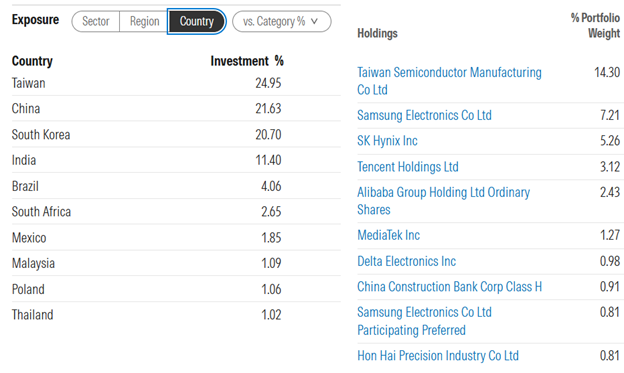
My take: Could it be that the future output of 1.4 billion people in China can produce less value than 23 million in Taiwan? Can one company (TSMC) be worth more than the future output of 1.5 billion people in India? Something doesn’t make sense.
3. Micron Technology
Memory chip maker Micron just hit a US$1 trillion market cap and is projected to make US$113 billion in net profit in FY2027.
UBS analysts are now slapping on a 15x P/E multiple to peak FY2027 earnings to reach their target price of US$1,652, the highest of all 46 brokerages covering the stock. In the report, they did not mention whether they owned any stock, but I guess not. They’re here for the flow, not the value.
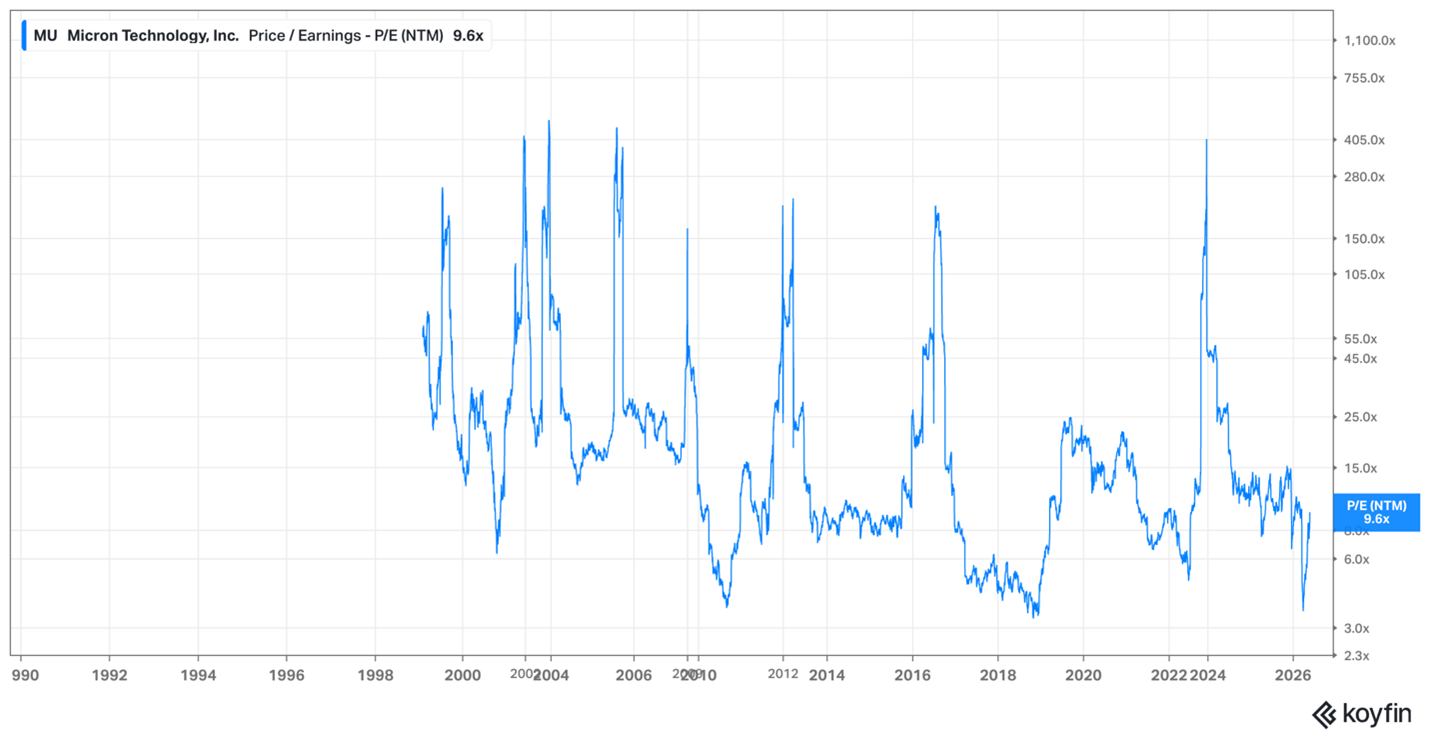
In my experience, when the P/Es of capital-intensive, cyclical stocks are low, it’s time to sell them, as this indicates the company’s earnings are high. So, we have to ask two questions:
- Is Micron (and its peer group of chip stocks) capital-intensive?
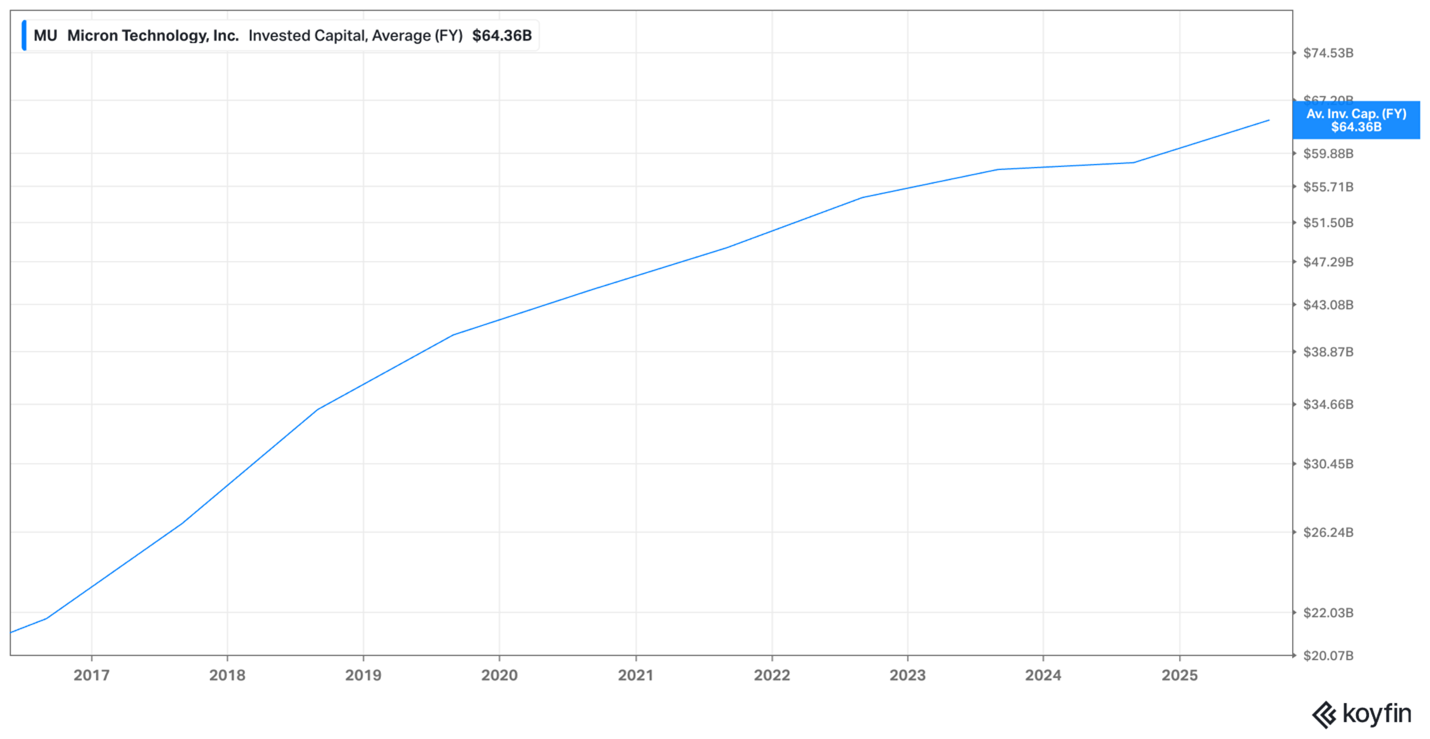
The answer is yes. Invested capital has grown by 11% p.a. over the past 10 years; this is not a capital-light business.
- Is Micron a cyclical business?
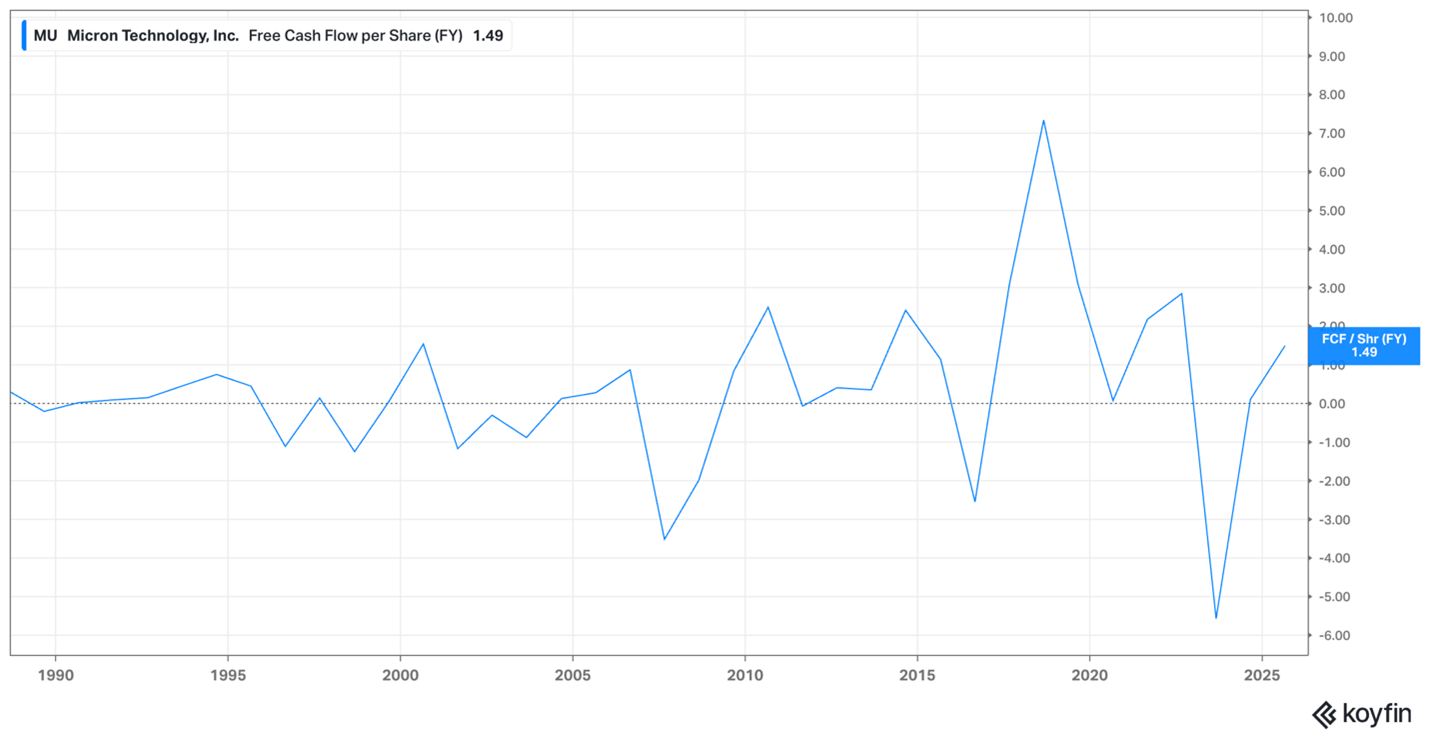
Again, the answer is yes, as its free cash flow per share oscillates around 0.
Finally, here is the forward P/E of Micron:
And here is the share price:
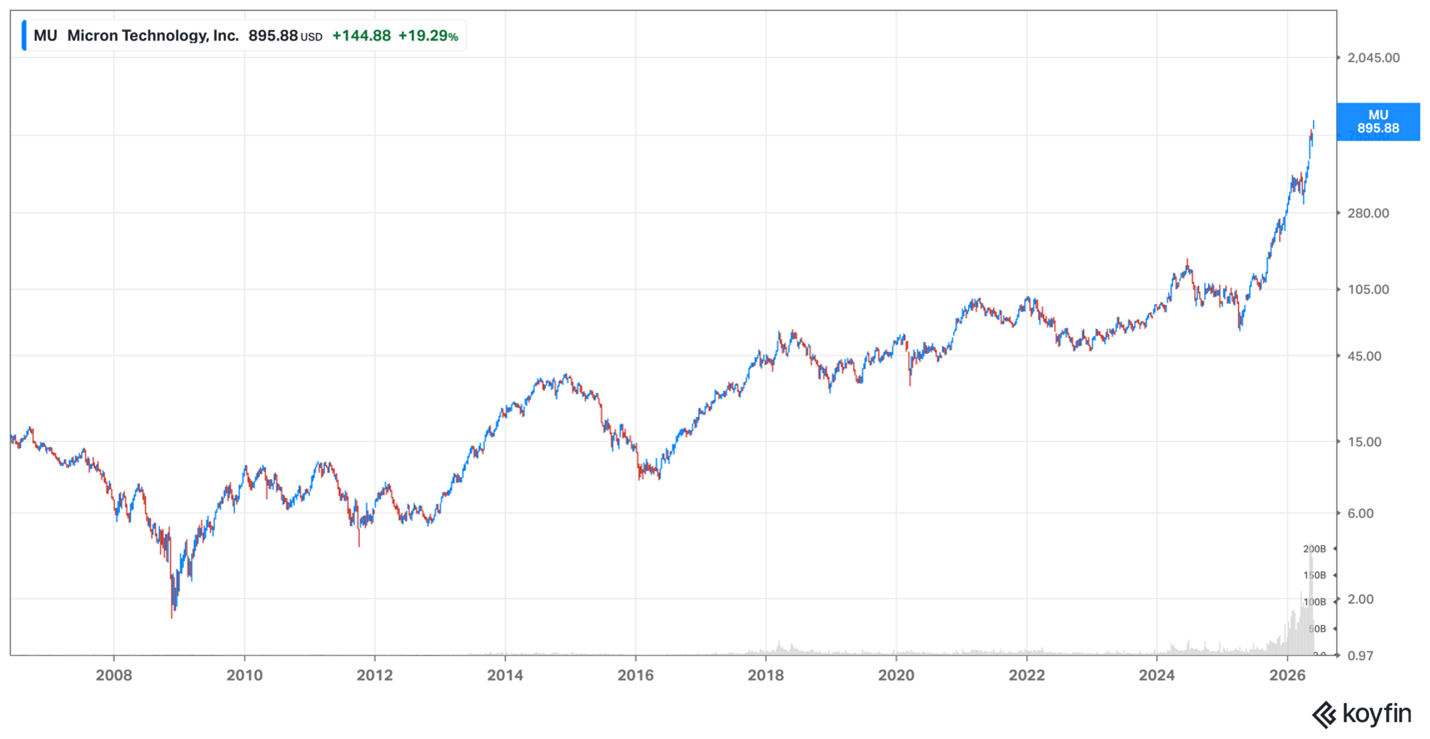
History shows that in 2010, 2015, 2018, and 2022, Micron’s P/E was low, and those years were good times to sell shares in this cyclical business.
My take: Maybe it’s different this time. But we should all be aware that this is the type of stock that is driving markets worldwide.
4. Indonesia
Staying with our theme of Emerging Markets, here’s a classic emerging market situation: Indonesia’s President Prabowo shocked markets by announcing an aggressive centralisation of Indonesia’s massive commodity wealth. The government plans to route all exports of palm oil, coal, and nickel through a state-owned entity managed by the newly established Danantara sovereign wealth fund.
This monopsony… wait, how’s that for a word? A monopsony is a market structure with only one buyer and many sellers. It is the buy-side equivalent of a monopoly. Just like a monopoly, it inevitably results in shortages of the product in question.
Here’s a nice X thread on Indonesia and monopsonies. TL;DR: This isn’t new in Indonesia; it seems politicians there have always chosen grift over their people’s welfare.
This has not been good for the Indonesian market, which is now lower than it was 15 years ago:
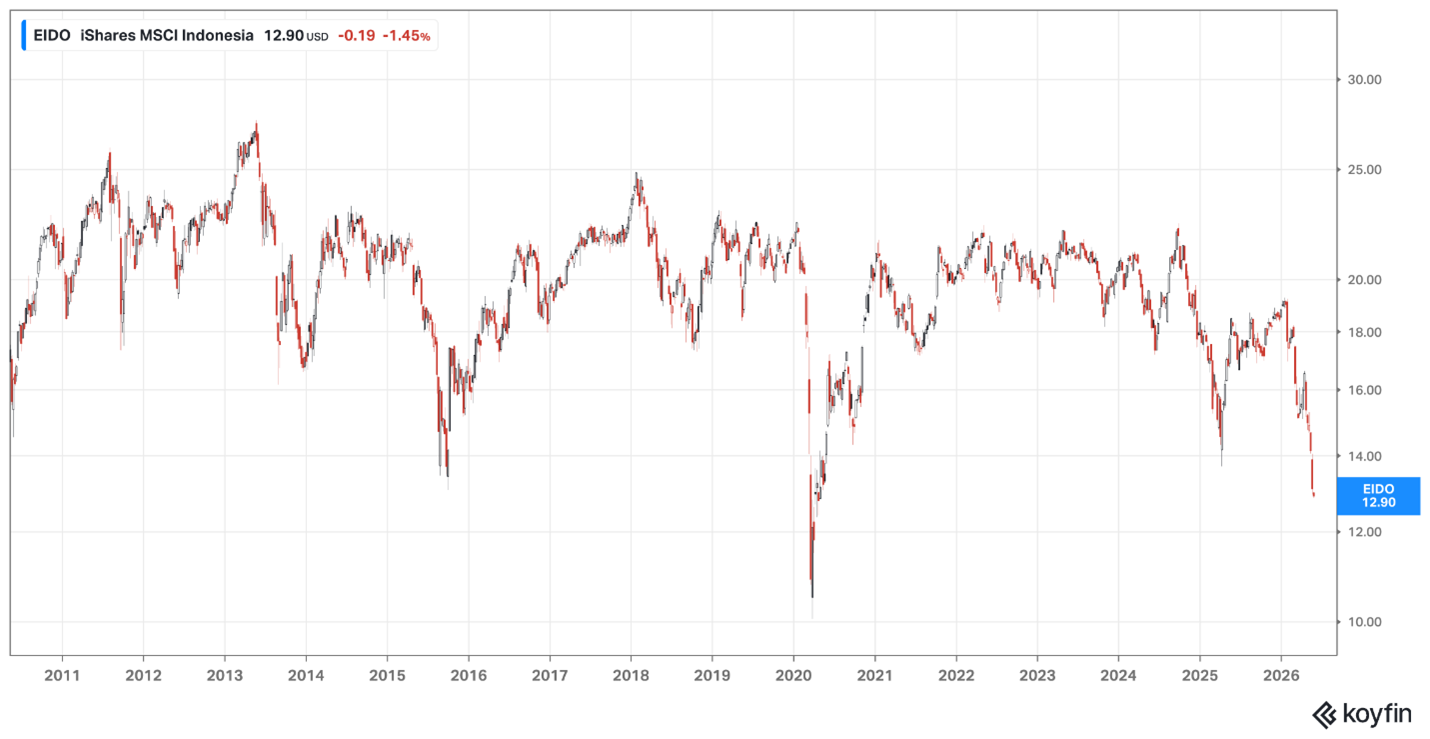
My take: The market reflects the economy – the only winners here are the political insiders. But expect supply pressures in nickel (Indonesia produces 60% of global nickel supply), coal (the world’s largest exporter of thermal coal) and palm oil (55% of global production).
In The Cockroach
As usual, no trades in the fund*.
I haven’t looked at the bond portion of the portfolio for a while, so here is what it looks like now, and how it has changed since January:
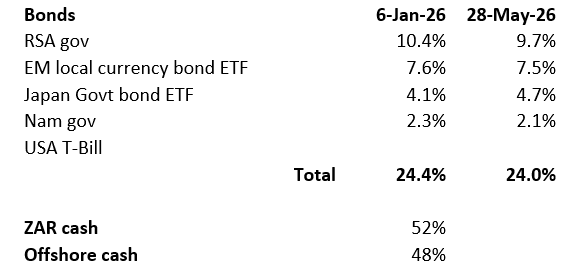
There have been no transactions in the bond portion so far this year. Weights have declined due to rising yields, which reduce the market value of bonds. Not enough to have to rebalance yet, though.
Real yields on South African government bonds remain highly attractive. With inflation at c. 3% and expected to rise, possibly toward 5%, yields of 9% or more are compelling. South Africa, in particular, and emerging markets in general, have much better fiscal positions than developed markets.
The one exception to this is the Japanese bond market. Here, yields have rocketed upwards this year. These higher yields, coupled with a significantly undervalued yen, make these bonds a compelling long-term proposition.
The fund continues to hold no (Western) developed-market bonds, whose fiscal positions are (generally) weak and whose currencies are (generally) overvalued.
Bonds are probably the least attractive asset class right now. Having zero bonds in the fund would be understandable. But one of the fund’s principles is that the future is unknowable, and most forecasters tend to get asset price movements wrong. So, the fund does not forecast and maintains a 25% allocation to cash, bonds, equities, and hard assets at all times, even when prospects for one or more of these asset classes are poor.
Because…who actually knows?
* I manage the fund on behalf of Merchant West Investments (Pty) Ltd (FSP 44508)
In The Media
1. Sake-Liga wins important court case
Sake-Liga, together with SAAI and Free State Agriculture, have won an important court case against the Minister of Agriculture, John Steenhuisen. The court has ordered the government to allow farmers to import and administer vaccines against Foot and Mouth disease.
The government’s centralised approach led to significant foot-dragging, poor policy and ineffective implementation, causing major losses for cattle farmers. The new order will lead to a decentralised, effective process.
You can read about it here.
Slowly but surely, Sake-Liga is moving towards its goal of “state-proofing” the economy. Good for business, good for the consumer, good for the country. They deserve your support.
2. The best music of 2002
This was the year I finally decided to venture out on my own. There were two major contributors to this decision. One, I felt that the compromises one had to make in the interests of building a big business were too large. Second, I got cajoled out of my institutionalised comfort zone by Theunis De Bruyn, who remains my business partner to this day. Thank you, Theunis!
Making the decisions wasn’t easy, but it was the easier part of the process. How does one extricate oneself from a business (Investec Asset Management – IAM) that one had helped build from almost a standing start? I decided the best way was to play my cards openly with my boss, Hendrik du Toit. I told him about my plans and committed to spending a year transitioning my clients to the portfolio manager who would take over my role. I also undertook not to approach any of the Investec client base when I started my business. In return, Hendrik allowed me to start getting the paperwork and admin for my fledgling business done.
It was a win-win deal:
- I walked out of IAM’s offices on the 31st of March 2003 and into the RECM offices on (appropriately) the 1st of April.
- Clyde Rossouw, who took over my portfolio and client management duties, has done an exceptional job over the past 20-odd years, building out my small portfolio into a massive one. Chapeau, Clyde!
- RECM has become a small, niche investor in public and private business, managing money for friends and family. Just the way I like it.
So, when I listen to the music of 2002, it really brings back good memories. Two others stand out:
- Going to Knysna to run my first Knysna Oyster Festival half-marathon. To this day, the oyster festival week is one of my favourite times of the year.
- Taking my son Nic – who was 4 at the time – to Willoughby’s on a Saturday. I would have lunch while he wandered around Peggity Toys (which was opposite), deliberating over the respective merits of Lego and Pokémon. He would share his conclusions with me in great detail, sometimes convincingly enough to earn him one. It was a joy to experience these moments.
Here are the 10 best albums from that year, on Apple Music and on Spotify. Who can forget Wilco’s Yankee Hotel Foxtrot, probably one of the albums of the decade? And whatever happened to Damien Rice, who produced a superb album with “O”, and then basically disappeared?
Here are the top 20 songs from that year. Again, on Apple Music and on Spotify.
Interestingly, two of my favourite songs from that year were covers – Johnny Cash singing “Hurt” (originally by Nine Inch Nails) and Lambchop singing “This Corrosion” (originally by Sisters of Mercy). Both are delivered in a quieter and more subdued tone than the originals, but are much more powerful and poignant for it.
Here is a long list of all the best songs from the year, only on Apple Music.
That’s about it for this week. Tomorrow, I leave for a one-week trip to China, arranged by those wonderful people at Cederberg Capital. I will be visiting companies in Shenzhen, Guangzhou, and Fuzhou. Having never been to any of these cities, I am really looking forward to the trip.
A side-effect of this exciting trip is that there might not be a letter next week. Let’s see.
Wherever you find yourself over the next week, remember to be extra careful out there.
Piet Viljoen
RECM
28 May 2026