
Dear Fellow Investors and Friends,
Welcome to my newsletter, where I share my efforts to understand markets and the world around me.
I appreciate you taking the time to read this. Feedback is welcome; feel free to drop me a line. It’s great to start conversations.
Today is Thursday, December 11th, the 345th day of the year. The holidays are approaching, and I can’t wait. But 16 years ago today, some people’s holidays were spoiled when Bernie Madoff was arrested and subsequently convicted of fraud. Investors lost around $20bn. It can safely be said that Madoff was not a caretaker. Instead, he played to our most basic financial emotions, greed and fear, and by doing so, extracted what he could.
> “If there is to be progress again, it will come when we understand that it is not the endless acceleration of change but the maintenance of meaning through time. It is not a line on a graph that ascends, but a circle that endures.
> Only when money measures service, and success is judged by what is built and preserved rather than what is traded or displayed, will progress cease to be an illusion – and become, once more, an achievement of character.”
> – Anthony Deden
I’ve been fortunate to have built a small pool of capital. Mainly due to the efforts of my business partners, Theunis de Bruyn and Jan van Niekerk, to whom I am forever grateful. Some would say I own those assets. But I prefer to think of my relationship to that pool of capital as that of a caretaker.
What’s the difference, you may ask?
Owners can be – and often are – caretakers. But a caretaker doesn’t necessarily have to be an owner. A caretaker has a different mindset from an owner, often reflecting a longer-term perspective.
How can this be?
Owners are the architects of wealth. They are akin to hunters, utilising their skills to provide for their tribe. To navigate the unpredictability of nature – or markets – they must be adaptable, agile, and willing to take calculated risks. To generate wealth, they must be prepared for various situations and overcome them.
Caretakers are like herders. Their job is to ensure the assets entrusted to them are always well maintained and protected against unavoidable force majeures, unforeseeable market vicissitudes, and the inevitable moral turpitude of politicians. They must do so, as they never know when the owner will come around wanting to know how things are going.
The herder’s job is to keep capital safe from harm. Only when this primary aim has been achieved can the caretaker consider the secondary question of how to enhance – or grow – the capital entrusted to her. Sometimes the herd needs to be moved to greener pastures, or a sheep holding back the herd might need to be culled. Occasionally, the fence that keeps out predators needs to be repaired or replaced. But these actions happen infrequently, and only when necessary.
For caretakers, asset liquidity is not a primary concern. Caretakers do not have the option of liquidating assets. So, they are forced to think about the genuine long-term threats and opportunities presented to them. To do so, cultivating humility and stewardship helps. Humility to provide the best service to the owner, shaped by respect for what preceded the current state, and what will endure beyond it. Stewardship to build with the next century, not just the next quarter, in mind.
In so doing, the caretaker provides that most essential input to the compounding process: continuity.
Perversely, owners may have a less true long-term mindset, often placing greater value on flexibility. Optionality allows an owner to always move towards the most promising asset. As such, asset liquidity is necessary; owners have the right to transact. If an owner is unhappy with their asset, they can sell it or swap it for something else. An owner also has the right to neglect an asset. They have no obligation, beyond their own sense of self, to care for their assets responsibly.
The caretaker has no such rights.
The owner’s job is to keep the line going up and to the right. The caretaker’s job is to guide the line into an enduring circle.
Today’s society places a high value on visible signs of wealth. The driven founder-owner behind the wheel of a Ferrari, furiously financialising on the phone, is seen as an exemplar. As Mr. Deden says: “In our hyper-financialised society, we have come to mistake valuation for value, and activity for achievement.”
No one knows about the trusted caretaker who carefully ensures continuity. And thereby, compounding.
Here’s a thought experiment: What is the ratio of fortunes made and lost within two generations vs those that have been maintained over multiple generations?
When you think about it, the caretaker’s contribution to overall societal welfare carries great, unrecognised weight.
In The Markets
1. File under: “They just can’t help themselves”
This week, we had two unrelated but concerning pieces of news.
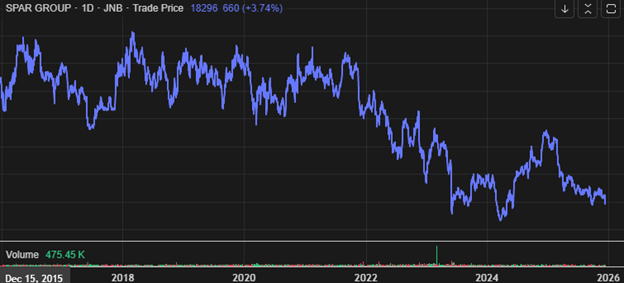
First, Spar issued a trading update detailing how devastating its European misadventures have been for shareholders. Like Famous Brands, Steinhoff, Woolworths, Pick ‘n Pay, Brait (via New Look), and Truworths, Spar has written off vast amounts of shareholders’ funds in their offshore ventures. Unsurprisingly, Spar’s share price today is lower than it was 10 years ago:
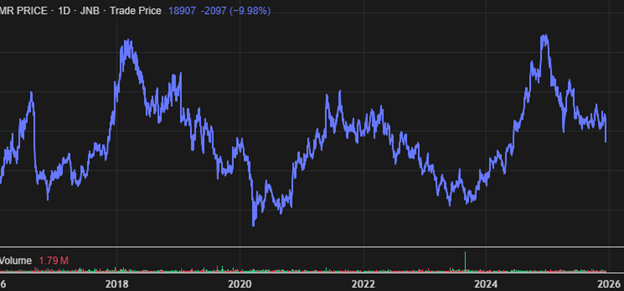
Then, local retailer Mr Price announced a shocker: they were acquiring an Eastern European retailer for R10bn. It appears they are buying it on a P/E of almost 40x, but I might be missing something. I guess when your share price has been going sideways for a decade, drastic action is called for. But a European retailer on a 40 multiple is a step too far.
And then you have one of my favourite retailers, Lewis Group. No transformative acquisitions, no tilting at offshore windmills – just good old-fashioned consistent execution on a simple business model, resulting in a share price that has rewarded long-term shareholders handsomely:
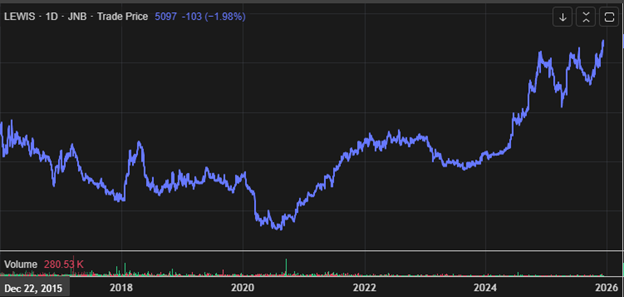
My take: Mr Price might be the one South African retailer that gets it right offshore. But the odds are against them, and in investing, it’s always sensible to get the odds on your side, especially when you have the option to invest in something solid like Lewis Stores.
Once again, the only winners here are the advisors, who earn huge fees. Why companies still give these kinds of people the time of day boggles the mind.
2. The streaming war is won. Or lost. Or something.
The other big news this week was Netflix’s announcement of its intention to buy WBD (Warner Bros Discovery), owner of HBO and various movie franchises. This is after WBD rejected three bids from Paramount Skydance. I wrote about this in “Mutually Exclusive” when I thought it would end with Paramount Skydance overpaying.
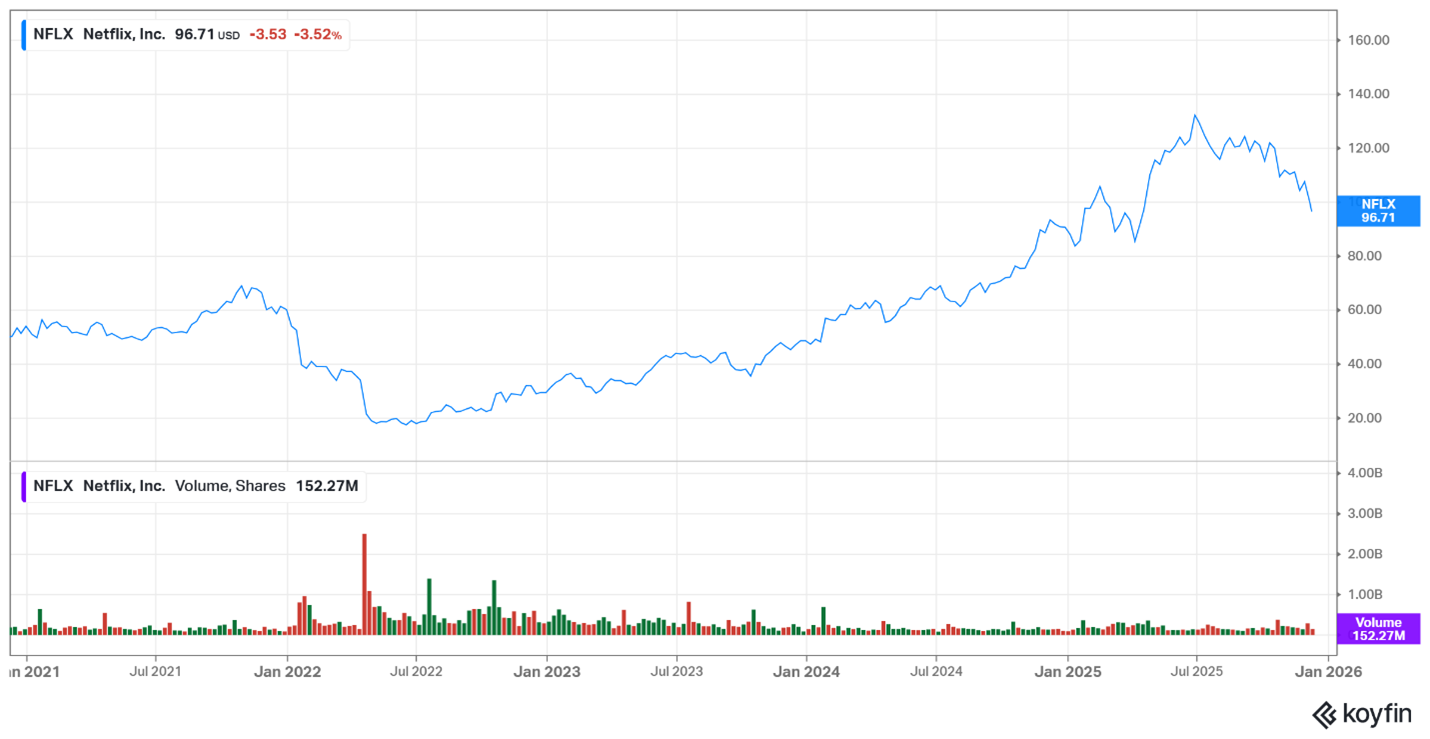
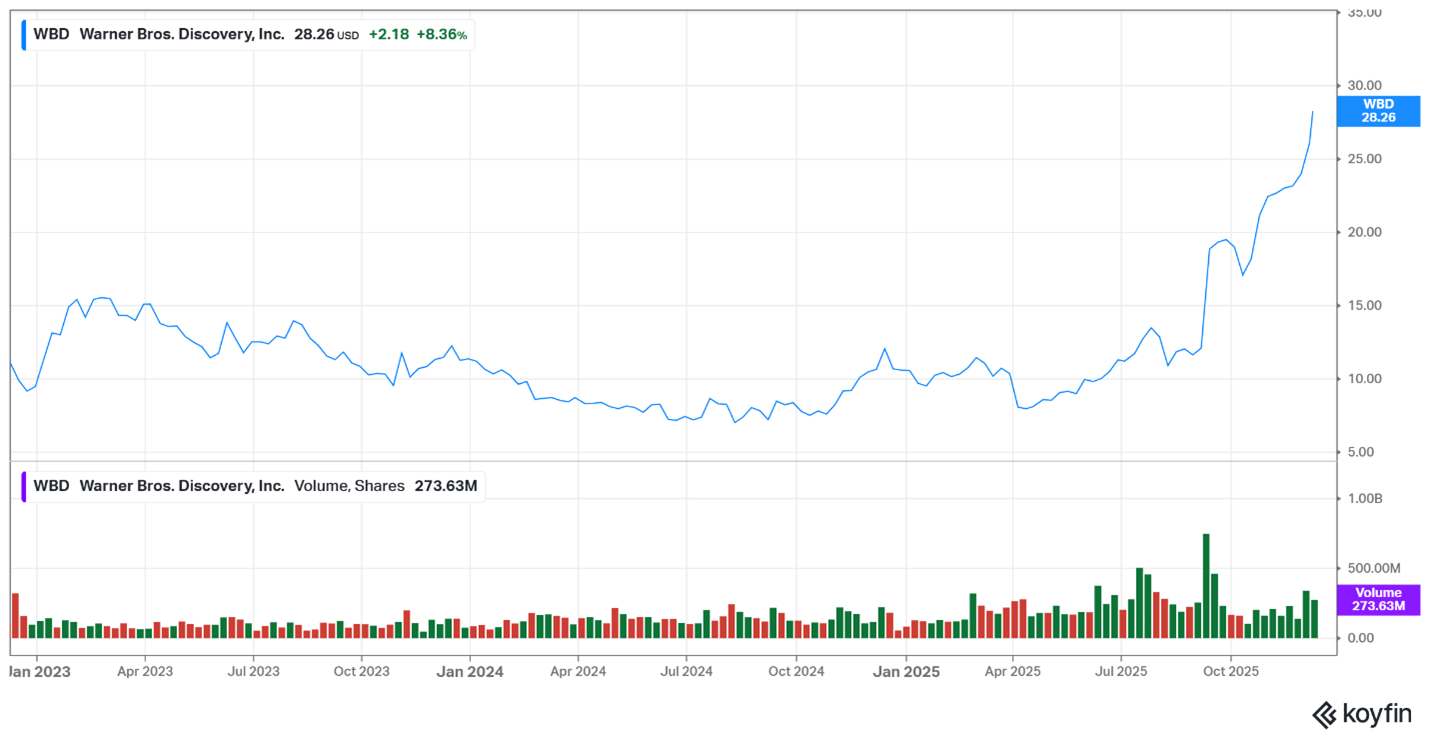
Little did I think Netflix would get involved. But now it looks like they will be the ones overpaying, at around $30 a share, or $72 billion, in a pretty complicated deal. In response, Netflix’s share price declined sharply:
And the shareholders of WBD are winning:
Strategically, I think the deal makes sense for Netflix. They have the dominant media distribution platform. Adding high-quality content to it will most likely enhance the stickiness of its customer base.
The history of Warner Bros. is fascinating. Harry, Albert, Sam, and Jack Warner bought a second-hand projector and started showing short films in mining towns in the East. They soon realised that distribution wasn’t such a great business – making films to be shown in a theatre was more lucrative. You could show a movie repeatedly, but you could only sell a seat once.
Then, in the Paramount decree of 1948, a landmark antitrust ruling which dismantled the vertical integration of Hollywood’s major studios, it was the distribution business – movie theatres – that was spun out.
Netflix also started with distribution, but over time, the rise of internet access has made online media distribution highly competitive. What matters on the internet is customer acquisition and reducing customer churn. High-quality content achieves this.
As of today, it looks like Paramount is going hostile on WBD. I think if they do, they will be big losers. Unless their strategy is to aggregate content and flip it to the highest bidder later.
Who will win this fight? Let’s have a look at the betting markets:
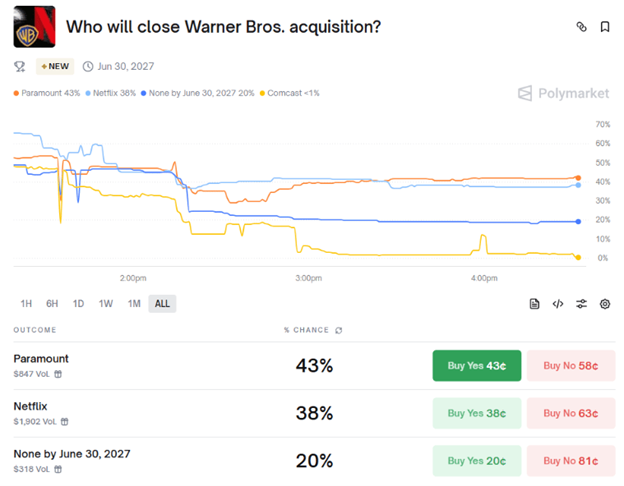
It’s Paramount by a head. Whoever wins, here’s a prediction:

My take: Distribution plus content makes for a strong business. There are only two online media businesses with strong positions in both: Netflix and YouTube. This deal, if Netflix secures it, would entrench its position. If the Netflix share price gets sold aggressively, it might be worth a look. On the other hand, if Paramount wins, it will have a valuable, eminently saleable library. If they are successful and the share price declines, it might be worth a bet. The only immediate non-losers here are WBD shareholders.
What this deal also highlights is the value of content, which is what one of my “10 Stocks, forever”, Walt Disney, has in spades. Disney is currently priced at a lower multiple than WBD.
3. Berkshire Hathaway
This is another of my forever stocks. It was in the news this week as Todd Combs, one of its two investment managers, both handpicked by Warren Buffett, left to join JPMorgan. Some market commentators attribute this, along with other corporate reshuffling, to the new CEO, Greg Abel, imprinting his will on the company.
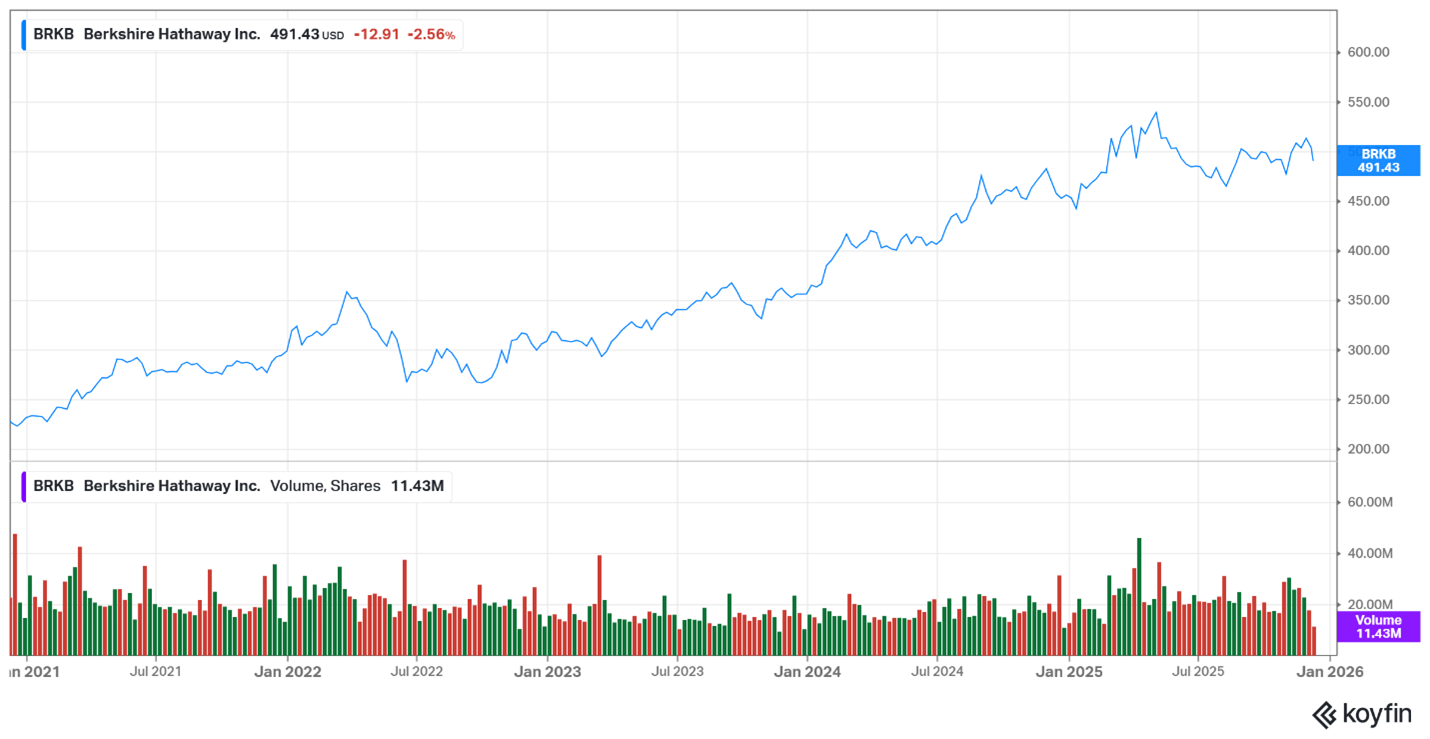
Specific reference is also being made to an “anachronistic” corporate structure – i.e. that of an investment holding company. Combs’s departure is said to be a deviation from Buffett’s strategy. The BH share price has sold off a little bit, but is still less than 10% off its recent highs:
I disagree with the market’s view.
Buffett has always believed in single-point decision-making. While he was at BH, he was that person. Now that he is retired, I think he wants one person to succeed him: Todd Weschler, rather than the other Todd, Combs.
Mr Combs is leaving his job as the CEO of one of the largest insurance companies in the USA (GEICO) to become Jamie Dimon’s senior advisor. Instead of managing a balance sheet of (I think) over $50bn, he will be managing a new strategic investment unit within the bank’s broader “Security and Resiliency” initiative, with $10bn in assets.
My take: I think this is a step down for Combs and an indication that Weschler is the preferred choice as the single point decision-maker. The investment role is a key role at BH, and Mr Buffett, as Chairman, will have thought carefully about this. BH remains in good shape for the long term.
4. Astoria
Speaking of investment holding companies, nowhere are they more out of favour than in South Africa. Most trade at significant discounts to the value of their underlying investments. In the USA and UK, most investment holding companies stand at 5 – 10% discounts. In South Africa 50% is not uncommon.
As a result, almost all of them are pursuing value unlock strategies. This takes the form of significant share buybacks, as in HCI, or the unbundling and sale of investments, as in Ethos.
Or all the above, plus an offer to minority shareholders, as in the case of Astoria.
Astoria’s controlling shareholders (of which I am one) are offering minority shareholders R8 per share, and it is unbundling its holding of Goldrush shares to them. It comes to around R8.60 per share, depending on your view of Goldrush’s valuation, which some believe is significantly undervalued by the market.
Whatever. Before the offer, Astoria was trading – in volume, I might add, at between R6 and R7 per share. During this period, we repurchased some shares. So, the offer allows shareholders who want to sell the chance to realise their investment at levels well above recent market prices.
Of course, we believe Astoria is worth more than the R8,60 on offer; otherwise, we wouldn’t proceed with the transaction. The current NAV per share of R11 is closer to the truth. But we have been saying this for a long time, yet there have always been more sellers than buyers – i.e., the market didn’t believe us. We are offering shareholders who believe in us the opportunity to stay invested; you will not be forced to sell your shares. If you are comfortable investing alongside us in an unlisted, illiquid structure, we are happy to have you join us.
There is a two-step process to play here. First, shareholders need to vote to approve the transaction, and then indicate whether, if the offer is successful, they will accept it. You can read the full circular here.
My take: If you are a shareholder, please vote on the transaction. The deadline is COB 15 December. I will analyse the history and speculate about Astoria’s future in greater depth in a future letter.
5. Dis-Chem
Dis-Chem is an impressive South African entrepreneurial success story. It was established in 1978 by pharmacists Ivan and Lynette Saltzman and has expanded from a single Johannesburg store into a nationally listed retailer with hundreds of outlets across Southern Africa. Its current market value stands at R30bn.
This week, Ivan announced his retirement.
I only ever had an opportunity to speak to him once, and that was not of my choosing. At the time, Astoria was a shareholder in a private, unlisted Dis-Chem. We bought these shares when the Saltzmans required funding for expansion. While the shareholding was important to us, it was small to them.
At one point, a journalist found out 1) that Astoria owned some shares in Dis-Chem and 2) Dis-Chem intended to list on the JSE. The journalist put 1 and 2 together and somehow came up with the theory that we controlled Dis-chem. An article in the Business Day ensued, the gist of which was that Astoria had given Mr Saltzman permission to list Dis-Chem.
Now, anyone who has built a business the size of Dis-Chem will never be a shrinking violet. And if you have built such a business and happen to control it, you will be less than happy about such garbage being published.
You can only imagine the tone of the phone call I got the following day! My ears are still ringing today, many years later.
My take: Ivan and his wife, Lynnette, exemplify the great entrepreneurs this country has produced. They have contributed positively to the lives of South Africans through their hard work, determination, and willingness to take risks. Years ago, pharmacies gouged consumers and were a license to print money, but the rise of Dis-Chem changed all that. For the better. The Saltzmans deserve every honour that comes their way.
6. Ferrari
I’ve written about Ferrari multiple times, as it is on deck as a potential forever stock. Its recent price action is edging it closer to inclusion:
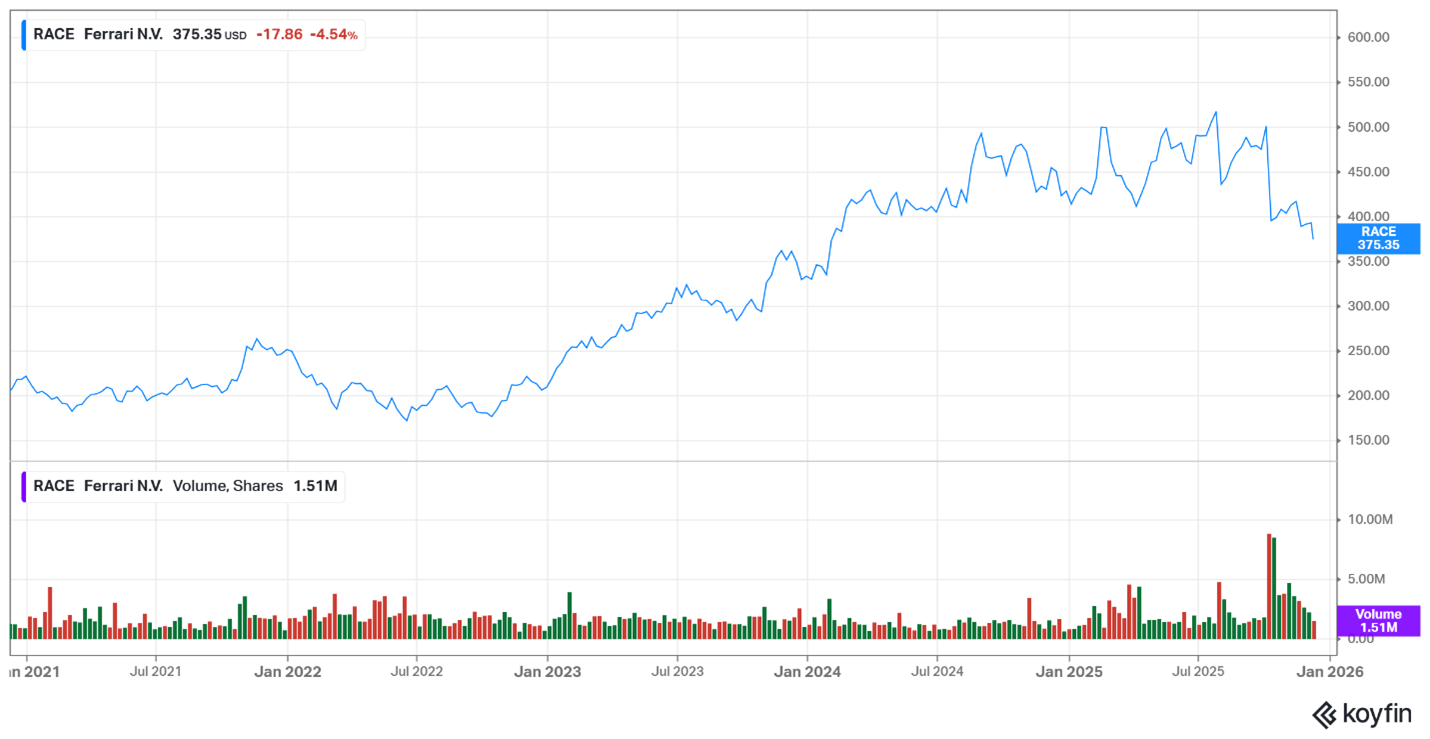
Why would the share price of such a great business be down 25%? Two reasons are being bandied about:
- The market is finally taking management seriously about the practical limit to volume growth, a deliberate decision around the exclusivity of the brand. This protects long-term pricing power, but creates a practical ceiling for the growth rate.
- Concerns about the reception of the Tifosi to the release of an all-electric vehicle.
My take: I think the first point is actually a reason to be more optimistic about the business over the long term, so, to the extent this causes price weakness, it should be taken advantage of. As for the all-electric vehicle, I am sure it will be an experiment, not a strategic departure. That all being said, Ferrari is still too expensive to buy. An EV: EBIT multiple of 28X is just too rich for me.
7. Chart of the week
Things are starting to go South Africa’s way. Exiting the grey list, credit rating upgrades, a controlled fiscal situation, declining interest rates, leading to a substantially lower cost of capital for corporates, and strong gold and platinum prices. It’s all happening.
And now the stock market is starting to outperform global stocks:
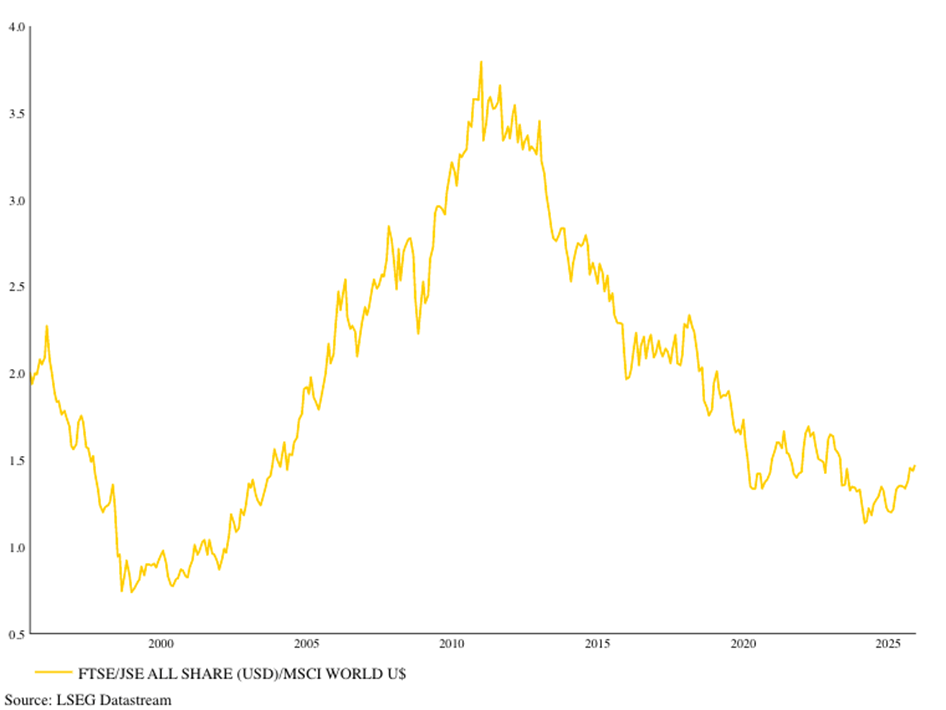
My take: This is only a start – we still have a long way to go, if history is any guide. Which bodes well for the next stage of my offshore vs. onshore bet with Magnus Heystek, which I wrote about a couple of weeks ago in “Paths not Taken”.
In The Media
1. Book review: Wealth, War and Wisdom by Barton Biggs (2008)
Barton Biggs (1932 – 2012) was an American money manager and one of Wall Street’s earliest and most influential global investment strategists. He had a long career at Morgan Stanley, where he focused on emerging markets. He co-founded one of the first U.S. hedge funds in the 1960s, Fairfield Partners.
In this book, Mr Biggs examines the history of the Second World War and studies how markets anticipated and reacted to events. He specifically studied which assets and asset allocation strategies performed best in the capital-preservation stakes. After all, when war engulfs entire continents, resulting in mass migration and markets being closed for long periods of time, it’s not the return on your capital that counts any more, but the return of your capital.
He concluded that there is no single strategy that will protect you in a time of war. It depends on many things, amongst others:
- Are you on the winning or losing side?
- Do you need to move elsewhere to stay safe?
- Does the rule of law survive the war?
The bottom line? Mr Biggs’ recommendation is to diversify your assets both by asset class and location; anticipate trouble; and pay attention to what the markets are telling you, not the politicians. The one asset class that, on average, afforded investors the best protection was equity. In an inflation-prone world – which is the general state of countries that are at war – you want to be an owner, not a lender. He also advocates for having a small portion of your asset base in land. Not buildings which can be destroyed, but land.
Finally, he suggests that the rich are generally too complacent, believing they have more time than they do to evacuate if bad things happen. Which is why he says it is crucial to anticipate the anticipation of trouble. As he says, “It is expensive to move early, but far better to be early than late”.
Studying history is one of the best ways to understand how to deal with the future. This book does an excellent job.
It’s that time of the year when early morning bike rides are a joy – it’s nice and cool, and the wind is absent. And, if you are on holiday, you can take a guilt-free afternoon nap to make up for the early wake-up call. Even if you don’t ride, an early morning walk is as joyful.
But please remember to be careful out there!
Piet Viljoen
RECM
11 December 2025