
Dear Fellow Investors and Friends,
Welcome to my newsletter, where I share my efforts to understand markets and the world around me.
I appreciate you taking the time to read this. Feedback is welcome; feel free to drop me a line. It’s great to start conversations.
Today is Thursday, October 30th, the 296th day of the year. There are 69 days until the end of the year. Tomorrow is Halloween, a favourite day for children worldwide as they go “trick-or-treating”.
The origins of Halloween lie in pagan ceremonies celebrating the end of the harvest and the beginning of winter, seen as a transitional period between the living and the dead. Which, according to pagan beliefs, allowed spirits to return to earth. To ward off these spirits, people lit bonfires, wore masks or costumes, and performed rituals to protect their communities.
As Christianity spread, church leaders incorporated these popular pagan traditions. Large-scale Irish and Scottish immigration to North America in the 19th century popularised Halloween customs. Over time, these blended with other cultural influences to create the secular, community-oriented celebration familiar to many today.
Halloween is one of the few examples of a successful fusion of incompatible elements.
> “Anything you build on a large scale or with intense passion invites chaos.”
> – Francis Ford Coppola
In Apocalypse Now, director Francis Ford Coppola wanted to create a big, sweeping statement on the nature of war and its associated American cultural impact. Filming was scheduled to take place for 5 months and ended up taking over a year. Cutting and editing took another year. Coppola had to negotiate numerous obstacles to realise his grand vision, which resulted in a movie by his wife about the making of “Apocalypse Now”, called “Hearts of Darkness”. It documented the story of the shoot, which was plagued by typhoons, actor breakdowns, health crises, and near financial collapse.
Due to its size and scope, Coppola’s big passion project had to overcome unexpected levels of chaos to be realised. The lesson? Size begets messiness. It takes a lot of time and energy to combat messiness.
> “CEOs feel this tremendous pressure to grow. The problem is that sometimes you can’t grow. Many times, you don’t want to grow because growth can force you to take on bad customers/clients, excess risk, or excess leverage.”
> – Jamie Dimon
A company’s size and scale attract investors and capital. In today’s concentrated markets, where indices are dominated by a few large companies and capital providers are dominated by a few giant index-tracking funds, to stand out, you need to be big.
Big companies accrue the most attention and the highest valuations.
This effect is compounded by the way modern executive compensation systems are structured. Effectively, the rewards for getting big are non-linear. Executive compensation grows proportionally to the cube of the company’s size. Incentives drive behaviour, so it’s no surprise that scaling up is what most executives work hard to achieve.
But as Dimon points out, this growth comes at an expense. The drive for size forces the business to do things that make it vulnerable. How often do you see dilutive rights issues to reduce leverage or impairments of expensive acquisitions? Every time, it’s the shareholders who foot the bill.
> “That which happens in the case of animals must also be true of structures… If you increase their dimensions, you increase the mass faster than the strength.”
> – Galileo Galilei
There’s a reason land animals don’t get much bigger than elephants. As animals increase in size, their body mass increases proportionally to the cube of their length, while the strength of their bones increases proportionally to the square of their diameter. At a certain point bones and muscle can’t support the weight. Beyond that, the whole system collapses.
Companies face the same constraints – the bigger they get, the more extraneous “weight” they accumulate. Weight which reduces the quality of their interactions with clients, the efficiency of their internal dynamics and sometimes even the quality of their products.
In large companies, processes get messy. As Coppola learnt in making his movie, it takes increasing amounts of energy to combat this entropy – energy that goes into product design in a smaller company, energy that goes into thinking about product-market fit in a smaller company, and energy that goes into understanding the customer in a smaller company.
Despite this, everyone’s trying to “scale up”. With the technology available today, it’s easy to produce more content, more connections, more slop. As all of this is made on an industrial scale, choice confusingly proliferates, complications deliberately compound, and sameness insidiously spreads. This leaves the customer wondering why her levels of satisfaction with the service or product keep declining, despite these large companies congratulating themselves daily on their market share statistics.
> “Cycling is all about staying light; rugby is about staying heavy. The suffering’s the same, just in different forms.”
> – Martin Johnson
In sport, the Venn diagram of who is good at rugby and who is good at cycling has no overlapping area. Cyclists are small, powerful athletes, while rugby players are large, strong athletes. Cycling is about inner toughness. It’s about the ability to suffer and handle your bike with precision. In contrast, rugby’s physical ferocity is expressed by players who find beauty in confrontation.
In business, the Venn diagram of good businesses and large businesses also has little overlap. Unlike rugby/cycling, there are a few exceptions. The problem is that all large companies think they are the exception. The CEOs of these businesses all think they are operating in the overlapping area of the Venn diagram. But then, what is “good” is usually measured along the axes of market share, brand awareness, and share price. True quality – a sustainably high return on equity, a robust balance sheet, and actual customer satisfaction – is rarely referenced.
Here’s a thought experiment: think about the last time you had a wonderful experience with a product or service. Then think about the size of the company that provided it.
I believe we’re entering an age where real people in small companies producing unique products are coming back into favour.
But this is not me just hoping for a different future.
At RECM, we recently signed a term sheet to invest in a small business called SLOOM, the leading foam mattress retailer in South Africa. 18 Months ago, we also invested in Noola, South Africa’s most popular baby brand. Young entrepreneurs founded both businesses and delight their customers daily. As a result, they are growing rapidly.
To put those businesses in perspective, about 13 years ago, we invested in a small company called Safari Outdoor, which had one shop just outside Stellenbosch. At the time, its turnover was less than R80m – about the same as Noola and SLOOM today -and it was growing rapidly because of its ability to delight customers. Today, Outdoor Investment Holdings does turnover of over R1.2bn and operates across multiple outlets and formats. It has grown revenue by 23% p.a. since our original investment. But it continues to delight its customers, and we think it still has tremendous growth prospects.
I believe that size and quality are mutually exclusive, and I am excited to increase my investment in small, private, entrepreneurial businesses.
In The Markets
1. Estée Lauder (EL)
As Freddie Mercury sang, “…bad mistakes, I’ve made a few” – Estée Lauder is one of mine. I included the company among my “10 stocks, forever” because it met all the criteria I set for inclusion – strong culture, long history, global diversification, good quality, and financial robustness.
But not as robust as it needs to be – I underestimated the increasing financial burden of EL’s debt from acquisitions, with the company having a balance sheet that reflects more debt than equity. This makes it too financially vulnerable, thereby disqualifying it.
Last week, I rectified the situation by selling the entire EL holding from the MWI Worldwide Flexible fund (aka the cockroach). At the time, it made up 2.9% of the fund, up from 2.5% at the time of the initial purchase. The good news is that the stock was bought after its precipitous decline and sold after a reasonable recovery.
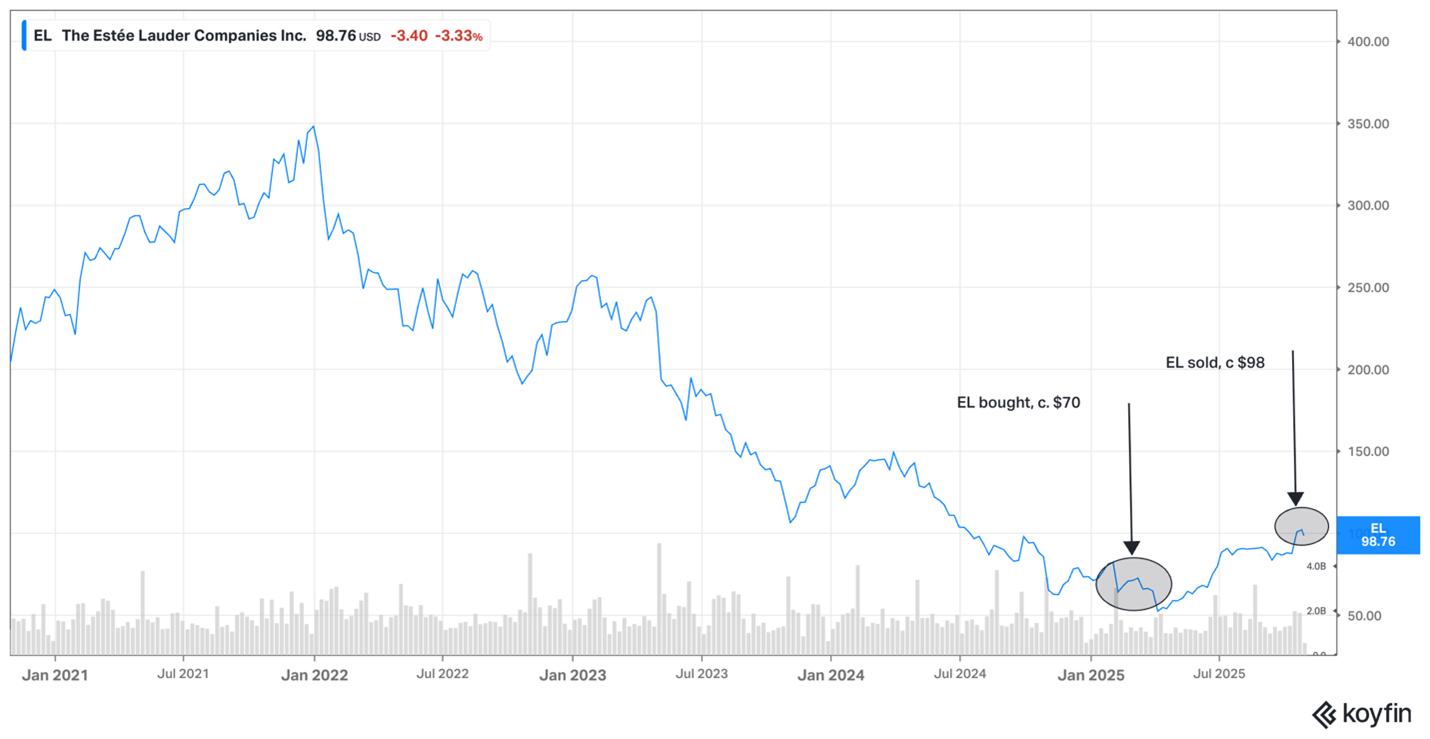
My take: This was a happy accident, which no one would know about, since the investment in EL turned out well. But it nevertheless remains a mistake, one in which I am publicly rubbing my nose, in the (probably vain) hope that in future I will refrain from making similar ones.
2. Growthpoint
Growthpoint is the largest REIT by market capitalisation in South Africa. Amongst other properties, it owns the V&A Waterfront precinct in Cape Town – probably the best piece of real estate in the country.
After suffering a near-death experience during the COVID scare, the REIT sector is making a comeback. Last week, Growthpoint’s share price reached an all-time high:
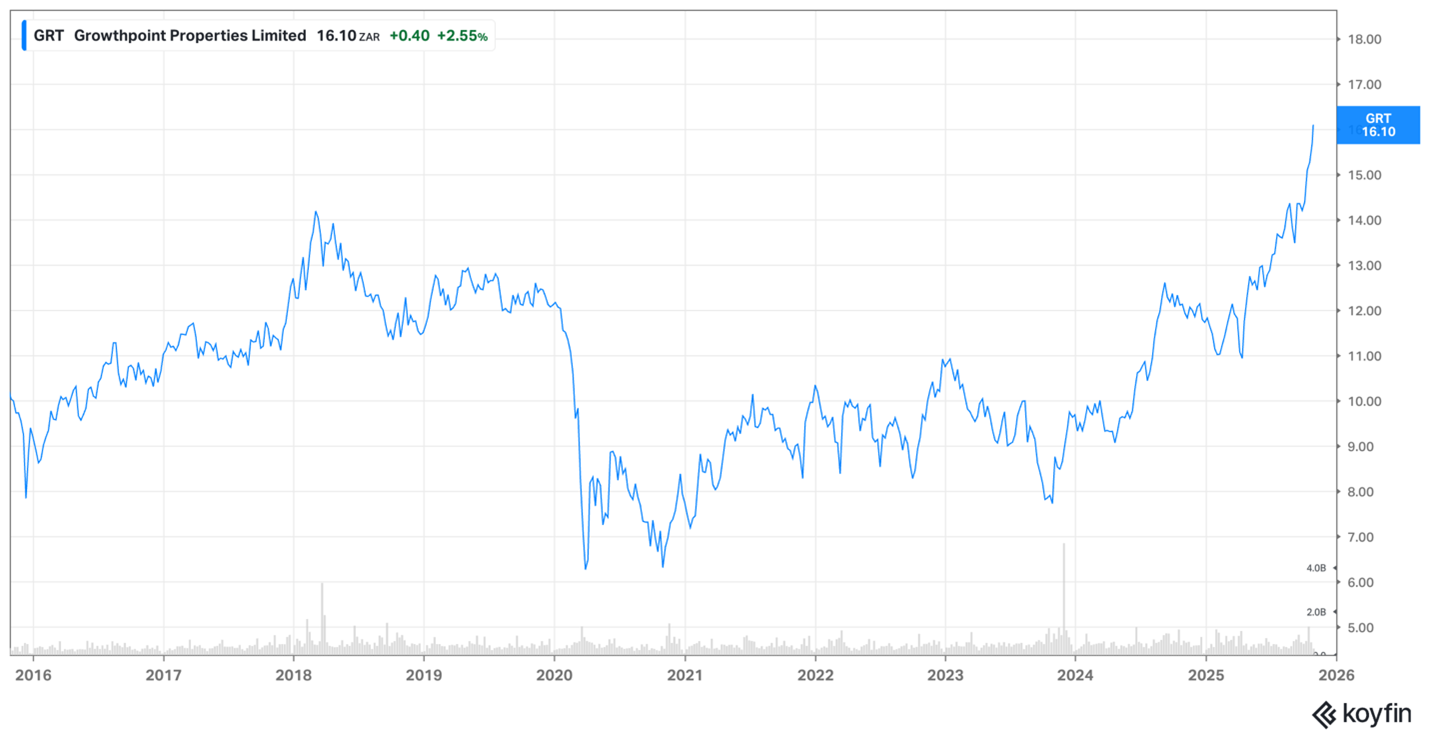
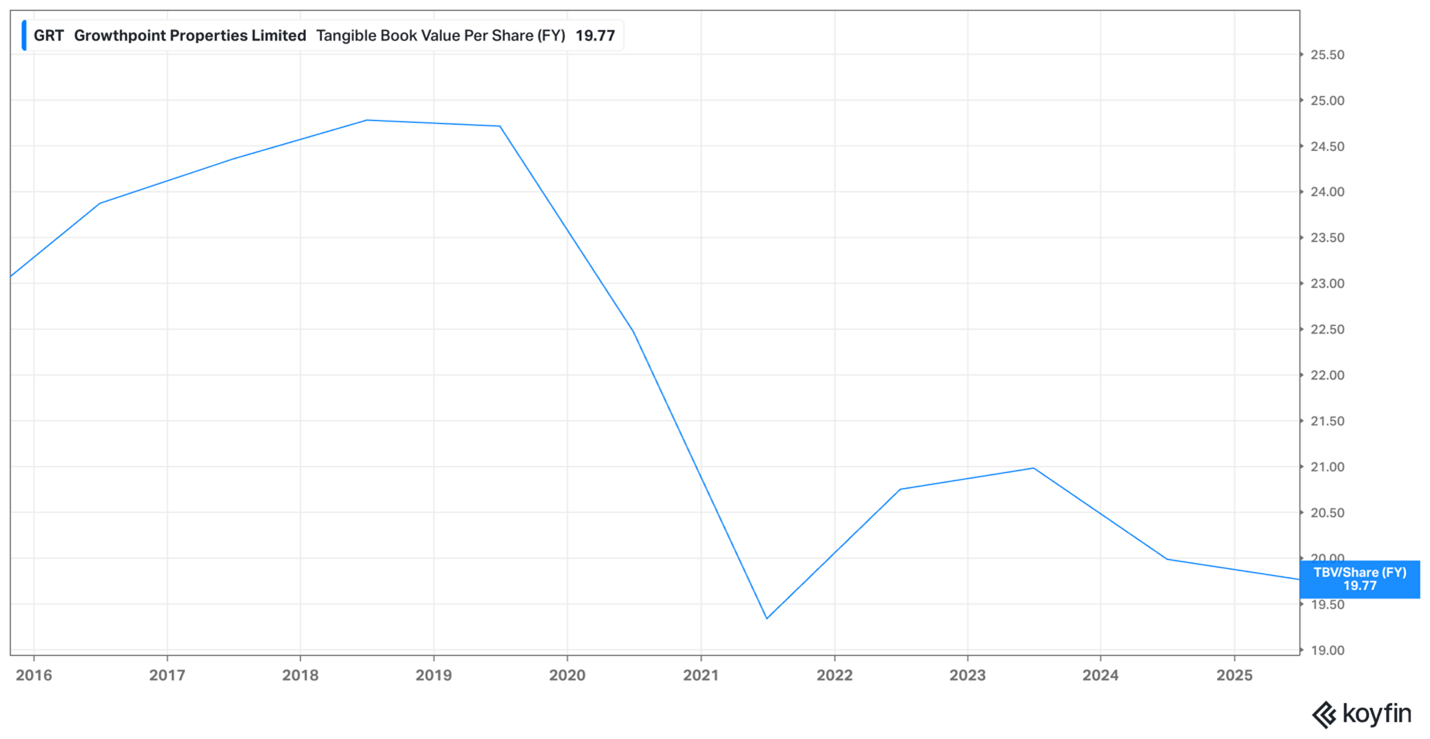
As a result, it is now yielding only 7.7%. This is a company that’s been unable to grow its NAV per share over the past 10 years. In fact, the NAV per share has declined, like the value of most properties over time:
Substantiating this value-destructive characteristic of property is the fact that Growthpoint – the biggest and “best” REIT in South Africa, which owns the most iconic property – has exhibited a peculiar inability to grow its distribution to shareholders over the long term. This is a graph of its distribution per share since 2010:
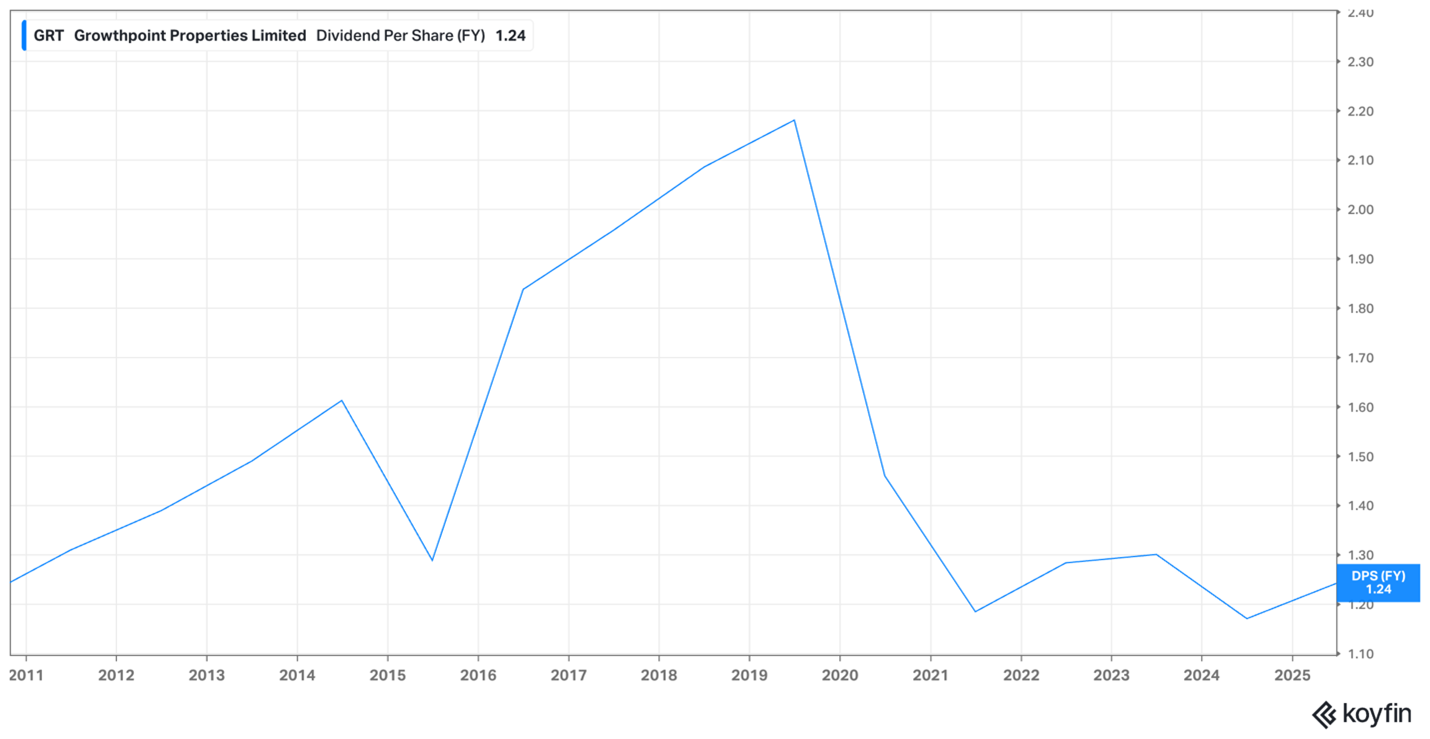
My take: This is a shocking indictment of property as an investment option. As I have often said, the words “property” and “investment” do not belong in the same sentence. At best, it can be a good trade. But right now, it seems the yield pigs have come out to play again. Caveat Emptor.
Why buy a deteriorating asset, with excessive management costs, on a yield of 7.7% when you can buy a government bond on a yield of 10%?
3. Warner Bros. Discovery (WBD)
The media sector is undergoing one of its regular revolutions. Streaming is radically changing the way media is produced and consumed. Last week, one of the bigger losers in this revolution, WBD, announced it was for sale and hoped to spark a bidding war. Its share price reacted positively:
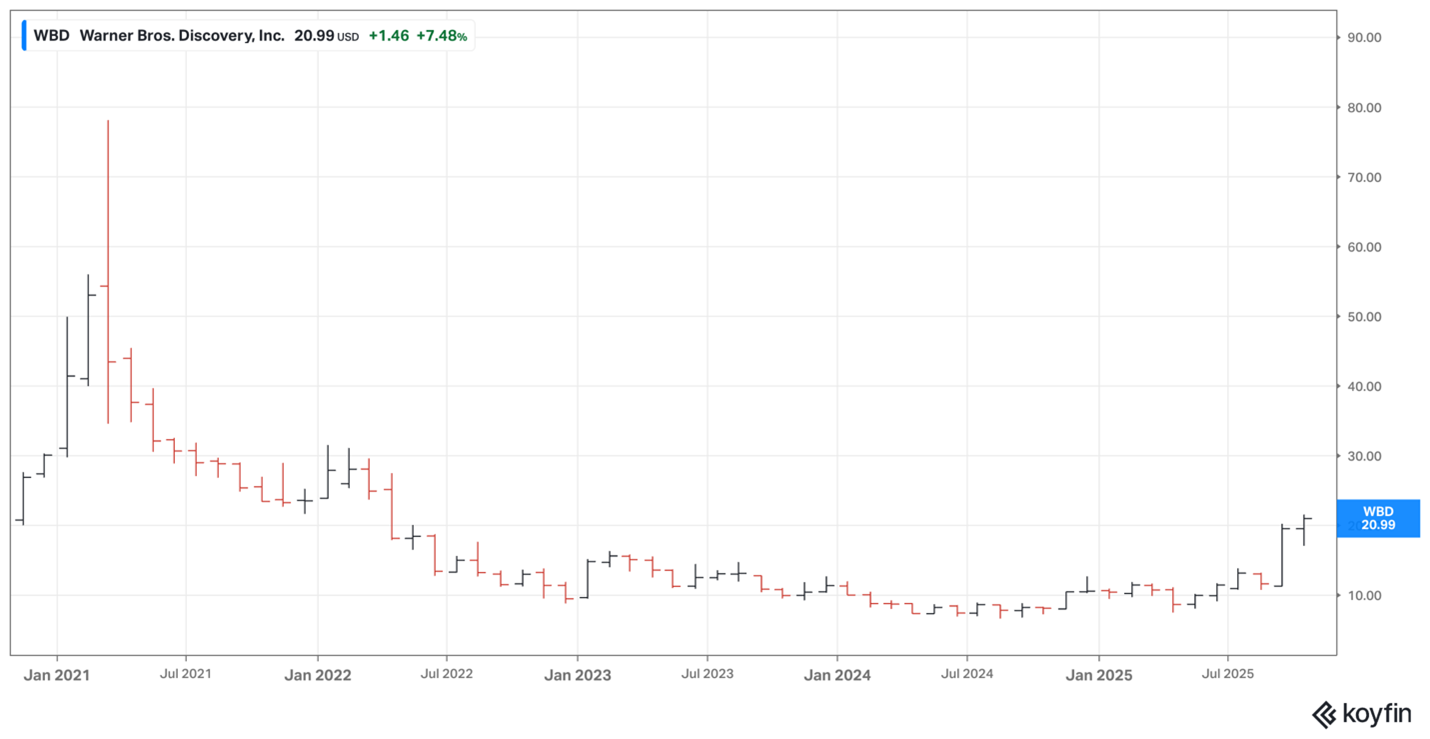
The scale doesn’t do it justice: that’s a jump of almost 100%! So far, despite all the hype, only one bidder has emerged: David Ellison of Paramount. Ellison is the son of Larry, one of the wealthiest men in the world and the founder of Oracle. Here’s an outline of events:
- WBD was created by merging Warner Bros. with Discovery. WB had content, and Discovery had a global reach. It was hoped the combined business could stand up against Netflix. The merger came with a lot of debt, which is still weighing heavily. And so far, Netflix is winning the streaming wars hands down.
- As a result, the strategy became to separate the linear business driven by sport from the streaming business driven by entertainment. Allowing each to follow its own plan with an appropriate debt level.
- Since then, WBD say they have received interest from several parties. According to media reports, Paramount submitted bids of 19, 20, and 23 dollars, though it seems to me that it is bidding against itself.
- As with most M&A transactions driven by bidding wars, the likelihood is that Paramount will overpay. On top of WBD’s already heavy debt load, this is seen as problematic by many market commentators.
But the wildcard is that Oracle is one of the buyers of US TikTok. What media companies need – in addition to rich content – is a funnel to attract and retain viewers. Netflix has a seamless user-focused onboarding process. Google has YouTube. Look what’s happening:
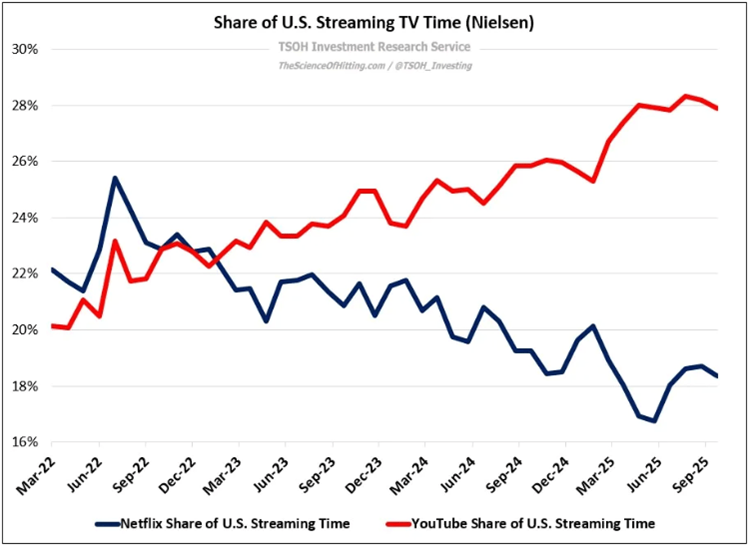
My take: If TikTok becomes Paramount/WBD’s funnel, Netflix could face a second significant competitor after YouTube in the form of Paramount/WBD/TikTok. But Paramount/WBD might face Richard Thaler’s winners curse. I continue to believe it is a sector to be avoided until the dust has settled.
4. Artificial Intelligence
Everyone has a lot to say about what’s happening in the world of AI. But I don’t think anyone – even Jensen Huang – really knows how things will play out. For me, the best guide to the future is not an “educated guess” but a good grasp of history.
Last week Vitaly Katsenelson published this article, which sets out in a very readable way why investors should sit out the AI arms race. The guys at Hosking Partners substantiate this view in this piece.
A reader sent me this link, which explains the capital intensity of the AI boom well. The TL;DR? “…we find that historical capital expenditure booms have typically resulted in overinvestment, excess competition, and poor stock returns – both at the macro and individual firm level.”
But maybe it’s different this time…
David Einhorn said it well in his latest letter:
“We write all of this to explain why we are refusing to participate in the excitement. It has been a good year for the S&P 500 and a great year for the few dozen companies central to the AI story. It has been harder to make money on long investments outside of this ecosystem, because most of the rest of the economy has been floundering. While others are doing better than us for the time being, many are taking risks that we find hard to get comfortable with.
In our experience, when the tide turns, it does so quickly and without warning. Even 25 years later, it’s still not clear why the internet bubble popped when it did. Our view is that it was due to the last buyer buying and the last short seller covering – a phenomenon that is very difficult to time. This remains the most expensive market we have experienced, and we don’t see a better option than continuing to be cautious.”
My take: There’s nothing like a 20-bagger in 5 years to drive FOMO:
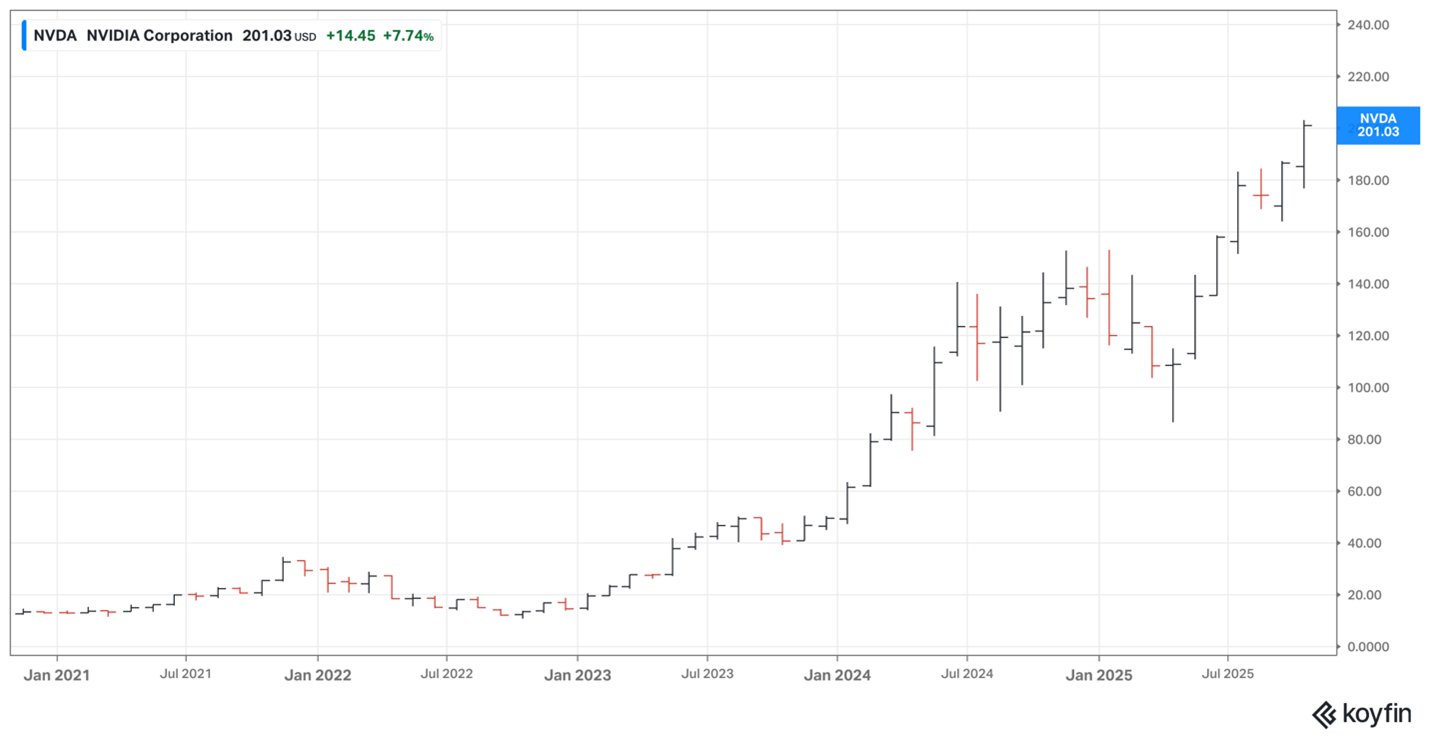
Last week I said I’m not involved and I’m sleeping well. The way I think about this is not that I’m losing ground against other – smarter? – investors, but I’m gaining ground slower than they are. Importantly, when the reckoning comes —which it inevitably does in capital-intensive industries —my gains should remain largely intact.
5. The MWI Worldwide Flexible Fund Quarterly Report
This report, detailing how the fund I have nicknamed “the cockroach” is currently structured and how it has performed, is now available here.
My take: The fund is slowly and steadily making up lost ground against its benchmark – ground lost during the 2017-2020 period. I am more than satisfied with the progress made since the process changes in 2020.
In The Media
1. The best music of 1996
Another month, another year reviewed. 1996 was when I had to put my head down and start working properly, after having enjoyed a “gardening leave” year in 1995. I was with Investec Asset Management, and under the leadership of Hendrik du Toit, it was growing like the clappers. We were a young and inexperienced team, but Hendrik threw us all into the deep end and trusted us to get on with it.
It was real sink-or-swim time. Fortunately, having started as non-swimmers, most of us kept our heads above water and eventually ended up swimming quite proficiently.
It was truly a year in which I experienced – and learnt – a lot. One of my favourite songs of all time, “The Freshman” by the Verve Pipe, was released in 1996. The song will always remind me of that hectic, rewarding time. According to Perplexity, “the song explores themes of innocence lost, the confusion of growing up, and the complexity of dealing with consequences that stem from adolescent decisions.”
I did a lot of “corporate” growing up in 1996. It was also an excellent year for music.
Here are the top 10 albums, according to me, from 1996 on Apple Music and on Spotify.
And here are the top 20 songs, ranked from 20 to 1 – just like any self-respecting hit parade. On Apple Music and on Spotify. Again, very much according to me.
Finally, the long list of all the best songs on Apple Music.
I hope you find something that brings you joy
2. Stephané Conradie
Amanda and I both love art, and as a result, we built a modest collection over the years. One of our favourite artists is Stephané Conradie. The Afrikaans magazine “Klyntji” recently had a lovely piece about her work. You can read it here.
It’s in Afrikaans, so use Google Translate if you struggle with that. Or simply look at the pictures of her work. They’re exquisite!
3. Longevity
Last week, I wrote about what one could do to maximise the time over which your investments compound. As if on cue, Peter Attia released a new podcast discussing the longevity benefits of protein intake, the mental and physical benefits of creatine, as well as the use of saunas. You can listen to it here.
As a bonus, a reader sent me this little video. After watching it and wiping the tears from your eyes, you’ll probably sign up for a gym membership. Virgin Active, thank me later.
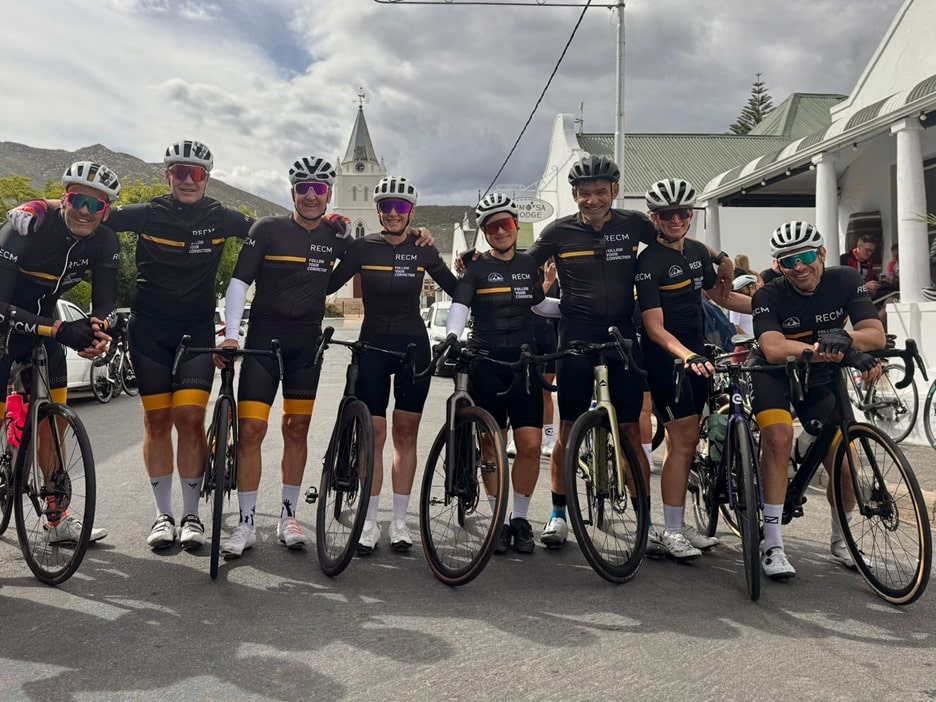
Last weekend, Amanda and I participated in the Cape Classic 380 cycling event. It covers around 340 km over three days and includes scenic and challenging stages along the famous Route 62 and surrounding valleys. Tony Pushman and his wife, Hazel, do a great job of organising it. If you’re a cyclist, no matter what level, it’s a must-do event.
Here’s our group at the end of day 2:
This weekend, we’re going to the Klaserie to celebrate the birthday of Alet, my business partner Theunis de Bruyn’s wife. It’s super hard to be successful without the support and feedback from a committed spouse by your side. In Alet, Theunis has the perfect sounding board. I am thankful for her presence in our lives.
Happy birthday Alet, Amanda and I look forward to celebrating it with you and your family!
Piet Viljoen
RECM
30 October 2025