
Dear Fellow Investors and Friends,
Welcome to my newsletter, where I share my efforts to understand markets and the world around me.
I do appreciate you taking the time to read this. I love getting feedback; feel free to drop me a line. It’s great to start conversations.
Today is Thursday, April 23rd, the 113th day of the year. There are 252 days left until the end of the year. On this day in 1985, Coca-Cola launched “New Coke”, replacing its 99-year-old original formula with a sweeter recipe to counter Pepsi’s rising popularity. Despite positive blind taste tests, the public vehemently rejected the change, prompting a return to the original formula 79 days later.
This ranks as one of the major misjudgments in corporate history and is an illustration of one of Charlie Munger’s 25 classes of misjudgments, which he so eloquently described in his treatise “The Psychology of Human Misjudgments”.
Coca-Cola executives underestimated how much customers would hate “losing” the original formula. The “Deprival-Superreaction Tendency” (nr 14 on Munger’s list) states that people react much more strongly to a loss than to a comparable gain. Even though New Coke beat the original in taste tests, customers felt a sense of loss that triggered a massive, irrational backlash.
Munger delivered his work as a speech at Harvard university in 1995, 10 years too late for Coca-Cola. But all of us – investors, businesspeople and even those of us just going about our daily life – can still benefit from internalising his work.
In the investment world, it has been my experience that the best investors succeed not because they are the smartest people in the room, but because they consistently avoid big mistakes. I’m sure this holds true in many other spheres of life.
Munger’s core insight is that cognition is situational: the same person, presented with different incentives, social cues, or emotional triggers, can reach entirely different conclusions. The common thread linking these tendencies is that they are often useful – evolutionarily sensible, even – but dangerously misleading when applied outside their proper domain.
Here are a few examples that illustrate the point:
Reward and punishment super-response tendency: Incentives are more powerful than we expect. As Ben Franklin observed: “If you would persuade, appeal to interest, not to reason.” This single principle explains much of human behaviour, from corporate scandals to the chronic incompetence of governments. People respond to what they are rewarded for, not to what they are told to value.
Liking/loving tendency: We are far too willing to believe, trust, and forgive people we like. Once affection enters the picture, objectivity quietly shuffles out. This is why charming executives raise capital more easily than competent but dull ones – and why investors so often confuse likability with ability.
Over-optimism tendency: Humans systematically overestimate their abilities, their odds of success, and their control over outcomes. This tendency is rocket fuel for bubbles. It convinces us that this time is different, that risks are manageable, and that the downside is borne by others. After all, we’re all above-average drivers, aren’t we?
Authority-misinfluence tendency: We are wired to defer to authority figures, even when they are wrong or speaking outside their domain of competence. Titles, uniforms, credentials, and confidence all short-circuit independent thought. The problem is not authority per se; it is unearned authority that goes unchallenged.
Twaddle tendency: This refers to Munger’s term for confidently presented nonsense. It often involves complicated language, jargon, and moral certainty to hide superficial thinking. Twaddle tends to thrive in environments where sounding intelligent is valued over accuracy. The financial services industry is a prime example of a place filled with twaddle.
In his work, Munger did, however, omit one tendency. One that feels particularly relevant today: epistemic spillover.
Epistemic spillovers occur when our trust, admiration, or agreement with someone in one domain improperly extends to unrelated domains. Because we like someone’s music, acting, or investment returns, we begin to treat their opinions on politics, science, or physics as insightful.
This is why musicians and movie stars wield such influence in public discourse. We appreciate the entertainment they provide, and that positive emotion spills over into areas where they have no expertise. Who cares what Bono thinks about extreme poverty and how aid should be applied? What gives him any credibility on this complicated social topic? Why are successful fund managers routinely treated as philosopher-kings – authorities on life, the universe, and everything – despite being, at best, specialists in a narrow and highly contingent field?
Frankly, I would welcome far more “I don’t know” answers from celebrities when questioned about topics they know only superficially.
This feeds directly into another of Munger’s key ideas: suboptimal information-seeking and judgment errors. If you rely on someone who can build a good spreadsheet for insight into social development policy, you are setting yourself up for serious error.
A contemporary example explains this effect well. Greta Thunberg is a 23-year-old political activist who was first given a global platform to denounce world leaders’ climate policies when she was only a teenager. What deep, first-principles understanding of climate science, energy systems, or international politics could she reasonably have developed in so few years on the planet? Does she meaningfully understand the political, historical, and religious complexities of the Gaza Strip? Yet she is handed the microphone whenever her handlers wish to persuade us of a particular viewpoint. That is epistemic spillover in action.

The danger compounds when this phenomenon merges with groupthink.
In the lead-up to the Global Financial Crisis, banks, regulators, rating agencies, and investors all operated within the same intellectual bubble. Everyone used similar models, relied on the same assumptions, and took comfort in the fact that “everyone else agrees.” Dissenters were marginalised, and warnings were dismissed as pessimism. The consensus became a substitute for thinking. When reality inevitably asserted itself, the damage was catastrophic.
This dynamic closely mirrors the Gell-Mann Amnesia effect – the peculiar habit of trusting the media or expert commentary immediately after noticing it was completely wrong. You read an article on a subject you know well and spot obvious errors. You recognise the journalist’s incompetence. A minute later, you turn the page to a topic you know nothing about – and instantly suspend disbelief. Amnesia sets in.
Put epistemic spillovers, groupthink and Gell-Mann amnesia together, and you get echo chambers, information cocoons, and a steady erosion of independent judgment. Social media, in a nutshell.
The takeaway for us is simple but uncomfortable: remain sceptical, especially when opinions are wrapped in confidence, celebrity, or consensus. Separate domain expertise from general wisdom. Be allergic to twaddle.
Avoiding stupidity is far more powerful than chasing brilliance.
In The Markets
1. A tour of global markets
After being on holiday for a while, I always find it useful to take stock of what market prices are saying. I find it more useful to listen to the market than to the talking heads. Except when it comes to music, where the Talking Heads rule.
The first stop is always Dr Copper – the commodity said to have a doctorate in economics. Let’s see what she is saying:
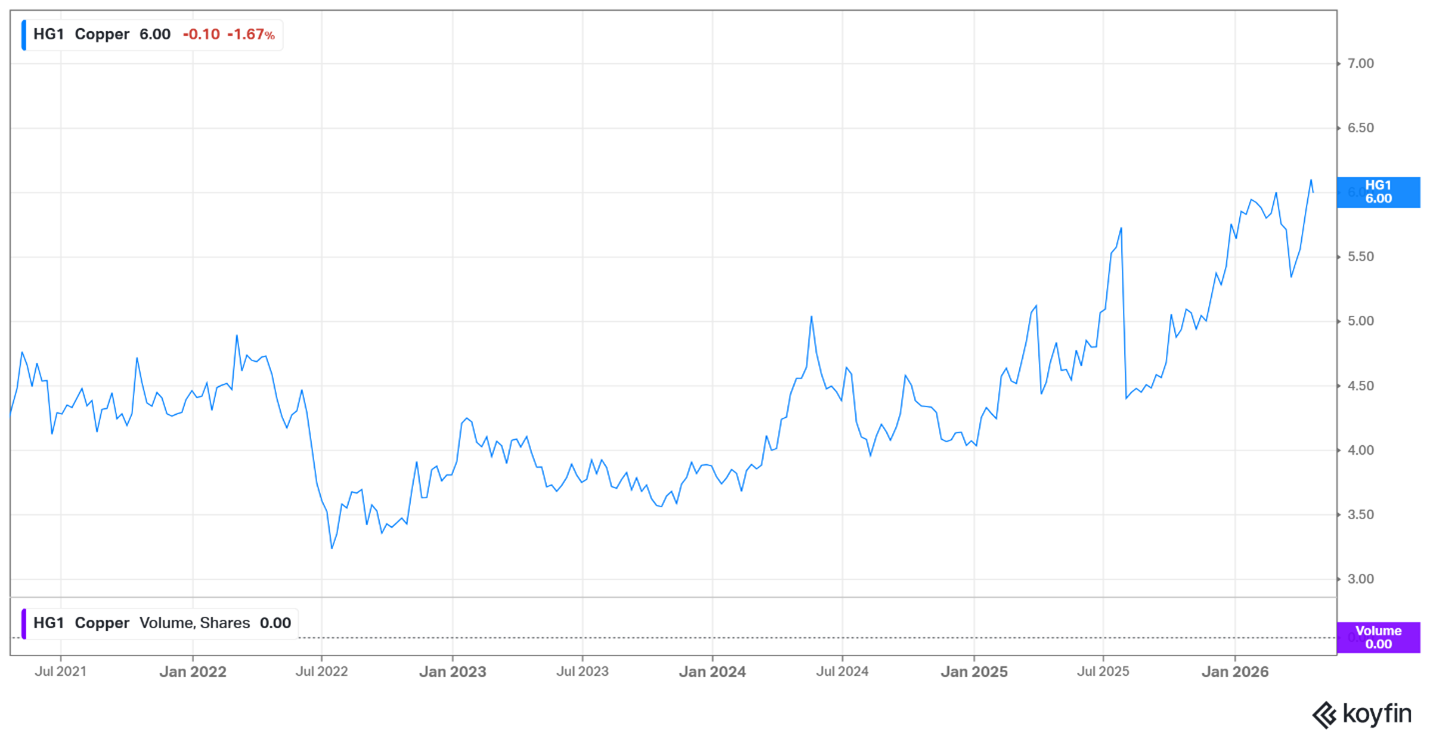
Despite the war in Iran, copper continues to hover around an all-time high. This is bullish, as the good doctor seems to be saying all is well with economic growth.
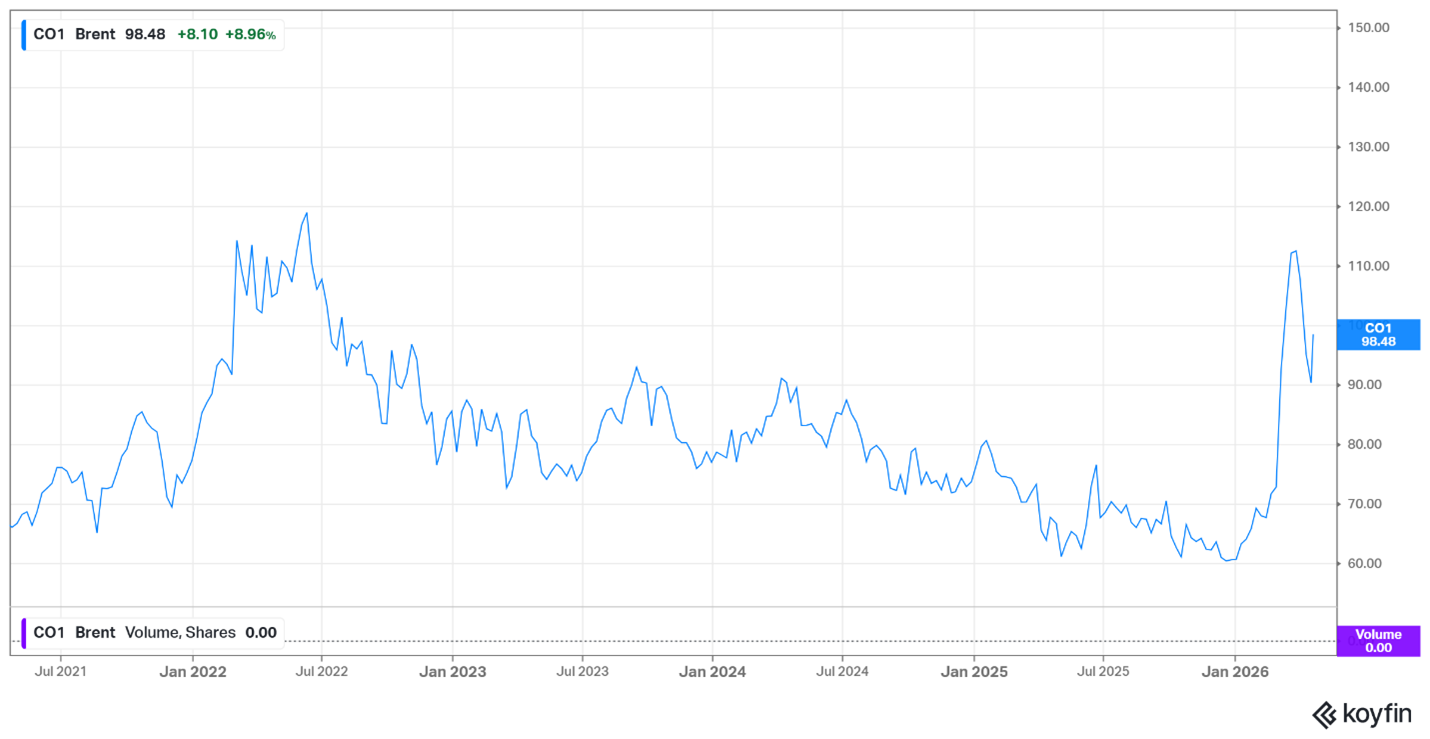
Oil prices are a good leading indicator of inflationary pressures. Currently, it indicates that inflation will probably be higher in the future than it has been in the past. But not as bad as post 2022:
Next up, let’s have a look at the gold price, an indicator of overall trust in the system. Despite the recent sell-off, the gold price remains at elevated levels:
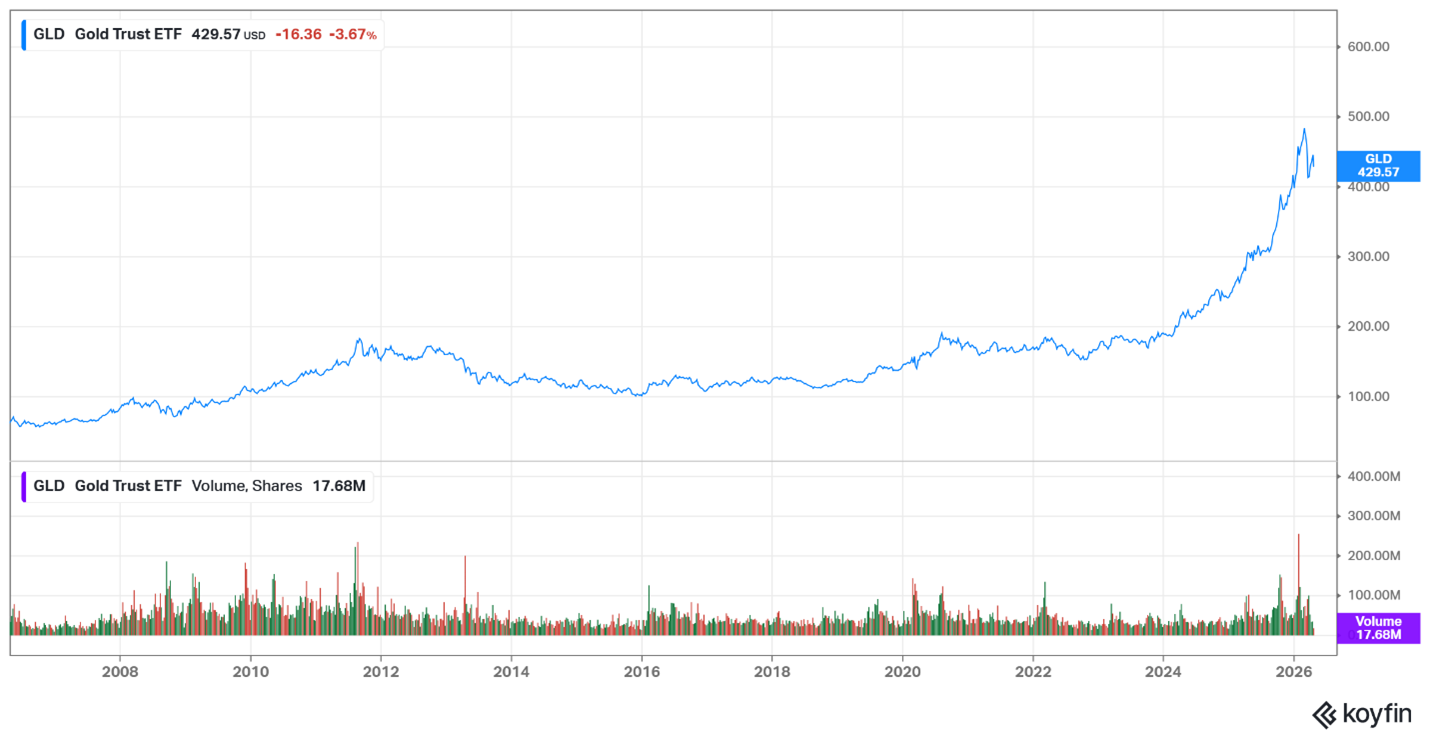
Trust remains at low levels. To me, this means we will probably see more regulation, more friction and more controls on the movement of people, goods and capital worldwide.
Now, for the equity market, the MSCI World recently hit a new all-time high:
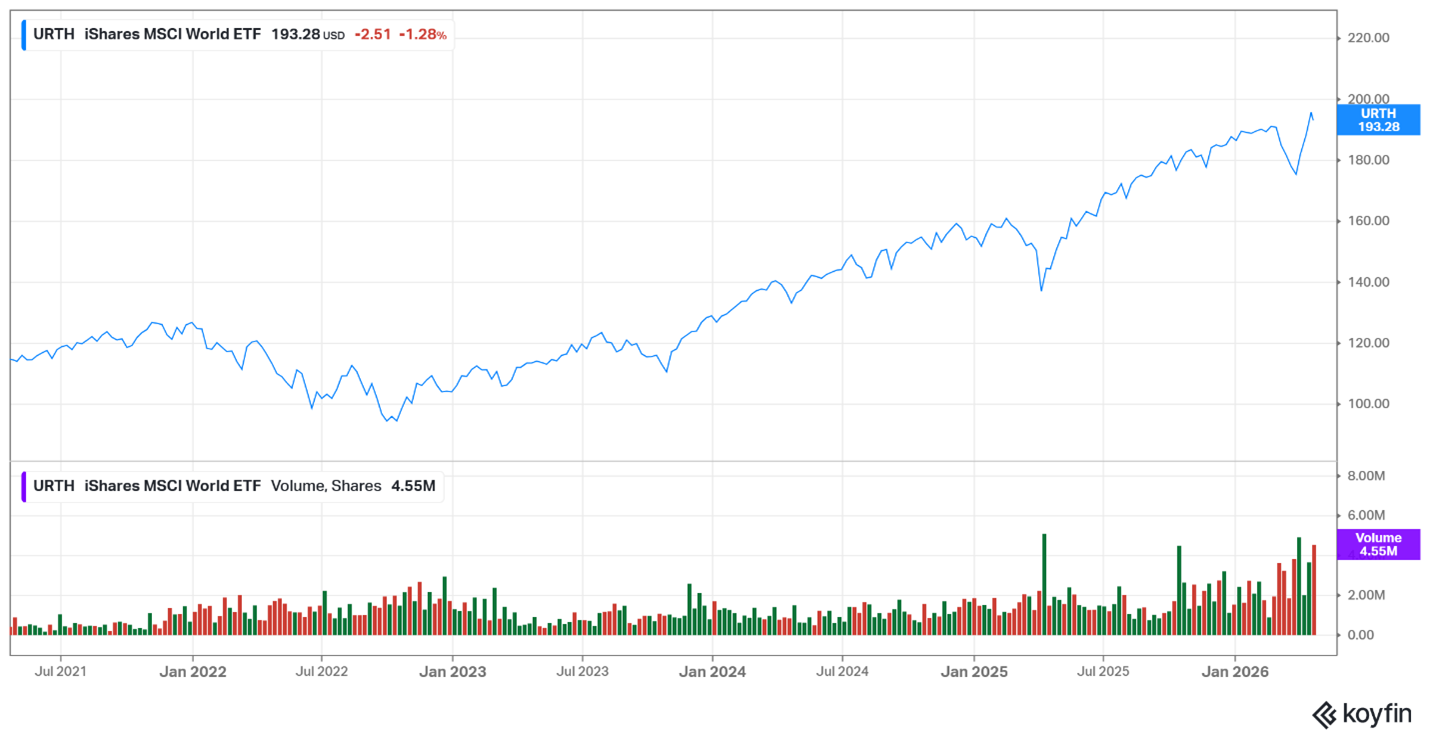
Equity markets do not seem to be fazed by the war. At all. The recent sell-off was as a small blip in a strong upward trend. Importantly, emerging markets continue to outperform developed markets:
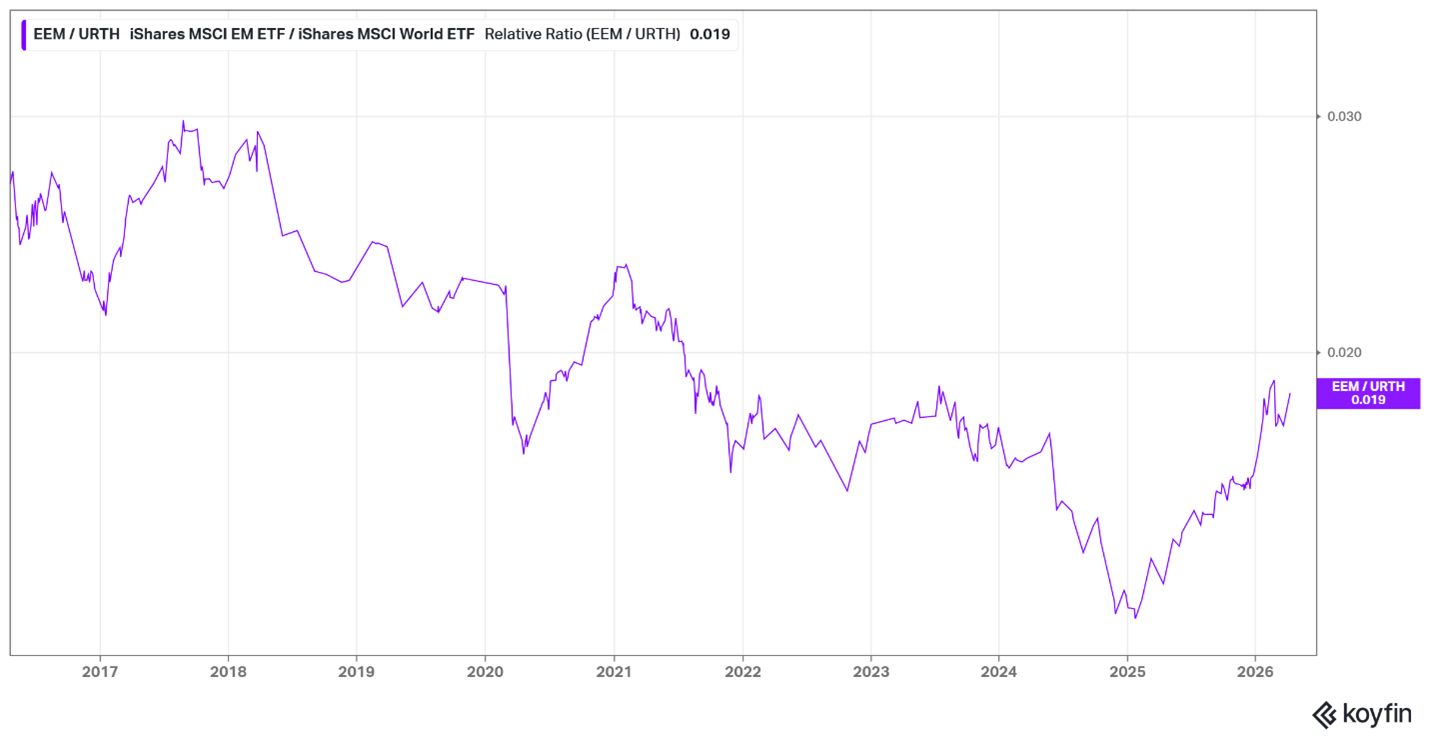
After underperforming for 10 years, emerging markets started outperforming developed markets in January of this year. Normally, when there is a risk-off event, such as a war, emerging markets take a big hit. Not this time. The market seems to be telling us that times have changed.
Prof. Aswath Damodaran from NYU wrote an extensive piece on what recent market movements imply. His views are much more rigorously substantiated than mine, and are worth reading here.
My take: There is a view amongst market commentators that markets are complacent in the face of the uncertainty caused by the war. Market prices, however, are telling me something is happening that is different to how markets have operated over the past 10 to 20 years. I don’t think traditional US-centric 60/40 balanced funds are prepared for these changes.
2. A quick tour of some recent stock-specific events
a. Prosus
As a quick refresher, Prosus is an investment holding company listed on the Amsterdam Stock Exchange. Its primary asset is Tencent Holdings, one of the world’s best companies, which accounts for 80% of Prosus’ NAV. The rest of its NAV consists of a hodgepodge of tech stock holdings, chiefly in the food delivery sector. Which is a sector that has performed particularly poorly:
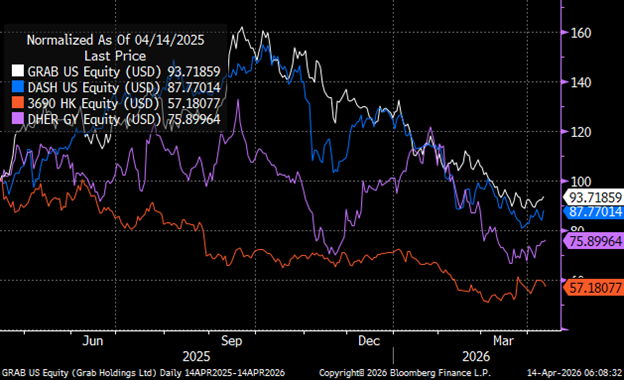
Prosus has stakes in Grab Holdings, DoorDash, and Delivery Hero and has recently acquired 100% of Just Eat. Last week, Prosus sold a portion of its Delivery Hero holding to Uber. Regulators are forcing Prosus to sell this to address competitive concerns. And so are shareholders, it seems, as the Prosus discount to NAV has widened markedly over the past year – coincidently (?) shortly after they acquired 100% of Just Eat:
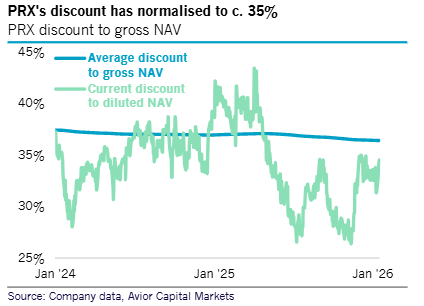
It seems that it’s not only the regulator that wants Prosus to stop investing in home-delivery businesses!
I understand the economics of “last mile delivery” – provided you are the last man standing in a sector where many deep-pocketed players are spending heavily to be that man. As with most of these capex splurges, I think the value created will accrue to the consumer rather than the provider.
My take: Prosus would be much better off selling these assets and buying back its shares. But the institutional imperative prohibits this. Just think of all the highly paid execs at Prosus being out of a job! Turkeys will never vote for Thanksgiving.
b. Spar
Spar shareholders have had a torrid time over the past few years. Poor offshore acquisitions and IT implementation, missing the online delivery boom and fights with franchisees have left the share price in the doldrums:
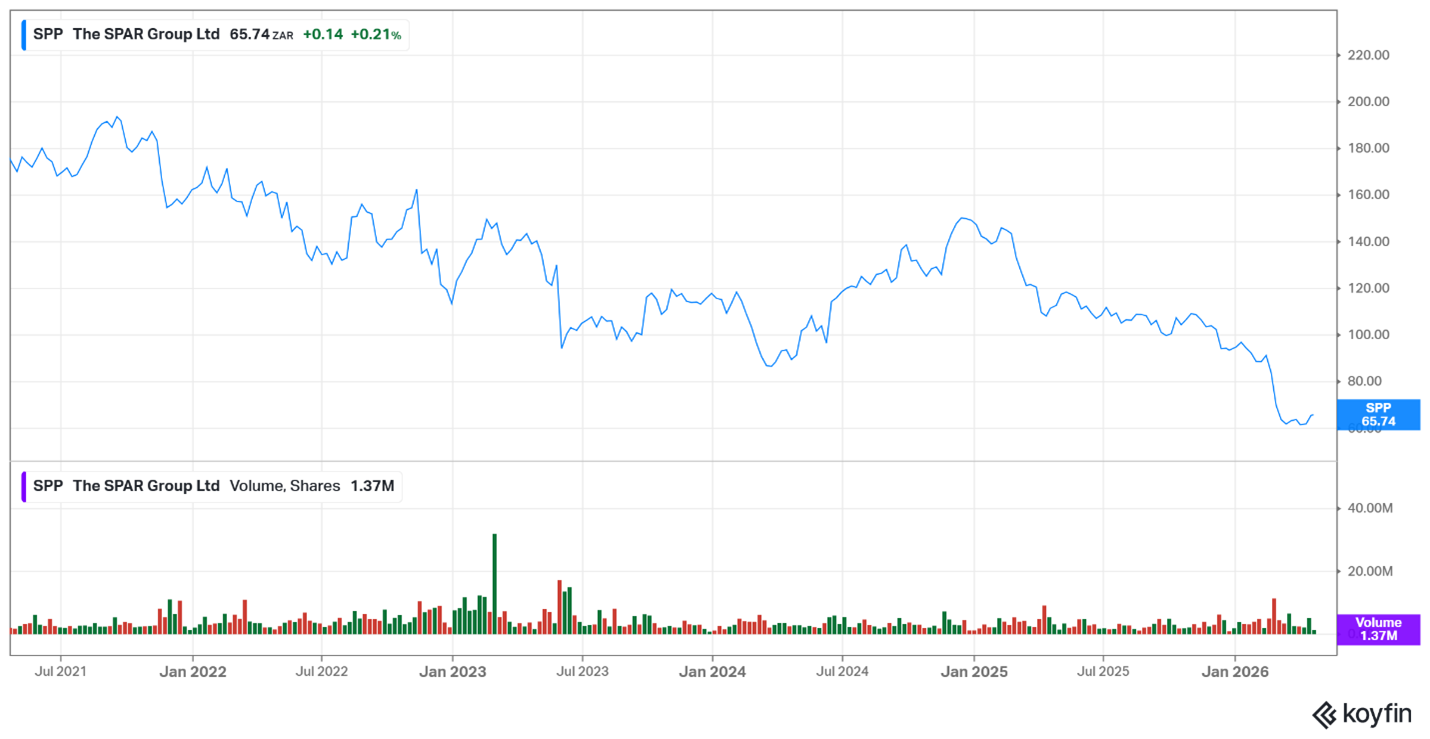
Given that it has declined by over 60% over the last 3 years, it’s not surprising that management has been a revolving door. There have been 4 CEOs and 2 CFOs during this period. Last month, the CFO was confirmed as the new CEO. From 2013 to 2023, this person was CFO at that other perennial disaster in South African retailing, Woolworths. This was what the share price of Woolies did over that period:
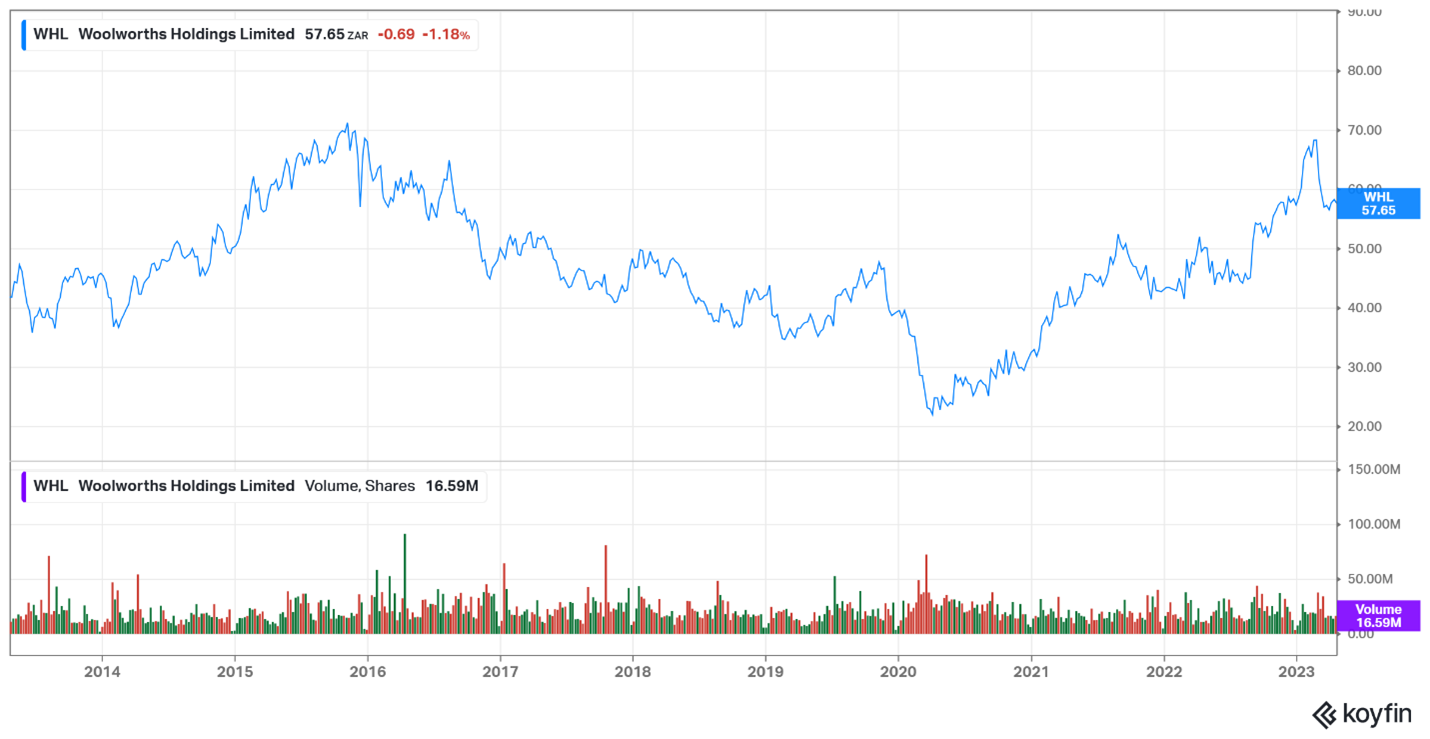
It compounded by 3% p.a. Enough said.
My take: Retailing in South Africa is a super tough game, and even the best people struggle to create value for shareholders. Management matters in all businesses, but especially in retailing. I’m not sure the shareholders of Spar should relax quite yet.
c. Afrimat
Speaking of management, Afrimat has long had a reputation for having one of the best management teams in the industry, and possibly even the country. But recent events have left the share price reeling, at 5-year lows:
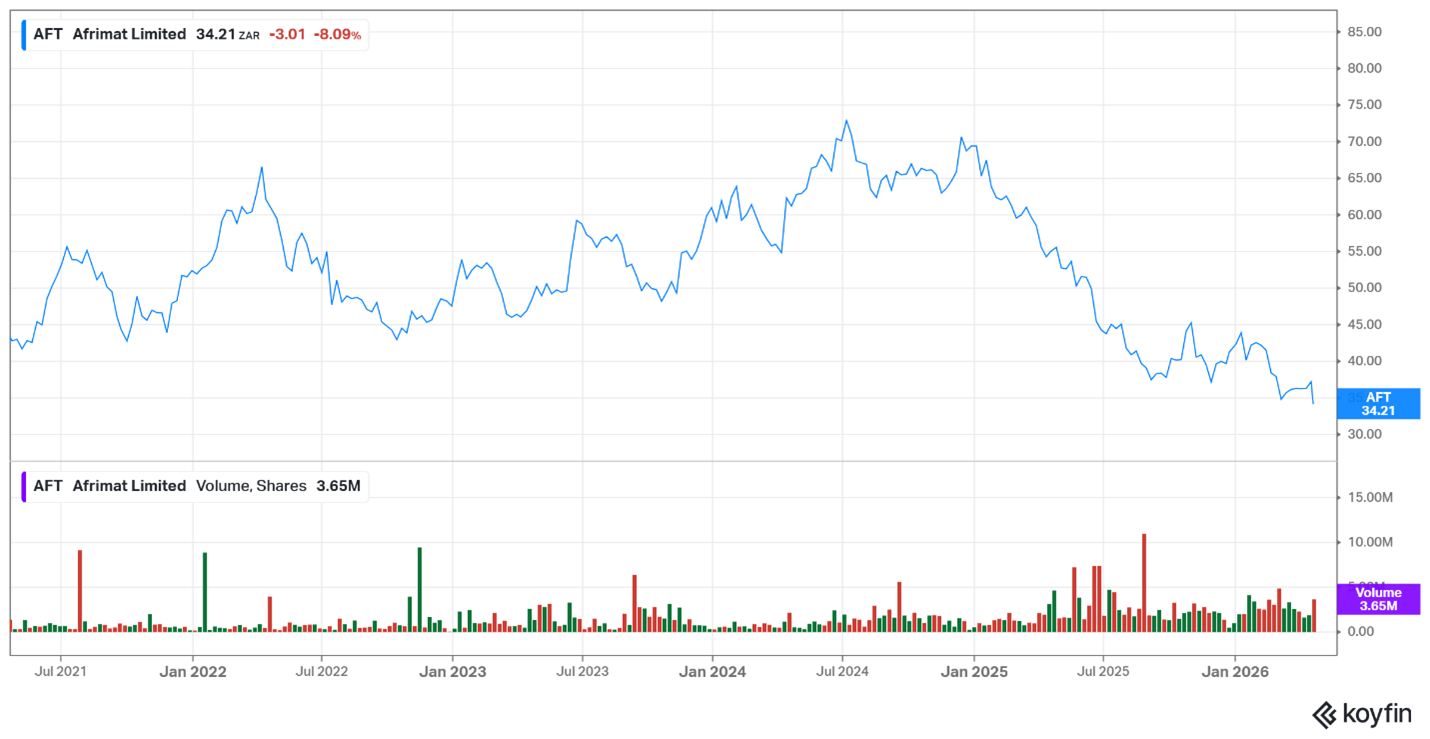
A confluence of events has given their reputation a knock, and the market is wondering whether management has lost its edge. Their acquisition of Lafarge is taking longer than expected to bear fruit; the travails of the Ferrochrome industry have hurt their anthracite business, and their Glenover acquisition is not working out as planned – so far.
All these things led to a loss in the second half of last year.
A lot of what happened is out of management’s control, which means I don’t think they have suddenly become stupid overnight.
My take: Management has set the company up for spectacular success during an upswing that is certain to come. The only uncertainty is the timing. I don’t own it, but it is only a matter of time before I do.
d. Apple
This week, Tim Cook retired as CEO of Apple. Cook became CEO of Apple on August 24, 2011, and in the intervening 15 years, revenue has increased by 303%, and profit by 354%. This means that, on an annual basis, both revenues and profits grew by around 10% p.a. Over the same period, Apple’s market value rose from $297 billion to $4 trillion, a staggering 1,251% increase. This translates to 36% p.a.
So, it helped that its P/E was well south of 20 when Cook took over, of course – compared to today’s 40 times. A rerating that is unlikely to occur again. But even 10% revenue growth is in line with the idea that, under Cook, Apple produced products that delighted its customers. As Capitec said in their results yesterday, you can only create value for your shareholders if you create value for your customers, as Apple has done in spades.
But the most interesting thing for me about Apple was that they were never the first with products, but they made sure theirs were the best. The Mac came after the PC, the iPhone after Blackberry, etc., etc. It seems to me that they are doing the same with AI.
My take: Apple is one of my 10 stocks forever. I haven’t bought it yet because it is way too expensive. I hope to get a chance in the next few years. Also, it does not necessarily follow that when a founder CEO steps down, the company is doomed, which is what’s worrying some Berkshire shareholders at present.
e. Property
The woes of property owners are not limited to those in Johannesburg, Pretoria or China. It seems London has also joined the party.
A friend forwarded me a Twitter account which tracks the decline of residential property prices in London. I have no reason to doubt the veracity of the information.
You can check it out for yourself, here: https://x.com/LondonPriceDrop
My take: Not even London property is immune to what I fondly term Viljoen’s First Law of Investing, which simply states that property is not a sensible investment.
f. Spear REIT
Speaking of property, this week, Beagle Investments (our BEE investment holding company) sold its stake in Spear REIT. Beagle acquired the stake in 2022, when it was trading at a 30% discount to NAV, which undervalued the business. What made the proposition attractive for us (despite it being a property company) was:
- Management. Under the guidance of Quintin Rossi, Spear has executed flawlessly on a sensible strategy.
- Leverage. Because Beagle is a BEE company, we were able to acquire non-recourse debt at 75% of the value of our investment in Spear. Which itself was leveraged to the tune of 40% debt to equity. If you work through the numbers, we acquired the property assets with roughly 10% equity.
Since we acquired the shares, Mr Rossi and his team have grown NAV and per-share distribution by 3% and 6%, respectively. Better than most other REITs. But the real kicker has been the rerating from a 30% discount to NAV to the current premium of 10%, which is even higher than the level at the time of the REIT mania in SA in 2018:
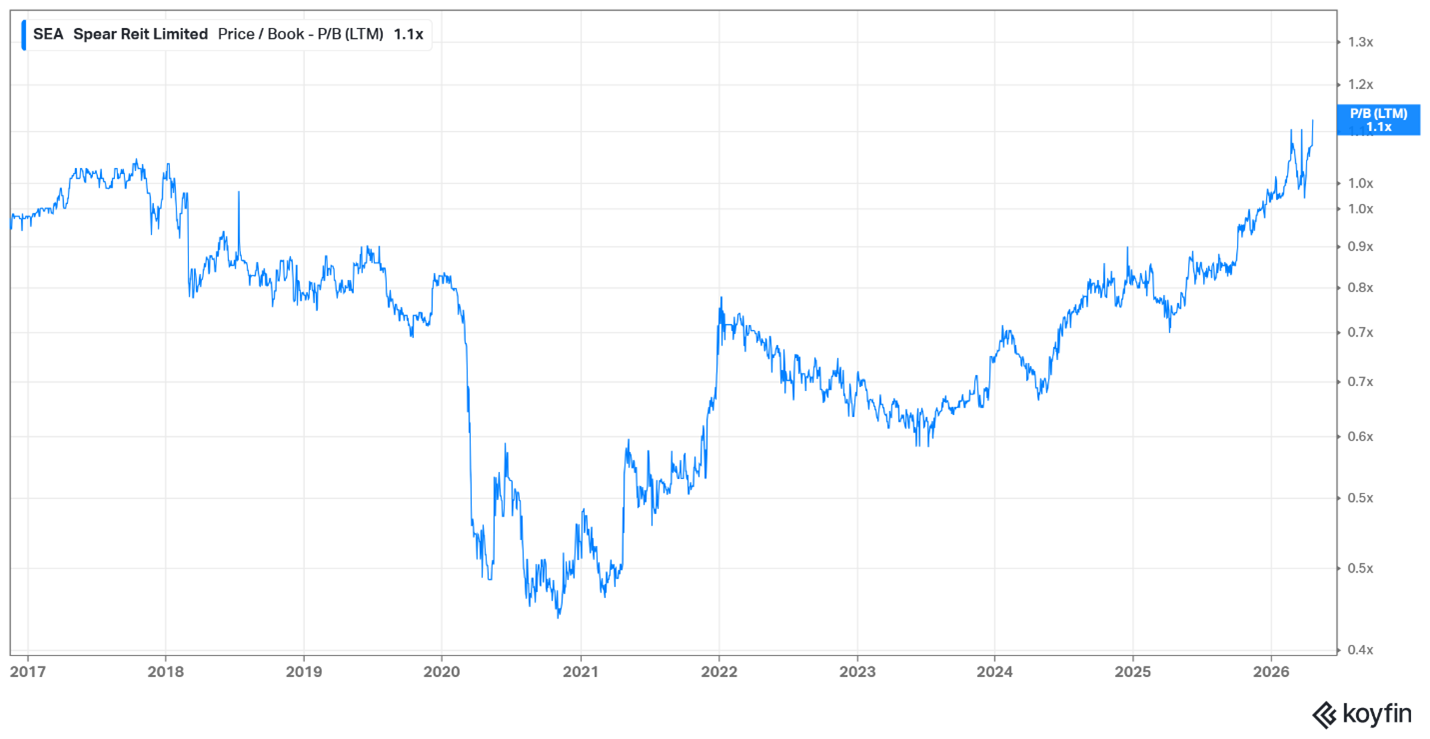
This is way too rich for a REIT to my taste – even a well-managed one like Spear, which is why Beagle decided to sell its shares. Thanks to Mr Rossi and his wonderful team, Spear turned out to be a good investment.
My take: Spear is the exception that proves Viljoen’s First Law of Investing.
In The Cockroach
Still no trades in the fund*, I’m very happy with the portfolio.
As a result of the uncertainty introduced by the war in Iran, credit spreads have widened recently, which is to say the interest rates that weaker borrowers have to pay have increased. Both James Grant and Howard Marks have commented about this recently. Given that I hold them in high respect, I thought such bonds might be appropriate for the bond portion of the cockroach.
Given my general preference for indexing over stock-picking, I had a look at HYG – the iShares High Yield bond ETF. It holds bonds from corporate borrowers with below-investment-grade ratings. Its current yield is 5.7%. Although higher than its recent low, it still strikes me as too low for the risk. South Africa is also a junk-bond issuer, but our yields in rand are currently around 9%. With inflation differentials between the USA and South Africa at about 1%, the 9% yield on local bonds remains more attractive.
So, the cockroach’s bond exposure remains as follows:
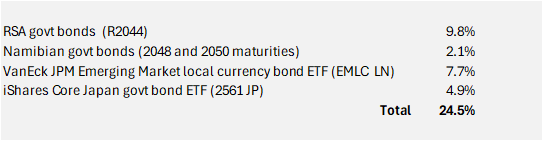
It’s a well-diversified portfolio of bonds of, on average, higher quality than HYG – but yields 100 basis points more at 6.7%.
* I manage the fund on behalf of Merchant West Investments (Pty) Ltd (FSP 44508)
In The Media
1. Keeping up with the art world
Both Amanda and I love art, despite the vile ecosystem that has evolved around it. See “But is it Art?” and “Art for art’s sake”.
Over time, we have built a small collection, which needs to be looked after. Fortunately, we came across a young man named Brett Scott, who does a great job managing the logistics of the collection for us. And believe me, even a small collection creates a lot of work.
Brett writes a weekly newsletter called Notes on African Art, which is well worth reading if this is your interest. You can read this week’s edition here. As you will see, Brett does a good job of collating interesting information about the African art scene.
But be careful! When you read some of the “thought pieces” by art world insiders, you will see how they struggle to reconcile their deeply fundamentalist Marxist outlook, which is highly critical of the market-based system, with a strong desire to achieve higher market values for their artworks. It can be quite funny sometimes, but mostly depressing. It does result in lots of what Munger called “Twaddle tendency”.
But if you love art as I do, don’t let that stop you from being informed about the art world. At the bottom of Brett’s newsletter, you can provide your email address to subscribe to it.
2. The 8th BizNews Conference
The 8th BizNews Conference was held recently in Hermanus. Alec Hogg assembled a wonderful selection of speakers over the three days of the conference. For some reason, Alec invites me to speak every year, and I am only too happy to accept, as it means I get to attend the whole conference.
Every speaker had something of value to share with the audience. But judge for yourself – here is a link to a summary and a video of each speaker’s presentation.
Finally, this week marks the birthday of some important people in my life.
- Dean Schweizer celebrates today. He is our CFO who lives in Altdorf, a pretty little town in Switzerland. Dean is the glue that keeps everything together here at RECM, and at many of our investee companies as well. Thank you, Dean!
- Theunis de Bruyn celebrates tomorrow. Theunis has been my business partner for over 20 years. He is probably one of the most rational people I know, and my life has been much better with him in it. He is also an extremely private person, so don’t tell him I told you about his birthday!
- Finally, my lovely, beautiful wife Amanda has her birthday on Sunday. Again, my life is much better with her in it. She is the glue that keeps our family together, and we all love her for it.
Is it a coincidence that three of the most important people in my life were born within 4 days of each other? I don’t believe in this astrology stuff, but it strikes me as interesting!
Be that as it may, I will remain careful this week, just as I am in any other week. And so should you. It’s a jungle out there.
Piet Viljoen
RECM
23 April 2026