
Dear Fellow Investors and Friends,
Welcome to my newsletter, where I share my efforts to understand markets and the world around me.
I do appreciate you taking the time to read this. I love getting feedback; feel free to drop me a line. It’s great to start conversations.
Today is Thursday, April 16th, the 106th day of the year. There are 249 days left until the end of the year. Amanda and I are in our fourth week of our Asian odyssey. We are currently in Singapore for a couple of days, before we begin the trek back home.
It’s been quite the adventure, and I thought I would share some of my reflections on it.
We started off in Osaka, the second city of Japan, where we spent 4 days acclimatising and getting rid of jet lag. Getting around Osaka – or anywhere in Japan, for that matter is simple. Signs are mostly in Japanese and English, and everyone is super friendly and helpful if you do get stuck – e-en if they don’t speak English. Once you’ve bought your ICOCA or SUICA card, which are easily rechargeable and are used for subway, bus and train trips as well as buying items from convenience stores like 7-Eleven, you’re set.
Speaking of the convenience stores – they are everywhere, and you can buy just about anything from them. These shops are an absolute revelation, and the logistics behind them must be mind-boggling.
After our stay in Osaka, we took the bullet train, bus and ferry to the art island of Naoshima. Then on to the ancient village of Kurashiki. In both these places we stayed in traditional Ryokans, where we enjoyed some of the best meals we have ever experienced. Then on to Onomichi where we cycled the Shimanami Kaido route. Back to Osaka where we were based for 5 more days during which we took day trips to Nara and Kyoto. During this time, the cherry blossoms were in full bloom.
During this trip, Japan further entrenched itself as my favourite country in the world. It’s like Switzerland – top-class infrastructure, scenic, clean and safe. But it has two key advantages over Switzerland: friendly people and an undervalued currency. The last time we were in Japan, a rand bought 6 yen. On this trip, it bought nearly 10. Today, Japan is a high quality, affordable destination for South Africans.
Some other thoughts:
- Signs of depopulation were evident, especially in the smaller towns.
- But it’s still a big market, with over 120 million “rich” people in a small geographic area.
- The Japanese love quality and take tremendous care with everything.
- The Japanese are an orderly people. They are particularly fond of forming orderly queues. Some people even join a queue without knowing what it’s for. The thinking goes that if the queue is long, it must be for something good!
- Japan is an attractive combination of being quite safe, but quite strange. A great place in which to go flaneuring, as Taleb calls it.
- The food – everywhere and anywhere – is out of this world.
After two weeks in Japan, we left for Seoul, the capital of South Korea. Coming from orderly, polite Japan, Korea felt more chaotic. The driving was certainly more aggressive and the people pushier. Despite all the brand-new infrastructure with massive buildings and an extensive subway network, you got the distinct feeling that it was still very much an “emerging” market not that long ago. The street food was amazing, and one of our better meals on the whole trip was a Korean barbecue dinner, where you cook your food yourself, at your table. Seoul was also quite safe. And cheap! As an example, our taxi ride from the airport took 90 minutes and cost the equivalent of R350. It was easy to get around, as English is widely used, albeit not spoken very well.
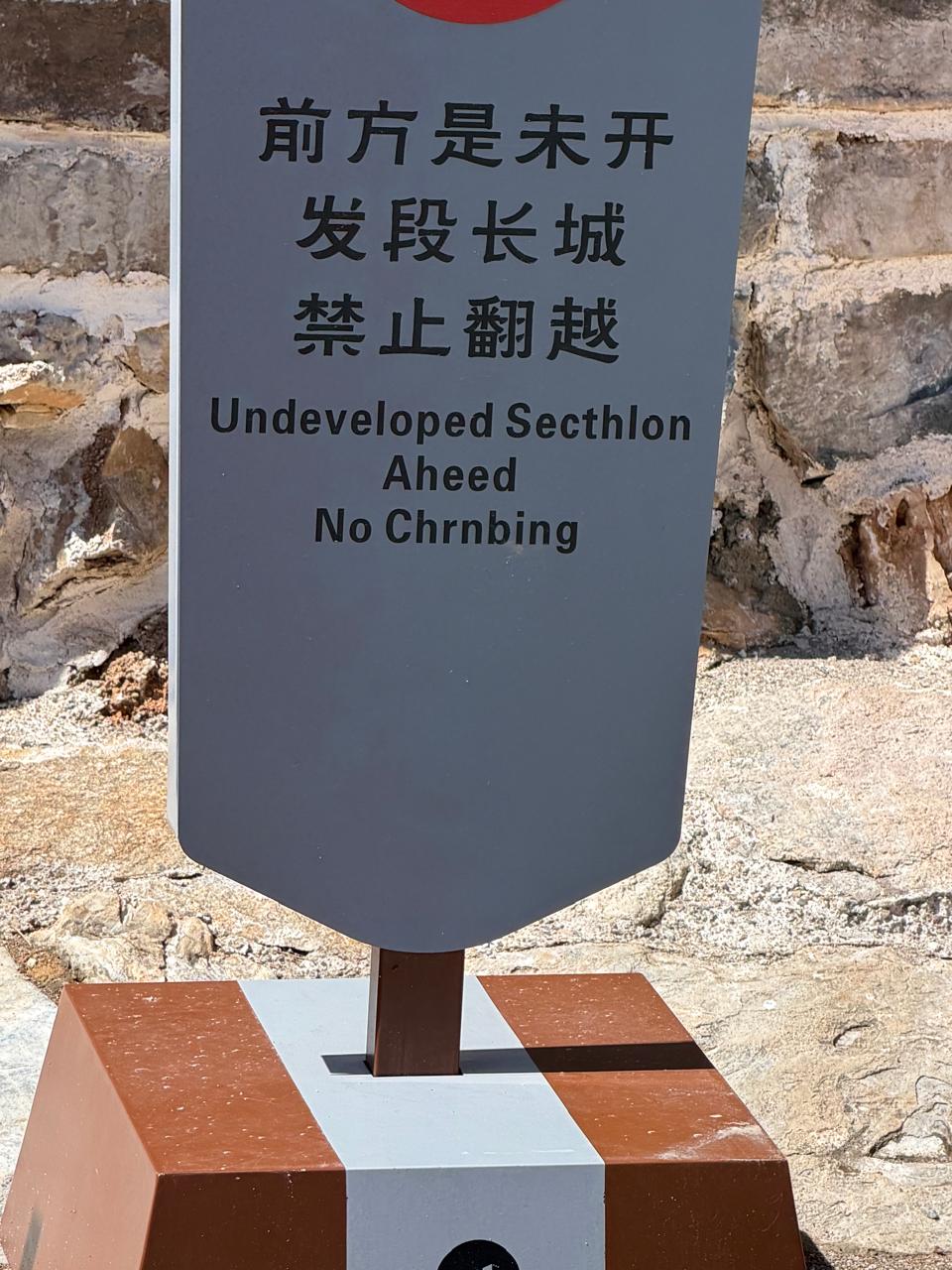
After three amazing days in Seoul, we left for Beijing. This came as a bit of a culture shock. Very little English on signage, and no one can speak it. And when they do, they might as well be speaking Chinese. The vocalisation of Chinese is just so different to that of the Gallic or Germanic languages. Also, unless you use a VPN (which you should and are allowed to do) you can’t access any Western apps like Google Maps. This can leave you feeling a bit disorientated. Even when there are signs in English, the translation often makes you wonder what they actually meant to say.
Unlike Korea and Japan, most buildings have very little advertising on the outside. So, it looks like there’s not much going on, until you go inside and discover huge malls filled with shops of all descriptions – including all the main Western brands. Visiting some of the temples and palaces imbues you with a strong sense of history, of which the Chinese are clearly highly conscious of and obviously proud of – despite the occasional misstep by some of their leaders.
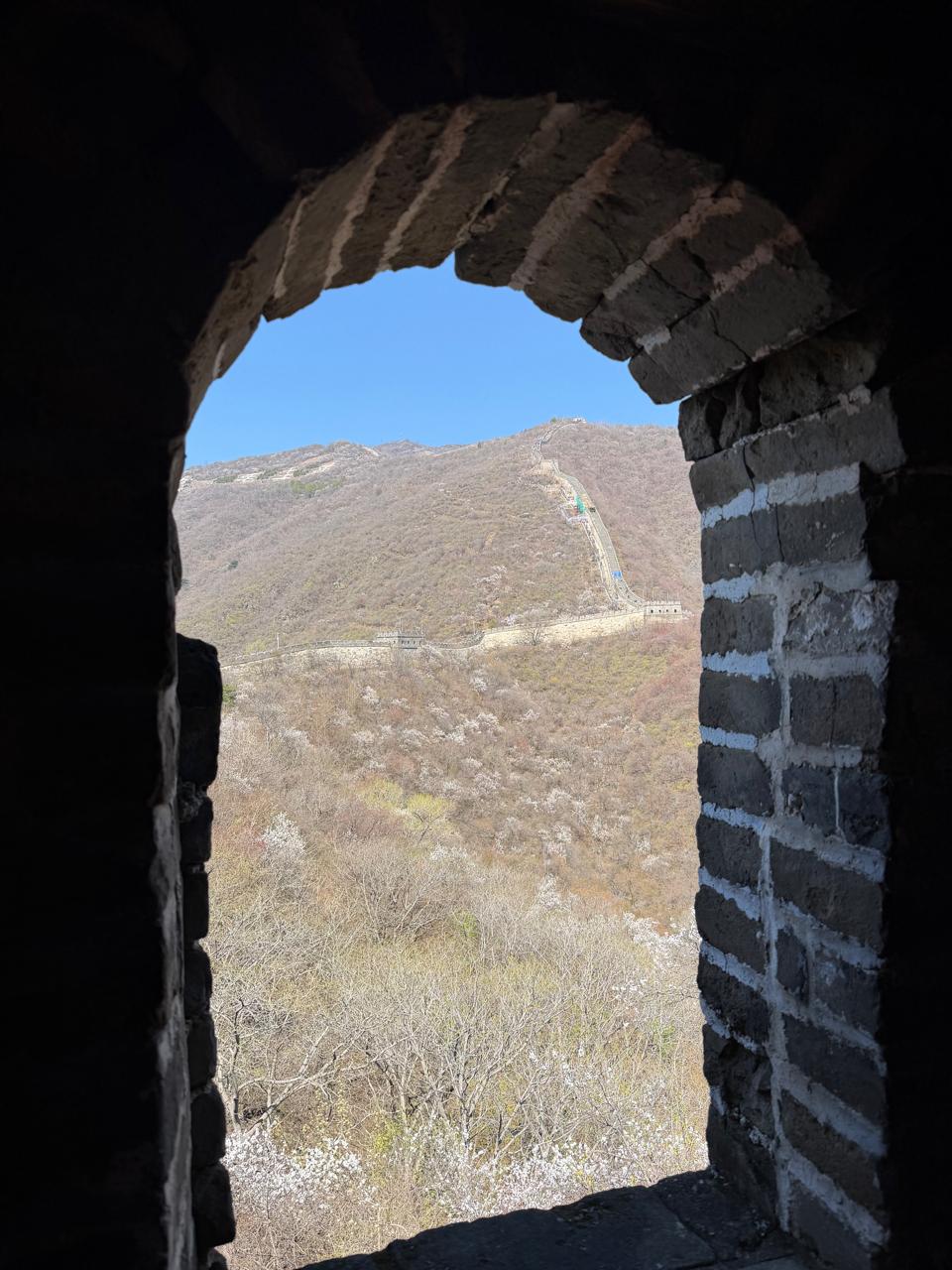
We spent three days in Beijing, of which the highlight was a visit to the Great Wall. We had high expectations and were not disappointed. The section we visited was quite challenging to walk, but the views were worth all the steps and climbing. A few years ago I read about David Grier and Braam Malherbe, South Africans who ran the length of the Wall, a distance of around 4,200km. At the time I didn’t think too much of it, but after having walked less then 4kms of it, I am now super impressed with their achievement.
After Beijing, we spent four days in Shanghai. If Beijing (the political centre) felt subdued, with a heavy police presence and not much visible commerce, Shanghai was an explosion of the senses. Many, many impressive buildings, neon-lit and a far more entrepreneurial feeling. The skyline is truly impressive, putting a place like New York in the shade. The size of these Chinese cities is truly mind-boggling.
If Japan was reasonable and Korea affordable, China was downright cheap! But it has even more of an “emerging” feeling than Korea. Even more chaotic and free-for-all than the other two countries. But the infrastructure is super impressive – including dedicated, physically separate bike and scooter lanes, almost everywhere. Also, no homeless people on the streets and I saw at most two beggars. And no shanty towns.
Some thoughts on China:
- Use an English-speaking guide. The place can be inaccessible without one.
- They have so many EV brands we have never even heard of, available at ridiculously low prices. BYD seemed to be the most popular car brand, with Tesla currently also quite common.
- Watch out for the electric scooters, which are everywhere. The Chinese drive on the right, and the scooters are silent, so for us they seem to jump out of nowhere.
- It’s clear the government plays a large role in the economy. Most companies are SOEs and select private companies are often heavily subsidised by the government. I’m not sure how sustainable this is.
- Everything is super cheap. This is a combination of over-production and an undervalued currency. Take advantage of it, while you can. I’m not sure it will be like this forever.
- Above all, this is a huge market. 1.4 billion people! You can’t make sense of that number until you visit their cities, which are bigger than anything you can ever imagine. If I was looking to operate in a market outside South Africa, I would be drawn to China. Even a niche product could be huge.
I left China thinking that if this was what Communism was like, I’m all for it. But I know far too little about the system to make such definitive judgements. It did reinforce my opinion that our alignment with the other BRICS countries might not be such a bad thing.
I am writing this letter from Singapore, where they speak English and things are eye-wateringly expensive. Singapore is much like the West, just with significantly better infrastructure. But it could just be the direction in which China and Korea eventually head.
In The Markets
I haven’t been laser focused on the markets over the past few weeks, so I will spare you any comments on specific stocks. But I do think it’s worth putting my thoughts about the war down.
The USA has two major strengths – its geographic location and its energy self-reliance. China has many strengths, but its weaknesses mirror the USA’s strengths. It is geographically exposed and is reliant on others for most of its energy inputs. Despite how the liberal press tries to portray Trump as a dumb ignoramus, in my opinion his administration is in the process of using its strengths in quite a smart way to put pressure on China.
Look, I’m no fan of the guy, but I think his administration is executing well. Reducing oil supplies to China, while tightening control of the major Western Hemisphere oil reserves will either force concessions from China or bring major conflict closer. While Trump is pressurising China, he is also piling the pressure on Europe. Their short sighted “Energie Wende” has exposed them to being reliant on third parties for the bulk of their energy inputs. At some point, they might have to join in the war, thus relieving the USA of much of their responsibility. And cost, of course.
Where this ends is the big question. I’m afraid no-one knows, and neither do I. But I do think the risks to the global economy are increasing.
For me, the investment implications are as follows:
- Countries like Germany (and South Africa for that matter) that have tried to reduce their carbon footprint will increasingly be forced to develop their own sources of energy. Nuclear, oil, gas and coal will become less of a swear word, and more of a necessity. Companies that facilitate oil exploration and extraction will benefit.
- In South Africa, HCI has an interest in extensive oil and gas deposits. These will possibly (hopefully?) be developed much more quickly. I am, of course, talking my own book here, as the stock is one of the biggest holdings in the MWI Value fund.
- As risks increase, investors should increase the discount rate they use to discount cash flows in their present value calculations. All else being equal, this will reduce valuations.
- Countries will want to become more self-reliant not only on oil, but an many other inputs. Supply chains will have to be rebuilt. Banks will benefit from increased lending into this process. But localising supply chains will increase the cost of doing business, with negative inflation ramifications.
But who’s winning the war?
You could probably use currency movements as a scorecard. If so, things don’t look great for the USA, despite their advantages. The Chinese yuan has appreciated by 7% against the US$ over the past year, despite enjoying a lower interest rate structure.
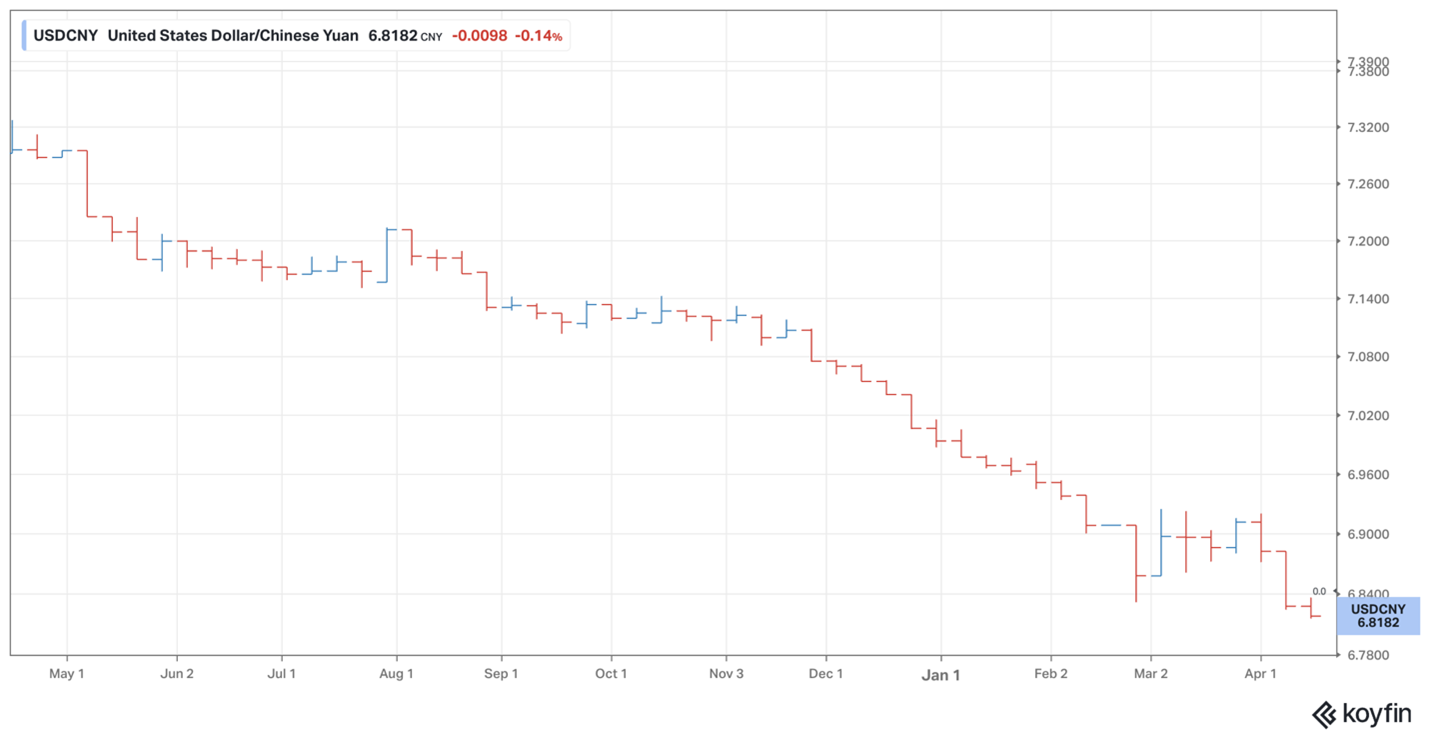
On the other hand, the S&P500 just hit a new all-time high, so it seems to be saying something else:
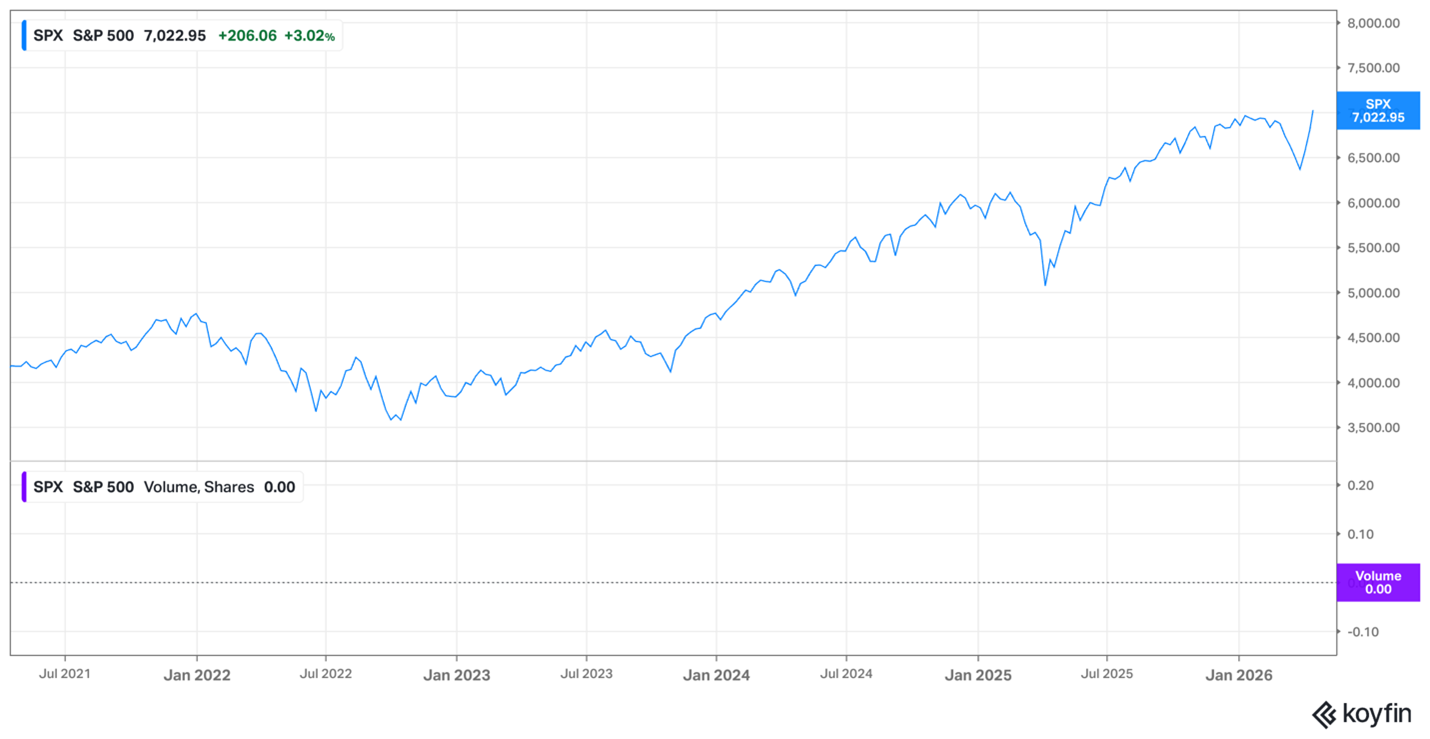
My take: The main thing is that this war – like most wars – is about energy. Any analysis of the situation that ignores this fact is likely to be inaccurate. But I’m sure there are many more “unknown unknowns” which only the passing of time will reveal.
In The Cockroach
Still no trades in the fund*. Not because I have been holidaying – I have been monitoring events – but because no trades are required. The fund is, by its very nature, well diversified and therefore well positioned for any eventuality. In any case, in these volatile times, any trades will probably look foolish in hindsight. Better to sit on your hands and let things develop.
Last week, news broke of the untimely passing of Murray Stahl. Mr Stahl was the founder and CEO of Horizon Kinetics Asset Management – a firm which I have mentioned many times in this letter. He was an original thinker and an eloquent speaker. His quarterly roundtables sometimes lasted for over three hours, as he patiently answered questions.
RIP Murray Stahl, a true investment legend. You will be sorely missed.
Importantly, it was his work which first alerted me to the company called Texas Pacific Land, a key holding in the hard asset portion of the Cockroach. Many readers have asked me why I continue to hold the stock, as it sports a high P/E, not typical of a value stock. But TPL remains one of my favorite investments. To make sense of its P/E ratio, it helps to interrogate its business model.
So here goes.
TPL is what is called royalty company – it owns, by dint of historical accident, a lot of land (880,000 acres, or c.350,000 hectares) in West Texas. This part of the USA is home to the Permian Basin, an area with one of the largest oil and gas deposits in the world and is the world’s highest producing oil region.
Because it owns the land, it can charge oil and gas companies to exploit the resource. To earn this royalty on each barrel of oil and gas produced on its land, it doesn’t have to make any capital investments, or employ any people. This explains its high operating margin of 75%(!) – and such a high margin makes it more inflation resistant than most other companies, as its cost base is small relative to its revenues.
But, as they say in the classics, that’s not all.
It also earns a revenue stream from easements on its land. An easement is what companies who operate on TPL’s land must pay for access to the land where they drill or for the pipelines they must lay to move oil, gas and water around. As demand for LNG (a by-product of oil) increase, more pipelines need to be laid, increasing TPL’s revenue stream – again at no cost to the shareholders of TPL.
Finally, TPL is developing another revenue stream – that of water disposal and treatment. Each barrel of oil that is produced via the fracking process also produces 4 or 5 barrels of water. However, this water is highly contaminated. To use it for industrial purposes (i.e. re-injection in the fracking process or, importantly, the cooling of steam generated by turbines) it needs to be treated. Alternatively, it needs to be disposed of. Disposal means that it needs to be piped to an area that can hold it – normally outside of the Permian area.
TPL is growing revenues from water treatment and disposal at quite a high rate.
Importantly, in the background, a development is taking place that will dramatically increase the earnings power of TPL in future, with very little capital expenditure required. This development is the build-out of data centres.
Data centres are the steam engines of the 21st century, and massive capital investment is going into building them out. The problem is that they require enormous amounts of energy to run, overwhelming the ability of the existing urban energy infrastructure. This has caused the cost of electricity to escalate rapidly for US consumers. As a result, inhabitants of many urban neighborhoods are protesting further data centre buildouts in their area.
Increasingly, the solution to this problem is to build data centres where energy is cheap and available, and where no one lives. West Texas is exactly such a place.
This has interesting possibilities for the revenue stream of TPL:
- More oil and gas production to feed power stations increases TPL’s revenues.
- As a result, the price of gas, a by-product of oil production, is often negative. Increasing the demand for it can cause its price to increase, further boosting TPL’s revenues.
- More activity on the land, increasing easement revenues.
- If dedicated data centre power plants get built, it will increase the demand for water (thermal energy – coal, gas and nuclear – requires water for steam AND water for cooling purposes)
- Finally, if/when these data centres get built, the value of TPL’s land will increase.
TPL has always had a high P/E, but despite that it has generated more than acceptable returns. 10 years ago, its P/E was around 400x (bottom line in the chart below), yet its share price has gone from around $16 per share to today’s price of over $400.
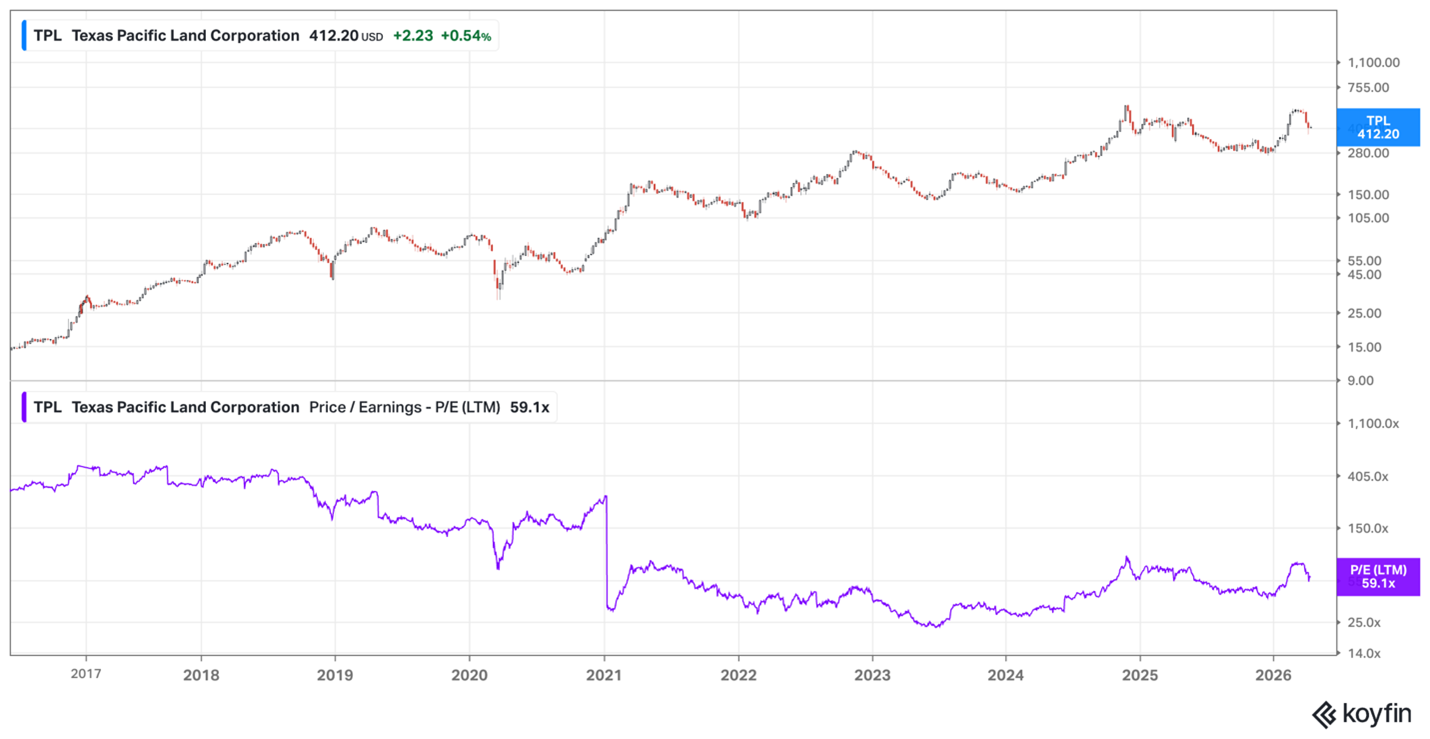
Its earnings power is now facing a hockey stick moment, where it could inflect upwards, substantially – without the need for very much capital spending at all.
In other news, bankrupt shoe company Allbirds pivoted from shoes to … AI infrastructure, and the stock went up by +450%!
What P/E would you then put on the TPL opportunity?
* I manage the fund on behalf of Merchant West Investments (Pty) Ltd (FSP 44508)
In The Media
1. Book reviews
Being on holiday, I had the time to read two(!) books. Both were fantastic, but for very different reasons.
a) The Winter of Our Discontent, by John Steinbeck (1961)
John Steinbeck won the Nobel prize for literature in 1962. This book probably had a lot do to with it. According to the Swedish Academy’s official citation, the honor was given “for his realistic and imaginative writings, combining as they do sympathetic humour and keen social perception”
That is this book in spades!
The book tells the story of Ethan Hawley, the descendant of a long line of proud New England Sea captains and Pilgrims. But the book opens describing Ethan as shopkeeper in someone else’s shop, his family having lost their riches through a combination of bad luck and poor judgement.
This loss of the family fortune reflects the decline of the old New England aristocracy. Ethan’s wife Mary still dreams of the luxury they once had, and his children are embarrassed by their poverty. Of course, this doesn’t sit easily with Ethan, and he is prone to wander around at night, thinking and planning.
It’s never clear what he is planning, until the denouement, when his plans start coming together. By this time, it becomes clear that he wasn’t the only one making surreptitious plans to improve their social standing.
The arc of the story plays out on many levels, but all of them have in common the willingness to do whatever it takes to get ahead, all under the veil of “common decency”. It’s a masterpiece of storytelling and a joy to read.
I can’t recommend it highly enough.
b) China’s World View, by David Daokui LI (2024)
Seeing as I was going to be spending some time in China, I thought it would be a good idea to learn more about the country’s political and economic system. This book does a good job of that.
It’s written by an insider, an academic who also moves in political circles. Dr. Li served as an advisor to senior Chinese Communist Party leaders, as well as some major international corporations. The book was written in response to growing anti-Chinese sentiment and the increasing threat of war, cold or otherwise.
I would stop short of describing it as a balanced view. Gross political mistakes like the “Great Leap Forward” and “The Cultural Revolution” are glossed over, with Mao Zedung’s role in these events almost excused. But it does provide some important insights into the historical context of the situation in China today. And it makes the important point that for the Chinese, history is important. To understand their actions and their system, you must understand their history.
Although the party governing the country is still called the Communist Party, it has adapted over time. Today’s China is increasingly a market-based economy, and the party – and therefore the government – is going along with it.
To understand the party, there are three key points to know:
- It is the largest political party in the world and governs the country from every village or even city building, right through to the top.
- Before assuming power, the Communist Party fought through 22 years of brutal military wars and learned in harsh ways that to win and stay in power, they had to be pragmatic and adapt.
- The party is delicately organised and managed and draws on thousands of years of the history of Chinese political governance. Meritocracy is a principle that has been inherited from history.
After reading this book, I came away feeling that I understood a little bit more about a country that is, for most of us, somewhat of a black box. As a result, I am going to spend more time trying to understand the culture and history of what is surely the most exciting market for the next 50 years.
This book was an interesting first step in that direction.
That’s all for this week – except for some of those inevitable holiday pics:
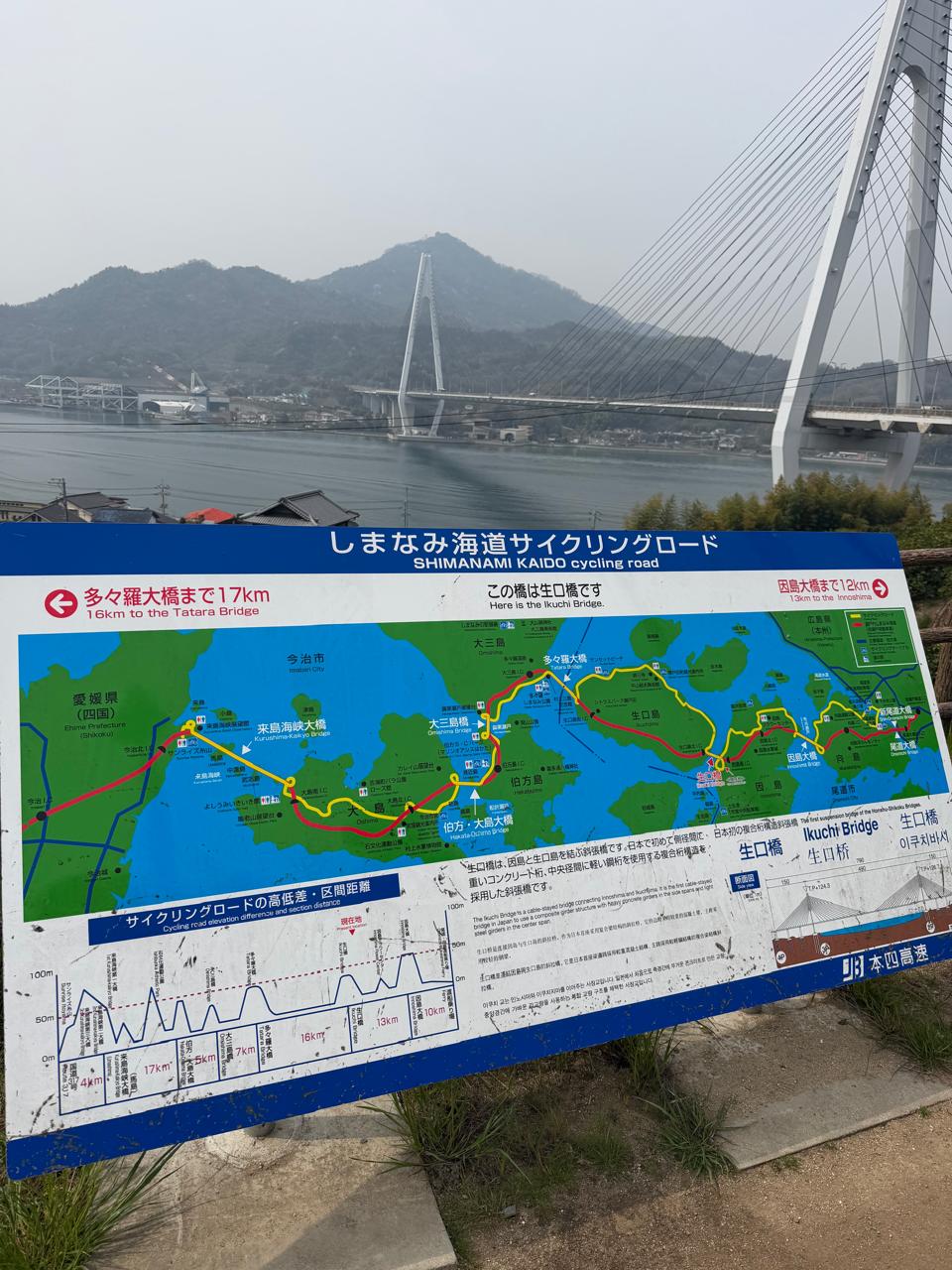
- The Shimanami Kaido cycling route, where you cross over 7 islands, using some very high bridges. Super scenic!
- Once you stray off the beaten path, this is a typical Chinese sign you might come across. I’m not sure what they wanted me to do – or not to do!
- A view of the “heroes walk” portion of the Great Wall – whatever you expect to see, its bigger and better IRL.
- A Yayoi Kusama piece on Naoshima Island. The island is full of amazing art and art museums. We were there for a day but could have spent much more time there.

- Cherry blossoms with Amanda!

That’s it for this week. The current war in Iran is a reminder to always be careful!
Piet Viljoen
RECM
16 April 2026