

Dear Fellow Investors and Friends,
Welcome to my newsletter, where I share my efforts to understand markets and the world around me.
I do appreciate you taking the time to read this. I love getting feedback; feel free to drop me a line. It’s great to start conversations.
Today is Thursday, July 9th, the 190th day of the year. There are 175 days left until the end of the year. I’m writing this to you from Knysna, where we are enjoying the Oyster Festival, as well as the cold (not so much!).
On this day in 2001, the mockumentary “The Office,” starring Ricky Gervais and Martin Freeman, premiered on BBC Two in the UK. The reason this series was so funny was that it was so cringeworthy and close to the truth. It highlighted relatable workplace archetypes, mundane settings, and the hilarious contrast between the characters’ inflated self-worth and the reality of their situations.
One day, they might even make a series about how we, as investors, react to market prices. Our reactions – and overreactions – have all the elements to create an even more cringe-worthy series.
If only we could be more like crows.
Crows are known for their intelligence and adaptability and have long been associated with collecting shiny objects. However, studies show that this behaviour is somewhat exaggerated. While crows may occasionally pick up reflective items, they are not universally obsessed with them. Despite, or maybe even because of, their intelligence, they are often cautious around bright, shiny things.
On the other hand, we humans do seem to be obsessed with them – especially when it comes to investing. We just can’t help ourselves when it comes to the latest high-performing asset. As soon as a stock or group of stocks performs exceptionally well, we immediately start expending tremendous effort to become experts in whatever we think drives their performance.
Just in time to watch them come back to earth.
Here are just some examples from the past few years:
Shiny, bright object #1 – China
Around 2018, China was all the rage. Fund managers had become Sinophiles. Some of us had even started learning Mandarin. There was growth as far as the eye could see – except that the eye couldn’t see far enough to anticipate a centralised, communist government cracking down on speculative activity, leading to a significant derating of stocks.
Alibaba, a market darling at the time, traded at $200 and eventually reached $300. Today, it’s trading below $100. According to most market commentators, China is uninvestable. The Mandarin classes are empty – today, people are learning Korean to watch Squid Game without subtitles.
Instead of focusing on the bright, shiny Chinese thing from 2014 to 2018, investors would have been better served by looking for value outside that niche, such as the luxury goods sector. LVMH, the sector bellwether, rose 4X post-2018 as Chinese stocks collapsed.
Shiny, bright thing #2 – Vaccine makers
During the COVID-19 panic, governments released daily death statistics. This, of course, heightened the sense of dread amid widespread lockdowns and the curtailment of other freedoms. When Moderna developed one of the first vaccines against the virus, its popularity skyrocketed.
Before 2020, Moderna had no commercial products on the market.
The pandemic validated its entire scientific platform, proving that modified RNA (mRNA) could be rapidly engineered to safely produce vaccines. Analysts became specialists in this biological niche and extrapolated Moderna’s earnings growth far into the future.
Instead of becoming amateur vaccinologists and studying the nuances of mRNA molecular biology, analysts would have been better off simply ascertaining that Moderna was essentially a one-product company. When demand for boosters declined post-Covid, Moderna’s share price fell by more than 90%. All the time spent studying mRNA vaccines would have been better spent thinking about human behaviour. Travel-related stocks such as Booking Holdings and Marriott increased by more than 4X in the years following reopening.
Shiny, bright thing #3 – GLP-1 drugs
Staying with the pharmaceutical theme, remember when Copenhagen-headquartered Novo Nordisk had a market cap larger than Denmark’s GDP? This was a result of its coming to market with the first GLP-1 drug, Ozempic. Unsurprisingly, taking a pill instead of going for a 5km run and choosing smaller portions proved to be quite a popular way to lose weight. Novo Nordisk made a ton of money.
Analysts, of course, fresh from studying mRNA biology, now turned their attention to GLP-1 biologics and extrapolated Novo Nordisk’s results far into the future.
Of course, when one company makes a lot of money from a product, it invites competition, which, in this case, didn’t take long to arrive. Today, Novo Nordisk is worth 60% less than at its 2024 peak. If analysts had instead spent their time considering the second-order effects of the widespread take-up of GLP-1s and had simply avoided alcohol and fast-food companies, they would have been much better off.
Shiny, bright thing #4 – Rheinmetall
Rheinmetall (a German weapons company) was trading at 90 euros when Russia invaded Ukraine. Three years later, in February 2025, its share price began to rise exponentially and ultimately peaked at 1,980 euros in September 2025, up 20X.
By the time Rheinmetall’s share price had 20X’d, it was no longer ignored. Analysts were burning the midnight oil to become geopolitical specialists, hoping to predict tensions across borders and, thereby, the demand for munitions supplied by companies like Rheinmetall. By the time they had developed this newfound skill, it was too late.
Today, Rheinmetall’s share price is 50% lower than it was last year, despite a new conflict breaking out. Instead of becoming warmongers, analysts might have looked around to see which assets wars are usually fought over, and invested in energy stocks.
A broad index of energy stocks is up by over 25% since Rheinmetall (and other munitions stocks) became popular and subsequently imploded.
Shiny, bright thing #5 – Memory stocks
The shift towards high-bandwidth memory (HBM) for AI accelerators, combined with tight global supplies, has created a memory shortage, granting producers immense pricing power. Analysts have now become specialists in the pros and cons of different types of memory (HBM, DRAM, NAND, etc.) as well as the chips they run on. As we’ve seen with stocks that have 10X’d over the past year, such as Micron (a capital-intensive designer and manufacturer of memory and storage solutions), analysts have studied hard to understand the drivers.
What they did not study is history.
Like all capital-intensive sectors, the memory sector is notorious for its boom-and-bust cycles. It’s not a question of whether the bubble will pop, but when. The question that should exercise our minds is not “why will this cycle last longer than previous ones?” but rather, “why won’t China disrupt this manufacturing process, as it has disrupted almost every other manufacturing process?”
Perhaps now is the time to start thinking about the disruptor as a potential destination for our investment funds, rather than the overpriced, cyclical, capital-intensive Western businesses that are ripe for disruption.
The lesson from all these recent events is that whenever investors fixate on a new, shiny, bright thing, it’s best to simply avoid it and either buy the asset that isn’t receiving all the attention, or consider which other assets will be positively or negatively impacted by that thing.
But above all, if we could only learn to be like a crow – cautious of shiny, bright things – our portfolios would be so much better off.
In The Markets
1. Choose your fighter
Nike is a market-leading global brand, earning just over half its $46bn in revenue from outside the USA. Despite this strong position, its earnings per share have flatlined over the past 10 years, due to a combination of market saturation and management missteps

Anta Sports is the leading Chinese sportswear brand. Rather than relying solely on its core value brand, Anta scales by acquiring international brands. It controls FILA China, Descente, Salomon, and Arc’teryx, and recently acquired a significant stake in Puma.
It earns by far the majority of its $12bn in revenue in the Chinese market, and has grown its earnings per share by 17% p.a. over the past 10 years.
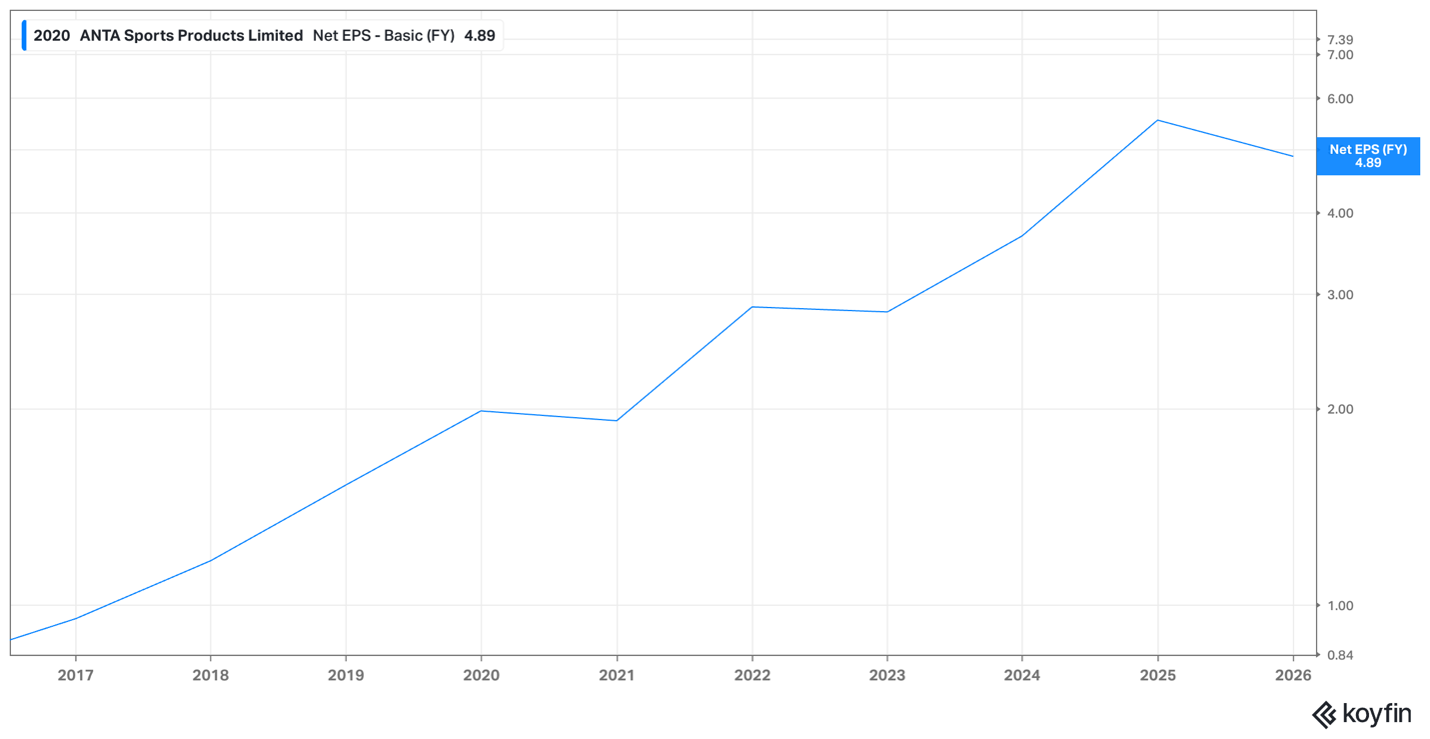
Today, Anta trades at a P/E of 12, while Nike trades at a P/E of 25.
Here is a chart showing the market shares of different sportswear brands in China:
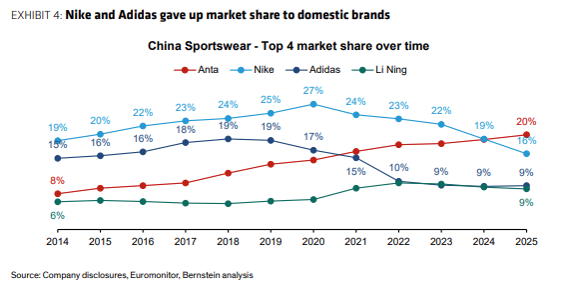
To be clear, my full research effort on Anta was simply to look up these numbers. I also bought a t-shirt in one of their shops recently. The product is cheap and cheerful, like a discount Mr Price Sport.
But the valuation discrepancy is striking.
One company has a huge domestic market to grow into, plus, eventually, the rest of the world, while the other is already a global dominator. Yet the one with more latent growth potential trades at half the other’s multiple.
If you could find a winning Chinese consumer brand, it would make for a great investment over the next 40 years. Like Coke, McDonald’s and Nike in the USA, if you could rewind 40 or 50 years.
I don’t know if Anta is that one, but it’s worth pondering.
This is Nike since listing in 1980:
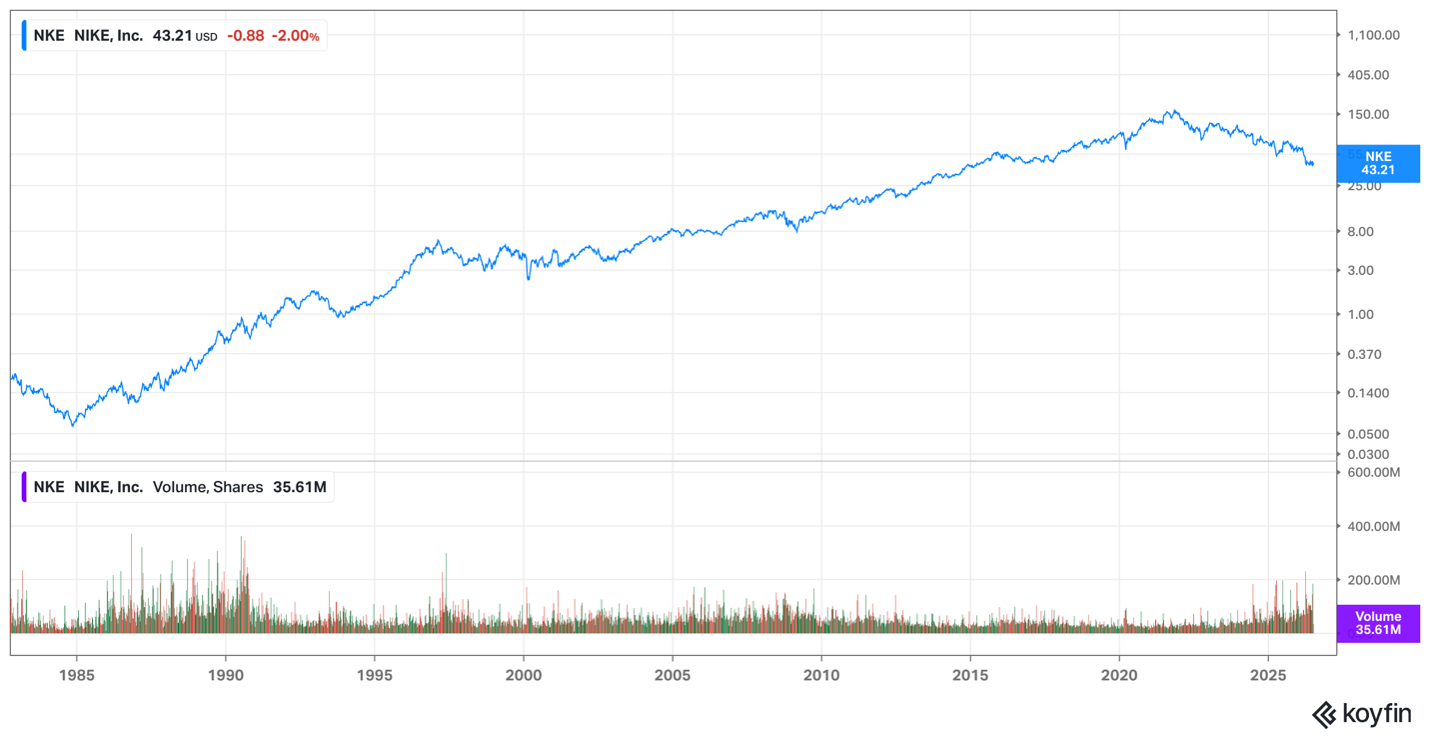
From 18 cps at listing to the current $43, it has compounded at over 20% p.a. since 1980, including the 60% drawdown over the past 5 years.
My take: Food for thought. For serious investors, China deserves more than a cursory investigation.
2. Remgro/Mediclinic
Last week, The Rembrandt Group (REM) completed the restructuring of its Mediclinic investment, with the transaction becoming effective on 1 July 2026. This is significant for REM, as Mediclinic makes up a quarter of its NAV.

Previously, REM owned 50% of Mediclinic Southern Africa (MSA) and 50% of Mediclinic International (MIH). The remaining 50% was held by the shipping company MSC. The restructuring saw REM swap its MIH holding for the 50% of MSA it didn’t already own.
Remgro now owns 100% of MSA, while MSC’s subsidiary IHL now owns 100% of Hirslanden, Mediclinic’s Swiss business.
For the purposes of the swap, the businesses were initially valued at $950mn each, with final adjusted values of $947mn for MSA and $1.077bn for Hirslanden. The transaction simplifies ownership and gives Remgro full control of Mediclinic’s Southern African operations, while exiting ownership of the Swiss healthcare business.
Mediclinic originally acquired Hirslanden, the largest private hospital group in Switzerland, in 2007 from the private equity group BC Partners for $2.4bn (or CHF 2.54bn / R16.2bn at the time). It has now sold it for an effective price not much different from the original purchase price. This ignores all the capital Mediclinic ploughed into the business over the years.
If you want to see how investment bankers can pull the wool over the eyes of even sophisticated investors, here is the information memorandum published on Hirslanden at the time of its sale to Mediclinic.
Who wouldn’t want to buy such a jewel (at any price!)?
REM’s NAV per share has underperformed significantly over the past 20 years because of this and other capital misallocations. It has barely kept pace with inflation. The market has now placed a significant discount on that NAV:
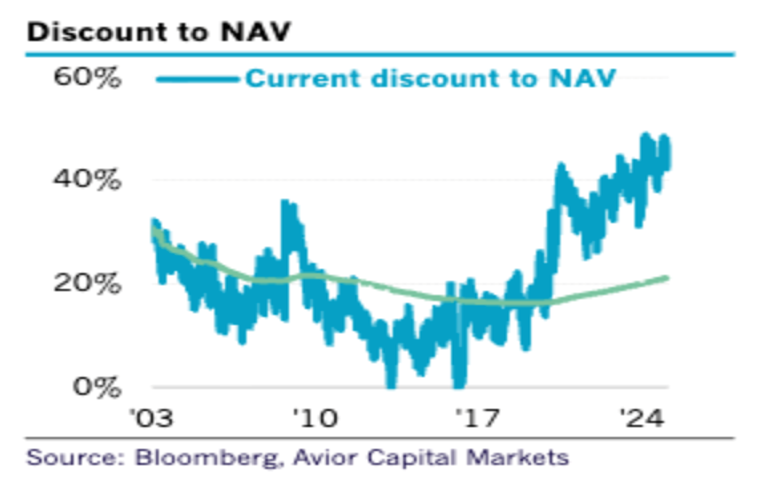
In effect, the market is saying that capital misallocation will continue.
My take: It’s sad to see how one of South Africa’s great entrepreneurial success stories, Mediclinic, has become a shadow of its former self. But they say the first step in fixing a problem is recognising it. Hopefully, this restructuring of REM’s hospital interests signals that management is coming to terms with reality. Now all that remains is to align the remuneration outcomes management has historically enjoyed with those received by shareholders. REM could then find itself back on some buy lists. Let’s see.
3. The yen
Japan has had far less inflation than any other country for most of the last 40 years. Economists would say its currency should strengthen, keeping its purchasing power in line with other currencies. This has not happened, as Japan’s real effective exchange rate against a range of currencies has weakened spectacularly. Small wonder tourists can’t believe how cheap everything is in Tokyo.

In the past, the yen was considered a safe-haven asset during periods of global volatility. But its recent weakness is causing foreign-exchange investors to grow nervous. Last week, the yen hit 161.97 against the US dollar, its lowest level since 1986. In that year, Bon Jovi had a hit with Living on a Prayer, something the yen seems to be doing right now:
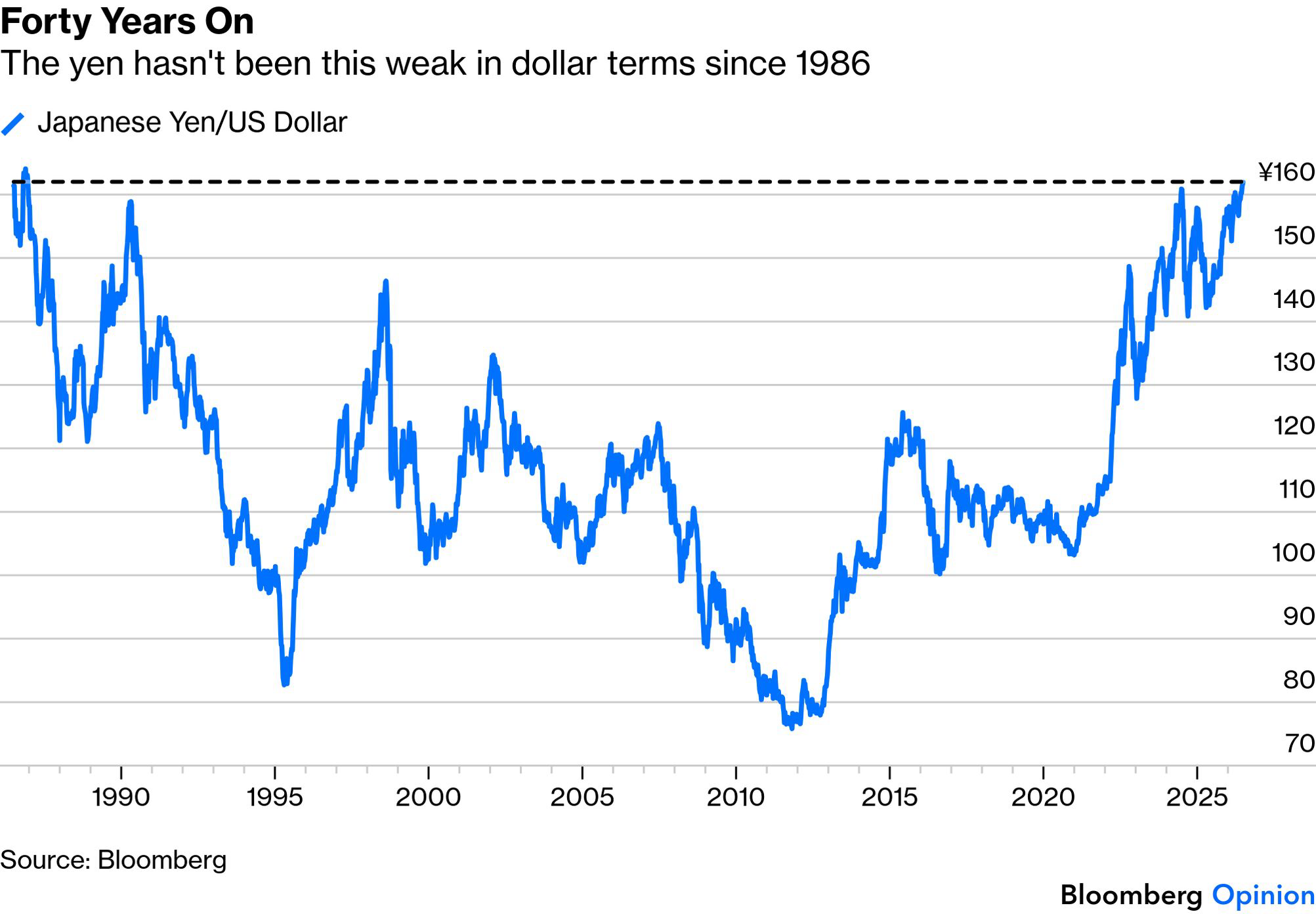
At the same time, Japanese bond yields are climbing, with the 10-year now above 2.6%. That’s above the typical return objective for defined-benefit pensions and for many insurance companies in Japan. When currencies (and bonds) are this weak, natural stabilisers tend to kick in – current accounts go positive and investors are attracted by higher bond yields. This leads to capital repatriation and a reversal of trends that might previously have seemed irreversible.
My take: We have seen that happen many times in South Africa, and Japan should not be an exception to this process.
In the cockroach
Last week, I mentioned the cash portion of the fund*, which I always keep at 25%. The allocations across currencies may vary, but the fund always maintains 25% in cash. This begs the question – especially during times when cash is obviously the worst-performing asset – why?
The answer lies in the fund’s dual objective.
The first is to generate returns that exceed inflation in US$ terms. In other words, to maintain and grow the real purchasing power of your capital – in hard-currency terms.
The second is to maintain reasonably low volatility. This is to keep us all on an even emotional keel. When prices rise sharply, our natural – but incorrect – inclination is to buy more. On the other hand, when prices fall sharply, our natural – but incorrect – reaction is to sell. If I can keep the fund’s unit price stable, there will be less temptation to make those emotional, value-destroying decisions to which we are all susceptible.
As with most things in life, volatility and returns involve a trade-off. Higher returns usually bring higher volatility; lower volatility usually means lower returns. My job is to optimise that balance.
A significant allocation to cash helps manage the fund’s volatility. But there is another advantage to holding so much cash. When the other assets in the fund go up a lot, the cash portion naturally shrinks as a percentage. I am then forced to rebalance by selling the expensive assets to bring the cash level back up to 25%. Conversely, when the other assets in the fund go down a lot, I am forced to use the cash to buy more of those relatively cheap assets to bring their weights back up.
By rebalancing to a fixed exposure, the fund is forced to buy low and sell high – something which does not come naturally, even to the very best investors.
With that background, this is what the Cockroach’s cash exposure looks like today:

The only change over the last few months is that a T-bill matured, and liquidity was raised by selling some of the short-dated US bond ETF. This liquidity was used to buy more hard assets, which I discussed a few weeks ago in Singleton Says, part 2.
This week, I am going to use some of that liquidity from the maturity to add back to the short-dated government bond ETF and increase the Japanese yen exposure.
The US bond exposure has an average duration of three months, making it as low risk as a cash deposit, while earning a slightly higher interest rate.
As discussed above, the yen is one of the most undervalued currencies in the world. If you haven’t visited Japan yet, now is the time to do so – it will probably never be as cheap again!
The largest share of the cash exposure is in the MWI Enhanced Income fund, which offers a yield pickup over vanilla cash at low risk. It’s probably one of the best-managed enhanced income funds in the market. Historically, the interest rate earned on South African cash has been more than sufficient to compensate for the depreciation of the rand over time. This remains the case, hence the relatively large exposure to this asset.
* I manage the fund on behalf of Merchant West Investments (Pty) Ltd (FSP 44508)
In The Media
1. Peptides
As many of you know, I am a long-term investor. But a basic precondition for being a long-term investor is that you need to be around for the long term. Which means you need to look after your health. The two key metrics associated with longevity (quality and quantity of life) are grip strength and V02 max. Moving heavy weights around and lots of low-intensity cardio helps me keep my numbers on those two metrics where they should be.
But I am also interested in any supplements that can assist this process. Recently, I have noticed the subject of peptides creeping up more in discussions of this nature. Apparently, there are many kinds of peptides that can assist with recovery, metabolic health, etc. Interest has skyrocketed since the special class of peptides, GLP–1, was found to be so beneficial for one’s health.
But then I came across a Substack by Dr. Paddy Barrett, called “We need to talk about Peptides” If you are at all interested in this kind of thing, it’s worth reading.
2. An antidote to negativity
For some reason, despite living in the most prosperous period in human history, many people seem so negative about the future.
Adam Singer’s Substack article examines each of the reasons that have entered popular discourse as contributing to this pervasive negativity. By and large, he finds them baseless. It’s a refreshing, objective look at where we actually are today as a species, relative to our perception of it. Just try to ignore the clickbaity title of the article when you open it!
For all the punters out there, here’s an inside tip: both horses are at 5:1 and joint favourites for the big race.
What’s more, they are racing in the colours of the late Jack Mitchell’s daughter, Nancy. A very long time ago, Jack was my boss at Allan Gray. He was probably the person who taught me the most about investing; for which I am eternally grateful. On top of that, he was a true gentleman.
If only for his sake, I hope these horses come in at one and two! I might even put some money on that.
3. The Durban July
Last week I tipped two horses – Note to Self and Wish List – to win the biggest horse race in the country, the Durban July. I had no inside information; in fact, I know absolutely nothing about horses. But I knew that my stepson, Zac Bloch, was connected to them.
Well, Note to Self won, and Wish List came second! You can watch the exciting race in this clip. And here’s Zac, unplayable post-race:

If I thought he would outgrow his fascination with horses, that’s not ever going to happen now. I can only wish him many more happy years of racing.
In other news, my son Nic and his girlfriend Daneel completed their second Knysna Oyster Festival half marathon. They couldn’t beat me again this year, like they did last year – mainly because I didn’t run, after a small op a few weeks ago!

And my other stepson, Ben, and his fiancée, Courtney, are on a trip to the UK to visit his grandparents. Courtney has never been; you can see how excited she is!

That’s all for this week.
Remember to be careful out there – those shiny bright objects can get you into trouble!
Piet Viljoen
RECM
9 July 2026