

Dear Fellow Investors and Friends,
Welcome to my newsletter, where I share my efforts to understand markets and the world around me.
I do appreciate you taking the time to read this. I love getting feedback; feel free to drop me a line. It’s great to start conversations.
I do appreciate you taking the time to read this. Today is Thursday, June 18th, the 169th day of the year. There are 196 days left until the end of the year. Today in 1815, at the Battle of Waterloo, French Emperor Napoleon Bonaparte was decisively defeated by allied (British and Prussian) forces, marking the definitive end of his rule. This came three years after the War of 1812, in which a fledgling USA engaged Great Britain over trade barriers.
What strikes me about these wars is not that they happened, but how they illustrate the shifting nature of national allegiances. The only thing permanent about the human condition seems to be war. Alliances change – your friends become enemies, and vice versa. It’s useful to bear this in mind when reading the latest headlines: the “landscape” invariably changes, but the risks remain. Sensible investing demands that we remain robust to the risk of change.
Last week, I discussed the role of dividends in a firm’s capital allocation framework. This week, I want to discuss how we should approach the trade-offs inherent in any such framework.
But before we get into the weeds here, let me be clear: I’m trying to provide a structure for thinking about the capital allocation question, not give a definitive solution to the problem. Even if you apply a “correct” framework, subsequent events might prove you wrong. As with most things in life, things are very much grey in markets, not black and white. But a sensible process, applied consistently over time, will get more things right than wrong.
And your advantage will compound.
The key to any sensible capital allocation framework is the careful consideration of opportunity costs. If I pay a dividend today, will I be able to make that value-enhancing acquisition tomorrow? If I buy back shares today, is that more value-creating than paying a dividend tomorrow? If I make an acquisition today, will I be able to pay a bigger dividend tomorrow? If I reduce debt by skipping a dividend, are shareholders better off?
These are the grey areas management needs to consider. Importantly, the thinking on these issues also needs to be communicated clearly, consistently and regularly. The messaging is as important as the process.
It’s also useful to clarify the difference between a buyback and a dividend. Both ways of returning cash to shareholders have the same effect on a company’s business picture: reducing the cash held by the business by transferring it to shareholders and simultaneously reducing the business’s equity.
In practical terms, let’s say you own equity in a company worth R10. If it pays a dividend of R1, you now own equity in a company worth R9. Plus, your R1 cash in the bank.
If the company bought back R1 of shares instead (and you tendered your shares), the entire company would be worth R1 less, but there would be fewer shares in issue, so on a per-share basis the value would remain constant (in theory). Plus, you would have R1 in your bank account. On the face of it, value accretive. But remember – you sold shares into the buyback, so you own less of the company. This puts you right back in the same position as if a dividend were paid instead of a buyback.
The key point is that neither action creates value. Value is simply transferred from the company to the shareholder, with taxes potentially affecting the outcome.
As a result, many investors refer to something called a “shareholders’ yield”, which is calculated by adding a stock’s dividend yield to its buyback yield. The argument goes that, if instead of paying dividends, a company simply uses the cash to buy back shares, it’s functionally the same as a dividend.
This is not quite correct.
- What happens if you choose not to sell into a buyback, or sell proportionally more or less into it? Each shareholder will have a different outcome, depending on their choice.
- The price vs. value of the shares the company buys back makes a big difference. If they are expensive, value is transferred to the selling shareholders. If the shares are cheap, value is transferred to the remaining shareholders. The point here is that the value transfer is not necessarily equitable.
- To accurately calculate the effect of a buyback on your value as a shareholder, one must also consider future events. After the buyback, the company has less cash, but also fewer shares in issue. Any future value creation will be spread over fewer shares, resulting in a higher growth rate for whatever metric is used to calculate value. This is not an easy calculation a priori.
Dividends and buybacks are therefore not interchangeable. One adjusts the capital structure by reducing outstanding ownership claims of shareholders willing to sell, while the other distributes surplus cash to all shareholders when the company has no other use for it. They serve different economic purposes and should be deployed in different circumstances. This argues for flexibility in when to use these tools.
From this discussion, it’s readily apparent that the decision on which to use and when to use them is not clear-cut. As I’ve tried to illustrate, many variables go into determining which lever is best to pull at any given point in time. Unfortunately, the market overemphasises companies’ dividend-paying ability and track record, which tends to reduce management’s flexibility in using these tools to allocate capital efficiently.
The only way I see around this is for clear-thinking management teams (supported by their boards) to think independently of market “perceptions” and communicate their conclusions clearly and consistently to their shareholders. Sadly, I see this happening much more regularly in private companies than in the listed market.
In private markets, dividends are not regarded as a performative ritual to be followed dogmatically. They are but one tool amongst many for creating value for shareholders.
In public markets, smart capital allocators might lose the short-term “news flow” battle to those who unduly emphasise rigid dividend policies, but they will win the long-term value-creation war.
And isn’t that what we really want as shareholders?
In The Markets
1. IPOs
IPO stands for Initial Public Offering, which is what we had last week with SpaceX. I have been on record as saying that IPOs do not make good investments, so let’s have a look at this one.
SpaceX issued 4.8% of the company in the recent offering, at a price of $135 per share. This valued 100% of the company at $1.9 trillion. After opening for trading on Friday at $150 per share, the share price has increased to $193 per share, now valuing the company at $2.5 trillion.
Very few shares in the company were offered to the market, with the other 95% being locked up – prohibited from trading for a period. With excitement around the company’s prospects at fever pitch, demand far exceeded supply.
In the short term, share prices are determined by demand and supply. So far, so good. But in the long term, fundamentals will prevail. We will see what happens to SpaceX’s share price once they report earnings publicly and the lock-up expires. In the meantime, if you were one of the few investors to get hold of some shares, well done!
Here is a quite reasonable review of SpaceX’s business outlook, written by shareholder and venture capital firm a16Z. It’s not completely unbiased, but it does paint an interesting picture.
But I would like to share a cautionary tale about a recent IPO here in South Africa. The company is Optasia, and before it was listed, it was owned jointly by the founder (a Nigerian named Bassim Haider) and a private equity firm called Ethos Capital.
Optasia described itself as an AI-enabled fintech company, thereby hitting the jackpot of catchphrases that are guaranteed to get the punters up and running. Financial commentators described Optasia’s business model as “divinely visionary”, adding even more fuel to the fire.
On listing, the excitement was palpable. The share IPO’d at R19 and quickly ran up to R22,50, as punters bought into the story. Unbeknownst to them, however, the founder was actively selling his shares into this excitement.
Let’s see what happened to investors in this IPO:
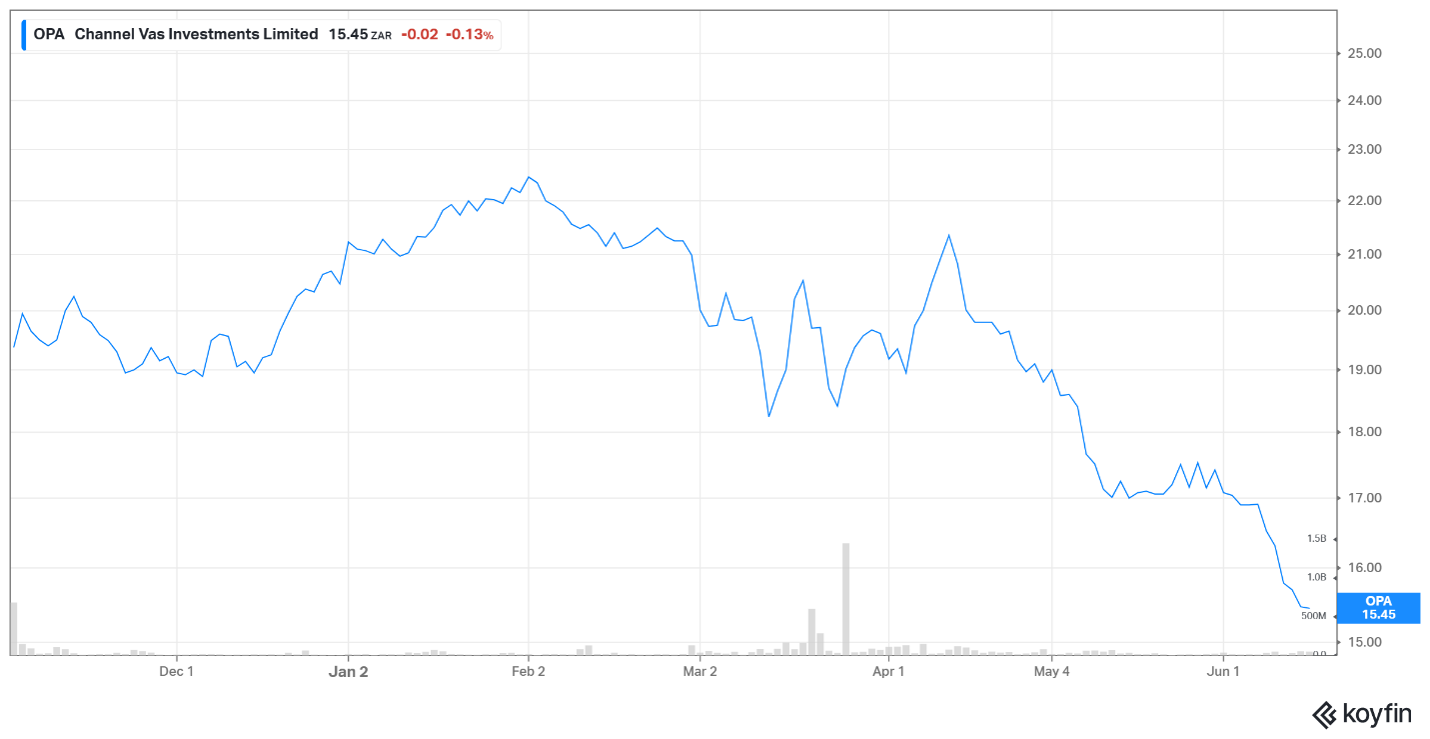
The price is down 20% from its listing price and 30% from the post-listing high. It turns out the “divinely visionary” business model was simply providing microloans to MTN’s customers. Following the listing, MTN Nigeria has also suspended its partnership with Optasia due to a regulatory crackdown on “digital consumer loans”. I’m not sure whether the “AI” part or even the “Fintech” part of the business is still running.
It also turns out that Optasia’s real name is Channel Vas Investments Limited, which sounds a lot less divine.
My take: This was a classic IPO takedown, in which knowledgeable insiders sold shares at a high price to excited, ignorant new shareholders. Sound familiar?
2. Mr Price
The current environment in the South African retail sector is tough. I wrote about it a few weeks ago. Mr Price is one of the companies I termed “the deplorables” – retailers whose share prices have languished over the past decade and who have tried to buy growth offshore. I described them as value traps, where low P/E multiples do not necessarily mean they are good investments.
It seems the CEO, Mark Blair, agrees with me. He was recently awarded almost R30mn worth of Mr Price shares. I’m not sure exactly why this was done, as shareholders have received absolutely nada over the past decade. But I’m sure the very independent remuneration committee rubber-stamped the award in line with the King Code. In any case, upon receiving the shares, he promptly sold 80% of them.
With the share price at multi-year lows, this is not a vote of confidence in the business:
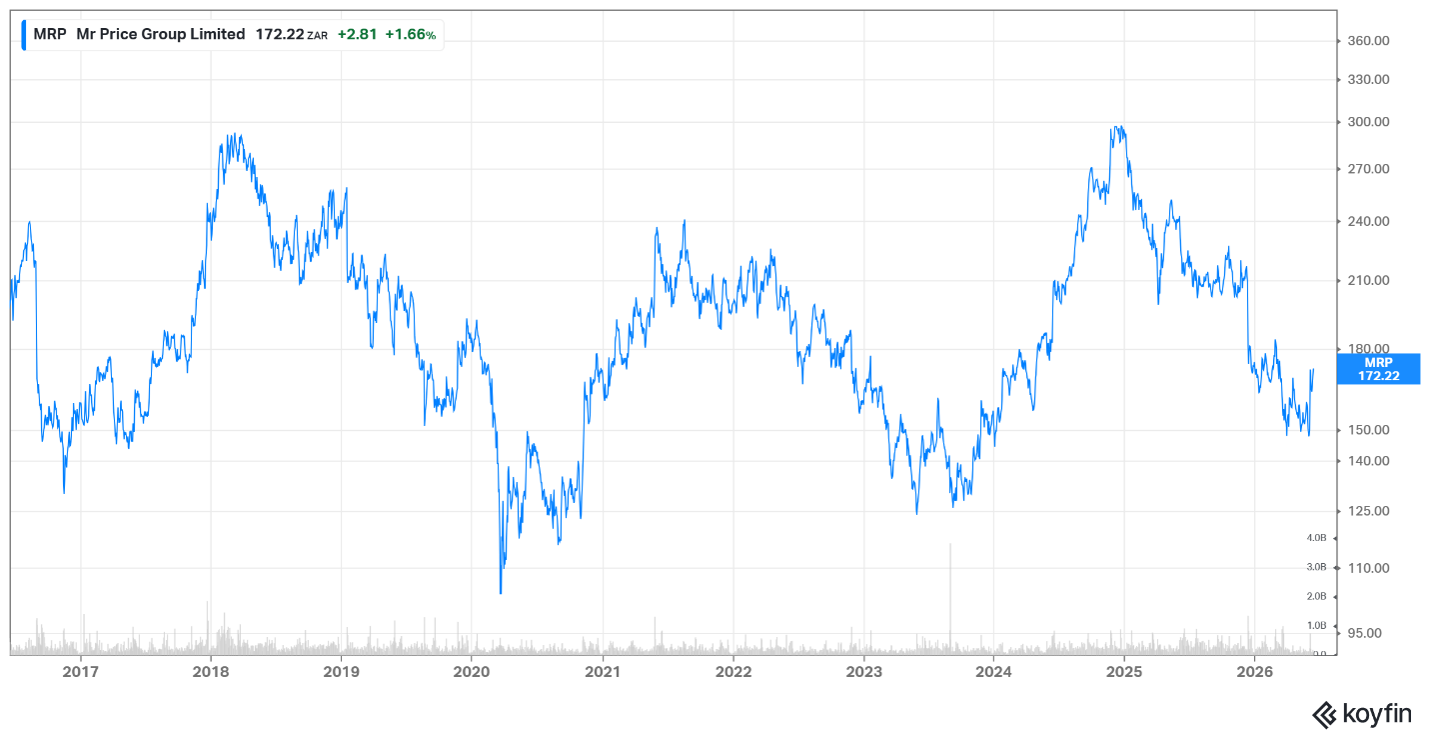
My take: Mr Blair is working hard to persuade shareholders that his offshore strategy will work. The sale of these shares does not support his messaging.
3. Alphamin
Alphamin owns and operates the high-grade Bisie tin complex in the DRC. Over the centuries, tin has played an important role: tools in the Bronze Age, cans for preserving food, and now as a “compute metal” integral to AI servers. AI needs computing power and energy. But it also depends on soldering bits of metal together, which tin does.
It should therefore come as no surprise that the price of tin is elevated:

Of course, this has positive implications for Alphamin’s share price, which reached a new all-time high this week:

The South African stock market has very few AI plays. Alphamin is one of them. Only two unit trusts in South Africa own it, and only one fund holds more than 1%. That fund is the MWI Value fund.
Don’t believe me when I say that tin is an AI play? Take a look at this chart from the FT:
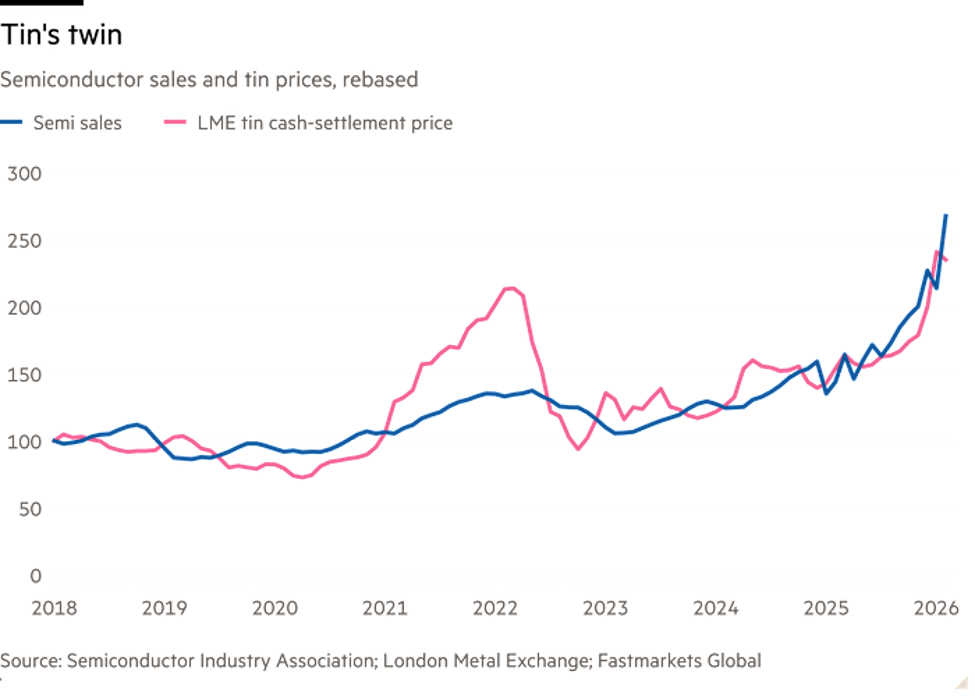
My take: Why would you buy AI fantasies, Optasia or SpaceX, from knowledgeable insiders at inflated prices, when you can buy a stock with real earnings which are inextricably linked to AI?
In the cockroach
Over the past few weeks, I’ve been thinking about the exposure to “hard” assets in the fund*. This note describes how my thinking has developed and the resultant changes I am making to this portion of the portfolio. I tried to define what a real or hard asset was in “The Real Thing“. In short, I defined a hard asset as something whose value derives from scarcity, rather than earnings power.
Last week, I was on a panel at a conference hosted by the crypto exchange Luno when one of my co-panellists, Prof. Adrian Saville, pointed out a deficiency in my thinking. He said that for a “hard” asset to have value, it needs to be not only scarce but also desirable.
This got me thinking – what are the aspects of widely accepted hard assets that make them desirable? I came up with the following:
- Beauty: precious metals are shiny and malleable, making them ideal for jewellery. Beautiful jewellery is desirable.
- Uniqueness: people desire scarce, unique assets. Ferrari commands premium prices due to the limited number they produce. Only 5,000 Richard Mille watches are made annually. That, and Tadej Pogacar racing with one on his wrist, makes them highly desirable.
- Portability: political refugees worldwide agree that the ability to move one’s assets easily across jurisdictions is desirable.
- Availability at scale: you can’t put money to work at scale in cars, watches or fine wine. Even art has limitations – despite the headlines, only around 40 or 50 fine art pieces are worth $100mn or more. Chump change for a billionaire who wants to preserve an asset base.
Looking at this list, it becomes easy to exclude many assets from being classified as the hard kind. Property springs to mind, as it might be unique and desirable, but is not portable. And needs lots of maintenance. Base metals are not scarce or portable. It’s hard to move fine wine around – and probably not very good for it. Art sits on the fringes. Fine art can be unique and desirable, and even easy to transport, but as I pointed out, it is difficult to transact at scale. The market for fancy cars is also relatively tiny.
Diamonds are made of carbon, which is not scarce, as the lab-grown variety of diamond is proving. Oil and gas are also made of carbon and are not scarce. There is enough oil and gas in the Earth’s crust to satisfy its energy requirements for millennia. Despite the green lobby’s best efforts, oil and gas remain highly desirable but are not easily portable. It takes a huge amount of infrastructure to move them around.
Uranium is also not scarce, geologically speaking. It is as common in the Earth’s crust as tin or tungsten, about 500 times more common than gold. Uranium oxide is not a portable asset and is only desirable to the extent you want to build a nuclear power plant or bomb your enemies. This tends to limit the market.
This doesn’t leave much.
Precious metals – gold, silver and PGMs. These have also stood the test of time, which is an important consideration.
Recently, a new asset has sought recognition as “hard” – Bitcoin, or more generally, cryptocurrencies. Some cryptos have a monetary policy that guarantees scarcity – Bitcoin, for instance, will ultimately be limited to 21 million coins in circulation. Being digital, it’s portable and, as such, highly desirable to people living in countries with hyperinflation or capital controls.
Finally, I’m inclined to include land in my definition of hard assets, provided it is in a jurisdiction where property rights are respected. Certain types of land can be scarce and desirable because they have unique features, such as a sea view or mineral and other rights. Crucially, land – as opposed to property – requires no maintenance to keep it in the same condition, an important characteristic of hard assets.
With that as prelude, let’s look at the portion of the “Cockroach” that is allocated to hard assets:
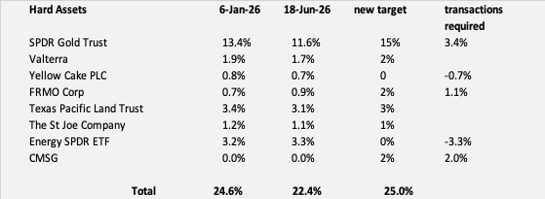
Firstly, due to underperformance, this portion of the portfolio has declined to 22.4% of the total. So, I need to rebalance it back up to 25%, with the following actions:
- Buy gold back up to a 15% exposure. Unfortunately, the regulations governing unit trusts do not allow a fund to have more than 10% in precious metal assets. So, I will have to buy the second-best precious metal asset – the equity of a streaming company. Although not ideal, I must operate within the rules, however irrational they may seem.
- As the fund is limited to 10% in precious metals and I have already maxed out on gold, the only way to gain PGM (Platinum Group Metals) exposure is through the equity of an operating business, in this case, Valterra Platinum. This is even riskier than buying equity in a streaming business, but the rules force me to do so. Fortunately, I bought Valterra some time ago, so I don’t need to do anything right now. To manage this risk, position sizing will always be conservative.
- I will sell the carbon-based “non-hard” assets in the fund, Yellow Cake (an investment trust that owns only Uranium Oxide), as well as XLE, the energy ETF, which holds shares of operating businesses in the oil and gas industry.
- I will increase the exposure to FRMO, an investment holding company that owns TPL as its main asset but is also involved in crypto mining. I wrote about landowner TPL in “Asian Odyssey” a few weeks ago. I will write about FRMO, one of my favourite investment holding companies, in future. St Joe is a landowner in the Florida Panhandle, a topic I will discuss in the future. I don’t need to make any trades in either St Joe or TPL.
- Finally, I will buy 2% of CMSG, Consensus Mining and Seigniorage Corporation. I wrote about the best business model in the world, seigniorage, in “Cash Machines”. CMSG is an investment holding company with four assets on its balance sheet: cash of $60mn, crypto mining rigs with a depreciated value of $1.7mn, 346 Bitcoin, and 12,370 Litecoin. There is no debt. The company’s market value at the current share price is $60 million. It uses interest income from its cash and the sale of Dogecoin (a by-product of Litecoin mining) to fund its crypto mining activities. This is the best way I can find to gain exposure to that emerging hard asset, Bitcoin. ETFs need to sell a percentage of their holdings annually to pay fees. CMSG adds to its holdings annually, at no cost to shareholders.
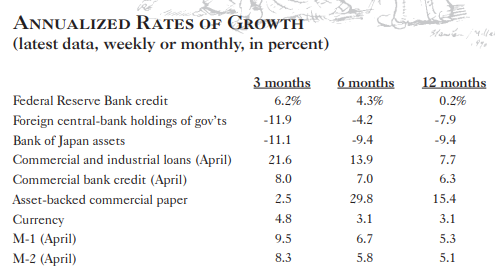
Why am I so adamant about maintaining the fund holding of hard assets? This is why:
Source: Grant’s Interest Rate Observer
Milton Friedman said inflation is always and everywhere a monetary phenomenon. If so, the growth in the money supply in the USA is worrying, even though no one is really talking about it.
* I manage the fund on behalf of Merchant West Investments (Pty) Ltd (FSP 44508)
In The Media
1. Singleton
Given that the title of this letter is Singleton, which refers to the legendary capital-allocating CEO of Teledyne Corp, I thought it might be fun to include a video clip of Singleton the cyclist and his legendary duel with Nakano at the 1982 Track Cycling world champs.
These two really went for each other and crashed out multiple times in the race. If this were a football match, the referee would have red-carded everyone involved and ended the match. But these tough guys just kept going.
You can watch it here.
It was sent to me by South African cycling legend Carinus Lemmer, an avid reader of this newsletter. Thanks, Carinus!
2. Collecting art
My wife (Amanda) and I used to be art collectors, but we have been reducing the amount of “stuff” in our lives. We still love art, however, and end up buying a piece every now and then. But only if we have a space for it!
In this regard, art critic Sean O’Toole wrote a lovely piece about buying and/or collecting art, which I wholeheartedly agree with. You can read it here.
TL;DR: Don’t buy with resale in mind; buy what you love. And live with it.
3. AfriForum
Julius Malema accused AfriForum of stealing money. In response, they made this video in which Afriforum CEO Kallie Kriel thoroughly rebuts Malema’s accusation.
NPOs (non-profit organisations) like AfriForum are what stand between us and total chaos in this country. They deserve our thanks and our support.
Finally, it was my son Nic’s 28th (!) birthday last week. Where has the time gone?
Despite my best efforts, he has become a polite, presentable, and capable young man, and I’m very proud of him. He has brought much joy to my life.

Cheers Nic – happy birthday!
That’s it for this week.
But remember, there’s only one thing that will hurt your pocket more than a rigged IPO – it’s our special set of incompetently corrupt politicians, so be careful out there!
Piet Viljoen
RECM
18 June 2026