

Dear Fellow Investors and Friends,
Welcome to my newsletter, where I share my efforts to understand markets and the world around me.
I do appreciate you taking the time to read this. I love getting feedback; feel free to drop me a line. It’s great to start conversations.
Today is Thursday, the 5th of March, the 64th day of the year. There are 301 days remaining until the year’s end. On this day in 1969, the price of gold reached a new all-time high of $47/oz. Of course, you should never buy things at all-time highs – but if you did, then today’s price of around $5,200/oz would have compounded your capital at a not-too-shabby 8.6% per annum. Come to think of it, maybe this thing about not buying at all-time highs is bad advice. Anyway, by law, I’m not allowed to give advice, so just ignore it.
But don’t ignore gold. Or other real assets.
When setting out on a journey, it’s always best to consult a map of the terrain one wants to explore. Today, I want to explore the valuation of real assets – but let’s start at the beginning.
What is a real asset?
A real asset is a tangible, physical asset which has intrinsic value due to its scarcity. The value lies in the asset itself, not its ability to generate income or cash flows. Examples of real assets include precious metals, land, and collectables such as art. Real assets can also be better understood in juxtaposition with financial assets, which derive their value from a discounted stream of future cash flows. Examples of such assets are stocks, bonds and property.
Financial assets always originate on someone’s balance sheet. They are the liability of a company in the case of equity or corporate debt, the government in the case of government bonds, or the property owner in the case of REITs. Importantly, real assets are never someone else’s liability, which is why I prefer the more descriptive term: hard assets.
The pricing of financial assets incorporates assumptions about the size of the asset’s cash flows, the rate at which those cash flows will grow in the future, and an appropriate interest rate at which to discount them to present value terms. In the short run, demand and supply might determine the price of financial assets, but not their intrinsic value.
On the other hand, hard assets have no ‘intrinsic value’, as they have no regular cash flows to estimate and value. The value of a hard asset is simply its price, as set by the interaction of supply and demand. As such, the quantity of money in circulation plays an important role in determining the value of real assets. The more money in circulation, the higher the demand, all else equal.
Now for the twist – real assets by their very nature are scarce; in other words, their supply is fixed. It follows that their price is thus primarily determined by demand factors.
In simplistic terms, in an economy with a fixed amount of one asset, let’s say gold, and a fixed amount of money in circulation, the gold will be worth exactly the amount of money in circulation. If the amount of money in circulation goes up, the price of gold expressed in those money terms will also go up. Of course, no system is ever that simple, but when trying to determine the long-term value (fair price?) of hard assets, a good place to start is the money supply.
Milton Friedman famously said, “Inflation is always and everywhere a monetary phenomenon“. One could think of fiat money as a kind of real asset. A dollar is always worth a dollar. But a dollar is a real asset with an elastic supply. In fact, there are strong incentives for governments to prefer more money in circulation, rather than less. In “Don’t Be a Bag Holder“, I wrote about the lessons that history teaches us in this regard.
An increasing supply of money – the thing in which assets are priced – implies an increasing price level for everything whose supply increases by less. In other words: inflation. However, several factors keep the general rate of inflation below the rate of growth of the money supply:
- Productivity gains. People just get better at things.
- Substitution effects. People actively seek out cheaper alternatives.
- Qualitative improvements. Over time, goods get upgraded.
So, hard assets should outperform inflation due to:
- Higher money supply growth than inflation drives demand growth.
- A scarcity premium, leading to increased pricing power.
- Emotional factors – greed, envy – can lead to price gains well in excess of that which would have obtained simply given the natural scarcity.
However, two things will temper this outperformance:
- Any supply growth. The supply of hard assets is not fixed. Annual global gold production is around 3,600 tons, with a total of around 220,000 tons ever produced. So, the supply of gold grows by c.1.5% per annum. Platinum grows by c.2% per annum.
- Holding costs reduce returns. It can be expensive to store, insure and maintain hard assets. Ask anyone with an art collection.
What has happened in the real world?
From 2000 to 2019, US money supply (M2) grew at an average annual rate of about 6.2%, while annual consumer inflation averaged only 2.1%. In the last three decades of the 20th century, money supply grew by around 7% per annum, while inflation averaged 5%. That’s a 200 basis points differential. So, it’s true, money supply grows faster than inflation.
Perplexity tells me the following: since gold floated in 1971, its average annual nominal return has been approximately 9% per year through February 2026. Over the same span, US inflation averaged about 3.9% per year (CPI), resulting in a real (inflation-adjusted) return for gold of about 4% per annum.
The other metals widely regarded as precious (and therefore hard assets) – silver and the platinum group metals (PGMs) – are more common than gold in the earth’s crust. PGMs are 25% more common than gold, while silver is 60% more common. Their returns should therefore be lower than golds over time, all else being equal.
Gold is at the top of the pyramid of hard assets.
- It’s the scarcest precious metal.
- It’s easily transportable.
- It’s uniform.
- Holding costs are reasonable.
Collectables (like art, wine and cars) are worse than gold across all these dimensions. Like property, I classify them as “lifestyle assets” – nice-to-haves, but not a serious investment proposition. In the book, “Art as an Investment? A Survey of Comparative Assets”, author Melanie Gerlis quotes an annual nominal return of around 4% for owning art – and that’s for the really good stuff. Barely worth it. I wrote about art as an asset class in “Art for art’s sake”.
Land is not transportable, is subject to taxes and is not uniform. As a result, it is probably, on average, the worst of the hard assets. But it can provide useful, uncorrelated, positive returns. And better than property, as it attracts no maintenance costs.
I have a personal data point here. I recently sold a vacant plot of land that I had owned for 23 years. It was an attractive piece of land within a game reserve. I also bought it during one of those times when people were negative about investment prospects in SA, so I bought it cheaply. My return over that period? 6.4% per annum. At the time I bought it, government bonds were yielding 9.4%.
Not the best investment I have ever made, especially considering the alternatives.
Over the past few years, we have experienced the creation of a potentially new hard asset. This asset – Bitcoin specifically, but cryptocurrencies generally – has many favourable characteristics. Supply grows by less than 1% per annum, and total supply is hard-capped at 21 million coins. Being digital, it is super easy to transport, and costs very little to store. Its only drawback is that it has been around for less than 20 years, so it has not yet become “seasoned”. Many people still regard it with suspicion, as it has attracted its fair share of opportunist scam artists.
Having said that, many people still regard gold as a “pet rock”.
Over time, I believe there is a non-zero chance that Bitcoin – and other digital currencies – will come into favour. They deserve an allocation to a portfolio of hard assets.
Be that as it may, any serious long-term investment portfolio should allocate a portion to hard – or real – assets. They provide a hedge against inflation and offer “uncorrelated returns”. Just be careful about exactly which hard assets you buy.
In The Markets
1. Thoughts on war
We started setting up RECM in early 2003. In January, we decided to begin operations on 1 April – an auspicious date for starting a new venture. 11 Days before we were due to open our doors for business, on 20 March 2023, the War in Iraq started, with CNN showing the shocking visuals nonstop.
Just over a month later, George W. Bush declared the end of the war in his “Mission Accomplished” speech. It dragged on for 8 more years.
Despite all the negativity surrounding the hostilities, we hunkered down and opened for business on the planned date. As luck would have it, a few months later, one of the biggest bull markets in the JSE’s history started.
Who would have thunk?
See if you can spot where the Iraq war started in this chart of the S&P 500: (Clue – I have drawn a circle around the first few months of 2003):

It was but a flesh wound (for the markets, at least).
Not to make light of a sad period in human history, but in market terms, it was a negligible event.
My take: No one knows how this will play out. Take whatever opinion you read on the effect of current hostilities on the market with a huge pinch of salt. The best (only?) defence against the unknown is a properly diversified portfolio. Something like “The Cockroach”.
2. Top of the Pops
The Annual Global Investment Returns yearbook was published this week. I still have a copy of the 2002 edition. It’s basically a history of returns from global markets – both bond and equity – since 1900. It really is a compelling read if, like me, you find historical data fascinating.
You can read this year’s version, sponsored by UBS, here.
If you want to know what the future holds, study history. This publication is a first step in that direction. I want to highlight one chart, though, which shows annual real returns in US$ terms from different markets:
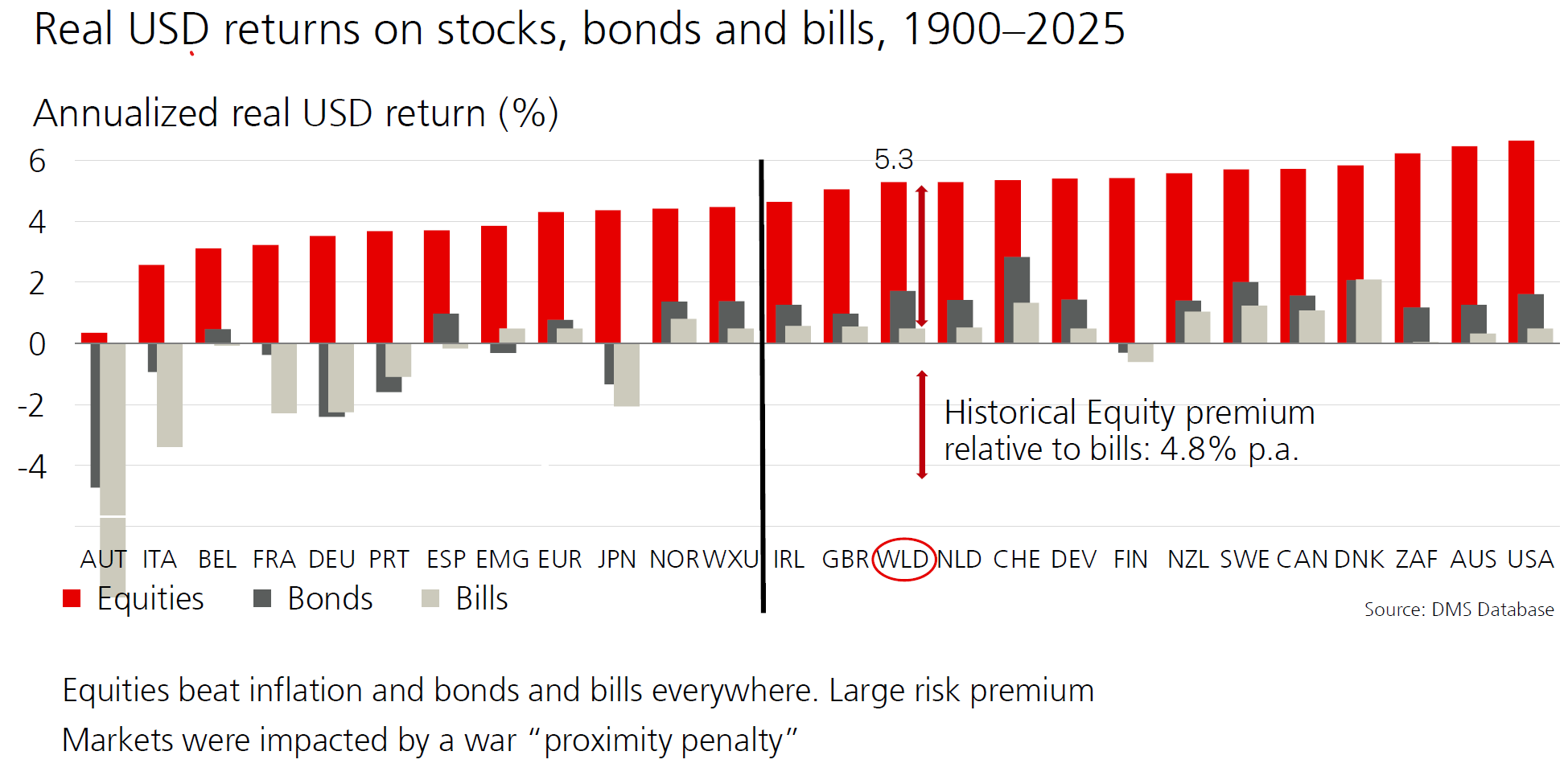
Note: ZAF is their abbreviation for the South African equity market – which happens to be the third-best-performing market in the world over the long term.
My take: ignore the South African market at your peril. We have the resources the world needs and people who can make a plan. Plus, we have the bonus of not being in one of the many developing global war zones.
3. The Scramble for Africa
Since Beijing choked exports of rare-earth elements, the United States’ efforts to loosen China’s grip on critical minerals has accelerated. President Trump’s administration is building a trade bloc for critical minerals. They have committed US$30bn for mining and processing projects to create alternative critical minerals supply chains. One target is Central Africa’s Copperbelt, where the US aims to challenge Chinese mining dominance.
A little-known fact is that President Trump invited the DRC’s President, Félix Tshisekedi, to the White House last December, where they agreed to a “strategic partnership.” This will give the US preferential access to Congolese mineral deposits. Trump also brokered December’s peace accord between the DRC and Rwanda, signed in Washington. The US International Development Finance Corporation has agreed to work with the state miner, Gécamines.
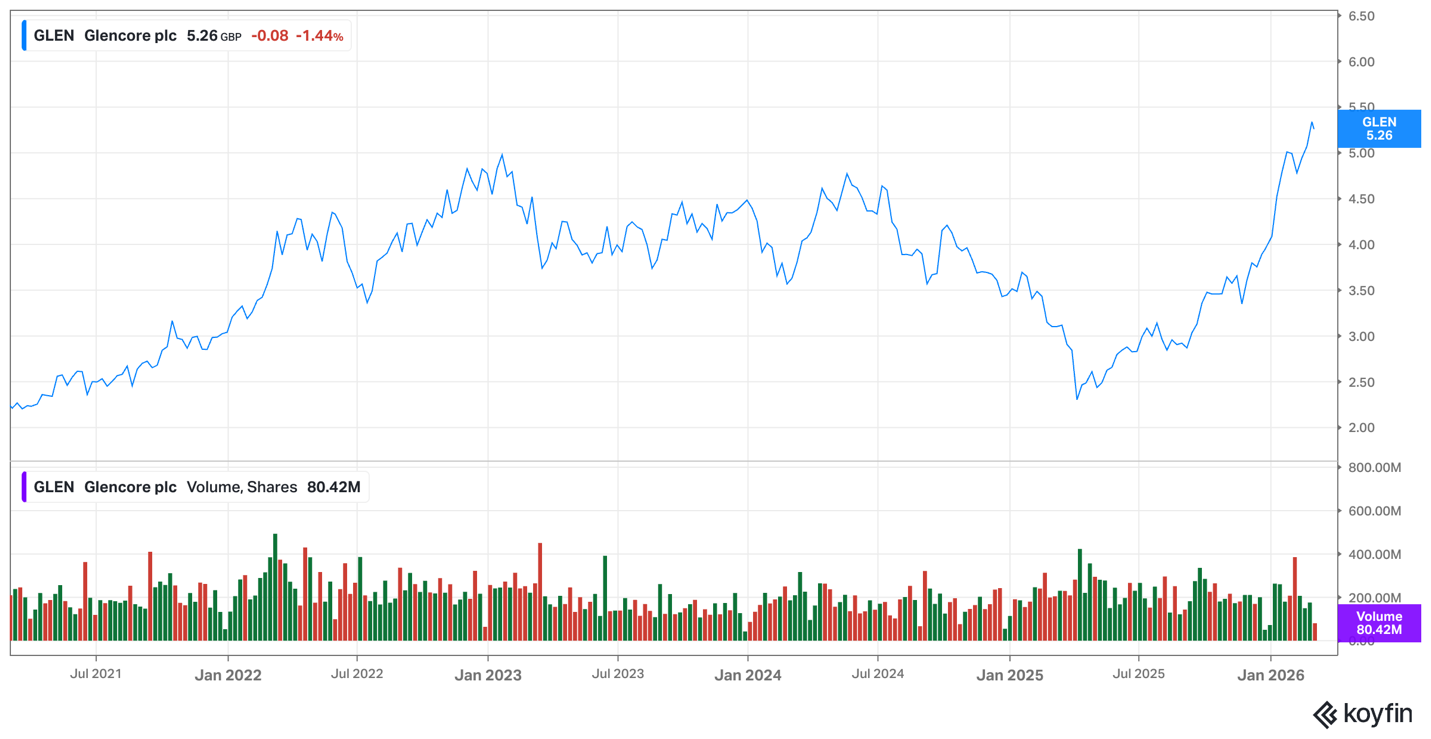
What gets mined in the DRC? A lot of industrial metals like copper, cobalt and tin. And their prices are going through the roof:

The MWI Value funds hold significant positions in Glencore and Alphamin, which are active in the DRC. Both are hitting new all-time highs.
Here’s Glencore:
And Alphamin:
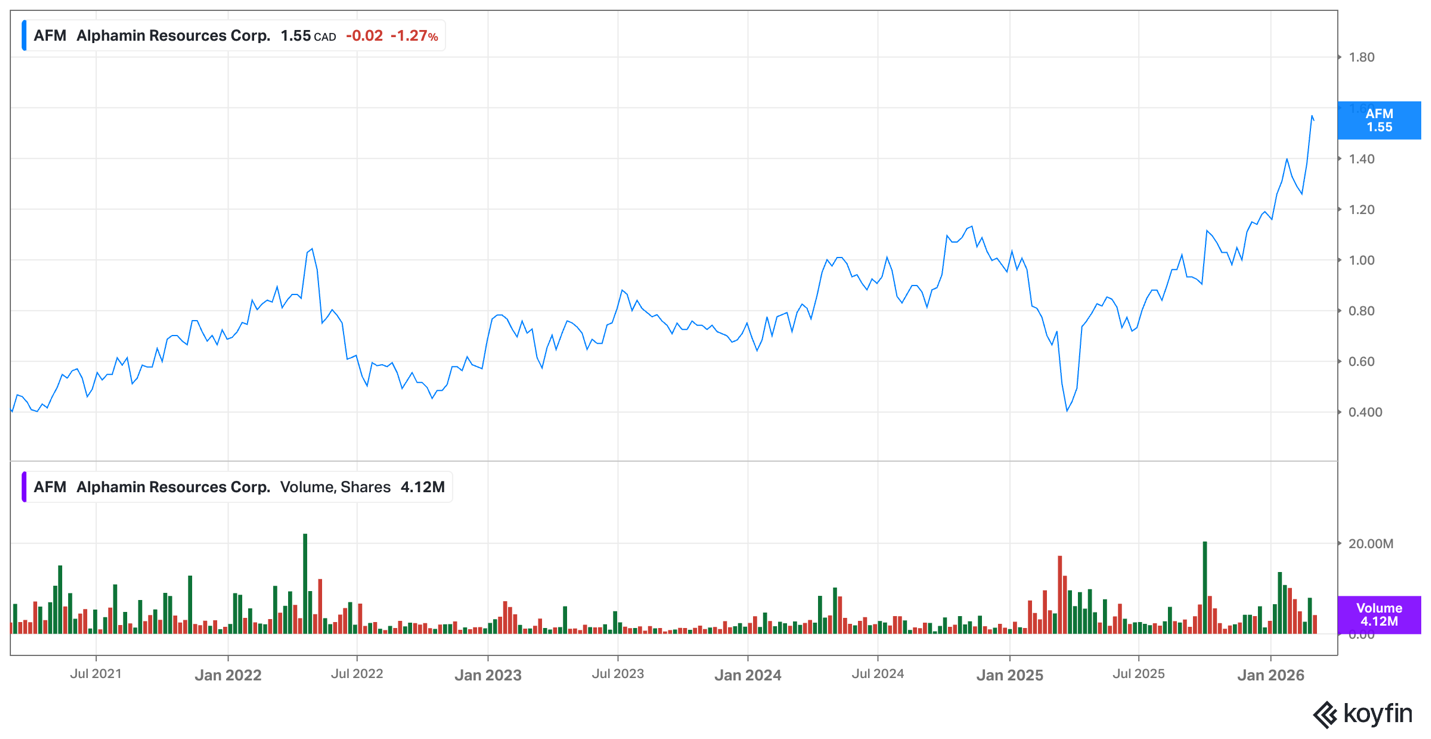
My take: The conflagration in the Middle East will not halt the re-industrialisation and the rebuilding of local supply chains in the USA. Postponed, maybe, but not halted. Africa’s resource endowment remains a key input into this process. It’s worth keeping this in mind when thinking about the investment prospects for the rand and South Africa.
4. Quick! What market am I in?
- I’m undervalued.
- I’m hated by most investors, especially the locals.
- As a result, investors are significantly underweight me.
- The political environment in which I operate is a clown show.
- People are emigrating, moving away from high tax rates, crime and interventionist government policies.
Let’s see if you can guess which market this is…if you guessed South Africa, you are wrong.
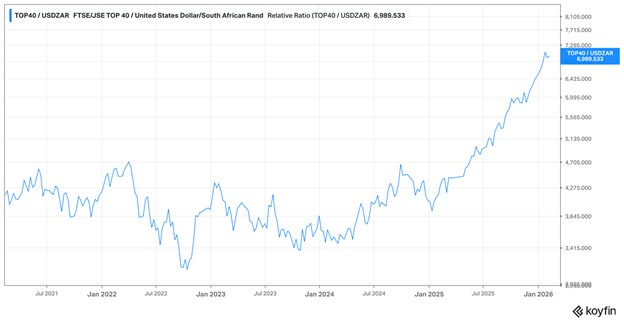
The above described us 5 years ago. Since then, sentiment has improved somewhat because of a (slightly) better political environment, and our stock market is flying. Here’s how that rocket ship, the JSE, priced in US$, has responded to a slightly better environment:
No, I am talking about the UK today.
- Newspapers describe the UK economy as being in a “low-growth trap”.
- If Sir Keir Starmer is driven from 10 Downing Street by (among other things) the Jeffrey Epstein scandal, it will bring the total number of prime ministers Britain has had in the past 10 years to seven (David Cameron, Theresa May, Boris Johnson, Liz Truss, Rishi Sunak, Starmer and his replacement).
- Newspapers report that approximately 252,000 British citizens left the UK in the last year.
Here is the FTSE small-cap index, in US$ terms:
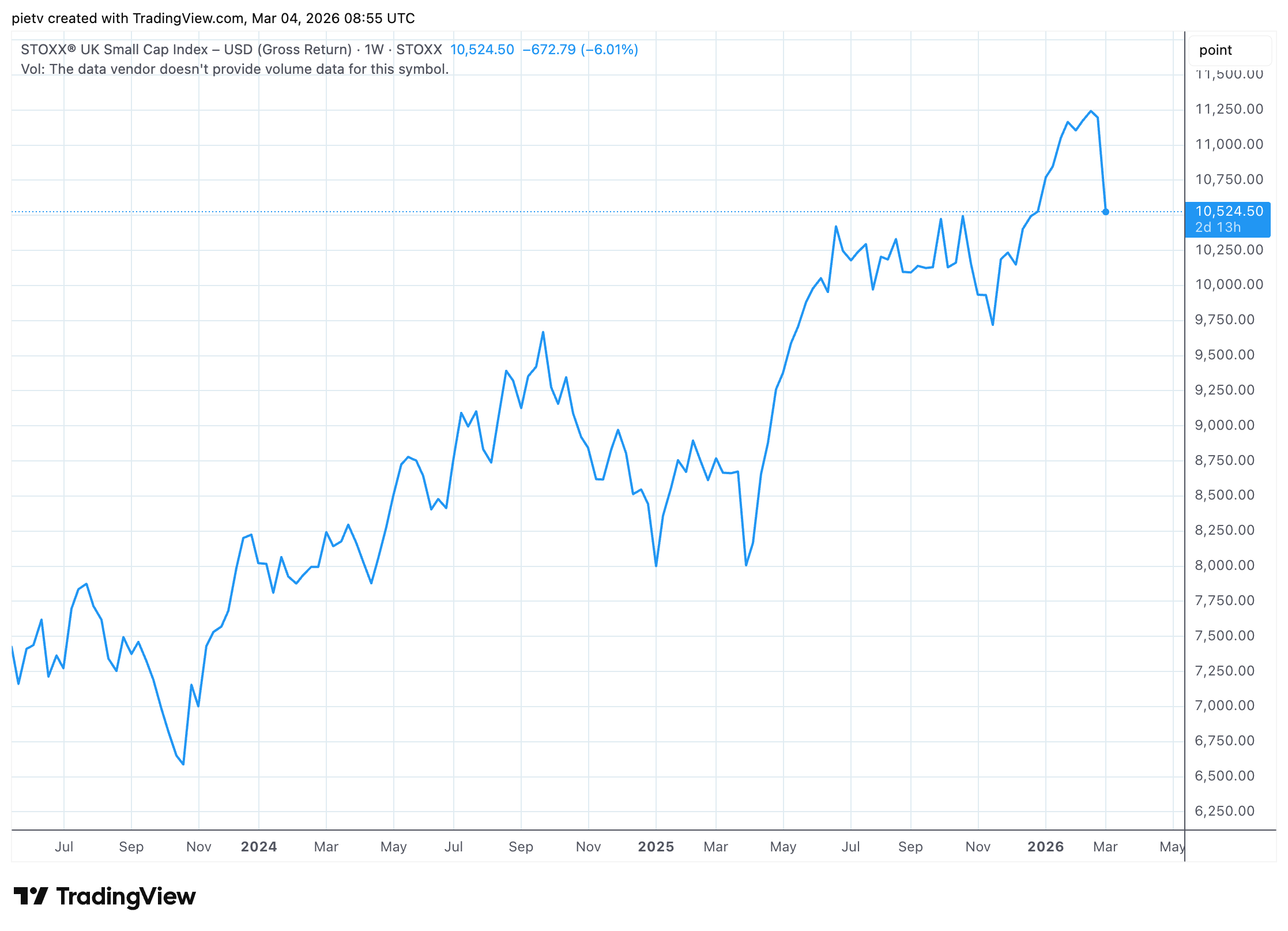
The small-cap index is more representative of the local economy than the FTSE 100, which contains many multinationals.
My take: High levels of negativity create good investment opportunities. The UK today reminds me of South Africa a few years ago. Also, UK small caps recently made new highs. New highs are bullish. This is not advice.
In the cockroach
As usual, no trades this week in the fund*. Given current geopolitical events, I’m happy with the fund’s 25% exposure to cash assets. As the price of risky assets declines, I will, in due course, use some of this cash to buy them up.
Last week, I promised that I would discuss the riskiest portion of the fund in this week’s mailer: its allocation to equities. It currently looks like this:

Overall, the recent sell-off has left the allocation slightly below 25%. But not enough yet to warrant any rebalancing. Over time, I want to own a diversified group of 10 stocks for a very long time. I have bought 5 of them so far: LSE Group, Nestle, Berkshire Hathaway, Walt Disney and DSM-Firmenich. Each of these has an attractive business model, benefits from the Lindy effect (they have been around for a long time), and is globally diversified.
The ones I haven’t yet bought are a luxury goods company (Hermes or Ferrari), a software/tech company (Microsoft or Apple), a gaming company (Nintendo or Roblox), a financial services company (Mastercard) and an industrial company (Investor AB).
I haven’t bought these yet because either:
- I haven’t yet done the necessary work to decide exactly which one, or
- They are too expensive.
Eventually, I aim to hold 2.5% in each of these 10 companies to make up my 25% equity allocation in the fund. While I am waiting to buy the remainder, I own index ETFs (MSCI World and Emerging Markets) and a fund (MWI Value). As I buy up the individual stocks that make up the 10 stocks forever, I will sell down the holdings of funds/ETFs.
* I manage the fund on behalf of Merchant West Investments (Pty) Ltd (FSP 44508)
In The Media
1. Joe Studwell on Africa
Developmental economist Joe Studwell (author of “How Asia Works” and now also of “How Africa Works”) was interviewed by economist Tyler Cowen on his podcast, “Conversations with Tyler”.
This podcast is one of my favourites, as his interviewing style is direct and to the point. He pulls no punches, but in a nice way.
In this podcast, he interrogates Joe Studwell’s optimistic outlook for Africa. I share Mr Cowan’s scepticism about the potential for an “African Renaissance”, which is different from a cyclical upswing, which I think is more than likely. I’m afraid Mr Studwell is less than convincing in his arguments.
My take: It’s always good to listen to opposing points of view. If Mr Studwell is right, then we can look forward to big things on the continent. But I share Mr Cowan’s doubts.
2. Art and Politics
In his latest Red Hand Files Letter, Nick Cave addresses the role of art in society. He agreed with director Wim Wenders when he said that art and artists are “the counterweight to politics, we are the opposite of politics”. Wenders went on to say that artists “have to do the work of the people, not of the politicians”.
He said this in response to the furore at the Adelaide Writers Week, which was cancelled after many authors pulled out following the Palestinian/Australian author Randa Abdel-Fattah’s uninvitation. Cave lamented that the event was “vaporised in a mushroom cloud of performative outrage”. In effect, political art became no art at all.
Something similar is happening regularly here in South Africa. The South African National Gallery (SANG) recently hosted a retrospective of artist Steven Cohen’s work. He is an artist who has spoken truth to power for many decades, both locally and internationally. For that, Amanda and I love his work. Unfortunately, the day before the show, which had been months in the planning, the management of SANG decided that several of his works would hurt the sensitivities of some people and forced him to cover them up. The show is just not the same as a result, and if I were Mr Cohen, I would have walked away rather than allow censorship to diminish my work.
Recently, artist Gabrielle Goliath was selected to represent South Africa at the Venice Biennale. This Biennale is the pinnacle of the global art scene, so having your work selected for display there is an exceptional honour. Unfortunately, our Minister of Sports, Arts and Culture censored the exhibition, due to its apparent sympathy for the Palestinian cause. I have no sympathy for that cause either, but I don’t believe censoring a show is the right way to approach the issue. Now, South Africa has no show at this year’s Biennale.
My take: In both these recent cases here in South Africa, political art became no art. And that is a sad situation. Freedom of expression – no matter how offensive to some – is a cornerstone of a healthy society. In such a society, art should not be subjected to political intolerance.
In other news, my stepson Zach – like many others – has emigrated from London, back to Cape Town. Of course, Amanda can’t be happier. Zach also heard last Friday that he passed his Board exam. He is now one step closer to becoming a Chartered Accountant. Of course, Amanda can’t be prouder. So am I.
On Sunday, Amanda, Nic and I will be riding the Cape Town Cycle Tour. Somehow, we’ve landed up in batch 1F – give us a shout out if you see us. And let us jump on your wheel, of course!
Next week I will be at the BizNews conference in Hermanus. If you’re going to be there, come and say hi. Alec and his team have put together a wonderful program of speakers over three days. I can’t wait for some of those presentations.
If you are riding the cycle tour, heading to beautiful Hermanus or just staying at home, remember to be careful!
Piet Viljoen
RECM
5 March 2026