

Dear Fellow Investors and Friends,
Welcome to my newsletter, where I share my efforts to understand markets and the world around me.
I do appreciate you taking the time to read this. I love getting feedback; feel free to drop me a line. It’s great to start conversations.
Today is Thursday, April 30th, the 120th day of the year. There are 245 days left until the end of the year. On this day in 1945, Adolf Hitler died. Not being able to face the disintegration of his 12-year-old “Reich”, he committed the cowardly act of shooting himself. His remains were moved around and finally scattered on the Elbe River. But no one knows for sure, which raises many questions…
All I can say is good riddance. But I have a different set of questions today.
As regular readers of this letter know, Amanda and I spent some time in Asia recently. The thing we both noticed was how well developed the infrastructure was. Enormous, architecturally interesting new buildings. Well-designed and properly maintained roads and highways. Clean, efficient and easy-to-use bus, train and subway systems. Dedicated cycling and pedestrian lanes, all over the show.
On top of that, it was safe. Everywhere, at all times of the day and night.
The cities we visited – Osaka, Seoul, Beijing, Shanghai and Singapore were all huge – pictures don’t do them justice. Given the scale of these cities, plus English not being the preferred means of communication, it would be a daunting exercise to flaneur your way around, as we like to do. But the high-quality infrastructure made it accessible and easy to do.
Take South Korea, a highly developed economy, home to some of the most technologically advanced businesses in the world:
- Samsung Electronics is Korea’s deepest tech platform: memory, logic/foundry, smartphones, displays, image sensors, AI devices and manufacturing automation. It spent $25bn on R&D in 2025 and holds over 281,500 patents globally.
- SK Hynix is Korea’s most advanced company in a globally critical niche: AI memory. It is a key supplier to Nvidia.
- LG Energy Solutions is one of the world’s key battery manufacturing companies.
- Hyundai Motor Group is advanced in EV platforms, hybrids, hydrogen, software-defined vehicles, robotics and manufacturing AI. It plans to invest $90bn in Korea by 2030.
There are many more, but you get the picture – big, high-tech companies, investing a lot of money into the local economy.
Here are some more interesting – and relevant – facts about South Korea:
It’s a small country, roughly the size of Portugal. Its population is around 50 million people, so it’s not a huge market. GDP per capita is around $37k, up from less than $2k in 1980. By way of comparison, in 1980, South Africa’s GDP per capita was $3k; today it is $7k.
Seoul, the capital, is 20km from the border with North Korea. The North Korean leadership views South Korea as a hostile enemy, with Kim Jong-un officially designating them as the “primary hostile state” and “most hostile state” in early 2026. The two countries are technically still at war because the 1950–1953 Korean War ended in an armistice rather than a peace treaty. This has resulted in intermittent hostilities. North Korea would like nothing more than to expropriate all of South Korea’s assets.
South Korea’s political history is marked by a trend where top leaders, rather than retiring gracefully, get pushed out, imprisoned, assassinated, or forced into exile. Five of the last nine presidents have served time in prison after leaving office because of major corruption, bribery and embezzlement scandals. Two were either assassinated or sentenced to death. Only two have had “normal” departures. As recently as 2024, martial law was declared by President Yoon Suk Yeol.
South Korea is one of the cheapest places in the world that South Africans can visit. Their currency is called the won, but it’s not winning any currency wars. Along with the Japanese yen and the Chinese renminbi, these Asian currencies are among the most undervalued around. We make fun of the rand (runt?) here in South Africa, but the rand has appreciated(!) by 30% against the won over the past three years. Over the past 10 years, the won has depreciated by 50% against the US dollar, a far worse performance than the rand.
South Korea has had an outsized impact on the entertainment scene over the past few years. Who hasn’t heard of Squid Games, Gangnam Style, BTS, and K-Pop Demon Hunters? Korea even had a big star in the English Football League, Son Heung-min. Since he left Tottenham, they have just about fallen apart.
With that as background, here are my questions:
- How is it that I didn’t see financial advisers advertising their services to help Koreans make offshore “investments” on billboards around the subway and airports in Korea?
- Why have I never heard of a Korean company making significant “transformational” offshore acquisitions?
- How is it that Korean companies are prepared to invest so much in their own economy, plagued as it is by political corruption and instability, the threat of expropriation, a relatively small market and a persistently weak currency?
- Why does the infrastructure work so well in a country that was poor less than two generations ago?
- How can such a small country have such a large impact on the world stage?
I have some vague thoughts about possible answers, but I would love to hear your thoughts, especially if you compare and contrast our situation here on the Southern tip.
In The Markets
1. The Devil Wears Prada
The sequel to this iconic 2006 comedy-drama is scheduled for release this weekend. It’s well known that life imitates art, which got me thinking about potential investment implications.
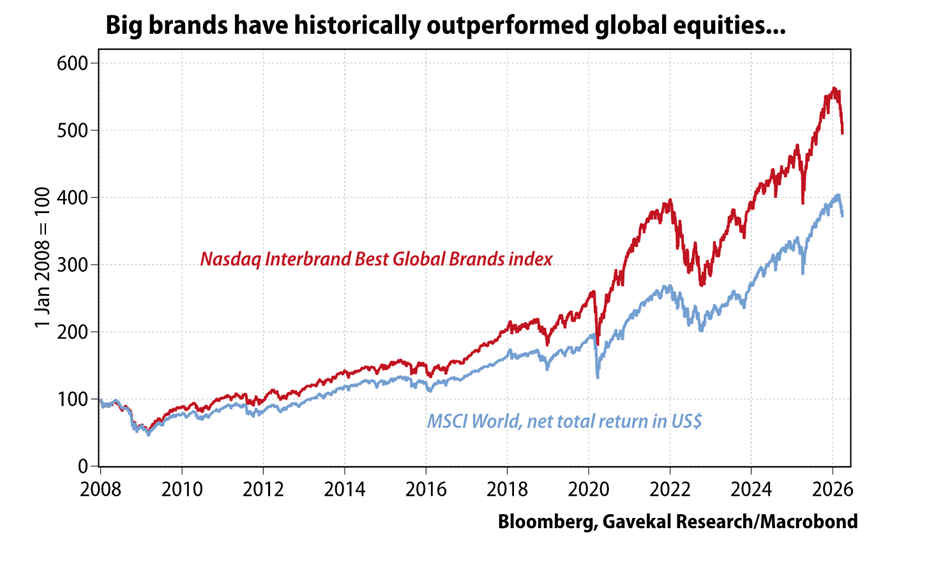
Historically, luxury goods businesses have been great investments. The Veblen effect (where higher prices create higher demand), coupled with managed scarcity, gave them great pricing power. This resulted in businesses with high margins and good returns on capital. Thus, big brands have been strong performers:
Over the past few years, a few things have changed, however:
- Conspicuous consumption has shifted from “things” to “experiences”.
- The work-from-home athleisure trend has taken spending away from “haute couture”.
- The luxury goods companies have pushed their pricing too hard, counteracting the Veblen effect.
- The rise of “Xiaohongshu”, where Chinese tourists increasingly complain about how European cities are dirty, smelly, unsafe and sometimes even unhygienic. Given that most luxury brands have a strong European association, this is not good for their “image” (having just been in China, I can vouch for the superiority of its urban environments).
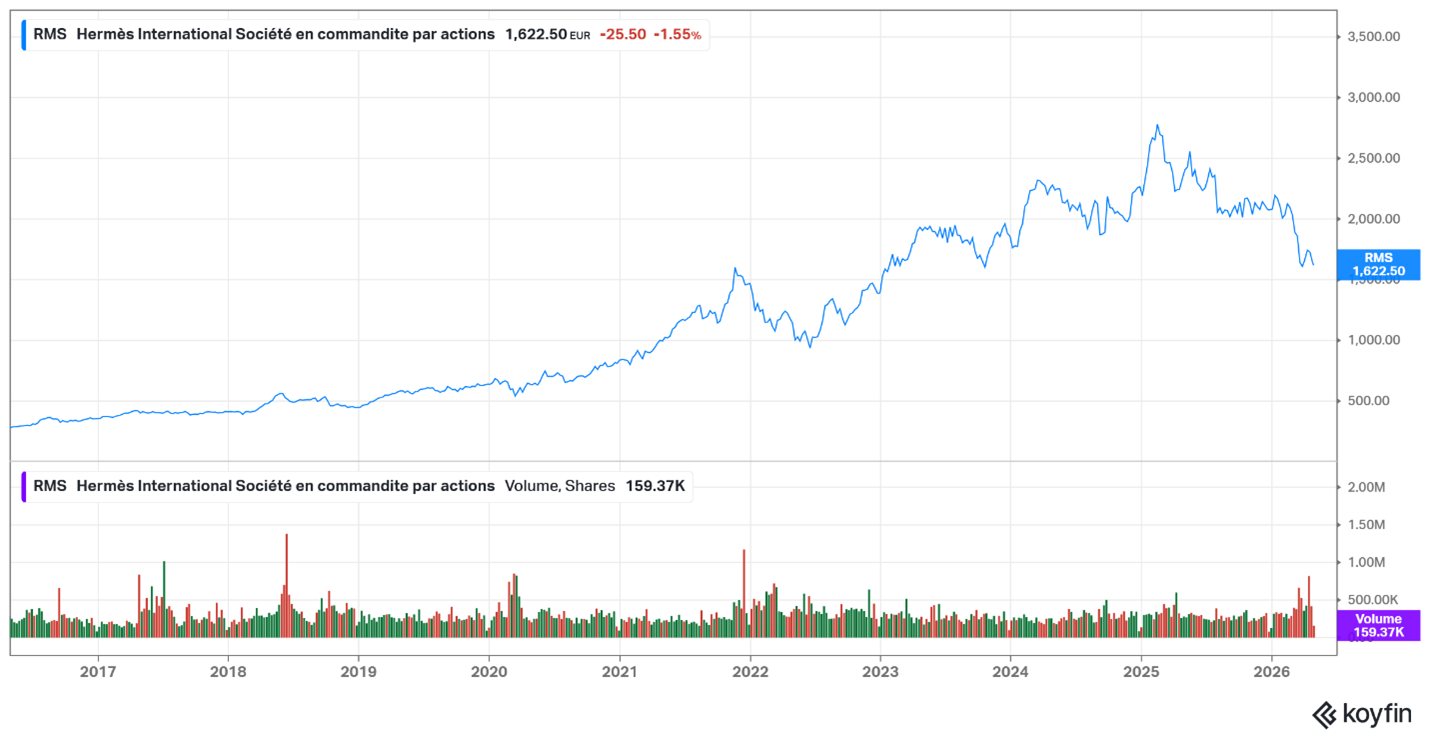
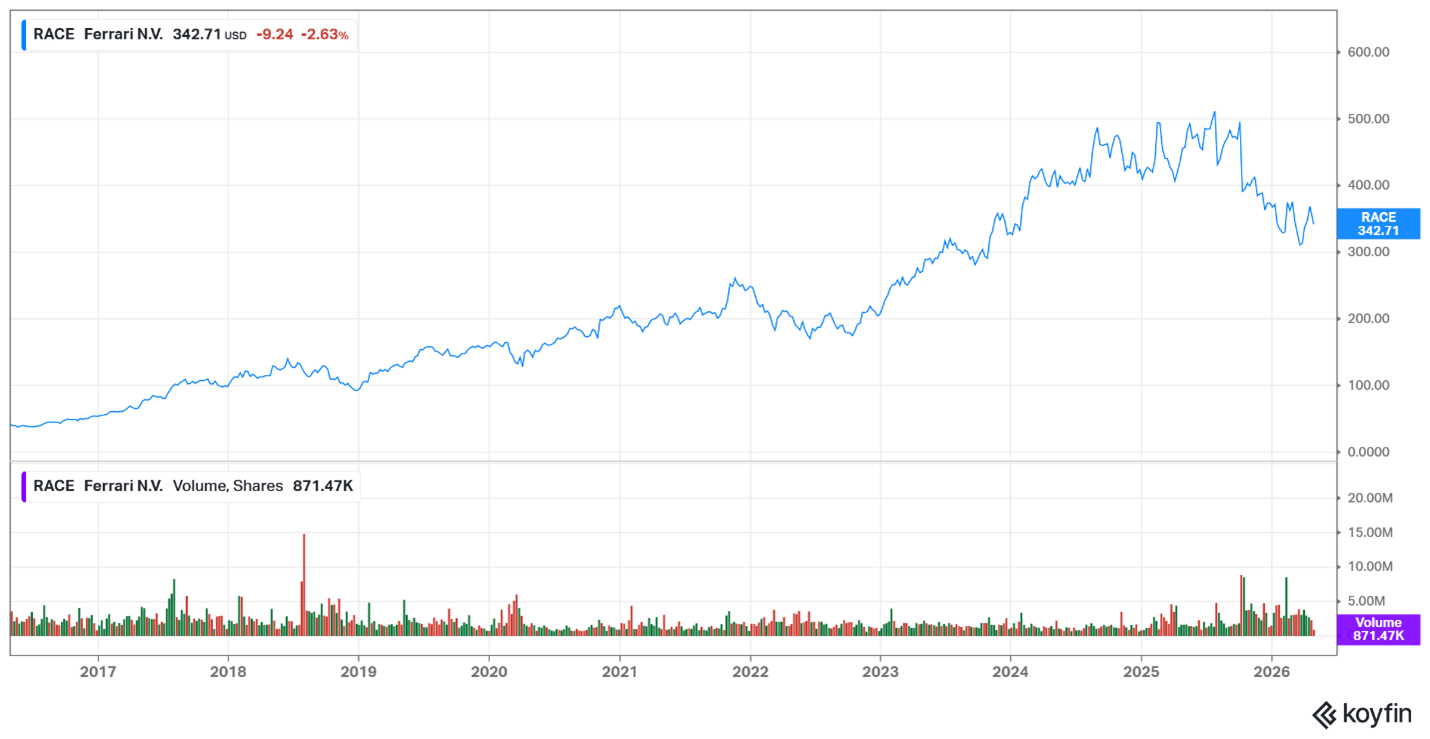
These trends have served to knock the share prices of luxury bellwethers like Hermes (down over 30% from its most recent high) and Ferrari (down a similar percentage):
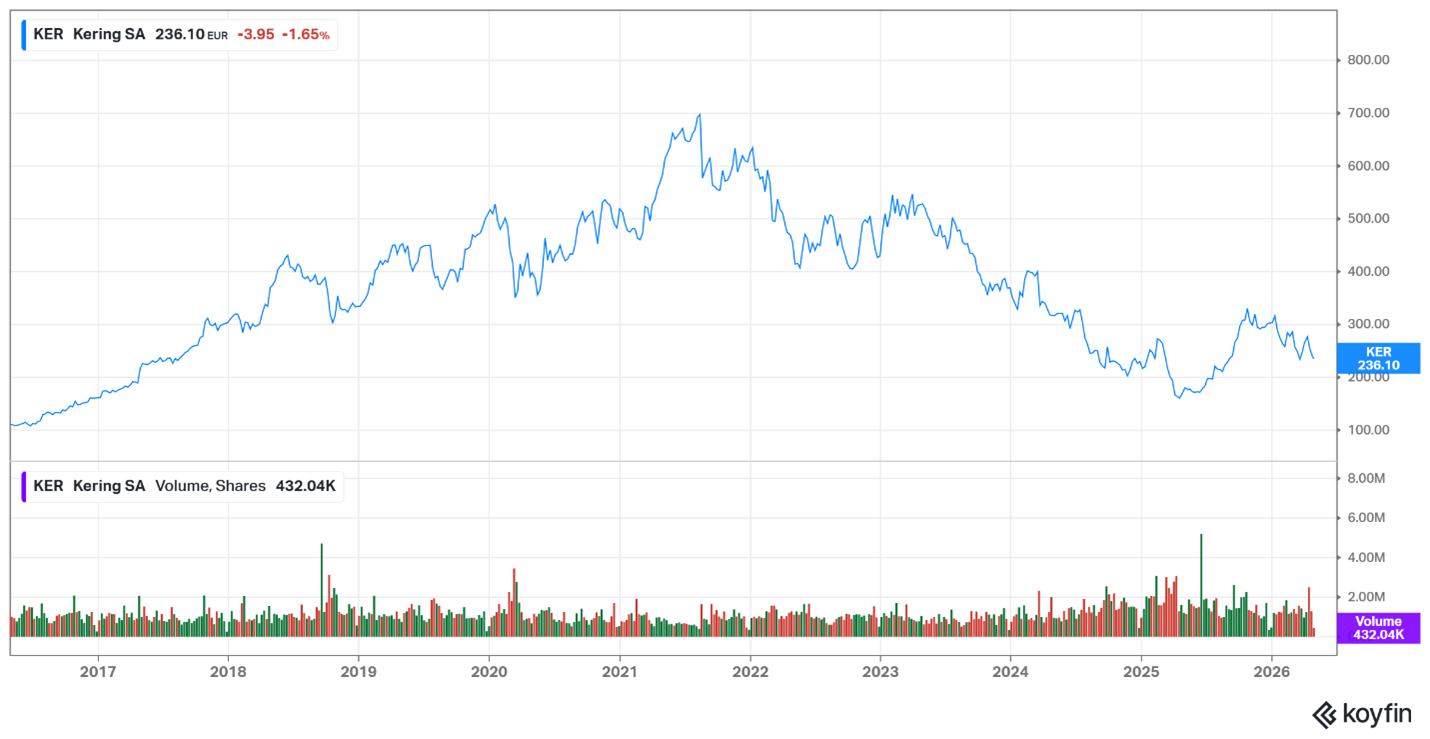
Second-tier luxury like Kering (owner of Gucci) and LVMH have fared a lot worse:

But two things are happening right now. Firstly, the sharp decline in the share prices of these businesses has considerably improved the price-to-value relationship. Second, as more companies demand a return to the office, the trend towards “athleisure” might be weakening – reflected in weak share prices at both lululemon and Nike:
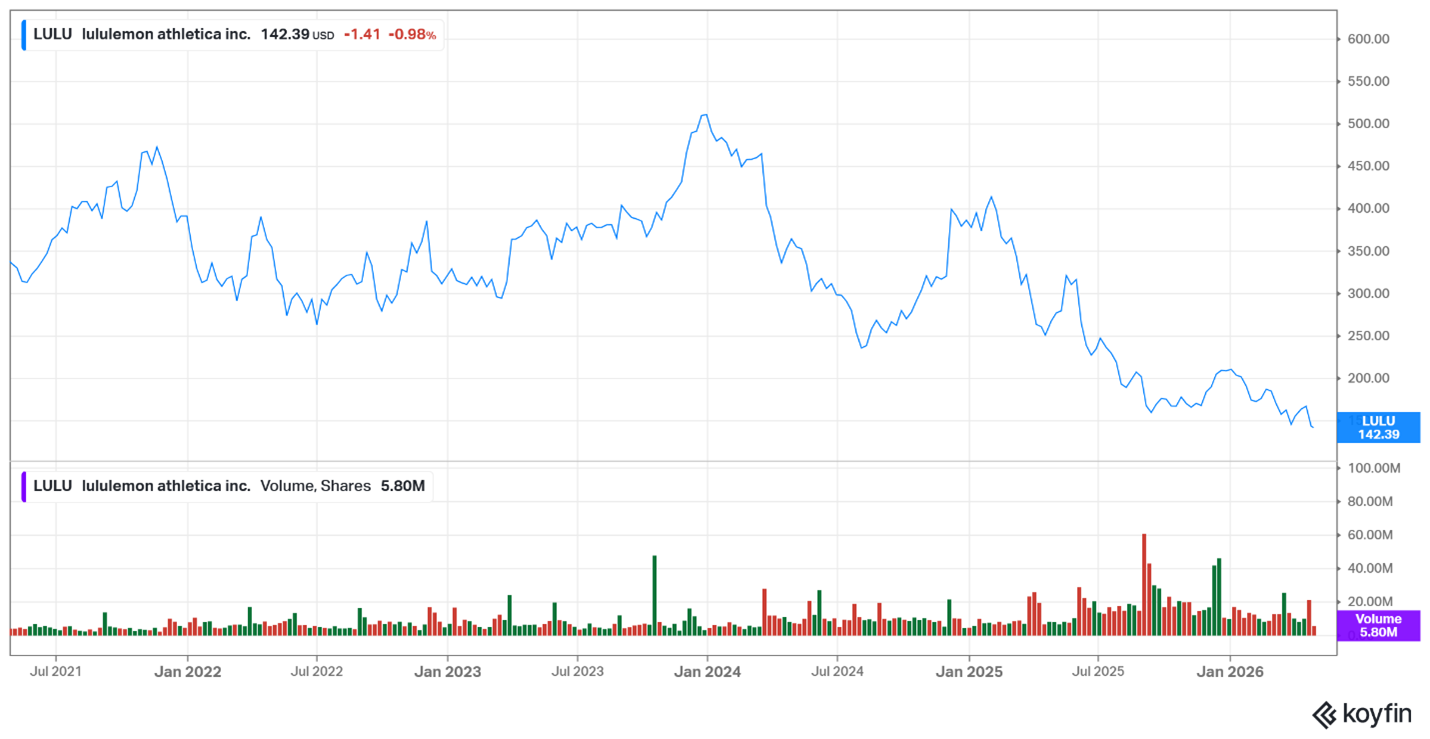

Interestingly, lululemon just appointed a new CEO, a 27-year Nike Veteran, who got the thumbs down from the market.
A successful run of The Devil Wears Prada might just be the signal for a return to luxury that we’ve been waiting for.
My take: I’ve increasingly been wearing suits (and ties!) to meetings and conferences. I had two suits made up over the last year and feel inclined to get one or two more. I think it’s time to start dressing up again. And invest accordingly.
2. There’s a pill for that
GLP-1s (or, as Donald Trump calls them, the fat pill) are a game-changer. Apart from helping you to lose weight, which is the single most significant thing one can do to improve your health span, GLP-1s are increasingly being found to have many other health-related benefits.
I first wrote about this a few weeks ago in “Culture Club”.
What has held back usage has been their cost, and the way in which the drug is delivered – through injections.
However, competition is already beginning to reduce the cost of these drugs and drive pharmaceutical companies to implement better delivery mechanisms. Novo Nordisk – the OG of GLP-1s – has announced plans to potentially halve the price of its brands Ozempic and Wegovy to regain market share.
Their main competitor, Eli Lilly, through better marketing, initially gained what Novo Nordisk lost. That gain seems to have come to an end with the introduction of oral GLP-1s (i.e. pills). Novo Nordisk seems to have some first-mover advantage in that space. After a big run-up on news of its overtaking Novo Nordisk, Eli Lilly’s share price is starting to reflect this recent turn of events:
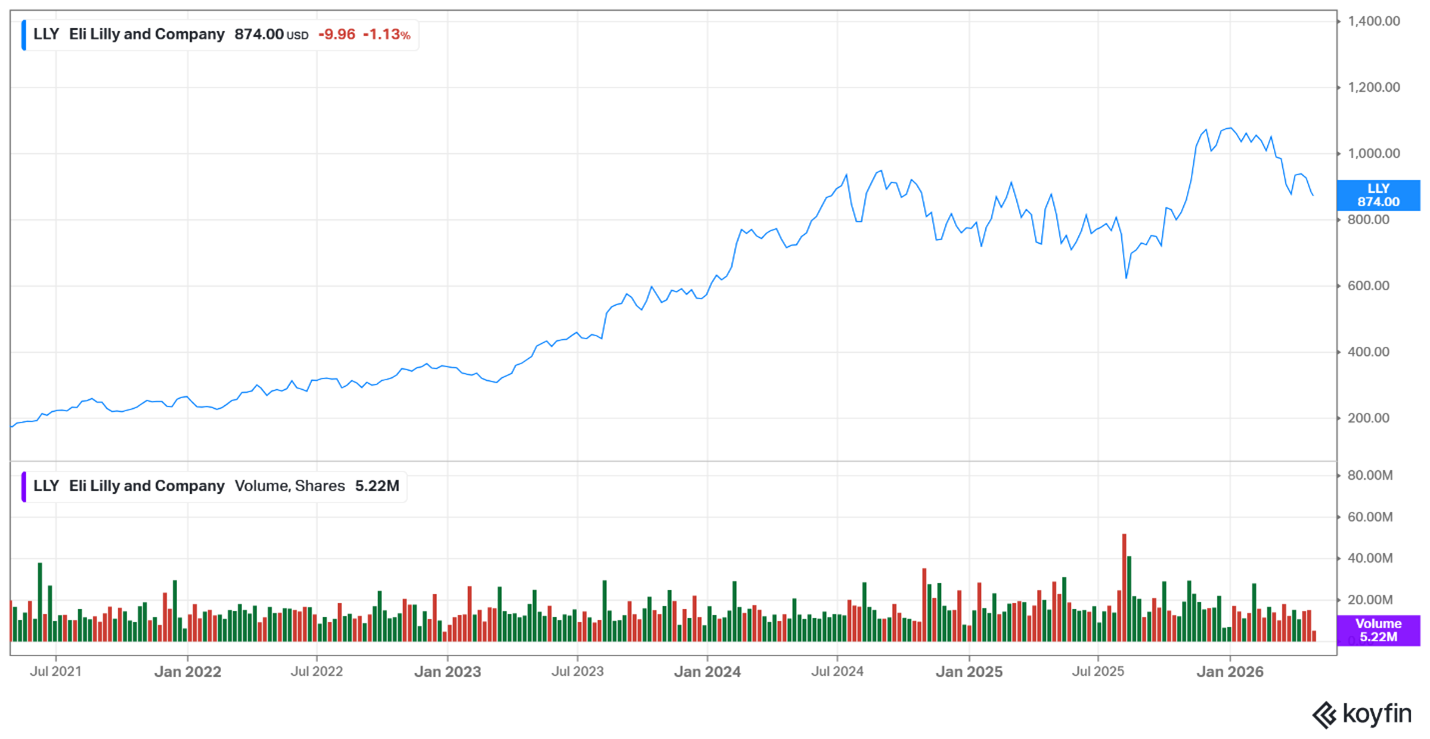
My take: Competition will, as always, ensure the consumer stands to gain most of the value created by new developments. I would hate to have to pick the winning pharma company, as they could be subject to the “Red Queen Effect” – where you must run as fast as you can to maintain your relative position. It’s much easier – as I pointed out in February – to avoid the obvious losers, like the purveyors of alcohol and snacks. In investing, you don’t get extra points for degrees of difficulty.
3. A token of appreciation
A (very) simplified view of the AI ecosystem looks something like this:
- AI is a pseudonym for “Large Language Models” (LLMs), which are programs that analyse words and sentences and predict what comes next based on all the words and sentences that currently exist. Such LLMs are built by companies like OpenAI, Anthropic, Meta and Google.
- LLMs are run on big computers, which are housed in datacenters. These computers use a lot of energy to run – in fact, their computing ability is measured by the energy they require to run the LLMs.
- These computers run on “computer chips” built by companies like TSMC, Samsung and Intel. The chips are predominantly designed and programmed by Nvidia.
- These chips process tokens, which are numbers associated with words, punctuation, spaces, or even sentences. The “AI”, or LLM, looks at these numbers on a complex “3D map” and places tokens with similar meanings close together. Then, it tries to guess the next token, based on statistical probabilities.
In a nutshell, an AI company’s revenue depends on the number of tokens it processes. If you haven’t noticed, there is a lot of hype around this new business model at present. All you need to do is listen to this ridiculous podcast, “Invest like the Best, with Dylan Patel”. I gave up about halfway through, when my brain began to hurt. But I did catch Patel saying, “If you don’t use more tokens, you’ll never escape the permanent underclass”.
Really? It reminded me of all the other statements that were specifically crafted to create FOMO in past bubbles. You might recall some of these:
- Crypto Bro’s saying “Have fun staying poor” in 2025.
- Chuck Price (CEO of soon-to-be-bankrupt Citicorp) said, “As long as the music is playing, you’ve got to get up and dance” in 2007.
- John Chambers (CEO of erstwhile market darling Cisco) said, “Growth as far as the eye can see” in 2001.
And so on.
Well, consider me a permanent part of the underclass, then. This view is only reinforced when a maker of second-rate computer chips, Intel, screams to a new all-time high. They have now finally surpassed their 2000 bubble top:
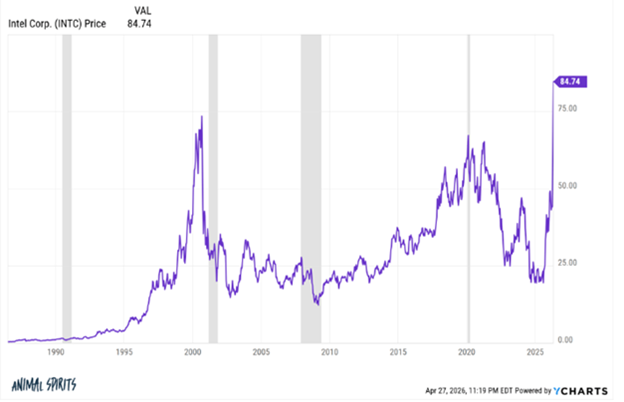
You would think Intel had invented a new technology, but ChatGPT says Intel’s chips are best at making your Windows run slightly faster. And that’s good for an additional $300bn of market cap? Count me out, thank you very much.
In other news this week, OpenAI missed its internal target of 1 billion weekly active ChatGPT users by the end of 2025 and missed multiple revenue targets this year. As a result, it has been reported that Sarah Friar, the Chief Financial Officer of OpenAI, has been warning OpenAI’s leadership that the company may not be able to pay for the computing contracts it has already signed.
It’s worth noting that OpenAI is the marginal buyer in the AI infrastructure complex. According to press reports:
- Nvidia’s 2027 revenue assumptions lean heavily on OpenAI deployments.
- Half of Oracle’s $550bn backlog is OpenAI demand.
- AMD’s “$90 billion in cumulative hardware revenue” claim from its OpenAI deal IS the OpenAI deal.
- CoreWeave is essentially a leveraged bet on OpenAI’s ability to pay.
- Broadcom’s custom silicon roadmap was built around OpenAI demand.
In the meantime, Similarweb’s statistics show that ChatGPT’s share of generative AI web traffic collapsed from 86.7% a year ago to 64.5% in January. In the same window, Google’s Gemini rose from 5.7% to 21.5%. For me, this is another ”Red Queen” effect, where value created doesn’t accrue to the business, but to the consumer:
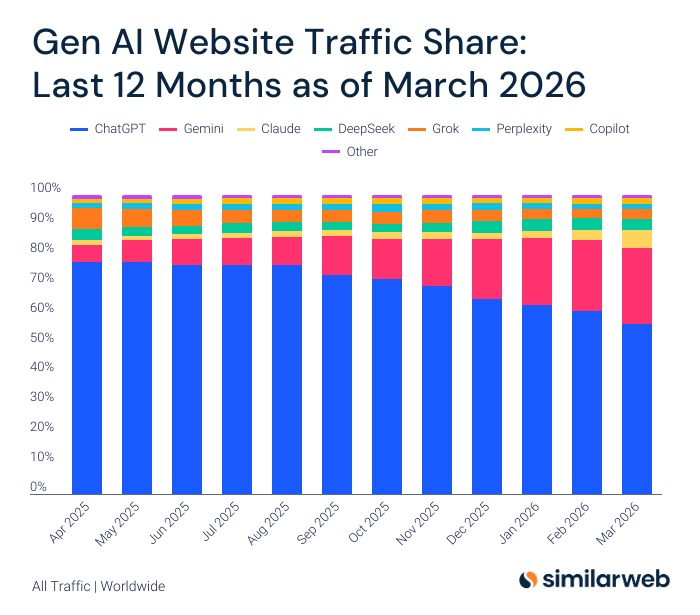
The purveyors of LLMs don’t seem to have the same network effects as the original Internet-native companies like Amazon, Meta, and Google had. But they are much more capital-intensive businesses. In fact, I would argue they are selling commoditised products with no switching costs, no network effects, and no two-sided markets. In short, no moat.
Historically, the heavy capex by companies in the chip space has led to extreme cyclicality. I can’t see that anything has changed. Here’s a chart of the historical valuation multiples of the SOX index – an index of semiconductor (chip) companies:
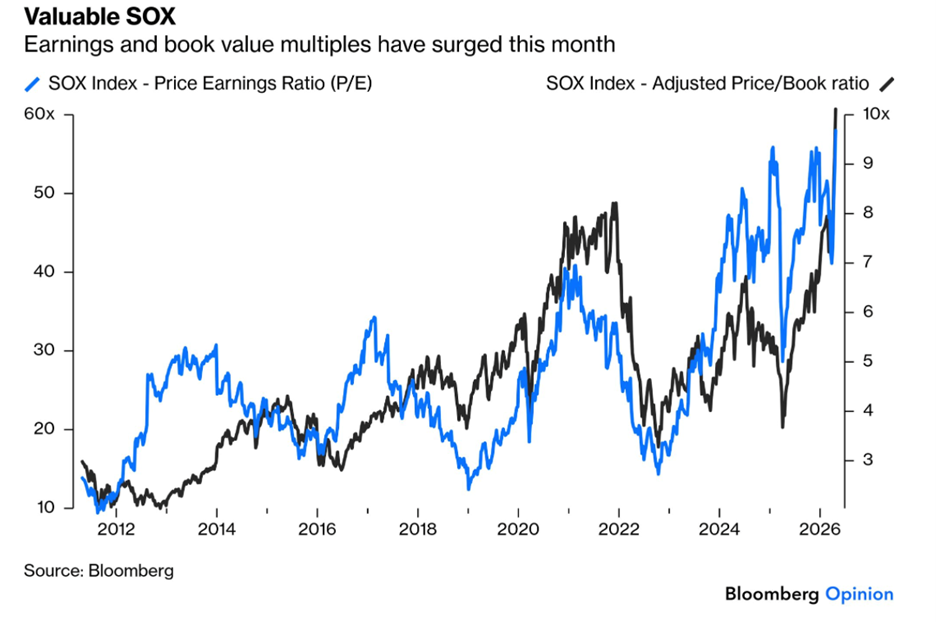
If that’s not cyclical, I don’t know what is.
My take: OpenAI (and all the other players in the token ecosystem) are rooting for you to escape the underclass. Not because they care about you, but because the more money you waste on tokens, the better the odds are for the insiders in these companies to cash in before the cycle turns. It’s no surprise that these stock promoters’ wet dreams – the IPOs of OpenAI, Anthropic, and SpaceX – are coming at you fast.
All of which reminded me of this classic quote: “I’m sorry Dave, I’m afraid I can’t do that” – Hal in 2001: Space Odyssey
In the cockroach
The fund* did a trade! The cockroach added to its existing position in FRMO.
What is FRMO, you may well ask? After all, you won’t find it in any index.
FRMO is an investment holding company which owns, as its major asset, shares in Texas Pacific Land (TPL). It also owns a stake in Miami International Holding (an up-and-coming listed derivatives exchange), a stake in Winland Holdings (an unlisted Bitcoin mining company), and an array of cryptocurrencies. It also owns 1% of unlisted Digital Currency Group (among other things, the owner of Grayscale, Luno and other crypto businesses). DCG is on FRMO’s books at a negligible cost. Grok estimates it’s worth $3bn to $15bn. ChatGPT says $3bn to $9bn. At $3bn, it adds 5% to FRMO’s NAV.
In addition, FRMO owns 4.4% of Horizon Kinetics Asset Management (which was listed 18 months ago, so is marked-to-market), as well as a 4.2% revenue share of the gross revenues of HK asset management, held at cost. It is worth more – estimated at another 5%-10% to NAV if less conservatively accounted for.
FRMO currently trades at a 16% discount to book NAV per share, a NAV which has grown by a satisfactory 16% per annum since it listed in 2009. It came to market with $26mn in equity; it has $ 376mn today. It has never and continues not to employ any leverage – in fact, it has $46mn net cash on the balance sheet.
The sad part is that the share price recently declined sharply on the passing of its founder, Murray Stahl, one of the most original thinkers in the US investment industry. Despite this loss, the firm is more than a one-man show, and the assets on FRMO’s balance sheet are unique and undervalued.
FRMO sits in the “hard asset” portion of the cockroach, which now looks like this:
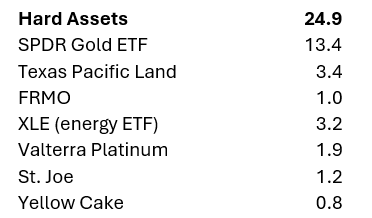
Gold remains the largest holding, followed by TPL. I discussed TPL recently in Asian Odyssey.
If FRMO were not so small and illiquid, I would replace the whole of TPL with it. But my undertaking to investors in the cockroach is that their investment is liquid – they can realise it whenever they need to, without risk of the fund ever being gated. So, I strictly limit the fund’s exposure to illiquid situations like FRMO.
XLE is an ETF that comprises the world’s largest oil companies and is, understandably, performing quite well now. I continue to believe this sector is an investable chokepoint in the AI ecosystem.
Buy tokens? The underclass prefers to buy energy!
As for Valterra, the fund would prefer to own physical platinum, but the collective investment scheme rules in South Africa prohibit funds from owning more than 10% in precious metals. Apparently, it’s too risky. Go figure. Anyway, we own more than 10% in physical gold, so that rules out buying any physical platinum. There is a long-term capital cycle developing in the platinum sector, so, to take advantage of it and due to regulators’ misplaced risk-management rules, I’ve had to buy the riskier proposition: equity in an operating mine. Therefore, I have kept the position small.
St. Joe owns land and develops properties in Florida, while Yellow Cake is an investment holding company whose only investment is uranium oxide. I believe there is also a capital cycle developing in the nuclear industry.
* I manage the fund on behalf of Merchant West Investments (Pty) Ltd (FSP 44508)
In The Media
1. Stranger than Kindness – The Nick Cave Exhibition
If you’ve been reading these letters for longer than a few weeks, you will know that I am a Nick Cave fan. I was pleasantly surprised to come across an interactive online rendering of an exhibition originally held in Copenhagen. COVID closed the exhibition almost to the day that it opened, so Cave decided to share it online.
The exhibition contained more than 300 objects owned or collected by Cave, providing a unique insight into the man and artist. It also contains Cave’s own reflections on the exhibition, plus the original soundscapes for the exhibition composed by Nick Cave and Warren Ellis.
You can visit the exhibition here.
2. The best music video
I came across this yesterday. I don’t know the artist – GENER8ION, which is a project created by the French producer and DJ Ben Surkin. This specific track, STORM, features the Swedish rapper Yung Lean. It’s a good song and an outstanding video. You can watch it here. But be warned, it has a long intro; the actual song starts at around the 4.20 mark.
3. Be careful how you consume data
I saw this graphic in a presentation by a well-known VC firm recently:
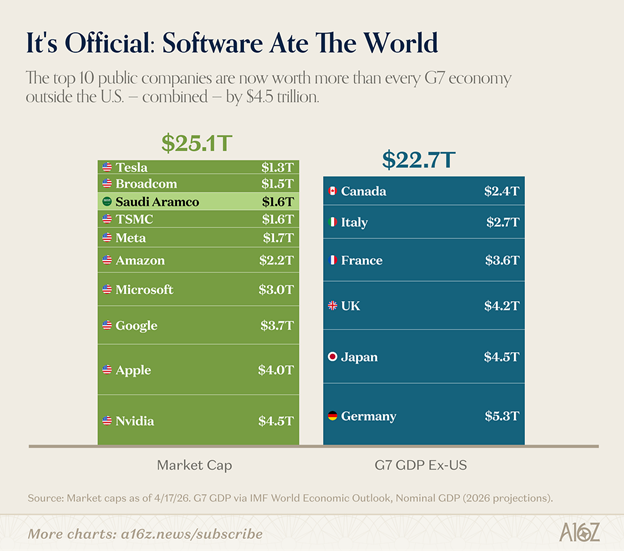
A16Z is a premier Silicon Valley venture capital firm founded in 2009 by Marc Andreessen (founder of Netscape) and Ben Horowitz. They coined the well-known term “Software is eating the world”. In this chart, they compare the market value of the world’s top 10 public companies with the GDP of the ex-USA G7.
I am sure their thesis is correct, but this is not the way to prove it. Market value is a stock figure – the worth of something, while GDP is a flow figure – the annual income of something. You are not worth your annual income. Your value is a multiple of that. It’s like comparing a house’s rent to its value.
So be careful of everything you read, even if it comes from a storied VC firm, especially in the run-up to what will be a year of massive stock sales through IPOs. Even if you don’t buy in personally, it’s more than likely your favourite fund management house will want to/be forced to. And the news flow will do its best to make it look like a good idea to buy these stocks.
That’s it for this week.
Remember to be careful out there, especially when these big IPOs start coming at you. Caveat Emptor!
Piet Viljoen
RECM
30 April 2026