

Dear Fellow Investors and Friends,
Welcome to my newsletter, where I share my efforts to understand markets and the world around me.
I appreciate you taking the time to read this. I love getting feedback; feel free to drop me a line. It’s great to start conversations.
Today is Thursday, 12th February, the 43rd day of the year. There are 322 days remaining until the year’s end. On this day in 1948, Ray Kurzweil was born. He is an American computer scientist and futurist who proselytised the inevitability of humanity’s merger with the technology it created. The way AI-related share prices are performing suggests that Kurzweil might be on the money.
“Forget about your house of cards
And I’ll do mine
Forget about your house of cards
And I’ll do mine
Fall off the table
And get swept under
Denial, denial
The infrastructure will collapse
From voltage spikes
Throw your keys in the bowl
Kiss your husband goodnight”
– Radiohead, House of Cards
OpenAI is not quite 10 years old. Its flagship product, ChatGPT, is only three years old. It loses around $50 billion annually, on revenues of around $25 billion. Its CEO, Sam Altman, has explicitly outlined a goal of 250 GW of compute capacity by 2033.
Let’s put these numbers in perspective: South Africa has 45 GW of power-generating capacity nationwide. The USA has 1,300 GW. So, Altman plans to add almost 20% demand (or more than 5 South Africas) to the US system over the next decade.
It takes two to ten years to build a 1 GW power plant, depending on the plant type. High-intermittency plants, such as renewables, are quicker to build than baseload power plants, such as nuclear. In 2025, the USA added 64 GW of new capacity, mostly renewable, with some battery storage. Only 4 GW of low-intermittency, baseload capacity came to market.
AI data centres need low intermittency.
It costs between $1 and $5 billion to build a 1 GW power plant, depending on the power source. Let’s use $2.5bn as an average. As a rough estimate, 250 additional gigawatts of generating capacity will cost $615bn, plus the cost of grid reconfiguration.
Like most investment “stories”, the numbers are almost believable. But, wait… this is just to satisfy OpenAI’s ambitions!
OpenAI has serious competition. A year ago, its share of the generative AI market was 86.6%. Today, it’s 72.3%. Google’s Gemini is gaining rapidly, and Anthropic is beating OpenAI when it comes to enterprise AI. These players don’t quantify their needs as precisely as OpenAI, but one should assume they are in the same ballpark.
You can see how quickly the numbers become excessive.
Money doesn’t seem to be a problem at present, as there are still a lot of gullible investors around, like Masayoshi Son of Softbank, who are willing to plough money in at any valuation. But debt is playing an increasing role in funding this capital-intensive infrastructure build-out – debt not just from banks, but also from just about everyone else in the AI game.
The nexus of these financing deals sits at Sam Altman’s loss-making OpenAI. OpenAI has signed contracts totalling $22 billion with Coreweave and $38 billion with AWS, and an open-ended deal with Broadcom.
Last week, Microsoft reported its Q1 earnings, and its share price fell by 10%. The biggest issue with Microsoft’s earnings was the size of the revenue pipeline. It grew dramatically to $625 billion, which sounds like great news. But here’s the catch: 45% of that backlog is attributable to OpenAI.
And where is OpenAI’s money even coming from?
It’s not coming from profits. It’s coming from Microsoft. Microsoft has committed to funding OpenAI by at least $13bn. In return, OpenAI has separately agreed to buy $250bn of Azure services from Microsoft.
It’s all just one big circular transaction.
Oracle is another large-scale funder of AI infrastructure deals. It’s one of the parties to the Stargate project – a $500 billion, 10GW AI infrastructure project. The problem is that Oracle is already heavily indebted, with 5x debt-to-equity. Its cash flows after rapidly-growing capex just about cover interest payments. There is nothing left over for shareholders at this point. And no reserves for future contingencies.
They are now trying to raise $50 billion. If they can pull it off, it should provide short-term relief from their funding obligations.
Author Sebastian Mallaby sums up the situation neatly: “People think we’re running an experiment about an amazing technology, but we’re also running an experiment about the depths of the capital markets”.
The phrase “house of cards” comes to mind: any significant equity market correction would pose serious risks to this structure’s stability.
What might lead investors to revise downward their expectations about the money to be made from AI and its associated infrastructure?
According to Josh Wolfe, two things:
- A slowdown in the uptake of OpenAI
- On-device inference
All the U.S. AI players compete fiercely in what has become a red queen phenomenon. The faster you run, the more you stand still relative to your competitors. Each new model leapfrogs the previous one. Now add in competition from China’s open-source models, which are outstripping their U.S. counterparts in worldwide adoption. More U.S. companies – for example, Airbnb – are using Chinese models because they are cheap. When Huang tells the Financial Times, “China is going to win the AI race,” that’s bad news for OpenAI’s rate of adoption.
And here’s Qualcomm: “Snapdragon platforms dominate premium Android smartphones, enabling widespread adoption of on-device generative AI features like real-time image generation, multimodal assistants, and large language models running entirely on the device for better privacy, lower latency, and offline capability.”
Could on-device inference supersede datacenters, the cloud and GPUs? The history of tech is rife with examples of disruptive innovation. After all, that’s what tech is all about, isn’t it?
I don’t know the answers to these questions, but the market isn’t reflecting any doubt in the share prices of the AI ecosystem players.
And then we have this chart from the FT:
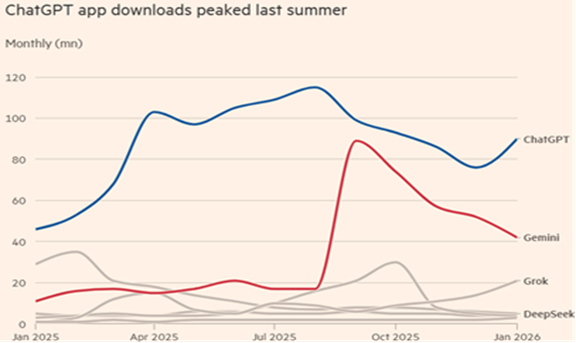
I don’t know whether all this is a house of cards or not. But the question you must ask yourself before joining Mr. Son and others in the chase for untold AI riches is: “Do I feel lucky?”
Well, do you?
Which is not a great investment strategy.
In The Markets
1. The other side of the argument
I always think one needs to examine both sides of an argument and then judge for yourself which one makes more sense. Over the past couple of weeks, I have come across two well-made arguments against the prevailing view that an AI investment bonanza is imminent.
- Jeremy Grantham, of GMO fame, co-wrote an interesting piece with Edward Chancellor (author of, amongst other books, “Devil Take the Hindmost: A History of Financial Speculation”). Grantham has done extensive work on investment bubbles and is likely the go-to expert on the subject.In the first part of the piece “Valuing AI: Extreme Bubble, New Golden Era, or Both”, Grantham concludes that we are, in fact, in an AI bubble, but that it shows no signs of topping out. Yet. In the second part, Chancellor dissects the anatomy of past technology manias and compares them with the current AI mania.
- US asset manager Horizon Kinetics always have interesting takes on the market. In their latest quarterly review, they examine potential pinch points in AI infrastructure projects. They go on to discuss how one could sensibly invest in the inevitable AI infrastructure buildout. TL;DR – it’s not about buying the shares of Meta, Alphabet, Nvidia or Microsoft.
My take: Both of these things can be true at the same time: AI will change our lives dramatically and investing in AI right now is not a good idea. It was true for the internet in 2000/21, and I think it is true for AI today.
2. Say it’s not so!
As I mentioned last week, the market now seems to believe that we will all become coders with the help of AI and that software companies will die a quick death. But recently, I was alerted to a post on X by Steven Sinofsky that presents a counterargument. I thought it was a well-made argument and worth sharing here.
My take: I have no idea how this will pan out, but the one thing I know is that the market rarely gets these kinds of forecasts right. Sinofsky’s views make sense to me.
3. A Century of Regret
Alphabet, the parent company of Google, raised a 100-year bond this week. Yes, that’s right, they borrowed some money – a billion pounds – and only have to pay it back in one hundred years. It was part of a $31.5 billion debt package.
The demand for fixed-income instruments has pushed credit spreads to record lows. Credit spreads are what corporations have to pay above the risk-free rate. Low credit spreads are normally a sign that investors are too optimistic about the future.
This is the current high-yield spread, showing how tight the spread is:

Previous issuers of 100-year bonds include:
- Austria issued a €3.5 billion, 100-year bond in 2017 at a yield of roughly 2.1%. Following the issuance, the 2017 bond saw strong demand, and its total return exceeded 60% by late 2019. However, as interest rates rose in 2022-2023, the bonds price collapsed. It’s currently trading at 30% of its face value.
- In June 2017, Argentina issued a $2.75 billion 100-year bond with a coupon of 7.125%. Despite being a high-risk issuer that had recently defaulted, the issue was highly successful, with demand reaching $9.75 billion. The price of this bond dropped dramatically in subsequent years as Argentina’s economic stability worsened and the risk of default increased again, forcing the bond to trade at distressed levels.
- Also in 2017, Oxford University issued a £750 million bond with a 100-year maturity. As interest rates normalised over the following years, the bond price fell significantly. By 2026, it was trading at less than a third of its original price.
My take: 2017/18 was also a period characterised by ultra-low spreads. The ability of an issuer to raise money by issuing such mega-long date bonds tells you more about the state of the credit cycle than the creditworthiness of the issuer. The only guarantee you have when buying these bonds at issue is that you will have a long time to regret your decision.
4. Roaring Bokke
I’ve been on record as being optimistic about the prospective investment returns on South African assets for quite a while now.
So far, so good.
But now it looks like the view is spreading. Last week, I saw a bullish sell-side article on the prospects for the South African market for the first time in a long time. Louis-Vincent Gave from Gavekal research – whose work I subscribe to – published a piece called “Roaring Bokke”. Being an ex-rugby player himself, Mr. Gave knows what he’s talking about when he talks about the Bokke.
But he also seems to know what he’s talking about when it comes to the investment prospects here on the southern tip. Normally, you have to be a subscriber to read their work, but Gavekal have kindly taken it out from behind the paywall for the benefit of the readers of this letter.
You can read it here.
The key chart was this one, showing how much the Rand has strengthened against the US$ over the past decade:

5. The Exceptions That Prove the Rule
Even if you are bullish on South Africa, there are still stocks to avoid. I’ve identified three such exceptions.
a. Mr. Price
There is a vast graveyard filled with the corpses of corporations that have ventured offshore in search of growth, diversification, or, most often, simply a “hard currency” paycheck for executives. Retailing is probably the sector that has fared the worst. Shoprite, Spar, Pick n Pay, Truworths, Woolworths and TFG have all cost shareholders a ton of money in various offshore jurisdictions.
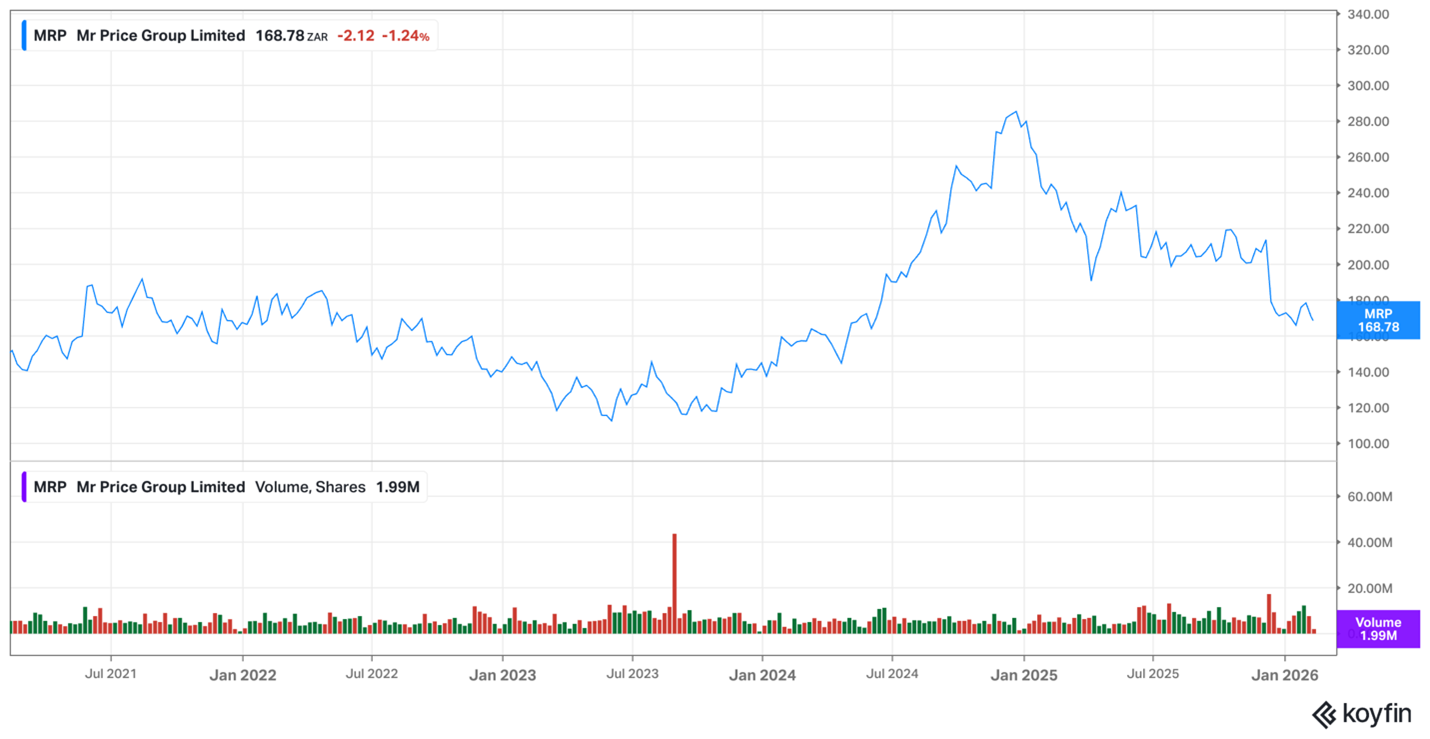
Despite all these examples, Mr Price decided to follow in their footsteps. I have it on good authority that little diligence was done on their target, and they are hell-bent on “buying growth” – a sure-fire disaster in the making. The “independent” directors here are failing to meet their governance responsibilities.
And the market is voting with its feet:
b. Pick n Pay
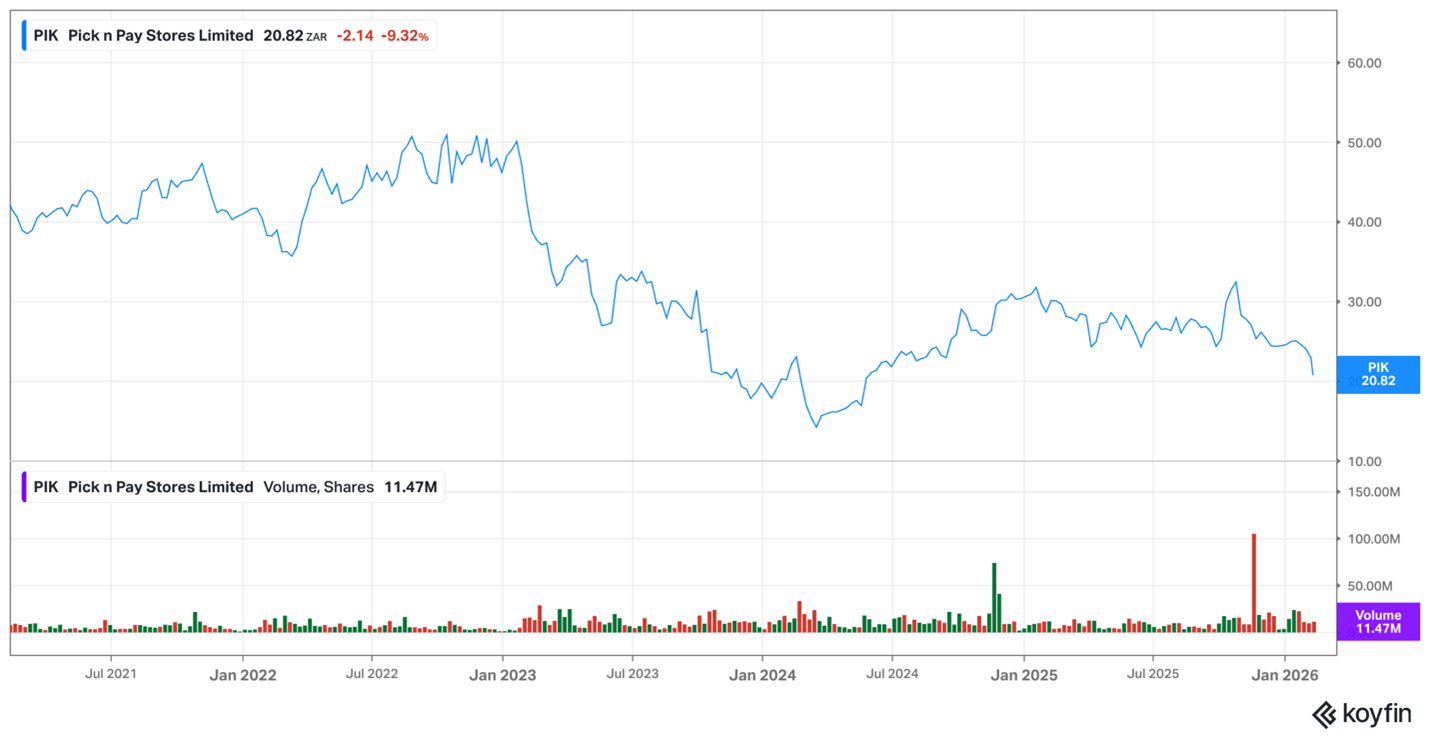
Years of neglect have forced this once-retail giant to shrink. Mr Sean Summers, a former CEO who the controlling family brought back to turn the ship around, has steadied operations. But a profit warning this week shows it’s not plain sailing yet.
Turnarounds are notoriously difficult, and I wish Mr. Summers well, but the odds are against him. The stats show that most turnarounds don’t work. The market seems to be increasingly of a similar view:
c. WeBuyCars
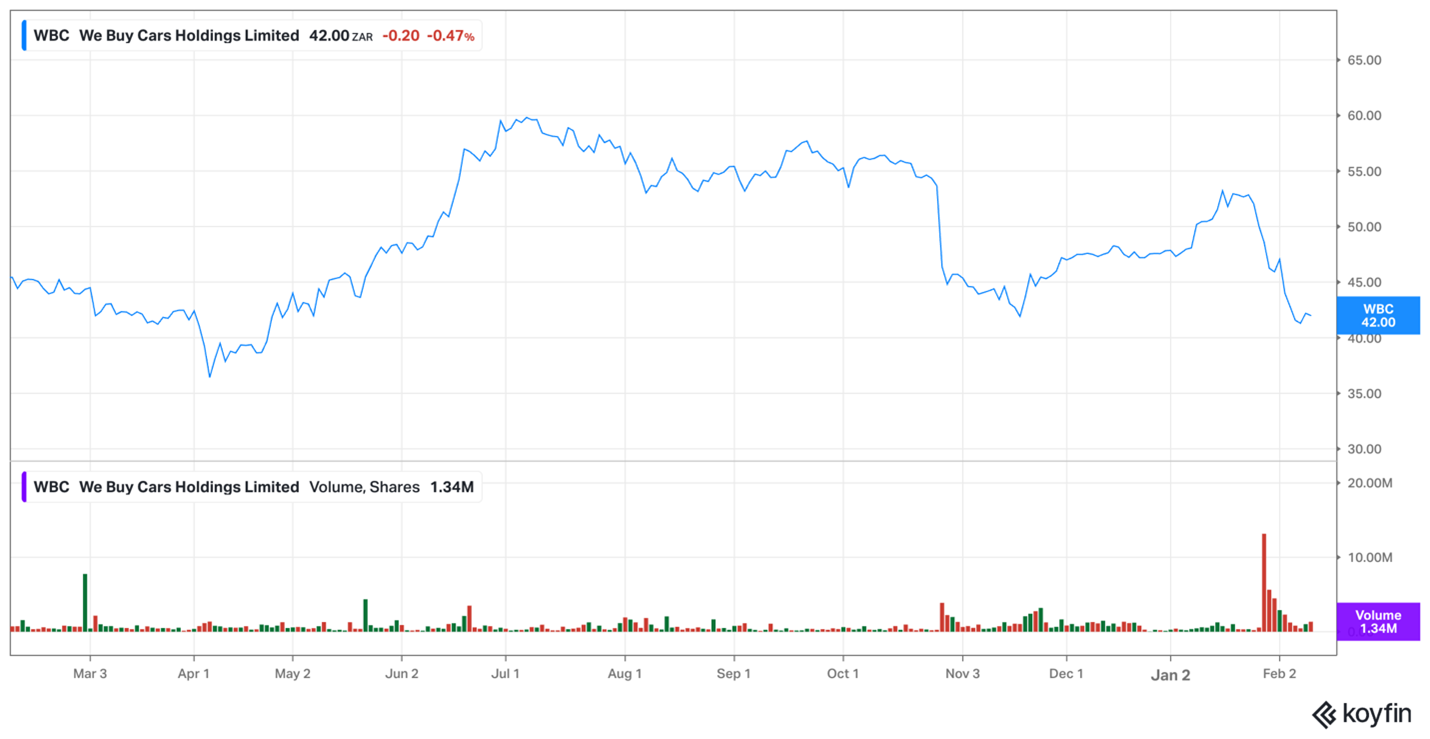
Last week, a SENS announcement shocked the investment industry – the founders of market darling WeBuyCars had sold over half their remaining shares in the business. But that wasn’t the worst part of the news. It later emerged they were using the proceeds to buy property!
I am strongly of the opinion that the words “property” and “investment” do not belong in the same sentence. There are many valid reasons to buy a property, but investing is not one of them. Just ask RMB’s management how well their property “investment” turned out. You know, the one they are now selling to the WeBuyCars founders.
The market seems to agree with me – significant insider selling is never a good look:
My take: There are so many good investment options right now, you don’t need to go scratching around in companies with poor governance, turnarounds or significant insider selling.
In the cockroach
Another week of no trades, so par for the course. I’m still considering Microsoft as a potential new stock holding, but I’m concerned about its heavy capex. Ferrari delivered strong results, and the stock jumped, so they’re out of contention as an addition for now.
This week, I want to review the cash allocation for the fund. As a reminder, the fund always holds 25% in cash: one, to act as a buffer; and two, to buy assets when risk assets decline sharply. So here it is:

Some notes:
- The fund used to have 8% exposure to yen deposits. Last month, I used some of those to buy yen bonds.
- To keep cash levels at 25%, I sold some South African bonds, which have had a fantastic run, and invested the proceeds in the Merchant West Enhanced Income fund. In my (admittedly biased, but substantiated) view, it is one of the best income funds in the country. Despite the strength of the rand, our relatively high interest rates continue to generate positive carry for US$ investors like this fund.
- Despite the potentially fiscally profligate Japanese prime minister’s landslide re-election, the Yen has continued to strengthen, which is a good sign. I am considering moving more US$ cash into yen cash. The yen is one of the most, if not the most, undervalued currencies in the world. Easily taking over the mantle once worn by our beloved rand.
- The inverse US yield curve continues to reward investors in the short end of the yield curve.
Finally, compliance says I have to say:
“I manage the fund on behalf of Merchant West Investments (Pty) Ltd (FSP 44508)”
Somehow, that absolves me of all kinds of sins; it’s just like the confession booth in the Catholic Church.
In The Media
1. Building out the railroad industry in the 19th century
I believe history is the best guide to the future, the corollary being that there is nothing new under the sun, just variations of things that have happened before. When we consider how the current investment boom in data centres might play out, it’s useful to read about the history of the railroad industry in the USA.
Here’s a piece from a Substack called “Fabricated Knowledge” on this topic, which you can read here.
The money quote: “Supply is being built for future demand, which exists, but in every capital cycle, supply comes first.”
Like all great spending booms (railroads, electricity, autos, air travel, computers, telecom/internet), the railroad boom ended in a bust in 1915-1916. Also, like other major spending booms, it didn’t create much aggregate wealth for the shareholders who funded it, but it did leave society with substantial, permanent benefits.
2. There can only two, by Grant Williams
Grant Williams’ work is normally behind a paywall, but the people at Epsilon Theory have kindly made it available for everyone. It’s a well-conceived thought piece on the history of currency transitions. They seem to happen at a glacially slow pace, but then, before you know it, things have changed dramatically.
You can read it here.
The money quote: “Systems that function well for long periods breed confidence, and confidence eventually becomes a toxic mixture of complacency and entitlement”.
3. The size of things
Here’s a fun graphic showing the relative size of living things, from DNA through amoebas, spiders, snakes, to the biggest living organism, a Pando clone (bet you don’t know what that is!) It also includes a useful feature that lets you compare the sizes of different organisms.
That’s it for this week; I hope you are all being careful out there!
Piet Viljoen
RECM
12 February 2026