

Dear Fellow Investors and Friends,
Welcome to my newsletter, where I share my efforts to understand markets and the world around me.
I do appreciate you taking the time to read this. Feedback is welcome; feel free to drop me a line. It’s great to start conversations.
Today is Thursday, September 25th, the 261st day of the year. There are 104 days until the end of the year. Today, 55 years ago, the Beatles released their “Abbey Road” album. Although it initially received mixed reviews, it is now regarded as one of the greatest albums of all time. Its iconic cover image became a pop culture icon, and the album had an influential impact on later artists.
Abbey Road has influenced albums ranging from Pink Floyd’s “Dark Side of the Moon” (also recorded at Abbey Road Studios) to Radiohead’s “OK Computer” and Kanye West’s “Late Registration”. All of them – and many, many others – draw on Abbey Road’s sonic experimentation, layered arrangement and eclecticism.
One could say Abbey Road was a “keystone species” in the music ecosystem.
In my letter from a few weeks ago, “Well-endowed Capital,” I mentioned watching a documentary called “The Serengeti Rules.” Its central concept was that of a “keystone species” – the removal of which causes an ecosystem to collapse. This is similar to how removing the keystone in a masonry doorway can cause the doorway to collapse.
“The Serengeti Rules” documented a few examples:
- In a tidal pool, starfish(!) are the apex predator. They feed on mussels. Removing starfish leads to mussel overpopulation and a dramatic decline in biodiversity.
- In oceanic kelp forests, sea otters are the apex predators that regulate populations of kelp-grazing sea urchins, which would otherwise devastate kelp forests if left unchecked. When absent, urchin populations explode and overgraze the kelp, transforming forests into urchin barrens.
- Although not an apex predator in their ecosystem, wildebeest in the Serengeti savannah are a keystone species. They regulate plant growth and influence many other species, from trees to butterflies to large mammals, including elephants and giraffes.
A few Friday nights ago at Shabbat, my friend Oscar Foulkes raised an interesting question. After watching “Serengeti Rules”, he wondered if the concept of “keystone species” could be applied to the economy or even society. It got us to thinking, what would a “keystone species” or “keystone behaviour” be in an economic ecosystem, and what happens if you remove it?
It didn’t take us long to come up with a possible answer. Both of us believed that the entrepreneur is an economic keystone species. Interestingly, there are some real-time experiments where entrepreneurs have been removed from the system, or at least actively discouraged from participating, which helped support our thesis.
These “entrepreneur light” systems go by the name of socialism and are often characterised by political systems in which the leaders have been so thoroughly corrupted by power that their sole purpose is to cling to it. Such a system features a bureaucracy in overdrive, as those in power subdue their subjects through a dense forest of rules and regulations – usually under the guise of “ensuring that everyone is equal and everything is fair”.
Such leaders also feel the need to allocate resources to where they see fit, as they do not trust the market to do so. Not because of any deep understanding of an alternative economic model, but simply for fear of less ending up in their own pockets.
These tinpot dictators can usefully be described as “men of system”, as described in Adam Smith’s “Theory of Moral Sentiments” (1759):
“The man of system, on the contrary, is apt to be very wise in his own conceit; and is often so enamoured of the supposed beauty of his own idea of government, that he cannot suffer the smallest deviation from any part of it. He goes on to establish it completely and in all its parts, without any regard to the great interests or to the strong prejudices which may oppose it. He seems to imagine that he can arrange the different members of a great society with as much ease as the hand arranges different pieces upon a chessboard. He does not consider that the pieces upon the chessboard have no other principle of motion besides that which the hand impresses upon them; but that, in the great chessboard of human society, every single piece has a principle of motion of its own, altogether different from that which the legislature might choose to impress upon it.”
Conversely, most entrepreneurs have no grand vision for society. They aim to develop a product or service that enhances the lives of as many people as possible and earn a profit from it. If successful, they make a lot of money. Success being defined as positively impacting the lives of many people. As such, they have no desire for them or their product to be equal to everything else. They need to be the best.
Developing the best product takes blood, sweat, and tears. It stems from years of trial and error, experimentation, and navigating the market’s vicissitudes. Entrepreneurs can be described as “men of disorder”, from which progress ultimately stems. Think Elon Musk – the exact opposite of our tinpot dictators.
When the “men of system” have the upper hand over the entrepreneurial “men of disorder”, the system inexorably deteriorates, often to the point of collapse.
In socialist systems, inequality and the drive to improve one’s standing in the world are treated with suspicion by the “men of system”. Scalable entrepreneurial activity is virtually absent in such systems, evident throughout Africa, the Middle East, and parts of Asia. In these systems, the absence of the keystone species – the entrepreneur – results in a poverty-stricken, wasteland of an economy.
But the “keystone” principle also applies to behavioural attributes, not just species. In “Trust Issues”, I wrote about what a trust deficit does to systems. Trust is a keystone attribute of human behaviour. Ecosystems are like human societies, as they are built on complex relationships. The stronger these relationships, the more resilient the system.
Trust is the binding agent that strengthens relationships.
In my career, I was fortunate enough to build a trust-based partnership with two unique individuals. Over the quarter-century I have worked with Theunis De Bruyn and the 15 years I have worked with Jan van Niekerk, we have never once had to refer to a shareholders’ agreement or any other document. Trust has created a strong bond between us. As a result, we have achieved a fair amount of success.
We might have been even more successful if we had chosen a more aggressive, more corporate, less trust-based approach. In such an environment, our partnership might not have survived. Our happiness quotient would definitely have been way lower.
Of course, this results in another of my made-up formulas for life:
Happiness = (Trust cubed * Wealth)
Trust is a value ranging from 0 to 1, with 1 indicating a high level of trust and partnership, and 0 indicating a typically aggressive corporate environment. Obviously, to maximise happiness, the variable to focus on maximising is trust.
Last year, the three of us went through a challenging period of self-reflection and cross-reflection. One of the conclusions we reached was that, moving forward, in our private investment activities, we want to invest only in businesses and partner only with people who trust us and want to work with us. And, importantly, vice versa.
Put simply, we want more happiness for any given amount of wealth
In The Markets
1. Anheuser-Busch InBev
The owner of one of South Africa’s premier industrial companies, SA Breweries, has not done well over the past 10 years:
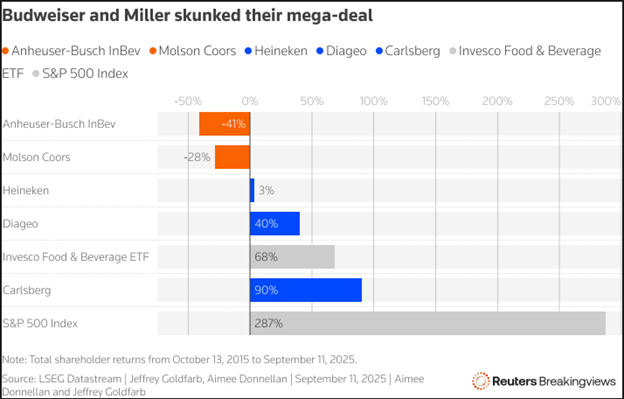
Your money would have been better off under a mattress.
What went wrong? The same thing that always happens to businesses resulting from hyperactive corporate finance activity: ennui inevitably sets in when the deals dry up. And that’s the best case.
To recap, AB InBev is a Frankenstein of a brewing company. It was created through a series of high-profile mergers and acquisitions, with at least three major transformative transactions preceding its final form: the creation of InBev through the Interbrew and AmBev merger (2004), the acquisition of Anheuser-Busch by InBev (2008) to form AB InBev, and ultimately the acquisition of SABMiller (2016). Additionally, numerous smaller acquisitions and divestments have occurred.
The mastermind behind the creation was a Brazilian private equity company called 3G. For a while, they were the toast of financial markets – and especially of corporate financiers, who earned massive paychecks through 3G’s frenetic activity. Their profile was further reinforced through partnering with Warren Buffett and Berkshire Hathaway to create another corporate Frankenstein, Kraft-Heinz, which has, just like AB InBev, struggled subsequently:
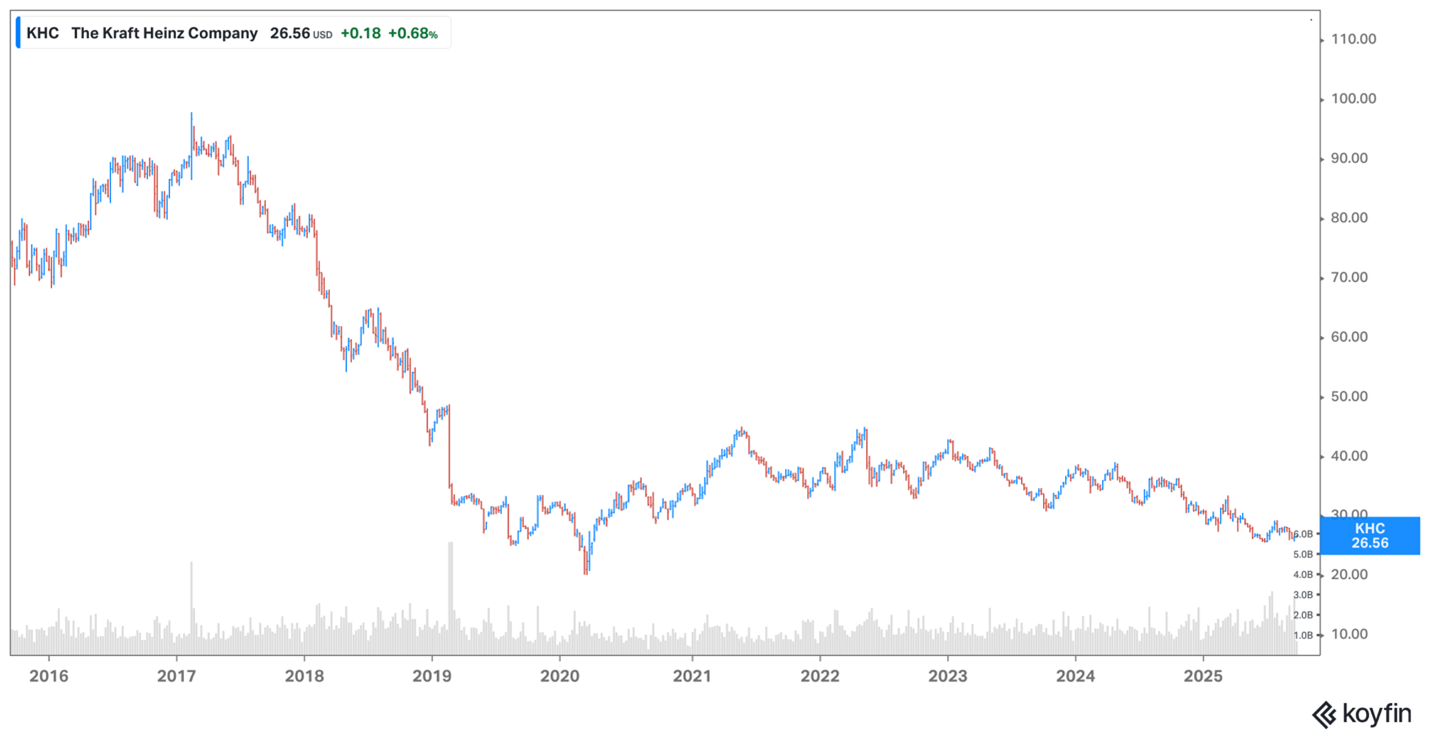
For a while, everyone wanted to be like 3G. Books were written about their innovative management techniques, especially about the magic of “zero-based budgeting”. Aspiring dealmakers started dressing down (a bit) and walking around with their laptops and papers stuffed in backpacks, just like Jorge Lehman.
The lesson? Acquisitions are hard, and the more you do, the higher the odds of failure. Moreover, once books started getting written about management styles, you can stick a fork in its ass; it’s done. Remember Keizan? Nobody else does, either. Despite well over 1,000 books being written about it.
My take: When you combine frenetic acquisitive activity with books praising the techniques used, run for the hills. Of course, this begs the question: where am I seeing this happen now?
2. Apple, or the dog that didn’t bark
The Magnificent 7 – Apple, Amazon, Meta, Tesla, Alphabet (Google), Microsoft and Nvidia are all heavily invested in AI. Larry Page, co-founder and controlling shareholder of Google, was recently quoted as saying, “I am willing to go bankrupt rather than lose this race” – sentiments that I am sure are shared by all the other executive suites of these companies.
All of them except Apple. Apple is the one dog that’s not barking about AI, which has not hurt their share price:
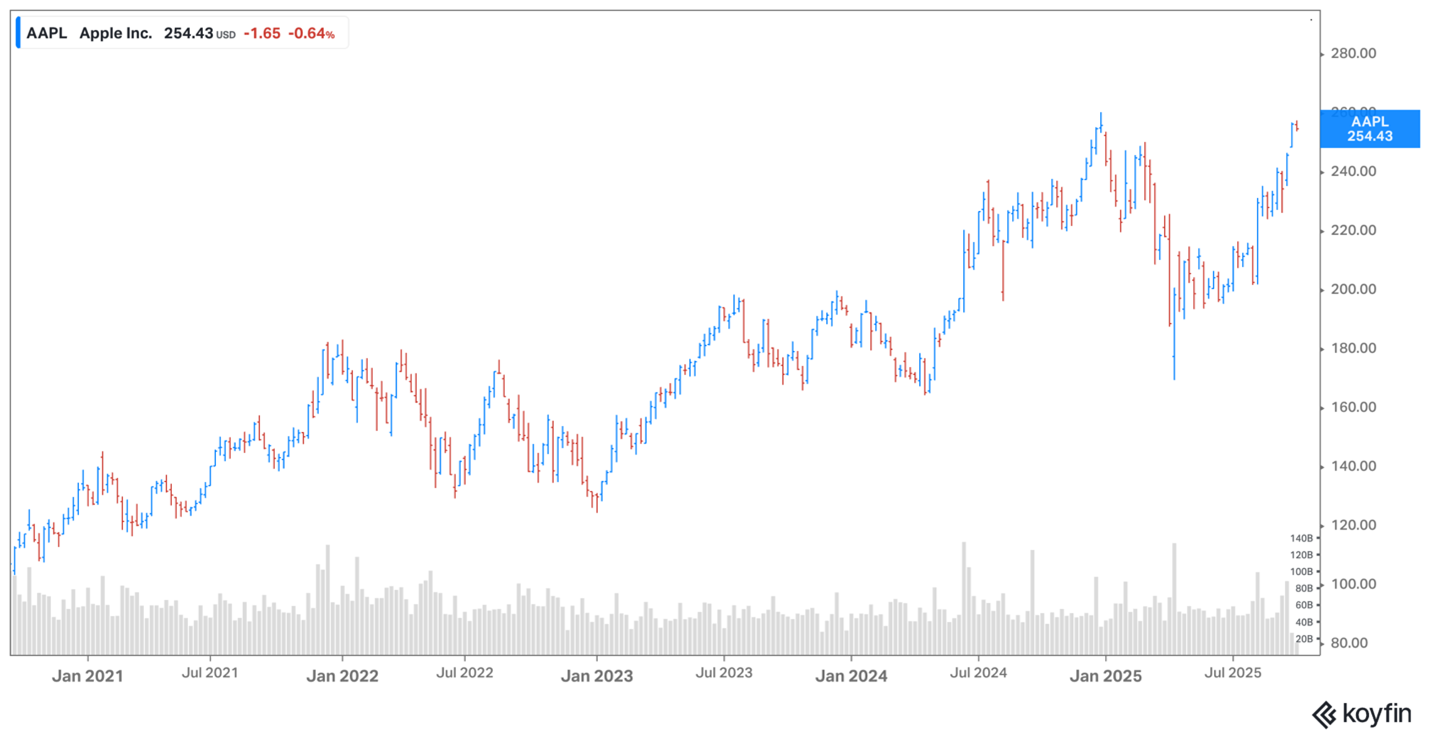
This week, Stratechery made the following point about who potentially wins the AI race:
“Here’s the million billion trillion-dollar question: what is going to matter more in the long run, text or video? Sure, Google would like to dominate everything, but if it had to choose, would it be better to dominate video or text? The history of social networking suggests that video is, in the long run, more compelling to a wider audience.
…the services that matter specialise in videos and entertainment, and to the extent that AI matters for the latter, YouTube is primed to be the biggest winner, even as the same people who couldn’t understand why Twitter didn’t measure up to Facebook go ga-ga over text generation and coding capabilities.”
My take: this might or might not be true. Who knows? But how will people watch YouTube? Apple might continue to be the developer of the platform (App Store) on which everyone wants to use their newfound AI superpowers. Apple was one of the biggest beneficiaries of the internet, despite not having spent a cent on installing fibre networks. Could the same happen with AI?
3. Valterra (neé AngloPlats)
The price of platinum has historically traded at a premium to gold, sometimes significantly so:
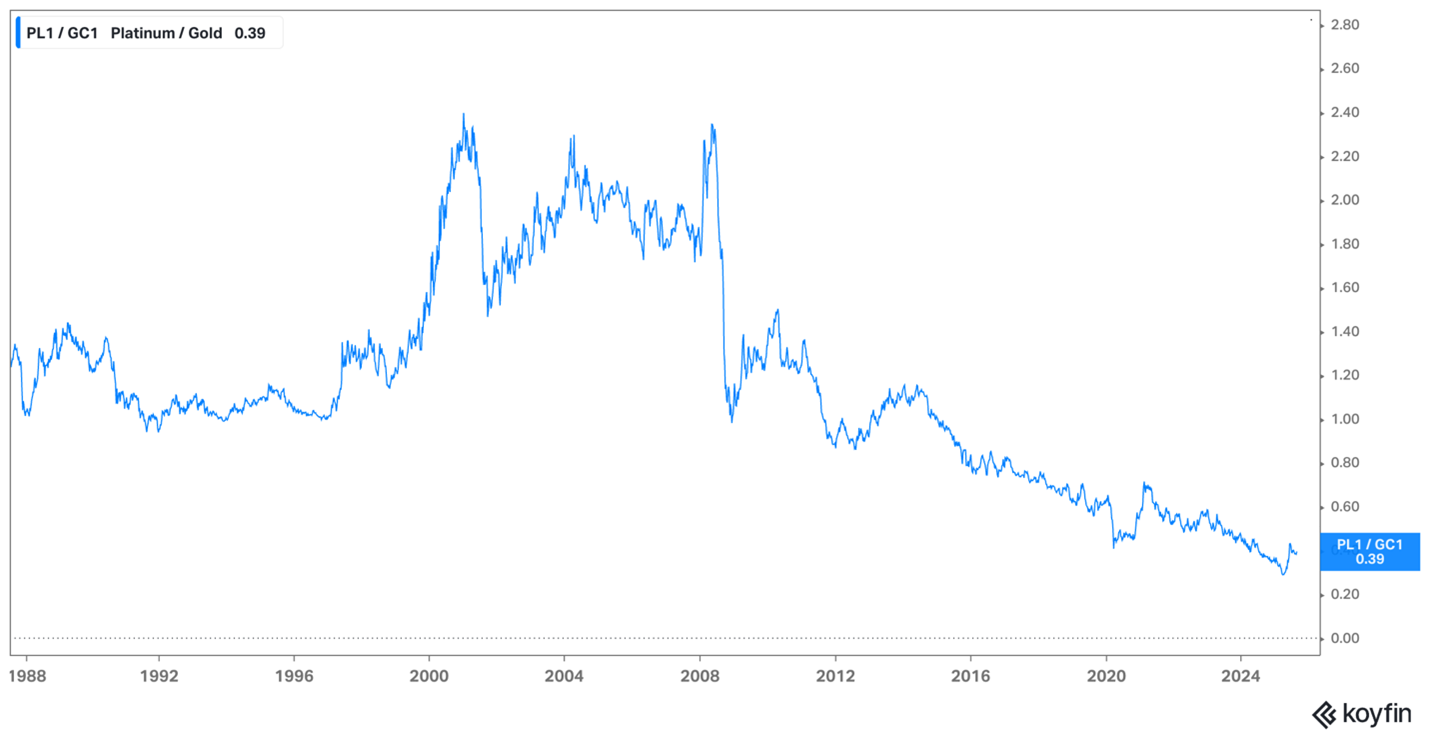
The reason for the historical premium of platinum over gold is simple: there is much less platinum around. Here’s a graphic showing the amount of platinum and gold that has ever been mined:
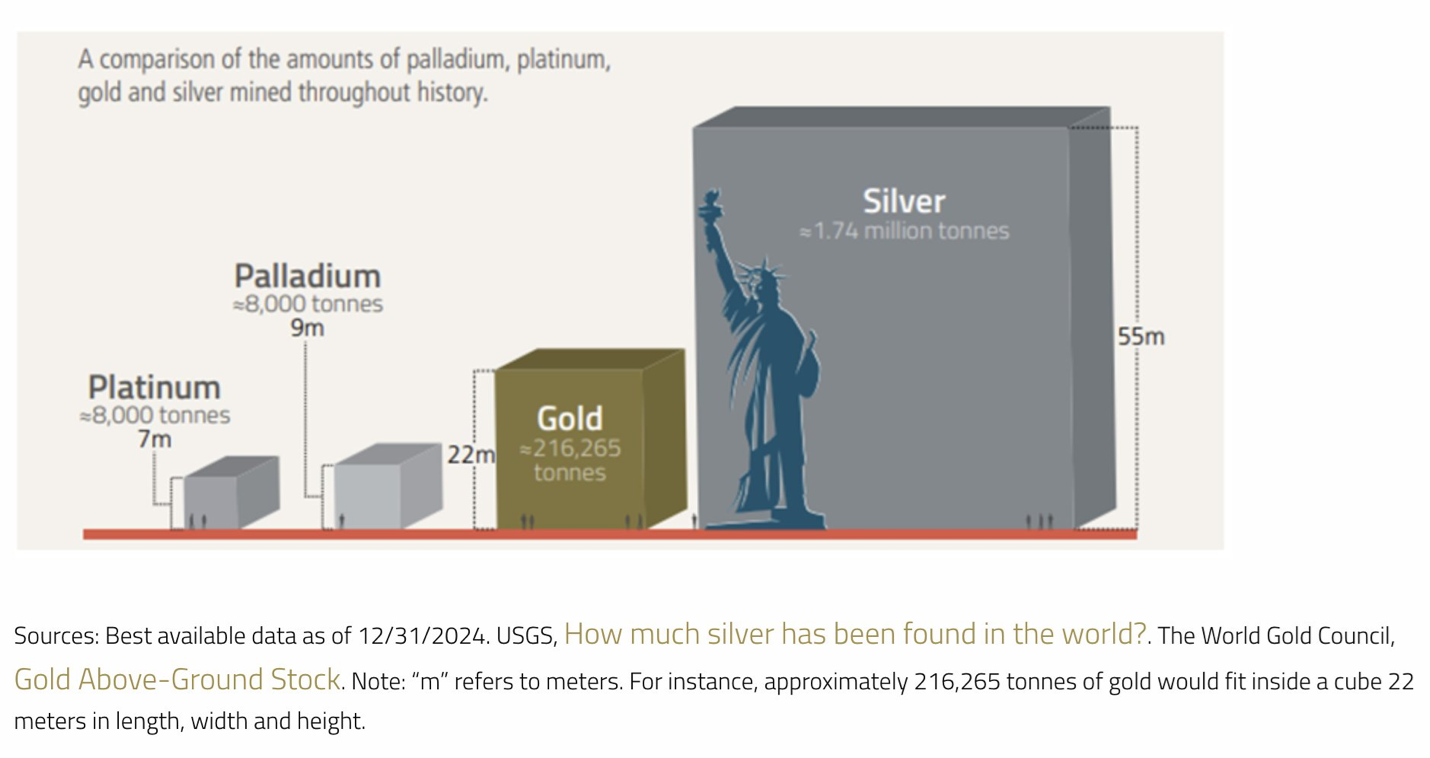
30% more gold than the combined amount of platinum and palladium has been mined in history. It’s probably a coincidence that the historical premium of the platinum price over gold has averaged around 30%, but still…
This all changed in 2015, following a period during which platinum mines significantly expanded their production. Today, platinum trades at a 60% discount to gold, and the platinum market has gone into deficit.
Additionally, Anglo-American recently unbundled its holding of Valterra (formerly AngloPlats). Let’s have a look at what happened with their previous unbundlings:
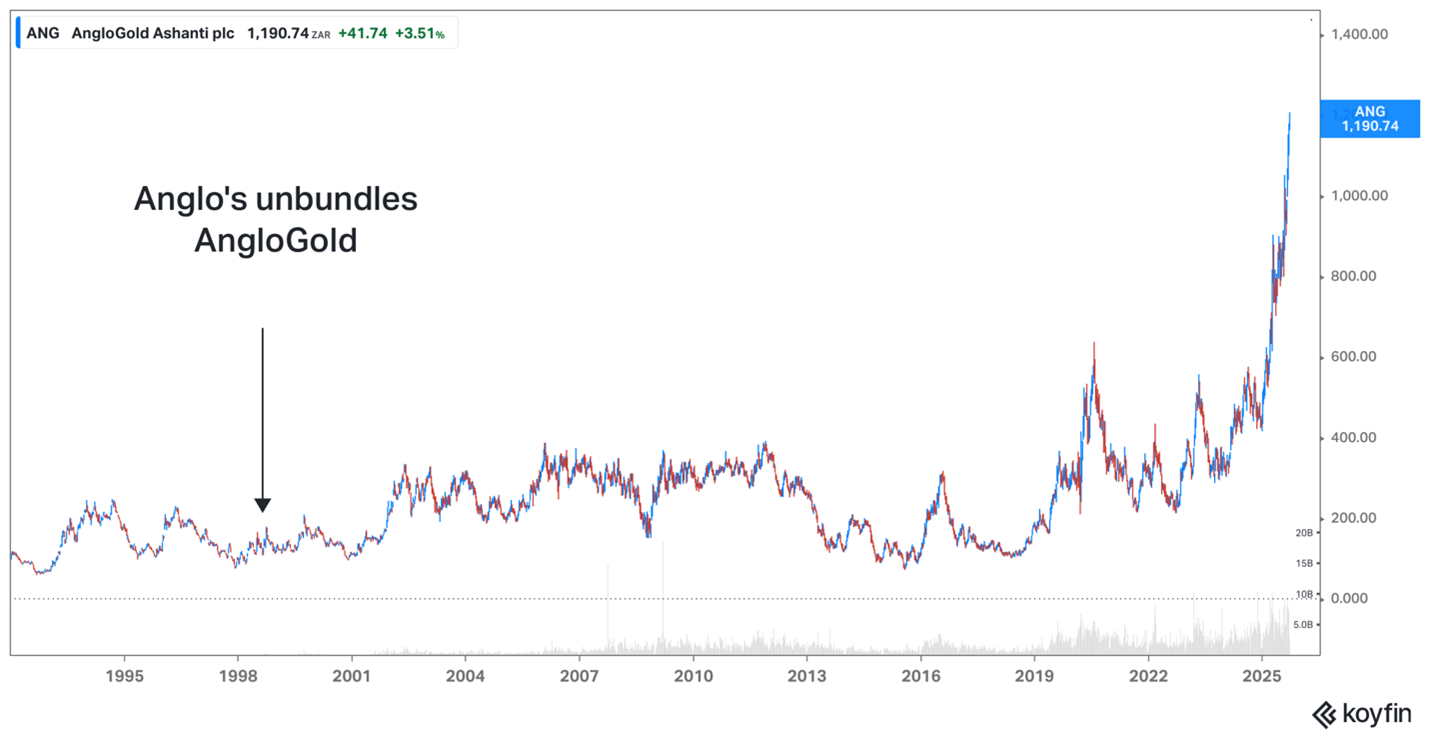
Within 5 years, AngloGold traded at three times the unbundling price. Today, it is a ten-bagger over the period.
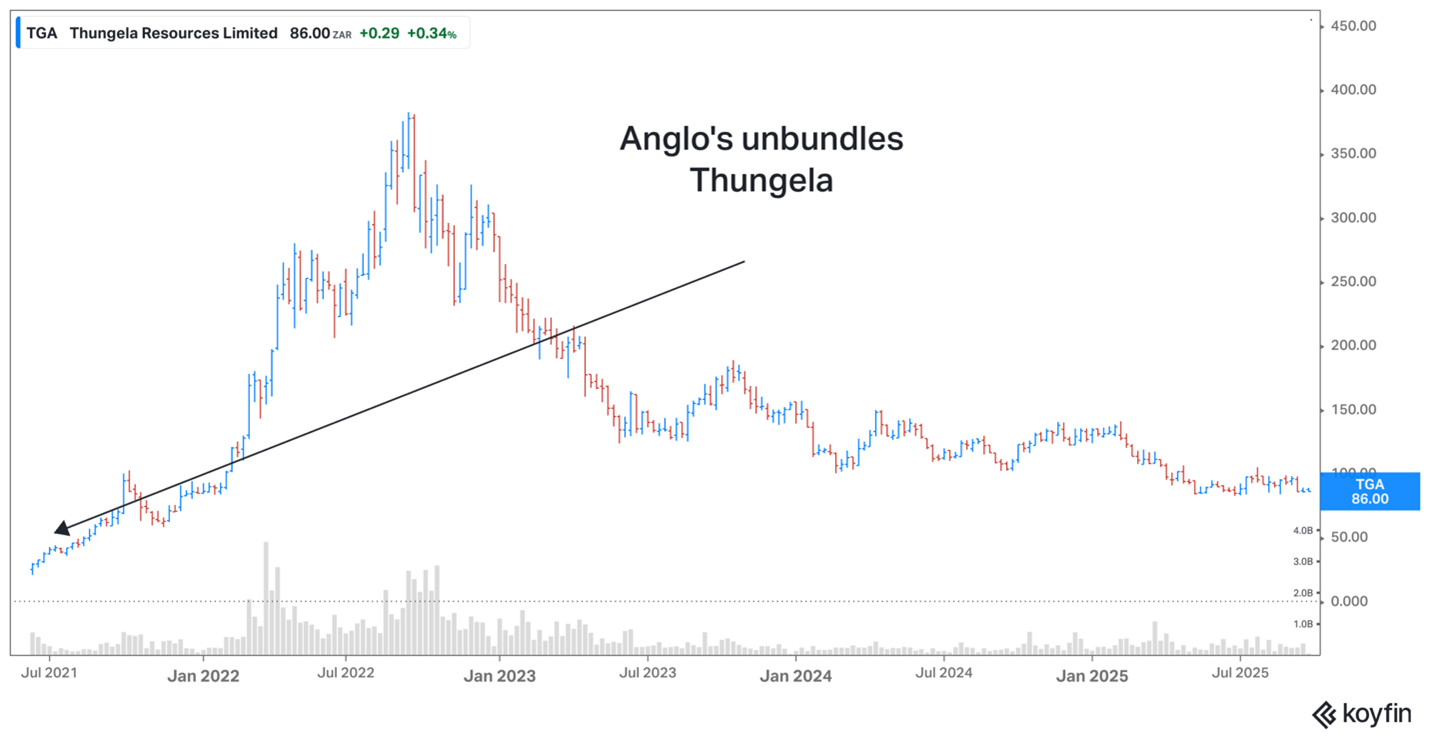
Within a few years, Thungela traded at 20 times the price at which it was unbundled. Even after a steep drawdown, it remains four times higher than its unbundling price today, four years later.
My take: I believe the odds are on Valterra’s side for a good investment outcome. The MWI Worldwide Flexible fund (aka the cockroach) owns it in the “hard asset” component of its allocation.
4. China
At the risk of mixing my metaphors – I know I have beaten this horse to death, but China is flying. Or its stock market is, at least:

This looks like an exciting picture to me – and South African investors are lucky: when you buy the index here, you get significant exposure to one of the best firms in the world, Tencent. Unfortunately, you get this together with the dubious investment strategy of its holding companies, Naspers/Prosus. But I always say you should take what you can get.
In other news, the FT reports that big banks are relocating senior staff back to Hong Kong, as a raft of IPO’s happen and dealmaking picks up speed. If you’re (understandably) too scared to buy Chinese stocks, it might pay to have a look at the Hong Kong Stock Exchange, which looks like it’s finally starting to make some headway:
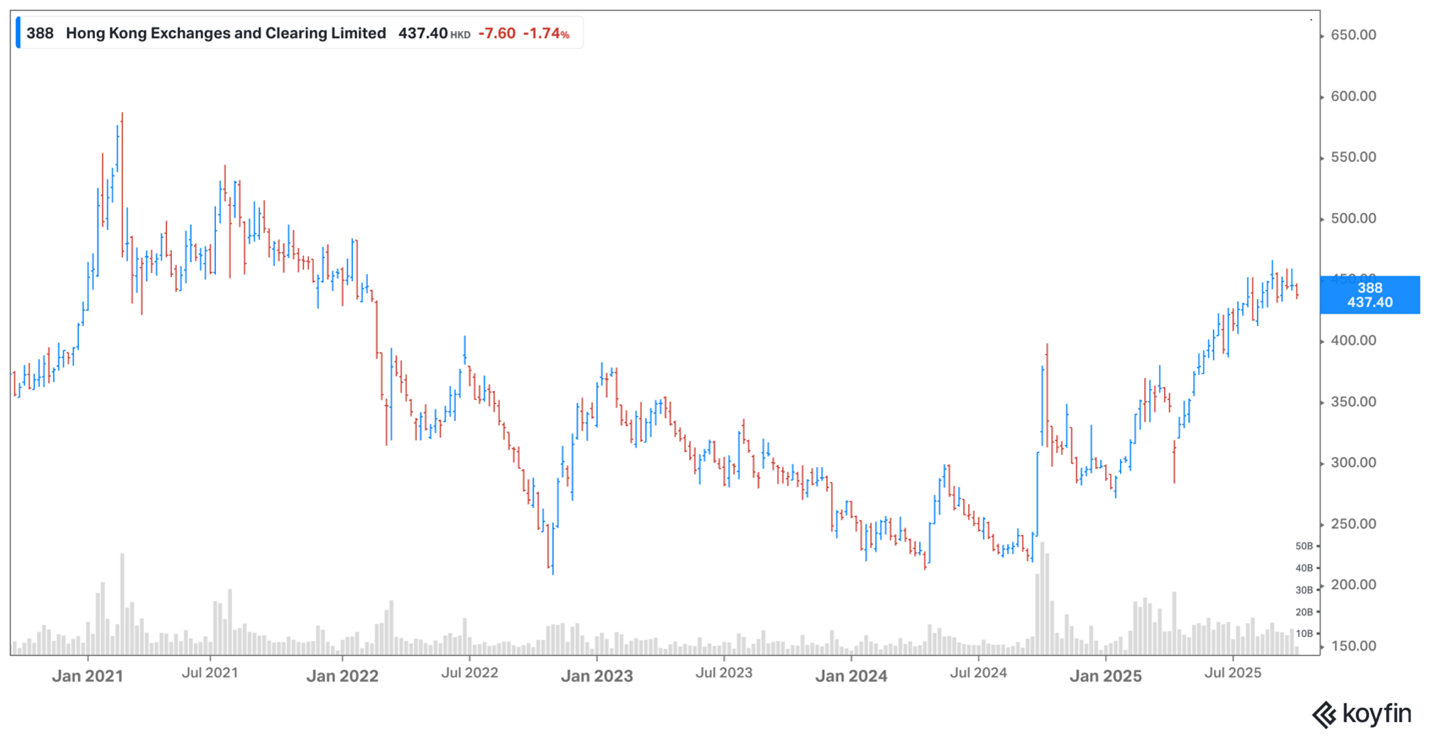
My take: On a purchasing power basis, China is by far the largest, and arguably most advanced, economy in the world. Global investors who track the major indices are extremely underweight. Therein lies the opportunity.
In The Media
1. Women
I’m 100% sure I’ll pick up some flak for this, but I love equations, so I can’t help myself. I must share this, which I found somewhere on X before my departure:

My take: I disagree entirely, of course. I have no idea why the equation works out so neatly. But it does.
2. Financial Repression in England at the time of the Black Death
They say there is nothing new under the sun, and this article proves it. It’s all about the policy response of the monarchy after the Black Death wiped out half the population of England between 1348 and 1350. When you lose half the people in your country, but their wealth in the form of silver and gold coins survives, it’s a recipe for inflation.
Which is precisely what happened – with so few people around, labourers could basically charge what they wanted for doing their job, inevitably leading to high inflation.
Now, when the people in charge of a country are faced with an economic distortion, they can generally correct it in one of two ways: repress labour or repress capital.
In a democracy, the choice will always be to make capital carry the burden, because capital doesn’t vote. But if you are a monarchy, you naturally choose to repress labour because you don’t need their vote.
So, in 1370, the King of England decided to repress labour to fight the out-of-control inflation rate. This took the form of:
- Restricting the mobility of workers
- Freezing wages
- Centralised enforcement through a raft of laws and regulations
Today, the developed world faces a debt crisis. Guess what they will be doing?
- Restricting the movement of capital
- Putting a ceiling on interest rates
- Passing lots of laws and regulations to control the movement of, and return on, capital
My take: The best guide to the future is history. That’s why I prefer reading history over the news.
3. The best music of 1995
Continuing my series of collating and organising the best music of each year, I finished 1995 this month.
Who can forget that year! Nelson Mandela handing the Rugby World Cup to Francois Pienaar, the whole country delirious with joy.

Today, the Springboks remain a uniquely unifying force in a country increasingly fractured by our inept politicians and their divisive politics.
At the time of the World Cup, I was between jobs. I had resigned from Allan Gray Investment Counsel early in the year to join Investec Asset Management and had to serve out a restraint of trade. Yes, those were legal back in the day. This meant they paid me to stay at home and not work for 9 months – which I took full advantage of. It was a wonderful time.
Understandably, the music of that year brings back good memories. It also helps that it was a fantastic year for music. Neil Young rocking with Pearl Jam on “Mirror Ball”, Radiohead giving hints of their future direction on “The Bends”, PJ Harvey getting even more raw on “To Bring You My Love”, Rickie Lee Jones giving her songbook a fully acoustic makeover on “Naked Songs”, Black Grape with their socially aware dance music and Tindersticks channeling their inner Nick Cave and taking it in new and interesting directions.
I constrain myself to ten “albums of the year” as a forcing function to really think about what was good, and what I enjoyed. It’s easy to expand it to 15 or 20 when you’re undecided. It’s much harder to choose between albums like Wilco’s genre-defining “AM” and Vic Chestnutt’s tour de force on “Is the Actor Happy?”. In the end, I had to kick off Oasis’ “What’s the Story, Morning Glory” to make room for both Wilco and Chestnutt. I never really liked the Gallagher brothers, and anyway, they’re from Manchester, so this Arsenal fan felt completely vindicated by the choice.
Here are the top 10 albums of 1995 on Apple Music, and on Spotify.
And here are (my) top 20 songs of the year on Apple Music and on Spotify, counted down, just like David Gresham did, from number 20 to number 1.
And here is a long list of all the good songs – as chosen by me – from 1995, only on Apple Music.
I hope you find some music in there that brings you as much happiness as the year 1995 did to me.
Finally, I’m in the dogbox this week – I forgot the birthdays of three people close to me. My brother and sister (they’re twins, which makes it even worse!), as well as my sister’s husband.
I’ll blame it on the excitement of having most of our family together for Rosh Hashanah on Monday night. It was truly a joy! A belated Shana Tova to all my Jewish friends and family. May the new year bring you only the best.
Even though it may be a new year for some, all of us still need to be careful out there.
Piet Viljoen
RECM