

Dear Fellow Investors and Friends,
Welcome to another edition of my newsletter, where I share my efforts to understand markets and the world around me.
I do appreciate you taking the time to read this. Feedback is welcome; it’s great to start conversations.
Today is Thursday, August 21st, the 233rd day of the year. There are 132 days until the end of the year. It’s that time of the year in the Northern hemisphere when students go back to school. Many of the schools they attend have exceptionally well-funded endowments, all of which are due to the efforts of one man:
David Swenson.
The legendary investor ran Yale’s endowment and revolutionised how large pools of capital choose to allocate their assets. In 1989, more than three-quarters of these significant funds were allocated to US stocks, bonds, and cash. By 2020, those three buckets represented less than 25% of their investments. The “Yale Model”, as it came to be known, performed incredibly well over the years and inspired a lot of copycats.
During Swensen’s 35-year tenure as Chief Investment Officer, the endowment generated a return of 13.1% per annum, resulting in over $45.6 billion in gains – $36.0 billion more than the average of its peer group.
What was the secret sauce?
The “Yale Model” combined four factors:
- The use of alternative investments – i.e. private, unlisted assets.
- Extensive diversification.
- Embracing illiquidity.
- A conservative, disciplined spending policy.
Investors, like all of us, can learn many valuable lessons from the processes at Yale. Unfortunately, we took away only one lesson: the value that alternatives add to a portfolio. We forgot about the contributions of diversification and illiquidity. Of course, with the benefit of hindsight, it’s easy to see why – financial intermediaries can package, sell, and charge high fees on alternative assets much more easily than on illiquid products or simple diversified portfolios. So that’s precisely what is happening.
But what are these “alternative assets”?
They represent a wide range of investment opportunities outside traditional public markets, including private equity, real estate, commodities, hedge funds, collectables, and more. They are generally less liquid, less regulated, and designed for investors willing to accept higher risks and longer investment horizons in exchange for the potential of higher returns and diversification benefits.
The sales pitch for including alternative investments in a portfolio primarily composed of stocks and bonds – the classic 60/40 portfolio – is that this combination will offer a better risk-return balance, with higher returns for each level of risk. This argument is based on two rationales:
- Alternatives have low correlations with vanilla stocks and bonds, allowing for diversification benefits in the form of lower volatility (risk) of returns.
- Alternative assets have the potential to earn higher returns.
This chart illustrates the evolution of the typical endowment’s asset allocation over the past 40 years, as more institutions have adopted Yale’s approach:
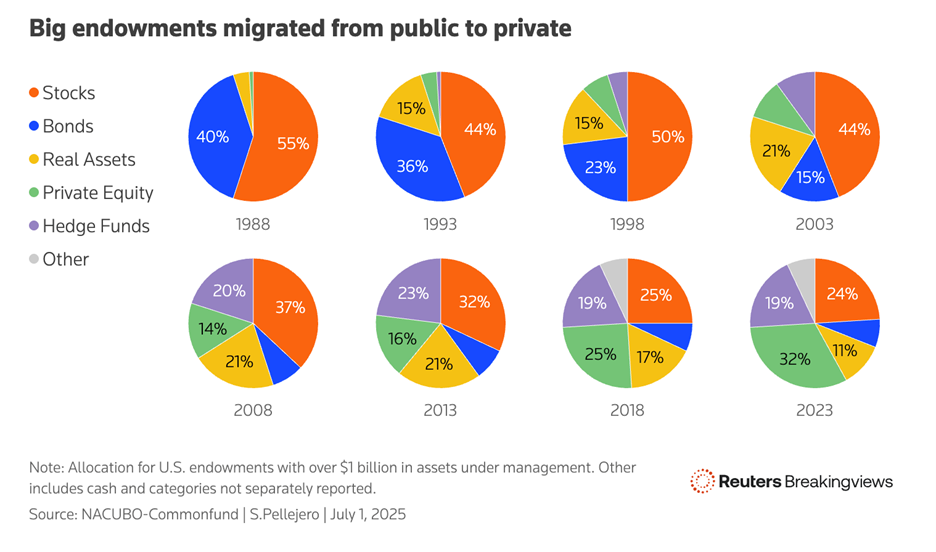
So, Swenson’s approach has gone mainstream. There is nothing financial markets like more than the appearance of a free lunch, and adding private assets to vanilla portfolios looks like a free lunch – higher returns with less risk.
In Larry Fink’s annual letter, he spent a lot of time talking about how BlackRock – predominantly a manager of index funds – is “going all in” on private markets. The reason for this move is not entirely altruistic. No, I think Mr. Fink noticed that Blackstone, a global alternative asset manager, has a market cap almost 20% bigger than that of BlackRock, but with only 10% of their AuM. Yes, managing private assets can be that profitable. And yes, that’s the real reason I think BlackRock is going all in.
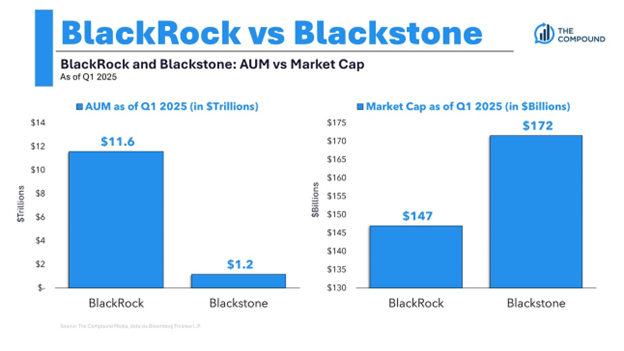
Which leads to this meme, of course…
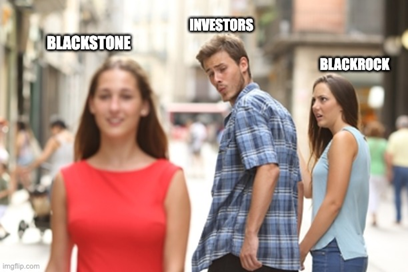
I am considerably less optimistic than the guy in the check shirt about the overall outlook for private investments in the future. Of course, they can provide good investment opportunities in certain situations. However, they are not the all-encompassing solution for portfolios as the BlackRocks of this world often suggest. And when companies like BlackRock promote a financial product, it is usually more for their benefit than yours.
In his book “The Devil’s Financial Dictionary”, Jason Zweig defines a Private Equity Fund as “A fund that is private but not equitable, extracting massive fees and often delivering mediocre results to investors… You could get pretty much the same return by using leverage to buy an index fund, but you won’t get the psychological return from bragging rights of “being in private equity.”
Here’s the thing – AQR published a paper that analysed private equity returns over the past thirty years. It concluded that private equity returns, which had run well above public market returns between 1998 and 2007, have started to resemble public market returns in recent years:
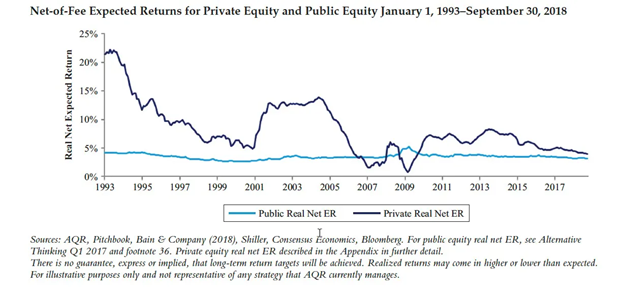
What’s happening here? As with any other financial product, returns are lower because too much money is chasing too few deals. As the demand curve for private assets shifts outwards and to the right, you have to pay more for the same asset. Paying more for the same asset almost guarantees a lower return.
So much for the “higher return argument”.
What about the “lower volatility” argument for private equity? The promoters of private equity claim that their funds exhibit lower volatility than public equity markets, approximately 10% lower, according to them. But many critics, chief among them Cliff Asness of AQR, are accusing them of “volatility laundering“. Researchers at AQR estimate that private equity may have a higher actual volatility than public equity, primarily due to a lack of accurate and timely mark-to-market valuation practices. I mean, aren’t private assets just highly leveraged small caps after all? If so, what explains their “low risk”?
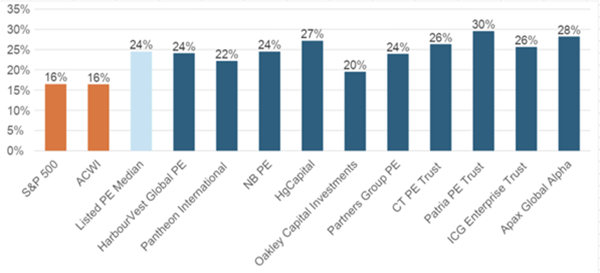
In a recent note, researchers at Verdad Capital found a way to resolve the debate. Since 1987, private equity funds have been publicly listed and traded on the London Stock Exchange. These funds have exhibited significantly higher volatility than the market:
So where does that leave us? In my opinion, private equity plays a valuable role in providing capital to deserving companies. But the purveyors of financial products are like Mae West when she said, “Too much of a good thing can be wonderful.”
Wonderful for the seller, not the buyer. The buyer – you, me, and every other investor – needs to be extremely careful.
As always, Caveat Emptor.
In The Markets
1. Gold
Earlier this year, I made the case for owning gold in “Golden”. With the gold price up sharply since then, it’s time to revisit the thesis. To summarise, the reason for owning gold was to hedge against currency debasement. I demonstrated how gold has retained its purchasing power over time, while currencies have not.
The main reason for gold’s ability to do so is scarcity. How scarce? All the gold ever mined in the world – 226 thousand tons – forms a cube with sides of 22 meters. That’s not very much. Annual gold production worldwide is just over 3,000 tons, resulting in a global supply of gold that increases by around 1.5% per year.
On the other hand, governments worldwide encourage inflation by printing ever-increasing amounts of currency. They do so because inflation hides many sins, not least of which is heavy indebtedness. Governments worldwide are beholden to the polling booth, which comes around every 4 or 5 years, and the best way to win votes is to spend money – money which they don’t have and can’t pay back. Inflation then does the heavy lifting of reducing debt levels in real terms.
The global M2 (a broad definition of money supply) is expected to increase by 18% this year. Of the major economies, in the USA and Canada, M2 is growing at c.5%, Europe and Japan around 2%, and China over 8%.
As Munger so famously said, “Show me the incentive, and I’ll show you the outcome.” So, don’t hold your breath waiting for governments’ behaviour to change.
Instead, own gold.
However, as with any investment, one must bear in mind its valuation. But gold does not generate any cash flows, so it’s hard to put a fundamental value on it, like one would with equities or bonds by discounting future cash flows to their present value. There are alternative perspectives to consider. Here are three methods from this article:

All three methods indicate that gold is expensive. However, that doesn’t mean it can’t become even more expensive. Considering the current high levels of debt in Western developed market economies, I would not predict a peak at this point.
My take: Gold should always be a foundation for any portfolio, as it is for the MWI Worldwide Flexible fund (aka The Cockroach), where it comprises 13% of the fund. But I would not be aggressively adding any more right now.
2. The US market is getting speculative
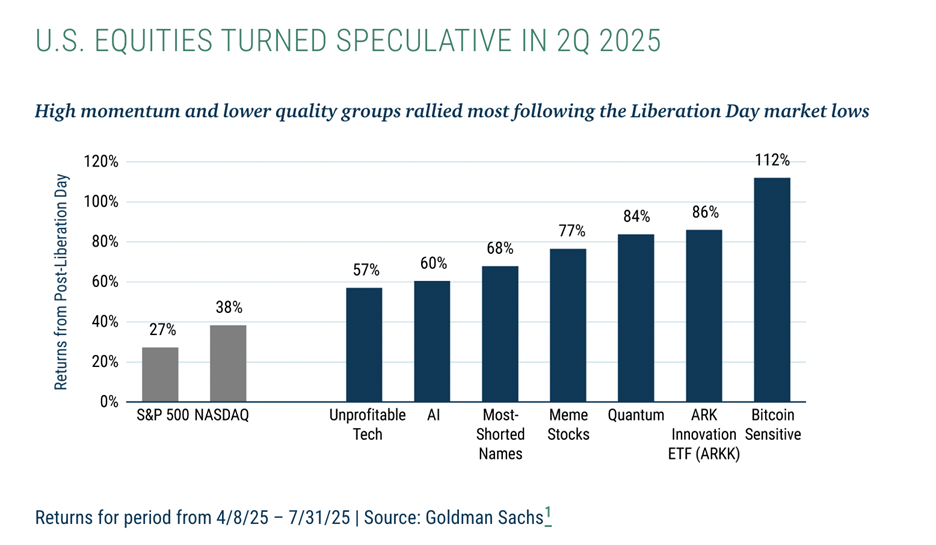
Last week, I wrote about Palantir’s nose-bleed valuation levels. But it’s not just Palantir. Strategy (formerly Micro Strategy) trades at a 40% premium to its net asset value, which consists of Bitcoin. But it’s not just Strategy – there are now over 40 “Bitcoin Treasury Companies” in the US market. The aggregate premium of these companies above the value of their Bitcoin holdings is 73%, according to Keyrock. This premium represents the speculation layer of the US stock market.
AI has also become a somewhat popular topic, as you probably know. OpenAI, the creator of ChatGPT, is in the process of raising $6 billion in funding, at an enterprise value of $500 billion. This is an increase from a value of $300 billion as recently as March. OpenAI currently incurs losses on revenue of around $12 billion. At 42 times sales, I would say there is a lot of hype in its valuation. Some might even consider a significant portion of its valuation to be purely speculative.
These are just two of the “speculative” areas in the US market. Others include meme stocks like GameStop and AMC Enterprises, which experience extreme, rapid price swings driven primarily by social media hype and coordinated retail trading, regardless of the company’s traditional fundamentals i.e. pure speculation.
Of course, the doyenne of speculative activity is Cathie Wood, the founder of ARK Investments, whose haphazard stock picking has led to inferior returns since 2021. After not featuring in stock market news for a while, she has recently resurfaced – a clear indication that speculative activity is intensifying.
This graph from Goldman Sachs illustrates the performance of various market sectors since the recent lows of earlier this year:
Howard Marks’ memos are always worth reading. His latest addresses the question of value in the US market, and he concludes: “Fundamentals appear to me to be less good overall than they were seven months ago, but at the same time, asset prices are high relative to earnings, higher than they were at the end of 2024, and high valuations relative to history.”
The killer quote? “In most ‘new, new things,’ investors tend to treat far too many companies – and often the wrong ones – as likely to succeed.”
My take: I remain cautious about the valuation level of the US stock market. However, that does not mean it will start going down tomorrow – my forecasts are as bad, if not worse, than those of any other out there. But I would not have a full weighting in my allocation to US stocks.
3. The Insurance Cycle
The short-term insurance industry has a unique characteristic – its clients pay upfront to insure their potential future losses. As a result, these companies have free funding until the losses happen. It’s no wonder that they do so well over time.
Despite this unusually favourable business characteristic, insurance companies can be quite cyclical. The reason is that they tend to price retroactively – when bad events occur, they suffer losses and then raise their premiums to recoup, blaming the “higher risk” environment. Then, when their risk-based pricing eventually surpasses actual risk, they make excess profits. This attracts new entrants and depresses prices until the pricing for risk undershoots actual risk, leading to losses. And so the cycle continues.
Brown and Brown is one of the world’s largest insurance brokerage and risk management firms. Their shares have been fantastic performers, until recently:

Berkshire Hathaway is one of the world’s largest insurance companies, with a particular focus on reinsurance. It too has performed exceptionally well until recently:
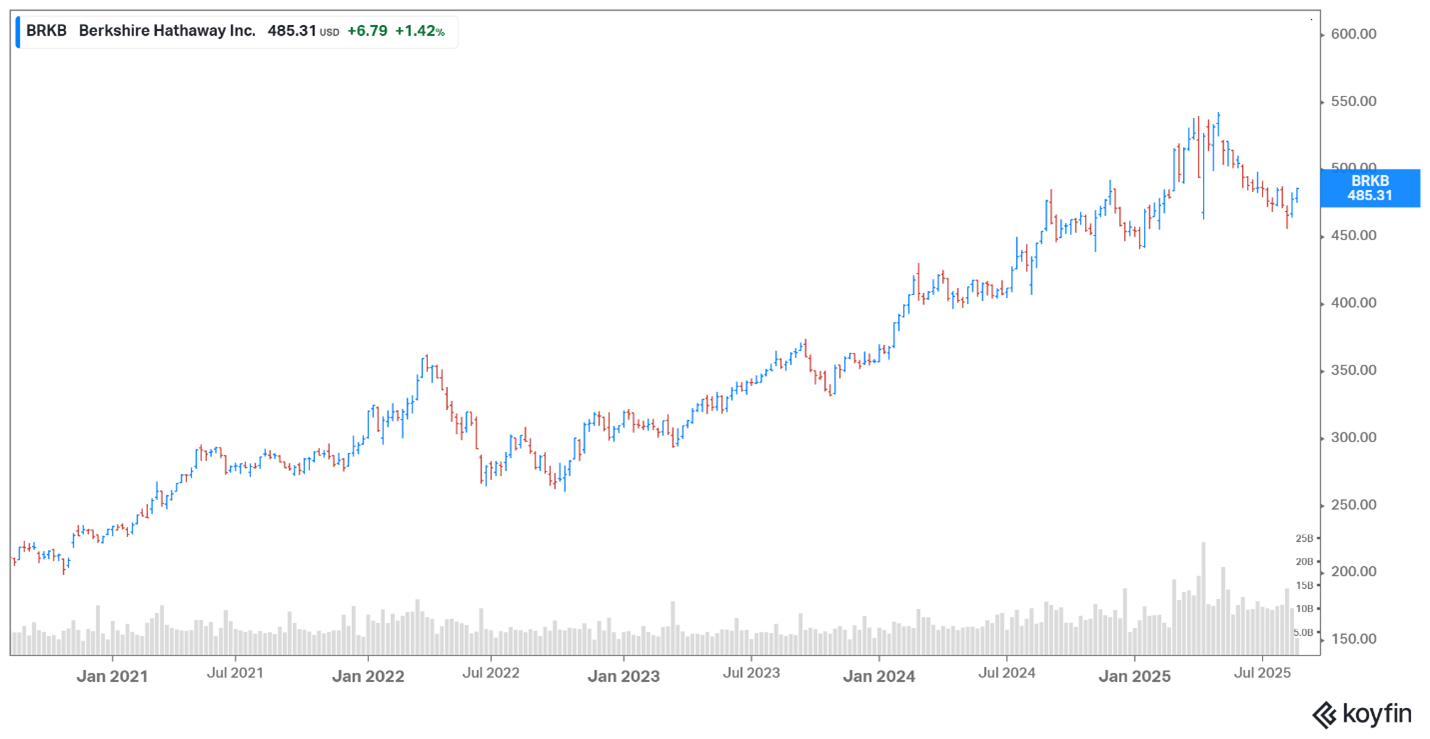
Some would say the recent poor performance is a result of its very famous Chairman and Founder resigning. But I think something else is at play.
The underwriting cycle, after an extended period of strong pricing, seems to be turning:

This is important for local companies like OUTsurance, which are subject to the same cycle. OUTsurance was listed in December 2022, amid this strong underwriting cycle. Its price is up by 150% since then:
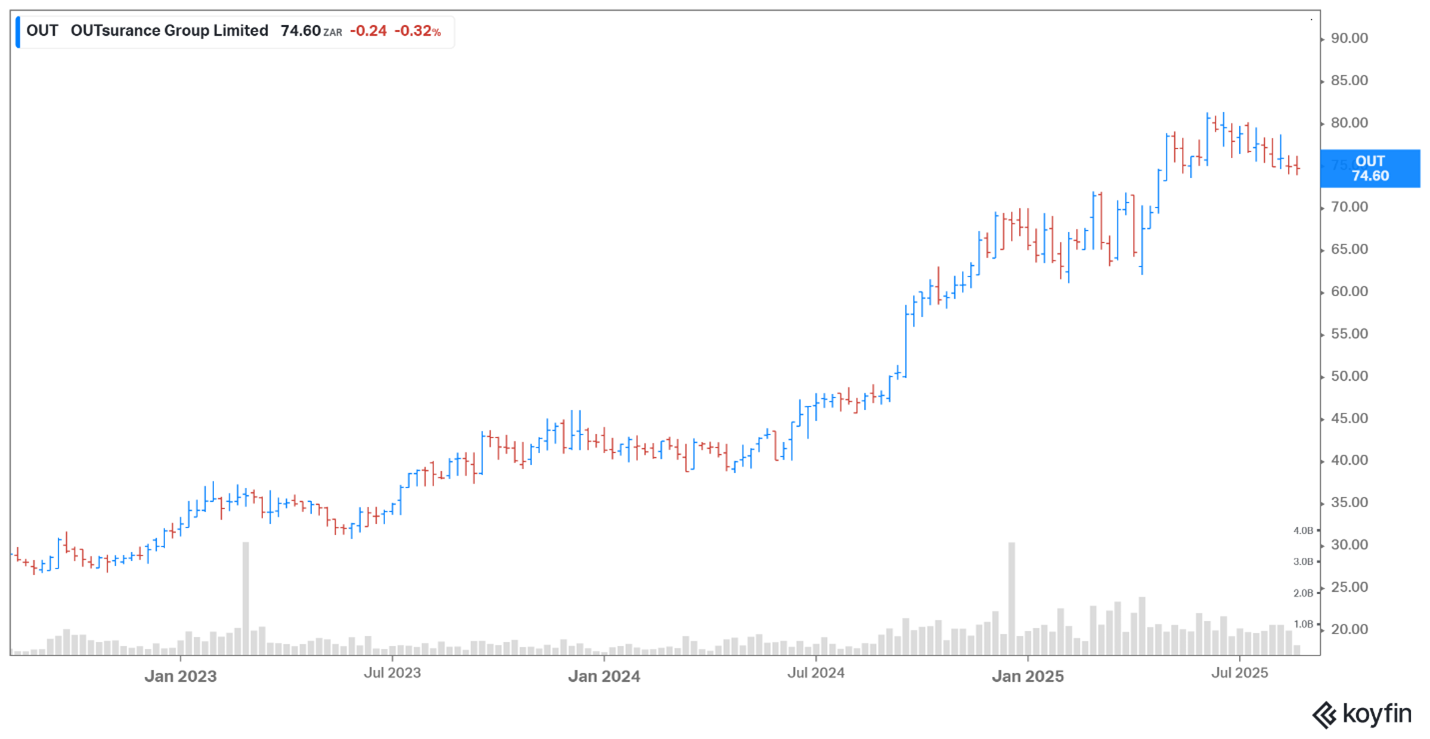
My take: Narrative follows price, as night follows day. OUTsurance has acquired the status of market favourite, a company that can do no wrong, as its P/E of 28 times attests. But I have questions. While it is undoubtedly a successful business with excellent management, could the cycle have played a significant role in its recent success? And, if the cycle is, in fact, turning, could the narrative also eventually turn?
4. Urquhart Partners
The good news is that Urquhart Partners has joined the RECM family.
Urquhart who?
Urquhart Partners offers something truly different to the market: the only dedicated JSE special situations fund. Founded by Richard Cheesman and Jonathan Maingard, the firm concentrates on opportunities arising from corporate activities. When companies spin off divisions, undergo buyouts, liquidate, restructure, or encounter shareholder activism, they can create moments of disruption and mispricing. Enterprising investors can achieve uncorrelated returns from these situations.
The current environment is abundant with such opportunities. The proposed delisting of Adcock Ingram by Natco Pharma and the shareholder dispute over MAS are just two examples of situations generating value for investors. For investors seeking alternatives beyond index-hugging strategies, Urquhart Partners’ new fund provides a fresh and distinctive approach.
Importantly, Urquhart will remain independent, owned by Richard and Jonathan. RECM will help with licensing, admin and fundraising. We will also share ideas. The relationship is modelled on our existing one with Desert Lion.
My take: Urquhart launches their fund on 1 September. If you’re interested in exploring a very different investment vehicle, you can connect with them on X or LinkedIn.
In The Media
1. Animal Farm, by George Orwell
This famous book was published 81 years ago this week. It was intended as a warning against totalitarianism in general and communism specifically, inspired by his experiences during the Spanish Civil War and the Second World War.
Here is a thread from X that outlines the key takeaways from the book. It makes these 10 key points:
- Revolution contains the seeds of its own corruption.
- Power corrupts incrementally through small compromises.
- Language becomes a weapon to control reality itself.
- Ignorance is manufactured to enable oppression.
- Historical memory can be erased and rewritten.
- Propaganda is more powerful than physical force.
- Scapegoating enables political manipulation.
- Fear and violence reshape consciousness itself.
- Mass conformity is engineered, not natural.
- The working class’ loyalty becomes their exploitation.
My take: This is precisely what is happening in South Africa right now, almost right down to a T. The only defence against our increasingly totalitarian government is civil society organisations like Sake-Liga, OUTA, and others. They deserve your financial support to keep on fighting the good fight. I know we are subject to extortionate taxes, levies, and duties from our profligate rulers, but any contribution you can spare is welcome.
2. The Serengeti Rules
“The Serengeti Rules” is a documentary that tells the story of five pioneering scientists – Bob Paine, Jim Estes, Mary Power, Tony Sinclair, and John Terborgh – who, through their field research, uncovered fundamental principles about how nature works.
Their groundbreaking research led to the development of two critical concepts.
The first was that of “keystone species”. Keystone species are certain plants and animals that play a disproportionately critical role in holding ecosystems together. The second was that of “Trophic Cascades”, where changes at the top of the food web ripple through all levels, dramatically affecting the landscape and its inhabitants.
In the field of ecological science, these findings were revolutionary, providing a framework for conservation. The movie is beautifully shot and well worth watching.
My take: Come for the cinematography, stay for the science! You can watch it here, on YouTube.
3. The Friday Song
Some of you are aware of – and even subscribers to – the Friday Song, which my friend Mark Rosin puts out every… Friday! As a true music aficionado, his choice of songs is always thoughtful, encompassing a wide range of emotions, personal stories, and thematic connections.
The good news is that he has just released a complete playlist of all 52 song choices from the third year of “The Friday Song”. You can listen to it either here on Spotify or here on Apple Music.
If you’re interested in years 1 or 2 – or better yet, if you’d like to subscribe to his WhatsApp group – let me know and I’ll set you up!
That’s it for this week!
And be careful out there.
Piet Viljoen
RECM