

Dear Fellow Investors and Friends,
Welcome to another edition of my newsletter, where I share my efforts to understand markets and the world around me.
I do appreciate you taking the time to read this. Feedback is welcome; it’s great to start conversations.
Today is Thursday, August 28th, the 240th day of the year. There are 125 days until the end of the year. Sixty-two years ago today, Martin Luther King delivered his famous “I have a dream” speech. In it, he famously wished for his children to be judged not “by the colour of their skin but by the content of their character”.
We have come a long way since then. Racism has not disappeared but has receded somewhat. I guess our report card would say “Johnny could do better”. Sadly, the content of our collective character as human beings has not improved, leading to an increasing trust deficit.
Confucius warned us:
“Abandon weapons first, then food. But never abandon trust. People cannot get on without trust. Trust is more important than life.”
But we have not listened.
In a classic episode of The Simpsons, Lisa convinces Marge that she’s too sick to go to school that day – offering no proof, just her word.
Incredulously, Bart asks his mother why she accepted Lisa’s story without even checking her forehead or looking for any symptoms. “How do I get that kind of credibility?” he asks. “With eight years of scrupulous honesty,” says Marge.
“Ehh, it’s not worth it,” he says.
Like Bart, societies worldwide are increasingly dismissing the slow grind of building trust.
China is generally seen as a low-trust society, where outsiders are viewed with scepticism. Outsiders can be foreigners, people from another city, or simply someone you don’t know. In a low-trust environment, it can be challenging to develop and maintain relationships, as well as conduct business. I wrote about this in “Market for Lemons“.
But Chinese society has developed a way of overcoming mutual distrust. It is called guanxi.
Guanxi involves implicit expectations of loyalty, commitment, and the exchange of favours. In contrast to Western networking, which can be more transactional, guanxi requires ongoing maintenance and personal investment; failing to reciprocate favours can damage one’s reputation and standing within the network.
Interestingly, Buffett and Munger built Berkshire Hathaway on similar principles, as Buffett himself describes it:
“We want to be a good partner ourselves because it attracts good partners. And that is a reputation that Berkshire deserves. Charlie and I do our part toward keeping that reputation intact, but that takes a lot of other people also behaving in a way that causes people to want to join them, causes people to want to trust them.”
Buffett was describing a system based on trust, and thinking about these words from Buffett helped me come up with another one of my formulas for life:
Trust = (Credibility x Reliability) + Vulnerability
where:
- Credibility is the integrity earned through experience and expertise.
- Reliability is the consistency of action. Showing up, not showing off.
- Vulnerability is always being transparent. Especially in the tough times.
Trust has specific characteristics, which make it valuable:
- Trust is only earned, never demanded.
- You can’t buy or sell trust. Trust is not a commodity; you can’t trade in it.
- It takes time to earn trust. It’s not an overnight success.
- Trust is fragile. It accrues slowly and can disappear instantaneously.
- Trust is a measure of a society’s health.
A business or system built on trust is a valuable system – no wonder Buffett became one of the wealthiest men in the world!
Today, as we look around us, fewer of our leaders – our exemplars – are exhibiting these characteristics. Politicians, CEO, and media houses who show scant regard for veracity, are inconsistent in their actions, and regularly obfuscate reality to paint a “prettier” picture, have lost our trust.
When trust breaks down, the simple things we once accepted for granted are no longer valid:
- Contracts, verbal or otherwise.
- Fiduciary duty.
- Ethical business dealings.
- Honouring one’s word.
A loss of trust means not only that we have lost something of value, but it also means there are increasing levels of frictional costs associated with doing business. As a result, in low-trust societies, asset values decline and doing business becomes hard – to the detriment of society. The whole idea of a social contract collapses. People are losing faith in the infrastructure of the system, which is represented by the government, banks, media, and even the legal system.
Inexorably, this leads to a system based not on meritocracy, but on patronage by the powerful. What’s right and wrong is arbitrarily determined by who has the most power – not the contract you have signed, or the duty you have to another, or the consensus of society at large.
How do we deal with this situation? Here are some ways:
- Narrow your circle of trust, and then work hard at building it out, one node at a time.
- Build structures around you to become increasingly independent of the “system”.
- When offered a choice, always opt for a decentralised process.
- Reduce exposure to contractual assets.
- Increase exposure to “hard” – non-contractual – assets.
- Increase exposure to assets that retain their value due to scarcity.
- Practice radical diversification.
The MWI Worldwide Flexible Fund (aka “The Cockroach”) applies these tenets as far as possible.
In The Markets
1. Intel
Intel Corporation was founded in July 1968 by Robert Noyce and Gordon Moore. It is a pioneering American technology company whose innovations powered the rise of the global semiconductor and computer industries. Gordon Moore is famous for his observation – mistakenly used as a “law” – that the number of transistors on an integrated circuit (microchip) doubles approximately every two years, with minimal increase in cost. This exponential growth has driven rapid increases in computing power, efficiency, and reductions in device size and cost for decades.
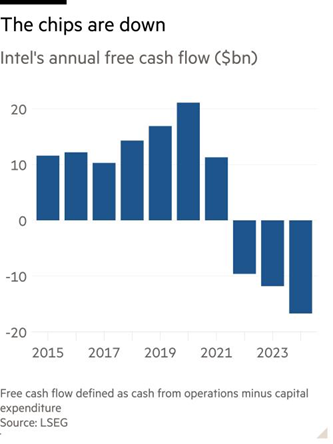
For a company that is basically synonymous with computer chips, it is a sad shadow of its former self, and even worse, a pathetic shadow of what it could have been. See TSMC. Poor management decisions, failed acquisitions, and frequent leadership changes resulted in missed deadlines for new products and a loss of investor and customer confidence. In other words, a trust deficit!
Here’s Intel’s share price, unchanged over 20 years:

And here’s the recent history of their cash flows:
However, this week, the US government announced that it would acquire a 10% equity stake in Intel. The $8.9 billion investment will be funded by grants from the US Chips and Science Act and the Secure Enclave program, which had previously been extended but not yet paid, Intel said, confirming a report by Bloomberg News.
Matt Levine, from Bloomberg wrote: “The US government had previously awarded Intel $8.9 billion of grants, but those grants hadn’t yet hit Intel’s bank account. Trump decided to tear up the deal and require that, to get the already-awarded money, Intel should hand over 9.9% of its stock. (An apparently arbitrary number: The stock closed at $24.80 on Friday, but the purchase price on the deal was $20.47 per share; the government got about $10.7 billion of stock for its $8.9 billion.) Paying $10.7 billion of stock for money that Intel was supposed to get for free seems like a bad trade.”
So, to me, that looks like expropriation without compensation? Imagine that happening down here in the southern tip! Definitely not building trust in the US system.
I can understand that the US wants to reduce its reliance on Taiwan, Korea and other “foreign parts” for computer chips, the most critical component of almost everything today. But it will have some quite negative unintended consequences:
- Bad for Intel’s long-term viability, as politics, not commercial considerations, increasingly drive its decisions (SOEs are notoriously slow, bloated, & unproductive).
- Foreign governments might target it for sanctions.
- Intel’s competitors are suddenly competing against it and Uncle Sam for customers, capital, and more.
- Intel’s customers must now fear they’ll be pressured/forced to buy Intel’s products.
Government ownership of business is not a good recipe for success.
In any case, is this just another case of creeping national socialism in the good ‘ole US of A? Like firing Fed governor Lisa Cook on flimsy grounds, attacking Fed governor Jay Powell in public, forcing him to toe the line on interest rates, and awarding itself 15% of all revenue that Nvidia gets from selling chips to China. Not to speak of the gaudy third-world interior decoration in the Oval Office!
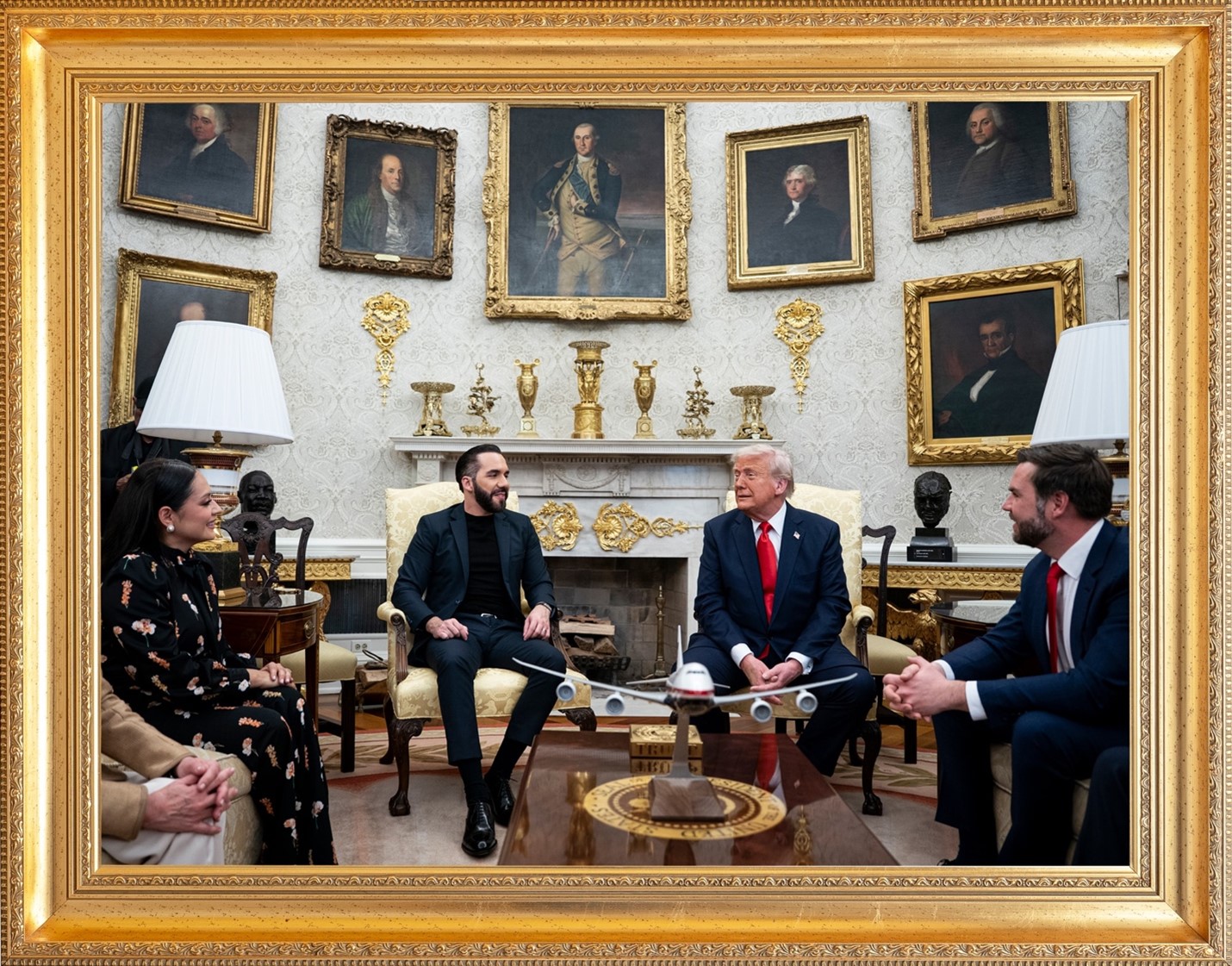
My take: The history of Louis XIV (the Sun King) is relevant here, but in short: play banana republic games, win banana republic prizes. Not for me, thank you. Long-term investors should increasingly look for alternative currencies/markets to invest in. The Cockroach is doing exactly that!
2. Curro
To say that Curro has been a disappointment as an investment would be an understatement. Its share price initially did well, but has languished for the past few years:

It was listed by way of introduction (i.e. no shares were sold to the public) in June 2011 and had its first rights issue at R6 per share shortly thereafter. It then embarked on an exciting journey, reaching R55 per share and becoming a market darling in the process. During this time, it raised R4.6 billion in fresh capital through six rights issues. The story was that you needed to invest in anything the government couldn’t provide – like schooling – as there would be an insatiable demand. The market bought the story hook, line and sinker.
However, eventually the market figured out what the actual business model was – a specialised property company that owned under-earning assets. Despite ladling on generous lashings of debt, it struggled to earn a decent return on its assets. Low to mid-single-digit ROICs don’t make for an exciting investment, no matter what the story.
Yesterday, we received news that the Jannie Mouton Stigting was tabling a buy-out offer and simultaneously taking Curro private. The offer is pitched at R13.00 per share, so I am sure all minority shareholders will accept it.
In a nutshell, if you bought stock in the first issue, 14 years later, you would have earned a return of around 5% per annum. I think most people who have ever owned Curro have made a loss. Fortunately, it is almost impossible to prove this, so I am safe in making such an unsubstantiated claim. What I can substantiate is that I have never owned this share.
My take: I have two opinions here. One, I think it is correct for most smaller companies to delist. There is no point in being a JSE-listed company. Institutional investors are just not interested, as for them, liquidity concerns weigh significantly more than valuation concerns. As a result, valuations remain stuck at depressed levels, even for well-run businesses. Two, I think mass market primary and secondary schools are more properly run as non-profits, which I assume is the aim of the new owner of Curro. Jannie Mouton was always a shrewd businessman. This transaction will enhance his legacy.
3. Aspen
Here lies another previous market darling, laid low by the mRNA vaccine, just like Moderna and Pfizer. Aspen was awarded a contract to manufacture mRNA vaccines a few years ago, for which it built a state-of-the-art facility. Unfortunately, it looks like the contract will not be honoured, apparently due to an (unsurprising) lack of demand for the vaccine. As a result, Aspen faces a potential EBITDA (read: cash flow) reduction of up to R2 billion, as well as an impairment of its fixed assets (i.e., the facility it built) of almost R1 billion.
This has resulted in a poor share price performance recently:
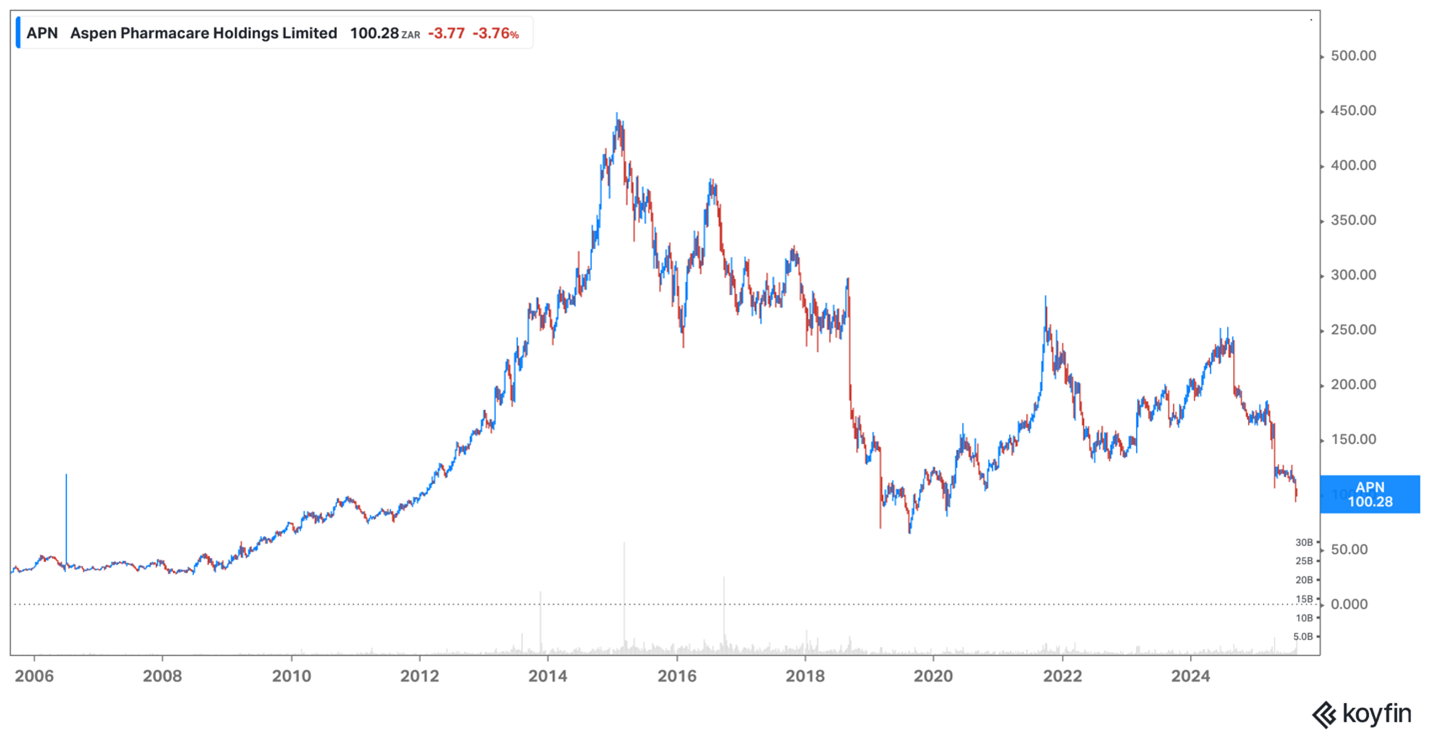
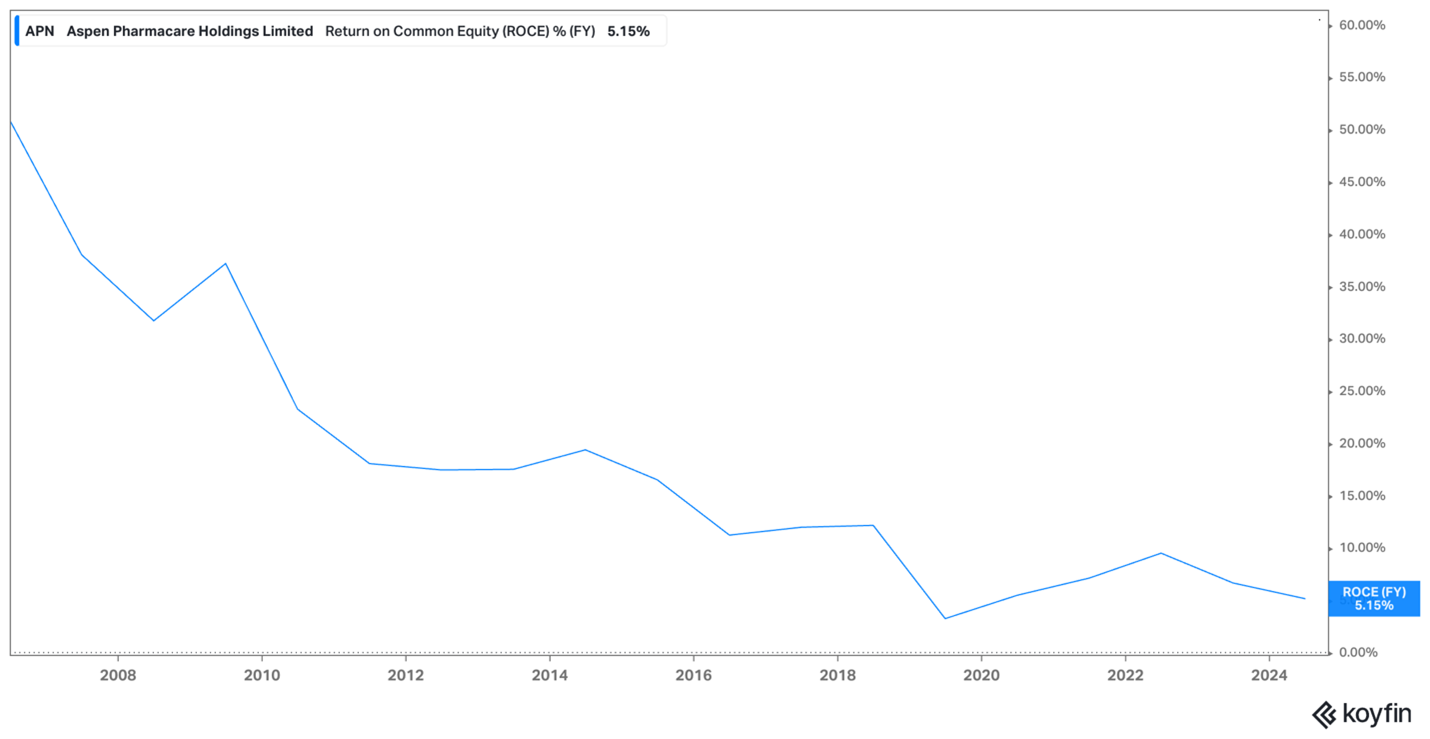
The question now is, given these depressed levels, is it worth buying? The answer to that lies in the business model. Over the years, Aspen has morphed from predominantly acquiring and distributing off-patent drugs (a pretty good business) to predominantly being a contract manufacturer of drugs for other pharmaceutical companies (a bad business).
The proof lies in its poor returns on equity, which have been consistently declining as the business model has evolved:
My take: This is another story I have never owned; another story which I would think has caused losses to most people who have owned it over time – and another story which I don’t feel is investable. Yes, even at current depressed prices, given the poor returns on equity it generates. To misquote Keynes: “When the story changes, I change my mind. What do you do, sir?”
4. The Clean Energy Debate
Pick your fighter: “clean” intermittent energy or clean baseload energy.
The first fighter I would like to introduce you to is Ørsted. Its business model is centred on developing, constructing, owning, and operating renewable energy assets, with a primary focus on offshore wind farms. It owns the most extensive global portfolio of offshore wind farms. Ørsted has been named the “most sustainable energy company” several years in a row by various independent rankings and ESG ratings.
For years, solar and wind generation have been touted as the “clean” solution to the human race’s increasing energy needs. However, the strains this type of energy source places on grids, as well as their high intermittency, resulting in low efficiency, are now being recognised.
The second fighter I would like to introduce you to is Cameco. Cameco Corporation is a global leader in uranium mining, refining, conversion, and nuclear fuel services, supplying essential materials and services for nuclear power generation.
For years, nuclear power generation has been viewed as the red-headed stepchild of the world’s energy mix, especially following the Fukushima incident in Japan in 2011. To recap, the damage caused by the tsunami resulted in only a handful of confirmed radiation cases, none of which were serious. Nevertheless, the “clean energy” brigade managed to portray it as a disaster and effectively halted nuclear developments worldwide for more than a decade. Fortunately, their duplicitousness is finally being recognised, and nuclear is rightly starting to play a larger role in most countries’ energy mix.
Mr. Market reflects these changing perceptions. Here is the share price of Ørsted:

And here is that of Cameco:
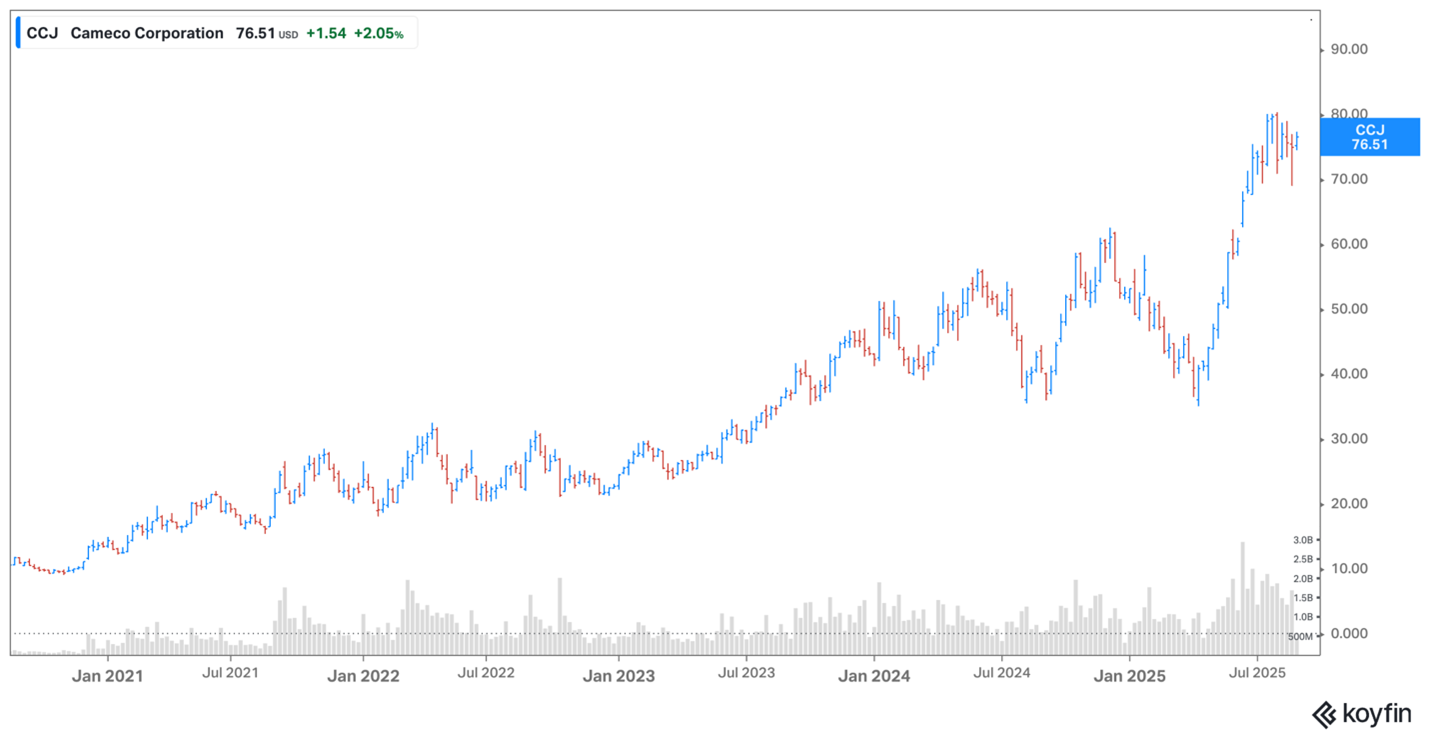
My take: The market is supersmart – it gets things right. Sometimes it does so immediately, and sometimes it takes a while. But the market gets it right almost 100% of the time. The energy debate is no different.
5. Japanese bond yields
If you’re looking for a dog that’s not barking, this is it. Long-dated Japanese bond yields just hit their highest level in over 20 years:

To me, this is a significant move. It reflects increasing inflationary pressures in a highly indebted country. It has a few implications:
- Japanese companies have low debt levels and high cash levels. Higher interest rates will be good for their earnings.
- Mrs. Watanabe has been a consistent seller of Yen and buyer of other currencies for a long time now. As interest rates rise in Japan, this flow will stall and then reverse, which is positive for the Yen.
- It will cause Japanese investors to sell offshore bonds and buy Yen bonds. Bad for highly indebted Western markets, which have received generous funding from (previously) low-interest-rate Japan.
My take: A sea change is happening in developed market bond markets, with Japan leading the way. Don’t stand in its way. In the bond portion of its asset allocation, the MWI Worldwide Flexible fund (aka “The Cockroach”) owns no bonds from developed markets.
In The Media
1. Dan Wang on China vs America
I have mentioned previously that I try to read as much “unbiased” – i.e. non-Western writing on China. Dan Wang is one of my sources. He is a research fellow at Stanford University’s Hoover History Lab. Previously, he was a fellow at Yale Law School’s Paul Tsai China Centre, and before that, he covered technology at Gavekal Dragonomics. For the better part of a decade, he has been trying to figure out China’s technology capabilities while living in Hong Kong, Beijing, and then Shanghai.
Dan writes an annual letter containing his experiences and views on developments in China. But this year, he didn’t write a letter – he wrote several, and combined them into a book. “Breakneck, China’s Quest to Engineer the Future” is out this month.
Also, this week, he wrote a piece describing his experiences while writing the book. It’s an interesting read for anyone contemplating writing a book or considering investing in China. I fall into both camps – but I think I will have invested in China long before I ever get around to writing a book! You can read his piece here.
My take: Wang characterises China as an “engineering” society, contrasting it with the USA, which he characterises as a “lawyerly” society. I find this distinction to be quite helpful when thinking about the pitfalls and opportunities each country faces.
2. The Best Music of 1994
I remember 1994 fondly. I had just moved into a house that I couldn’t really afford, but had to buy due to the low offer price, caused by negative emotions surrounding the upcoming election; an election which ended up being a memorable event for all the right reasons. The only people disappointed by the election were the hoarders of candles and tinned goods. Oh, and probably the guy who sold his house to me.
Towards the end of the year, I decided to resign from Allan Gray, and spent most of my time running a book on the Football World Cup. In so doing, I learned a lot about odds, risk management, lay-offs and parlays. But mostly, I learned that a well-managed “house” always wins. I can’t even remember who won the World Cup that year, but my book made a tidy profit.
1994 was also memorable for being the year that “prescribed assets” were finally scrapped. Up to then, South African institutions had to hold at least 50% of their clients’ portfolios in government bills and bonds to fund the government. Prescribed assets had a massive distortive effect on the market price for all kinds of assets – an effect coming to a theatre near you in developed markets over the next 5 or so years. I think.
1994 was also an excellent year for music. Some outstanding hard rock albums were produced: Live’s “Throwing Copper”, Pearl Jam’s “Vitalogy”, plus Soundgarden, Veruca Salt and Bush. But also the classic “Grace” by Jeff Buckley and “Protection” by Massive Attack. And who can forget Portishead’s “Dummy”! And finally, my personal favourite, “Mighty Joe Moon” by Grant Lee Buffalo.
Here are my top 10 albums for the year, on Apple Music and on Spotify.
Here are my top 20 songs from the year, ranked from 20 to number one, on Apple Music and on Spotify.
And also my long list of best songs of the year, only on Apple Music. Put it on shuffle, turn up the volume, and enjoy it – hopefully as much as I enjoyed 1994!
That’s it for this week, except to say that it still pays to be careful out there!
Piet Viljoen
RECM