
Welcome to my newsletter, where I share my efforts to understand markets and the world around me.
I appreciate you taking the time to read this. I love getting feedback; feel free to drop me a line. It’s great to start conversations.
Today is Thursday, the 26th of February, the 57th day of the year. There are 308 days remaining until the year’s end. On this day in 1852, an English troop carrier, the Birkenhead, under Captain Robert Salmond, stranded on a reef close to what has become known as Hermanus today.
Survivors of the wreck settled there, existing on gardening and what the sea could offer. Today, Hermanus is South Africa’s premier summer holiday destination.
How times change!
What has also changed is the software of our society, the intangible infrastructure that drives our behaviour.
Our culture.
As the Birkenhead was sinking, seven women and thirteen children were helped into the only two lifeboats available while the men stood in line on deck. The Birkenhead secured a place in history due to the gallantry of her men, who, in the face of great danger, allowed the women and children to escape in the boats before trying to save themselves by swimming ashore. Of the 638 passengers, 445 men perished.
Imagine what would happen if a contingent of our country’s armed forces found themselves in a similar position today.
How times change!
In this regard, Edelweiss Holdings plc Chairman Tony Deden recently wrote a typically brilliant essay on “the hollowing out of democratic substance beneath the preservation of democratic form”, stating: “What is emerging is not simply illiberalism imposed from above, nor a relapse into overt authoritarianism. Rather, it is a gradual reorientation of democratic politics away from restraint and toward consumption – of capital, of institutional credibility, and of social trust.”
Another way of thinking about credibility and trust is to say that they are markers of a strong culture. Credibility is only obtained through the imprimatur conveyed by years of consistently applied effort. But not just any effort – effort that moves society forward. Trust is also only obtained through consistency, both in good times and bad.
High levels of credibility and strong bonds of trust develop slowly over long periods of time. This gradual accumulation underpins the culture of a society.
In a recent issue of Big Think, Beatrice Erkers published an op-ed entitled “Why culture may be our most powerful lever for progress”. Erkers posits that culture is the infrastructure of human intelligence: “We usually think of infrastructure as bridges, satellites, and fibre-optic cables,” she writes. “But beneath steel and concrete lies something less tangible but just as powerful: culture – the stories and symbols that make some futures seem absurd, others inevitable, and a few worth building.”
Prosperity and standards of living are the downstream consequences of previous investments into its physical and cultural infrastructure. We can’t help but notice the capital investments in physical infrastructure. But the intangible investment into our cultural infrastructure is just as real and just as important. The stories we tell each other, the memes that define the principles to which we collectively subscribe. These are attributes which build and develop over time, that move us forward as a society.
Just like the level of physical infrastructure is an indicator of economic success and progress, I believe the key to a successful investment program is its underlying philosophy and process. The philosophy tells you how the investor thinks about the world, and the process tells you how she will implement this philosophy in the portfolio. To develop an advantageous philosophy and process requires an enormous investment of time and energy.
But these physical characteristics of an investment programme – its philosophy and process – are a necessary, but not sufficient condition for investment success. What brings sufficiency is a deliberate investment in the culture of the programme. If your investment manager doesn’t act consistently in both tough times and good, or if they lack intellectual integrity, or if the stories they tell don’t stack up with what is happening, eventually even the most well-developed investment process will not succeed.
Culture is like when the judge delivered his verdict on whether an item was indeed pornographic: “I know when I see it“. A strong culture replicates automatically and kicks out those who don’t fit. It is very much a self-perpetuating system. An investment programme with a strong culture is fractal – a single element/person is representative of the whole system. The companies with strong cultures I have worked at, or with – Investec, RMB or Allan Gray – were like that. By interacting with one of their employees, you could tell a lot about their firm.
But like any physical asset, culture needs continuous maintenance. Even firms with a strong culture can slip if they aren’t spending enough time and energy on it.
I wrote about the value of maintenance in “Making it Last“. My conclusions were:
“Societies characterised by trust and resilience are ones in which it pays to build – build businesses that employ more people, build infrastructure that keeps the wheels turning. The first step towards creating such a society is to take care of what is already there. To create a foundation for growth, we should first celebrate maintenance and upkeep.”
Trust and credibility define the culture of a good investment programme. The question any investor needs to ask themselves is: am I investing enough into the maintenance and upkeep of culture to ensure that it doesn’t get consumed, but sustains and strengthens?
In The Markets
1. The fat pill is working
The use of the so-called fat pill, or the class of drugs known as GLP-1, is becoming increasingly socially acceptable. GLP-1 (Glucagon-Like Peptide-1) is a natural hormone produced in the gut after eating. It regulates blood sugar, slows digestion, and signals fullness to the brain. As a medication, it mimics this hormone to effectively treat type 2 diabetes and promote weight loss by reducing appetite.
As time goes by, doctors are discovering that it has several positive side effects. These “unexpected” benefits include reduced systemic inflammation, metabolic and cardiovascular improvements, improved kidney and liver disease management, improved cognitive health, and reduced addiction and craving.
It’s no wonder that the penetration of this class of drug has grown over the past few years. In the USA, which currently has over 50% of the global market, usage has increased exponentially. By late 2025, GLP-1 prescriptions accounted for over 7% of all prescriptions in the US, up from a fraction of that in previous years.
Novo-Nordisk was first to the market with injectable Wegovy, initially leading the breakthrough in obesity medication in 2021. Despite much excitement at the time, their initial market leadership has not translated into good returns for shareholders:
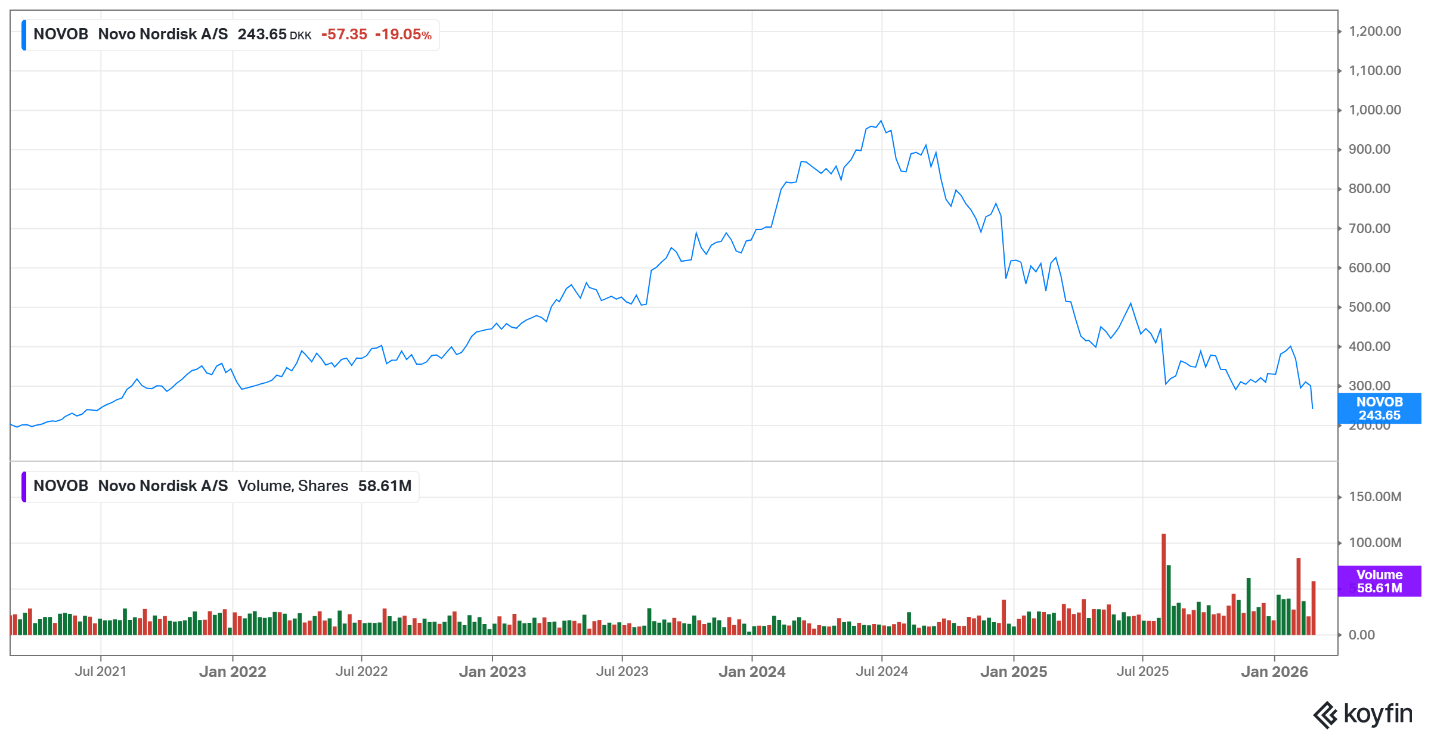
I wrote about Novo-Nordisk in 2023, at the height of the excitement about their drug, in “Bear Baiting”.
Right now, the market has shifted its excitement to Eli Lilly, which was first to market with an ingestible pill. This has expanded the addressable market, as many people don’t like to inject themselves:
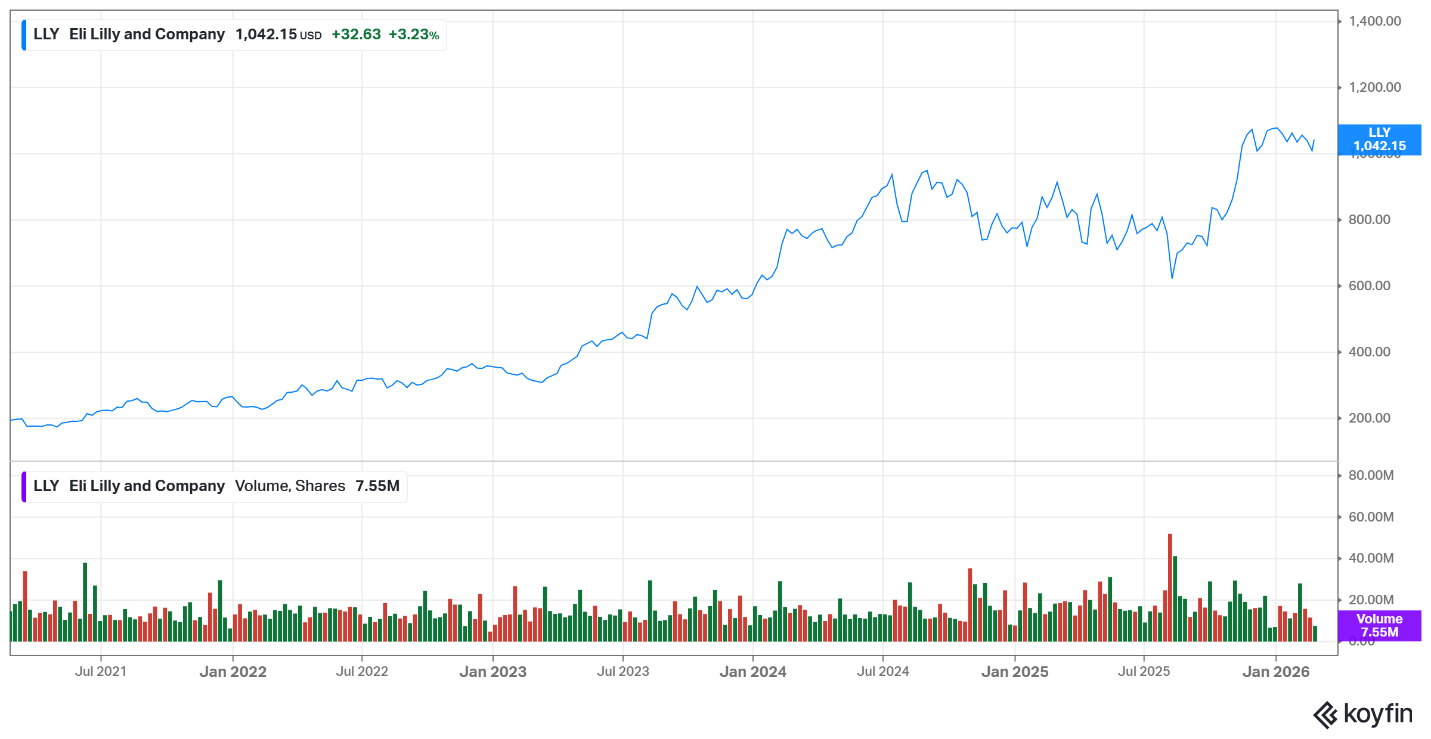
Warren Buffett famously said, “Beware of excitement and expenses, as they are the enemy of the rational investor.” Investors in Novo Nordisk would probably agree wholeheartedly with him on this point. On the other hand, Eli Lilly investors probably regard Buffett as a 95-year-old fuddy-duddy.
However, if you accept that 95 years of investment experience is worth listening to, how does one approach the investment landscape with respect to the increasing usage of GLP-1 drugs?
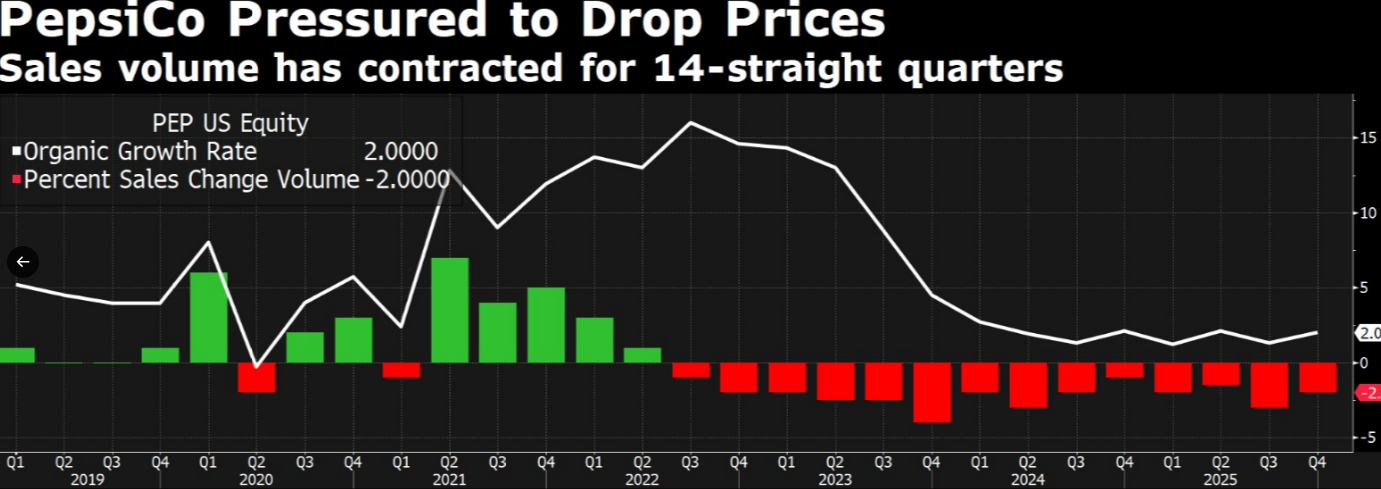
My approach would be to invert. Stop looking for the “exciting” opportunities and think about what to avoid. Top of my list would be the makers of snacks and beverages like Pepsico. Here’s a chart showing their volume growth:
The same is happening in the alcohol industry. In January, the US Treasury released information that whiskey distillers had produced a little under 142 million combined proof gallons, which was 55 million less than a year before, as first reported by the Lexington Herald-Leader.
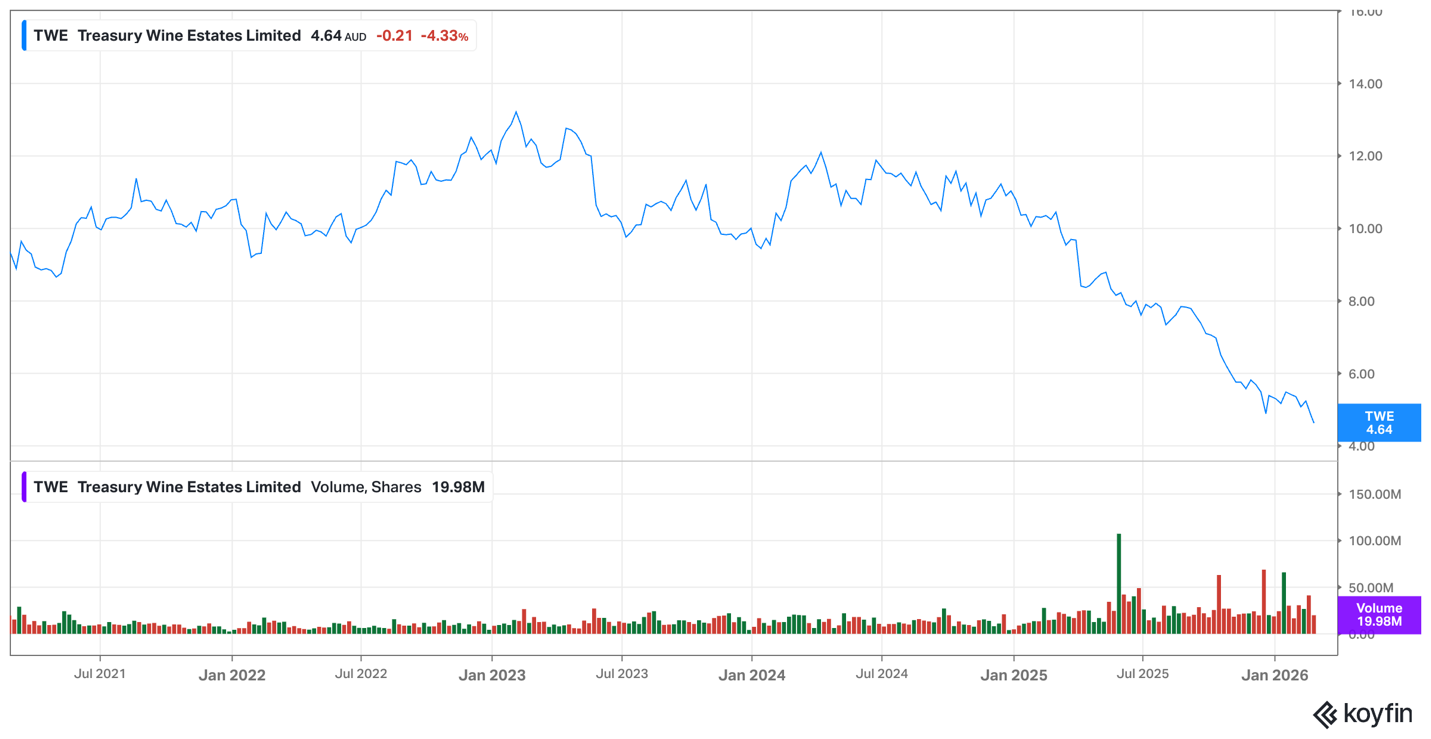
These are severe headwinds for future profitability. And the shareholders of drinks companies are noticing it. Here is Treasury Wine Estates, the Australian-based global maker and distributor of wines:
And here is the share price of Diageo, the British-based, multinational leader in premium drinks, including Johnnie Walker, Guinness, and Smirnoff:
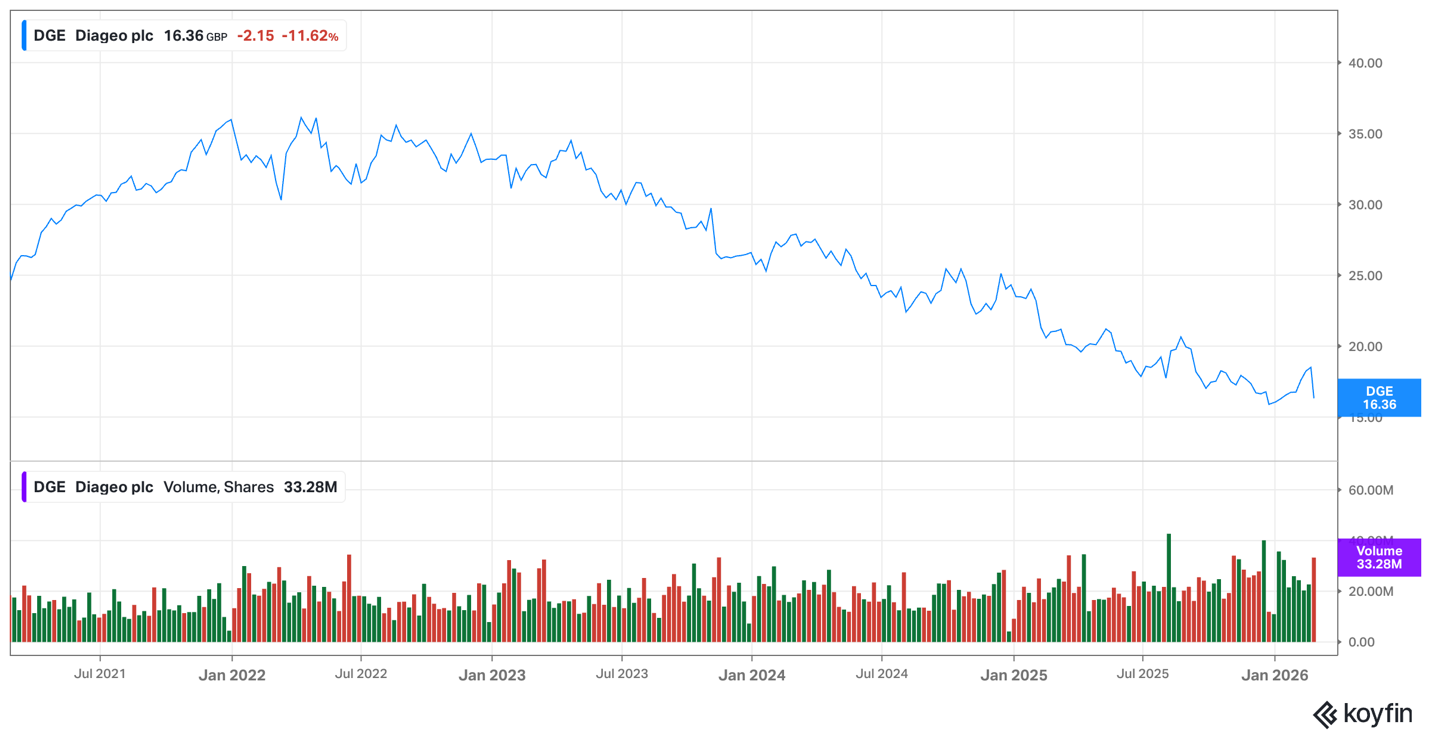
My take: An old saying in the market goes like this: “Don’t try to catch a falling knife”. These kinds of sayings are based on decades of accumulated market experience of millions of investors. In my view, that’s better than AI…
2. The sanctions are not working
When the West first introduced sanctions in Russia, media outlets reported that the “Ruble is Rubble” and that sanctions on oil would “hit them where it hurts”. So, let’s check in with Russia and see how it’s going.
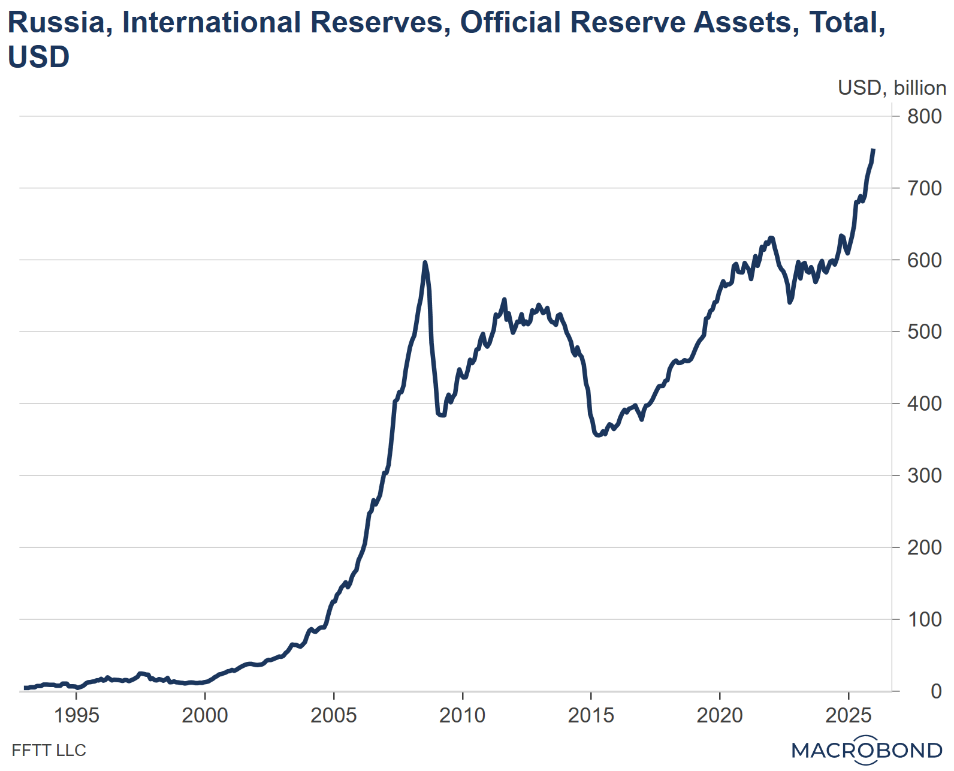
Here are Russia’s foreign reserves:
And here’s the Russian ruble against the US dollar:
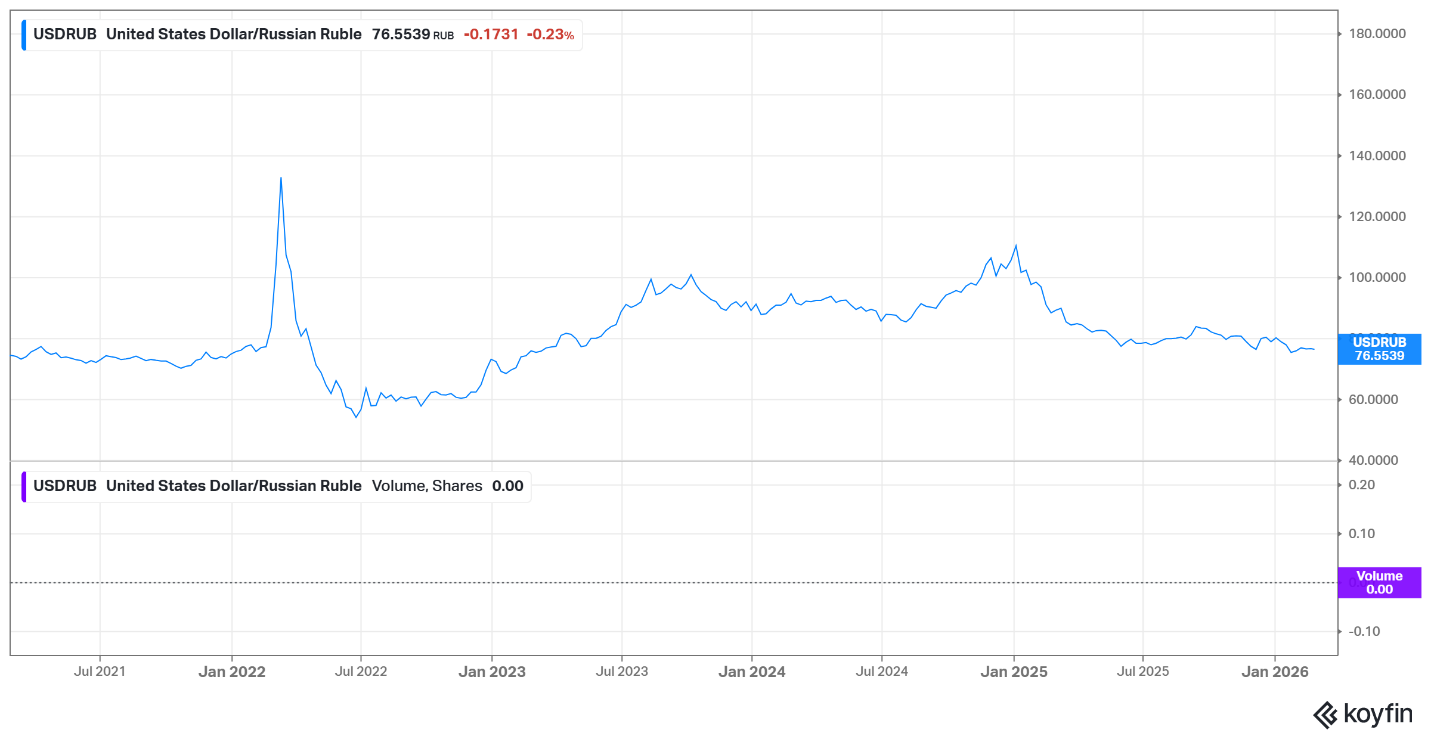
Since the start of the Ukraine war and the subsequent inception of Western sanctions, Russia’s foreign reserves have increased, and the Ruble has strengthened!
What’s going on?
As a result of sanctions, India and China get to import cheap oil from Russia – a nice gain for them. But Russia continues to earn foreign exchange. On top of that, Russia historically held a large proportion of its reserves in gold, which is no one else’s liability and cannot be sanctioned. I don’t have to tell you what has happened to the gold price over the past few years.
Russia’s gold holdings mean that despite fighting an expensive war, being cut off from the western financial system, and the West seizing hundreds of billions of dollars of Russian forex reserves, its reserves are at an all-time high. How so? Essentially, the West printed money to pay for its side of the war, bidding up Russia’s gold and, by extension, Russia’s FX reserves!
My take: If Russia, India and China are all better off due to sanctions, who is paying the bill? My guess is that the taxpayers in the West will be first in line to find out.