
Dear Fellow Investors and Friends,
Welcome to my newsletter, where I share my efforts to understand markets and the world around me.
I do appreciate you taking the time to read this. I love getting feedback; feel free to drop me a line. It’s great to start conversations.
Today is Thursday, July 23rd, the 204th day of the year. There are 161 days left until the end of the year. I’m already finding myself thinking about the end of the year and what still needs to be done before then.
On this day in 1944, the Bretton Woods conference ended, establishing the modern monetary order. It created the International Monetary Fund (IMF) to stabilise currencies and the World Bank to fund post-WWII reconstruction. By pegging global currencies to the US dollar, the conference cemented the dollar as the primary global reserve currency.
But that was a process; there was no one specific day which you could point at and say, “That’s the day the US dollar became the currency of choice.”
I believe that the global monetary order is changing again, but it’s a process, not an event. It has important investment implications. One of them is that we might see a revaluation of the currencies of many emerging market economies relative to the US dollar over time.
There are many reasons why this might happen, including:
- fiscal imbalances in Western economies
- the need for “reshoring”
- the need for infrastructure spending
- starting valuations (have you noticed how expensive everything is in the USA/Europe, for instance?)
I’m not going to discuss any of these in depth; that’s for another day. But it does influence something we, as South Africans, love talking about: how offshore investment returns compare with local investment returns.
For the longest time, local investors have laboured under the illusion that there was a “free lunch” in offshore investments, provided by a currency (the rand) that would continue to depreciate at rates well more than inflation differentials.
Well, that stopped happening a while ago:
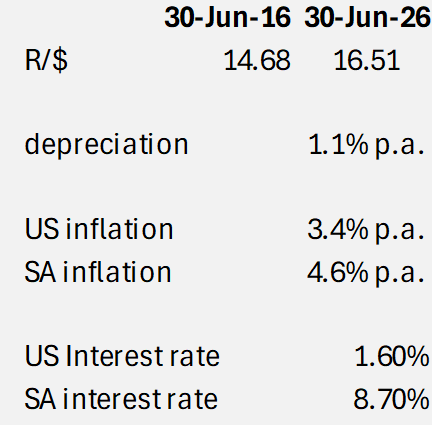
From the table above, it’s clear that the rand has maintained its value in real terms against one of the strongest currencies in the world over that time, the US dollar. Importantly, because of our high interest rates, you earned almost 6% p.a. more in real terms by keeping your money in rands than by taking it offshore into US dollars. To be clear – 6% real compounded over 10 years is a very big number.
Many of my regular readers will know that I took a bet with a prominent local financial advisor that onshore assets would outperform offshore assets. One of the members of the BizNews community put up R1mn of real money. He gave me R500k, which I placed in the MWI Value fund. The advisor bought (and sold) several different offshore investments over the almost 5 years that the experiment has been running.
The reason I took the bet was not because I confuse patriotism and investment prospects. It was simply that local assets were undervalued at the time, local real interest rates were high and developed market currencies were overvalued – conditions which remain in place today.
Unsurprisingly, my local investment has convincingly outperformed the advisor’s offshore investment. But it’s also true that he would be the first to say that trading in and out of assets cost him a lot, so I decided to have a look at how South Africa’s top fund managers have been doing. As a sanity check, so to speak.
To do so, I looked at the returns of General Equity unit trusts in South Africa over the past 10 years, to the end of June 2026. By way of background, there are 93 general equity funds with a 10-year track record. Ten years is long enough for any lucky – or unlucky – bounces of the ball to wash through. These 93 funds are split between funds that invest only in local equities (27 funds) and funds that can invest in local and offshore equities (69 funds).
Here are my findings:
- The JSE has been a great place to invest – over 10 years it has compounded at 11.6% p.a. That’s 7% real, or 3X your money. Fantastic, whichever way you look at it. Interestingly, 10 years ago was peak Zuma.
- Only 5 actively managed funds outperformed the JSE over 10 years. None of the funds managed by the big houses did so. The funds that outperformed were managed by Fairtree (AuM of R190bn), Camissa (AuM of R97bn), Methodical Investments (AuM of R12bn), 36One (AuM of R60bn) and Merchant West (AuM of R10bn). These firms are tiny compared to the AuM of N91 of R3.9tn, Coronation of R780bn, Old Mutual of R1tn and Allan Gray of R700bn.
- There are only three funds with the word “Value” in their names. Only two of them have a 10-year track record. There is the (small) Merchant West Investments Value fund, which has outperformed the index. Then there is another “Value” fund managed by the biggest fund manager in South Africa, N91, which hasn’t.
- The average equity fund which invests only in South African equities returned 8.9% for the 10 years. The average equity fund which includes offshore equities returned 8.5% p.a. Both underperformed the index substantially.
Here are the facts based on these findings:
- In investing, size is your enemy. Avoid the large investment houses. Their skill lies in marketing, not investing.
- In equities, indexation is a superior strategy to active management, regardless of size.
- There are market niches which an active manager can successfully exploit, but you need to use a small manager to do so effectively.
- When the political environment feels at its scariest, assets are often at their cheapest, offering the highest prospective returns. Don’t get confused when this happens.
- Given the set of circumstances in South Africa, offshore assets do not add to your expected return. Unless you were the one smart alec who bought Nvidia 10 years ago. Which, judging by the returns of their funds, not one of the local fund management houses (which are filled with very smart people) seems to have done!
I hope the above helps you to make rational decisions informed by facts – not fund manager marketing material – about your investments. Of course, there is a place for offshore investing; it reduces risk through diversification. But its deserved role, under current conditions, is smaller than the one we as an investment collective here in South Africa place on it.
There is no free lunch offshore – except for the “helpers” who earn huge fees by scaring you into over-allocating to expensive offshore equities.
In The Markets
1. Netflix / Media
Is there nothing worth watching on Netflix these days? Or is it just me?
Is it because the providers of content that attracts eyeballs have become fractured?
It used to be that there were three or four TV channels to choose from. Then we had the oligopolistic satellite/cable TV providers with a multitude of channels. Then streaming took over, passing some of those oligopolistic profits back to consumers.
Netflix was the champion here.
Today, we have multiple streaming services plus TikTok, Reels and others – all competing for the same set of eyeballs.
The mishmash of platforms operated by content creators, telecoms companies and tech groups has left viewers with a fractured, confusing and annoying user experience. How many remote controls are in your living room? If it’s anything like mine, it’s way too many.
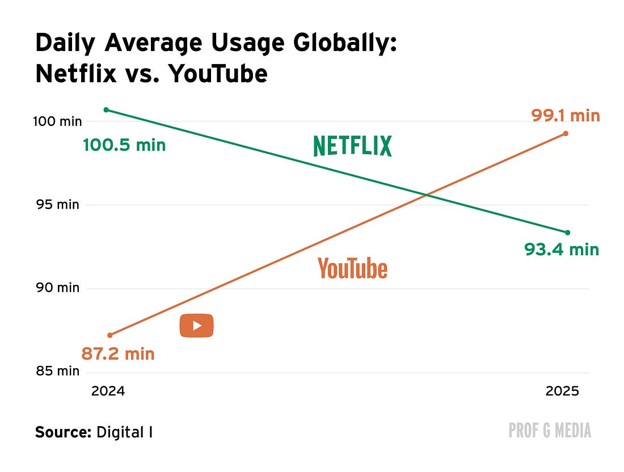
The only protection against this splintering viewing ecosystem is content. Those with the best win the war for eyeballs. For a long time, this was Netflix. But recent surveys show that YouTube has a 10% market-share lead over Netflix, and that lead is growing. Personally, I have found it difficult to find much decent content on Netflix recently.
It’s no wonder its share price is in the doldrums, down by 50% from its most recent high:
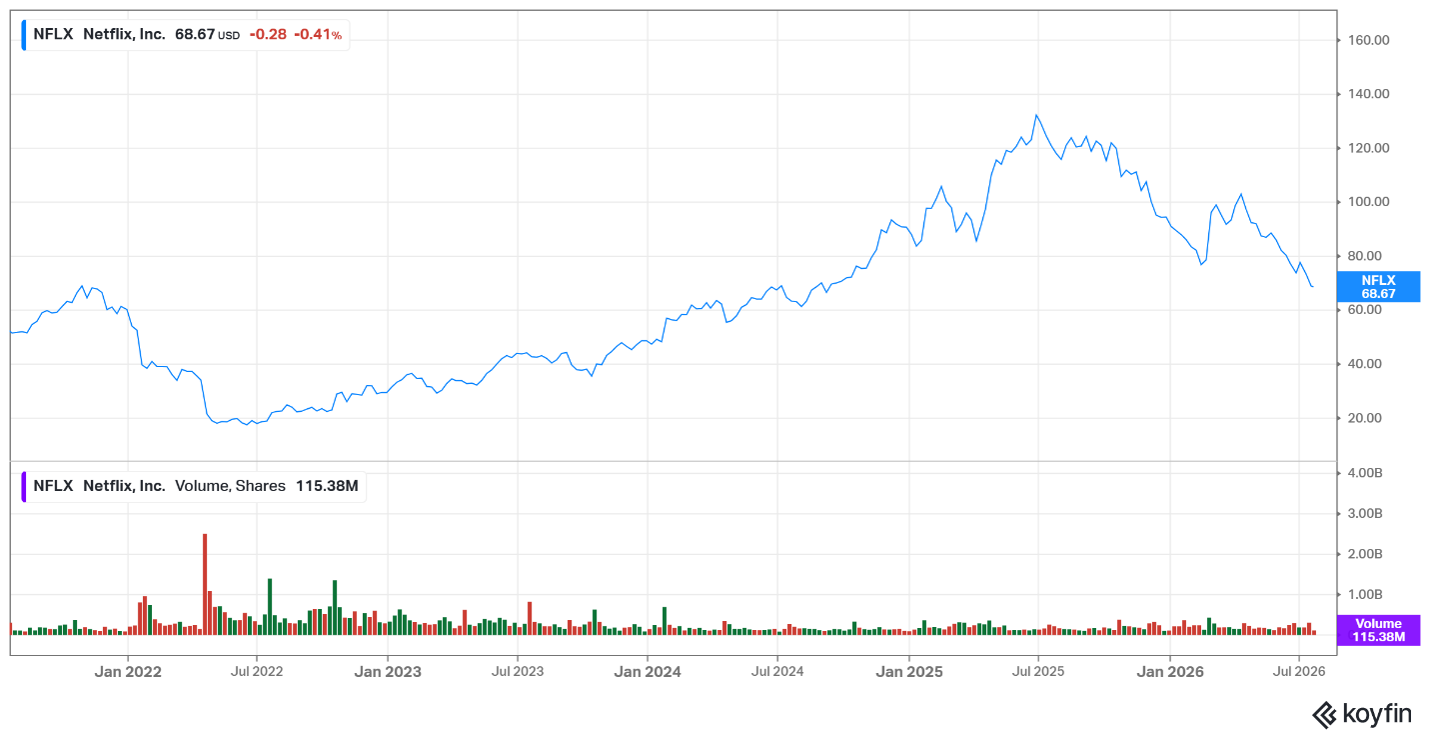
To stay competitive, Netflix needs to up the quality of its content. If they can, the current share price offers a significant buying opportunity. But this could be a problem. As Michael Burry says, when it comes to content, Netflix produces milk, while Disney produces wine. I’m happy to have Disney in my 10 stocks, forever.
In other news, two of the biggest hits of the northern hemisphere summer season were produced by young YouTubers, on a limited budget, while Paramount has just spent a bomb to acquire Warner’s content. No guesses here who’s winning.
Here’s the Paramount share price, which seems disappointed with its acquisition of Warner:
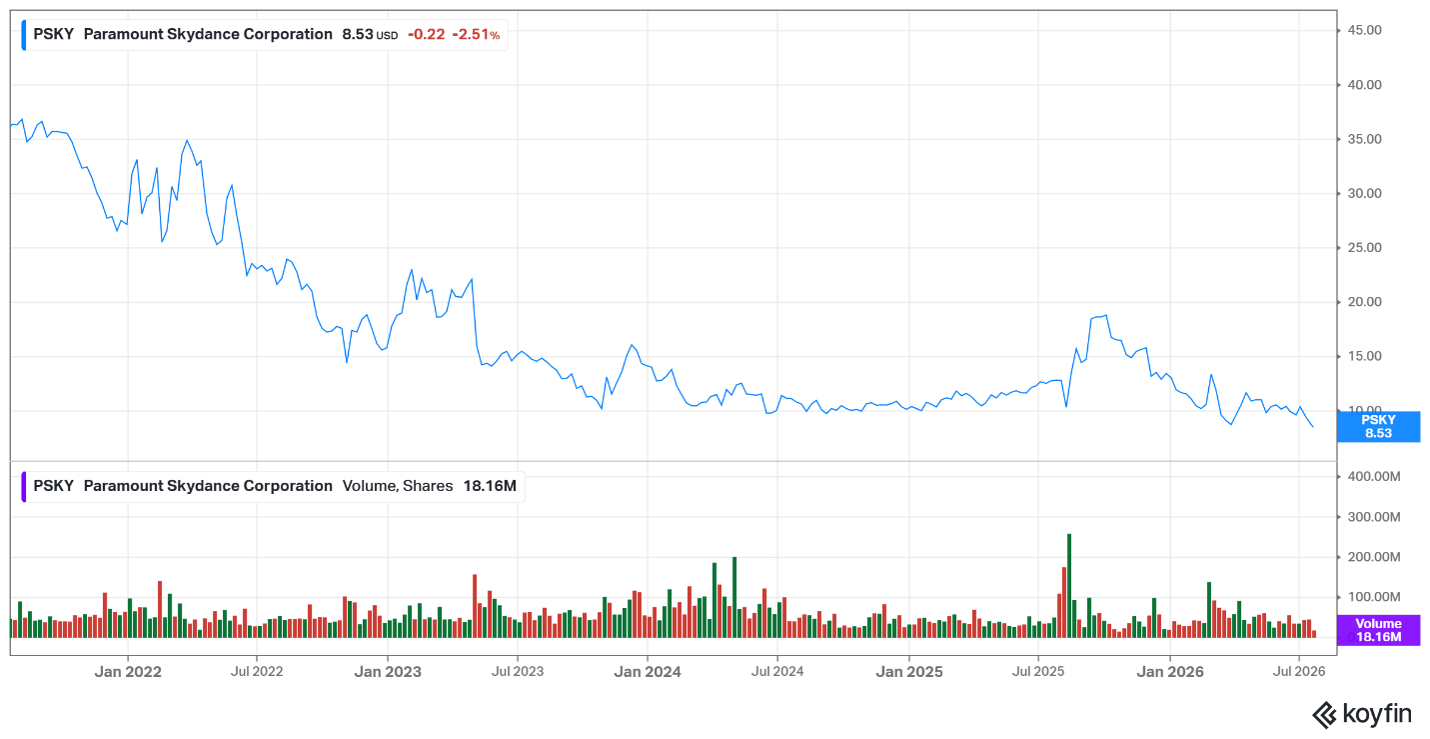
My take: In a massively competitive environment, the cautious investor will do well to see who’s left standing when the dust clears. It might not be the ones we think it will be.
2. OpenAI
Being a South African investor, I have been exposed to more commodity cycles than I care to mention. My firm lost a lot of clients in 2006 when we refused to invest late in the cycle. We also lost (a lot more) in 2014 when we invested early in the cycle. Both times we were right, but there was a mismatch between our clients’ time horizons and ours.
Right now, the world is going through another commodity cycle – a commodity cycle in the tech sector.
How can that be, you might ask?
Well, the current AI mania is centred on physical things – chips and data centers. Unlike internet-native businesses like Google or Meta, which have no marginal cost, AI businesses do. To serve an additional user on Facebook or WhatsApp costs nothing. To increase the data processing capacity of a data centre costs a lot.
Commodity cycles end the same way every single time. Not when demand collapses – it rarely does – but when the variable rate of demand growth decelerates against the fixed supply the boom has just finished building.
Here is a super simplified picture of the AI industry…
There are effectively two parties: the hyperscalers like Google, Microsoft, Meta and Amazon, and the model builders like OpenAI and Anthropic. The hyperscalers build (or finance) data centers where the model builders’ data gets processed. The model builders are clients of the data center. The clients – OpenAI and Anthropic – are both loss-making businesses – and will be for years.
Here are OpenAI’s financials (courtesy of the FT):
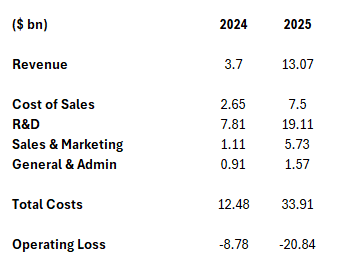
In short, to continue operating, OpenAI needs to raise a lot of cash – not just this year, but for several years to come.
The economic substance of the AI mania is that the hyperscalers have extended a credit facility to clients that have no independent operating income with which to pay their bills. If those clients default, the hyperscaler balance sheets must absorb the fixed costs of customised, rapidly depreciating capital assets.
Those clients’ (to recap: AI model builders) payments are obviously not serviced out of earnings, as there are none. They are serviced out of equity financing, which for a borrower in this position is available only to the extent that funders are willing to step up to the plate – by taking up shares in a hot IPO, for example.
What could cause funders to withdraw? As I pointed out earlier, demand growth slows a little bit. This is what kills all commodity cycles.
So, recent headlines are cause for worry, as it seems – that just like in any other capital-intensive, commoditised industry, when supply exceeds demand, you get price wars. And new supply is coming from – you guessed it – China!
Open-source Chinese models now account for nearly 50% of enterprise token usage on OpenRouter, a marketplace for AI models. That’s up from just 4,5% in early 2025.
In response, American firms are cutting their prices dramatically. Last week, Meta announced a new model, Muse Spark 1.1, that is up to 75% cheaper than OpenAI and Anthropic. Under industry pressure, OpenAI released a new model, undercutting itself by 80%.
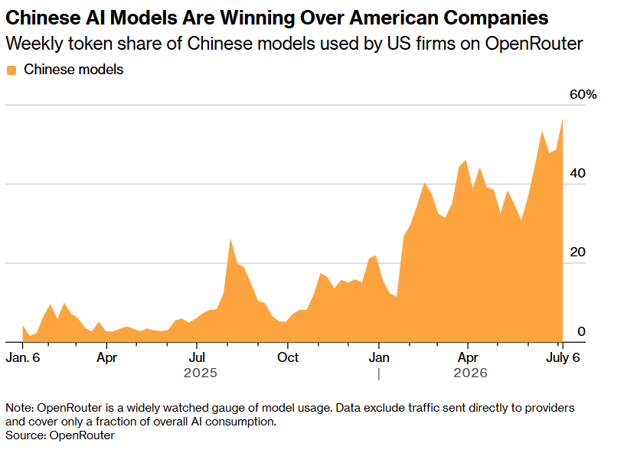
Demand for the US model builders’ output might not be accelerating anymore. Recently, according to The New York Times, we found out that OpenAI is thinking about delaying its IPO until next year.
My take: This house of cards is bound to implode at some point. OpenAI and Anthropic are not this decade’s version of a 2005 Google and Meta. They bear more resemblance to a 2005 BHP or Anglo. I am happy to sit this cycle out completely.
3. Lewis Group
I visited with the Lewis Group CEO, Johan Enslin, a few weeks ago. The main purpose of the visit was to thank him and his management team for the work they have done for shareholders over the past decade or so. Investors are quick to criticise when management teams underperform, but I don’t think enough acknowledgement is given to teams who do well.
In any case, during our discussion it became clear that there was far more to it than good execution and a bit of luck. This is a management team that kept their head down and executed a sensible, conservative strategy, while everyone else in the industry was losing their minds.
Lewis Group’s last decade is best understood as a journey from crisis and regulatory disruption, through diversification and repair, to renewed expansion:
- The collapse of African Bank and Ellerines in 2014 exposed the fragility of South Africa’s credit-furniture model.
- New affordability-assessment regulations under the National Credit Act made it more difficult to grant credit, particularly to informally employed or lower-income customers.
- JD Group, once the biggest furniture retailer, became a victim of excessive credit growth and over-expansion. The National Credit Act was the last straw.
- Covid-19 temporarily closed stores and disrupted deliveries, collections and credit origination.
Johan Enslin has been chief executive since 2009. He is an operating insider who joined Lewis as a salesman in 1993 and worked his way up from branch level. Rather than recruiting a turnaround specialist from outside, the board backed someone with deep expertise in credit granting, collections and branch economics.
Operationally, Lewis Group has excelled under Mr Enslin’s leadership. It has also been particularly adept at capital allocation. No tilting at offshore windmills or pursuing large-scale transformative M&A. Just a few select in-fill acquisitions, a generous dividend policy and a smart share buy-back program.
Over the past 10 years, Lewis has delivered an annualised return of close to 15% p.a., while the overall retail sector of the JSE has returned less than 10% p.a. The All-Share Index itself has returned 11.7% p.a.
To put these numbers in perspective: at 15% p.a., over a ten-year holding period, you will have 4X your original investment, while at 10% you will only have 2.5X your investment. That is a huge difference.
It also makes for a nice price chart:
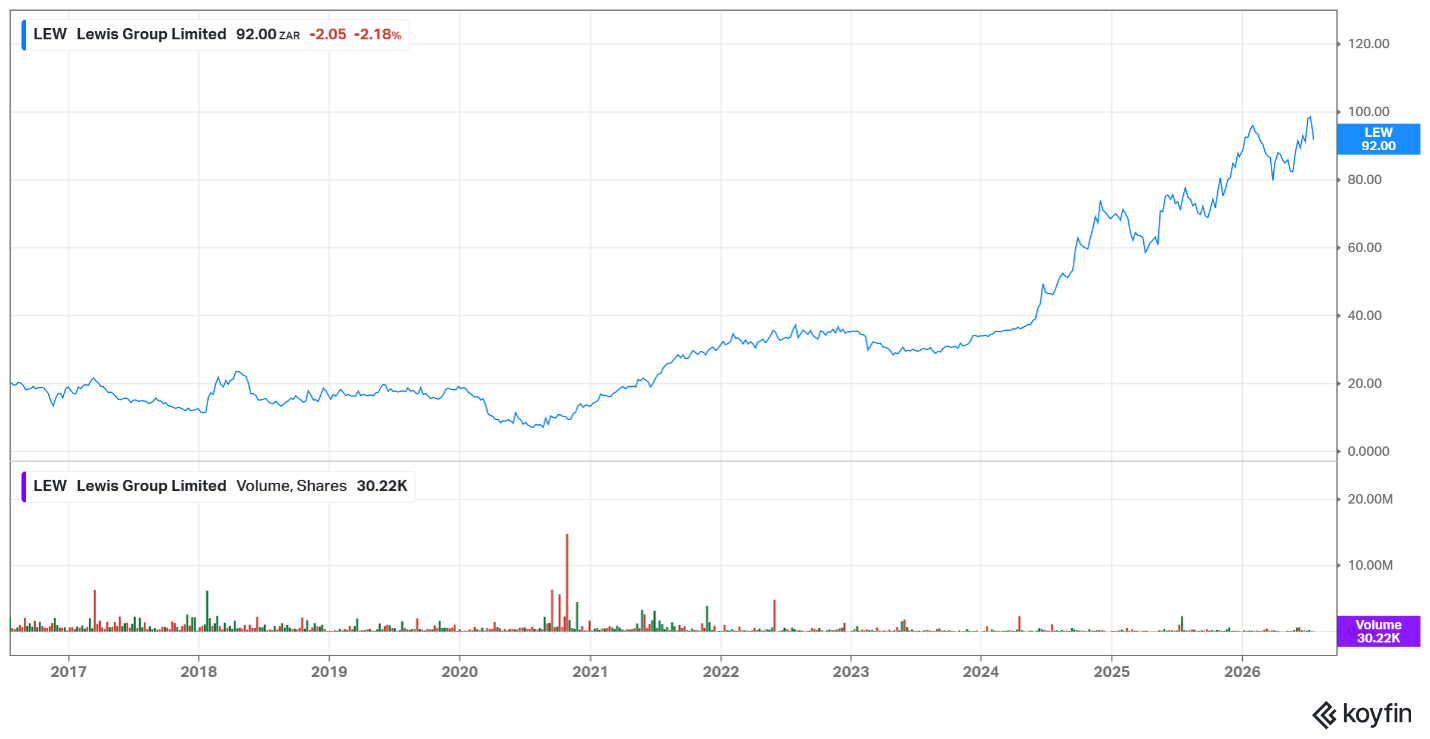
This well-managed business is currently trading on a dividend yield of 10% – yet another small-cap that is ignored by the market.
How ignored? There are fewer than 10 unit trusts in South Africa with greater than a 1% exposure to Lewis Group. The MWI Value Fund is the fund with the biggest exposure to Lewis, with 3.2%.
My take: Lewis is managed by a conservative, low-key management team that has outperformed all the South African retailers by a lot. These companies, with their fancy investment bankers in tow, overseen by disinterested boards of directors, can take a leaf out of this business’ book.
Thank you, Mr Enslin!
In The Cockroach
Merchant West has published the latest quarterly report for the fund*. If you are invested in the fund, or are considering an investment in the fund, it is obligatory reading.
Since I started managing the fund in the “way of the cockroach” – September 2020 – the fund has produced a return of 10.4% p.a. in ZAR, and 9.9% p.a. in USD. Over that time, US inflation has averaged 4.4% p.a. The fund has thus returned a real return of 5.5% p.a. in dollars.
This is probably slightly higher than I would have expected at the outset, and I would not extrapolate this return into the future. But the fund remains well set to generate real returns in the 2 – 4% p.a. range going forward.
Not because of my money management skills, but because the asset classes in which the fund is invested have stable real return expectations built into them over the long term:
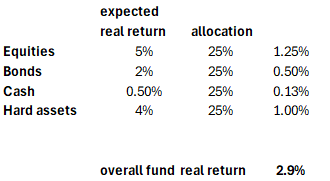
All I have to do is leave things alone long enough for the asset class returns to come through.
Importantly, the fund has achieved its return expectation with low volatility. In layman’s terms, this means the fund stands a good chance of not scaring its investors into doing something foolish. In its sector, the fund has the second-lowest volatility, downside risk, and maximum drawdown. For interest’s sake, its maximum drawdown (i.e., loss) over the past 6 or so years was 5.1% from top to bottom. Again, this is due to design, not my brilliance. The fund is well diversified between and within asset classes, which makes for low volatility.
* I manage the fund on behalf of Merchant West Investments (Pty) Ltd (FSP 44508)
In The Media
1. The World Cup
Finally – the tournament is over. What began as a super exciting showcase for football became a snoozefest towards the end, capped off with a stodgy final. It was so boring that I went to bed and missed the most exciting part – a multi-player brawl just after the final whistle.
One of the reasons the final was so boring is that Lionel Messi, arguably one of the world’s greatest football players ever, saw almost no action. If you’ve ever seen him play, it always looks like he is just loitering around, minding his own business. That is, until he springs into action and either dribbles the ball past helpless defenders, or puts through a pinpoint pass.
After the tournament, I came across this YouTube clip, which explains why Messi looks so harmless…until he doesn’t. It’s a pity such a great player had to be on the losing side.
2. Is it a bubble?
Here’s an interview with Ben Inker, the strategist at fund management firm GMO.
His short answer is yes – to paraphrase him, if it looks like a bubble, walks like a bubble and quacks like a bubble, then it’s not a duck; it’s a bubble.
According to him, and I agree, which is why I am posting this clip, of course – small cap is cheaper than large (which is expensive), and value stocks are somewhere between cheap and extraordinarily cheap. He goes on to say that the typical private equity portfolio is a leveraged small cap junky portfolio – and investors (at least in the USA) are quite overweight these attributes. So, biasing your portfolio towards quality is a good idea.
These are not just his opinions; they are based on GMO’s rigorous analysis of the expected returns over the next 7 years of different asset classes. You can see their full table here.
3. BizNews Conference
I will be speaking at the 9th BizNews Conference to be held at the Champagne Sports Resort in the Drakensberg, Tuesday 11 August to Friday 14 August. Apart from an interesting array of speakers, which you can see here, late autumn is also a great time in the ‘Berg.
I think there are still a few tickets available – so get yours today and come say hello when you arrive!
Finally, my stepson’s fiancée, Courtney, got some great news last week – she passed her final exam for her degree. With that, I am another step closer to retirement, where I can lie on the couch and live off the earnings of the progeny. If only they would work harder.
Seriously though, she did work very hard for it and deserves it through and through. Mazeltov Courtney!
That’s it for this week. Tomorrow, Amanda and I are off to the UK to visit her parents. I also plan on doing a three-day bikepacking trip. Travelling solo on a bike is a great way to clear the mind, and the UK has amazing cycling infrastructure.
Finally, we’re going to the Nick Cave and the Bad Seeds concert in Brighton. The supporting acts are The Flaming Lips, English Teacher and Cate le Bon. Can’t wait! Live music is such a joy.
It’s a jungle out there, so remember to be careful!
Piet Viljoen
RECM
23 July 2026