
Dear Fellow Investors and Friends,
Welcome to my newsletter, where I share my efforts to understand markets and the world around me.
I appreciate you taking the time to read this. Feedback is welcome; feel free to drop me a line. It’s great to start conversations.
Today is Thursday, January 22nd, the 22nd day of the year. There are 343 days left until the end of the year.
It’s the birthday of pilot Daniel “wrong way” Corrigan, an Irish-American stunt pilot. Corrigan became famous – and earned his nickname – from an unplanned transatlantic flight in 1937. He wanted to emulate his hero, Charles Lindbergh, and his famous achievement, but was denied permission by authorities in New York because his aeroplane was deemed unsuitable.
He told authorities he would fly back home to California, using the magnetic compass on board – his only navigational aid. According to Corrigan, after takeoff, cloud cover prevented him from navigating accurately. Later, when he dropped below the clouds, he saw nothing but water. At that point, he says, he realised his navigation was off.
Despite the confusion, he continued his journey. 28 hours later, he landed in Ireland.
I suppose financial markets often make us feel like Corrigan – clueless about where we’re heading, with limited navigational aids. In fact, it’s probably even worse – there are many people claiming to have better navigational tools we can use, if we only pay them enough.
That’s the point of this letter – mainly to help me navigate my uncertain journey through the clouds, but also to share with you the waypoints I follow. Some of these might lead me entirely off course. I do promise, though, when I realise I’m lost, I’ll also tell you what I’m doing to find my way back. And hopefully before the coast of Ireland appears on the horizon!
So, here goes year number four of feeling my way through the unknown. This year, I’m going to change things up a bit. Previously, I had three sections to the letter:
- an intro piece, discussing ways and means to think about investing
- a few shorter pieces on specific market-related events
- a few reviews of things I found interesting in the media.
This year, I’m adding a fourth section: what I am thinking about – and any actual trades – in “The Cockroach”, as I like to call the MWI Worldwide Flexible fund. This is the fund that reflects my views on global markets and to which all my savings are allocated.
Today, I want to share a story about investment holding companies – commonly called a “Holdco”.
I’m going to discuss the history of Astoria, a Holdco with which I was closely associated that was delisted at the end of last year. Next week, I’ll analyse the sector more generally and see if we can learn some lessons.
In April 2021, RECM and Calibre (the predecessor to Goldrush Holdings) spun out Astoria Investments as a standalone Holdco. Astoria was specifically set up to hold non-gaming-related investments. At that time, Astoria was fully invested in a diverse range of companies. Its NAV per share on the day of listing was R3.95.
As it turns out, some of the businesses Astoria owned were good, and some were excellent. One was bad. But overall, it turned out well. For the first three years of its existence, Astoria’s share price and NAV per share strongly outperformed the All-Share Index.
Despite this performance, Astoria continued to trade at a significant discount to NAV.
Maybe investors saw what was coming: first, in 2023, the market price of our investment into Leatt, a local business that has developed a global brand of motorbike and bicycle-related safety equipment and apparel, started to decline precipitously. Second, in 2024/25, our investment in the diamond mining business, Transhex, required repeated capital infusions (to which we did not contribute) due to the negative impact of lab-grown diamond prices on the industry. The decision not to participate effectively meant that the value of our holding in Transhex became nil.
These two events reduced Astoria’s NAV per share over the past two years. The one – Transhex – was a permanent loss, while the other – Leatt – we consider a temporary setback.
The decline in our NAV per share obviously scared investors and exacerbated the discount, which widened to over 50% at certain times.
The problem Astoria faced was that it lost access to capital. It couldn’t raise equity at such a discount to NAV as it would be massively dilutive to existing shareholders, and its board was loath to incur significant debt to make new investments.
In effect, despite good investment results on average, the market was saying, “Don’t give these guys any more capital, they can’t invest it properly.”
This prompted the Astoria board to make an offer to those shareholders wishing to cash in their investments at a fair price, which was a discount of less than half the historic level. Around 35% of shareholders took this opportunity to realise their investment.
For those investors who accepted the offer, their investment in the company still outperformed the All-Share Index’s growth over its entire lifespan. Here’s a chart of the history:
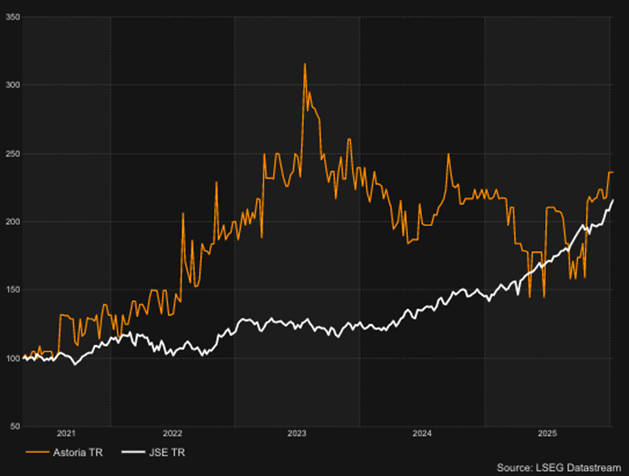
Since listing, Astoria’s total return was 127% or 19.1% p.a., compared with the ALSI Total Return Index’s 116% or 17.9% p.a.
Over the same period, the average general equity fund returned 13.8%, while only 12 out of 103 funds outperformed the index. Of these twelve, six were some variant of the index.
Yet, despite this poor showing, unit trusts (or, more correctly, collective investment schemes) always trade at NAV with no discount.
Some would say that’s not fair. But I would say life is not fair. Don’t sit and complain about it, instead do something about it. Next week, I’ll discuss what investors should look for in this sector to help generate healthy returns.
In The Markets
1. Mining vs. Chips
Both the mining and semiconductor (chip) industries are highly capital-intensive and, as a result, highly cyclical. Here’s Samsung’s (one of the major producers of semiconductors) operating profit over time:
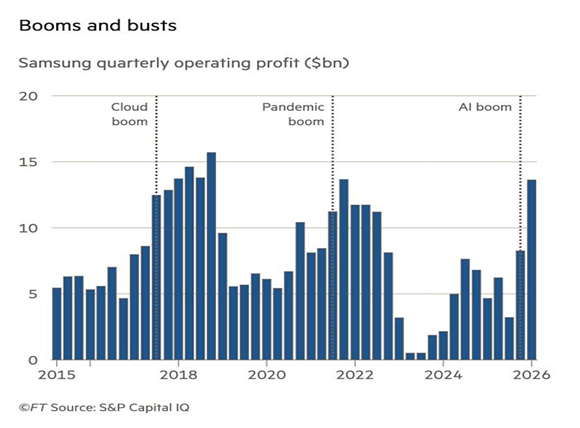
As you can see, basically sideways (i.e. no growth), but with big swings up and down. In other words, a typical cyclical business. Here are the operating profits of another cyclical business:
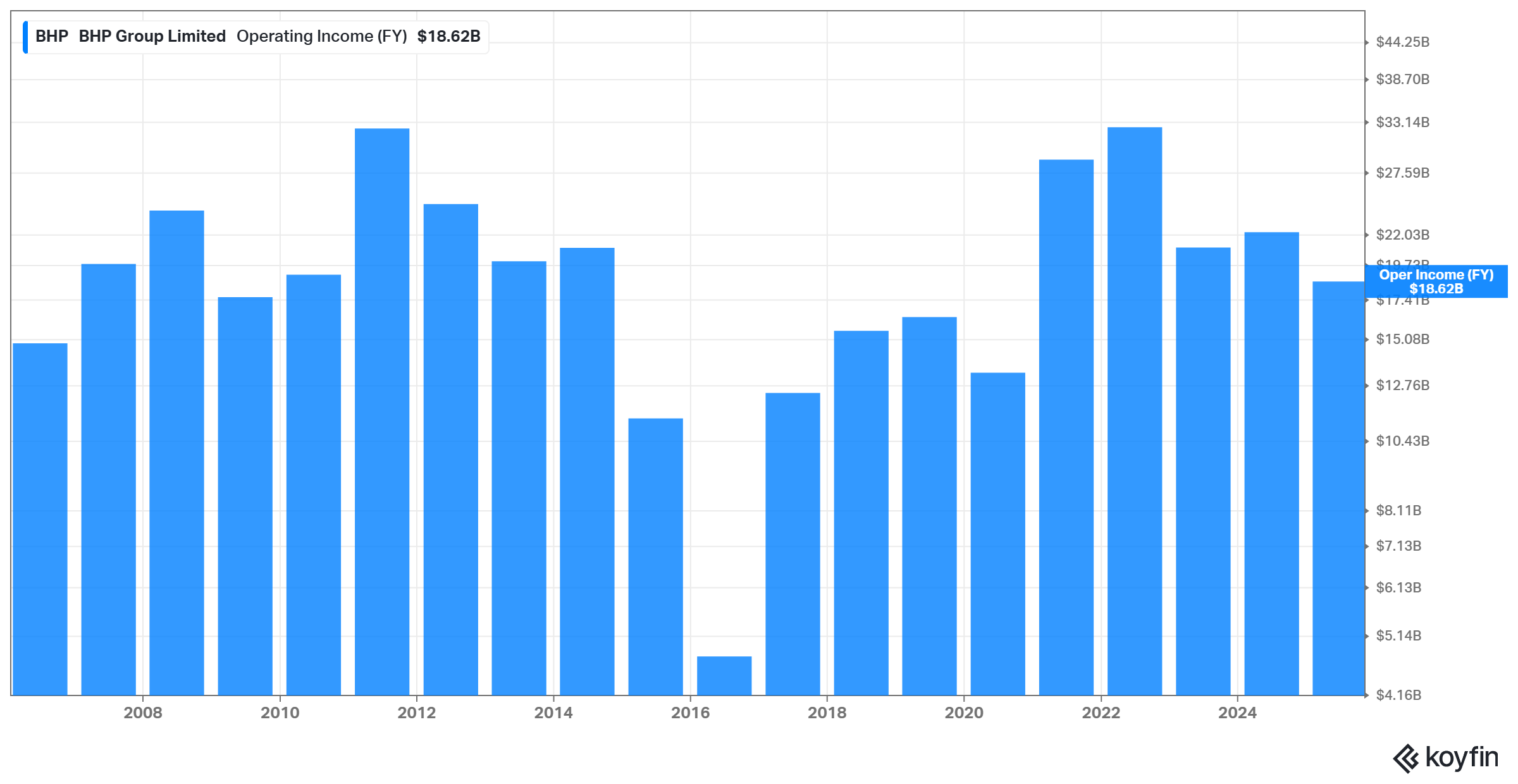
This business is called BHP – another business with profits that barely grow over time and show large swings. There are two differences between the companies:
- It takes a lot longer to find, prove out, and exploit (via mines) a new resource than it does to retool for a new type of chip. The chip cycle is about 4 years, while it can take up to 29 years to build a new mine.
- BHP is on a P/E of 18 – on low earnings, while Samsung is on a P/E of 33 on arguably high earnings.
My take: This goes to show – once again – that anything to do with AI, chips, etc., etc. is probably overvalued and one should expect a low prospective return from the area. Mining – an essential input into the chip-making, data-center building process – not so much.
2. Inflation in emerging markets
It’s common knowledge that emerging markets are much, much worse run than developed markets. Politicians, monetary policy and fiscal policies are much better in the West, aren’t they?
Aren’t they?
Well, here are some recent news snippets:
- The US Department of Justice opened a criminal investigation into Fed chair Jerome Powell for overspending on office renovations. This, after Powell was called “a knucklehead,” “a major loser”, and “either incompetent or crooked” by the president, for not lowering interest rates faster.
- France missed the 31 December deadline to adopt their national budget for 2026.
- Over the past five years, the UK has had four(!) prime ministers.
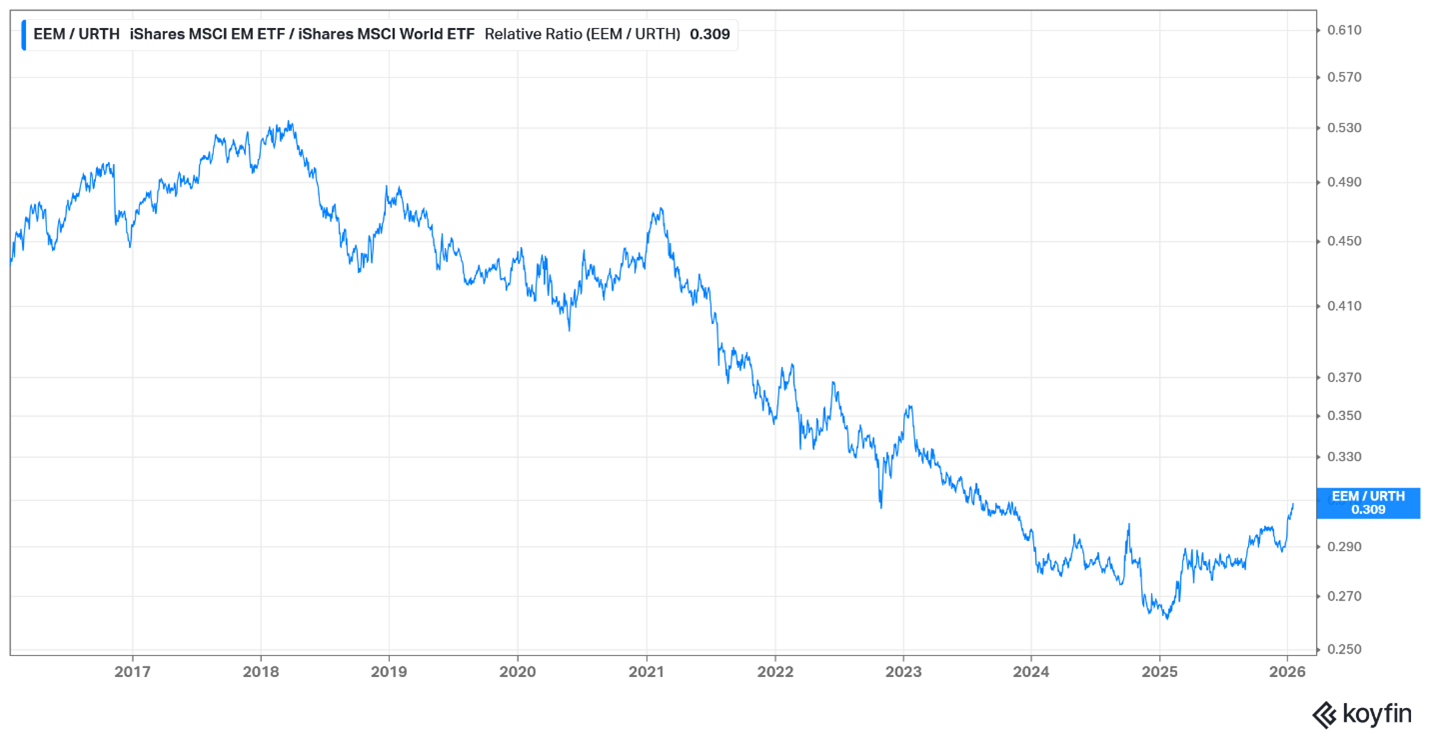
- For the first time in 25 years, inflation in emerging markets is now below that of developed markets, and moving in a different direction:
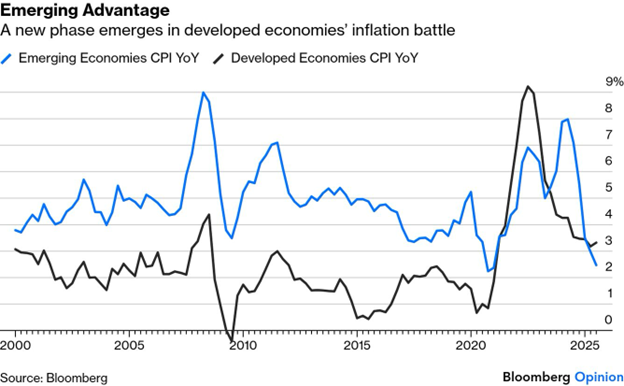
My take: I would describe the current situation as “developed markets with emerging market characteristics”. Yet, asset values do not reflect this shift. Not by a long shot. Emerging has only just started to outperform:
3. The most undervalued currency in the world
No, it’s not the Rand – although, for a long time, that used to be the case. It’s not the Japanese Yen, although it’s close. It’s the Chinese Renminbi:
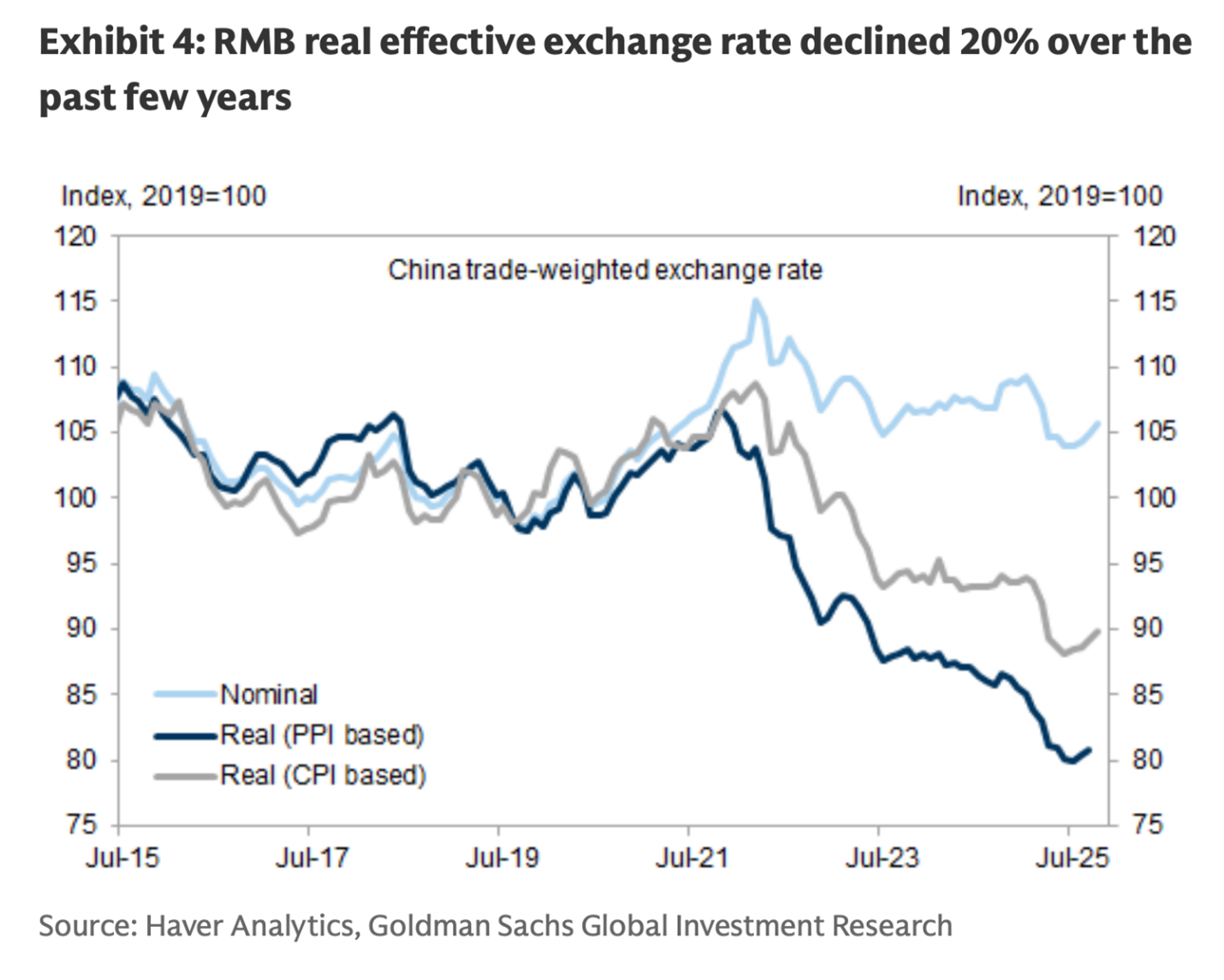
It’s no wonder the Chinese are posting such massive trade surpluses, month after month. Their goods are too inexpensive due to a combination of enormous manufacturing capacity, rapid quality improvements, and an undervalued currency.
Here’s another data point: what things cost in China vs what they cost in the USA:
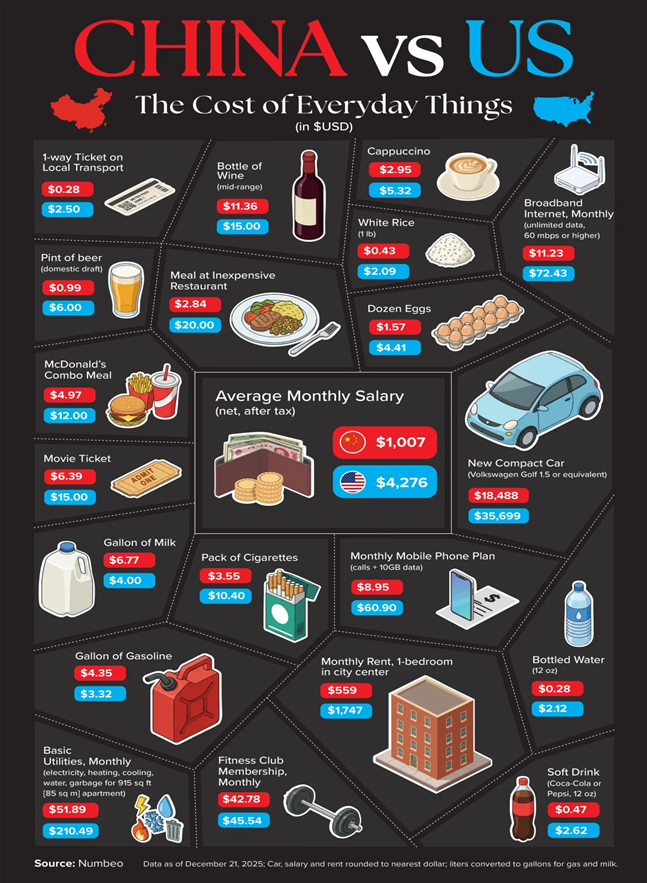
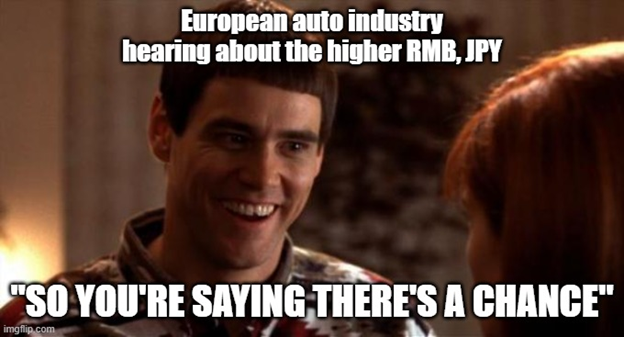
It’s a matter of time before the Renminbi starts appreciating and taking the Yen with it. European manufacturers (those that will have remained solvent) can’t wait!
(hat tip to Gavekal research)
My take: Amanda and I will be travelling to Japan, Korea and China in a couple of months, where we will enjoy the blossoms and the cheap currency. In the meantime, if you decide to buy a European car, all you’re really doing is incinerating money for no good reason. Chinese cars (and just about everything else from China) are better and half price.
In The Cockroach
This is the new section, where I discuss what I’m thinking about and what I’m doing in the MWI Worldwide Flexible fund (aka the cockroach). I’ve decided to do this, so I can:
- Benefit from feedback from readers.
- Hold myself accountable in public for what I’m doing. Sunlight being the best disinfectant.
- Give those who prefer to manage their money themselves (instead of entrusting it to me lol) information they can use/not use.
I’ve been thinking about the Japanese market for some time now, and this week I decided to buy some bonds through the iShares Japanese Government Bond ETF (ticker 2561). 7% of the fund has been held in Yen cash for quite a while, and the sharp sell-off in Japanese bonds, with yields rising above their European counterparts, presented me with the chance to move further along the curve.
Since I always keep 25% of the fund in cash, I needed to find some cash elsewhere – and what better way than selling some of the South African bonds the fund has been holding for over five years? The fund’s exposure to these bonds was about 17%, but this has now been reduced to 11%. The remaining 14% of bond exposure consists of emerging-market bonds via the VanEck EM Local Currency Bonds ETF (ticker: EMLC). Additionally, there’s a small allocation to Namibian government bonds, which trade at a significant yield spread compared to similar South African government bonds. If the offshore oil and gas prospects materialise, those yields could decrease substantially. In the meantime, the fund continues to earn a very attractive running yield.
I also sold out of the Holdco FRMO, which Horizon Kinetics manages. It accounted for 2% of the fund’s 25% allocation to “hard assets.” This allocation, mainly consisting of physical gold held through the SPDR Gold Trust ETF (ticker GLD), performed exceptionally well and had to be trimmed back to 25%. Therefore, I sold FRMO, which has Texas Pacific Land as its primary asset (over 70%). The fund holds a direct 3% allocation to TPL, so I reduced that exposure somewhat. I’m sorry to see FRMO go. I need to be strict about asset class exposures.
In the 25% of the fund allocated to equity, I made no changes. However, Ferrari and Mastercard are beginning to knock on the door to be included as the sixth and seventh in my “10 stocks, forever” portfolio.
Overall, due to Rand strength, the South African exposure in the fund has increased to 27% – still mainly in government bonds, but it now also includes cash exposure. This is held through the Merchant West Enhanced Income Fund, which is a well-managed alternative to cash in the bank. Over time, it has performed 1%-2% better than money-market interest rates without taking on overpriced credit risk.
In The Media
1. Defending the indefensible
Ann Crotty, one of SA’s best journalists, posted an open letter to me on one of the better financial news sites called Currency. You can read her original article here, my response to it here, and her subsequent open letter here.
I’ll leave it to you to read all the articles and make up your own mind. Ann and I will have to agree to disagree, and I’ll leave it there.
2. Music – A Subversive History, by Ted Gioia (2019)
The book opens with a quote by Plutarch: “Music, to create harmony, must investigate discord“.
I’ve always felt the best music contained a combination of discord and repetition. The discord moves us forward, gets us thinking and is a call to action. The repetition speaks to the role of music in bringing tribes together to harmonise and act in concert.
This book embodies both elements in abundance. It’s a meticulously researched work that repeatedly emphasises its central message: the finest music often comes from outsiders, those outside the system, the underdog. Additionally, the best music is frequently either an ode to or a call to violence.
Consider this: the blues originates from the poorest of the poor – the slaves of the American South. Country music comes from the cowboy – the landless hired hand. The Beatles emerged from the poor north of England. And how many talented musicians has Ireland – the land of the potato famine – not produced?
Music has long been a subversive force for change, and Gioia traces this history back to the earliest moments of human existence. Today, we can choose to listen to a gentle, algorithmically generated sound — or we can seek out the more unconventional offerings on the fringes of what is deemed acceptable or normal. Gioia demonstrates how provocative content has repeatedly been adopted and normalised into mainstream culture over time.
Gioia’s journey through musical history uncovers profound insights that bear thinking about.
If you read nothing else in the book, read the Epilogue, which includes a list of truths about music. Some examples (and I quote):
- “Music is a change agent in human life, a force of transformation and enchantment.”
- “Charts of best-selling songs can be read as an index of leading social indicators. What happens in society tomorrow can be heard on the radio today.”
- “Each major shift in technology changes the way people sing.”
- “If authorities do not intervene, music tends to expand personal autonomy and human freedom.”
- “Authorities usually intervene.”
- “Music entertains but can never be reduced to mere entertainment.”
If you have any interest in music, this book is a must-read. It’s somewhat dense, but highly rewarding.
3. Podcast: Peter Kaufman, The Multidisciplinary approach to thinking.
If you listen to only one podcast this year, this should be it. It’s just 26 minutes long, but it offers a wealth of wisdom. Peter Kaufman was a lifelong friend of Charlie Munger and was also the editor of that wonderful book: Poor Charlie’s Almanack – The Wit and Wisdom of Charlie Munger.
Kaufman’s approach can be summarised in this quote:” Go positive and go first, and be consistent in doing”.
It comes from testing principles against 3 statistically significant buckets of data:
- 13.7bn years of the history of the inorganic universe, i.e. chemistry, geology and physics
- 3.5bn years of the history of the organic universe, i.e. biology
- 20,000 years of human history
When a principle is true in all three buckets, you can trust it completely. So, he tested several principles and came up with the three core principles with which to guide one’s life:
- Reciprocation. 98% of the time, you will get back what you put in. Perfectly mirrored reciprocation.
- Going first. Psychologists have shown that we are willing to sacrifice 98% of the potential benefit to avoid 2% of the risk in all areas of life. That’s why we rarely put ourselves out there – we’re too afraid of being ridiculed. And then he quotes baseball legend Lou Gehrig, who said: “Show me a man who’s afraid to look foolish, and I’ll show you a man who can be beat every time.”
- Compounding. This principle is based on evolution – gradual, incremental progress over a very long time frame. That’s how animals have developed, and that’s how Berkshire was built. He says, “Intensify is overrated, and consistency is underrated”.
There’s a lot more meat to this bone; it will pay you to listen to the whole episode, which you can do here. It’s part of “The Knowledge Project” by Shane Parrish, which is a treasure trove of information.
4. BizNews interview
I had an interesting conversation with Alec Hogg of BizNews this week. You can watch it here. We covered a lot of ground, but mainly discussed why I thought SA stocks were a better bet (as prospective investments) than the Mag 7.
That’s it for this week. I hope everyone managed to have at least a little break and is now back doing what they enjoy with renewed vigour. Globally, markets are bringing us much joy, so let’s enjoy it while it lasts!
Piet Viljoen
RECM
22 January 2026