
Dear Fellow Investors and Friends,
Welcome to another edition of my newsletter, where I share my efforts to understand markets and the world around me.
I do appreciate you taking the time to read this. Feedback is welcome; it’s great to start conversations.
Today is Thursday, September 4th, the 247th day of the year. There are 118 days until the end of the year. On this day in history, several notable technological breakthroughs happened. These include:
- In 1882, Thomas Edison opened the world’s first commercial electrical power plant in New York City, marking the beginning of the electrical age.
- In 1888, George Eastman patented the roll-film camera and registered the Kodak trademark, enabling mass-market photography.
- In 1951, the first live transcontinental television broadcast occurred in the United States, connecting people across the country in real.
- In 1998, Google was founded, leading to revolutionary advances in information technology.
All these inventions helped to move us forward along the arrow of progress. But down here on the southern tip, our arrow is facing in the opposite direction.
The South African government wants to move the local economy up the value chain. Instead of simply exporting raw materials for the rest of the world to consume or transform, they want local firms to add value to these materials.
Now, if you want someone to do something, there are two ways you can go about it. You can either use a carrot, creating conditions under which it is easy for a person to do what you want them to do. Or you can try to force them to do so via the whip. The whip being rules, regulations, penalties and taxes.
If government creates the right conditions and incentives for local businesses to add value to primary output, business will thrive while executing the plan. Of course, they will claim it as their own brilliance and remunerate themselves accordingly, but the outcome will be more growth, more jobs, and more taxes. All government must do, once it has created the right environment, is to stand back and let the market do its job.
A win-win scenario.
A government that doesn’t understand and doesn’t trust the market, a government that is incapable of building or maintaining anything, will try to force business to execute on the “masterplan” through the whip. Of course, businesses will spend a lot of resources on trying to avoid the whip as far as possible. They will circumvent the regulatory quicksand, which is the hallmark of an incapable government. Less gets done with more resources. Less growth, less jobs, and less taxes.
A lose-lose scenario.
South Africa today is firmly on the second path. A few examples:
- Merafe recently indicated that they might close 50% of their operational ferrochrome smelters due to high electricity prices and weak ferrochrome prices caused by oversupply in China. The plan is to export chrome ore instead, which would otherwise have been used in the smelters. This is in addition to several unprofitable smelters that were already closed in prior years. The result is less local beneficiation rather than more, due to governmental infrastructure neglect.
- Astral’s largest poultry processing facility, known as Goldi, is in the Lekwa Local Municipality. The facility experienced severe production interruptions, attributed to poor municipal service delivery, ageing infrastructure, and a lack of proper maintenance.
- The Lesotho Highlands Water Project (LHWP) phase II costs have skyrocketed by R11-billion, to R53.3-billion in a year, with completion delayed to October 2030. DA MP Stephen Moore warns of escalating costs and delays threatening water security for Gauteng, Free State, and Northwest.
- Most of South Africa’s fuel refineries are old and inefficient. Upgrading them to produce cleaner fuels and meet updated fuel quality and emissions standards would require considerable investment, which owners deem uneconomical.
- Raubex has had to implement stringent quality checks for bitumen procured from offshore suppliers as South Africa faces a domestic shortage of the key road-paving material.
- Assmang officially stated that “the continued operation of its Cato Ridge Works is no longer viable” and confirmed that all employees would be retrenched as of August 31, 2025. Cato Ridge produces ferromanganese alloy. This has become uncompetitive due to high energy input prices. Manganese ore will now be exported directly, with no beneficiation.
- ArcelorMittal is closing its Longs steel business, blaming high logistics and energy costs. ArcelorMittal noted that Transnet’s performance has deteriorated to its lowest levels ever. ArcelorMittal also describes South Africa’s electricity tariffs as being “globally uncompetitive”. They also complain about insufficient import protections and local companies easily dodging the tariffs that are in place. The IDC lent ArcelorMittal R1.7 billion, but that’s gone – good money after bad. The Newcastle blast furnace is now on temporary care and maintenance ahead of the entire Longs steel manufacturing shutdown at the end of the month.
- Ongoing failures in Transnet’s rail operations have compelled companies to shift the transportation of minerals, agricultural products, and general freight from rail to road. This transition has caused a surge in the use of heavy trucks, particularly “side-tippers,” exerting immense pressure on the national and local road network. Kumba has been unable to move iron ore designated for rail, leading to stockpiling at mines, higher road transport costs, and missed export targets. Woolworths stated that delays and congestion at ports, partly caused by Transnet’s shortcomings, disrupted supply chains for imported retail goods, resulting in stock shortages and increased operating costs.
In such an environment, being able to navigate complex regulatory networks counts for more than entrepreneurial skills. If there is one thing innovative entrepreneurs have in common, it is a distaste for bureaucracy. As a result, some of our best skills will increasingly look to apply themselves in other, more lucrative markets.
Unless and until we have a government that understands and trusts the market’s ability to allocate resources efficiently, our economy will continue to be hollowed out. This hollowing out can be illustrated in one graph:
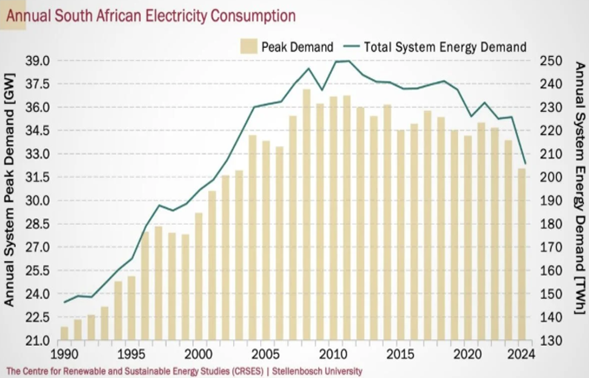
If energy is life, South Africa is dying.
And energy is life.
That’s not to say there aren’t investment opportunities in such an economy – I am positively surprised every day by the entrepreneurial talent I see. Young South Africans are taking the initiative and building remarkable businesses. At RECM, we are invested in some of them, and it really is exciting to see.
What is sad is the realisation that if we only had a somewhat capable government, things could have been so much better. Under the current, incapable government, investment opportunities are fewer and less lucrative than they might have been otherwise.
One beacon that stands out is our country’s vibrant civil society entities, such as Sake-Liga, OUTA, and the IRR – to mention just a few. They are putting in the hard yards to improve social and business conditions and deserve our support.
In The Markets
1. Nestlé
Nestlé is one of my “10 stocks, forever” – to recap, every time you make an investment decision, you increase your chances of making a mistake. So, a simple way to reduce mistakes is to make fewer investment decisions. Taking this to the limit, my theory is that if you can identify great companies and acquire shares in them at reasonable prices, you never have to sell them.
Thus, fewer trades leading to fewer mistakes.
Earlier this week, Nestlé announced the departure of their CEO after allegations that he had a relationship with one of his direct reports. Nestle will now have its third CEO in less than 15 months.
One of the criteria for a company to qualify as one of the 10 stocks forever is that it has a strong culture. What’s happening at Nestlé does not reflect well on the organisation’s culture. The share price reflects this, and other problems, facing the business:
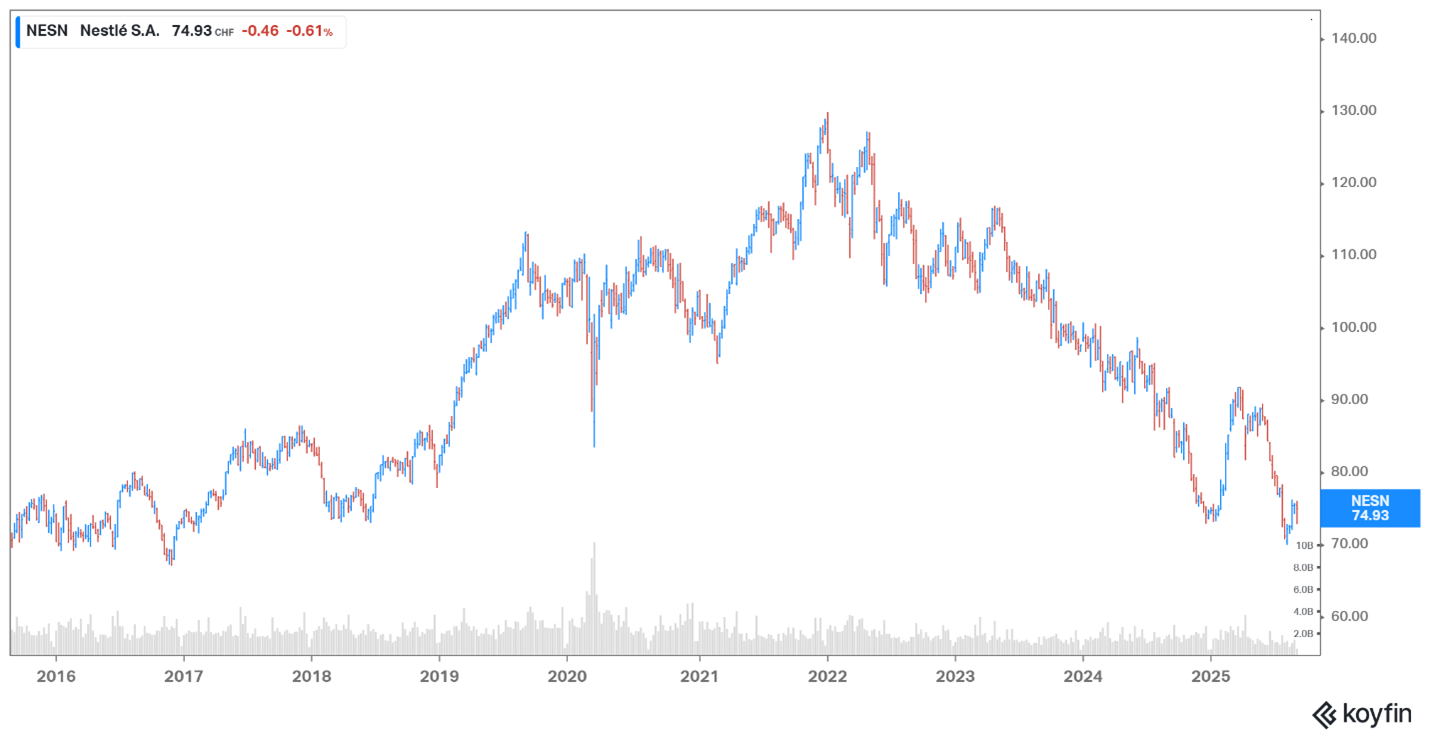
The burning question now is whether the current sell-off offers an opportunity to buy a great business at a reasonable price, or whether a once great business has now become mediocre.
Let’s test it against the criteria to qualify as a forever holding:
1. An identifiably strong culture
Nestlé’s culture has historically been strong and oriented to long-term success. Independent reviews show high employee satisfaction. Nestlé also has a strong reputation for capital allocation. But recent events most likely indicate a weakening of this culture.
2. A long history as a listed company
The Nestlé company’s history dates to 1866, with the founding of the Anglo-Swiss Condensed Milk Company. Henri Nestlé developed a breakthrough baby food in 1867, and in 1905, his company merged with Anglo-Swiss to form what we know as the Nestlé Group. Nestlé has been publicly listed since 1873.
3. A globally diversified business
Nestlé is a global leader in three key high-margin product categories, where brand loyalty and scale offer almost impenetrable competitive advantages:
- Chocolate and confectionery
- Pet food
- Coffee
Some would argue that Nestlé is more globally diversified than the current composition of the major market-cap-weighted indices!
4. A large market capitalisation
The market cap of $270bn is definitely in the large-cap category.
5. A high-quality business
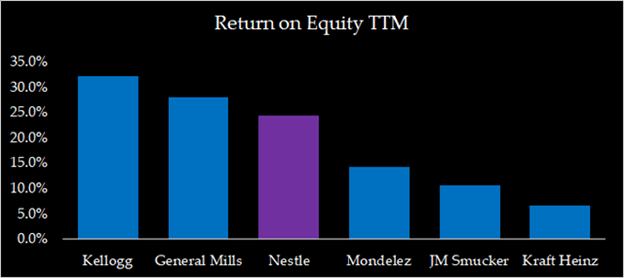
Despite its massive size, Nestlé has a high return on equity:
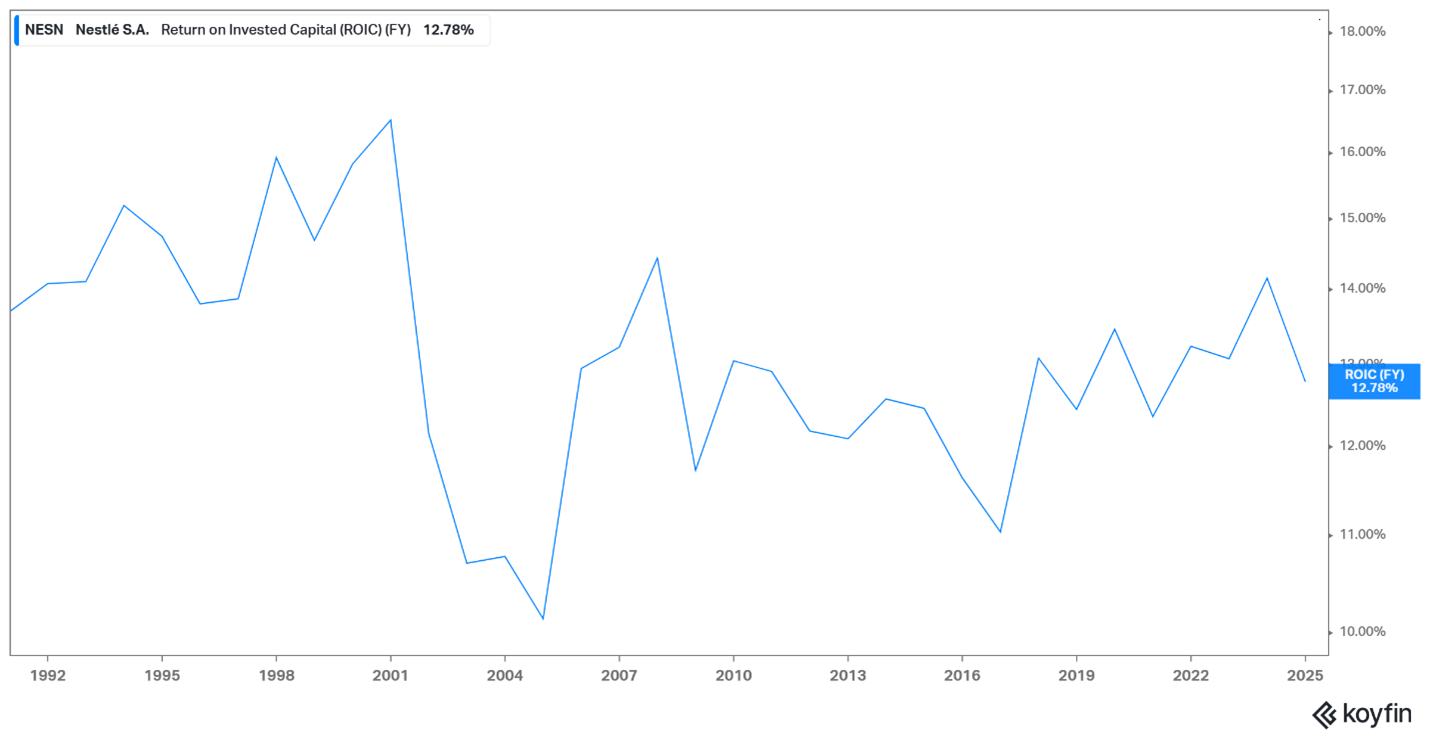
Its ROIC is consistently above its cost of capital:
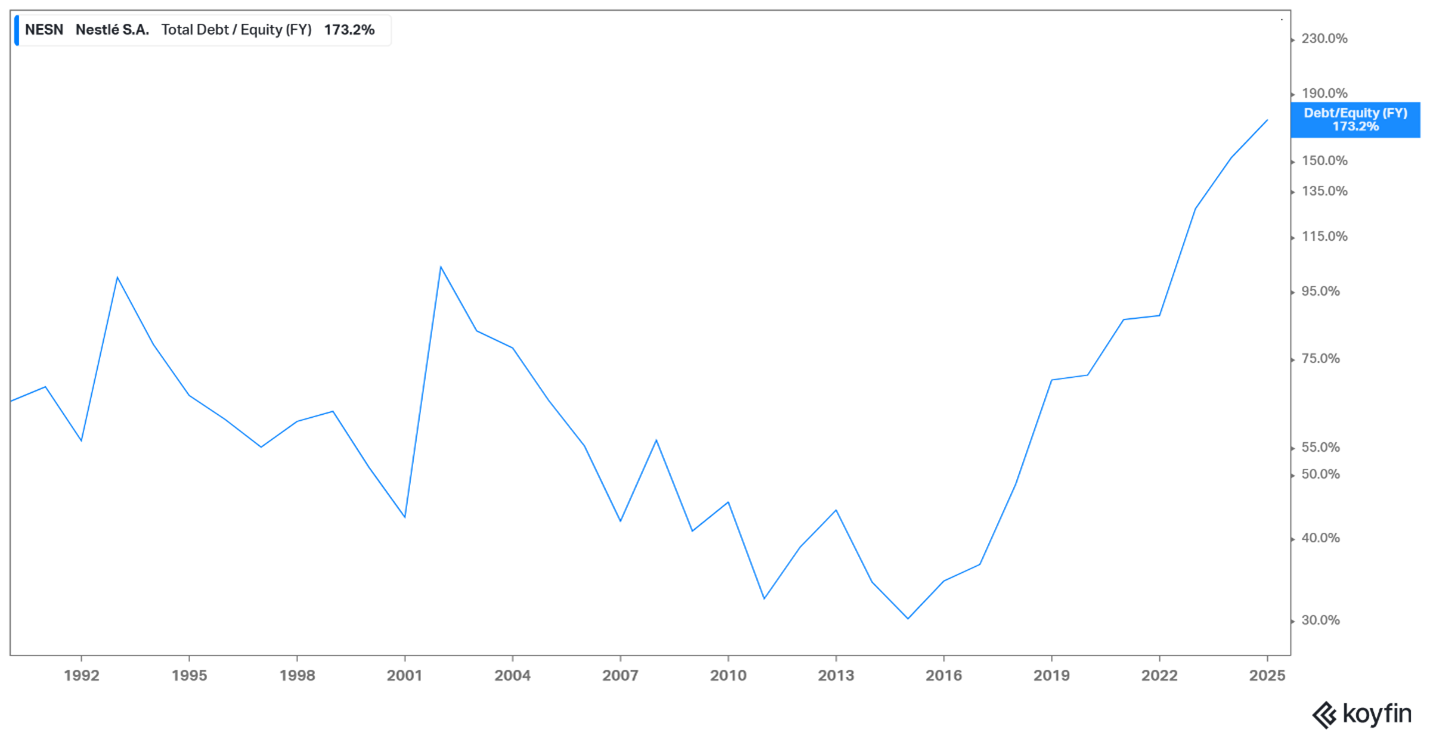
6. Low debt levels
The company maintains a financial leverage target range of 2–3 times net debt to EBITDA, which is considered prudent compared to its industry peers. Nestlé’s balance sheet quality has deteriorated though:
7. Valuation
Nestlé’s price-earnings ratio has derated over the past few years to the lowest level since the financial crisis:
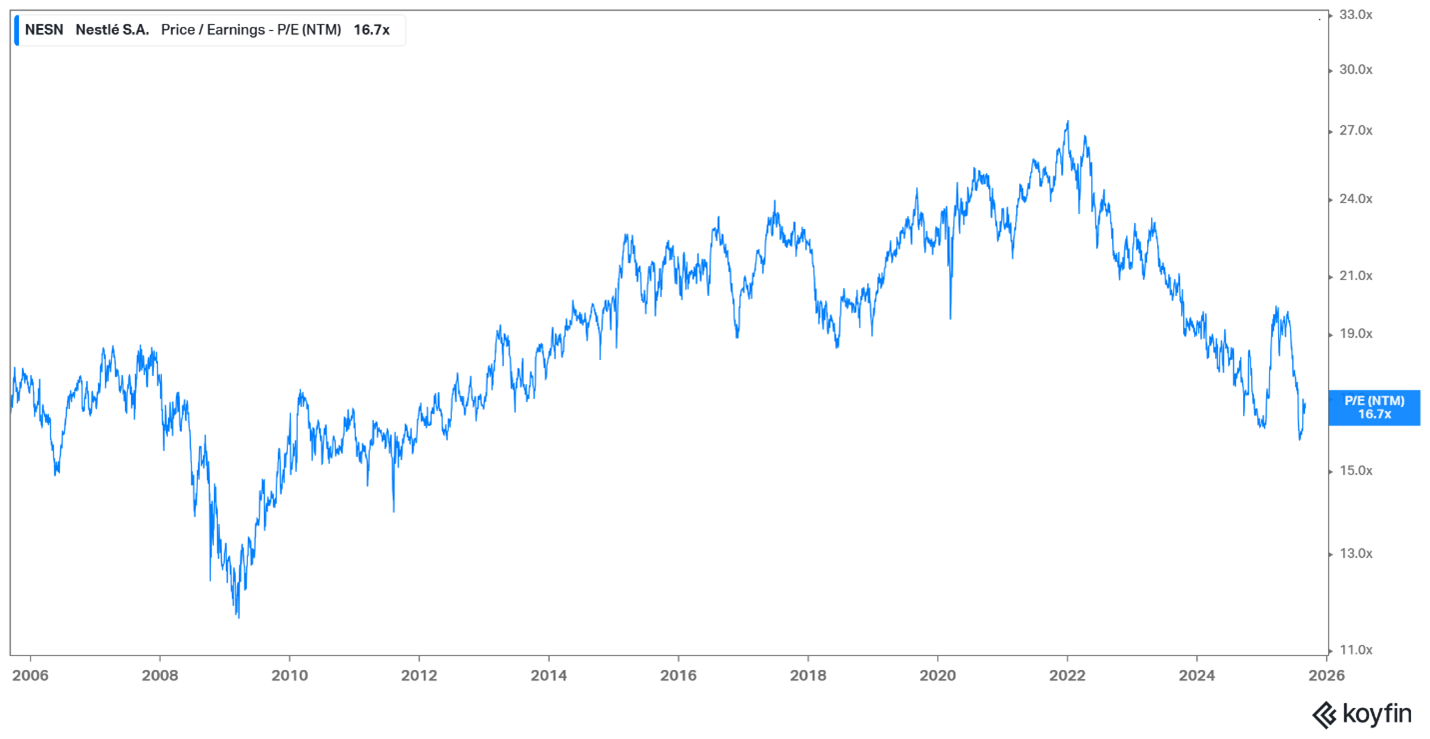
A P/E of 17 times – or an earnings yield of 6% for a company which should grow at rates at least in line with nominal global GDP – say 6% – strikes me as offering a reasonable prospective return.
My take: When good companies are priced reasonably, there is always a reason. The question is, is it a permanent or a temporary reason? In my view, Nestlé remains a high-quality business, albeit with some management challenges. To misquote Buffet: “When a great business meets lousy management, it is the reputation of the business that generally stays intact”.
Nestlé has historically traded at a 25% premium to the average stock in the world. Today it is at a discount. The odds are on your side.
Nestle remains in my 10 stocks forever.
2. The Exceptional USA
This week, I read two pieces which have brought the narrative of “US exceptionalism” into doubt. The first was by Ben Inker and John Pease of GMO, in their quarterly letter entitled “American Unexceptionalism”.
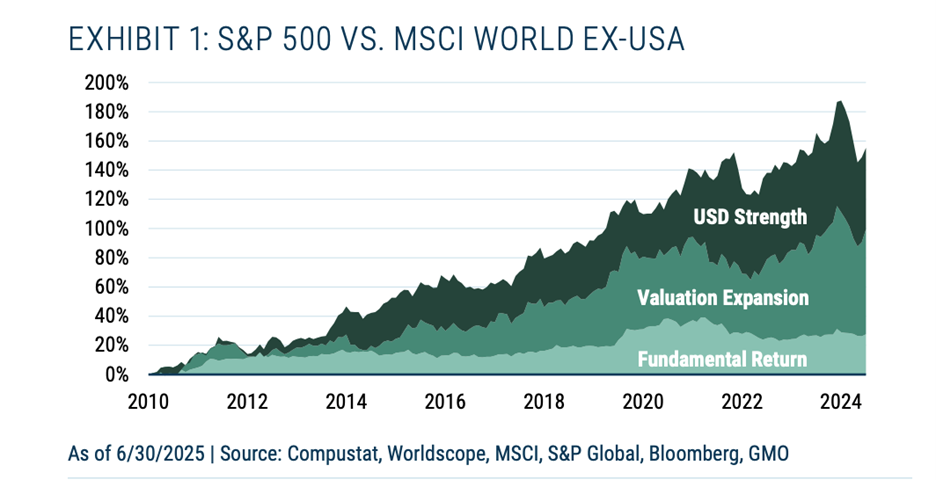
In it, they dissect the outperformance of the US equity market over the past 15 years into its component parts:
- The strong dollar
- Valuation (or multiple) expansion
- Fundamental outperformance (i.e. earnings, dividends and growth)
Their conclusion? The strong dollar and, secondly, multiple expansion drove the bulk of the exceptional performance. Most of the fundamental outperformance happened before 2015, and most of that outperformance was driven by a few giant companies.
Here’s a chart showing the breakdown:
Today, the key question is: Can the outperformance continue? Again, the outlook is not good. The dollar is overvalued and likely to face a long-term weakness. Additionally, the US faces a self-imposed trio of supply shocks: a negative labour supply shock, tariffs, and further policy uncertainty.
On top of that, GMO says international (i.e. non-US stocks) are on sale – with more attractively valued currencies and better growth prospects.
Yesterday, Ben Hunt of Epsilon Theory published a piece discussing the US political situation. It’s called “So What, Now What” – in it, Ben Hunt discusses the regime change happening in America – you know, the increasing socialist policies being implemented: increased taxation through tariffs, expropriation of equity stakes in private businesses (see Intel), the 15% tithe demanded from chip companies (see Nvidia sales to China), etc. etc.
Hunt says there are going to be more of these demands for direct public sector ownership and control of the private sector. I think he’s right – once you start down this path, you don’t suddenly stop and turn around. He calls this path the path to “The Great Ravine”, and illustrates it with this chilling question:

My take: Welcome to socialism with American characteristics. Whatever your current exposure to US assets is, it should probably be less.
3. Interest rates and inflation
Recep Tayyip Erdoğan, the strongman Turkish Prime Minister, has repeatedly and famously asserted that lower interest rates will lead to lower inflation, contradicting mainstream economic theory which holds that raising rates curbs inflation. He stated, “The lower interest rates, the lower the inflation will be,” and has described those who connect rate hikes with lower inflation as “traitors or illiterates.” This became central to monetary policy in Turkey in 2021. The outcome?
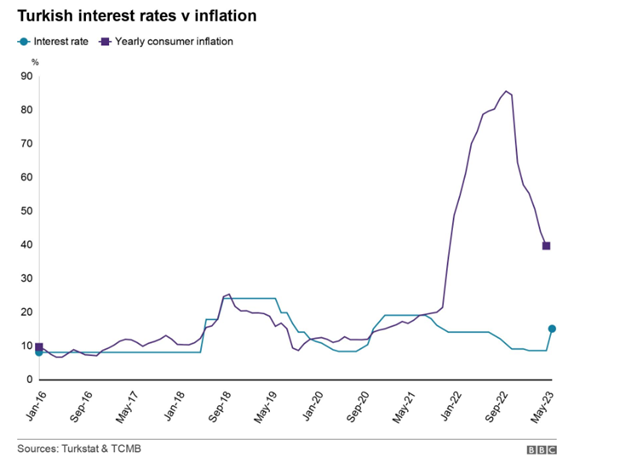
Much higher inflation, of course!
Fast forward to 9 August 2025, and Scott Bessant, US Secretary of the Treasury, said, “A big rate cut by the Fed would ultimately lower inflation, by producing a boom in home construction.”
I have questions: Did Erdogan and Bessant attend the same school of economics? Will the inflation experience in the USA resemble that in Turkey after Erdogan’s experiment? Is the USA today any different from the typical dictator-led emerging markets of the past 50 years? What is your allocation to US stocks?
My take: Welcome to socialism with American characteristics. Oh, wait, I think I’ve said that before.
In The Media
1. History
This is a conversation between Dominic Sandbrook and Konstantin Kisin about history and the importance of perspective. Sandbrook is a British historian, author, and broadcaster known for his vivid storytelling and in-depth examinations of modern British history. He co-hosts The Rest is History podcast with Tom Holland.
It’s a fascinating discussion, which you can watch here. The money quote? When Sandbrook says, “The lesson of history is that your neighbours will probably try to kill you and eat you, so make sure you kill them first”.
I’m sure he didn’t mean that literally, but rather as a reflection on the depths of depravity that normal human beings can sink to when given the right incentives – examples of which are common in history. We did observe some of that behaviour during the Covid panic.
2. Eddington
Which brings me directly to one of the better movies I have seen for a long time, a movie called Eddington. It’s about the conflict between a town sheriff and the mayor, set in the fictional small town of Eddington, during the Covid panic and the George Floyd protests.
It’s directed by Ari Aster and stars Joaquin Phoenix. Aster’s directorial style is well-known for blending horror, psychological drama, and dark comedy and is suited to capturing the chaos and polarisation of the Covid era. As the feud between the two main characters escalates, events spiral out of control, ultimately ending in death and destruction.
The movie highlights how social pressures can cause otherwise normal people to behave in ways that are very different from what one would typically expect. The slow-motion train wreck of events in Eddington underlines Sandborn’s pessimistic view of human nature.
You can watch a trailer of the movie here.
3. What’s going on in Korea?
Apart from Hyundai and Samsung, which are well-known brand names, how about this list of Korean cultural achievements:
- Gangnam Style – “Gangnam Style” by Psy was the first music video to reach a billion views.
- Baby Shark – has generated more than 16 billion views. No other video even comes close.
- Parasite – won the Academy Award for Best International Film. It also brought home the Oscar for Best Picture, beating out Martin Scorsese and Quentin Tarantino, among other Hollywood legends, in the process.
- Squid Game – has become Netflix’s most popular TV series.
- K-Pop – The more successful K-Pop artists generate 95% of their YouTube views outside of Korea.
- KPop Demon Hunters
- The #1 most-watched film ever on Netflix (~240m views)
- 4 of 6 most-streamed songs on Spotify
- First soundtrack with 4 songs on the Billboard Top 10
Through Samsung, Korea dominates the smartphone and television technology that people use to consume these cultural products. Korea somehow captures the entire value chain, producing everything from entertainment to devices.
The theory is that there is less cultural arrogance in Seoul than in almost any other capital city you will visit. A willingness to look outward, with an attitude of collaboration and cooperation, is unmatched in (for example) Tokyo or Beijing, not to mention Paris or Rome or London.
I don’t know – but I think a visit to Seoul must be on the cards. Also, here’s the Rand against the Korean Won:
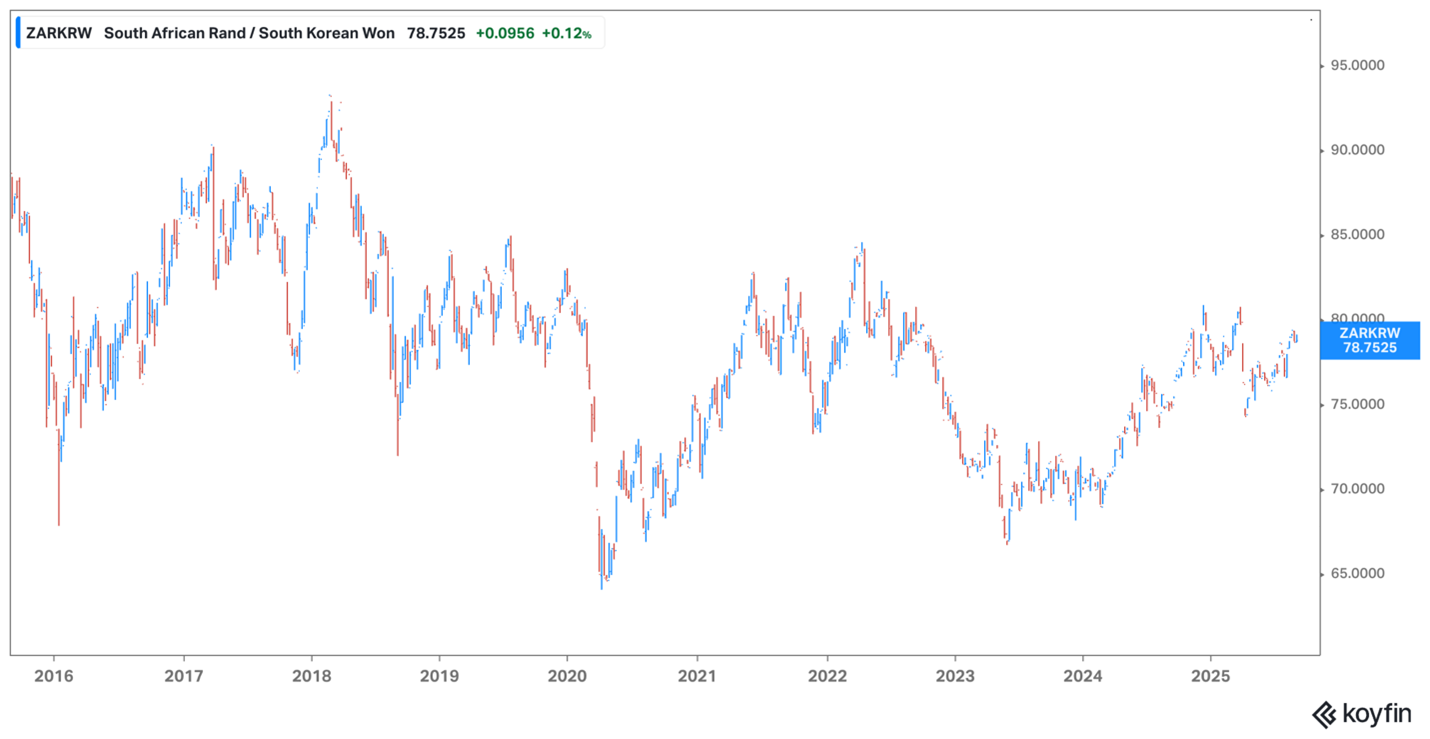
Pretty much unchanged over 10 years! Why go to expensive national socialistic USA or sclerotic Europe when you can go to cheap, vibrant Korea, Japan, or China? Maybe it’s also time to allocate more capital to those areas?
4. BizNews conference
I will be speaking at the BizNews Investment Conference next week. Alec Hogg hosts a good conference, and I am honoured that he has asked me to talk again. I have attended every previous one, and the content is always thought-provoking, relevant, and insightful. Even if I weren’t speaking at the conference, I would still attend. It is that good.
Here is this year’s line-up. If you can still obtain a ticket, I would recommend doing so.
5. Vasco
I am a member of a mountain bike club called Vasco, led by Colin Dix-Peek, a stand-up guy. The club’s main activity is to – every month – assign a segment where members measure their times. A mountain bike time trial, so to speak. These segments last around half an hour – about half an hour of intense effort. Egged on by his committee members, Colin never opts for the easy choice.
Tragically, one of our members, Mark “Big Zone” Pienaar, died last week, after being hit by a car.
Mark was always in and around the top of the leaderboard of these time trials, so I didn’t come across him very much. Whenever I did run into him, he was always super friendly – you could see he was one of the good guys!
This month’s time trial incorporates a trail he used regularly, and we are riding it in honour of him. I’m sure everyone will be going at least 10% harder in honour of Mark.
RIP Mark, the world is a much poorer place today without you around.
On a lighter note, our last chicken has flown the coop. Our oldest, Ben, moved out last week. Apparently, his girlfriend, Courtney, cooks better than his Momma. Or so Courtney says. I’m sure that’s why Amanda is so sad! So sad that she’s leaving for London today to visit the youngest, Zac.
The good news is our dining room table now has a bit of extra space.

Finally, it’s the second birthday of this letter. I wrote “The First Time is the Sweetest” on 31 August 2023, and since then, I’ve written 93 further letters. It’s fun to look back and see what I got wrong and what I got right. But the wrong ones are the more fun ones.
I can’t believe two years have passed since then. I guess it just goes to show how time flies when you’re having fun! I hope these letters bring you as much joy to read as they give me pleasure to write!
And remember to be careful out there.
Piet Viljoen
RECM