
Dear Fellow Investors and Friends,
Welcome to another edition of my newsletter, where I share my efforts to understand markets and the world around me.
I do appreciate you taking the time to read this. Feedback is welcome; it’s great to start conversations.
Today is Thursday, August 7th, the 219th day of the year. There are 146 days until the end of the year. In August 1899, 126 years ago, Henry Ford launched his first car manufacturing company, known as the Detroit Automobile Company. It failed within the year.
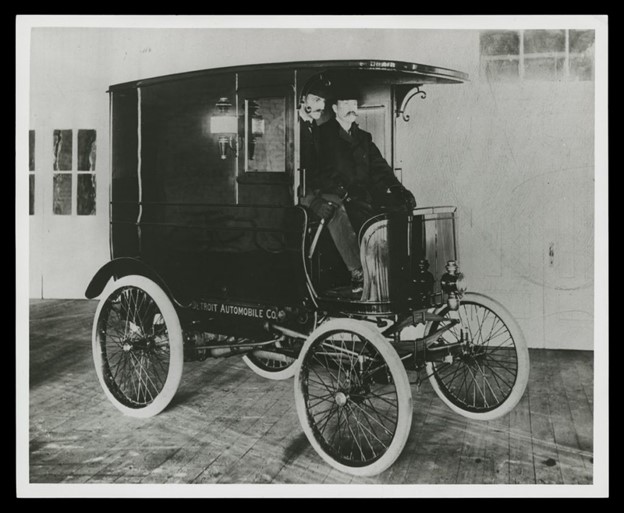
Cars have undergone significant changes since then. However, the industry dynamics have remained essentially unchanged. In honour of Henry Ford’s ubiquitous product, this whole issue of Regarding… is dedicated to cars.
First off, a personal cautionary tale:
I’ve been bullish on BYD (the stock) for a long time. Why? It’s simple – superior technology available at low price points. But I was late to the party. Charlie Munger first brought the world’s attention to BYD’s technological prowess. He drove Berkshire Hathaway’s purchase at HKD 8 per share in September 2008. It took me 15 years to get over my anti-Chinese bias, a bias most of us Westerners struggle with. Today, BYD trades at HKD 112.
But how can you be confident in an investment in a company if you haven’t actually tried out its products? You can read all the company analysis and product reports you like, but I believe the proof of the pudding is always in the eating. So, in April of this year, I took the plunge and walked into my local BYD dealer.
A local company called Mekor owns the dealership. I had seen their name around, and BYD wouldn’t just hand out the representation of their brand to just anyone, would they? My first impression upon entering the showroom was positive. I was met by a friendly salesperson named Christoff Garner, who seemed knowledgeable about the cars and was happy for me to test drive the specific car I had my eye on: a fully electric BYD Sea Lion. How can you not love a car with a name like that?
The car drove beautifully and was well-equipped – especially given its price point, which was around 60% of the price of an equivalently specced German SUV. I was worried about the after-sales service, however. But the salesperson did his best to allay my fears, and I decided to buy the car. That was towards the end of April, and I was told the specific car I wanted would be there by mid-May. I paid the deposit, happily awaiting the delivery of my BYD Sea Lion.
That’s where the problems started. By the middle of May, I was being told stories of delayed shipping and that my desired colour might not be available. Then, I was asked to pay the full amount before delivery. This was when alarm bells started ringing – alarm bells which I chose to ignore, duly paying the full amount with an EFT to a bank account in the name of Mekor.
Big mistake.
By early June, the car had not yet been delivered, and stories of problems with the licensing were being held out as an excuse. Frustrated by the poor service, I requested a refund. By June 18th, it had not been paid back, despite repeated promises. I was increasingly of the opinion that I had somehow been scammed.
Several phone calls to the Sales Manager, Danie Snyman, went unanswered, and my worst fears were being realised. I finally got hold of him three days later, at which time he confirmed that I had, indeed, been scammed by Garner. He had substituted his bank account number for Mekor’s, and the funds were gone. According to Snyman, so was Garner. Snyman also confirmed that several other of Mekor’s clients had also been scammed.
I guess this is where a “brand promise” comes in. I had been dealing with BYD/Mekor in good faith. If I had been dealing with a BMW or Mercedes dealership, my money would most likely have been returned immediately. But from Mekor/BYD, I didn’t even get as much as a “We are sorry and will try to help you get your money back” – just radio silence. When pushed, Snyman suggested I should pursue Garner in his personal capacity. But no other communication. The directors of the business were conspicuously absent.
Fortunately, my sister is a pretty good lawyer, so off I went to consult with her. The bad news was that the law was not much help in a case like this – if I sued Mekor, they could just drag it out interminably, which they were likely to do, given their behaviour to date. We sent them a letter requesting repayment of the stolen funds. Although their reply admitted that they were at least partially at fault, no money was forthcoming. Or any other form of reassurance or communication.
But my sister then came up with a good plan – to apply for their liquidation on the basis that they couldn’t pay me, which we duly did. Within 18 hours of filing, I received a call from Snyman to ask if we could meet to talk about it, which I refused to do at that point. Less than a day later, they offered to repay me. A week later, they had repaid my loss in full, plus a significant portion of my legal costs. It turns out the Afrikaans saying “Likwideer is die beste geweer” is true.
What’s even worse is that to this day, I still haven’t heard a word from any of the directors.
I’m absolutely gobsmacked that a business can be so oblivious to its brand value! Not only have they lost me as a client, but it has also cost them legal fees. If they had offered to repay me at the outset, or even better, provided me with the car I had paid for, their brand would have been strengthened. Right now, I would not buy a Chinese – or any other vehicle – from Mekor. If this is their attitude, when they are clearly in the wrong, who knows what they will do if a car they sell has a problem?
I am now eyeing a Xiaomi YU-7. However, I suppose I’ll have to wait until BYD, along with the other Chinese manufacturers, find more reliable distributors to represent their brands.
Moving on from this personal story about a car to stories about cars and the stock market.
Where better to start than with BYD?
In The Markets
1. BYD
US electric vehicle sales rose just 1.5% in the first six months of the year, according to Cox Automotive. But globally sales rose 28% to 9.1 million vehicles. In Europe, BYD has surpassed Tesla in sales.
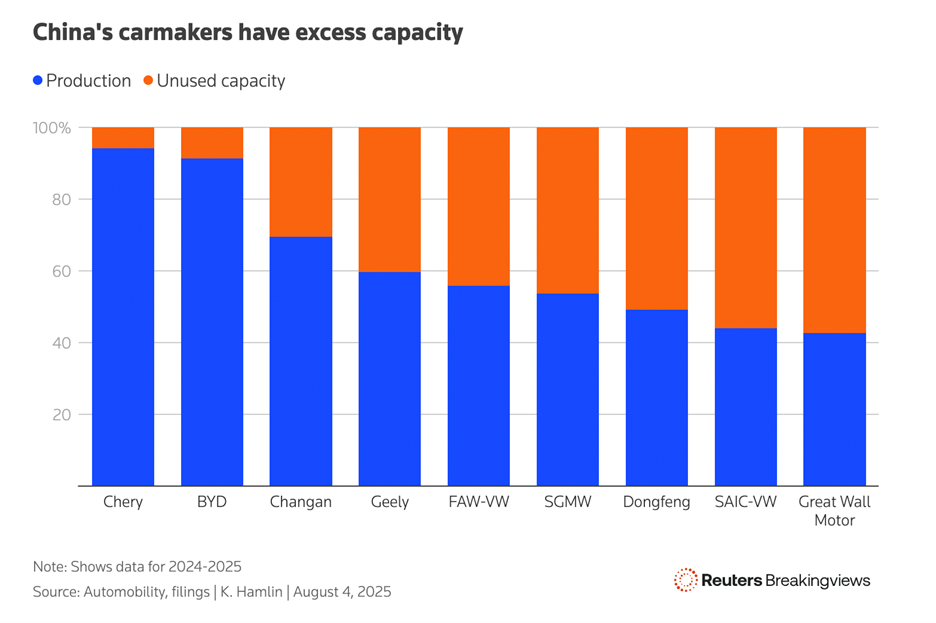
Just in time, because there is severe overcapacity in BYD – and all other Chinese motor vehicle manufacturers’ production facilities. This is the picture according to Reuters:
The American car industry in the early part of the 20th century produced a great new product – petrol-driven cars – and made it affordable and accessible to the public. At least 1,900 different car manufacturing companies were established in the United States, with over 3,000 distinct makes of automobiles produced during that period. Almost all the original 1,900 car makers either went bankrupt, were acquired, or exited the industry within a few decades. The big winner? The American car buyer.
Similarly, the Chinese auto manufacturers are producing a great new product (EVs) and making it affordable and accessible to the global car-buying public. I believe the Chinese auto industry faces a similar future to the one the American industry experienced a hundred years ago. Chinese policymakers have called for companies to cease “neijuan” – loosely translated, as a “rat race” – a race to the bottom. They might or might not listen – but any industry with so much overcapacity will inevitably face pricing pressure, consolidation, and bankruptcies.
My take: There will be a few winners, and BYD might be one of them. But the big winner will be the consumer, as we can already see happening here in South Africa.
2. CMH
This brings me to a well-managed South African small-cap, CMH. CMH is a leading integrated automotive group in South Africa, operating an extensive network of 115 vehicle showrooms across the country, which represent 26 different automobile brands – amongst which Haval and Chery, two of the leading Chinese auto brands in South Africa. CMH’s parts distribution unit, Mandarin Parts Distributors, has become the largest distributor of Chinese automotive parts in South Africa.
The news of the week was that South Africa’s domestic new-vehicle market surged in July, reaching its highest monthly sales since October 2019, with 51,383 units sold – a 15.6% year-on-year increase, marking the tenth consecutive month of growth. Passenger cars led the market with 36,248 units sold, the strongest performance since January 2017.
Undoubtedly good news for CMH. The share price? Crickets…
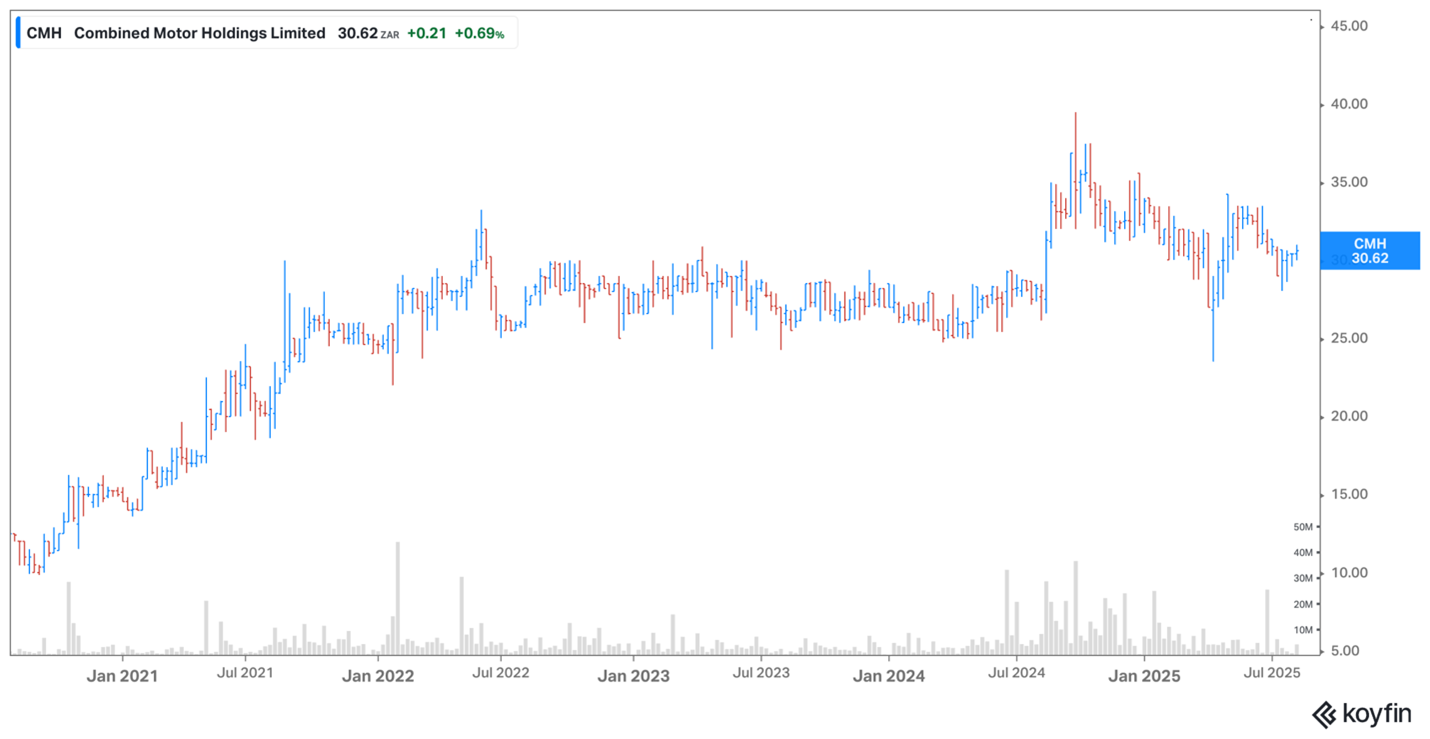
CMH has been going sideways for three years. Yes, management is old, and there are doubts about their succession plan. Yes, they have fewer Chinese brands than they might wish for. Yes, they are a small-cap. However, with a P/E of 7, an EV:EBITDA ratio of 3, and a dividend yield of 9%, all these problems and more seem to be reflected in the price. And none of the good news.
My take: CMH is emblematic of the neglect in the South African small-cap market. It should also ultimately benefit from developments in the Chinese auto market. Now, if it would only take over the BYD brand!
3. Renault
When I first started working, I bought a Renault. I traded my basic Toyota Corolla in for a Renault with all the bells and whistles. It turned out to be a well-appointed piece of crap. At one point, I had to hit the carburettor with the tire lever to get it to start, if it started at all.
So, I am not surprised that the Renault share price looks like this:
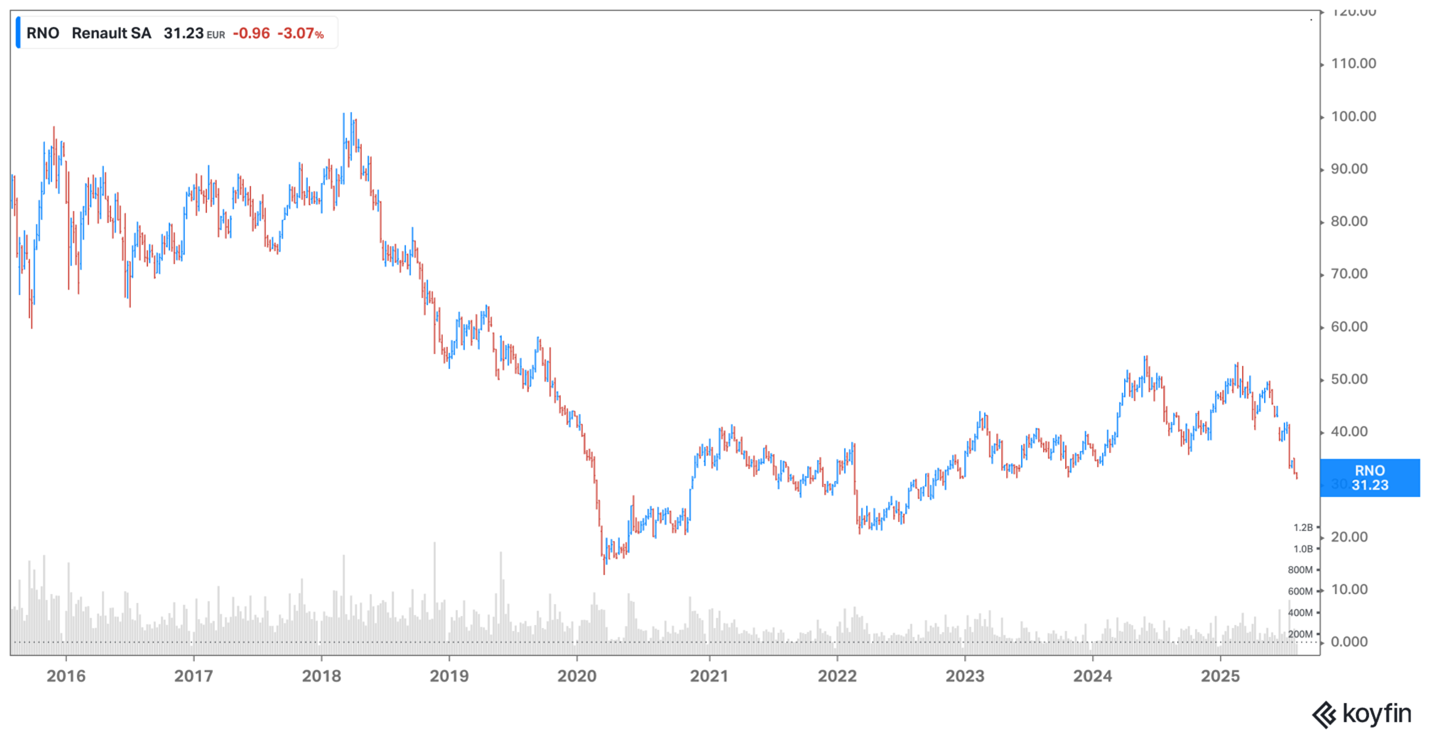
Inverse Nvidia, some would say.
But it is simply a reflection of the broader problem in the auto industry – China has better cars at lower prices. The share price charts of Stellantis (Chrysler, Fiat, Maserati, etc.), BMW, VW and Mercedes don’t look much different.
My take: Even for a dyed-in-the-wool value investor like myself, shares like Stellantis, with a P/E ratio under 5, are not particularly attractive, given the industry fundamentals.
4. Ferrari
Of course, for every rule there is an exception. In the auto industry, Ferrari is that exception. With Chinese automakers destroying everyone in the industry’s pricing power, Ferrari’s two-year waiting list provides it with a strong defence.
Ferrari also happens to be one of my “10 stocks, forever” As a reminder, this is my work in progress for building the equity component of the cockroach portfolio. I haven’t bought Ferrari yet, but the recent sell-off of luxury goods businesses might provide me with the opportunity to do so in due course:
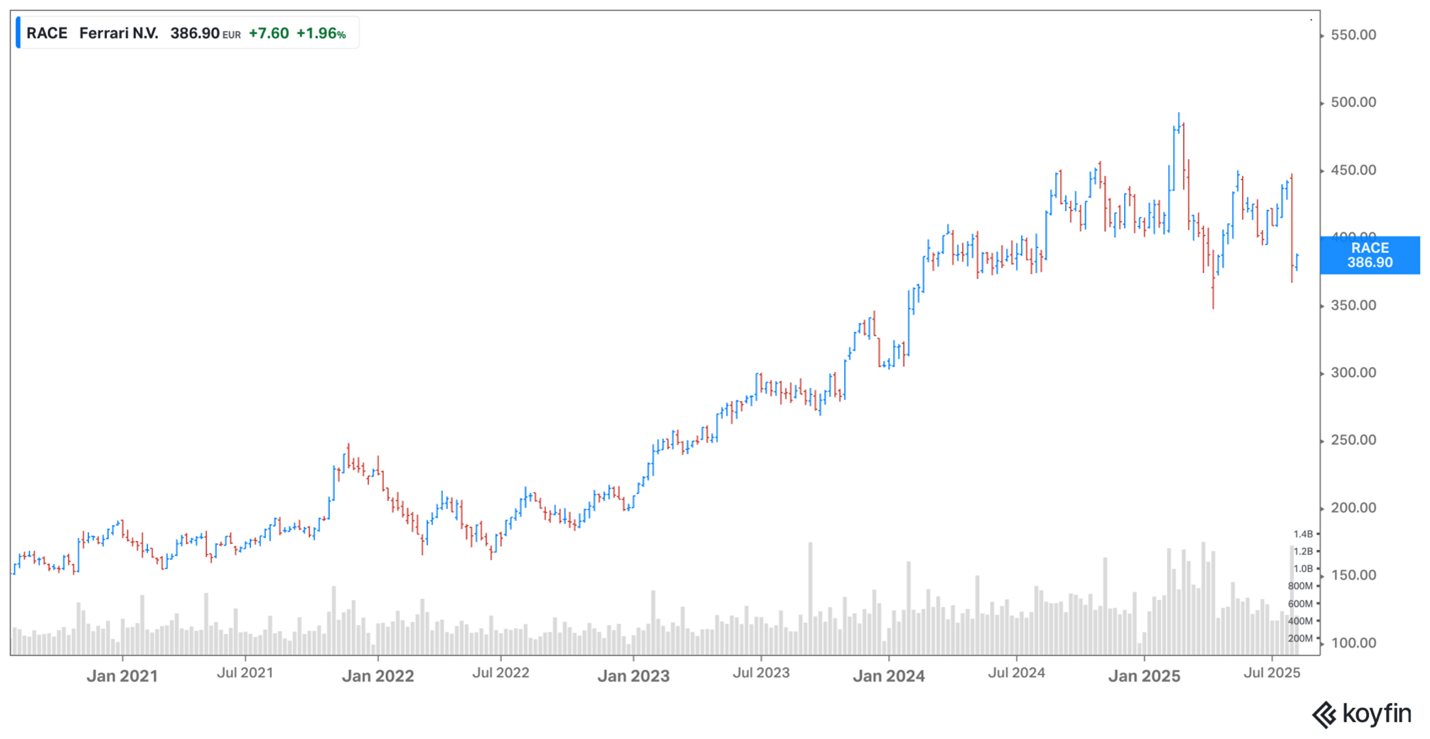
I wrote about my view on Ferrari – and other luxury goods companies – last year in May, titled “Veblen Goods”.
My take: Even after the recent sell-off, on an EV to sales of 10X, that’s still too rich for me. But we’re getting closer to a buying level – let’s hope for some more downside price action.
5. Carvana
Carvana operates the leading platform for buying and selling used cars in the US. It has accrued significant efficiencies from its nationwide scale, in addition to its proprietary technology. The company’s large-scale reconditioning capacity, fulfilment, and customer acquisition, as well as a high degree of automation, act as significant competitive advantages in a fragmented industry.
Sound familiar? In South Africa we have a company called WeBuyCars, which has a similar business model. The big difference is scale – in the USA, up to 40 million used cars trade annually. In South Africa, the number is 10% of that, or almost 4 million cars.
Carvana is probably the stock with the most significant turnaround in history:
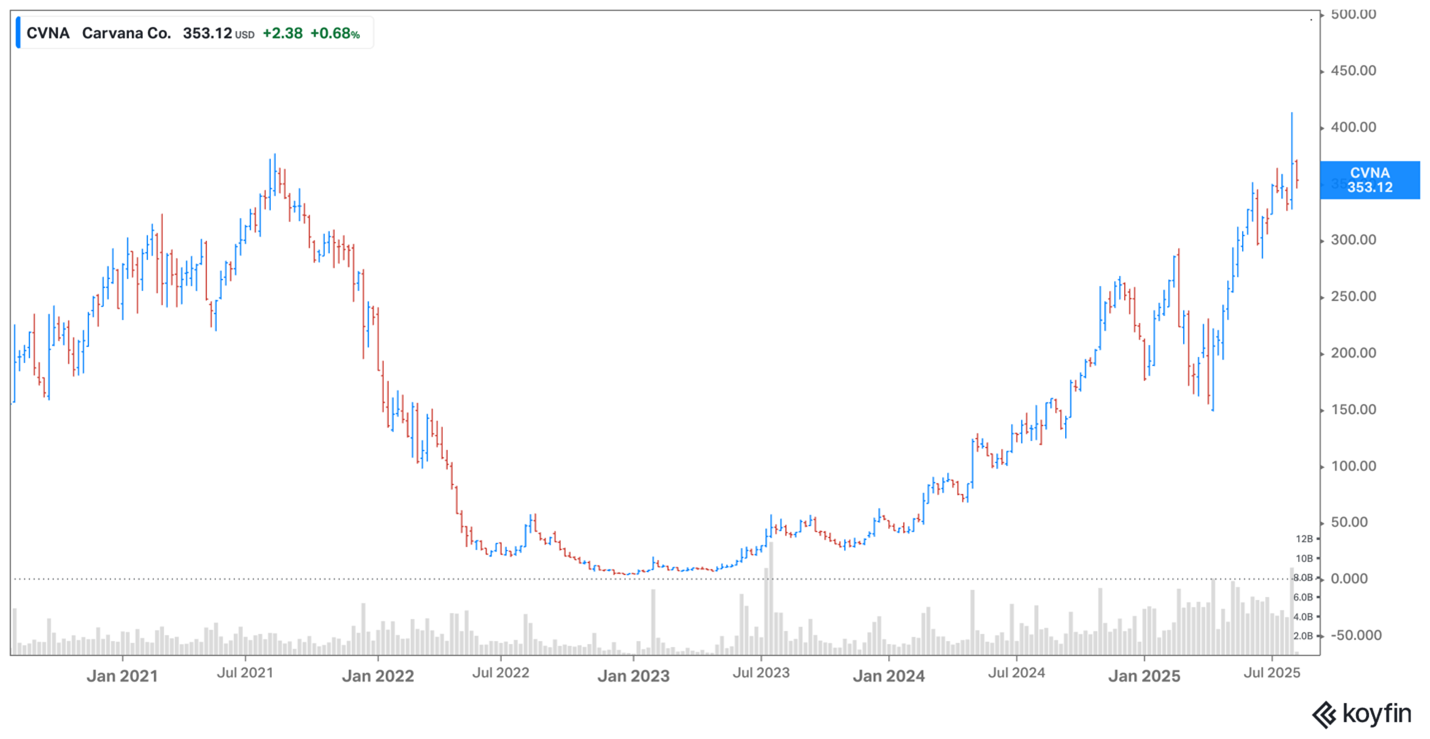
It lost 90% of its value in 2021/22, declining from $375 to a low of $3.75 per share over the course of 16 months. Since then, it is up by a factor of over 100, reaching a new all-time high of $404 per share last week.
What’s going on?
- The used car business is highly fragmented. Although a dominant player, Carvana only deals in 1% of the used car market. Therefore, they have considerable growth potential.
- The used car market can be cyclical – it largely depends on the consumer’s propensity to spend. Market analysts believed the tight market of 2022/23 would be the end of Carvana’s business model. Today, the same analysts say the expanding market means untrammelled growth as far as the eye can see. The truth is probably somewhere in the middle.
- Mobility is a top priority for consumers, resulting in a robust market for used cars.
- Finally, putting a used car dealer on a P/E of almost 100, no one can say the US markets’ speculative juices are not flowing. Sure, it’s growing nicely, but a hundred times earnings? Not for me.
My take: The used car market has many positive attributes. If you have management that can build a scalable business in this market, you can do very well. Carvana seems to have done that.
6. WeBuyCars (WBC)
The South African version of Carvana. A wonderful business built by two outstanding entrepreneurs: the Van Der Walt brothers. They sell around 200 thousand cars annually – still only a 5% market share. Another way to look at it is that WBC sells half the number of vehicles that Carvana does.
In terms of profit, Carvana generates $ 200 million, or roughly ZAR3.5 billion, while WBC earns an annual profit of ZAR1 billion. So, WeBuyCars generates almost 30% of Carvana’s profit, by selling the equivalent of 50% of its volume.
But that’s where the similarities end. The market values Carvana at $77bn. In ZAR terms, this equates to R1.4 trillion. That’s trillion with a tr! WeBuyCars, on the other hand, has a market value of R22 billion. WBC is valued at 1,7% of the value of Carvana.
Something is out of whack here, and I don’t think it’s WBC’s valuation. They might have a bigger market share than Carvana, and as a result, have a little less room for growth. However, the discrepancy in market values suggests that something else is at play here.
Not that WBC has done poorly – its share price has more than tripled since it listed 18 months ago:
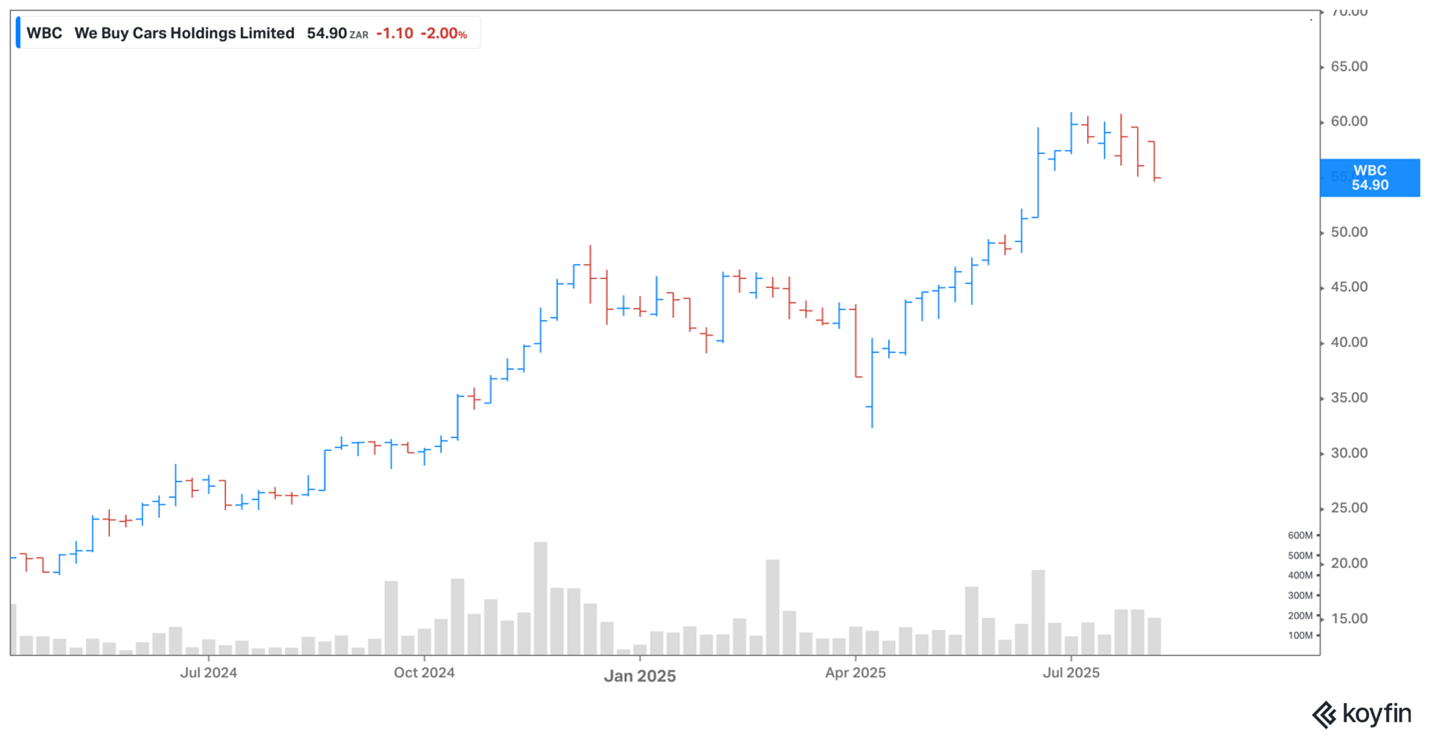
My take: Both Carvana and WBC have built good businesses. But the one is listed in a market where the speculative juices are flowing freely, and the other isn’t.
In The Media
1. Sake-Liga
Sake-Liga (full disclosure: I am on their board) won a critical case against BEE this week. BEE is effectively a tariff imposed by its own government on South African businesses – a government that then acts surprised when it finds out there is no appetite for investment, low economic growth and few new jobs. From their vantage point behind the high walls of their indecently acquired mansions, never having gotten their hands dirty doing a day’s honest work in the private sector, everything seems fine.
But it isn’t. And Sake-Liga’s win is the thin edge of the wedge of civil society fighting back against our wilfully ignorant, corrupt and incompetent government.
You can read more about the win here. And here is a video of executive director Russ Lamberti explaining South Africa’s new race-based hiring quota, which we are fighting so hard against.
My take: Organisations that represent civil society, such as Sake-Liga, OUTA, and others, deserve your full support.
2. National Women’s Day
On Saturday, it is National Women’s Day in South Africa. A day in which we celebrate and honour the women in our lives. The origins of the day lie in the 1956 march of 20,000 women to the Union Buildings to protest the oppressive pass laws – a brave action in a time when the government didn’t take kindly to any kind of insurrection.
Maybe we can arrange a march against our oppressive BEE laws at some point?
In the meantime, I thought I would highlight my favourite female guitarists. Rock music is generally associated with male lead guitarists, full of swaggering, hip-thrusting bravado. But the female of the species brings something different to the instrument, something I’ve always appreciated.
Here are 6 of my favourite female guitarists, playing songs, I love to listen to. All of these artists had a significant influence on the rock music scene. So, in honour of Women’s Day, here goes:
- Sister Rosetta Tharpe: Didn’t it rain, children
- Joni Mitchell: Big Yellow Taxi
- Patti Smith: Horses
- Liz Phair: Supernova
- Kristin Hersh: The Thin Man
- St Vincent (Annie Clark): Lithium
That’s it for this week – I need to get to the beach, as one does here in Mauritius.
But whether you are sitting next to a fire in Cape Town, on a beach in Mauritius or wherever – please remember to be careful out there!
Piet Viljoen
RECM