
Dear Fellow Investors and Friends,
Welcome to another edition of my newsletter, where I share my efforts to understand markets and the world around me.
I do appreciate you taking the time to read this. Feedback is welcome; it’s great to start conversations.
Today is Thursday, July 10th, the 191st day of the year. There are 174 days until the end of the year. Seeing it’s holiday season here on the southern tip, when family time becomes even more critical than usual, I’ve decided to keep this week’s letter short – purely selfishly, of course!
> “Writing is nature’s way of telling us how lousy our thinking is.”
> – Leslie Lamport
I am a compulsive writer. Whenever I want to figure something out, I write about it, preferably in a public setting. Public writing creates a valuable feedback loop which can improve your understanding of a topic. But it does come with problems:
- When you write about an investment idea in public, it becomes more challenging to change your mind when circumstances change that might invalidate your original thesis.
- “Giving away” ideas could weaken one’s position in the competitive world of fund management.
- Publishing investment ideas could also be seen as a form of “front running”, or inducing others to follow your lead, thereby strengthening your position.
Despite these drawbacks, I believe writing in public is beneficial. To understand why, let’s analyse the job of an investment professional.
One way to describe the job of an investment professional is that of an information funnel. Information enters at the top of the funnel, gets processed, and a workable framework of factors that influence the market emerges at the bottom.
This “top-down” approach receives considerable attention, as it addresses topics that most people believe they have some knowledge about, such as economic growth, currencies, inflation rates, and interest rates. Everyone has an opinion on these matters, and market publications devote considerable space to them. But the investment professional needs to have more than an opinion. She needs to form an integrated view on the direction of travel of these factors, the interaction between them, and their resultant influence on the market price for different assets.
It’s not easy, and it comes wrapped in an expansive sheath of unknown unknowns.
But that’s just the first step. The second part of the investment professionals’ job is to survey the actual price of assets and build a framework which extracts the expectations embedded in these prices.
This “bottom-up” approach is far less common, as it entails examining factors such as revenue, margins, ROIC, capital expenditures, free cash flows, enterprise values, and the competitive dynamics within and between different industries. These are topics that cause the eyes of most people to glaze over, so they get much less attention and almost no space in market publications. However, the investment professional must devote considerable time to considering them, as they influence the pricing of assets such as equities or bonds.
But as they say, there’s many a slip between the cup and the lip. At any given point, emotions play a significant role in asset pricing, such that even the most sophisticated models can produce results with almost no resemblance to real-world pricing.
This brings us to the third step of the investment professional’s job: mapping the bottom-up view to the top-down view.
Do asset prices accurately reflect “the way the world works” according to the constructed framework, or are there opportunities to make money by having a differentiated view? In other words, are mispricings available?
The big money is made here – if you’re right.
However, when one considers the integration of all three steps, it becomes clear how uncertainty can play a significant role in the investment analysis profession. It’s almost impossible to have a firm view on anything.
Asset pricing is like being a person with poor eyesight; everything seems blurry and out of focus. The job of the analyst is like that of an optometrist – fitting lenses that reduce blurring with each iteration. A good analysis is like the best lens; it brings the picture sharply into focus.
For me, writing about investing – mainly focusing on the psychology behind it, but also analysing specific ideas in public – is like trying on those new lenses. It clarifies ideas, and gradually the world becomes more understandable. Some doubt dissipates, and residual areas of uncertainty become better defined.
But one must accept that you will never have 20/20 vision; there are just too many uncertainties out there.
This is why the criticism levelled at writing in public doesn’t amount to much.
With investment decisions, you never really know that you’re right until well after the fact. With this understanding, “giving away” or “front-running” ideas becomes an impossible proposition. Importantly, writing’s main job is to serve as a powerful tool to highlight potential areas of uncertainty. Hopefully, this should put one in a position to more easily change one’s mind when new facts emerge, rather than cementing them in place.
So, I will continue to write about my ideas – good, bad and indifferent. The icing on the cake is that with your feedback, these ideas evolve into much better versions of themselves over time.
For that, thank you!
In The Markets
1. It’s a bull market
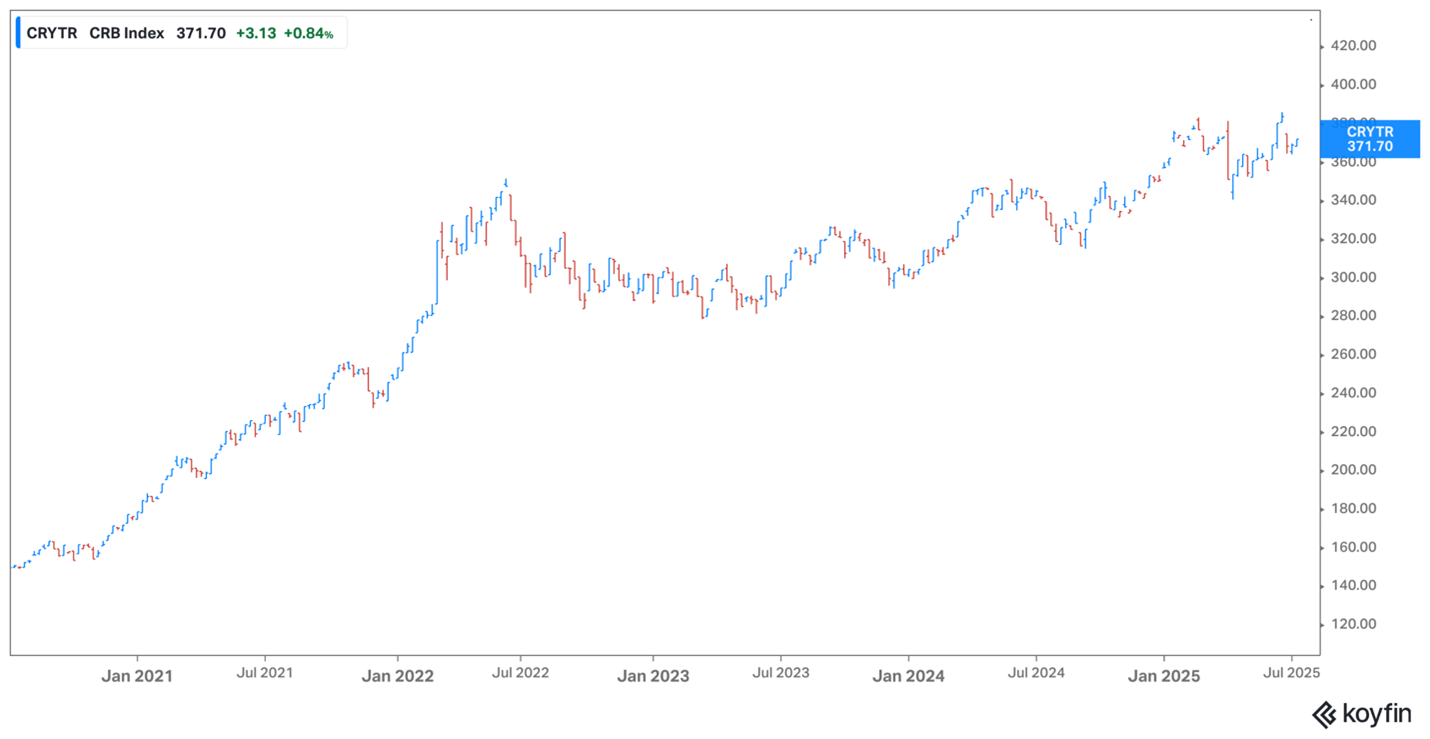
Markets worldwide are reaching a succession of new highs. Equity markets, such as South Africa’s JSE, the S&P 500 from the USA, the UK’s FTSE 100, and the German DAX, have all hit new all-time highs over the last week. However, it’s not just equities – Bitcoin reached a new all-time high yesterday, and commodity markets are also surging ahead. Here is a chart of the CRB index, a broad gauge of commodity prices:
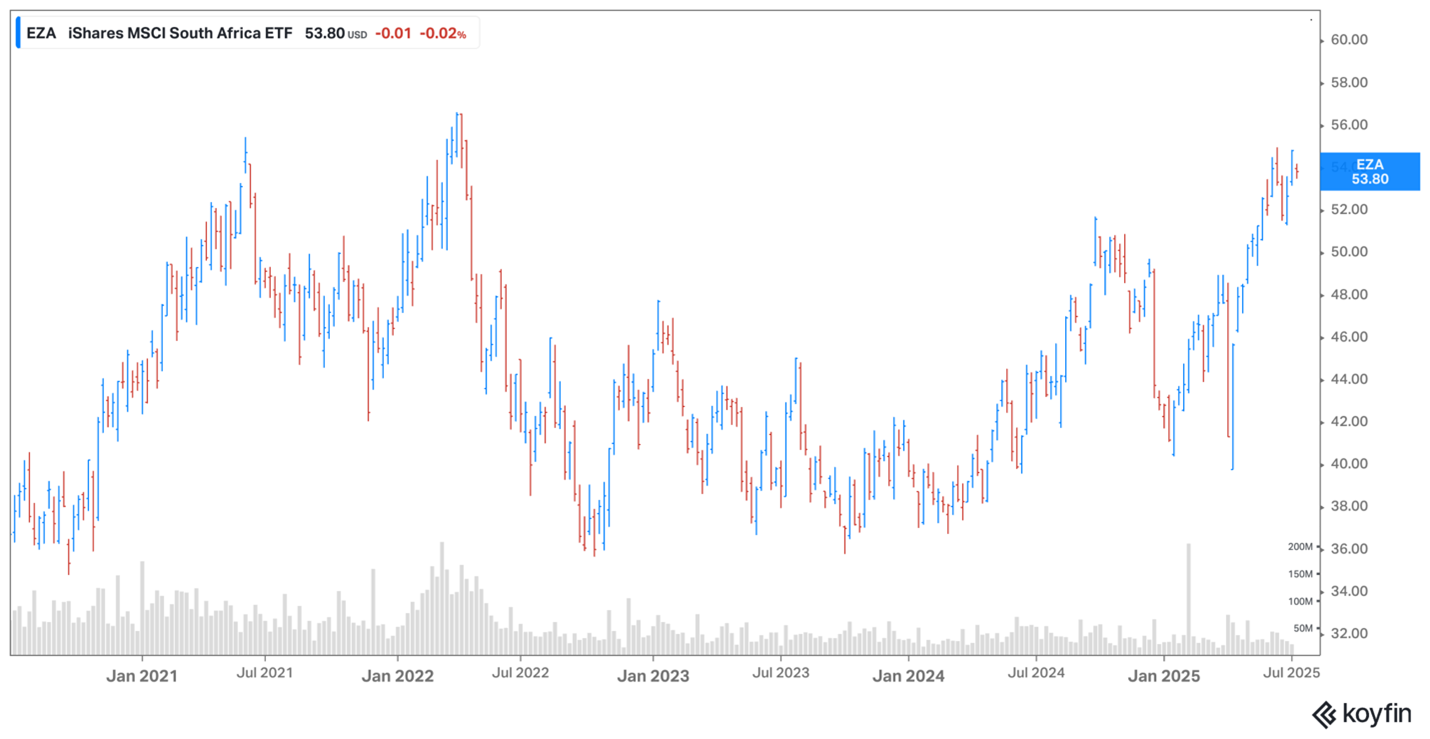
Even here in South Africa, where all of us are so perennially and unwaveringly negative on everything to do with our country (except for rugby, cricket and increasingly, football), the market is close to hitting new all-time highs in US$ terms:
And in Rand terms, we are flying:
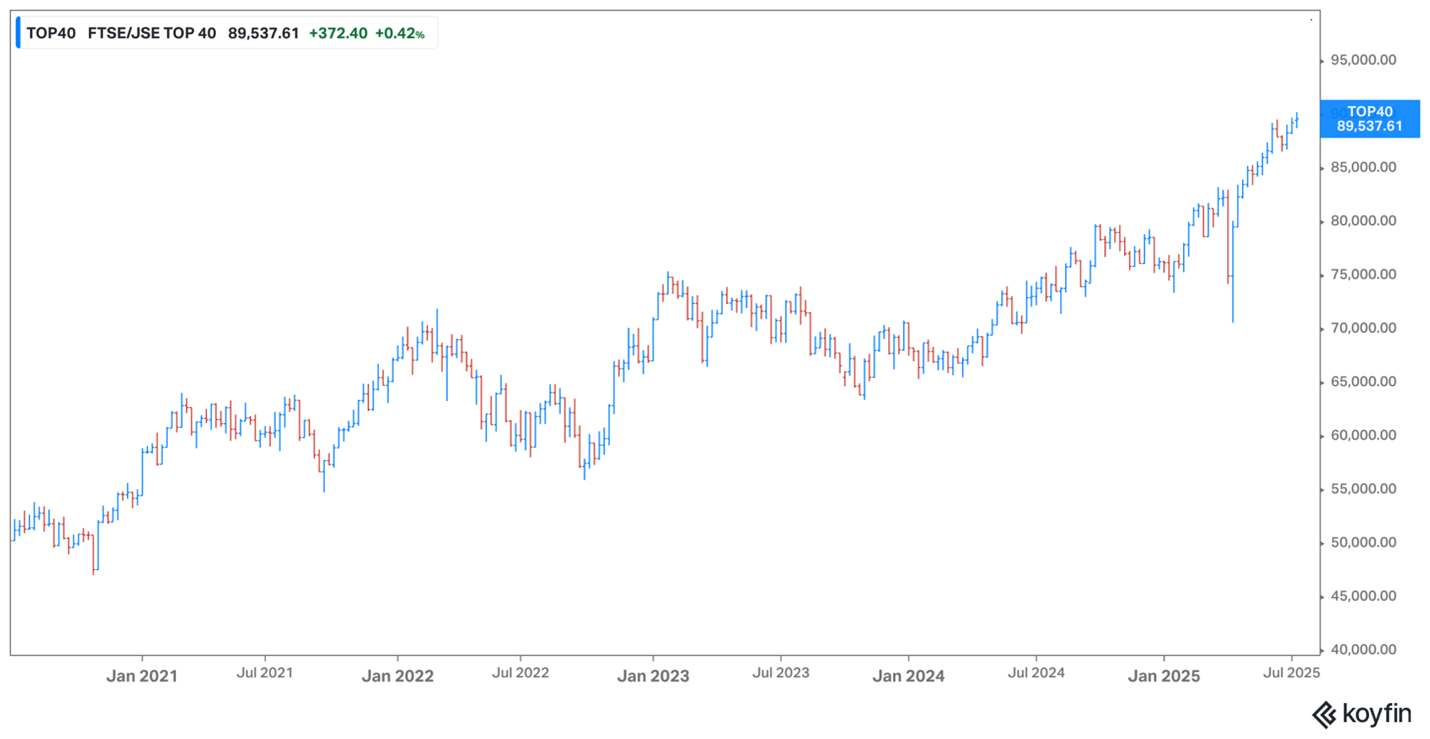
So, the next time your neighbour comes around with their negativity, just show them these charts. Also, if they tell you that Trump’s tariffs, our crooked politicians and useless police force are reasons to avoid any local investment at all, ask them to go home and think again.
Imagine a country surrounded by much bigger ones whose stated ambition is to eradicate that country’s inhabitants from the face of the earth. This is their stock market:
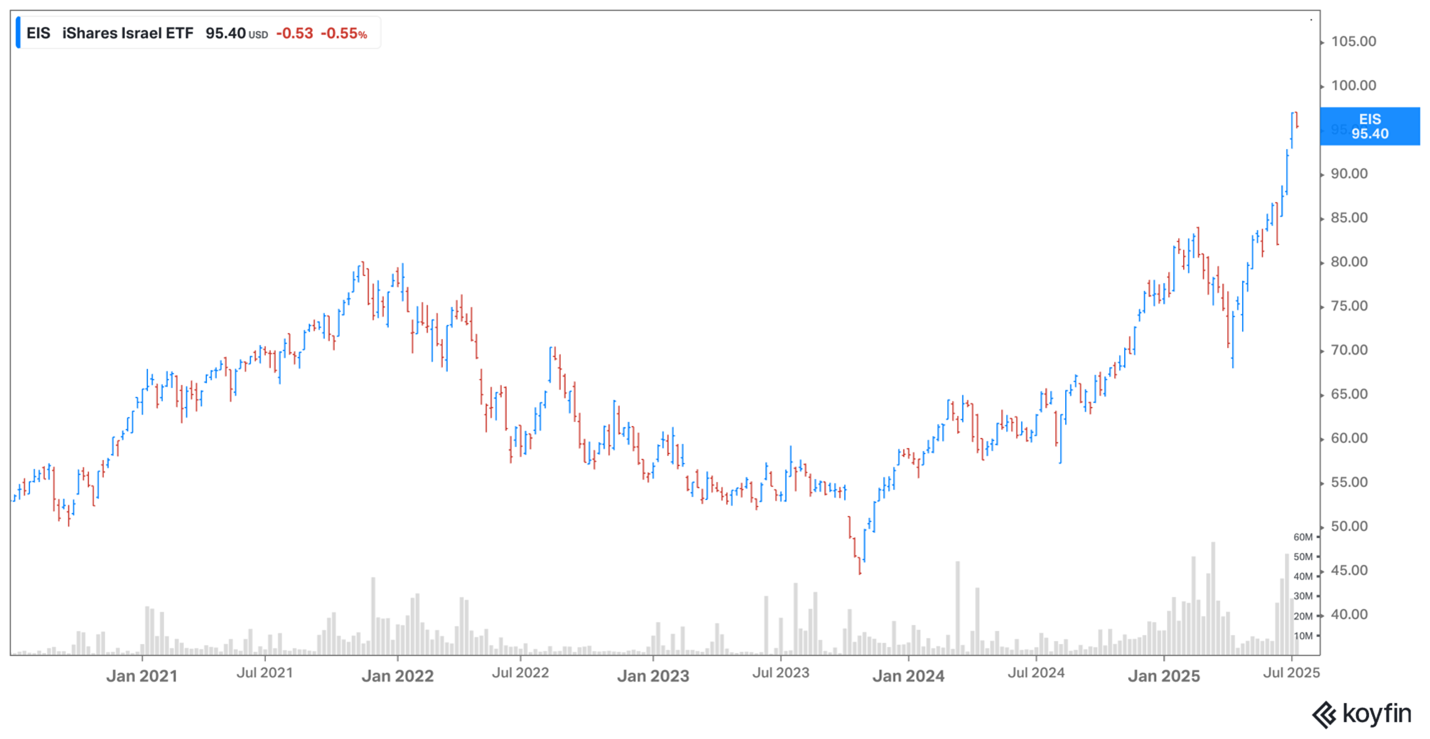
Yes, Israel’s stock market is also screaming higher.
My take: If this isn’t a global bull market in risk assets, I don’t know what it is. Given the expectation of continued money printing in the West, this price action could persist indefinitely. However, be aware – a significant portion of this is due to money illusion.
2. Russian Ruble
Speaking of places where you can be negative, how about Russia? Facing deep financial, trade and political sanctions, embroiled in a protracted war, you would think their currency would tank. At least if you’re a South African, you would think so!
Here is the Ruble against the US$:
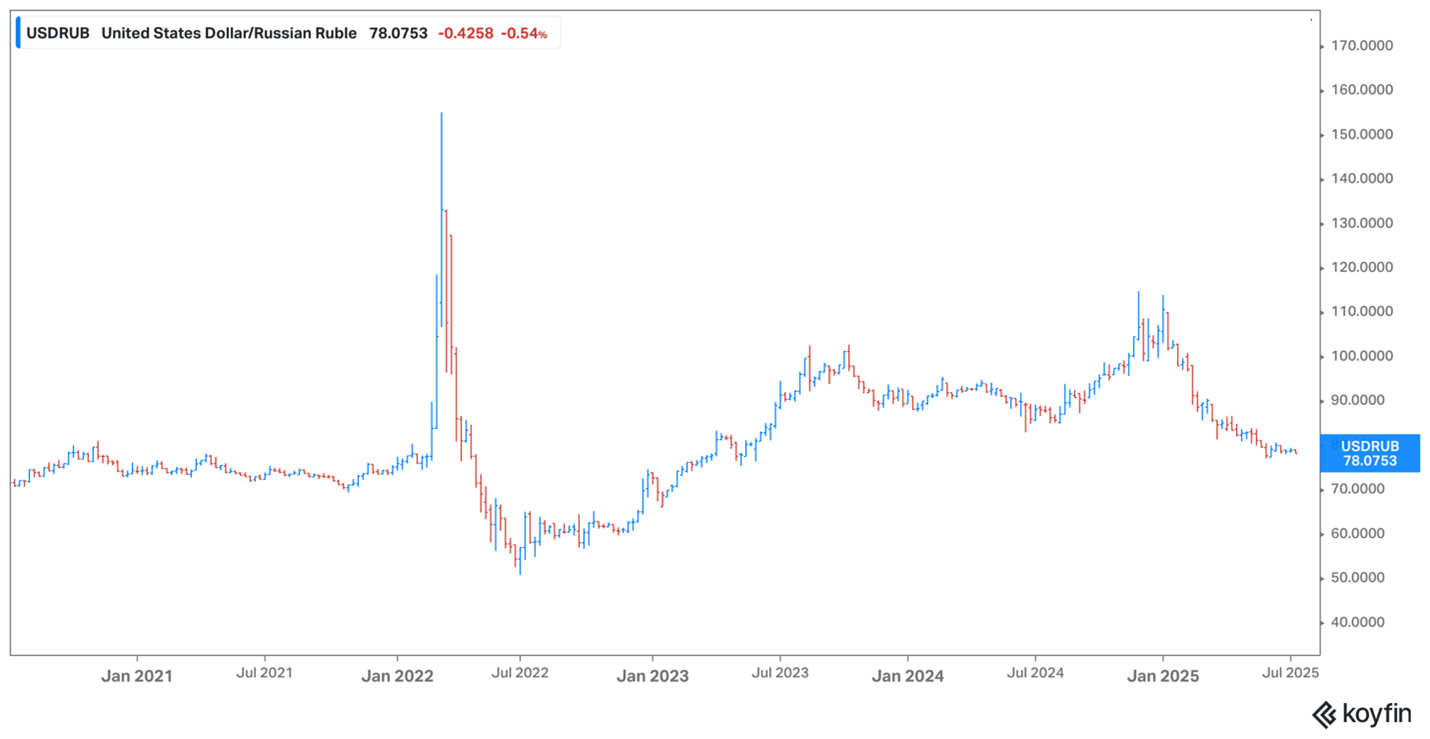
Since the start of 2025, it has appreciated by 30% against the US$, leaving it roughly unchanged from its levels just before the outbreak of hostilities with Ukraine and the imposition of sanctions. Who would have thunk?
My take: Russia has 99 problems, but its currency ain’t one. We have some problems here in SA, but we tend to believe our currency should be a lot weaker than economic fundamentals would suggest. We are hyper-aware of all the negatives in our own country, but when you look at other places with similar or worse problems, we tend to discount them. It’s a special type of Gell-Mann amnesia.
3. Beagle
Our BEE investment company, Beagle, recently released its annual results for the year to March 2025. It had an uncharacteristically poor year, gaining 4.1% against the JSE All Share Total Return Index’s gain of 20.4%. However, its long-term record remains intact. Beagle’s NAV per share has compounded at 25.8% annually over the last 15 years, against the ALSI’s 8.1% p.a.
This is what it looks like if you assume that you had invested R100 in each of Beagle and the JSE All Share Total Return Index in March 2010:
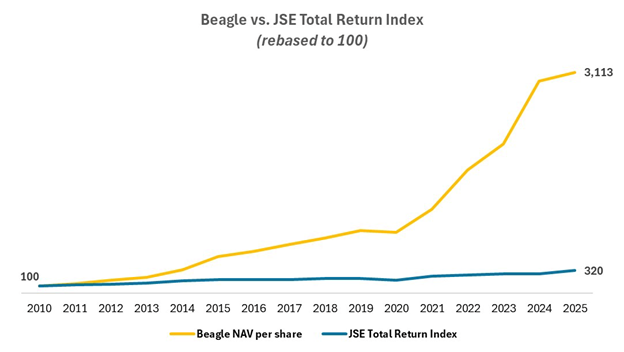
There are two points to make here.
The first is that BEE acts as a tax on investment in the economy, and it is one of the main reasons our economy performs so poorly. It destroys jobs and benefits only a few elites, not the broader masses. At RECM, we are firmly opposed to this policy and believe that everyone in the country would be better off if the government abandoned it.
Secondly, the elite who benefit from receiving free or very cheap shares in enterprises become rich without lifting a finger, seldom contributing to the nurturing and building of those businesses. They do not properly value their equity in companies and tend to sell the shares to obtain cash as quickly as possible. However, BEE shares must be sold to black people, so the pool of buyers is limited, resulting in BEE shares consistently trading at a significant discount to their underlying value.
This is where Beagle comes in. Beagle acts as a responsible BEE shareholder. It is well-capitalised, so it can buy undervalued BEE shares when they become available. Hence, the outstanding return it has generated over a long period.
One of the most significant shareholders in Beagle is the RECM Foundation, which supports the Centre for Early Childhood Development. As a result of Beagles’ good performance, the Foundation has grown to a respectable size. It has been able to fund or partly fund the development of several daycare centres in some of the poorest areas of the country.
Finally, although black shareholders predominantly own Beagle, it also offers the white friends and family of RECM an opportunity to take advantage of this structural mispricing in the South African financial market.
You can read Beagles’ annual letter to shareholders here.
My take: I serve on the board of Sake-Liga, whose mission is to improve the business environment in South Africa. Getting rid of the BEE regulation would be a massive win for the business community, white and black. At Sake-Liga, we are pushing back hard. Sake-Liga and NEASA recently lodged a legal challenge against BEE. However, while BEE exists, RECM will capitalise on the investment opportunities it presents.
In The Media
1. Nick Cave on the fragility of life
As you might know, I am a firm believer in the Stoic philosophy. One of the tenets of this philosophy is “Memento Mori” – Latin for “remember you must die,” which serves as a reminder of the inevitability of death and the transitory nature of life. This is not to induce despair, but to invoke gratitude, presence and urgency in how we live.
It is for these reasons that this New Yorker interview with Nick Cave resonated with me. As you might know, Cave has lost two sons to death, so he knows all about grief and the shortness of life. He tells how he developed The Red Hand Files – interactions with his fans – to deal with his grief.
He has an interesting position on religion, loss and “creativity”.
> “…at the very least, doubt is the antidote to dogma and fanaticism and reductionism. This position – and this is not just a religious point of view; I would say, personally at least, this is where I sit on most things – is a place of uncertainty. This uncertainty or unknowing, which I equate with creativity, comes from an understanding of loss. We understand that life is not stable or dependable. This doubt feeds into everything I feel spiritually. I try to approach these matters with humility and uncertainty, and not to be dogmatic. That’s my problem with militant atheists: their lack of humility. But, in the end, I don’t think atheism is the real problem. The atheist’s point of view is weirdly sustained through the imagination of other people and their beliefs. Demoralised indifference to spiritual matters is the problem.”
My take: When Cave says, “that’s right – certitude and indifference – they’re the problems with this world”, I couldn’t agree more.
2. Plato’s Cave for Music
On his blog, “Hot Takes”, Adam Singer recently wrote an interesting piece, entitled “Most People’s Musical Taste is Stuck”.
In it, he shared this graphic from the New York Times, showing when people’s musical tastes were cemented:
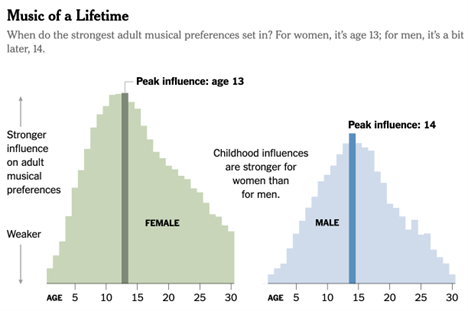
This also correlates with which decade you will choose your “best decade for music”. Singer makes the point that most of us are stuck in an arrested state of creative development. He goes on to say that in the internet age, still listening to popular music is like still getting all your news from CNN or never venturing out of the frozen food section at the grocery store. There is just so much more around!
And with the rise of corporate-driven algorithms choosing your music for you, people seem to be stuck in a Plato’s cave of music:
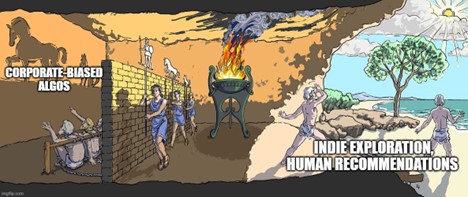
My take: Music is a personal choice, but there’s so much good stuff out there that it’s almost a crime not to try to explore the world beyond the self-imposed boundaries of the algorithm. That’s why I religiously listen to new music and build playlists of the best stuff out there, sharing them with you. And why, after a lifetime of resisting it, I am increasingly listening to jazz.
Finally, a report back on last weekend’s proceedings:
1. Nick and Daneel ran their first-ever half marathon at The Knysna Oyster Festival and put 15 minutes into me. Here we are at the start:

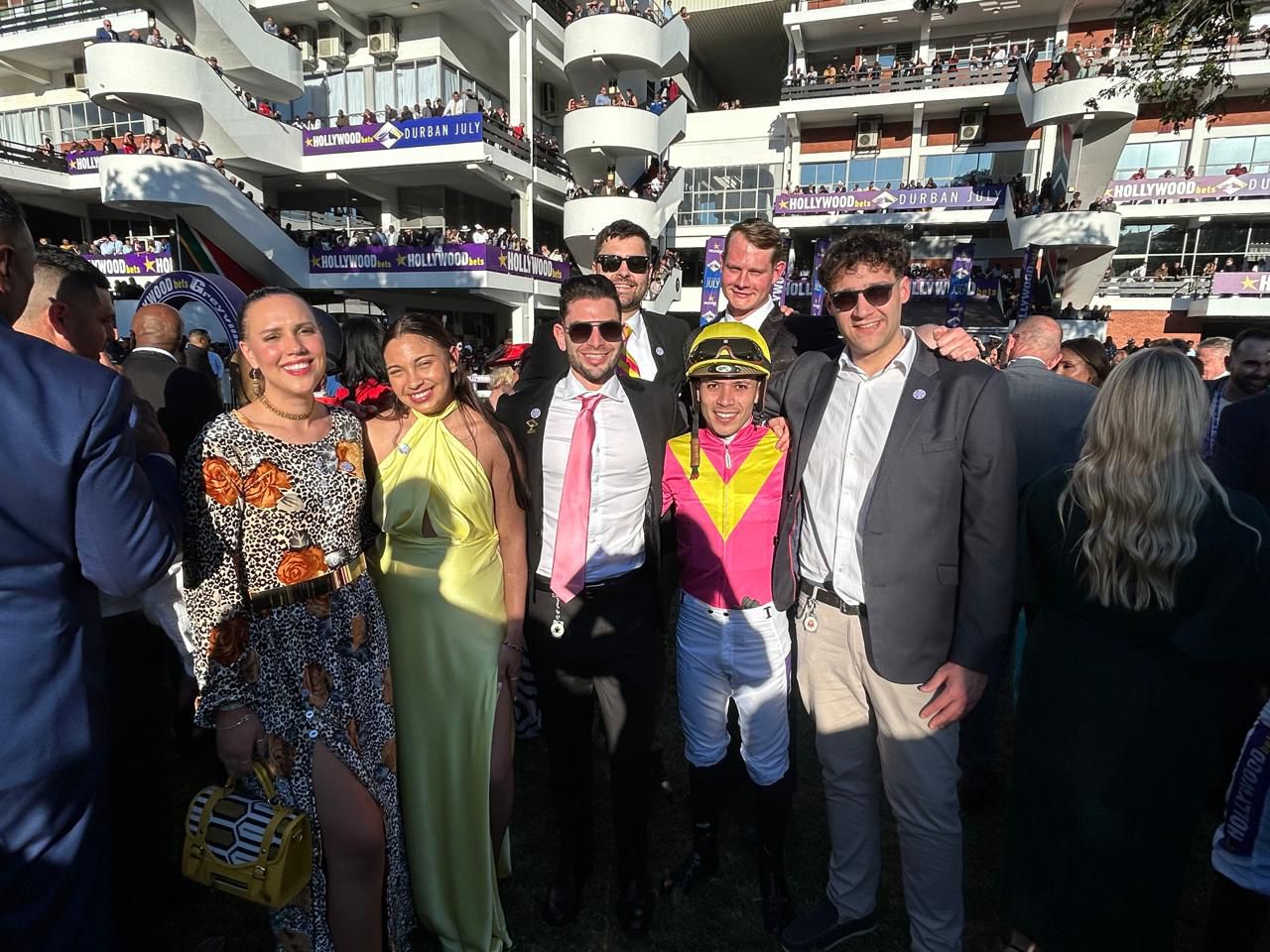
2. The Yuppie Syndicate, led by my stepson Zac, had a runner in the Durban July. I think it’s still running, though. But they had a lot of fun at Greyville on the day. Here’s a picture of some of the syndicate members and their jockey (Zac’s the cool-looking dude in the middle, and yes, ladies, he’s still single):
3. My other stepson, Ben, and his girlfriend, Courtney, are in Thailand on their first-ever overseas holiday with no parental supervision. Here they are in a romantic moment in Bangkok, after having just directed traffic or something:

In short, all the kids are having a good time. Therefore, so am I.
But still remembering to be careful out there.
Piet Viljoen
RECM