
Dear Fellow Investors and Friends
I'm Piet Viljoen, and today is Thursday, the 1st of February, the 32nd day of the year. A total of 334 days remain until the end of the year. Remember, this month has an extra day. On this day in 1991 - only 33 years ago, FW De Klerk promised to repeal the Apartheid laws. This was a huge positive change and a lot has changed since then. But change is a constant; the human species is very good at dealing with it and moving forward. I would never short the human spirit, and the ingenuity which results from its strength.
If you’re new here, welcome! And welcome to everyone else, of course. I do appreciate you taking the time to read this.
Quote of the day
"The first stone is decisive because it is the most difficult to throw...because it is the only one without a model."
René Girard
Yesterday, my stepson Zac left for London, where he will be doing his accounting articles. His departure leaves a massive hole in our lives, and especially in his mother’s. Being Jewish, my wife Amanda tends towards anxiousness, so change like this is hard. I am sure Zac is also somewhat anxious about this next phase of his life.
But Zac has a long-term goal, and this is a necessary step towards that goal. Getting to a long-term goal means that you must make short-term compromises. If life merely consisted of a series of easy short-term choices, free of moral or existential weight, it would quickly lose all meaning, as Milan Kundera described so brilliantly in his book "The Unbearable Lightness of Being".
I was reminded of this once again last Sunday when I was out for a run. But first, I need to give you some background.
About a year ago, I changed my training program. Before, I used to push myself during each session. Easy sessions were few and far between. And despite that, I felt like I wasn't getting any better. Plus, I was tired most of the time, and always carrying niggling injuries.
Then I read Peter Attia's book, Outlive (you can read my review of it in Regarding Vol 2 No 1). In the book, he identifies two main requirements for longevity - strength and cardiovascular fitness. In terms of fitness, he emphasised that most training should be done in heart rate zones 1 and 2. By way of explanation, zone 1 is where you can still have an easy conversation, zone 2 is where you can still string sentences together, while in the top zone, zone 5, you aren't able to get a word out because you're breathing so hard.
But it was hard to change my training habits. For someone with even a small amount of competitive instinct, riding up Suikers (my local hill) with everyone passing you does not come easily. Slowing your running pace down to a gentle jog, where some of the faster walkers are passing you, does not come easily. I was used to hard training sessions, but this was even harder!
However, my goal now was not to do well in the next race, but to be a participant in what Attia terms the centenarian decathlon. This is truly a long-term goal, as my centenarian decade is 30 years away. According to Attia (and others I follow on X, such as Howard Luks and Paddy Barret), lots of training in zones 1 and 2 is one of the key building blocks to achieve optimum cardiovascular fitness.
So, given my long-term goal, it was easy to figure out what my process had to be - mostly going for easy runs and rides, gradually building up the amount of time spent doing so. Then, intersperse them with the odd high-intensity session.
The equation is simple:
Process X Time = Success.
In training, as in life, you need to stick to your process over a long period of time to achieve success. Avoid those things that hinder your process or reduce the amount of time you can apply it.
So, back to my Sunday run. I was cruising along comfortably in zone 2. Around halfway, I noticed that if I sped up, I could come close to my previous best time over that distance. So, my competitive gene kicked in, and I upped the pace. But I immediately noticed my heart rate had jumped to zone 4. In terms of my long-term goal, this was not good. So, against my natural instincts, I slowed down.
You know what? When I finished the run, despite not coming close to beating my previous best, I felt great.
I felt great because I had taken one step closer to my long-term goal.
Yesterday, Zac took one (hard) step into the unknown but one step closer to his long-term goal.
And despite missing him already, I am overjoyed for him.
“New highs are bullish”
1. Netflix
Last week, in Regarding...Vol 2 No 3 I discussed the streaming wars. It seems the elephant in the fight is Netflix. Over the years, they have built a dominant content library and an easy-to-use user interface. Together, this creates somewhat of a moat.
Here's a new word for you: Anthimeria. Anthimeria is "the use of a word in a new grammatical form, usually using a noun as a verb". That should come in useful in your next Scrabble game. More importantly, when a brand starts being used as a Verb or a Noun, you know it has reached escape velocity. We still "Hoover" the floor, the "Kreepy" always cleans the pool, we "Google" for information...and come the weekend, it's "Netflix and chill" time.
As a result, WDB, Disney and many other smaller competitors are struggling to create value in the DTC video industry. Due to the competitive environment (read: a strong Netflix), Warner Brothers Discovery stock price has declined approximately -70%, while Disney has declined by -60% from its peak.
Remember what we all used to do during lockdown? Well, when we went back to work, Netflix suffered for a while. But, as you can see from the chart, Netflix is back up to its pre-pandemic levels.
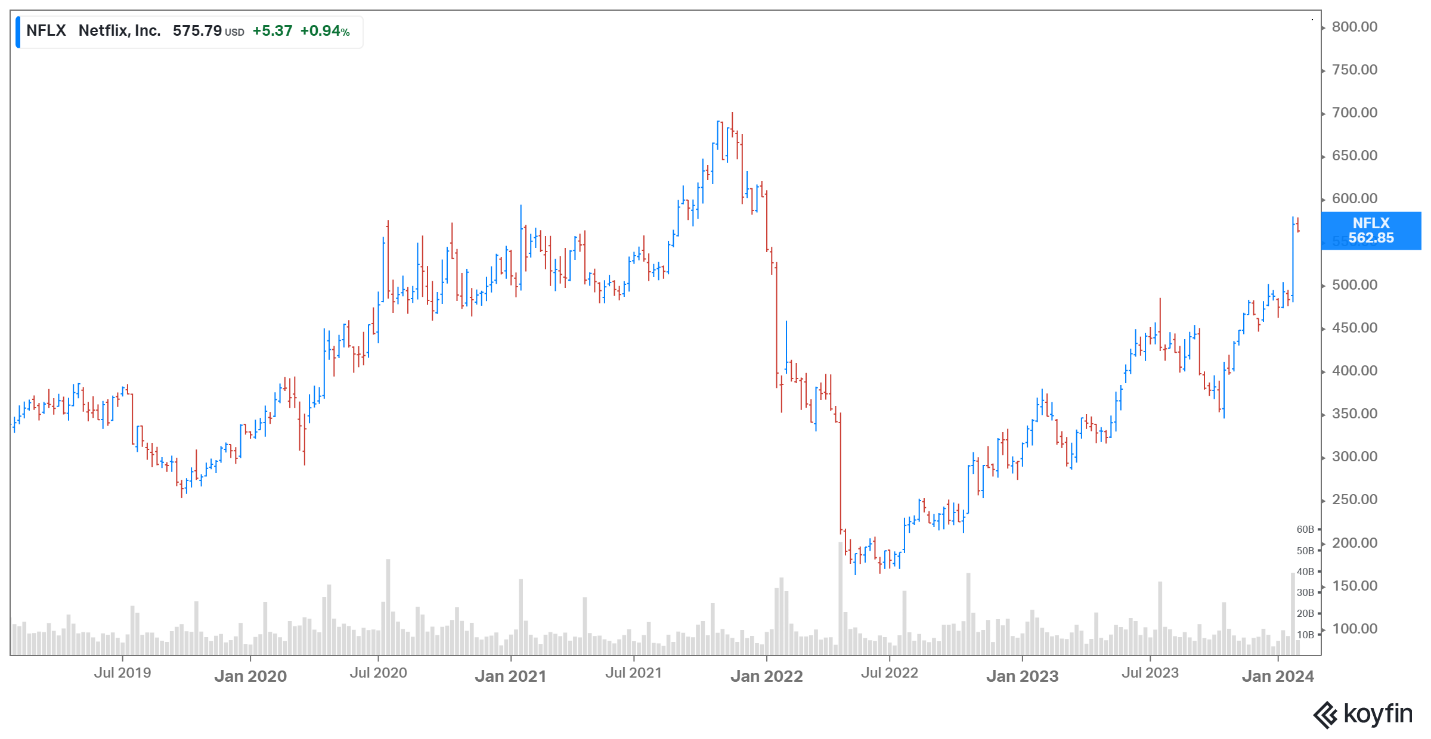
Mark Narramore posted this interesting chart on X. It shows the free cash flow yield per subscriber of Netflix (the light bar):
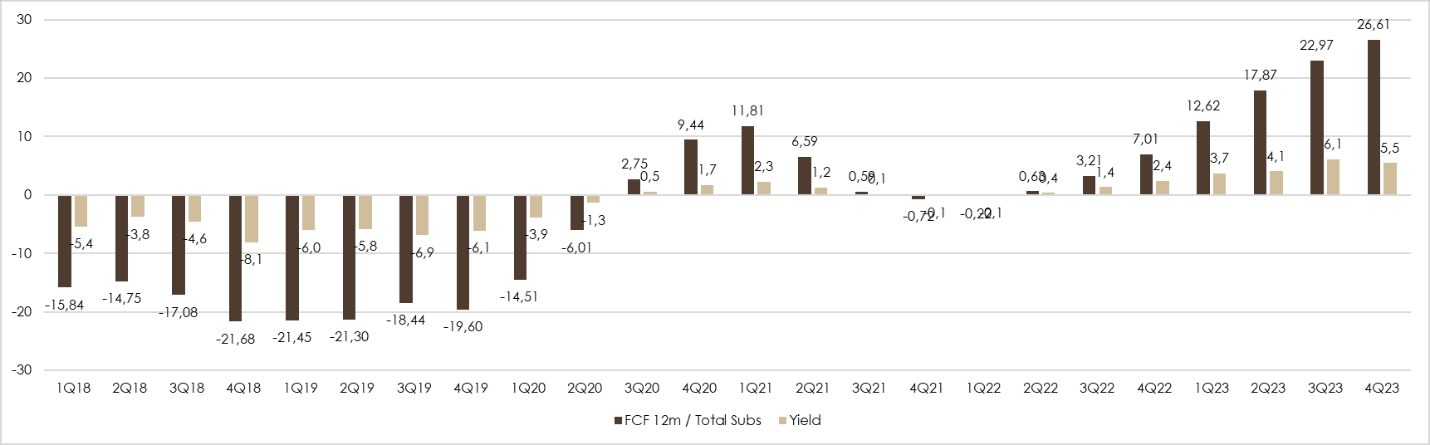
My take: There are likely to be a handful of key global subscription services, while most other media companies will probably find better economics in licensing to them rather than building their own platforms. The dominant platforms should have great economics. Netflix's destination seems to be that it will be one of the platform winners. I'm just not sure a 5,5% FCF yield is the right price given the (continued) risks involved in getting to that destination. Although tempted, I don't own it.... yet?
2. ITA - the iShares U.S. Aerospace and Defense ETF
Things are not well in the world:
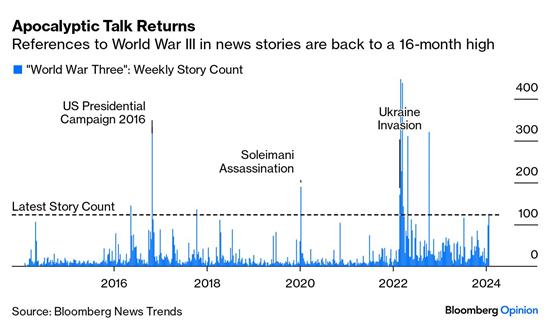
And this is reflected in the share prices of defense-related stocks, as reflected in this ETF, which reached a new high recently:
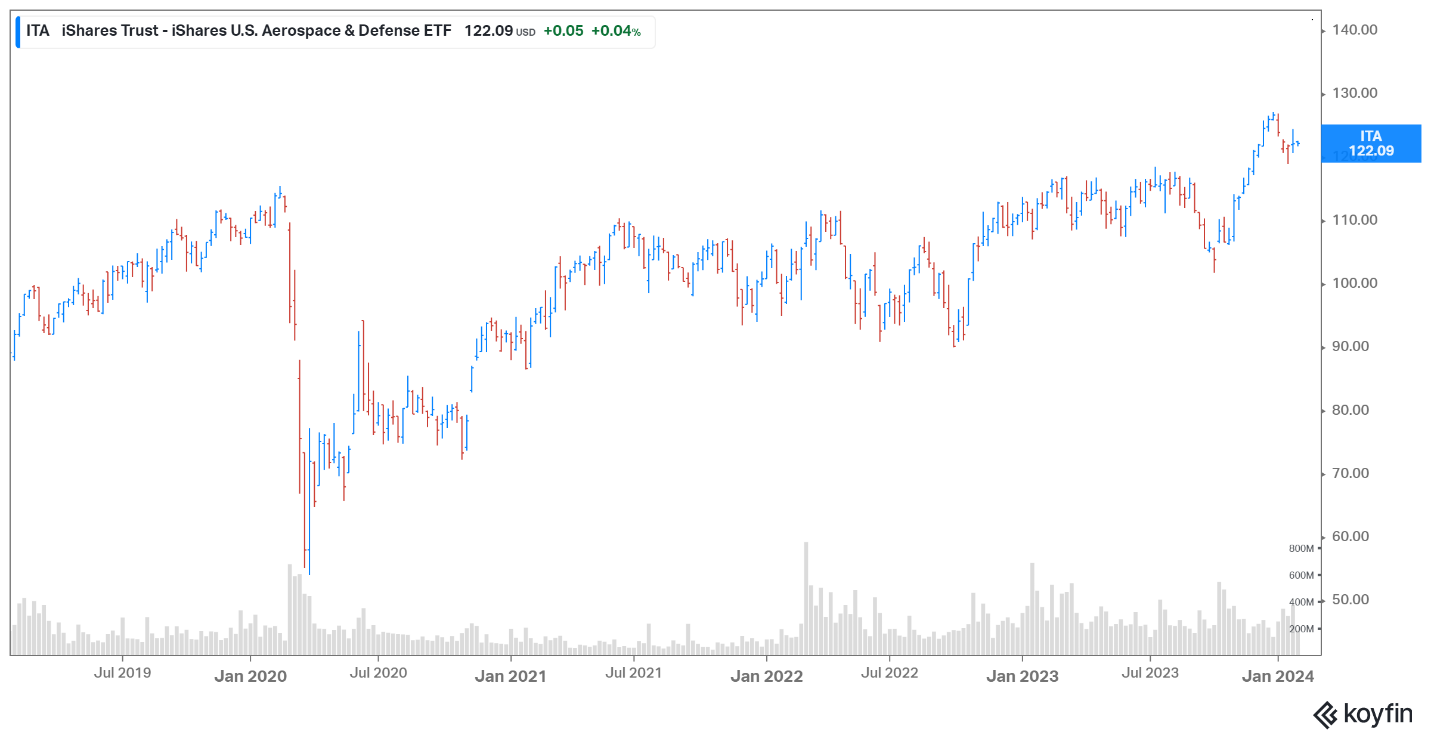
My take: War, as unfortunate as it is, is part of the human condition. War is a negative, but since time immemorial, we humans have been waging war against each other. Despite this, we have also managed to improve our condition on a net basis. Life expectancy continues to increase, literacy continues to improve, and Global GDP per capita continues to grow.
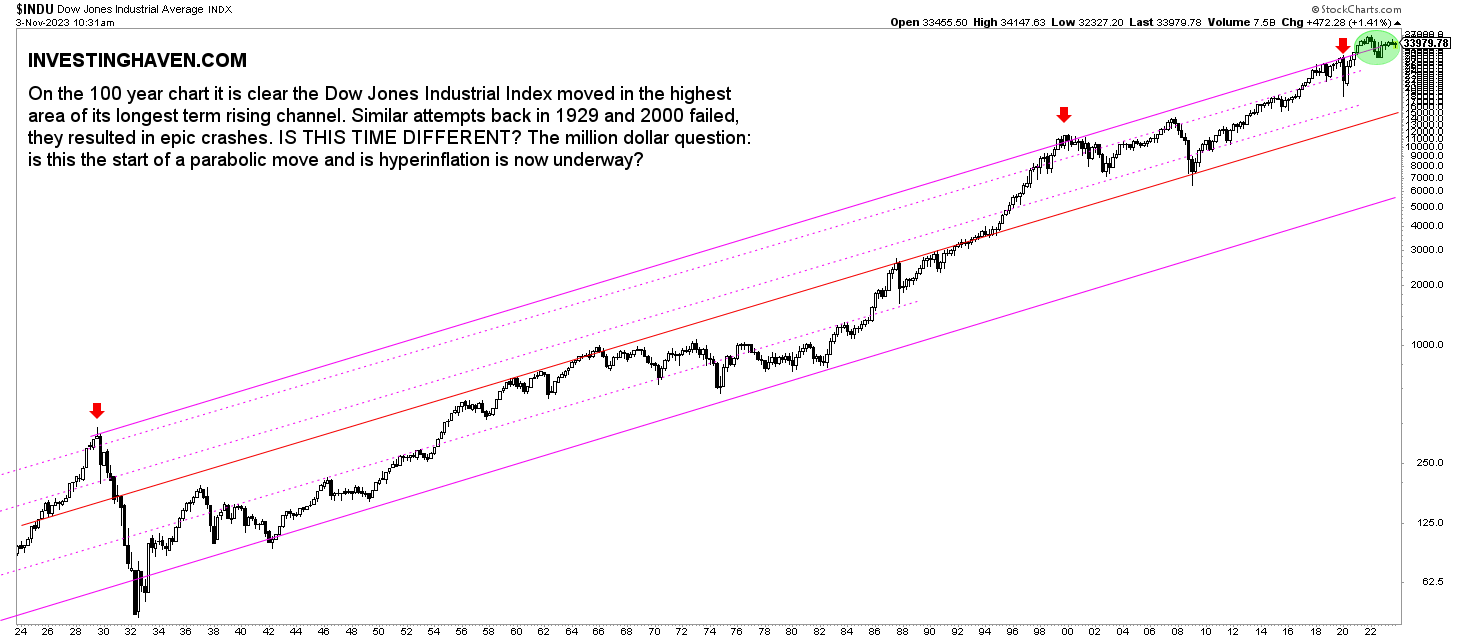
Look at a 100-year chart of the MSCI World. It’s very hard to see the influence of the two great wars of the last centuries on share prices, despite times being tough. While we are living through turbulent times, it all seems as if everything is falling apart, but on a longer-term view, progress is unrelenting. Here is 100 years of the Dow Jones Industrial Index - it consistently slopes up and to the right:
3. The stock market, generally. And Berkshire Hathaway specifically.
Over the last week, the US market has been strong. Both the S&P500 and the Dow Jones Industrial index have gone to new all-time highs. On the face of it, this looks and feels like a bull market. So does the price action of Berkshire Hathaway:
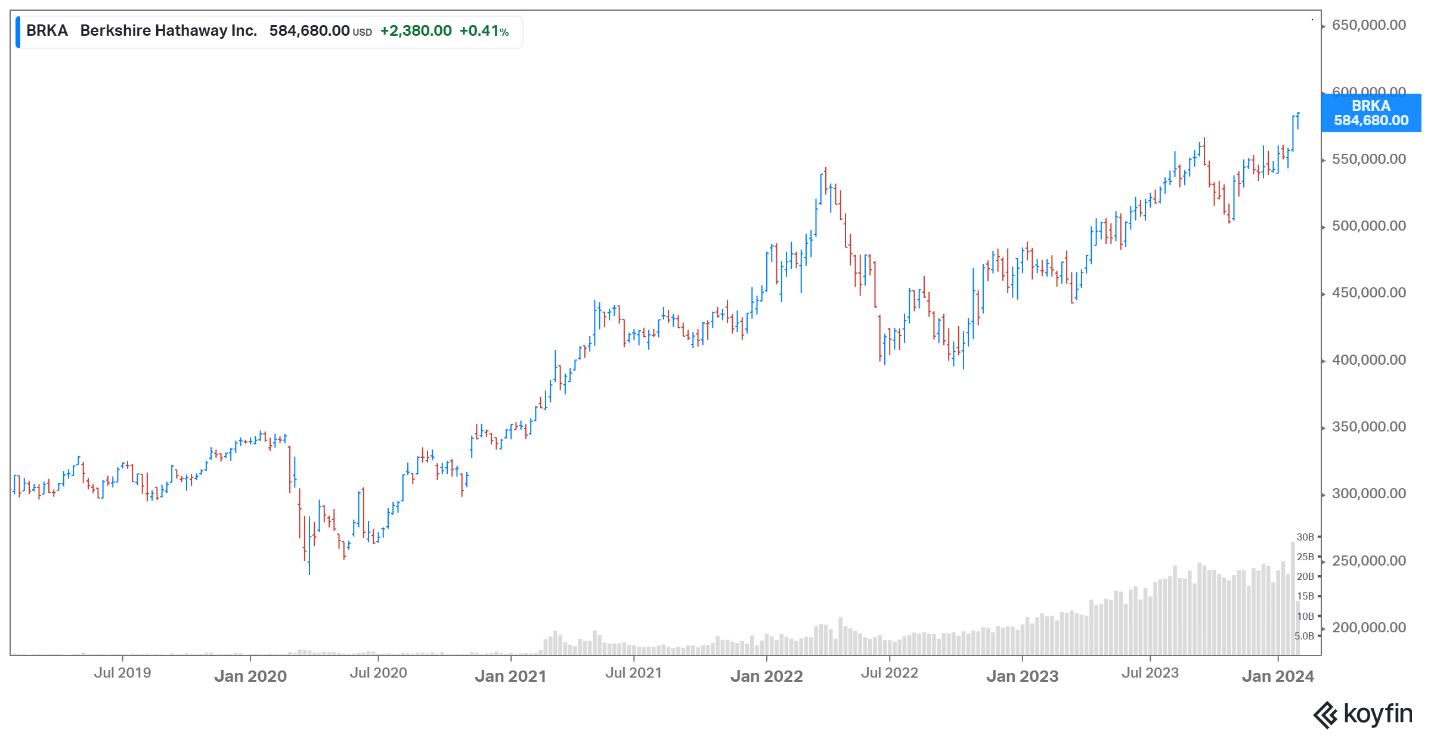
My take: Although the MWI WW Flexible fund (the cockroach) is underweight US equities in its equity allocation, it takes all its US exposure via Berkshire instead of using ETFs. I'm scared of the US market, and for me, BH is the least scary way to get access to it.
“New lows are bearish”
1. Tesla
The news on electric vehicles is not good. Grant's Interest Rate Observer reported recently:
Hertz Global Holdings announced an eye-catching course correction this morning, detailing plans to offload 20,000 electric vehicles, equivalent to one-third of the rental outfit’s inventory within that category. Hertz, which plans to reinvest proceeds from that sale into the purchase of conventional internal combustion engine vehicles, expects to take a $245 million non-cash charge in the fourth quarter. “It’s not at the level of demand that we had anticipated,” Hertz CEO Stephen Scherr told CNBC with regards to EVs. “We may have been ahead of ourselves.”
Also, the Financial Times reported that
"Stellantis shares fell 3% after temporarily laying off 2,250 workers at a plant in Italy, citing weak electric vehicle (EV) demand. This is not the first time the company has implemented such a measure, reiterating the ongoing challenges the EV industry faces."
And:
"The lithium price plunged, as miners scaled back production on slowing demand in China for electric vehicles."
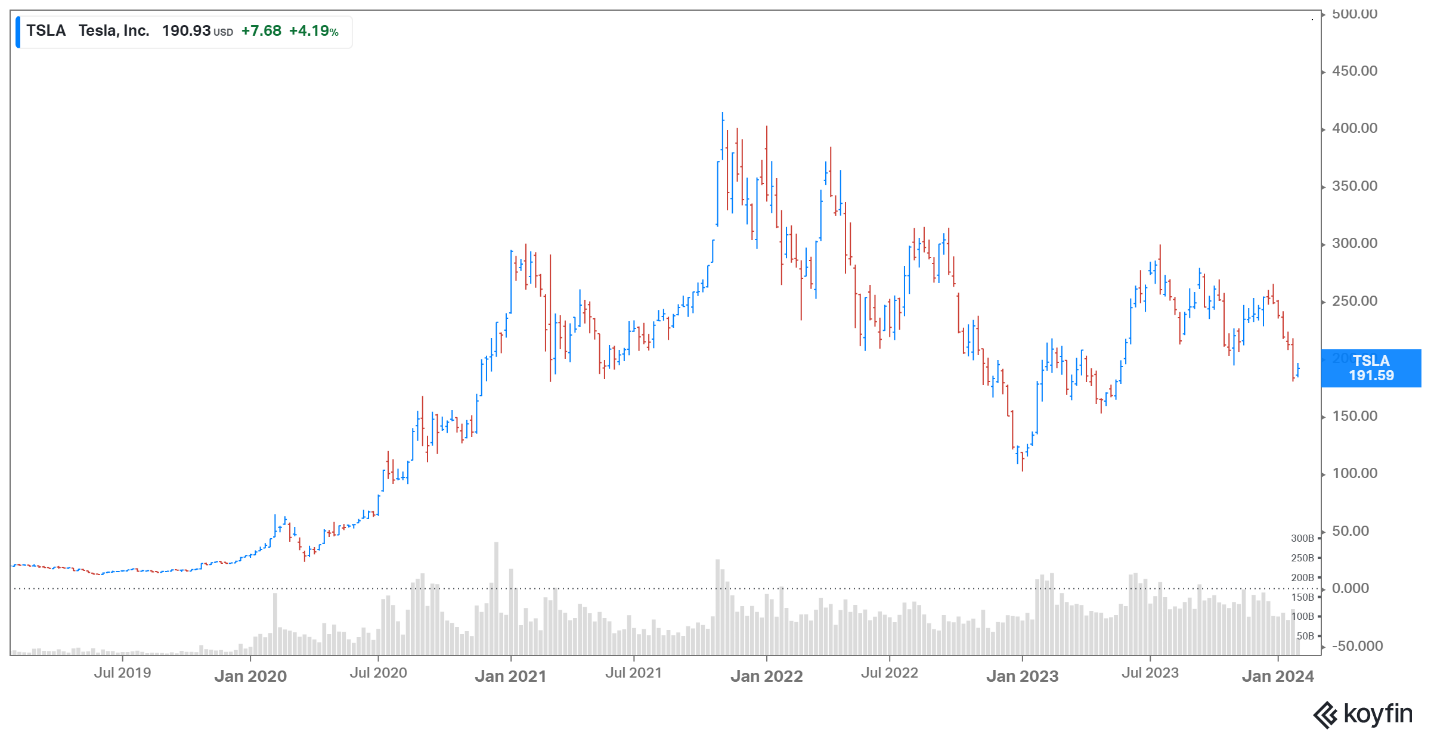
My take: The Tesla operating margin was 8.2% in Q4 2023 vs. Mercedes at 13.4% and BMW at 17.6%. If the market decides Tesla is just another car company and the EV narrative is past its sell-by date... no price target is too low.
Interestingly, the BYD chart looks similar (BYD being the Chinese electric vehicle maker that outcompetes Tesla). The EV sector is another sector (like the DTC video sector) where capital has been abundant, and as a result, I have no position. Abundant capital eventually earns poor returns. To earn a decent return, you need to look for places where capital is scarce.
2. UPS
UPS stands for United Parcel Service and is the largest global courier delivery service. It delivers north of 30% of US Package volume, so it is a pretty good indicator of economic activity.
While its recent labour negotiations with the Teamsters union are partially to blame, the core trend of declining shipping volumes remains. Volumes in the U.S. fell 7.4% YoY and 8.3% internationally.
The share price is roughly 40% below all-time highs, while the broader market indexes hit new highs daily (see above).
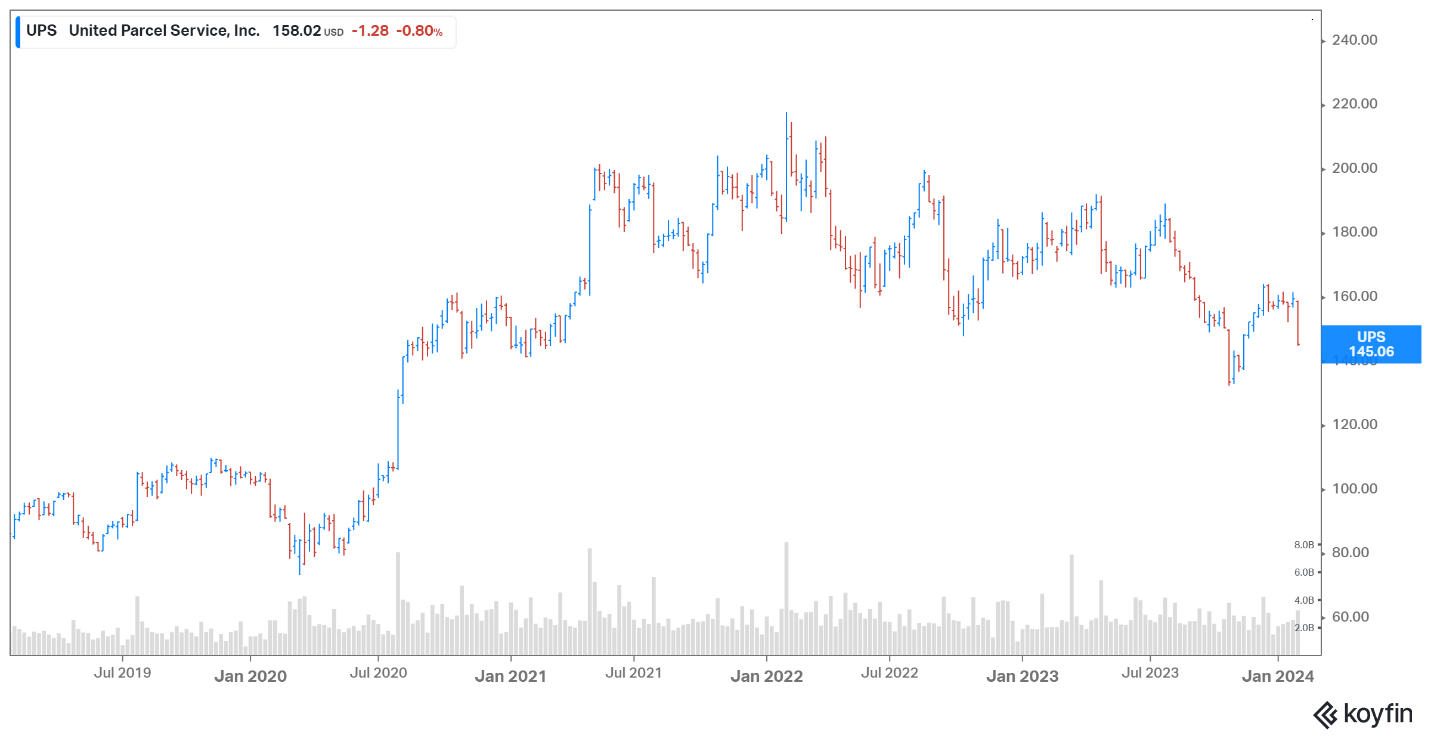
My take: Many US share price charts look like this, while only a few are making new highs. As I pointed out last week, the market is very narrow. And when a company like UPS is struggling, things can't be good. Maybe we should not ignore that US yield curve inversion. I'm not, and that is why I am so scared of that market.
3. Country Garden
According to Wikipedia, Country Garden is a property development company based in Guandong, China, controlled by the Yang Guoqiang family. It ranked 206th on the Fortune Global 500 list for 2023 (that is the top 500 companies worldwide, ranked by revenue). This week, one of its biggest competitors, China Evergrande, was ordered by a Hong Kong court to liquidate.
This is a chart of the Country Garden share price:
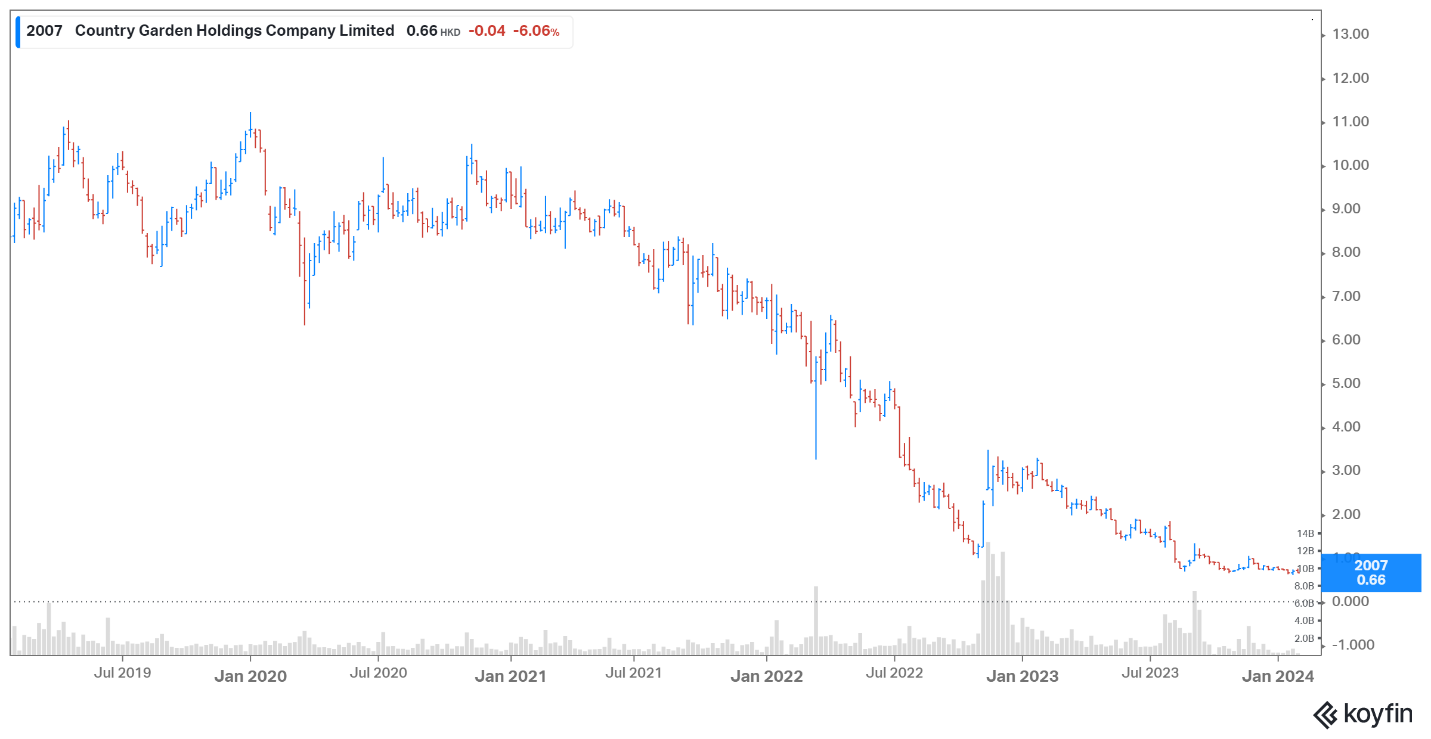
My take: According to CNBC, "China is ramping up stimulus to boost market confidence" - according to me, it's not working. What's even more interesting than my opinion on Chinese stimulus is what will happen to "share" holders of China Evergrande, as most investors' claims on the company's cash flows are owned via an interest in a "VIE" (Variable Interest Entities), not actual equity in the company. This is a liquidation we will all learn a lot from.
This article is a good summary of the situation from the Financial Times. My favourite way of learning is by watching what happens to other people, and that's how I plan to learn in this situation, too!
Did you know?
1. You can’t have a Lamborghini
This is a Lamborghini, and you can't have one:
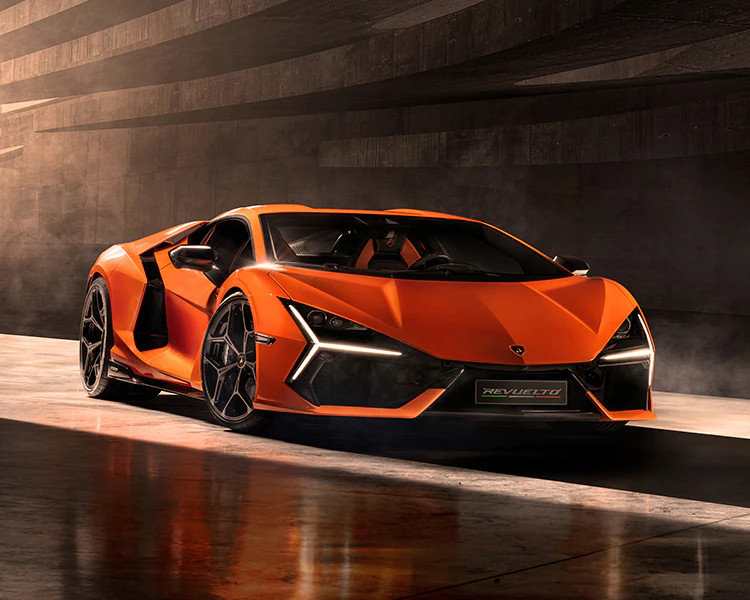
You can't have one, not because you can't afford it - I am sure many, many of my readers can actually afford one - but because, according to Bloomberg News, "Lamborghini has sold out of super-cars until 2026 as the world's wealthiest consumers keep spending."
It really is a two-speed world out there, as the rich get richer and the poor become more numerous. Or so we are led to believe.
In fact, the world has always had a cohort of super-rich. In the Middle Ages, according to general AI bot Poe:
"Rich medieval people spent their money on a wide range of luxuries and status symbols. They invested in expensive clothing made of fine fabrics and adorned with jewels, as well as elaborate jewellery and accessories. They also spent on extravagant feasts, entertainment, and lavish homes. Additionally, they often patronised the arts, commissioning elaborate works of art, supporting musicians and performers, and funding grand architectural projects such as castles and cathedrals. Many also invested in land and property, which were important sources of wealth and power during that time."
My take: Sound familiar? That's how the world has always worked. The more things change, the more they stay the same. Lambos just weren't around then. In any case, I don't own Volkswagen (the parent company of Lamborghini), but the MWI Worldwide Flexible fund (the cockroach) does own Exor in its equity allocation. It owns Exor as a proxy for broad European equity exposure. In turn, Exor owns a big stake in Ferrari, the OG of supercars.
2. The price-to-innovation metric
To support sky-high valuations in certain sectors, US market strategists have come up with a new metric. Remember price-to-eyeball or price-to-clicks? Now, we have a price-to-innovation metric. No, I also don't know what that means. But the lady in this video, apparently, does.
My take: looking at her facial expression, I'm not sure she believes what she's saying, or even understands. But, hey - you have to pay the bills at the end of the month. Maybe her clients at Morgan Stanley Wealth know what’s going on.
3. Options are valuable. Build optionality into your thinking.
I got this chart off X at some point; I forgot exactly when and from whom. If anyone recognises it, please let me know so that I can attribute it properly. But I think it is powerful:
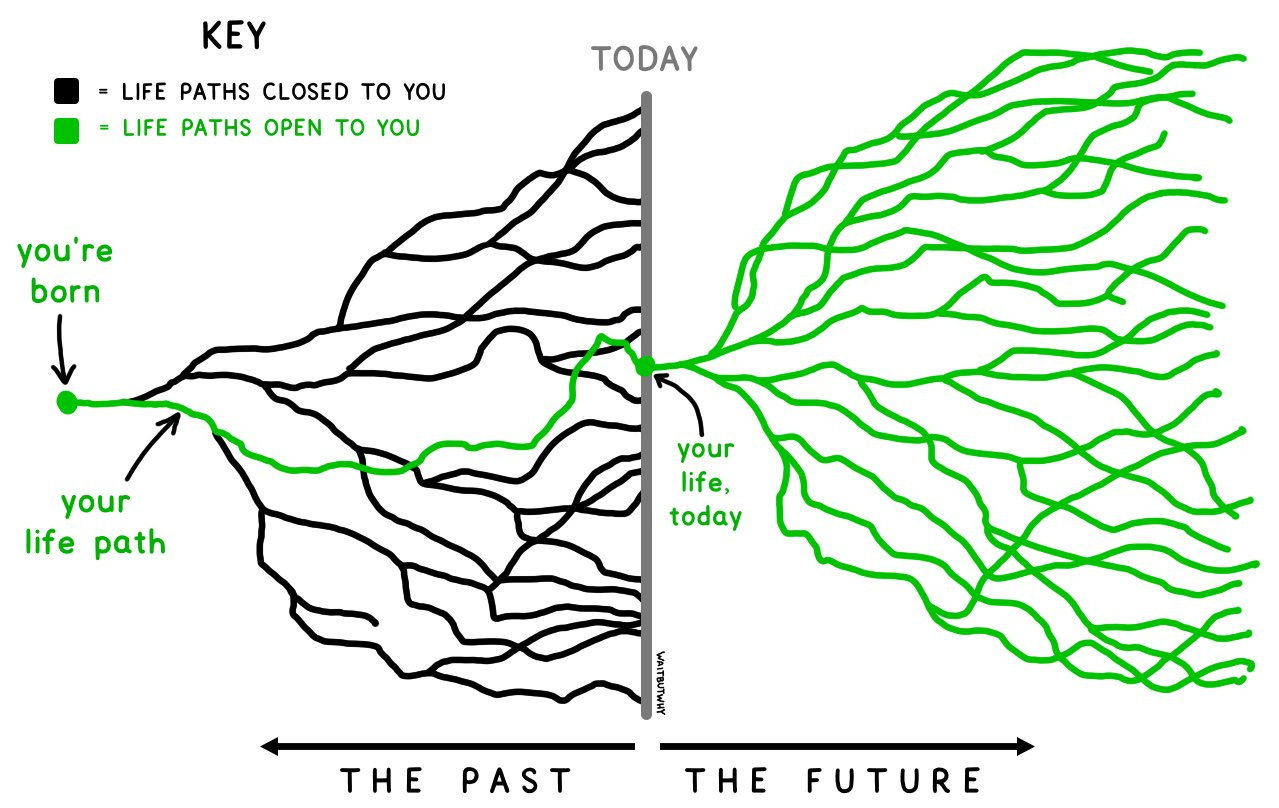
I listened to a podcast this week, on which a very successful investor explained how he got going: by emailing his CV to 300 firms. He got 298 rejections. The job he chose (or that chose him) was instrumental in launching his career. If he had been lazy and kept his optionality down by sending out, say, only 10 CVs, he might have been washing cars today.
My take: No matter what has happened before, if you work hard on building optionality into your life, you will be surprised at the great things that can happen.
What I’m watching
Last week, there was only one thing to watch. Javier Milei, the newly elected prime minister of Argentina, spoke at the WEF. This is the English translation.
My take: The world would be a much better place if people of his ilk ran it.
What I’m listening to
The David McWilliams podcast, where McWilliams discusses the speech.
In McWilliams words:
"Last week at Davos, Javier Milei delivered a fiery speech that spared no one, from Keynesians to Globalists. Despite some controversy, Milei's libertarian ideas are gaining traction both in Argentina and beyond. As people grapple with economic and geopolitical challenges, they are increasingly drawn to solutions that Milei proposes.
In this episode, we explore Milei's speech, which delves into the history of economic growth, where he attributes much of it to the principles of free-market capitalism. Regardless of whether one agrees with Milei's thesis, the importance lies in fostering a dialogue around these ideas. Join us as we kick off a series where we dive deeper into the factors contributing to the global explosion in growth, using Milei's speech as a thought-provoking starting point."
What I’m reading
This week, I'm going into Nick Cave's archives. He publishes correspondence with his fans called the "Red Hand Files". The piece I am referencing today is one he wrote just after I started writing these letters last year. Some of you might know from my very first letter (Vol 1 No 1) that Cave is (by far) my favourite singer-songwriter. I grew up with his bands. First, The Birthday Party, then the Bad Seeds and more recently, just him and violinist Warren Ellis. I've loved every minute of the journey.
Here is Nick and Warren covering T-Rex's Cosmic Dancer.
(By the way, this song was on my top 20 list of songs for 2023. You can find the full playlist in Regarding...Vol 2 No 1)
But the piece I am referencing today is all about deciding when you are good enough to do something. Cave recalls what he went through his head at a young age, learning to be the lead singer in a band: "I learned something valuable – a kind of defiant resilience to the messages, mostly in my own head, that told me my singing could be better. I got tough and protective of my vision and learned that the thing that ‘could be better’ was actually the ever-vital energy that propelled me forward."
His message hit home to me in many ways, and I re-read this specific letter often. And at that specific time, it was hugely motivating to me. And I want to dedicate it today not only to Zac but also to my other stepson, Ben and my own son, Nic. And everyone else going through the issues Cave talks about.
You can read the full piece here.
Good luck, Zac!
As they say in the classics - and Nick Cave advises - just do it.
But always remember to be careful out there.
Piet Viljoen
RECM