

Dear Fellow Investors and Friends,
Welcome to my newsletter, where I share my efforts to understand markets and the world around me.
I do appreciate you taking the time to read this. I love getting feedback; feel free to drop me a line. It’s great to start conversations.
Today is Thursday, September 10th, the 253rd day of the year. There are 112 days left in the year. Appropriately enough, given what I have been writing about over the past few weeks, it is also the birthday of Jack Ma. He founded Alibaba, one of China’s leading e-commerce and technology businesses.
I promised to end my series of articles on China with some investment conclusions. These are all strong opinions, weakly held. High levels of certainty in markets are strongly correlated with poor outcomes. With that word of warning, here goes…
The late economic historian Charles Kindleberger argued that the length and depth of the 1930s Depression in the USA stemmed from the failure of either Great Britain or the US to act as a responsible hegemon in the global economy. Kindleberger’s view was that an impoverished Great Britain, the declining hegemon, was unable to provide leadership, while an isolationist US, the rising hegemon, was unwilling. Hence, the eponymous trap.
The world lacked an open trading system, any credible coordination of economic policies, and a reliable international lender of last resort. When every country turned to protect its national private interest, the world’s collective public interest was neglected, and with it the individual private interests of everyone.
That sounds eerily familiar to events on the global stage today.
Could we be heading for another Kindleberger trap? This time, with the USA as the declining hegemon facing inflation and China the rising hegemon, facing deflation, both too focused on their domestic affairs to provide global leadership. It would be fascinating, but not surprising, if the future mirrored the 1930s.
If one were to base an investment strategy on such a forecast, it would mean avoiding Chinese equities and US bonds, while buying Chinese bonds and US equities.
This course of action has two problems. First, like all forecasts, this one should at best be humoured, and not taken seriously. Secondly, in his book The Great Depression, a Diary (highly recommended), Benjamin Roth showed that the US equity market bottomed well before the end of the depression. So, getting the timing right is hard.
Roth also made the following pertinent observation: “During the depression, prominent bankers, businessmen, etc. were all wrong in most of their predictions. Use your own judgement and do your own thinking.”
But accepting that you don’t know what the future holds doesn’t mean accepting that you are helplessly beholden to the whims of fortune. A sensibly diversified portfolio is a great tool for dealing with market vagaries.
On where to hold cash, I guess you want to avoid places where inflation might be a preferred policy choice, and gravitate towards those where real interest rates are high. This would point to holding a basket of emerging-market currencies.
As further diversification, some exposure to the world’s most undervalued currency, the Japanese yen, warrants consideration. The yen could even become the ultimate safe-haven asset if financial repression became “de rigueur”. If Mrs Watanabe repatriated her assets, it could cause major fallout in Western bond markets.
Given Western financial fragility, I would minimise exposure to their fixed-income markets. Emerging markets offer greater financial stability, greater diversification and, on average, higher yields than Western bond markets. Last week I showed you how well rand-based fixed-income investors have performed over the past decade. The conditions that drove this strong performance remain in place: an undervalued currency coupled with high interest rates. These conditions are replicated in many emerging markets.
So, when it comes to one’s fixed income (i.e. cash and bonds), tilting towards emerging markets makes sense.
But emerging markets have not historically been paragons of virtue. Their governments and policymaking have well-deserved reputations for instability. Hard assets, whose value is primarily determined by scarcity and are not liabilities of anyone or any government, are always a good hedge against instability. So any sensibly diversified portfolio should include exposure to precious metals and possibly Bitcoin.
Finally, we come to the part of the portfolio that drives growth – equities. Here, the answer is simple: buy the index.
When I say index, I mean broad exposure to a diversified basket of equities.
Unfortunately, most indices are heavily weighted towards the US, and within that US exposure, they are concentrated in stocks related to the AI build-out. I have chosen to avoid this problem by buying a diversified basket of 10 global businesses, leaving the decision of where it is best to do business to these companies’ management teams.
Whatever your choice is – buying the index or buying a set of stocks- the most important thing you can do is not to interrupt the compounding process of your business. In other words, do not trade in and out of the equity you own based on news flow or “expert prognostication”.
In conclusion, I see two main investment themes. First, the US is becoming an increasingly fragile system, and second, China is becoming an increasingly anti-fragile system. At the same time, most Western investors regard China as “uninvestable”, while the USA dominates the weightings of just about any index you care to look at. Right now, this presents an interesting opportunity. Diversification reduces risk without sacrificing potential returns. But I would be careful not to overcommit to any particular view of the future – the world is far too unpredictable a place to do so.
Finally, as they say, don’t tell me what you think; tell me what’s in your portfolio. I do that later in this letter, where I discuss The Cockroach’s holdings.
In The Markets
1. The Great Sucking Sound
On July 27, CXMT (ChangXin Memory Technologies) launched its IPO on Shanghai’s STAR Market at CNY 8.66 per share. By the end of its first trading session, the stock had closed at CNY 49, a 466% gain in a single day. Today it’s trading at CNY 54.
One of my investment rules is to avoid all IPOs. So, is this the IPO exception that proves the rule? Or is it something else completely?
Let’s have a look.
CXMT makes exactly one thing: DRAM, the memory that runs on a chip in your phone, your laptop, and some of the servers running AI models. It’s the fourth-largest company in this industry, behind Micron, Samsung, and SK Hynix. All have enjoyed stellar share price performance recently.
Despite the current hype, this remains a capital-intensive, and therefore highly cyclical, group of companies. This is the revenue from two of the big players in the industry, Micron and SK Hynix:
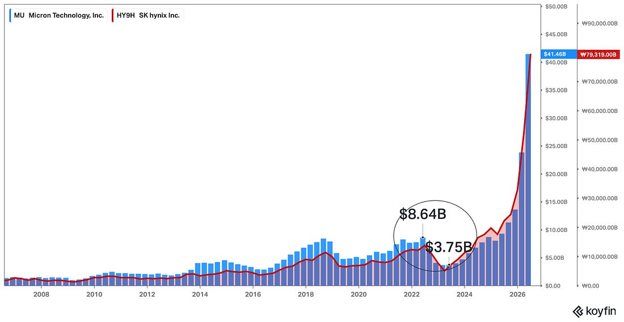
Generally, the time to buy cyclical companies is not when they are producing record revenues. During those periods, companies use strong cash flows to expand capacity. Almost always, this continues until there is too much. This is when prices start to fall as players try to sell their surplus stock.
Once you have built the fab, the cash cost of one more chip is close to nothing. So, when prices fall, cutting output is the last thing any producer wants to do. Everyone runs flat out, and the market clears at whoever is willing to lose the most money.
This continues until the losses force one or more to quit producing completely. This is called the “Capital Cycle Theory”, more on which later.
This brings us back to CXMT, where the Chinese government plays a significant funding role. It’s clear that CXMT was not built to maximise return on capital but instead prioritises domestic supply. Right now, this does not matter, but when the cycle inevitably turns, it will.
CXMT is a mid-cost producer that will survive troughs on state money and prosper at the peaks. Government support makes CXMT a permanent producer, unresponsive to market signals.
This could change market dynamics. Troughs will be as deep but now longer. The old cycle ended when survivors cut output together. The next trough will feature a producer with no shareholder pressure to cut, and a balance sheet backed by the Chinese government’s strategic interests.
My take: Why should the computer chip industry be any different from other capital-intensive industries like the motor vehicle industry or the solar panel industry? Eventually, China will suck the profit out of this one, too.
2. The Capital Cycle Comes for Bitcoin
It wasn’t that long ago that Michael Saylor told his disciples to sell a kidney before they sold their Bitcoin. I have no idea whether Mr Saylor still has a full set of kidneys, but I do know he has been selling Bitcoin.
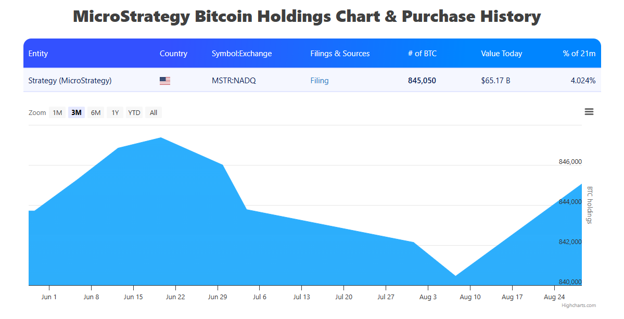
As mentioned above when I discussed CXMT, a useful framework for understanding asset price movements is commonly known as “The Capital Cycle Theory”. It holds that supply, not demand, drives asset prices.
Supply responds to price. When prices are low, supply contracts as loss-making producers are forced to close. Prices then tend to bottom out around the marginal cost of producing the asset. When supply has contracted enough, prices start rising because supply is no longer enough to satisfy demand. Rising prices then signal suppliers to expand production again. Supply then expands until it overwhelms demand, and prices start dropping again.
Once you understand this model, you can see the pattern almost everywhere. Right now, it’s happening in Bitcoin.
As AI and datacentres have captured the imagination of the investing public, Bitcoin miners are increasingly redirecting their computing power to the AI ecosystem:
- IREN, the Australian-founded Bitcoin miner formerly known as Iris Energy, signed a five-year partnership with Microsoft projected to generate $1.9bn in annualised revenue at an 85% EBITDA margin – economics that bitcoin mining could not produce, but that renting its infrastructure and interconnects to AI companies can.
- Bitcoin miner Riot Platforms signed a $9.1 billion infrastructure deal with Anthropic to lock in computing power for its flagship Claude AI model. The deal anchors a 20-year commitment for 191MW of power out of Riot’s Rockdale, Texas campus.
- TeraWulf, another bitcoin miner, has contracted some $6.7bn in revenue, with up to $16bn in extensions, from the AI cloud firm Fluidstack.
- Cipher, which has dropped the word “Mining” from its name, has exited most of its bitcoin operations entirely in favour of a $9.3bn, 300MW deal with Amazon Web Services.
- Bitfarms has announced it will wind down cryptocurrency mining altogether by 2027.
In classic capital-cycle terms, lower prices are driving supply out of the market. The global bitcoin mining hashrate (i.e. computing power) has fallen from about 1,160 exahashes per second in October 2025 to the current level of 930.
Those shiny, bright companies from yesterday, Bitcoin Treasury companies, are liquidating Bitcoin to pay down debt and fund a pivot to AI energy rental businesses. The remaining miners face production costs of more than $70,000 per coin, while the spot price has spent much of the year around that level – leaving almost no margin.
But the Bitcoin ecosystem has an added quirk – something called the halving. Every 4 years, the reward for “mining” – i.e. verifying information on the blockchain – halves, which serves to increase the marginal cost of “mining”. In response, Bitcoin supply halves, reinforcing the capital cycle.
This chart from Bernstein shows that the current price of Bitcoin is below its marginal cost (the green line):
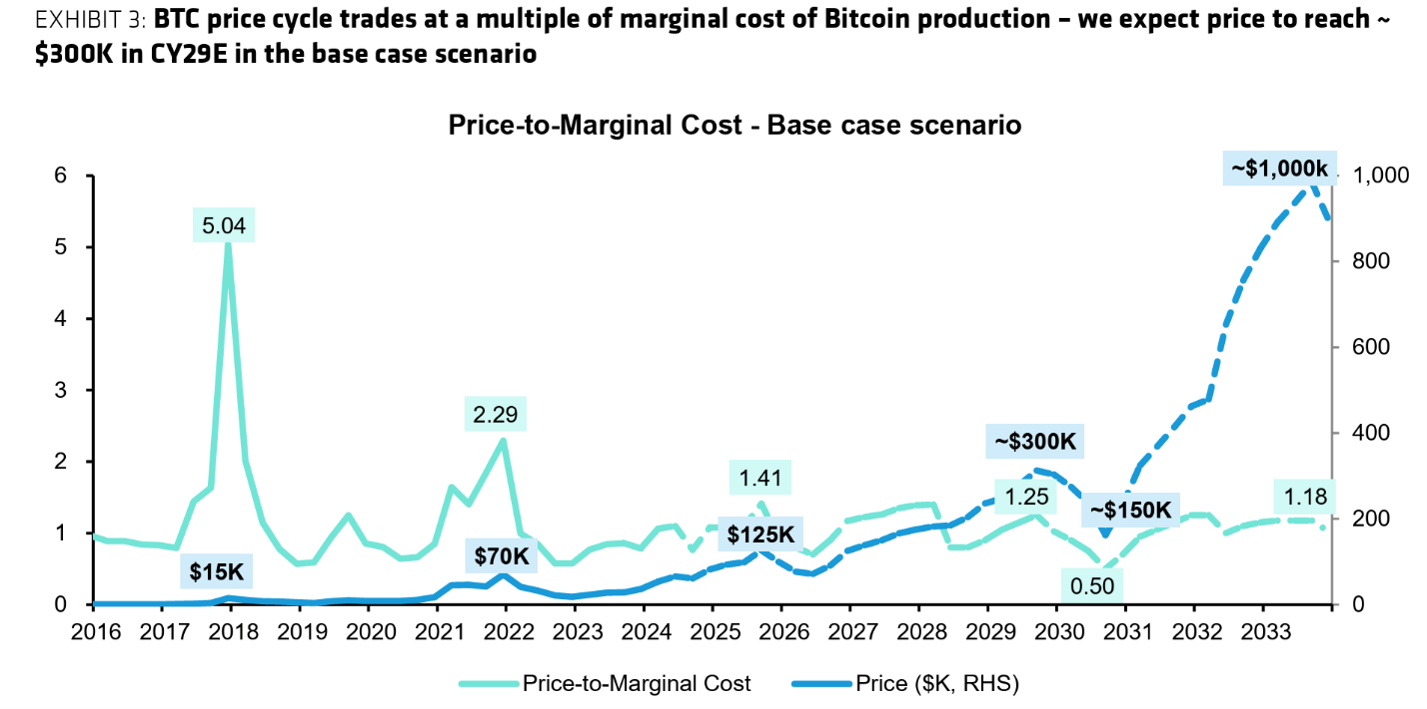
My take: Ignore their forecasts (everything after 2026 in the chart above) – that’s pure speculation. The key point is that we are now at the stage of the capital cycle where low prices are destroying supply. This inevitably leads to the next bull market. When and how high are unknown, even to Bernstein.
3. Steelmanning the argument
BHP was formerly known as BHP Billiton. Billiton was one of South Africa’s premier mining houses, built by Brian Gilbertson. In 1997, after being unbundled from Gencor, it moved its primary listing to London to escape SA exchange controls and globalise its business.
In 2001, it merged with BHP in a (then) blockbuster deal worth $57bn. BHP was Australia’s premier mining house, with a mix of oil and gas, iron ore, coal, and copper. Billiton produced a range of metals and minerals, led by aluminium and coal.
BHPBilliton sold its oil and gas business to Woodside and spun off its mid-tier – mainly South African – mining assets into South32. It subsequently dropped the name Billiton and once more became BHP. The new BHP is focused on massive, low-cost iron ore and copper mines, plus a developing potash business.
Long story short, after 20 years of intense dealmaking, BHP’s share price is riding high, mainly because of its increasing exposure to copper, which now makes up more than 50% of profits. Not to overlook its wonderful Australian iron ore business, which is free from the infrastructure mismanagement that affects iron ore businesses in South Africa.
It’s probably fair to say BHP is well positioned for the “electric future” (Chinese future?) that will need much more copper, as well as steel. These data centres aren’t made of renewable fibres!
If the electric revolution happens as planned, the world will need much more copper and steel. Right now, not enough of either is being produced. To encourage mines to produce the required inputs, they will need much higher prices. Higher prices for the world’s low-cost producer – BHP – are a gift from heaven.
No wonder the share price is hitting new highs, even in strong currency (ZAR) terms:
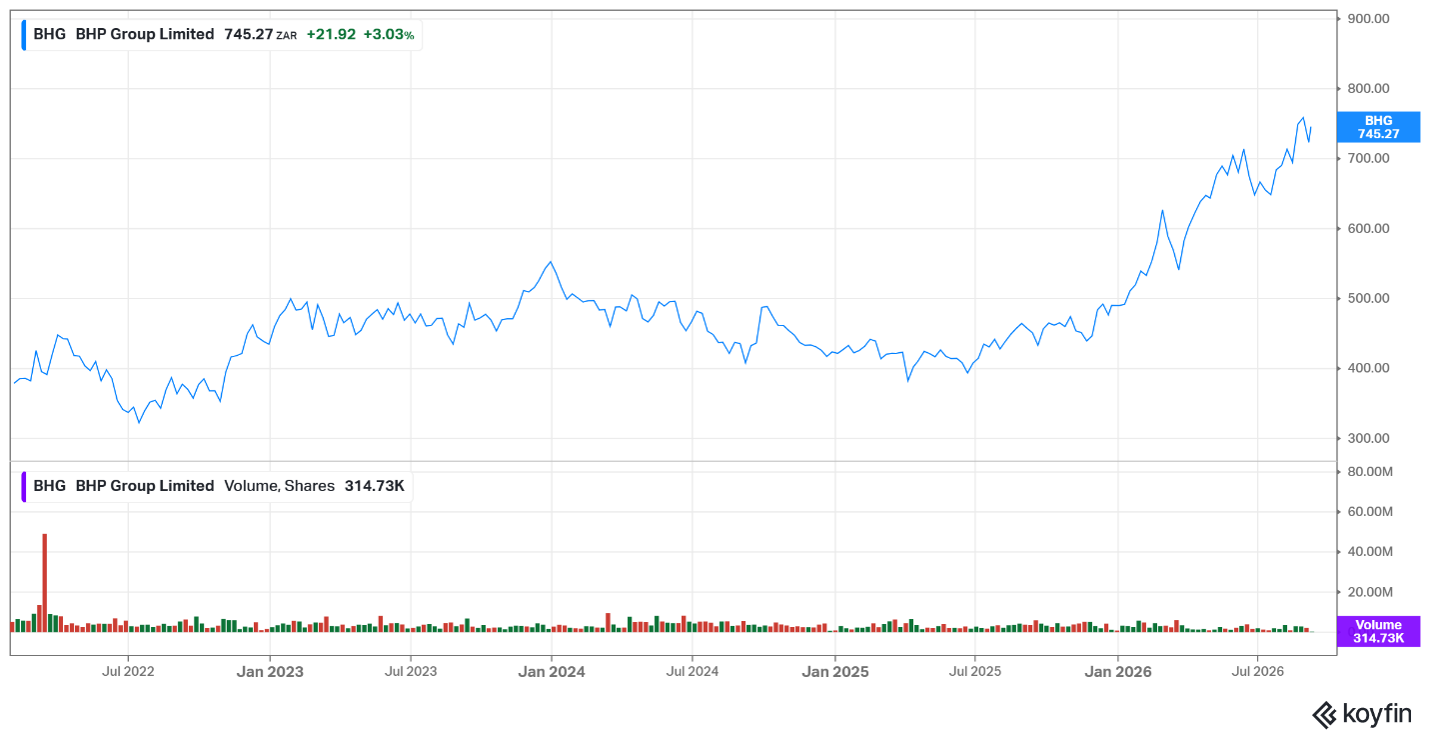
A reminder: new highs are bullish.
There’s also this important chart, showing that capex remains well below the 2011 peak in real terms:
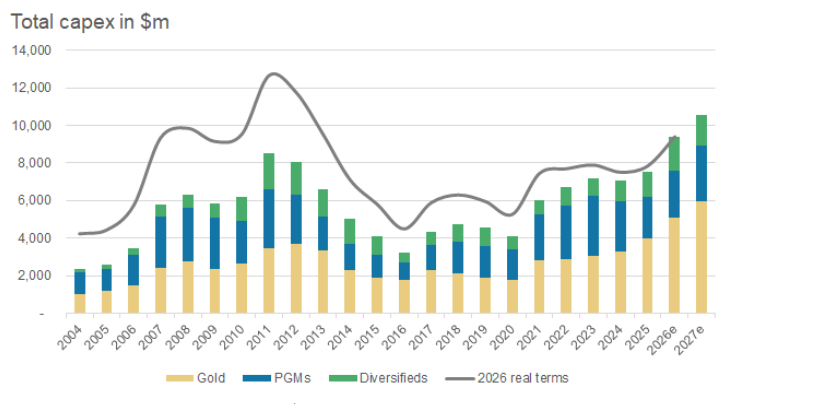
My take: The capital cycle in mining – low prices leading to underinvestment, which in turn leads to high prices and eventually overinvestment – is alive and kicking. In most minerals, including copper and steelmaking materials, we are still transitioning from the underinvestment phase to the higher-prices phase. The overinvestment phase is still a long way off – these cycles play out over 20 years. BHP is one of the premier ways to invest in this cycle, as the MWI Value fund has done.
In the cockroach
“The Cockroach” is my nickname for the MWI Worldwide Flexible Fund. My family is the fund’s single biggest investor. It’s how I choose to manage whatever bit of liquid wealth we’ve managed to accumulate over time.
Why is it called “The Cockroach”? Because it is built to survive the worst times and thrive in the best. Just like a cockroach. Also, because no self-respecting DFM would ever allocate to a fund called “the Cockroach”.
So, here’s what’s in the fund, asset for asset:
Cash is (always) 25% of the fund:
- 10% in US Treasury 0–1 Year Bills ETF
- 5% in Japanese Yen deposits
- 10% in the Merchant West Enhanced Income Fund (one of the best-managed income funds in South Africa)
Bonds are (always) 25% of the fund:
- 5% in the iShares Core Japanese Govt Bond ETF
- 8% in the VanEck/JP Morgan Emerging Market Local Currency Bond ETF
- 10% in long-dated SA government bonds (R2044/R2040)
- 2% in long-dated Namibian government bonds (which yield 2% above similar SA bonds)
Equities are 25% of the fund:
- 14% in 6 of my “10 Stocks, Forever” – a group of multinational businesses that I intend to hold for, you guessed it, forever
- 5% in the MWI Value fund for exposure to high-quality, deeply undervalued South African stocks
- 3% in the iShares MSCI World ETF
- 3% in the iShares Emerging Market ETF (these two ETFs are placeholders until I get the full 10 stock, 25% exposure to my “10 stocks, Forever”
Hard Assets are 25% of the fund:
- 12% in the SPDR Gold Trust
- 4% in the SS Energy Select ETF
- 3% in Texas Pacific Land
- 2% in FRMO Corp (an investment trust that owns a collection of hard assets)
- 1% in Consensus Mining and Seigniorage Corp (an investment trust that owns crypto and crypto mining operations)
- 1% in St Joe Corp (A landowner and developer in Florida)
- 1% in Yellow Cake (An investment trust that owns uranium)
- 1% in Valterra Platinum
It’s a well-diversified collection of assets that has returned 7% in US$ (2.5% higher than US inflation) with low volatility since August 2020, when I implemented the process. In Rand terms, it has achieved 9.9% p.a. over that period, again well ahead of inflation.
This week, I did some trades on the fund:
- Some excess cash had built up due to some recent inflows into the fund.
- I took some of this offshore and bought more EM bond exposure.
- I added to the South African government bond exposure.
- I added to the Nestle holding after some recent weak share price performance.
* I manage the fund on behalf of Merchant West Investments (Pty) Ltd (FSP 44508)
In The Media
1. Investment Library
A young reader of this newsletter asked me for a list of reading material related to investing he could learn from. As I thought about it, I thought it might be a good idea to create a dedicated space on our website where anyone can access the list, and we can keep it updated.
I got some input from my colleagues and put together this list. It’s not meant to be comprehensive – these are the best of the best. They are a good place to start your reading journey if you are so inclined. Hopefully, they will lead you to new, uncharted waters over time.
Books
Enough, by John Bogle.
Capital Account: A Fund Manager Reports on a Turbulent Decade, by Edward Chancellor.
Capital Returns: Investing Through the Capital Cycle, A Money Manager’s Report, 2002-15, by Edward Chancellor.
Common Stocks and Uncommon Returns, by Phil Fisher.
Extraordinary Popular Delusions and the Madness of Crowds, by Charles Mackay.
Poor Charlie’s Almanack, by Charles T. Munger. (especially the transcripts of his speeches)
The Psychology of Money, by Morgan Housel.
Same as Ever, by Morgan Housel.
Berkshire Hathaway Letters to Shareholders:1965-2025, edited by Max Olsen
Fooled by Randomness, by Nassim Taleb.
Outlive, by Peter Attia.
Influence, by Robert Cialdini.
Seeking Wisdom from Darwin to Munger, by Peter Bevelin.
How the World Really Works, by Vaclav Smil.
Margin of Safety, by Seth Klarman.
The Outsiders, by William Thorndike.
Podcasts
The Psychology of Money with Morgan Housel
Conversations with Tyler
Naval
The Rest is History
The Knowledge Project with Shane Parrish
Substacks
Doomberg
FT Alphaville
Boom Doom and Gloom by Marc Faber
Investment Websites
Horizon Kinetics – https://horizonkinetics.com/whats-new/
GMO – https://www.gmo.com/americas/research-library/
The Michael Mauboussin Archive – https://www.michaelmauboussin.com/#writing
Memos from Howard Marks – https://www.oaktreecapital.com/insights
Publications/Periodicals
Grants Interest Rate Observer – www.grantspub.com
“The Solid Ground” by Russel Napier
You will need to subscribe to or pay for some of these. Some of the books are out of print and hard to get. Do yourself a favour and take the trouble to find them.
If you have any suggestions on classics that I might have missed, let me know!
This list will grow over time and can be viewed at its new permanent home:
That’s all for this week. But I’ll leave you with this: I bought a new car! It’s Chinese! It’s fully electric! I drove it from Knysna to Cape Town!
Yes, I am that excited about it.
I’ll share feedback on my experience over the next few weeks. Like Bob Dylan, going full electric is a big step.
We are having 22 people over for Shabbat tomorrow night to celebrate Rosh Hashanah. It’s a huge joy for us. To all my Jewish friends and family – I hope the New Year brings lots of happiness, good health and good times together.
Shana Tova!
But please remember to be careful out there.
Piet Viljoen
RECM
3 September 2026