

Dear Fellow Investors and Friends,
Welcome to my newsletter, where I share my efforts to understand markets and the world around me.
I do appreciate you taking the time to read this. I love getting feedback; feel free to drop me a line. It’s great to start conversations.
Today is Thursday, September 3rd, the 246th day of the year. There are 119 days left in the year. It’s now officially spring here in the Southern Hemisphere – the days are already noticeably longer. More cycling time!
On this day in 1752, Britain and the British Empire adopted the Gregorian Calendar. In doing so, they “lost” 11 days, prompting riots because people believed the government had stolen them from their lives.
This illustrates how the “madness of crowds” manifests. Next time you come across a strong consensus on something, think twice.
China is one of those places where consensus seems quite strong on certain issues. Let’s see if we can have a look at what’s really going on.
Paul Kennedy’s 1989 book, The Rise and Fall of the Great Powers, contains powerful ideas. The most interesting is that countries become great powers by mastering the key technologies of the day – gunpowder, sailing ships, steam power, mass production, the combustion engine, industrial chemicals, electricity, airplanes, and so on.
The corollaries to this are equally interesting. The decline of the great powers is often blamed on the usual suspects: hubris and overstretch. But technological disruption may play at least as large a role as they do.
According to Kennedy, aerospace and combustion engines were among the key technologies America mastered to win the 20th century. Now those technologies are being disrupted, even superseded, by technologies that China has mastered, while America has fallen behind. Electrification, robotics and open-source AI are all areas where China is forging ahead, while the main thing that occupies the minds (and time) of people in the USA is the question of which backyard should contain all the proposed data centres.
But the problem runs deeper, as the electric revolution is unifying manufacturing supply chains around a single stack. Diverse products – from consumer electronics and appliances to heavy vehicles and drones – are increasingly built from the same modular core components. This “plug-and-play” compatibility allows companies to manage manufacturing with unified software systems. Specialised knowledge gained in one sector translates directly to another.
It’s no wonder that one of the best electric vehicles, the Xiaomi YU-7, is made by a company better known for its cutting-edge telephones.
The density of Chinese manufacturing capability, coupled with their mastery of the electric revolution, has given them a massive edge in the new world.
China has mastered the electric revolution, and America has not.
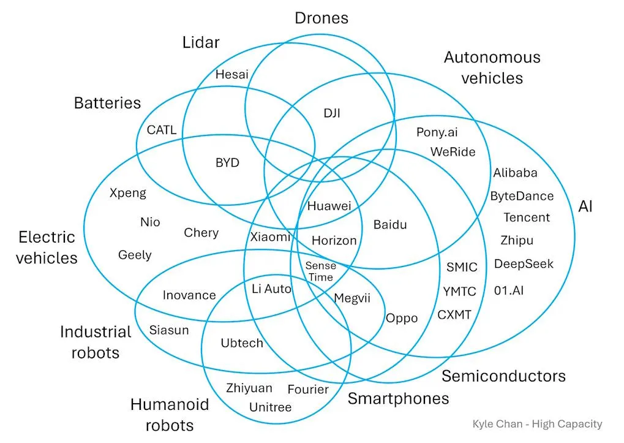
All this time, the USA has been collectively downplaying the importance of the electric revolution. In his Substack, Noah Smith says the US has given itself “Galápagos Syndrome” when it comes to energy tech – increasingly orphaned from the global technology stack. This means it is losing out on high-growth markets, becoming dependent on increasingly bespoke supply chains, and missing out on the benefits of continuous innovation. It might also have military implications, as it can’t make the basic components of FPV drones.
Smith goes on to say, “The electric revolution is the first major technological revolution that America has just completely whiffed on. The negative consequences are still to come, but come they will. And yet so far, no one seems particularly perturbed.”
But how did China take the lead here? As always, some history is useful.
The Communist Party took power in China in 1949. Since then, China has endured many challenges. Mao Zedong launched a campaign to eliminate his enemies, which led to the deaths of more than a million people. His “Great Leap Forward”, an ill-conceived agricultural modernisation programme, killed 30-45 million in one of the worst famines on record. This was followed by a frenzied period of ideological radicalisation, “The Cultural Revolution”, which killed another 16 or so million people.
By the time Mao died in 1976, China was internationally isolated, economically stagnant, and still desperately poor.
Despite this difficult history, China has become a manufacturing superpower and the fastest-growing economy over the past 50 years. Its per capita GDP, on par with India’s in 1976, is now about 2.5 times higher.
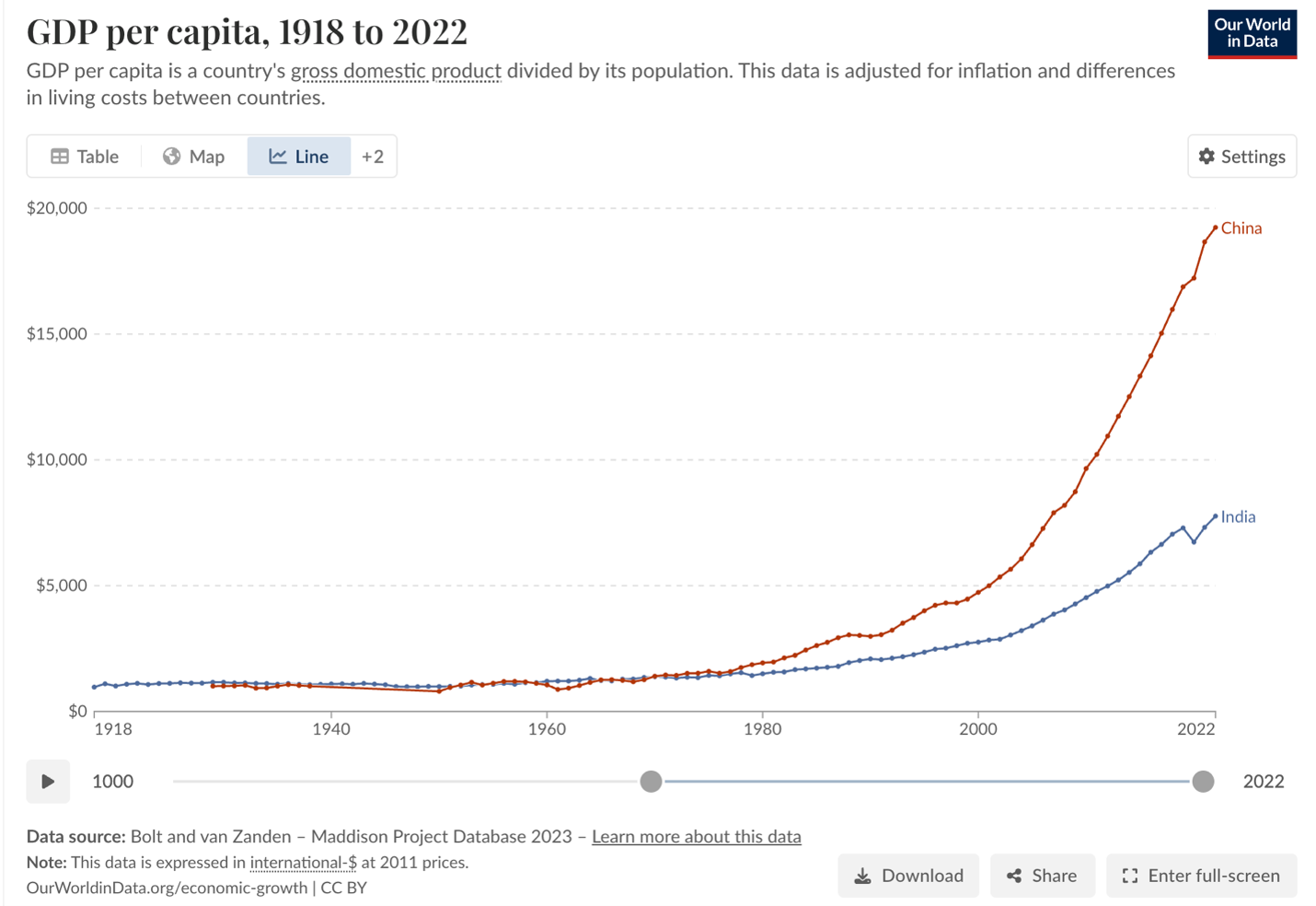
The difference was that China developed its human capital (albeit at the barrel of a gun) between 1950 and 1980. It did so by forcibly dismantling traditional social structures – structures that often stand in the way of developing human capital. By the time it started opening up to the world, it had the skills in place to accelerate industrialisation.
But what’s even more important is what China has done with all its capital since then, as it opened up to trade with the rest of the world.
- It has invested heavily in infrastructure, a physical manifestation of the long-term time horizons embedded in its thinking. Most of it is not built for today or tomorrow, but to serve the economy in the long term.
- China has also invested in dense economic activity. For instance, 45 years ago, Shenzhen was a cluster of fishing villages. Today, it is a centre of excellence, home to 25 million people. This type of density becomes self-reinforcing once it reaches a certain scale, creating network effects within physical manufacturing processes.
- As Gavekal says, the economy is effectively energy-transformed. China has invested heavily in both energy production and transmission, which represents genuine long-term competitiveness.

These “initiatives” have given China a structural advantage. Naval Ravikant puts it well: “Environments communicate expectation, expectation shapes behaviour, and behaviours at scale shape outcome.”
By contrast, many Western societies have substituted comfort for discipline in a way that is economically corrosive. They confuse maintaining current prosperity with creating future prosperity and, in doing so, trade future positioning for present comfort. The debates on Net Zero, Degrowth and Identity all serve to entrench the incumbents and undermine the estate.
Chinese policy is to maintain a stable system, even if this sometimes entails short-term economic weakness and lower asset prices. By contrast, the USA’s main policy seems to be maintaining a rising stock market, even if this comes at the cost of long-term financial stability.
The Chinese system has anti-fragile characteristics – resilience to setbacks, a young, dynamic population, and abundant energy. At the same time, the US system faces increasing vulnerabilities – rising cost of capital, inefficient government expenditure, and rising inequality.
US fiscal and monetary policy has defaulted to a massive transfer of wealth from (poor) fixed-income investors to (rich) equity owners. In China, the policy is to maintain a stable system underpinned by a stable currency – a store of value for savers, on which they can depend.
China is a society that has systematically built on its advantage over the rest of the world, partly because of an authoritarian government. We can debate the merits of the system itself, but my (limited) experience of China tells me that if the current system in China is communism, I won’t be upset if you call me a communist.
I know I promised some investment conclusions this week, but that will have to wait until part 4 next week. As Mark Twain said, “I didn’t have time to write a short letter, so I wrote a long one instead.”
Oh, and Niu Lai means “The Bull is Coming”. It references a recent social media phenomenon in China where an essentially homemade animated film became a huge hit. In my view, it might also be an appropriate description of the Chinese stock market.
In The Markets
1. Show me the money
This is one of the most important charts you will see in a long time. Please study it carefully:

The red line shows how much US$ you would have if you had kept your money offshore in, say, a JPMorgan money market account for the past 10 years. The answer is around $124, if you started with $100.
On the other hand, if you had taken your $100, converted it into ZAR at the prevailing exchange rate of about R14 to the US$, and then invested it in e.g. a FirstRand Money Market account, before converting the proceeds back into US$ at today’s exchange rate, you would have had $172. That’s the white line.
Yes, you read that correctly. You would have had almost 50% more US$ by keeping your money here in South Africa rather than sending it offshore.
But – as they say in the classics – that’s not all.
The blue line in the above graph shows what would have happened if you had really pushed the boat out and bought a South African government bond 10 years ago. If you had done so, you would have 3 times as much US$ today than if you had taken your money offshore. Plus, you would have had the enormous psychological revenge of actually getting something from the government for all the tax you pay.
My take: Yes, South Africa is a risky place to invest. But risk always has a price, and in South Africa you get well compensated for taking the risk of investing here. So, stop lending your ears to the fear-mongers, who are simply lining their own pockets by playing on your emotions.
2. Role reversal
Scott Bessent, the US Treasury Secretary (like our Minister of Finance), used to work for Stan Druckenmiller at George Soros’ fund management firm in the 90s. Back then, “bond vigilantes” were a thing. Bond vigilantes were an unidentified group that acted as a disciplinarian whenever American fiscal policy threatened to become too loose. In effect, they sold bonds, pushing up interest rates whenever the government spent too much.
I’m sure Druckenmiller was a bond vigilante, which is why he recently penned an op-ed in the Wall Street Journal criticising his erstwhile mentee’s actions. Unfortunately, most of the reaction to his op-ed was that it was obviously written by an AI bot, diluting its credibility. AI just doesn’t make for a good vigilante!
However, if you can look past the AI slop, Druckenmiller makes some telling points, chief among them being “Markets aggregate information no committee possesses, and prices are how that information reaches decision makers.” He goes on to urge the government to allow the market mechanism to set prices. Of course, that would imply the government subjecting itself to market discipline as well.
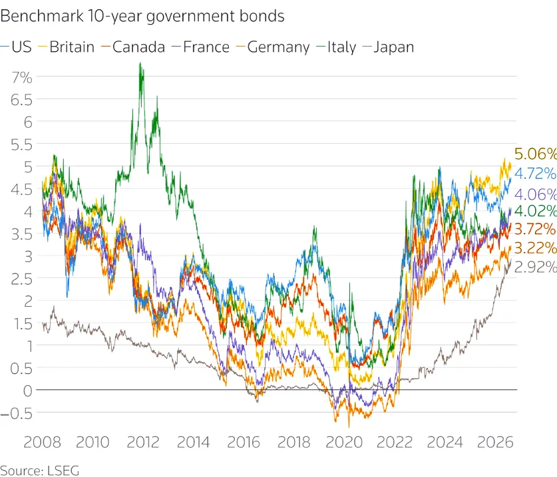
Of course, given their high debt levels and persistent massive deficits, they are not keen on this. Neither are most other developed markets. It’s no surprise that their bond markets have performed so poorly:
At the same time, those countries running relatively responsible government finances are doing well. I know the word “relative” is doing a lot of hard work here, but the market knows:
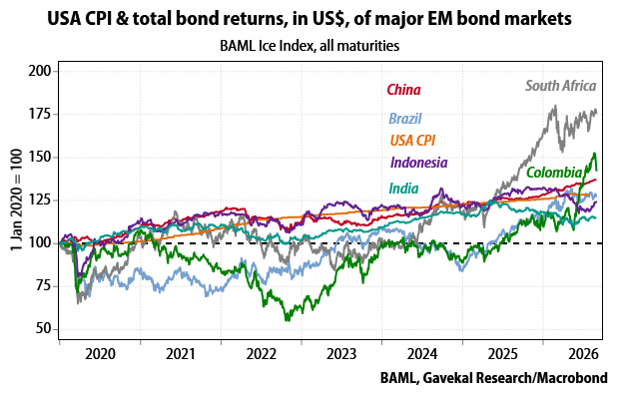
My take: Many market commentators say that bond market “vigilantes” will rein in politicians; they find US and other Western bond markets attractive at current yields. But I’m not sure it’s prudent to hang around these bonds to find out. You might just find yourself collateral damage in a showdown between the market and Western politicians.
3. Desert Lion
Desert Lion is a Delaware-registered fund that invests in South African equities. My colleague Rudi van Niekerk manages it. Being Delaware-registered means its target market is the USA. Despite the juicy returns on offer in South Africa, and the fund’s solid performance in US$ terms, it’s crickets from US investors.
Our inept, corrupt and morally bankrupt government presents a kind of double-edged sword. On the one hand, they set the governance bar lower and lower, but still consistently fail to clear it. This creates a poor business environment, weak investor sentiment, and a complete disregard for our market by foreign capital. Except if they’re trafficking drugs or laundering money, eagerly facilitated by our government, standing around with their palms outstretched.
On the other hand, it is exactly because of this that assets are so cheap here and offer such high returns – an opportunity the Desert Lion Fund is grabbing with both hands.
You can read Rudi’s latest letter here. Since inception, the fund is well ahead of the All-Share Index, something very, very few fund managers have been able to achieve. In US$, the fund has returned 10.1% p.a. over the 7-plus years it has been running. That’s juicy in anybody’s language.
My take: If I were a US-based investor, I would sit up and take notice. And for South Africa-based investors, you can access Rudi’s skill in the MWI Value Fund.
4. The Big Apple
Two mental models apply to Apple.
The first is that during periods of heavy capex spending, it’s best to avoid the big spenders. The ultimate winners will come from elsewhere. Amazon was probably the biggest beneficiary of the capex telcos spent building out the internet from 1998 to 2003. The other big winner, Google, didn’t even list until the capex binge was over, in 2004 (which was also when Meta was founded). The telecoms companies – i.e. the big spenders in the TMT bubble – all either went bust or were financially crippled.
The second is that, in most industries, from brewing to fund management, the one who owns distribution wins.
Apple wins on both counts. It is spending nothing on data centre infrastructure, probably because it knows its devices will remain the toll bridge through which customers access the hyperscalers’ products.
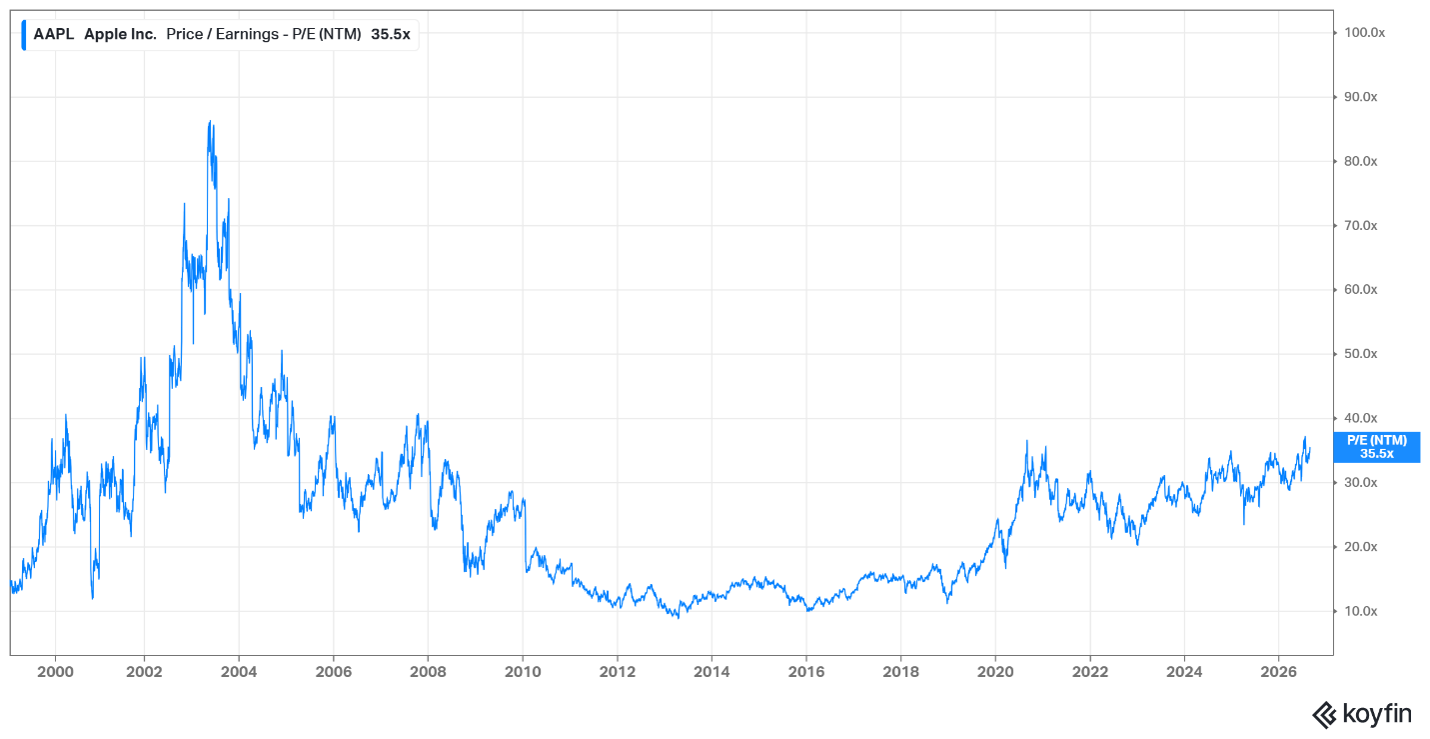
It’s no wonder Apple – the second most valuable company in the world – is reaching new highs relative to the S&P500:

This week brought news that Tim Cook is resigning after 15 years as Apple’s CEO. He leaves the company with shareholders having been richly rewarded. Investors who put $1,000 into Apple stock when he started would now have about $23,600, about 3.6 times what the S&P 500 returned over the same period.
Interestingly, he is handing over to John Ternus, who led the hardware side of the business. I guess this says a lot about what Apple thinks it is.
My take: Apple remains under consideration for inclusion in my 10 stocks, forever. Its strategy vis-à-vis the AI buildout supports this. However, it is still way too expensive to even consider right now. A P/E ratio of almost 40x is a bit rich. I liked it more at 10X, which was not that long ago.
5. AI Maths Doesn’t Math
This letter has around 2,500 subscribers. If I lend each one of them R1mn, with the proviso they invest it in the MWI Worldwide Flexible Fund (aka The Cockroach), I will have increased my AuM by R2.5 billion. The fee on the Cockroach is 1% p.a., so my revenue increases by R25 million.
If I do it again next year, my revenue will grow by 100%. In Silicon Valley terms, a business growing its revenues at that rate is easily capitalised at 50 times revenue. No accounting questions asked.
So, using Silicon Valley math, this newsletter is worth 50 X R50 million = R2.5 billion.
Voila! – a unicorn is born.
I’ll worry about the debt later. It’s off-balance sheet anyway. In any case, if it’s big enough, I’ll probably get bailed out.
My take: I’m raising a Series A round for 10% of this newsletter at a pre-money value of R2.5bn. Wait – I live in the real world, not Silicon Valley, so I can’t. What a pity.
In the cockroach
This week, I want to cover the equity portion of the fund*, which looks like this:
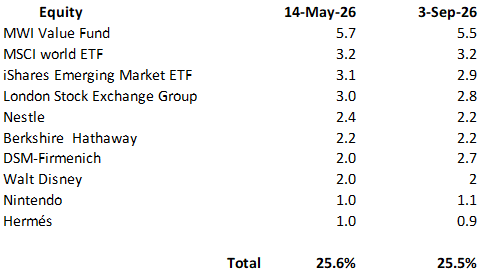
There have been no transactions since May. The percentage exposure has only changed because of relative price changes. But what is noticeable is how well DSM-Firmenich has done.
You have probably never heard of DSM Firmenich (DSFIR), but if you drink a sugar-free soda, spray a luxury perfume, or take a morning vitamin, you are probably consuming one of their products. DSFIR is a consumer ingredient company that, among other lines, produces flavours and fragrances.
This business meets the pattern of many good businesses in that
- It provides a small but important part of big things,
- It has high switching costs, and
- It is a consumable.
As a result, DSFIR has sticky clients, despite earning high margins. DSFIR is also much less capital-intensive and more cash-generative than most chemical companies.
The underperformance since its IPO two years ago reflected cyclical end-market weakness rather than structural deterioration. In fact, DSFIR has been transforming from commoditised compounds to more specialised, tailored solutions for a few years now.
Recently, the share price has started to notice, too:
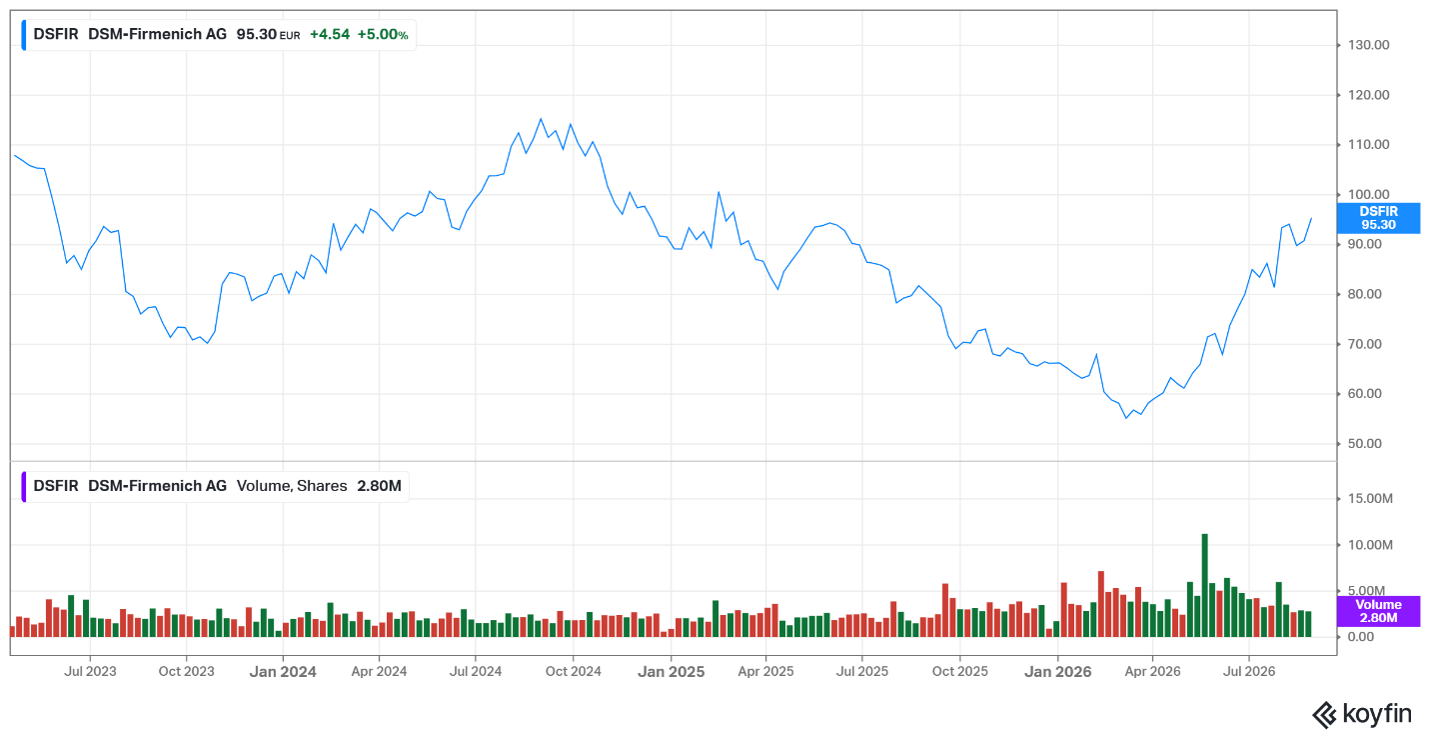
My take: Recent earnings reports seem to confirm they are on the right track. Current valuations in the sector are at 10-year lows, even though their long-term structural advantages remain intact. These tailwinds include increasing regulation, clean-label demands, and sugar/salt/fat reduction, which make reformulation a necessity largely independent of consumer demand cycles. It is for these reasons that DSFIR is one of the “10 stocks, forever” holdings in the MWI Worldwide Flexible Fund (aka “The Cockroach”).
The rest of the equity exposure comprises the other six of my “10 stocks, forever” (Berkshire Hathaway, London Stock Exchange Group, Nestle, Walt Disney, Nintendo and Hermès), some exposure to high-quality South African small and mid-caps via the MWI Value fund, and some broad index exposure, which are placeholders until I find the right opportunity to buy the other 3 of my “10 stocks, forever”.
* I manage the fund on behalf of Merchant West Investments (Pty) Ltd (FSP 44508)
In The Media
1. Sake-Liga update
As you might know, I serve on the board of Sake-Liga. Sake-Liga’s mission is to make the economy state-proof.
Although this is a Herculean task, Sake-Liga is making good strides under CEO Piet le Roux.
You can find an update on our activities here. You will also notice a “donate” button on that page. Please click it to support our mission. Organisations like Sake-Liga stand between us and chaos in our country.
2. Old Mutual Investival
I will be speaking at the Old Mutual Investival, to be held at Fancourt from 14 – 16 September. The Investival is a novel concept that blends entertainment with finance. Alongside the earnest financial types, there will be entertainment from comedians such as Alan Committie, rugby gurus such as John Smit, and even live music. Plus, me! You can view the agenda here.
If you are a financial adviser and would like to attend, please contact your Old Mutual representative. I believe there are still one or two places available. It looks like fun.
That’s it for this week, except to point out that September is – by far – the worst month in stock markets:
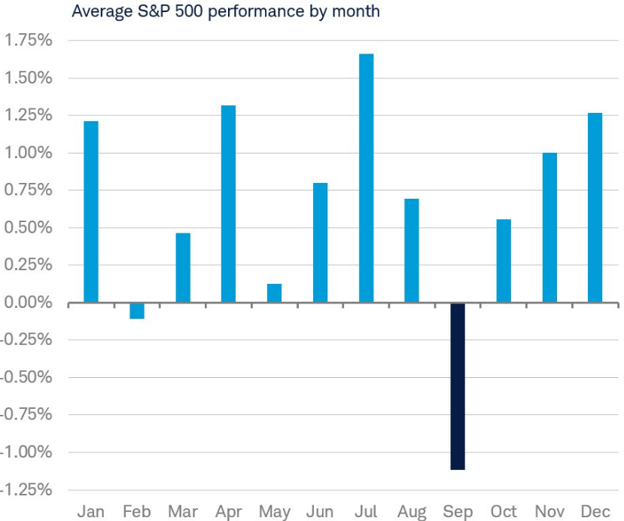
So, let’s be careful out there.
Piet Viljoen
RECM
3 September 2026