

Dear Fellow Investors and Friends,
Welcome to my newsletter, where I share my efforts to understand markets and the world around me.
I do appreciate you taking the time to read this. I love getting feedback; feel free to drop me a line. It’s great to start conversations.
Today is Thursday, August 20th, the 232nd day of the year. There are 133 days left in the year. The Ides of August are just behind us; seasons are changing and life moves on rapidly. Time waits for no man.
On 18 August 1988, at the height of political unrest, then Prime Minister PW Botha dismissed the possibility of black majority rule in South Africa. Only 6 years later, also on 18 August, Nelson Mandela delivered a speech marking his first 100 days in office.
History makes fools of us all, eventually.
With that as background, I would like to explore the current major global political development – the rise of China as a superpower – and how it will impact our investment choices.
I’ve spent some time in China this year on two separate trips. One was a holiday, the other more of a business trip, during which I met with several companies. What I saw deeply impressed me and sparked a train of thought that I will develop over the next few weeks.
These are simple thoughts on a highly complex subject. They are not meant to be the final word on anything – exactly the opposite. They are initial impressions that I hope to develop into something more concrete. So, bear with me while I put my ignorance on public display.
Over the past 20 years, China has rapidly developed into a global superpower. As a result, we are moving towards a multipolar world. The days of a USA-dominated unipolar world are over. This has significant long-term implications for our investments.
China seems to be on the up and up, while strong arguments suggest the USA faces headwinds. Despite this, the US stock market has grown to over 70% of the MSCI World Index, up from less than half 20 years ago. China makes up less than 3%. Countries in the Valeriepieris circle, where more than 50% of the world’s population lives, make up less than 15%.
This raises the question: do these indices reflect the world as it is, or as it has been? Investment returns come from the future, not the past.
Let’s start with the two superpowers. In a few important ways, they are similar:
- Both have strong nationalist leanings, fly their flags everywhere, and maintain a strong military presence. Government officials wield significant power.
- They are the world’s two largest economies. In terms of purchasing power, China’s GDP is much larger; per capita, the USA is wealthier.
- Surprisingly, they are roughly the same size, at around 9.7 million square kilometres.
- Both are extraordinary innovation machines, arguably the world’s two most important centres of technological progress.
- Both increasingly regard economic policy as part of national security policy and are pursuing technological sovereignty and industrial policy.
But their differences run deep and wide.
USA:
- It has a long history of armed conflict, from the Wild West and the Civil War to Korea, Vietnam, Iraq and Afghanistan – and now, Iran. Americans are an aggressive people.
- It has a large private sector and decentralised features, although the government is playing an increasing role in capital allocation.
- It is becoming more isolationist, maligning partners in Europe and neighbours such as Canada and Mexico. A less open economy means lower potential growth.
- Inequality is rising, with the divide between the super-rich and the rest widening. Financialisation is worsening the situation. US happiness is also in long-term decline.
- Capital is abundant, markets buoyant, and the bezzle is expanding. Speculation permeates markets.
- Political cycles are short. So are incentives, as reflected, amongst other things, in infrastructure quality.
- Capital is free to move, with a well-established legal and regulatory system.
- In Breakneck, Dan Wang describes the USA as a “lawyerly society”, focused on process and obstruction, where large corporates have captured regulators.
China
- It has a long history of isolationism – of keeping people out: the Great Wall, the Great Firewall, etc. With few exceptions, China has not sought armed conquest in the region.
- Intense, centralised control is gradually giving way to more decentralised private-sector initiatives, which could lead to higher equity returns and improved ratings.
- Geographic vulnerability encourages partnerships with neighbouring countries. Regional partners create trading opportunities and growth.
- Inequality is declining as people move from rural areas to cities and up the income ladder. Happiness remains below US levels but is rising.
- Markets are normal – there is little or no bezzle. Valuations are reasonable, and speculation is contained.
- The policy cycle is five years, but leadership tenures are much longer. Incentives are long-term and embodied in high-quality infrastructure.
- Capital controls are strict, and the legal and regulatory system is opaque.
- Wang describes China as an engineering state focused on building at scale, employing a top-down, heavy-handed, technocratic approach that suppresses individual rights and freedoms.
The key question is whether the USA and China are heading towards conflict. The Thucydides Trap suggests this is likely. However, direct conflict seems unlikely – the USA is protected by geography; China by size. More likely are regional conflicts, proxy wars and trade wars, with rising barriers to trade, capital and population flows.
What matters to us is not who wins, but how we position our savings to safely navigate what I think will be a tricky couple of decades. I’ll expand on this over the next few letters.
In The Markets
1. Sheer Driving Terror
In a recent profit warning, BMW highlighted its struggles in China, compounding an acute vulnerability to ongoing trade wars and a sluggish domestic car market. Like other German car makers, BMW has been hit by the rapid rise of Chinese rivals since the pandemic – in both global export markets, and on the upstart’s home turf in the People’s Republic. After it sold more than 700,000 vehicles in China in 2023, its sales this year will barely exceed 500,000.
The slump has forced the automaker to slash its 2026 profit outlook, signalling that Germany’s old, China-driven playbook is no longer viable. Recently, CEO Milan Nedeljkovic also said they would pull out of this year’s Paris car show – Europe’s most important annual car show – to cut costs.
BMW’s planned restructuring is likely to include drastic cuts to its German manufacturing base. Other German car makers are also suffering.
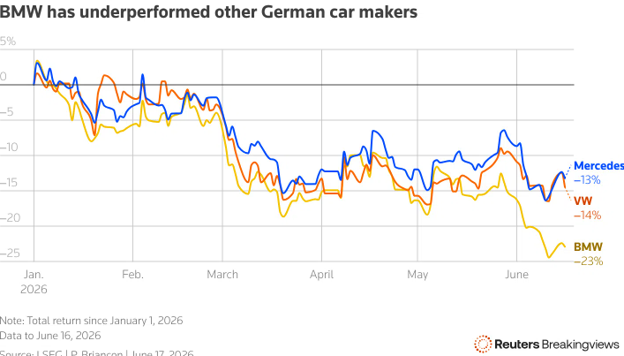
Although Volkswagen has outperformed BMW, it is also struggling. Last week, CEO Oliver Blume told staff that up to 100,000 workers could be retrenched. This would be one of the most extraordinary “right-sizings” in corporate history, underscoring the once-mighty carmaker’s challenges.
Once an industrial powerhouse, Germany’s automotive sector is now an expensive endeavour, thanks to high wages and even higher energy bills. In his memo, Blume estimated that VW has roughly a 20% cost disadvantage relative to peers. VW has a workforce of 680,000 and built about 9 million vehicles last year. Toyota, with a workforce of 390,000, built 2 million more cars.
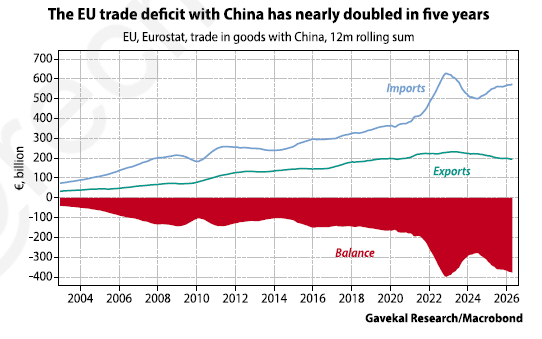
Because of decades of poor policymaking on energy, immigration, protectionism, and taxation, German manufacturing is no longer globally competitive. China is eating their lunch:
It’s amazing to see how BYD, a Chinese car maker, has taken global market share in a very short space of time. I don’t think they are anywhere near a ceiling, either.
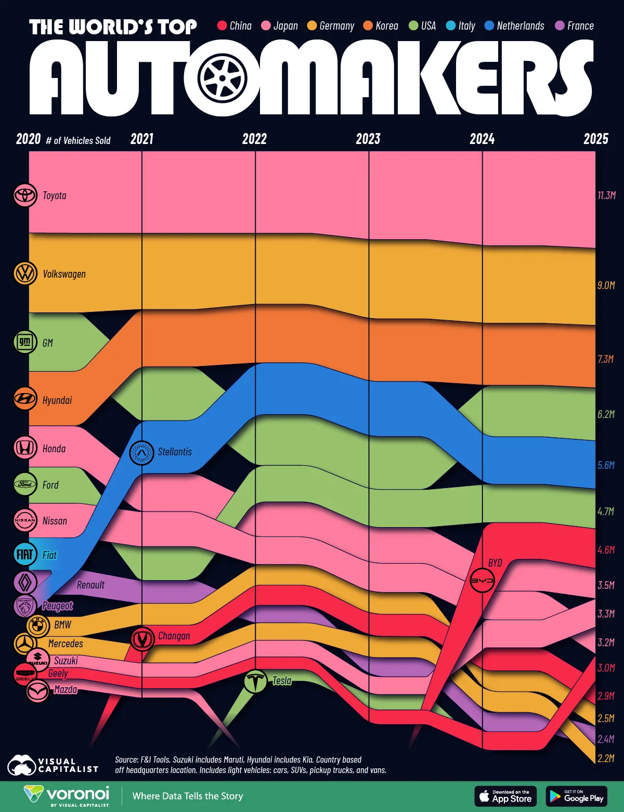
My take: VW owns a football team, VfL Wolfsburg, which used to play in the Bundesliga. In May, it was relegated. Is Volkswagen, together with BMW and Mercedes, heading for the second division of carmakers? Be that as it may, what’s happening in the motor vehicle industry is a microcosm of what’s happening across global industries.
2. The TPL trifecta
Chevron recently announced it would fuel a major data centre in West Texas with natural gas under a 20-year agreement. The data centre, called Project Kilby, is expected to consume nearly 2.7 gigawatts of electricity, enough to power about 2 million homes.
Kilby will ultimately consume approximately 1 billion cubic feet per day (bcf/d) of natural gas.
In a separate announcement, Texas Pacific Land Corporation (“TPL”) said it had agreed with Chevron to provide land and water resources for Chevron’s recently announced Project Kilby. As part of the agreement, TPL contributed surface acreage in exchange for cash consideration and the exclusive right to source aquifer-derived water for the power generation facility and other aspects of the project.
Not surprisingly, AI and data centres are at the heart of things in the US. When you look at the scale of the data centres being built, it’s not hard to see why. Meta’s Hyperion AI data centre, under construction in Louisiana, will cover more than 14 square kilometres. That’s almost the size of a major city, for instance, Manhattan, as evidenced by this image doing the rounds on the internet:

What’s more, data centres of the future are expected to be far more energy-intensive than those of today. NVIDIA recently noted that its new Blackwell architecture increases power demand “from tens of kilowatts to well over 100, with a megawatt [1,000 kW] per rack now on the horizon.”
Fortunately, the US has cheap energy in the form of natural gas:
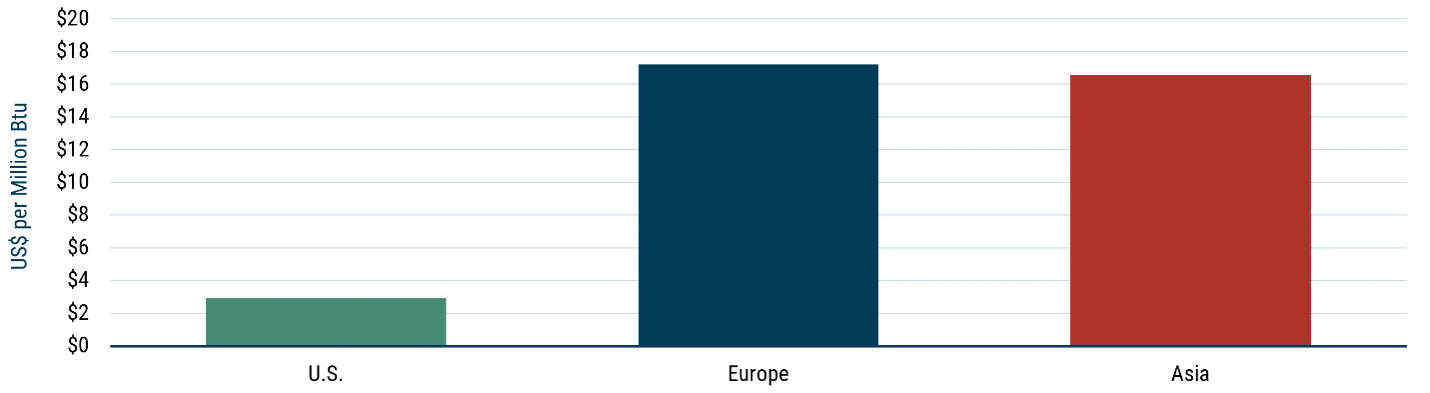
At the same time, US energy companies are seeking to capitalise on substantially higher natural gas prices worldwide by significantly increasing liquefied natural gas (LNG) export capacity. Projects under construction will double US export capacity, and approved projects could triple it. As new export capacity comes online, US natural gas producers stand to benefit from selling at higher global prices.
People have a simple choice: you can produce more energy or consume less. To its detriment, Europe has chosen the latter path, while the USA (and China) are firmly on the higher production path.
My take: As it happens, TPL provides everything the booming data centre industry needs – isolated land, water and abundant, cheap energy. A powerful trifecta, which is why the cockroach owns it in the “hard asset” portion of the portfolio.
3. Why we can’t have nice things
HCI – a MWI Value fund holding – has been in the news for the past couple of weeks.
Firstly, they released their annual report, which includes their CEO’s annual letter. This is always worth reading, and you can find it here from page 8 onwards. Its key message was that HCI sold some of its properties at full value and used the proceeds to repurchase its own shares at a significant discount to their underlying value. This is a masterstroke of capital allocation.
Over the years, HCI has been what is sometimes called a share-cannibal – a company that uses free cash to buy back significant amounts of its shares, thereby increasing the per-share value of the business – to the benefit of shareholders.
This is HCI’s history of shares in issue:
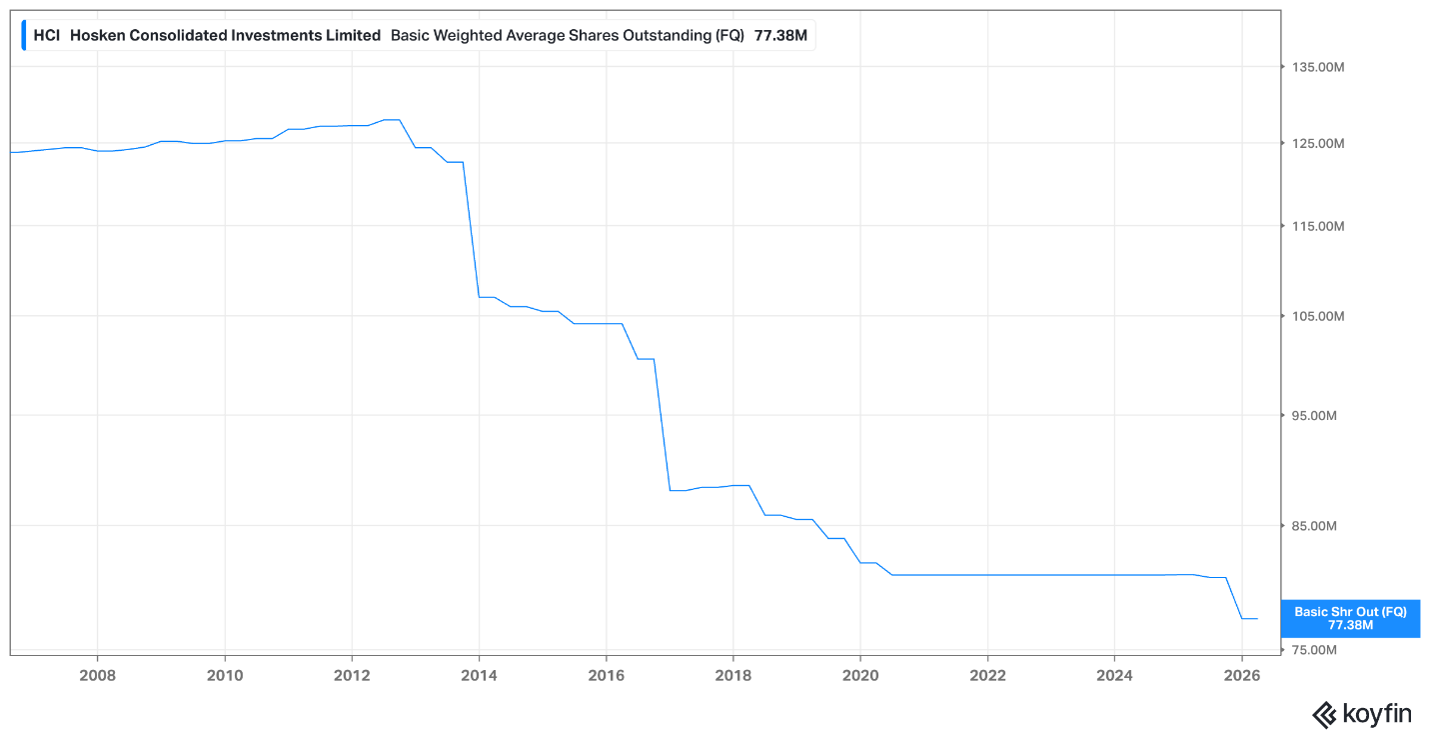
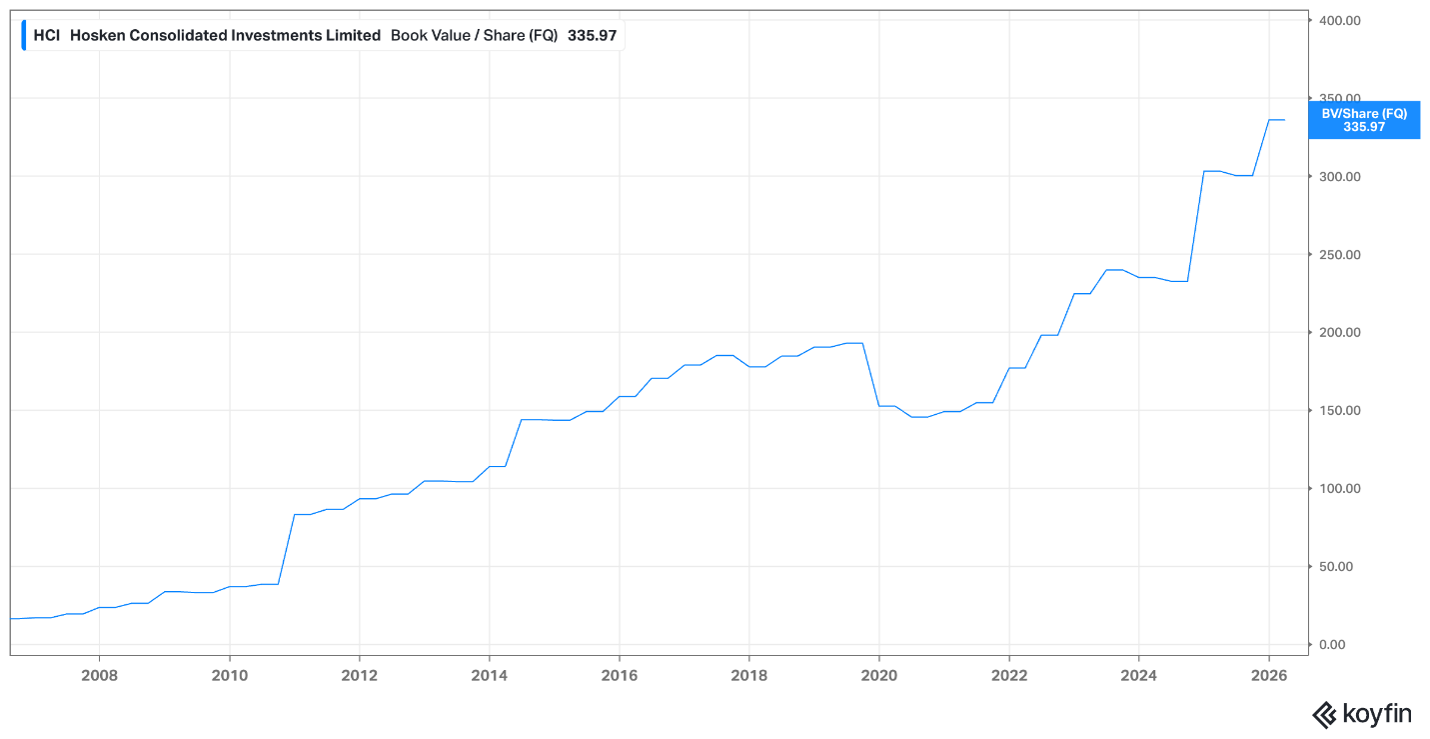
This has been a significant factor in their outstanding track record of increasing their NAV per share by c.16% over the past 20 years – better than the All-Share Index and much better than most (if not all) fund managers.
The second newsworthy event was CEO Johnny Copelyn’s announcement that he was retiring. Mr Copelyn was always going to retire at some point. But the way he is doing it – by gradually handing over the reins to seasoned insider Kevin Govender, executive director – fulfils one of the most important duties of a CEO: succession planning.
Mr Copelyn is a unique individual, and it will be impossible to replicate him. However, he is handing over a portfolio of assets that largely manage themselves. Any significant capital allocation decisions will occur only in several years, when (if?) the oil and gas assets start generating significant cash.
So NAV growth may be slower going forward. But at the current discount to NAV of close to 50%, the market seems to be implying that NAV will decline, which I sincerely doubt.
The third piece of news is that the Constitutional Court ruled against Africa Energy’s (an HCI subsidiary) right to conduct seismic studies off the Transkei coast, where a significant gas deposit is believed to be located. The parties who brought the application to stop these studies are a toxic mix of shortsighted social warriors. South Africa desperately needs cheap energy sources, which, if extracted and processed efficiently and responsibly, could raise the living standards of our entire nation. Instead, these so-called “green” environmentalists have chosen a path that will leave many, many people in our country cold and hungry.
My take: This is a setback for HCI’s efforts to develop an energy business. Time will tell how they handle it, but in the meantime, this is exactly why we, as a country, can’t have nice things. It’s sad.
4. Obliviousness
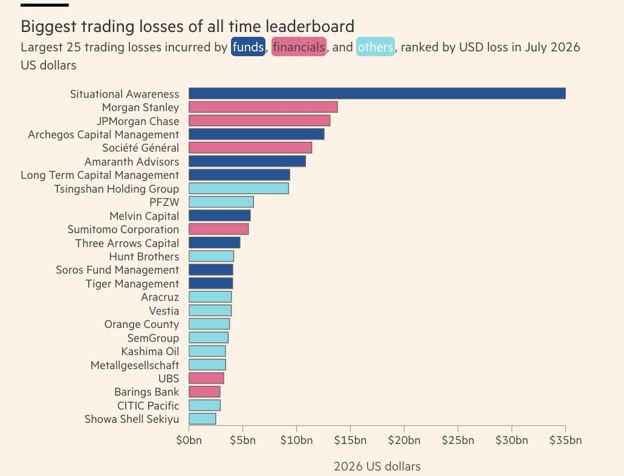
Long story short: a 25-year-old wunderkind, known as Leonard Aschenbrenner (ash burner, geddit?), is fired from OpenAI for leaking data. He then writes a 167-page treatise on how AI will change our lives over the next decade. This attracts the attention of Silicon Valley’s great and good, who invest $500mn in his newly formed hedge fund. The fund goes on to shoot the lights out, returning over 1,000% over the next two years, aided by generous leverage. His fund ultimately reaches AuM of $35 billion by June 2026.
It then imploded within 4 weeks, wiping out most of its investors’ capital.
I have some thoughts about this:
- Who entrusts a 25-year-old with no experience or track record with so much money? It can only happen in a market where speculation has finally destroyed common sense.
- Such astronomical returns can only be achieved by taking on significant debt. Leverage cuts both ways and invariably does. Situational Awareness was no exception.
- The fund followed the classic 2% (of AuM) and 20% (of specified upside) fee structure, which tends to encourage excessive risk-taking by management.
- To be clear, Mr Aschenbrenner did nothing wrong. He did exactly what he was incentivised to do: swing for the fences. Mistakes were made by investors who, out of greed or envy, invested too much of their net worth in such a fund.
- This type of fund, with its associated fee structure, often benefits managers disproportionately and leaves investors poorer. It’s a great business model, but a poor investment model. I am pretty sure Mr Aschenbrenner is not a poor man today, despite his fund blowing up.
- The 4D chess version is that the whole situation is a Potemkin Village set up by Silicon Valley insiders to mobilise funds from the market and push up their companies’ share prices. This would position them to either fund the business at attractive levels or allow insiders to cash in their options at attractive levels. But I’m sure that’s just a misguided conspiracy theory.
Meanwhile, the loss at Situational Awareness is significant. Remember how the loss at Long Term Capital Management roiled the markets in 1998? Books were written about it. It pales into insignificance compared with what Mr Aschenbrenner achieved at Situational Awareness:
My take: A business (such as Mr Aschenbrenner’s company, which managed the Situational Awareness fund) exists to create wealth. Investing has a different purpose: to preserve and carefully grow previously created wealth in real terms. Never confuse the two; choose the fund you invest in carefully.
In the cockroach
As usual, there have been no transactions over the past two weeks for the fund*. Steady as she goes. The bond positioning remains top of mind, which I discussed in July in Volume 4 No 25. Everything I said there still stands.
Today, I want to have a look at the hard asset portion of the portfolio, which looks like this:
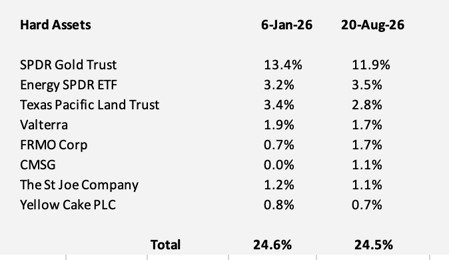
The only transactions this year have been adding to FRMO and introducing a new holding in CMSG (Consensus Mining and Seigniorage Corporation). The gold weighting has decreased due to the drawdown in the gold price. I would have liked to add to it during this drawdown, but the fund is limited to an initial 10% position in precious metals. According to the regulator, these are risky assets. TPL and Valterra have also recently experienced a price setback, although both businesses continue to perform very well.
CMSG is a new holding. It’s an investment holding company managed by the folks at Horizon Kinetics. In essence, it’s a crypto-mining business. It holds $60mn in cash and uses the interest earnings to fund its crypto “mining” business. It also owns 354 Bitcoin and 13,274 Litecoin, with a market value of around $21mn. It has mined these coins over time and keeps them on the balance sheet. That’s it. This brings the book value to around $35 per share. The fund acquired the shares at around $28. In my opinion, this is the cheapest and most efficient way to get Bitcoin exposure.
FRMO is also an investment holding company, managed by Horizon Kinetics. It holds five main assets:
- Cash, c.12% of NAV
- Equity in TPL, c.60% of NAV
- A diverse array of crypto-related assets, c.5% of NAV
- Equity in Miami International Holdings, which operates regulated financial exchanges and execution services for U.S. options, equities, futures, and international securities, c.5% of NAV
- Equity and a revenue share in the asset management business of Horizon Kinetics, c.20% of NAV.
All these assets are largely anti-fragile. FRMO is debt-free and run very conservatively. It has compounded its NAV per share by 16% p.a. over the past 15 years and is currently trading at a 15% discount to NAV. The only downside is that the share is illiquid, which limits the fund’s potential exposure to what I believe is a highly attractive asset.
* I manage the fund on behalf of Merchant West Investments (Pty) Ltd (FSP 44508)
In The Media
1. The Uni-context, explained
Why are we so unhappy when we undoubtedly live in the best of times? Across every single dimension – health, wealth and education – humanity is much better off than at any previous time in history. Yet our “happiness quotient” is not at its highest point today.
This fascinating interview attempts to explain our present sense of unhappiness. A context is a set of circumstances that tells you how you should act. For most of human history, contexts were local and multiple. If you wanted to know how you should act, you would look around. You would get guidance by looking at your physical environment, the people around you, and how they were acting.
But the rise of the internet has collapsed everything into a single context – everyone on earth has been forced into the same global room. In this world, comparison becomes more important – you start making comparisons you were never able to make before.
And it’s these comparisons that are making us unhappy.
In the pre-internet world, you compared yourself to your neighbour or the person sitting next to you in your local church. The people would be in very similar circumstances to you. But now every 22-year-old is comparing their life to some influencer or an overpaid football star, leading to unhappiness. This is because happiness is overwhelmingly influenced by your relative status, not your absolute status.
I’m sure I’m not doing this fascinating interview justice – but it does leave me feeling that stepping off social media is one of the better decisions I’ve made.
You can watch the entire interview here.
2. DeepSequel
In this podcast, Edward Chancellor interviews Laura Fyfe, an emerging markets analyst from Marathon Asset Management. It provides fascinating insight into how Chinese innovators and imitators are threatening Western businesses.
That’s it for this week. I’m back home for the first time in almost a month, with no travel planned for at least a few weeks.
This past week also brought a few birthdays in the family – my stepson Zac turned 26, and my other stepson Ben’s fiancée, Courtney, turned 27. It’s a joy to celebrate their birthdays and to see how well they have progressed over time.
Today would also have been my father’s 90th(!) birthday. Unfortunately, he never got to enjoy his old age – he died at 46. This motivates me to live as healthily as possible for as long as possible. That, and being able to compound my investments for a long time. In any case, happy birthday, Nic the elder! By the way, you would have been very proud of your grandson, Nic.
Piet Viljoen
RECM
20 August 2026