

Dear Fellow Investors and Friends,
Welcome to my newsletter, where I share my efforts to understand markets and the world around me.
I do appreciate you taking the time to read this. I love getting feedback; feel free to drop me a line. It’s great to start conversations.
Today is Thursday, July 16th, the 197th day of the year. There are 168 days left until the end of the year. Today is World Snake Day. For me, it’s just like any other day, and I’d rather not come across a snake.
On this day in 1789, King Louis XVI of France reinstated his finance minister Jacques Necker following riots at his dismissal. Necker was a reformist who was fired for trying too hard to get the country’s finances on a firmer footing. In the end, he was doomed to fail, as he was fired again in 1790. His dismissal is often cited as one of the factors leading to the storming of the Bastille, which marked the beginning of the French Revolution.
The French Revolution is widely regarded by sociologists as a quintessential example of crowd psychology and mass hysteria. It demonstrated how ordinary individuals can succumb to extreme, uncharacteristic violence and irrationality when swept up in collective fervour.
But there is also a large body of work that purports to show that crowds are generally quite smart. In fact, it’s the reason why active managers find it so hard to outperform the index.
This contradiction was brought home to me once again a few weeks ago when I gave a guest lecture at the GIBS (Gordon Institute of Business Science). I really look forward to these sessions; interacting with the students is a pleasure. What makes it such a pleasure is that the interaction is a two-way street. I not only give a lecture, but also get to spend at least 45 minutes answering their questions.
These are not undergraduate students there because they have to be, with no exposure to how life really works. No, these are MBA students, all with real-world jobs and experience. They’re probably paying for the course out of their own pockets.
By and large, the questions are good ones that force me to think on my feet.
Last month, at one of these sessions, I was asked to reconcile the concepts of “the wisdom of crowds” and “the madness of crowds”. As a proponent of indexation, I firmly believe in the wisdom of crowds. But as a value investor at heart, I also recognise the madness of crowds.
One of the students asked how to reconcile these beliefs, which seem to contradict each other fundamentally. The question was so obvious that it caught me completely off guard. My rambling answer was something along the lines of “Crowds often behave poorly, which explains why the madness of crowds is such a well-entrenched concept. But you, as an individual, can behave differently, enabling the crowd to be wise”.
Or some such drivel. And it bothered me, because I knew my answer was wrong.
Let’s use some examples to set up the arguments properly, to see why both concepts are correct, and don’t contradict each other. Starting with a quote by Charles Mackay, from his book “Extraordinary Popular Delusions and the Madness of Crowds“, first published in 1841.
Men, it has been well said, think in herds; it will be seen that they go mad in herds, while they only recover their senses slowly, and one by one.
He wrote the book to present his historical study of economic bubbles, scams, and mass hysterias. It explored famous historical events in which collective judgement failed. Mackay examined manias, ranging from financial bubbles (such as Tulipmania) to social delusions (such as witch-hunts and alchemy). He showed that these are not isolated events, but recurring patterns in human history.
Mackay concluded that emotions drive crowds to behave abnormally. Emotions such as greed, fear, and the desire for excitement can act as catalysts. Sound familiar? Those are exactly the emotions that have driven wild price gyrations in stock markets since time immemorial, or at least since the early 1800s.
Then, we had Mauboussin. In his article, “The Wisdom of Crowds“, he posited that market efficiency arises from the aggregation of diverse, independent, and often irrational individual views, where uncorrelated errors cancel out. He argued that you needed three conditions for crowds to be “wise”:
- A diversity of opinion, i.e., heterogeneous points of view.
- An independent aggregation mechanism – a way of bringing information together.
- The existence of healthy incentives – proper rewards for being right or wrong.
Mauboussin concludes that market failures and bubbles arise not from a lack of intelligence, but from a loss of diversity that leads to correlated behaviour and information cascades.
The upshot of the work of these two men is that crowds can be either wise or mad – it depends on the circumstances. So, the rule of thumb (for me) remains – index where markets are reasonably efficient and only seek out active management in those pockets where diversity has broken down.
In The Markets
1. SpaceX
It’s been a month since the most hyped new listing of all time: SpaceX.
Since then, it officially joined the-Nasdaq 100, qualifying under new fast-track listing rules which reduced the required trading history from at least three months to just 15 days and eliminated the minimum public float requirement.
Wall Street analysts have now had time to run the numbers. Of the 32 analysts covering SpaceX, only one issued a “sell” rating. Surprise!
There is, of course, evidence that analysts have a positive bias on stock recommendations, especially if the bank they work for is affiliated with the stock they are analysing. For example, just two months before Enron went under, 16 of the 17 sell-side analysts covering the stock rated it “buy” or “strong buy.” Most of them were from banks that did business with Enron.
The same happened in South Africa with Steinhoff. Mr Jooste smartly distributed his companies’ banking business widely, resulting in no negative recommendations on the stock just before the business imploded.
In other news, which was not widely reported on, China, for the first time, managed to ‘catch’ their first first-stage rocket booster. This puts them firmly in second place behind SpaceX, probably still 5-10 years behind. But it is not inconceivable that assumptions around SpaceX’s intergalactic-sized TAM might be reduced by Chinese competition over time. Just like almost all other capital-intensive manufacturing businesses.
Despite all the manipulation, hype and positive analysts, the market is slowly figuring things out:

Today, SpaceX is trading 10% below its opening price. You can buy as much as you like at the same price at which people were scrambling to get shares in the IPO (of which they got very few).
But it’s still not cheap. This week, Prof G posted this chart in one of his missives:

Are these analysts biased? You be the judge – but estimating a single company to be worth more than all the companies in some of the world’s biggest economies does not smack of conservatism. I hope for their sake their employers get a lot of business from SpaceX.
My take: Excitement is the enemy of the rational investor. Hopefully, you ignored all the snake-oil salespeople who were trying to use this listing to generate more fees for themselves. I hate people who say I told you so, so I’m not gonna say it.
2. Don’t be a duck
Speaking of IPOs to avoid, here’s another one: Korean memory chip maker SK Hynix raised US$27 billion through a placing of ADRs on the Nasdaq (ADRs are a mechanism for companies to list shares on secondary, foreign markets).
Just as SpaceX was the largest-ever IPO, SK Hynix became the largest-ever share sale by a foreign company in the US, surpassing Alibaba’s US$25 billion raised in 2014. That old market saying, “feed the ducks when they quack”, springs to mind, because right now they are not quacking; they’re screeching like geese.
SK Hynix says the proceeds will be invested in new chip facilities, which could lead to a memory chip glut two years from now. Of course they will – this is why cyclical industries are cyclical. Capacity gets added until there’s too much.
SK Hynix isn’t the only memory maker expanding. Micron is planning a $150 billion buildout in the United States, and Samsung and Hynix (again) are targeting $516 billion in capital expenditures in South Korea.
If your share price chart looks like this, wouldn’t you also be raising as much money for expansion as you could (even if it is already down a third from its most recent high)?
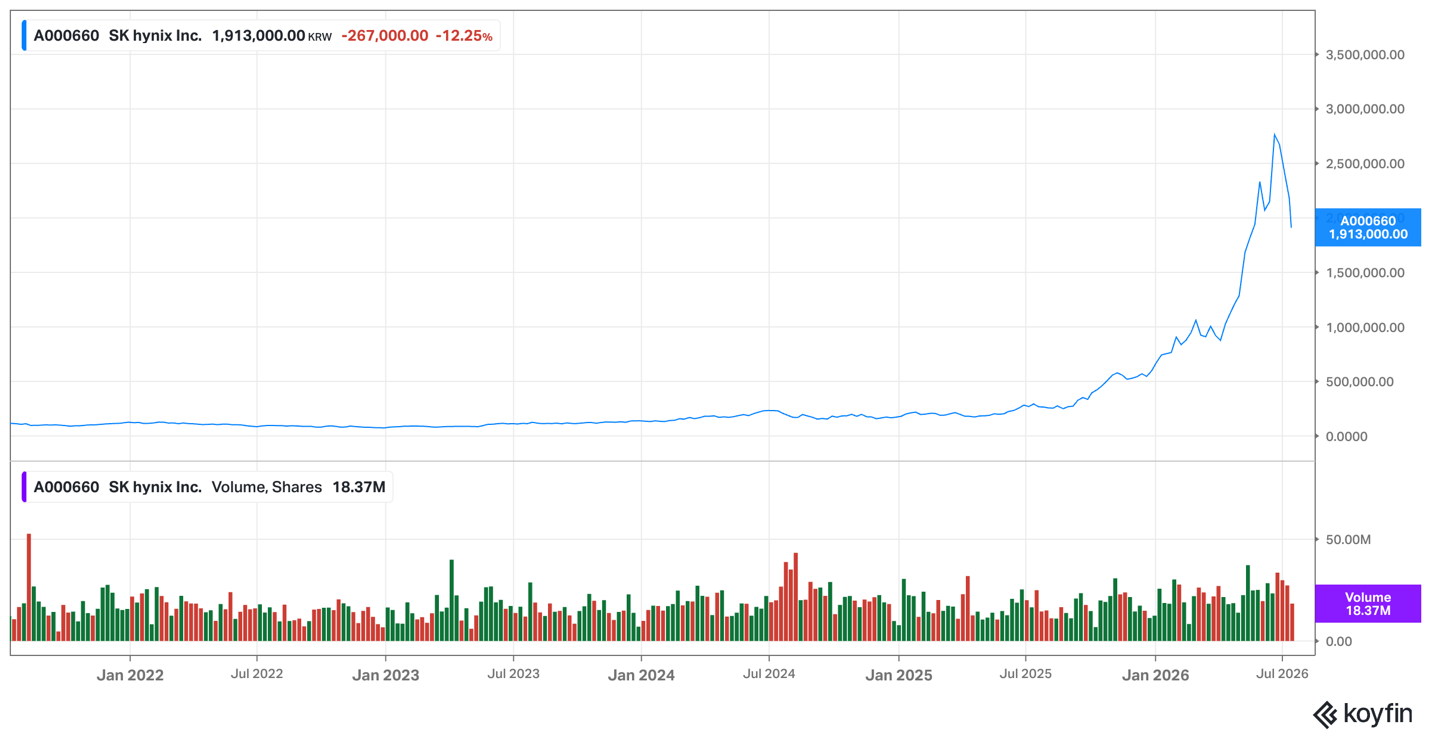
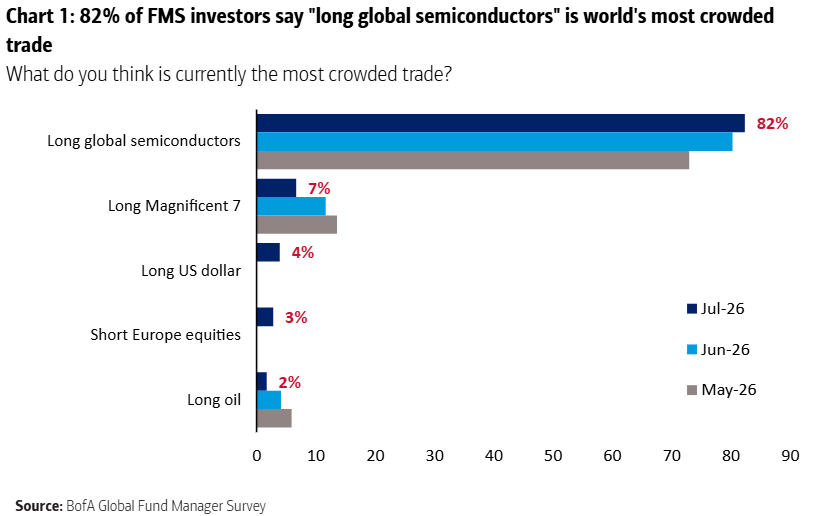
Remember, one of the conditions for the crowd’s intelligence level moving from thoughtful and wise, to raccoon-on-crack crazy, was the breakdown of diversity. That seems to be happening in the market right now.
This chart, which John Authers showed in his Bloomberg column today, shows that the semiconductors sector – i.e. chipmakers like SK Hynix – is the most crowded trade in the world right now:
The previous frenzied, capital-intensive infrastructure build-out was the internet in 1998 – 2003. The winners from the internet were not the infrastructure providers like Worldcom, but companies that faced deep downturns during the inevitable crash – Amazon, Apple, Microsoft, or companies that weren’t even listed at the time: Meta (Facebook), Google (Alphabet) or Netflix. In fact, many of the high-capex companies went bankrupt, despite building out life-changing infrastructure:

(chart courtesy of Grants Interest Rate Observer)
When companies raise capital in other countries, like Korean SK Hynix is doing in the USA, it is generally a sign of one or both of the following:
- Their stock is overvalued
- The market in which they raise capital is overvalued
In 2016, Schroder European REIT and Hammerson PLC listed ADRs in South Africa. These companies were not being generous by offering South African investors an “opportunity to diversify”; they were taking advantage of an absolute mania for property stocks to raise capital cheaply.
Today, Schroders is busy delisting after a decade of disappointing performance.
Hammerson is trading at a third of the price at which it offered its shares to excited South African property investors:
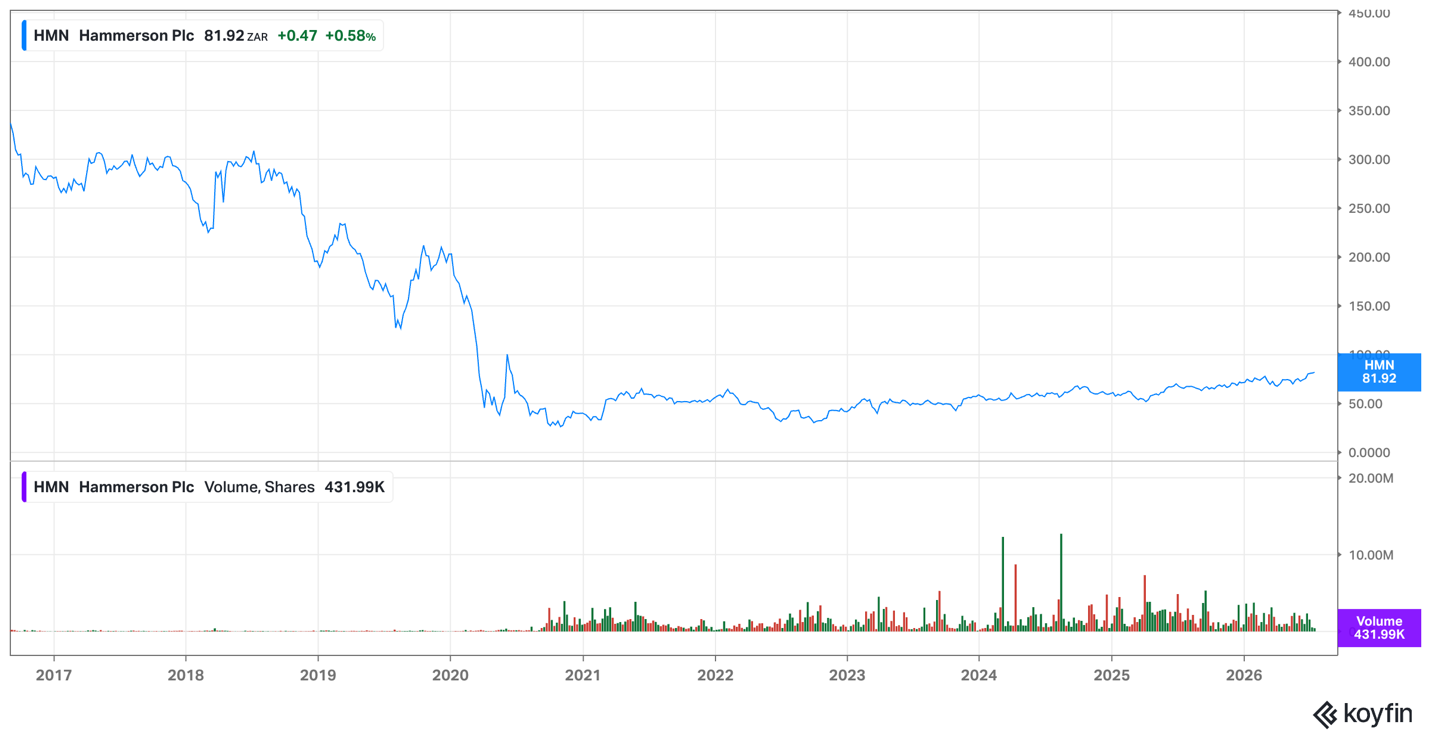
My take: Might Korean memory stocks be facing a similar future to that of Hammerson and Schroders, if not WorldCom? Remember, companies doing IPOs are not being kind and generous – they are simply feeding an excitable flock of quacking ducks.
3. Tax avoiders of the world, unite!
If you’re on Strava like me, it’s a guilty pleasure to check in to see where people you know are running/riding/walking, etc. Right now, it looks like many of them are in Greece. It’s not clear whether they are on holiday or trying to get residency to avoid South African tax, but it feels like an opportune time to have a look at the Greek stock market.
Recently, MSCI elevated Greece to developed market status. This is significant for a country that had to be bailed out after effectively going bankrupt during the European sovereign debt crisis of 2010. Greece was the only Eurozone member without that status, having been downgraded to “emerging” status in 2013. Despite this “second-class citizenship” until recently, its stock market has performed commendably:

Despite its bankruptcy 15 years ago, the Greek benchmark 10-year yield is now trading at 3.77%, or 75 basis points below the yield on comparable US debt(!).
Greece’s fiscal trajectory runs counter to the rest of the world. Last year, Greece recorded a primary surplus of 4.9% of GDP, equivalent to €12.1 billion – for the third consecutive year. Greece has also delivered the fastest and most substantial debt reduction in the eurozone: the debt-to-GDP ratio fell by 63 percentage points, from 209% in 2020 to 146% in 2025.
Despite the recent positivity, Greece has underperformed the world by 99% over the past 20 years:

Source: Hellenic Prosperity Fund (HPF)
My take: Will the next 25 years be different? Does a leopard change its spots? With their newfound fiscal responsibility, maybe Greece is a good place to hunt for bargains… but I will leave that judgement up to those who choose to become citizens. I have enough excellent businesses that are still tainted with the “emerging market” epithet to look at here in South Africa, thank you very much.
4. Football is life
Twenty-six years ago, Argentina was suffering economically, having sunk into a great depression. Like South Africa or China today, it was considered uninvestable, and the currency plummeted after the 2001 decision to abandon its one-to-one peg to the US dollar. In 2002, their football team (La Albiceleste, the white and sky blue) failed to advance beyond the group stage after losing to England.
Two years ago, Javier Milei was voted into power, giving him the opportunity to implement what he termed his “anarcho-capitalist” libertarian economic policies.
Since then, their economy has improved.
- Inflation is down to around 30% from the world’s highest rate of 230% before he was elected.
- The national budget is in surplus, achieved through significant cuts in government expenditure.
- GDP growth is picking up – the IMF expects 4.5% growth this year.
Even more impressively, since Milei’s election, their stock market has outperformed the “Magnificent 7” (the Alphabets, Microsofts, Nvidias and Metas of the world):

My take: Yesterday, Argentina, the current holders of the football World Cup and finalists in the 2026 edition, beat England convincingly. Can Argentina win the World Cup again? With magician Lionel Messi still leading La Albiceleste, a title defence is realistic. It could also be a powerful boost to the pragmatic economic policies of Milei.
5. Is Terry Smith giving up?
For those who don’t know, Terry Smith is an investor and the celebrated founder of Fundsmith, an investment house that prides itself on buying quality companies. He even wrote a book titled “Investing for Growth, how to make money by buying only the best companies in the world.”
Doesn’t that title make you want to go out and buy the stock of these great businesses? Or at least invest in his fund. Well, it’s a good thing you didn’t, because over the past 5 years – since the book was published – Fundsmith has underperformed the MSCI World by around 40%.
The underperformance has been so bad that his eponymously named firm is facing an existential crisis. Clients are deserting the sinking ship. AuM has declined to £16bn from a high of £29bn in 2021.
I want to be careful not to sound facetious about this. RECM endured a similar situation in 2015/16. We lost 75% of our client base due to a long but temporary period of underperformance. It’s not pleasant, and it left deep scars on me and the people around me (you can read more about that unpleasant time here).
So, I have a lot of sympathy for what Mr Smith and his people are going through. I would not wish it on my worst enemy.
In his book, he described his investment philosophy:
- Buy good companies
- Don’t overpay
- Do nothing.
Simple, isn’t it?
Except that it stopped working almost as soon as his book was published.
This week, his semi-annual letter to shareholders landed. It describes the biggest shift in Fundsmith’s approach since the fund launched in 2010. Portfolio turnover of over 50% in six months, twelve new positions and thirteen exits – not exactly doing nothing.
Most active strategies ask you to endure long stretches of underperformance while maintaining faith that the manager’s process still works. Sometimes that faith is justified. Often it is not. When it is not, you either fire the manager or the manager changes what they do and how they do it. Fundsmith, after enduring too much of option 1, has decided to go to option 2. To change your philosophy takes tremendous guts, but when what you are doing is no longer working, you have no choice.
My take: One thing I have learnt is never to be too rigid about your investment philosophy. You need to adapt and change, because the market eventually figures you out. Terry Smith and his team are going through a hard but necessary pivot. Hats off to you, Mr Smith!
In the cockroach
This week, I want to have a look at the bond portion of the fund*.
Two aspects are important here.
The first is that after a 40-year bull market, US 10-year bond yields entered what I believe to be a long-term bear market in 2021. Here’s a long-term chart of this yield:

It only goes back to 1961, but the previous bear market started after WW2, in the late 1940s, with yields eventually peaking around 15% in 1981. The 10-year US Treasury yield is the asset on which most assets are priced. The 40-year bull market in yields has been a massive tailwind for most asset prices in my lifetime. This may be turning into a long-term headwind.
The second is that Japanese 10-year yields hit 2.9% last week, the highest in 30 years. Simultaneously, the yen is hanging around a 40-year low of 162 to the dollar. Here’s a long-term chart of the Japanese 10-year yield:
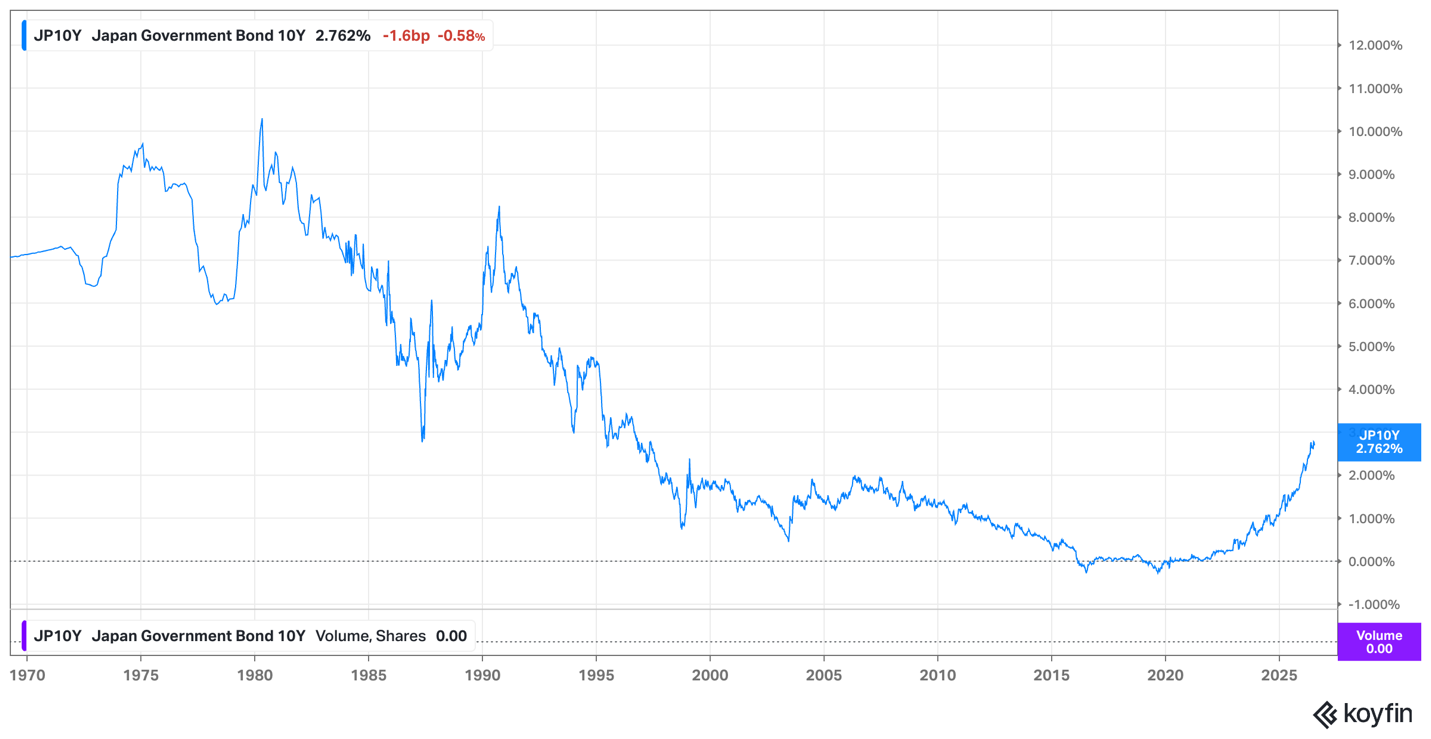
As expected, on Friday Japan’s Finance Minister suggested that Japan would “steer” the Government Pension Investment Fund (the world’s largest pension fund) to “substantially” boost domestic holdings.
Is this the start of capital controls in Japan, forcing local institutions to buy Japanese bonds?
If so, that would be bullish for the yen, the most undervalued currency in the world.
The bottom line here is that the biggest developed world bond markets have entered long-term bear markets.
The Cockroach is avoiding developed market bonds, apart from a small allocation to Japanese long-dated bonds. Emerging market bonds offer higher yields on the back of better fiscal situations.
This is what the Cockroach’s bond position looks like right now:
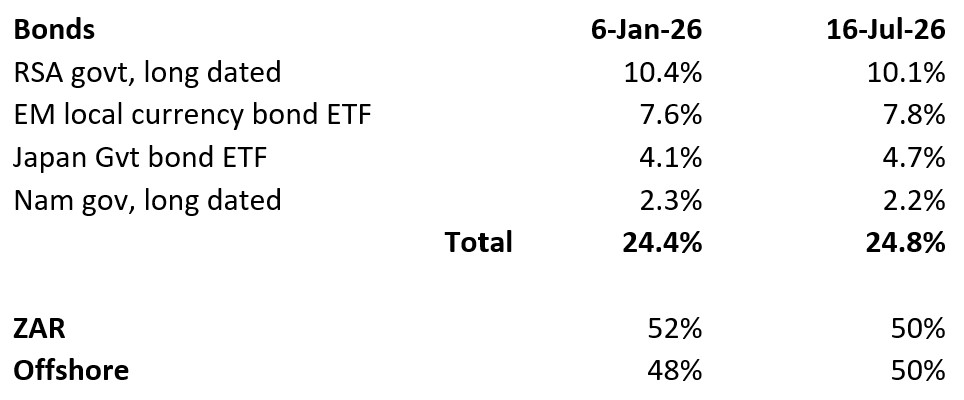
There have been no transactions in this part of the fund this year; any changes in exposure are purely due to market movements. You can read what I wrote about the fund’s bond exposure earlier this year here, here, and here.
* I manage the fund on behalf of Merchant West Investments (Pty) Ltd (FSP 44508)
In The Media
1. V02 Max beats Dementia
As I mentioned last week, one of the basic prerequisites for being a long-term investor is actually being alive for the long term.
There are two ways you can go about achieving this:
- Rely on luck and really good genes like Warren Buffett and Charlie Munger.
- Do everything you can to maximise the odds of a long, healthy life.
One of the things I am most scared of is being physically healthy, but getting dementia or one of its neurodegenerative cousins.
A high VO2 max is an indicator of high cardiovascular fitness, which, in turn, is linked to better metabolic health. Impaired metabolic health is a risk factor for Alzheimer’s disease. Not only that, but a higher VO2 max is one of the strongest predictors of how long you will live.
You can read the full article here, but the good news is that “the levels of fitness that are linked to a significant decrease in dementia risk are within reach for anyone. Generally speaking, the lower end of the fitness range in the “high fitness” groups in this study falls near the 50th percentile for VO2 max values in the general population. You do not have to have the fitness (or fortunate genetics) of an elite athlete to reap the benefits of fitness on brain health.”
If you want to test your VO2 Max, this will help.
2. On Tokyo
Regular readers of this letter will know that I love Japan.
And Tokyo is the best city in the world.
By far.
This article explains why. It was written two years ago. The yen is cheaper now, and the city is even better. Take it from me, it is a real joy to spend time in Japan.
Enough said, book your flights now.
For all the punters out there, here’s an inside tip: both horses are at 5:1 and joint favourites for the big race.
What’s more, they are racing in the colours of the late Jack Mitchell’s daughter, Nancy. A very long time ago, Jack was my boss at Allan Gray. He was probably the person who taught me the most about investing; for which I am eternally grateful. On top of that, he was a true gentleman.
If only for his sake, I hope these horses come in at one and two! I might even put some money on that.
That’s it for this week. Except to say that it always pays to be careful out there. Even if you are fortunate enough to find yourself in Japan.
Piet Viljoen
RECM
16 July 2026