

Dear Fellow Investors and Friends,
Welcome to my newsletter, where I share my efforts to understand markets and the world around me.
I do appreciate you taking the time to read this. I love getting feedback; feel free to drop me a line. It’s great to start conversations.
Today is Thursday, March 19th, the 78th day of the year. There are 287 days until the end of the year. The countdown is relentless; a reminder to make the most of every minute you have.
On this day in 1962, Bob Dylan released his eponymously titled first album. He went on to become one of the world’s most influential music artists. His songs “Blowin’ in the Wind” and “The Times They Are a-Changin’” became anthems for the anti-war movement.
Also, on this day in 2003, the Iraq war was launched by President George W. Bush, completely disregarding Dylan’s anthems. Despite the best anti-war sentiments efforts of poets, novelists and artists through the centuries, war is ever-present. Humans are an intensely competitive species; war is simply a reflection of their nature.
Although war has been a constant presence in our journey through time, it doesn’t pay to be negative. Another characteristic of human beings is their ingenuity, which enables them to overcome adversity and flourish. Just compare how many wars there have been since your grandfather was born, and then compare the quality of the life he led with yours. Human ingenuity at work.
They say a picture is worth a thousand words. Well, here’s a chart that’s worth a couple of books:

It proves that, for the human species, things have unequivocally improved over the past 200 years. Poverty is down, people are way more educated, and literacy rates are skyrocketing. Vaccinations are up, leading (at least in part) to longer, healthier lifespans. Importantly, child mortality has dwindled to almost negligible levels.
Why do we tend to think like the guy on the left? Given the fundamental truth about the quality of life we enjoy, we should think like the guy on the right:

There are a few reasons. In no particular order, they are:
- Bad news sells. There’s an old saying in the journalism industry, “If it bleeds, it leads”. Make no mistake, attention is what journalism sells. They sell your attention to their advertisers. Imagine a world where someone tried to get your attention by saying, “Everything is fine. Don’t worry, it’s just unicorns and rainbows everywhere.” You would think they were insane. And you wouldn’t buy what they were trying to sell. But, compared to 200 years ago, it is almost all unicorns and rainbows.
- Humans don’t have horns, tusks, thick skin or fur, sharp claws or teeth. We are physically the most vulnerable species. What we have are our instincts and reactions. Humans are hardwired to expect the worst; that’s how we survive in the wild. So, when things are going well, we tend to focus on the negatives. Our instincts tell us there is danger, and we need to prepare.
- Humans are morbidly curious. Airplane travel is statistically one of the safest forms of travel – yet we are collectively terrified of air travel. Possibly, a direct result of hit TV programs like “Air Crash Investigations”. Be that as it may, we love watching reality shows that feature bad outcomes. Which is why we get more such shows over time, reinforcing our belief that bad things happen more often than they actually do.
- Related to this, is the fact that we tend to experience negative outcomes viscerally. Last year in South Africa, roughly 12 000 people died in car crashes, 100 cyclists died in accidents and 1 person was killed by a shark. Yet we are super scared of shark attacks and bicycle accidents, but suffer from no anxiety at all when we get into our cars. The appearance of safety makes us complacent about real risks, while a sense of vulnerability makes us over-index on the risks of cycling or swimming.
Over time, equity markets go up. But volatile daily price movements make us feel vulnerable to the uncontrollable vicissitudes of market forces. As a result, we find comfort in the platitudes of the doomsayers.
Because there is so much bad news around (see point 1), focusing on the negatives always seems prescient. No one wants to be that person who ignored Cassandra’s warnings. But the reality is that many market Cassandras predicted 20 out of the last three crashes. And identified 50 of the last 2 bubbles. Investors buy their funds because, surely, they are the funds that have prepared for the worst and will protect our savings? (see point 2)
But the reality is that the market tends to rise over time. Here is a chart of the S&P 500 over the past 20 years:

The crash after the TMT bubble, the Global Financial Crisis, and the Covid panic all look like small blips on an exponentially upward-curved chart.
If you had bet on stocks crashing or going down as often as the Cassandras would have wanted you to, the odd blip up or down might have vindicated your feelings temporarily. But if you had instead bought the index and stayed the course, your finances would have been in much better shape. And if you had supplemented your index exposure now and then with an asset class that was hopelessly undervalued (value stocks in 2000, staples in 2006, tech stocks in 2014, EM bonds in 2024, SA small- and mid-caps in 2025, etc.), your asset base would have been off to the races.
Chris Williamson, host of the Modern Wisdom podcast, recently wrote:
“Because worrying is so common in every pursuit you attempt, your successes are seen as proof that worrying is a performance enhancer, and your failures are proof that you should have worried all along.”
He termed this “Unfalsifiable Negativity”.
Negativity is not a wealth-enhancing state of mind.
In The Markets
1. It’s not the economy, stupid
Would you buy shares in an economy where the central bank is politicised, with three governors over the past 6 years?
An economy where the headlines say:
- Inflation is currently running at 30%, having averaged 48% for the 5 years since 2020.
- 10-year bond yields are currently at 31%, up from 6.3% in 2013.
- GDP growth is around 1.5% p.a.
- The current account deficit is $20bn, or 1.2% of GDP.
The numbers make our economy here in South Africa look positively vibrant. Given our perpetually negative view of our own country’s economic situation, we would be mad to buy shares in the Turkish market. Right?
Here’s the Turkish market ETF in US dollar terms:

The market has doubled – in US dollar terms – over the past 4 years.
My take: The market is not the economy. Be careful when you overlay macroeconomic views, which we all love to talk about and forecast, onto stock market expectations. Companies are, by and large, run by smart, innovative people who can help them transcend the obstacles governments put in their way. Paraphrasing Jack Nicholson in As Good As It Gets – “Go sell your negativity somewhere else, we’re all stocked up”.
2. Easy come, easy go
Recent resignations at the top of several listed companies made headlines. Both Roy Bagattini (the CEO of Woolworths) and Leila Fourie (the CEO of the JSE) resigned after serving six years in their respective roles.
Both did well financially. But how did shareholders fare? After all, the CEO is appointed by shareholders with the primary aim of increasing the company’s value.
Isn’t that right?
Yes, I understand that (according to the widely accepted standard – the King Code) other stakeholders also play an equally important role. However, as I am led to believe by all the corporate governance consultants, considering all these stakeholders in their diverse richness will boost the firm’s value.
Won’t it?
Let’s have a look.
Here is how Woolworths’ shareholders fared during the Bagattini reign:

It’s evident that the intrinsic value of Woolworths did not increase significantly. Revenue grew by 1,4% per annum, the NAV per share increased by 3.2% per annum, and the earnings and dividend per share declined. The share price reflected this stasis, increasing by only 1% per annum over the six years.
I’m not sure how the other stakeholders fared, but I can refer you to the 114-page Good Business Journey Report, which forms a significant part of Woolworths annual report. It ticks all the King code boxes: “Managing Sustainability”, “Social Development”, “Ethical Sourcing”, and even includes a nod to the Greta Thunberg fanboys in the “Energy and Climate Change” section.
What it doesn’t do is explain how the CEO’s remuneration could grow at a compound rate of 23% during this period of stagnation for shareholders.
I’m sure the members of the remuneration committee know, though. Here’s another interesting table for you:

Their report makes up 24(!) pages of the annual report. I’ve tried reading it, but I can’t make heads or tails of what it is trying to achieve. What it did achieve is a gross injustice. And shareholders paid this committee a total of R8.9 million for this dubious achievement.
Of course, under the King Code, all the members of the remuneration committee are classified as independent directors – which means they don’t own shares in the company. But given how much they’re paid, they obviously don’t have the appetite for a heated discussion with management about pay. And the numbers prove it.
Ann Crotty gives a lot more colour to the value destruction under first Moir and now Bagattini that Woolworths shareholders were subjected to in this well-written article.
There are just too many cases like this in the listed company universe for it to be a coincidence.
Here’s another one – the JSE itself. Let’s have a look at how their shareholders fared under Fourie’s reign (based on 2020 to 2025):

This is a less egregious example, but once again, it is clear that shareholders are last in line to receive the economic benefits from the activities of the firm. Their 71-page “Sustainability Report” details their “transformation approach”, their “path to net zero”, and their support for “internationally proclaimed human rights”, etc.
But it doesn’t explain how the CEO’s remuneration can grow by well over double the rate at which the company’s intrinsic value grew. Fourie’s remuneration grew by a healthy 16% p.a. vs. revenue at 6,1%.
Maybe this group of people can explain the situation:
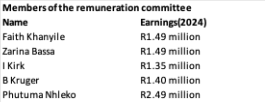
Again, according to the King Code, they are all independent. But their pay makes them beholden to management, which makes them non-independent in my books.
My take: Executive remuneration at many JSE-listed companies is a disgrace. For this, I put most of the blame on the King Code. It has achieved exactly zero alignment between executive pay and shareholder outcomes, which is not sustainable.
3. Hedging against inflation
For quite a while now, I have believed there is a significant chance that the world could be entering an inflationary period. This view is based on the cost of prioritising local over global supply chains, the need for (Western) governments to reduce nominal debt levels relative to their economies’ size, and the resource demands posed by multiple regional wars.
The best way to hedge against inflation is to own real assets, which I wrote about two weeks ago in “The Real Thing”. Unfortunately, collective investment scheme regulations limit the Cockroach (aka the MWI Worldwide Flexible Fund) to only 10% exposure in precious metals.
This leaves 15% of the fund to be allocated to other real assets. For me, energy has been a preferred choice, and this has worked very well. But what else?
The regulations don’t allow the fund to hold Bitcoin. Land is an option, but it’s not easy to find listed assets that consist solely of land. Most people think property will protect them, but in my opinion, property is a depreciating asset, not a real one. I avoid it as far as possible.
The second-best thing is to invest in a company with very low variable costs – i.e. high-margin businesses. Royalty companies fit this bill.
TPL (one of my favourite stocks) has a gross margin of 93% and an operating margin of 75%. It employs around 100 people and generates almost $1bn in revenue. If input costs were to accelerate, it would barely notice it.
Another class of companies with high margins is stock exchanges, which also benefit from higher nominal share prices, as some of their fees are ad valorem on trading values.
But which specific stocks to buy? I don’t have the time, skill, or inclination to trawl the world for such businesses and then analyse them. Fortunately for me, a few years ago, Horizon Kinetics launched an ETF called the “Inflation Beneficiaries ETF”, with ticker $INFL. Here is how it has performed since launch:

And here’s what it owns:

Note: it doesn’t own a single property REIT. Correctly so.
My take: Due to a quirk in the rules governing collective investment schemes, I am forced to look beyond Gold, Platinum, Silver, and Bitcoin for real-asset exposure. Royalty companies and exchanges are not perfect, but they are a good second choice. And INFL is a one-stop shop for this type of exposure.
In the cockroach
Speaking of which, yet another week has gone by without a trade in the fund*. You might ask, given current market volatility, why not? The answer is simple: the fund is designed to handle whatever the market throws at it. If I were forced to trade, it would mean the fund was misconfigured.
One thing I have been thinking about in the fund is its bond exposure, which always makes up 25% of the total. This is what it looks like, currently:

Interest rates (bond yields) follow long cycles of about 40 years. After the 2nd world war, the yield on US government bonds bottomed out at c. 2.3% by the end of 1945. They then followed an upward trajectory, peaking at c 16% in 1981. A long-term decline followed, with yields ultimately troughing at 0.5% in 2020.
For various reasons, I believe we are in another 30-odd-year bear market in bonds. These reasons include, but are not limited to, the following “national emergencies”:
- Highly indebted Western governments,
- that are intent on “re-shoring” supply chains,
- and are fighting wars on numerous fronts,
- facing the biggest oil shock ever,
- while private credit, which has grown rapidly, is facing convulsions.
In the light of these “national emergencies”, the least painful political choice will be to ditch freedoms. Freedom to allocate capital across borders and within borders. Savings will be called up for national duty through financial repression. This means that when inflation picks up due to these emergencies, interest rates will be capped at affordable levels through regulatory intervention.
Bond investors are facing what the Greek Historian Thucydides described as “The strong (the government) will do what it can, while the weak (savers) will suffer what they must.”
This is not a good backdrop for the bond market. Bonds pay you whatever the ruling interest rate is. When you buy a government bond at, say, the current yield of c.9%, that is what you will earn. That’s why the bond market is also called the “fixed income” market.
There are two ways to make more money in bonds than the ruling interest rate:
- Extend duration. Interest rates are generally higher, the further out in time the bond matures.
- Take on more credit risk. You earn a higher interest rate on non-investment-grade credit.
Given the current backdrop, extending the duration does not seem sensible. In fact, in times of inflation, extending duration is a money loser. Also, when countries face “national emergencies”, default risk is heightened.
So, what to do?
Firstly, I do not expect the bond asset class to be a top performer over the next 20 or 30 years. But then again, I might be completely wrong – which has happened more than once before. That’s why I will never exclude an asset class just because my expectations are low.
But I will look for the best odds against losing money in that asset class. Today, in bonds, that means keeping duration short and gravitating towards bonds of relatively good credits, such as emerging markets, where high rates are paying you for the risk – like South Africa or Namibia.
As a hedge, it might also mean moving some money back into US$ short-term bonds.
Fortunately, the current bond exposure in the Cockroach largely reflects this view.
If and when I do a transaction to restructure the Cockroach’s bond holdings, I will share it here. For now, these are simply the lines along which I’m thinking.
* I manage the fund on behalf of Merchant West Investments (Pty) Ltd (FSP 44508)
In The Media
1. Book review: Breakneck, by Dan Wang (2025)
Dan is a Chinese American who lived in China for almost a decade. He worked as an analyst for Gavekal Research and lived through a time of massive progress.
His main theme is the contrast between China’s “engineering” society and the USA’s “lawyerly” society. Engineers are builders, with little regard for societal niceties. Engineering societies are characterised by an overarching will to get things done, with little regard for the impact of “getting things done” on societal well-being.
On the other hand, “lawyerly” societies are characterised by an inability to get things done, due to a pervasive respect for process. Such a society is fixated on rules, procedures, and mitigating even the slightest potential negative impact on “stakeholders”.
The book provides a useful and objective assessment of the strengths and weaknesses of each system. Neither appears entirely ideal. Wang concludes that the optimal outcome would be for the engineering state to consider individual liberties, while the legal state should be less procedural.
It’s a well-written document about the current situation. Amanda and I will be visiting China next month, and I look forward to seeing things firsthand. After reading this engaging book, I am quite excited about our trip.
2. Chris Williamson on Neediness
I quoted Chris in the intro to this letter, but his weekly blog, delivered every Monday morning, called “3 Minute Monday”, has become a must-read for me. Last week, he posted a piece called “Neediness, strippers and obeying”. Ignore the parts about the strippers and obeying – interesting, but not pertinent.
His piece on neediness was powerful and reinforced my view that practising Stoicism led to better life choices and (much) higher levels of happiness.
3. Ray Dalio on the historical perspective around the Straits of Hormuz
Dalio calls it the final battle. You can read the full article here and make up your own mind. In this regard, I also came across this quote, from J. Wiliam Fulbright, in his book, The Arrogance of Power, which I found quite telling:
“Power confuses itself with virtue and tends also to take itself for omnipotence. Once imbued with the idea of a mission, a great nation easily assumes that it has the means as well as the duty to do God’s work. The Lord, after all, surely would not choose you as His agent and then deny you the sword with which to work His will.
German soldiers in the First World War wore belt buckles imprinted with the words “Gott mit uns.”
4. Bob Dylan
I mentioned his album in the intro. You can – and should – listen to it on Apple Music here, or Spotify here.
That’s it for this week, except to mention that Amanda and I are heading to Osaka, Seoul, Beijing, and Shanghai over the coming weeks.
It’s Sakura season in Japan, and I will be fulfilling a lifelong dream to experience Hanami. The related philosophy of “mono no aware” – beauty in impermanence – resonates with me. As a bonus, we will do so in Japan’s foodie capital, Osaka.

With a side trip to the art Island of Naoshima, and a cycling trip on the Shimanami Kaido.


Can’t wait!
The downside is that this letter might be slightly more irregular over the next month.
Please remember: 気をつけて (Ki o tsukete)
Piet Viljoen
RECM
19 March 2026