

Dear Fellow Investors and Friends,
Welcome to my newsletter, where I share my efforts to understand markets and the world around me.
I do appreciate you taking the time to read this. I love getting feedback; feel free to drop me a line. It’s great to start conversations.
Today is Thursday, June 4th, the 155th day of the year. There are 210 days left until the end of the year.
On this day in 1989, the student protests in Tiananmen Square were forcibly ended by the Chinese government, resulting in the death of many of the protesters. Ultimately, the crackdown led to a shift from political liberalisation to economic freedom. It effectively established an unwritten social contract in which the public accepted one-party rule in exchange for economic prosperity.
Today, I am writing this letter to you from Shenzhen in China. As I look out of my hotel window, the surrounding infrastructure is mind-boggling. The events of June 4th kick-started a transformation that is almost incomprehensible. Most of us missed this, as we were still thinking about China as it was, not as it was going to become. The lesson? As in life, the one constant in investing is that things change.
In late 2025, an obscure Dutch company became the focal point of a global geopolitical stand-off. Nexperia is a Chinese-owned, Dutch-incorporated chipmaker. In October of last year, the Dutch government seized control of the business to prevent the transfer of technology to its Chinese parent company, Wingtech Technology.
Today, the situation remains unresolved. It’s a case study in how technology, sovereignty, and geopolitical rivalry are reshaping global supply chains and capturing the unravelling of the old globalisation model.
Global economics – trade, capital flows, business activity and investment are like a living organism. It can be sick or healthy; resilient or vulnerable. Over the past 40 years, it has evolved into a highly efficient form – supply chains have been globalised, linking areas of manufacturing excellence with areas of design excellence.
How the world is put together drives its financial characteristics. Despite what many in the finance world believe, Interest rates, GDP growth rates, and stock earnings multiples do not determine the state of the world so much as they reflect it.
Since the late 1970s, the world has been in a state of Glasnost, or openness. In my adult lifetime, this “openness” has dramatically increased freedom of speech, the press, and information. In South Africa, we once had a repressive government that relied on exchange controls, prescribed assets, censorship, high tax rates, and closed borders to sustain itself. Today, through a combination of intentional policymaking and unintentional ineptness, our government has delivered an open economy.
We are not unique. This pattern is evident all over the world. Capital has become mobile as country after country abandoned exchange controls. Increasingly open borders have facilitated greater movement of both goods and people. Large new markets have opened as previously communist regimes either democratised or became market-driven. Overall, the world has become a much more efficient place, and increasing returns on capital, lower interest rates and higher stock multiples reflect this reality.
Ricardo’s theory of comparative advantage was put into practice, and it worked.
But, as with everything in life, there is a trade-off. The true price of increased global efficiency is reduced resilience. The growing reliance on global supply chains has diminished or even replaced local supply chains. This leaves local economies increasingly vulnerable to events that originate far away. A trucker’s strike in Pakistan affects the availability of winterwear in Argentina.
The butterfly effect writ large.
We have become super-efficient, but also super-fragile.
Gradually – the Covid panic, the Ukraine war, increased demand for AI infrastructure, and now the Iran war have highlighted the need for increased robustness around supply chain issues. It’s been proven that we can’t rely on open borders and free trade to reliably supply what we need. Resiliency and efficiency sit on opposite ends of the spectrum. The only way to increase our resiliency is through less efficiency.
If we gave up resiliency for higher returns on capital, I guess reduced profitability would be the price of greater reliability. If pursuing efficiency led to higher value, the only way back to resiliency is to destroy some “value” along the way. But we have seen this movie before; the trade-offs between free movement of capital, goods and people and self-sufficiency have been made many times. When one system eventually leads to fragility, the world gradually moves to the other end of the spectrum. And eventually, back again.
History shows that these long cycles in the shift between individualism and communalism, and back again, have affected returns on capital, as the freedom to allocate human and financial capital efficiently and profitably, both within a country and across borders, ebbs and then flows.
As local supply chains are rebuilt, Adam Smith’s invisible hand is regulated away in favour of greater robustness to external factors. This comes at a cost – if resources are not allocated efficiently, the economic surplus shrinks. The natural reaction is to keep the number of mouths this reduced surplus has to feed to a minimum, implying stricter immigration controls. Building local resilience costs money. In a world where national debt is already high, capital needs to be conserved to finance this rebuild, implying controls on the flow of capital.
All in all, this leads to a very different world from the one we grew up in.
And here’s the thing: the tyranny of the benchmark confines most investors to exposures optimised for the world as it was yesterday.
But we need to invest in the world as it will be tomorrow. Investing is a forward-looking activity.
Tomorrow starts today.
In The Markets
1. Berkshire / Alphabet
This week, in the biggest capital-raising ever (until next week), Google’s parent company, Alphabet, raised $80bn. In this period of mega capital raisings, that’s probably not very surprising. What was surprising was that Greg Abel, the newly installed CEO of Berkshire Hathaway, committed the company to provide $10bn of the $80bn – at a price close to its all-time high.
You can read more about the background to the transaction here.
Seeing that Berkshire is one of my “10 Stocks, Forever”, and a holding in the equity portion of The Cockroach, it’s worth thinking about this. In this week’s Stratechery article, “The Google Capital Company”, Ben Thompson discussed the transaction. The key quote from the piece:
“What if the ultimate battle – the one that determines who gets compute – becomes a matter of who can bring the most cash to bear? And what if that advantage compounds, such that the company with the most cash capacity ends up with the most compute capacity (which we already know they will sell, in addition to using themselves) driving the ability to generate more cash? In that world, what company would be your best bet?
Thompson argues that the key risk for hyperscalers is irrational competition to spend the most capex to build and acquire the most compute. This would result in excessive spending and poor returns. What if there were a way to signal to the competition, before the bulk of the spending takes place, that there is a player with enough cash to outspend the rest – and thereby halt, or at least subdue, the potentially irrational competitive capex spend?
My take: Associating Berkshire’s cash pile of $376bn with Alphabet’s need to spend might be just that signal.
2. Petra Diamonds
Some of you might remember that I had an interest in the diamond mining business, Transhex, through the investment holding company, Astoria. You might also remember that it was an investment that did not turn out well. It needed regular equity infusions, which we declined to participate in. By early 2025, the value of our investment had been diluted to zero.
It seems the troubles of the diamond mining industry are not over. This week, Petra Diamonds initiated business rescue proceedings at its Finch mine, one of its two mines. This appears to mark the start of the supply response to the diamond surplus, partially driven by the widespread acceptance of lab-grown diamonds.
Petra’s share price does not paint a pretty picture, down to 10p from £65 ten years ago:

My take: That’s around $1bn of market value wiped out. I’m happy to be out of the diamond mining business. I think lab-grown diamonds have caused it permanent damage.
3. SPAR
I’m very worried about this company. A share price chart that looks like this one doesn’t send a positive message about the company’s prospects:

What happened at South Africa’s friendly neighbourhood convenience store? The retail sector in South Africa is tough and highly competitive, but this is a story of management taking its eye off the ball. Expanding into unprofitable European countries while neglecting local franchisees, botching an SAP implementation at an important distribution centre (further damaging franchisee relationships) and completely missing out on the home delivery revolution.
In fact, I think the last point might even be a potential death knell for the business. If your business model is that of a convenience store, and something even more convenient comes along – something like fast, efficient home delivery – you might have an existential problem.
My take: On a P/E of around 6, Spar looks superficially cheap. But I think the smart operators like Shoprite/Checkers might see an opportunity here to kick a man when he’s down. Ask Pick ‘n Pay about how that’s going for them.
4. Lewis Group
Speaking of retail, here’s a good news story: a South African retailer that has just about tripled its earnings per share over the past 5 years – from R6,17 per share in 2021 to its most recent result for the year ended March 2026 of R17,53. One could even argue that Lewis Group is under-earning: its balance sheet is super conservative, and its creditors’ book is arguably over-provisioned. How did they achieve this?
Firstly, their competition imploded: JD Group was bought by Steinhoff and eventually disappeared into Pepkor, which is principally a clothing retailer. Ellerines was bought by African Bank and disappeared when the parent company went bankrupt.
Secondly, management kept its eye on the ball and executed properly. No disruptive offshore acquisitions, no fancy financial engineering. As a result, it’s by far the best performing share in the retail sector over the past 5 years. And one of the top performing in the whole market, I would guess.
If this company were listed in the USA, it would trade at a P/E multiple of over 20.
But here in South Africa, no one cares. Lewis trades at a P/E of 5 and a 40% discount to book value. It’s too small for institutions to invest in, and local analysts would rather be the 5,000th person analysing Microsoft than the only one analysing Lewis.
This is a beautiful chart:
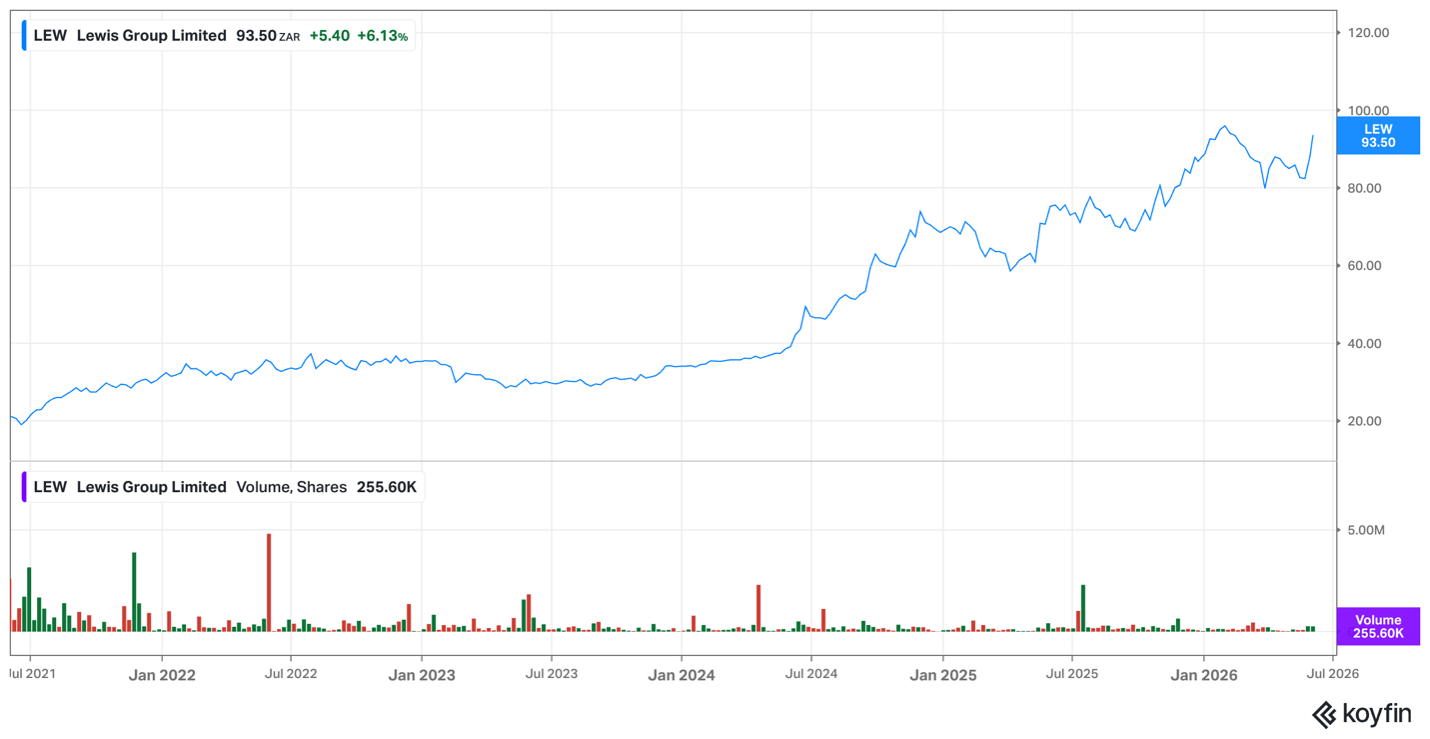
If you add on the roughly 10% annual dividend yield, the total return from owning Lewis over the past 5 years was 340%, or 34% p.a.
That’s a lollapalooza outcome! And it’s still cheap.
My take: Lewis is a significant holding in the MWI Value Fund – one of the very few funds in South Africa that owns it. Rudi (the lead manager on the fund) also likes it that everyone in South Africa is a “specialist” on Microsoft while ignoring these jewels in their own backyard.
You can read a good interview with Lewis’s CEO by a journalist at Currency here. He does a good job of explaining their success.
5. HCI
Here’s another jewel that local institutions would rather avoid than spend any time thinking about. HCI is an investment holding company with a track record second to none. Since 2010 (when I began looking at it), it has compounded its NAV (net asset value) per share at 14.8% p.a. and paid around 1% p.a. in dividends. So, a total return of almost 16% p.a.
Over that same period, the All-Share Total Return Index has compounded at 12.6% p.a., so HCI has outperformed the index by over 3% p.a.
How have the institutions that ignore this great business done? The average general equity unit trust (there were 49 of them) returned just over 10% – underperforming the ALSI by almost 3% p.a.! The best-performing fund returned 14.7% compound, slightly worse than HCI.
But that’s not all, as they say in the classics.
Over the past 5 years, HCI has grown its NAV per share by 21% p.a., 5 percentage points better than the index return of 15.7% p.a. The average general equity fund compounded at only 14%. The best-performing fund posted a 20.5% compound return, again slightly worse than HCI.
How has HCI achieved this stellar track record? Astute deal-making at the top, judicious share buybacks over a long period of time, and a culture of careful maintenance inculcated in each of their investee companies. I wrote about the value of maintenance in “Making it Last”. No space rockets, agentic programming or datacenters on the moon. Just good old-fashioned sensible business practices.
In the USA, this stock would trade close to, or at a premium to its NAV. But here in South Africa, it trades at a discount of almost 50%. Because, you know, the institutions say they can do it better.
My take: HCI is one of the biggest holdings in the MWI Value Fund. It owns a collection of valuable businesses and has a free option on the development of the Namibian offshore oilfields, which, given how things are developing in the Straits of Hormuz, is becoming an even more attractive asset.
6. Goldrush Holdings
I have a fairly significant interest in this JSE-listed holding company, whose only asset is an interest in Goldrush Limited, one of South Africa’s biggest alternative gaming companies. In turn, Goldrush owns a stake in Sizekhaya, which won the right to manage the South African Lottery a year ago. Since then, Sizekhaya has spent the time gearing up for the handover from the previous operators.
On Monday, Sizekhaya took over the management of the Lottery in a smooth process, which included:
- Proper integration with banks and retailers
- Distributing 6 500 terminals throughout the country
- Bringing back live draws on TV, making the draw more transparent
- Reducing the number of balls in the draw – increasing participants’ chances of winning
The management of Sizekhaya is going all out to increase the profile of the Lottery, which has declined over the past few years. If they are successful, it could have a positive impact on the share price of Goldrush, which has gone backwards over the past few years:

My take: The Lottery provides much-needed funds for deserving beneficiaries. Increasing its profile will help them – and perhaps even give Goldrush Holdings’ share price a bump. I would, of course, not mind that.
In the cockroach
As usual, no trades in the fund* this week.
Given the weakness in gold and Bitcoin prices. I thought it might be useful to have a look at the 25% of the fund I allocate to what I call hard assets. Here is the current allocation, and how it has changed since the start of the year:

The only transaction in this part of the fund so far this year was to add some FRMO Corp (an investment holding company that, amongst other things, “mines” and owns Bitcoin and other digital currencies). Due to the poor performance of all components, except the energy ETF, the fund’s allocation to hard assets has dropped to 23.5%. This is not enough to warrant a rebalancing yet, but I am keeping a close eye on it.
Here is what the gold price has done this year:

Here is the Bitcoin price:

I can honestly say this is not what I would have expected, given what is happening with inflation around the world. I can only offer two possible explanations, both of which are probably wrong:
- These assets anticipated high inflation, and now that it is happening, they are giving back some of their gains. A buy-on-rumour, sell-on-fact type of thing.
- Or, the levitation of anything related to AI is sucking capital out of all other assets, including gold and bitcoin.
Be that as it may, this part of the portfolio serves a useful purpose. Hard assets are scarce and, importantly, are not someone else’s liability, which helps them (and the portfolio) withstand stressful times better than most other assets. The way I look at it, the current price downturn in these assets gives the fund an opportunity to rebalance on favourable terms.
* I manage the fund on behalf of Merchant West Investments (Pty) Ltd (FSP 44508)
In The Media
1. Howard Marks – most investors are average
I really enjoyed this fairly recent interview with Howard Marks, which you can watch here. Initially, he seems a bit irritated with the interviewer, a young Indian man with a strong Indian accent. I think Marks struggles to understand him clearly. But then he realises the young man has done some proper preparation for the interview, and he opens up and speaks quite candidly about his career, which is quite refreshing. Mr Marks is one of the few fund managers I know who (correctly) attribute much of their success to luck.
There are a lot of valuable insights here.
2. Infinite Loops podcast
In this podcast, Jim O’Shaughnessy interviews Chelsea Miller about her new book, “The Grim Old Days”. They examine the sad fact that we always seem to think the past was so much better than the present, although it was undeniably and provably worse. It argues – and I concur – that we should caution against being perma-bears, or negative about everything all the time.
Things are good, and they keep on getting better!
As I mentioned at the start of this note, I am writing to you from Shenzhen, just north of Hong Kong. Shenzhen is one of China’s tier-one cities, with a population of around 20 million. I was also recently in two other tier-one cities, Beijing and Shanghai. It’s hard to imagine the scale of these cities until you actually visit them.
But they have a few things in common:
- They are all massive, with no discernible “city centre”. The skyscrapers just carry on for kilometre after kilometre as you drive through them.
- The architecture is amazing. Angles, curves, and cantilevered sections abound. There are very few “blocks”.
- The cities are neat and tidy, with no litter anywhere.
- Things are generally very ordered. It’s easy to walk around and very, very safe. Public transport is efficient and abundant.
- Roads are good, with no potholes and well signposted. Cycling lanes are everywhere, separate from traffic. They aren’t Uber parking lots as we have in Cape Town.
- In the south, where it is warmer, I guess around 70-80% of vehicles are electric. It is weird to walk around Shenzhen in almost complete silence despite the heavy traffic.
- All the Western brands are here, plus a whole bunch of Chinese ones. If you like shopping, this is paradise.
- The food is abundant and can be…interesting!
As I said to someone the other day, if this is communism, I’m happy to be called a communist. I visited a number of companies, and for a market of 1.4 billion people, of whom say 400 million are middle class, I think the investment opportunities are enormous. If I were young right now, I would base myself in Hong Kong for a few years to get to know the market.
Here are some pics of Shenzhen:


That’s all for this week!
Even if you are in China, it’s worth being careful out there.
Piet Viljoen
RECM
4 June 2026