

Dear Fellow Investors and Friends,
Welcome to my newsletter, where I share my efforts to understand markets and the world around me.
I do appreciate you taking the time to read this. Feedback is welcome; feel free to drop me a line. It’s great to start conversations.
If you prefer to read this in your browser, then use this link. If someone forwarded this to you and you like what you read (or if you want to forward it to someone), here’s the ability to subscribe.
Today is Thursday, October 9th, the 275th day of the year. There are 90 days until the end of the year. Historically, October has not been a great time for markets – let’s hope this month passes uneventfully.
On this day in 1908, Harry Oppenheimer was born, the son of Ernest Oppenheimer, the founder of Anglo American. Under Harry’s leadership, Anglo American became a dominant player in the global mining industry, a position it retains today, despite numerous corporate restructuring efforts. Today, it owns no gold, platinum and soon, diamond interests – the interests on which it was built.
But one can objectively say the Oppenheimers built something that has lasted a long time. Whether it will last for even more time depends on the ability of the professional management teams to maintain the assets in good order. Unfortunately, their track record in this regard is not great.
Noema is a magazine exploring the transformations sweeping our world. In a recent issue, the journalist Alex Vuocolo makes a compelling case for an argument that the future won’t be built – it’ll be maintained.
His essay, centred on New York’s R32 subway cars and the workers who kept them running long after their expected lifespan, argues that maintenance is more than just upkeep. It’s a philosophy – a form of care. Behind the decades of underinvestment and political sabotage lies a more fundamental story about maintenance. As he writes, “More often than not, maintenance is done only under conditions of austerity; those that can afford brand new things can simply discard what breaks or is no longer useful.”
This resonated with me, living in a country where a particular class of people has become extremely wealthy, not through hard work, solving problems for consumers, or creating new things, but merely by being there. Their presence is rewarded by a system that seeks to right previous wrongs by creating new ones.
These people can afford lots of bright, shiny new things, and they have gone about acquiring them with intent. Maintenance does not enter the picture. Maintenance takes planning, hard work, skill and determination – all qualities lacking in those who get stuff for free.
Like teaching physics to ghosts, some things don’t compute. Expecting people who get stuff for free to take care of them, is one of those things.
It’s far easier to run a system down until it breaks, and then replace it with something else, even if it is worse. Especially if the replacement allows for additional extractive opportunities:
- water tankers instead of fixing the pipes
- trucks carrying mining material instead of railways
- generators instead of functioning power plants
- patching potholes instead of retarring the surface
“Repair is when you fix something that’s already broken,” Alex writes. “Maintenance is about making something last.”
Maintenance provides a framework for considering stability and progress within a society. Societies that look after their assets, nurture them and maintain them are societies that always have something to build on. These are societies where businesspeople can work with politicians to create an environment that is conducive to investment.
Investment that facilitates growth and employment.
To create new jobs, you need growth. If your business’s revenue stays the same, there is no incentive to employ more people. In fact, to show some growth, you will cut costs and employ fewer people. The only way a business will employ more people is if it can grow.
To grow, you need investment. The government needs to invest in infrastructure that facilitates businesses’ ability to provide goods and services to their customers efficiently. Companies need to invest in people and infrastructure to provide these goods and services to an increasing number of customers, thereby earning more profits.
Here’s the thing: more profits mean more tax; more employees mean more tax. As a result, the government’s tax base expands, allowing it to invest in more and better infrastructure.
A virtuous circle.
I wrote about the problems that a low-trust society faces in “Trust Issues” a few weeks ago. Such an environment is not a good one in which to invest. To invest, you need to trust that:
- The rules will stay the same
- Counterparties will more often than not keep their word
- Contracts go to the best bid, not the most connected/corrupt
- The system will be properly maintained, if not improved
Societies characterised by trust and resilience are ones in which it pays to build – build businesses that employ more people, build infrastructure that keeps the wheels turning.
The first step towards creating such a society is to take care of what is already there.
It’s about making these things last. If we want resilience, we need to start celebrating the people who keep the world from falling apart. Instead of celebrating the loudest and the flashiest, we should celebrate those who do the hard yards out of sight of the public.
To create a foundation for growth, we should first celebrate maintenance and upkeep.
In The Markets
1. Afrimat
Buffett famously said, “When a management with a reputation for brilliance tackles a business with a reputation for bad economics, it is the reputation of the business that remains intact.”
Unfortunately, over the past few years, the reputation of the management team at Afrimat has taken somewhat of a knock, reflected in its share price action:

It’s struggling with its anthracite mine, Nkomati, as well as its recently acquired cement business. I think the cement business will eventually turn out to be a great acquisition, but I have my doubts about Nkomati mine (which I know well, having previously been a shareholder in it).
My take: I don’t think Afrimat’s management team has suddenly become incompetent. In fact, if anyone can turn this ship around, it will be them. They remain amongst the best in the country. But mining is not for the faint-hearted, of which you can include me.
2. Sabvest Capital
Speaking of outstanding management teams, here’s another one: Chris Seabrooke and his team at Sabvest. They have compounded the net asset value (NAV) per share – the only metric that really counts for an investment holding company – at 22.6% since 2010. This is almost double the 12.9% achieved by the JSE All Share Index (ALSI) over the same time.
At 12.9%, the ALSI has done fantastically well, which speaks volumes about the ability of the team at Sabvest. The market – kind of – recognises this in the share price action:
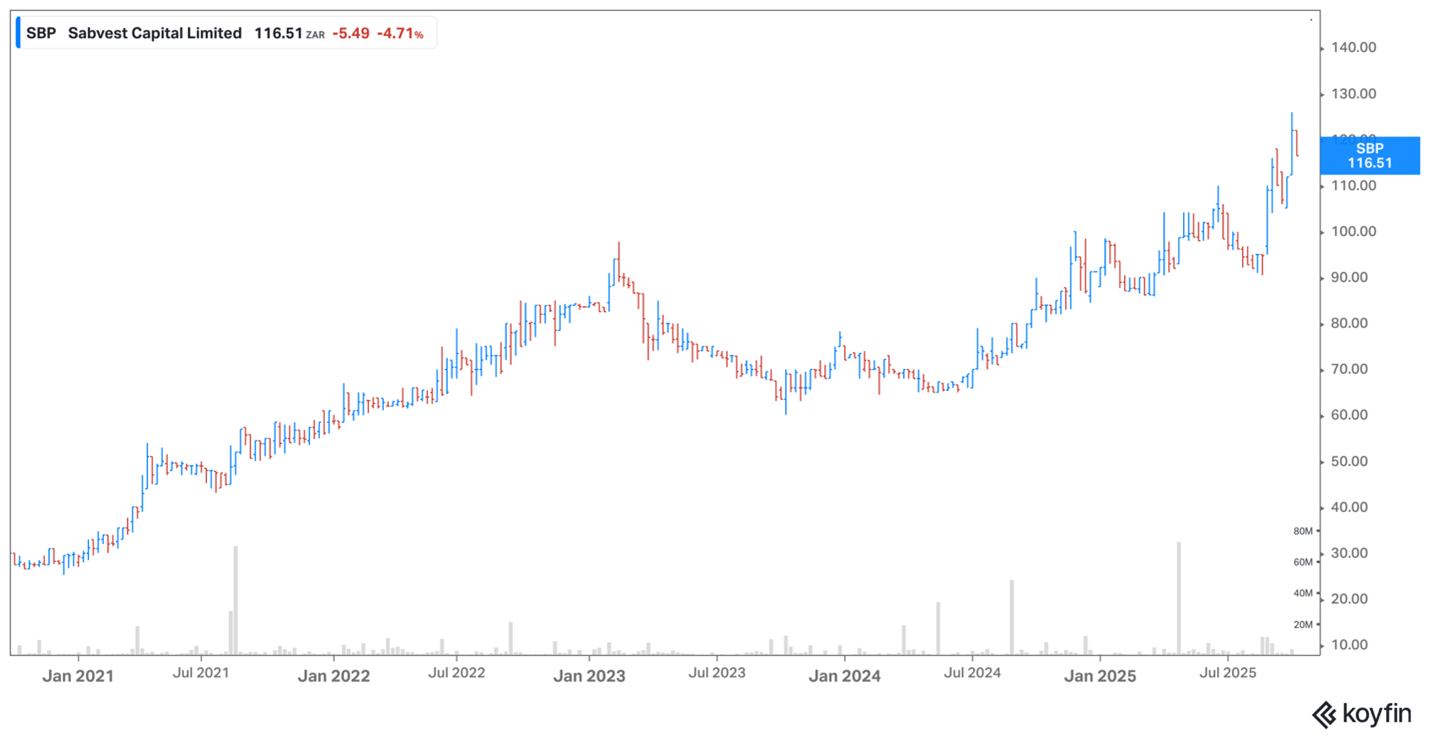
The share price has compounded at a rate of 26.5% per annum over the past five years. Despite the remarkable growth in intrinsic value over time, significant insider buying, and strong positive momentum, the share still trades at a 15% discount to NAV – a NAV that is expected to show further growth by the end of its financial year in December.
Why is this happening? One would expect a company like this to trade at a premium to NAV!
The discount persists because institutions hate investment holding companies. They believe they can do better and would prefer that you invest in their funds – their funds that underperform the JSE and always trade at NAV. Go figure.
My take: Those of us without these prejudices are provided with a fantastic investment opportunity by the inability and/or unwillingness of institutional investors to look at companies like Sabvest. We should gratefully accept their generosity.
3. Bitcoin / gold
Both these “hard assets” reached all-time highs this week. Here’s gold, going parabolic:

And its digital version, Bitcoin:
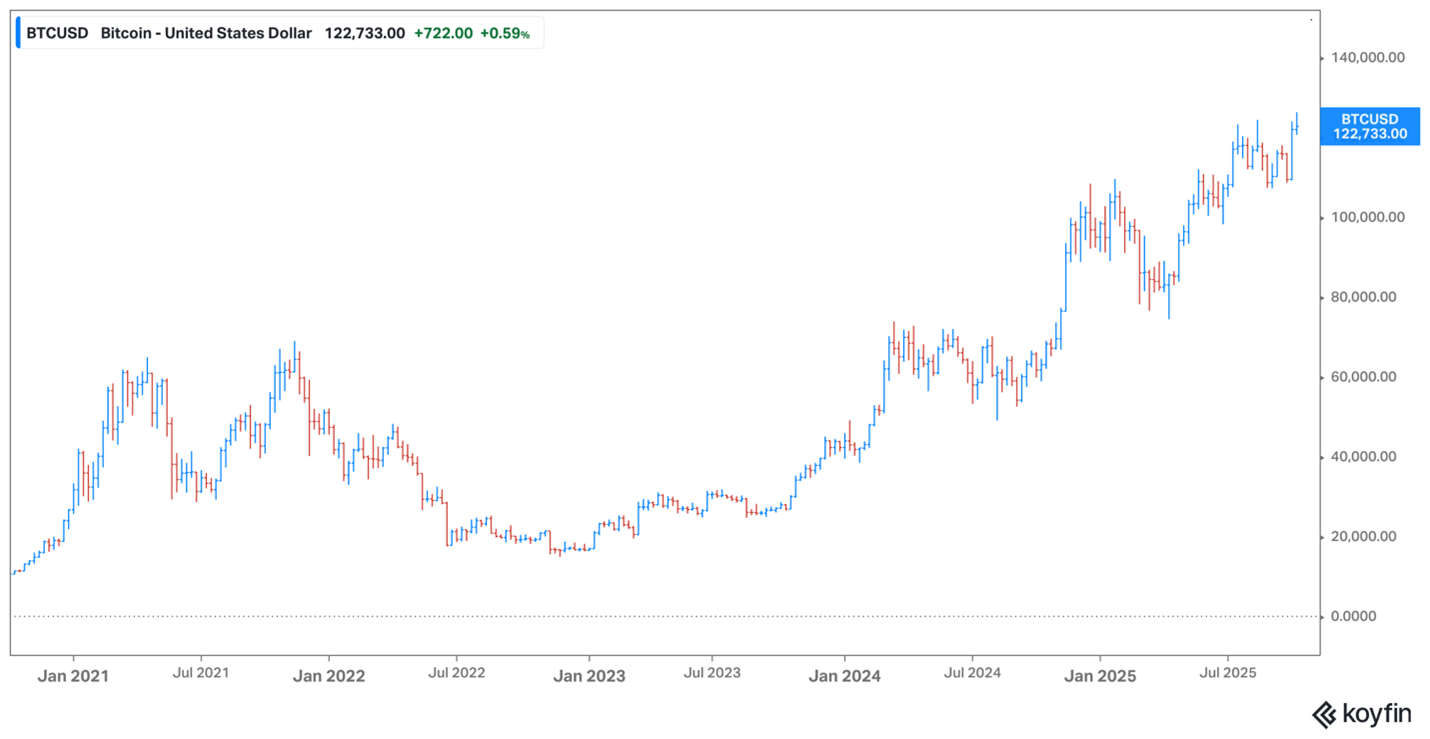
It’s noticeable that both follow a similar pattern, with Bitcoin being more volatile. The reason for this is simple – both assets have limited supply. Annual global gold output is growing at less than 1% per annum, while Bitcoin supply is growing at a similar rate of 0.8% per annum – and is ultimately capped at 21 million.
In the background, the amount of fiat currency in which their price is denominated, US dollars, has been growing at over 6% per annum since 2020. Given current policy settings and the debt situation in the USA, it’s unlikely that this growth rate will subside anytime soon.
Another way to think about both Bitcoin and gold is that they are energy-related currencies. It takes (a lot) of energy to mine and smelt gold, just like it takes a lot of energy to solve the cryptographic puzzles that validate information on the blockchain.
It takes no energy at all to run the printing presses of fiat currencies.
My take: Hard assets have a significant representation in the MWI Worldwide Flexible fund (aka the Cockroach). The prices of these assets might be somewhat out over their skis right now, but in the longer term, they will continue to provide a hedge against government profligacy. A profligacy which is almost as sure a thing as you can find. Additionally, these assets could also serve as a hedge against (significantly) higher energy prices.
4. Strategy
Speaking of Bitcoin, let’s check in on Strategy – formerly known as MicroStrategy Ltd. Around five years ago, its CEO, Michael Saylor, started implementing a “Bitcoin treasury strategy.” The strategy entailed raising capital for the company through issuing equity at a premium to NAV and then buying Bitcoin with the proceeds.
For a long time, regulators prohibited investors from buying Bitcoin, so buying shares of Strategy was one of the few ways to access it. High demand for the shares led to them trading at a significant premium to their NAV, which allowed Saylor to issue even more shares, thereby accretively buying more Bitcoin.
And so on.
Today, Strategy Inc. owns 640,031 bitcoins. At the latest market price of c $125,000 per bitcoin, their holdings are valued at approximately $80 billion.
But despite Bitcoin being at a new all-time high, Strategy’s share price is 25% below its recent high:

What happened? Two things:
- Regulators globally have become a lot more relaxed about Bitcoin and have allowed investors to invest directly (except, of course, here in South Africa, where theft-proof innovations are regarded with scepticism by the authorities).
- Strategy has been issuing stock at increasingly smaller premiums to NAV, disappointing investors, as Saylor said as recently as July, they would not issue stock below 2.5 times NAV.
As a result, the premium of Strategy’s NAV over its underlying Bitcoin holdings has dissipated:
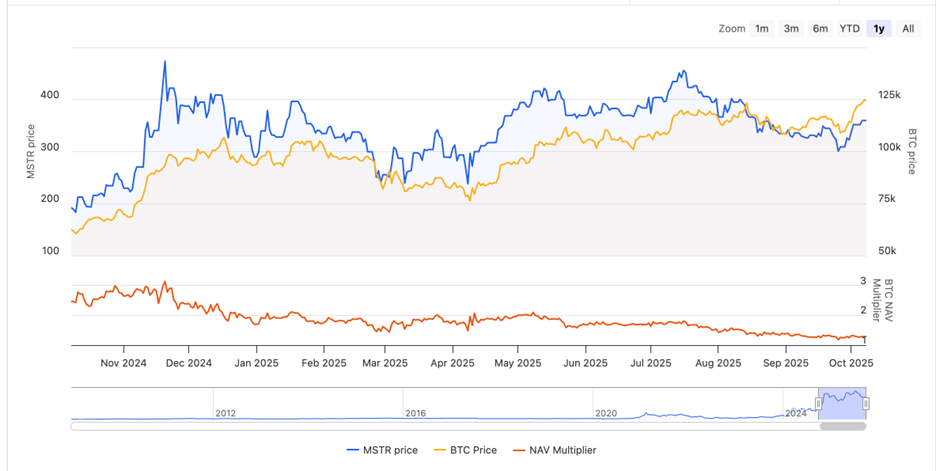
Source: Bitcointreasuries.net
The red line in the chart above is the premium to NAV, which has declined from 3 times a year ago to just 1.2 times today.
My take: The upshot of this is that while Bitcoin has been on a massive bull run, shareholders of Strategy have gained nothing. However, Saylor has gained access to permanent capital of $80 billion. There’s only one winner here. My prediction: At some point, you will be able to buy Bitcoin at a discount via Strategy.
5. OpenAI, Nvidia et al.
I’m only going to make two comments on a topic that is exercising everyone’s minds.
But first, you need to study this chart, courtesy of Scott Galloway (Prof G):

Action is happening up and down the LLM stack: Nvidia is making deals with Intel, OpenAI is making deals with Oracle, and Nvidia and OpenAI are making deals with each other.
To me, this looks like just another form of vendor financing. You know, when a seller provides its customer with the finance to buy its products. However, what’s happening here is even worse: sellers are providing customers with funding while accepting funding from those same customers.
This sort of thing only happens when capital is free. And free capital inevitably gets misallocated. Historic examples abound:
- In the 1870s, railroads absorbed 20% of U.S. capital investment (AI today is around 2%), only to collapse into bankruptcy when too many lines failed to generate traffic.
- In the 1920s, utilities massively overbuilt the electric grid, setting the stage for financial wreckage after the 1929 crash.
- During the dot-com boom, billions were spent building fibre optic cables for internet demand that hadn’t arrived yet.
Also, since this chart was made, OpenAI announced two deals:
- OpenAI and AMD completed a multi-year strategic partnership to deploy 6 gigawatts of AMD GPUs for AI compute.
- OpenAI’s deal with Nvidia commits to deploying at least 10 gigawatts of Nvidia systems for its next-generation AI infrastructure.
That’s 16GW of chips in just two deals. To put that in perspective, South Africa’s entire energy generation capacity, when everything is working, which it never seems to be, is a grand total of 53 GW.
My take: As mentioned, I have two comments:
- A bubble financed every previous infrastructure buildout. This one seems similar. So, there is time to simply stand and watch this passing parade. The investment opportunities will come.
- Datacenter capacity in terms of chips is quoted in terms of energy requirements (i.e. Gigawatts). Neither the existing grid nor the current energy generation capacity can handle this massive additional future demand. There are investment opportunities here.
That’s the sum total of my investment knowledge regarding the entire AI concept. But there are some people with strong views out there. This one is worth reading.
6. Nuclear
The world is caught between Scylla and Charybdis. It needs a lot more energy to drive the electrification of everything, but it wants it in a clean form, so as not to destroy the environment.
Like Odysseus, we can manoeuvre our energy ship successfully between the two dangers by committing to the nuclear route. Which is increasingly happening. Westinghouse, the firm responsible for the only two nuclear reactors built in the US in the past three decades, is among those leading the charge. The company has announced plans to begin construction on 10 reactors in the US by 2030. This time around, the company is following the lead of the White House, which hopes that a series of executive orders issued earlier this year will kickstart a nuclear rebound.
As of October 2025, China is building up to 33 nuclear reactors. The Japanese government’s new energy strategy, approved in February 2025, calls for “maximising nuclear energy usage” and specifically removes prior commitments to reduce reliance on nuclear power. Even Germany is showing signs of reversing their anti-nuclear stance.
Nuclear reactors use uranium as fuel. It is a low-cost input into the energy generation process of a nuclear plant, but it is all-important. Security of supply is becoming a significant issue in the nuclear industry. Countries in the Chinese/Russian sphere produce over 50% of the world’s uranium output, highlighting the USA’s recent comments about the need to boost its strategic uranium reserve.
It should not, therefore, come as a surprise that the share price of Canadian-based Cameco, one of the major producers of uranium, has been on a tear lately:
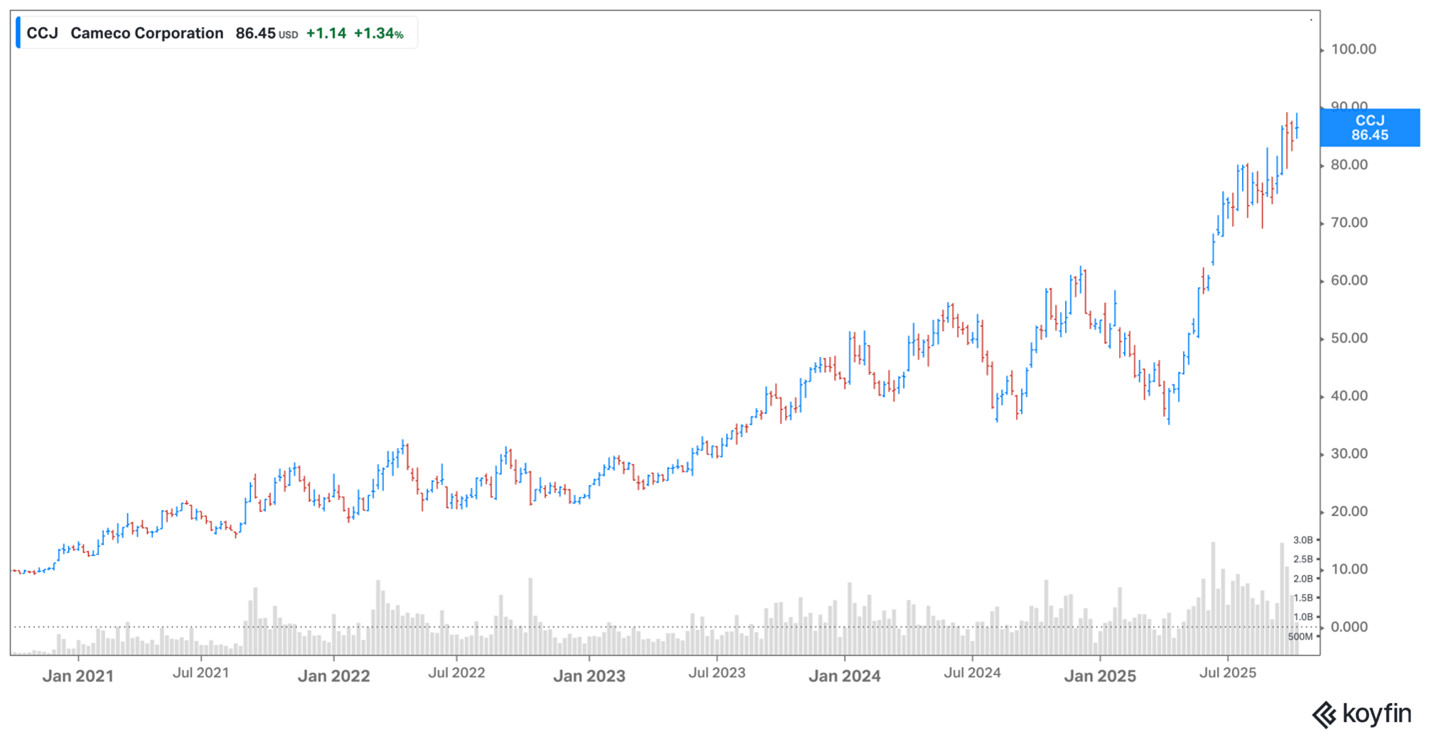
The price of uranium itself has been less buoyant, but still showing a marked upward trajectory:
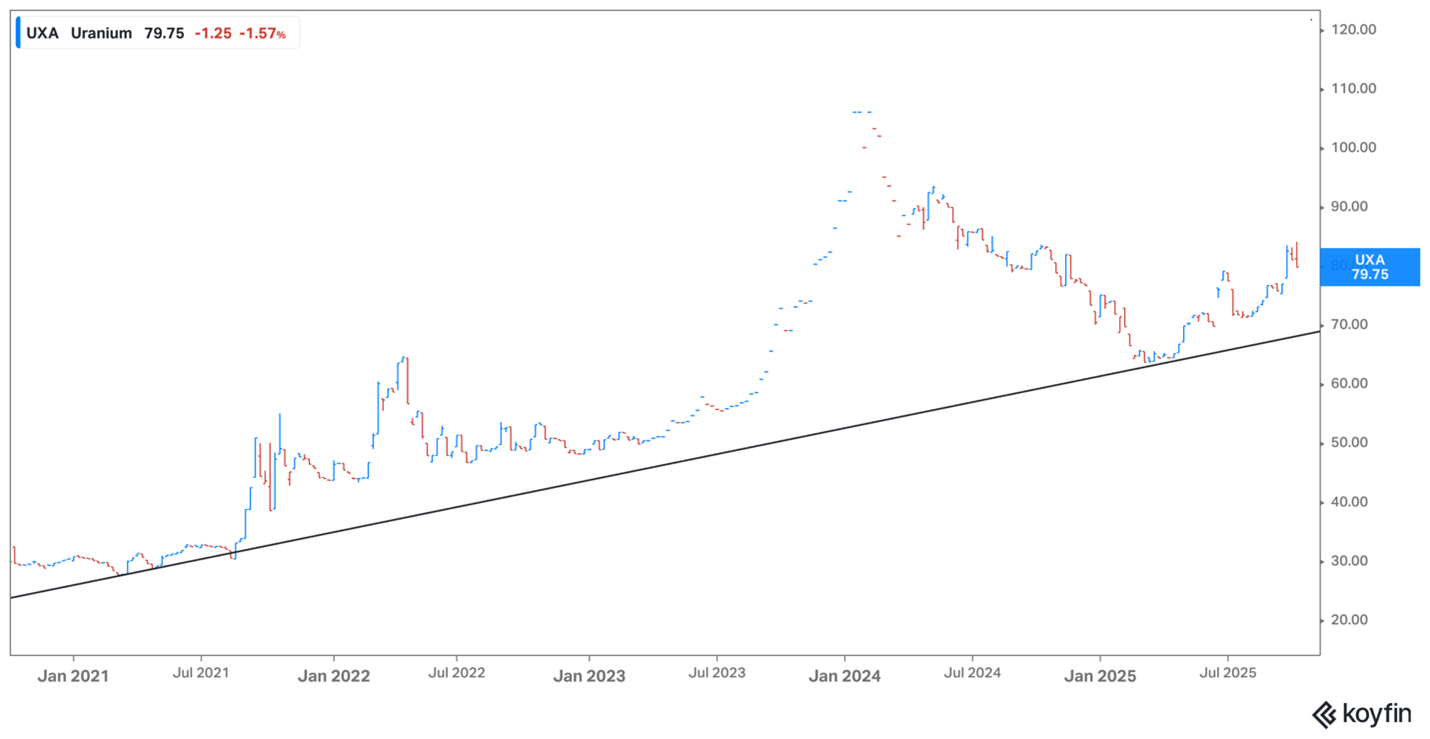
My take: No matter how much “clean” renewable energy is installed, the world will always need clean baseload energy. Nuclear is the increasingly acceptable answer to that. The MWI Worldwide Flexible fund (aka The Cockroach”) owns Yellow Cake, an investment trust that has Uranium as its only asset, in the “hard asset” part of its portfolio.
7. Banking
Last week, I wrote about how the best time to invest in banks was when corporate activity was muted and expectations were low. The time not to invest was when M&A activity picked up, expectations of synergies and growth became elevated, and an air of excitement prevailed.
Well, as if on cue, Fifth Third Bancorp announced on Monday that it has struck a $10.9 billion, all-stock deal to acquire Comerica, a buyout that would create the country’s ninth-largest bank. Comerica shareholders will receive 1.8 Fifth Third shares for every share they own, a 20% premium to Comerica’s share price.
Excitement much?
My take: In the USA, the clock has not yet struck 12. But the second hand is inching closer, and soon the bankers will realise they were in a pumpkin after all. So, we can all be like Chuck Prince and continue dancing. Or we can leave the ball early and look for a party that hasn’t yet got out of control.
In my experience, the early leavers in financial markets always live to dance another day.
In The Media
1. The value of studying history
I have often said the best way to understand the future is to study the past. Forecasts are unreliable at best, but human nature is predictably reliable. History reveals that human nature has a significant influence on outcomes.
So, forget about those thick stockbroking reports that forecast all the lines going up and to the right. Instead, read about how our forefathers dealt with issues. The second-best thing to do is to read novels that explore human nature; they also contain many clues about the future.
In any case, I came across an article on the excellent BizNews site, called “Beat modern populism by learning from the 17th century” by renowned historian Adrian Wooldridge.
The money quote? “The lessons of history are surprisingly clear. The great question is whether we possess the political will to learn from them.”
2. V02 Max beats dementia
Firstly, what is V02Max? It’s simply a measure of the maximum amount of oxygen that a person can utilise during intense or maximal exercise and is usually measured in millilitres of oxygen consumed per kilogram of body weight per minute (ml/kg/minute). A high VO2max is associated with better fitness and typically a lower risk for cardiovascular disease.
New research seems to show that a high V02max also indicates a lower risk for that most fearful of modern illnesses, dementia. This quote from René Descartes says it all: “The mind and the body are like a pilot in his ship; although they are distinct, they are closely interconnected.”
This article from the Substack “Physiologically Speaking” explains it:
It is well known that having high aerobic fitness (1) necessitates better blood vessel function, which means more blood flow to the brain, and (2) is linked to better metabolic health, including improved insulin sensitivity.
So, having a higher V02max is one of the most important indicators of how long you will live. But does it have a protective effect against neurodegenerative diseases like dementia and Alzheimer’s?
According to this article, recent research suggests that cardiorespiratory fitness is dose-dependently associated with improved global cognitive function, enhanced prospective memory, and increased processing speed.
In short, the answer is very much yes. Achieving high cardiorespiratory fitness might be one of the most effective strategies to reduce the risk of dementia.
So, get on your bike or start walking – and then running. Start now to increase your VO2max above 42 for men and 32 for women (by comparison, Tadej Pogacar is said to have a V02max of 90). For men, a rough approximation would be to run 1.8km in 12 minutes, and for women, 1.4 km. Additionally, because V02max is measured relative to weight, simply losing weight will increase your score. But you will still need to exercise.
Get cracking to make your body and your mind last.
If you do – and I really hope you do – please be careful out there.
3. John Lennon
Today is the birthday of one of the most influential musicians in rock history, John Lennon. In his honour, I have compiled a playlist of 10 songs he wrote that I like the best. His music has brought much joy to my life, and I hope you recognise and like some of these, too.
Piet Viljoen
RECM