

Dear Fellow Investors and Friends,
Welcome to my newsletter, where I share my efforts to understand markets and the world around me.
I appreciate you taking the time to read this. I love getting feedback; feel free to drop me a line. It’s great to start conversations.
Today is Thursday, 5th February, the 36th day of the year. There are 329 days remaining until the year’s end. On this day in 2003, the US Secretary of State presented evidence to the UN that Iraq possessed “Weapons of Mass Destruction”. Later, he admitted that the claims he presented were false and based on a deliberately misleading source. Nevertheless, at that time, the so-called evidence removed all constraints on the US military, and they proceeded to invade Iraq. This, in turn, led to a massive loss of life, prolonged instability, and civil conflict in Iraq.
I remember this well because it happened when I was starting up RECM. It’s quite disconcerting when you are starting a new business, and all you see on TV is war footage. How I wished the USA had been more constrained at the time!
Here’s another, more positive story about the power of constraints:
Keith Jarrett is not my favourite musician. He is – or was – a virtuoso pianist and performed a reasonably accessible type of jazz. But it was jazz, and I never developed a taste for it in my formative years. With the help of my friend Mark Rosin, I am currently giving it a try, but it’s far too late in my life to allow someone like Jarrett to rise to the (my) top tier; a tier that includes artists of the “popular” variety like Cave, PJ Harvey, and Greenwood/Yorke, rather than those of the “technically brilliant” variety like Jarrett, Coltrane, or Brecker, who come entirely from the jazz genre.
In any case, last year was the 50th anniversary of a famous album by Jarrett called the Köln Concert. I wasn’t even aware of until I was invited to a special playing and discussion of the album at my friend Oscar Foulkes’ house.
Mark, a true music aficionado, led the discussion, with Oscar chipping in his angle. It brought the album to life, and I recommend you give it a proper listen sometime.
The backstory of the album was that, leading up to the performance, Jarrett was exhausted and had a sore back after a long drive to the venue in an uncomfortable car. He arrived to find that the 18-year-old promoter had not secured the required piano. Instead, it was an out-of-tune, battered baby grand. Even worse, it had some sticky keys.
Despite these constraints, Jarrett spontaneously improvised 90 minutes of music. Sometimes you can almost sense him contemplating the next note as he plays. Released as a double album later in 1975, The Köln Concert became the best-selling solo jazz album and the best-selling piano album of all time, with over 4 million copies sold worldwide.
A truly virtuoso performance.
That’s what makes art so remarkable: that we, deeply flawed beings with our innate limitations, can sometimes create extraordinary things. Without limitations, it’s impossible to attain the true transcendent artistic experience. There is nothing to transcend!
Constraints and limitations serve as a forcing function to encourage clear thinking about your goals. Applying constraints to a process helps you reach the essence of what you aim to achieve.
When I create my “best-of” music lists, I limit myself to the top 10 albums and 20 songs from each year. Each time I compile one, this numerical limit makes me consider what I aim to achieve. Do I want to include the most popular song by an artist, or one that offers more nuance? Do I prefer an album full of hits, or one with musical depth? Each choice involves trade-offs, prompting me to weigh the advantages and disadvantages. Ultimately, it’s the constraints that shape the essence of the playlist.
An unconstrained playlist would meander, possibly offering something for anyone – if they had the patience to wade through the whole thing. Most often, you end up with nothing for everyone. Like an unfocused photograph, you can see there is something there, but you just can’t make out exactly what it is. Such photographs are quickly discarded.
That is why I constrain the equity selection in the cockroach portfolio to 10 stocks. In so doing, I get focused exposure to 10 high-quality, global businesses. But some questions arise:
- Is such a portfolio properly diversified?
- Aren’t you afraid of missing out on a new trend?
- How do you weigh the individual holdings?
Modern Portfolio Theory (MPT) says you need 20 to 30 stocks to eliminate all sources of systematic risk through diversification. To believe this, you need to believe that MPT is an accurate reflection of how the market works – which I don’t.
To avoid getting into the weeds, MPT assumes that market returns are normally distributed. But even the casual market observer would have to admit that very large return events (positive and negative) happen far more often than a normal curve would predict. I think 10 global businesses across different sectors provide sufficient diversification to eliminate the most serious systematic risk. The remaining systematic risk is the risk of owning great businesses, which I willingly accept.
When creating a portfolio of high-quality businesses limited to just 10 holdings, you are effectively outsourcing all future investment decisions to the management teams of those companies. If a significant new technology threatens the business (AI, blockchain, Labubu dolls), you must trust that management will identify it and, if necessary, invest in it. They might do so defensively to protect the business, or proactively to drive growth.
Remember, one of the criteria for inclusion in the 10-stock list is that the company is (1) a high-quality business and (2) has been established for more than 50 years. To meet both criteria, the company must have faced and overcome numerous competitive threats – technological or otherwise – during its history.
In the 10-stock portfolio, each stock receives an equal weight. Remember, I am not aiming to replicate a typical market cap-weighted index here. Instead, I want to gain targeted exposure to 10 global, high-quality businesses. All of them are large-cap and international. I prefer not to attempt the nearly impossible task of distinguishing between the strong and the weak of each and allocating weights accordingly.
Constraints funnel us to the sweet spot, where process intersects with clarity.
In The Markets
1. Software is no longer eating the world
Marc Andreessen’s 2011 essay “Why Software Is Eating the World” presented a few key arguments. He argued that software was becoming central to every industry, making existing businesses vulnerable to software-native competitors. In the long term, Andreessen stated that every company needed to become a software company.
And he was right. Software has become the dominant business model over the past 15 years. But before you could say “long-run”, things have changed. This is the Software index relative to the S&P 500 Index:

It has given up all its gains since Andreessen’s article!
Some market darlings are suffering here…
Like Constellation Software, that “structurally advantaged compounder”:

Or how about that “market leader in mission-critical enterprise application software”, SAP:

It’s even starting to affect Mr.Softee, one of the highest quality large caps globally, the “exceptionally positioned to capture AI upside”, “dominant platform company in the world”:

These great businesses are all off by 20% – 40% over the past few months. What’s happening?
Well, it seems AI is eating its parents. Apparently, you can now “vibe-code” an app over a weekend with no previous coding experience, using AI.
I have yet to try this myself, and I am sure it’s not as simple as many make it out to be. However, the market is recognising it as an existential threat to any company that offers software with a per-seat revenue model.
My take: This may just prove to be an exaggerated fear. After all, which company would purchase mission-critical software from someone sitting in their mother’s basement, with no dependable support or promise of further development? But AI is still in its early stages. Who knows how things will unfold? The only certainty is that technology inevitably raises its mainsail when Schumpeter’s gale begins to blow.
2. Digital Ducats Depreciating
The prices of Bitcoin and other cryptocurrencies have been undergoing rapid depreciation recently. Here’s a chart of Bitcoin’s price in US$:

What’s happening now is not unprecedented. In December 2017, the price of Bitcoin began to decline and bottomed out 12 months later, having lost 80% of its value. In November 2021, its price began declining again, losing 75% of its value over the following 13 months.
If – and this is a big if – history were to repeat, this time around, Bitcoin should bottom out at a price of $30 000 around the 4th quarter of this year.
Importantly, each time Bitcoin experienced such a major reversal, it subsequently reached highs well above previous levels. So, once again, if history were to repeat, we could eventually see Bitcoin reach $ 300,000.
This is not a forecast, though.
History never repeats, but it rhymes. And sometimes it’s like a dissonant poem that keeps reaching for a rhyme – and misses.
My take: I remain of the opinion that Bitcoin – and other cryptocurrencies – have the potential to supplant significant parts of the world’s financial plumbing. If they do so, they will be worth much more than they are now. But I also don’t think the chance is much more than 50%. The crypto system is facing significant, highly lucrative vested interests. If it doesn’t succeed, crypto will be worth significantly less than current prices. Size your position accordingly.
3. Proudly average
Absa is a pretty average South African bank. When it comes to shareholder returns, it’s no FirstRand and definitely not a Capitec. But it’s also definitely better than Nedbank, and – dare I say it – Investec.
As such, I use it as a bellwether for the local banking sector. If ABSA is doing okay, so should the sector. And its share price is fine, thank you very much:

That’s a proper bull market! What’s going on?
Lending growth is the lifeblood of the banking sector. If lending picks up, profitability does too. Banks were in the doldrums for so long because lending had wilted under the pressure of our high-interest rate levels.
But that’s starting to change.
Ratings firm S&P Global reports that South African banks are entering their strongest lending cycle in seven years. They forecast 8% – 9% loan growth in 2026, stimulated by lower interest rates and rising corporate demand, particularly for energy and infrastructure projects.
At the same time, South African banks’ robust capital positions support increased lending. This higher lending should boost the returns banks earn on equity.
My view: South African banks offer a good opportunity to benefit from higher growth and lower interest rates in the local economy. Despite ABSA’s strong performance over the past year, it still trades at a P/E of 9 with a dividend yield of 6%. After tax, this yields better returns than depositing your money with them! So, if the economy doesn’t grow a bit faster and lending doesn’t increase, there isn’t much downside. That’s my kind of investment.
4. Got Tin?
Forget about software – it’s all about hardware. Suddenly, memory chip and storage device businesses like SanDisk and Western Digital are the flavour of the month. SanDisk is one of those mythical beasts, a ten-bagger in six months:

Western Digital is a little bit less impressive, but still:

Of course, a year ago, no one was talking about these guys – it was all Nvidia, all the time.
Recently, these stocks have surged because they are situated at the intersection of AI and cloud expansion, with demand growing much faster than supply. Consequently, manufacturers of flash memory storage (such as Western and SanDisk) have turned their fortunes around: contract prices have increased by approximately 25 – 45% since mid-2025, and vendors have regained pricing power as inventories return to normal levels.
These are highly cyclical businesses that are currently experiencing a strong upswing. However, their share prices reflect increasing confidence that the upswing will last well beyond a typical cycle. Western is now trading at a price-to-sales ratio of 10 times. That’s sales, not profits.
But Rudi van Niekerk, the manager of the MWI Value fund, has found a cheaper, less risky way to invest in this chokepoint: tin. His fund is one of only three in South Africa that owns shares in Alphamin, a tin producer. Tin is a critical, high-volume input into the manufacturing of storage devices and memory chips.
Here is the price of Tin:

And here is the share price of Alphamin:

My take: The mining of tin is probably as cyclical as the manufacturing of memory chips. But Alphamin today is on a price-to-sales ratio of 2.5X – four times cheaper than the latest bright, shiny stock the market is fixated on.
In the cockroach
No trades this week. But I am thinking about starting a small position in the 6th of my “10 Stocks, forever” So far, the first 5 – the last 5 stocks in the list below – have not shot the lights out, but it is early days. Here are the fund’s current holdings and its equity allocation, which is always around 25% of the overall fund:

A few comments:
- The bulk of the exposure is in index (or fund) form. I think I have an edge with my forever stocks, but until I am fully allocated to them, the rest of my equity exposure will always be in index or fund form.
- Almost a fifth of the fund’s equity exposure is allocated to South African equities, primarily focused on mid-cap value stocks. This is achieved through the MWI Value fund. I believe this is an asset class in which investors, both globally and in South Africa, are significantly underexposed.
- The fund holds more emerging market exposure than developed and is therefore significantly underweight the most riskiest investment geography in the world: the USA.
- The five stocks I have purchased so far out of my ten forever stocks have not performed well over the past year. They are therefore below their target weight of 2.5%. I will buy more of them in due course, but I first need to see some improvement in their relative momentum.
I am debating a choice between Microsoft and Apple as my sixth forever stock. The issue I have with Microsoft is not the “software issue,” which is what the market is currently concerned about. It relates to it becoming much more capital-intensive as it expands its data centres. And a capital-intensive stock can easily trade on a low multiple if the cycle turns against it. This has happened to Microsoft once before, and everyone seems to have forgotten by now.

There was an extended period from 2010 to 2014 during which Microsoft traded at around a 12 P/E on average. On the other hand, Apple is not throwing money at AI infrastructure – it owns the distribution of information, via the iPhone, and is agnostic to which LLM wins or where the computations behind the LLM take place. In my experience, distribution often trumps content. So, I am leaning towards Apple. But it remains too pricey. Let’s see how things play out, but for now, I am sitting on my hands.
The latest quarterly report for the cockroach (the Merchant West SCI Worldwide Flexible Fund) was published recently – you can read it here. The fund is outperforming the benchmark (US inflation plus 6% in dollar terms) with significantly lower-than-average volatility – it has the second-lowest volatility among 90 funds in its sector.
This is what the unit price track record looks like relative to the average fund in the sector over the past 5 years:
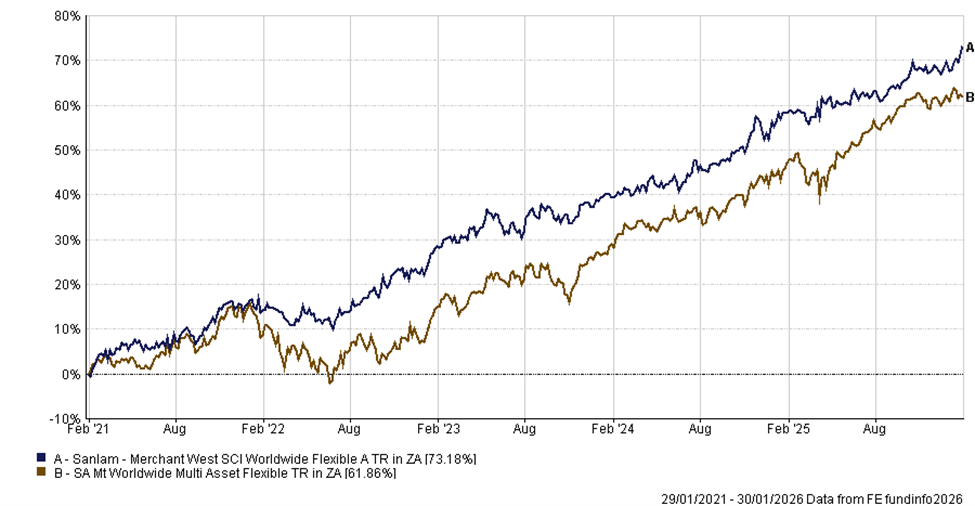
As for its volatility, you don’t have to calculate it; you can just eyeball it in the chart above.
My compliance officer, Guy Simpson, says I must add the following:
“I manage the fund on behalf of Merchant West Investments (Pty) Ltd (FSP 44508)”
I always listen to Guy on compliance matters. The alternative is too ghastly to contemplate. So, there it is, Guy!
In The Media
1. Cherry blossoms
I have always wanted to see the cherry blossoms in Japan. This year, Amanda and I are travelling to Japan to do just that. She came across this graphic, showing the expected best time to view them (“Sakura” is the Japanese word for cherry blossoms, the flowering cherry trees and their pink or white blossoms):

We will be basing ourselves in Osaka from the 22nd of March onwards – but also taking multi-day trips to some small towns west of Osaka – Naoshima, Yoruya, and Onimichi. I hope their Sakura forecasts are spot on!
Oh yes – here’s another reason why we are going:

The rand buys 30% more yen than it did 5 years ago! Tell me again what a weak currency we have?
2. Pluribus
This is a mini-series I finished watching about a week ago. It stars Rhea Sehorn and was created by Vince Gilligan, the creator of Breaking Bad and its spin-off Better Call Saul – in which Rhea also starred. If you liked those shows, you’ll probably like this one too.
I experienced it as a slow-moving meditation on how different people choose to live with a kind of “AI”. The plot is that an alien virus infects everyone except a few, including Rhea. It effectively turns them into one giant “hive mind” or general intelligence. I loved the way the camera lingered on scenes, exploring the emotions of those few who still had them once the alien virus had infected everyone else.
The series finale was a bit open-ended, though. If you like your shows to be wrapped up neatly with a clear denouement, this is not for you. But if, like me, you love ambiguity and uncertainty, this is a great watch.
3. Nick Cave and The Bad Seeds
Regular readers will know he is one of my favourite musicians, so it should come as no surprise that I have bought tickets to see him and his band play in Brighton, his hometown, later this year.
As a teaser, here is an excerpt from his current live show, where they perform one of his earliest songs, “From Her to Eternity.” It was this song that first got me listening to Cave in the eighties.
It’s not too different from the original, which he wrote and first performed when he was around 20. Now that he is sixty, he gives the song a (slightly) less deranged feeling.
You can watch the performance here. Here’s another live version from 37 years ago.
We’ve gotten old, Nick and I, but I still can’t wait to see him perform. And the rumours that I named my son after him are simply not true.
That’s all for this week – but remember it always pays to be careful out there.
Piet Viljoen
RECM
5 February 2026