

Dear Fellow Investors and Friends,
Welcome to my newsletter, where I share my efforts to understand markets and the world around me.
I appreciate you taking the time to read this. Feedback is welcome; feel free to drop me a line. It’s great to start conversations.
Today is Thursday, January 29th, the 29th day of the year. There are 336 days left until the end of the year. Just like that, there are only 11 months of the year left – and I feel like I still need to be wishing everyone I see a happy new year!
On this day in 1964, the British film Dr Strangelove or: How I Learned to Stop Worrying and Love the Bomb was released in theatres. It was a landmark Cold War black comedy, directed by Stanley Kubrick; a classic movie which highlighted the idiocies – and dangers – of the then cold war between Russia and the USA. Today, we seem to be entering another such era.
This clip from the movie is one of the most iconic scenes:

The image also reflects what investors in some investment holding companies – Holdcos – feel like. Last week, I started writing about these vehicles. For those of you who missed it, you can catch up in “Life’s Not Fair”.
This is part two of my thoughts on investment holding companies.
Let’s start with some investment facts:
- Sabvest has compounded its NAV per share in the 10 years to December 2024 (the latest available annual result) by 17.3% p.a. Over this time, the JSE All Share Total Return Index has compounded at 9.1% p.a.
- HCI has compounded its NAV per share in the 10 years to 31 March 2025 (its latest available annual result) by 10.3% p.a. The JSE All Share Total Return Index has compounded at 9% p.a.
- Over the 10 years to December 2024, the average general equity fund has returned 6.5%. Only 5 of 60 funds outperformed the All Share Index (by the way, the MWI Value fund is one of them). The numbers for March 2025 are similar.
Both Holdcos have generated returns superior to those available from actively managed collective investment schemes (an easy hurdle) and passive indexation (a more challenging hurdle). Yet discounts to NAV of 20% to 50% persist.
Let’s examine the explanation provided for these persistent discounts on the NAV of investment holding companies:
- Fees. The argument is that an investor should calculate the present value of all future fees earned by the manager of Holdco and deduct that from the NAV, since the contract is unlikely to be terminated. I have a lot of sympathy for this argument. The other side of this argument is that collective investment schemes (unit trusts) often have fees and costs relative to NAV greater than those of Holdcos. But unit trusts always trade at NAV, regardless of their fee structure – and underperformance.
- Valuations. Here, the argument is that the Holdco’s management values its assets. Fees are charged as a % of asset value, so it is in their interest to always have it as high as possible. The counterargument is that these Holdcos regularly sell assets at valuations at or above the levels at which they are carried on the books.
- Replication. Many investors argue that they can replicate the Holdco portfolio, so why should they pay the Holdco manager to invest in those assets? This is clearly an asinine, self-serving argument from the collective investment scheme fund management community, and easily disprovable. Just look at their track record.
- Illiquidity. The argument is that an investor in a unit trust can sell their entire investment at any time with one day’s notice. In contrast, shareholders of Holdcos sometimes struggle to sell their assets due to a lack of liquidity. This argument holds for short term traders, but surely not for the institutional stewards of our country’s savings.
Clearly, most of the arguments are flimsy. But there is a valid one – and that is that the performance of some Holdcos leaves much to be desired. I have highlighted the best ones – Sabvest Capital and HCI. But for every two of those, you get Remgro, African Rainbow Capital and Ethos Capital Partners, which have all been consistent underperformers.
So how does one, ex ante, identify the underperformers? Simple: look for dilutive share issues. These are often done to:
- Acquire “trophy assets” at inflated prices – as in the case of Remgro with Mediclinic, or
- Pay fees to the manager (!) – as in the case of African Rainbow Capital, or
- To acquire assets, regardless of their quality, to inflate the asset base on which fees are charged – as in the case of Ethos.
I guess it boils down to answering the questions: are the management of the Holdco more interested in generating fees or making good investments? Do they have skin in the game?
One way to answer this is to look at the number of shares in issue. If Holdcos always trade at a discount to NAV, shouldn’t it always make sense to repurchase shares and keep share issuance to a minimum?
If so, this table makes for interesting reading:
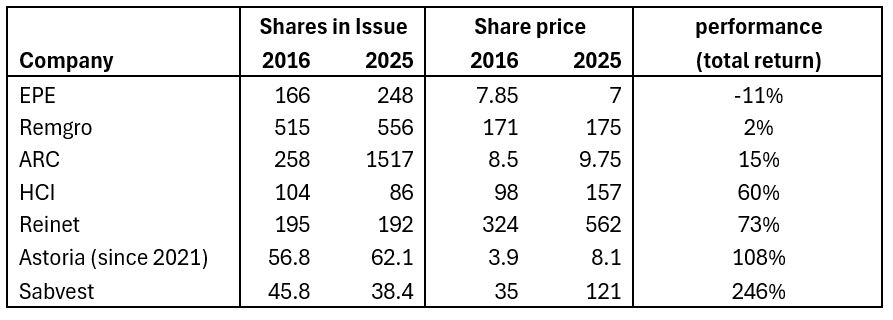
By and large, the companies that bought back shares over the past 10 years outperformed those that issued shares (Astoria being the exception that proves the rule).
That leaves us with an interesting investment proposition. Instead of complaining about the unfairness of the discount to the NAV of superior Holdcos, buy their shares. The worst case is that the discount to NAV persists, and you get the NAV growth, which is superior to that of the All-Share Index. The upside is the discount narrows, and you get supercharged growth.
In The Markets
1. Exceptional Americanism
When someone takes your money and doesn’t give it back, you might fall for it once, not two or three times. But in that generally accepted paragon of financial virtue and exceptionalism, the USA, it has become standard practice.
First, it was NFTs, then SPACs, then meme stocks and meme coins, all the while getting scammier and scammier. Now, their president – that paragon of moral virtue – has joined the bandwagon.
Trump Media and Technology Group (TMT) was listed in 2024 via a SPAC merger; it now has a market cap of almost $4bn. A fair question would be: what business does it do to justify this valuation? Well, not much, really. It owns Truth Social, President Trump’s one-to-many social “network”. From this, TMT makes annual revenues of less than $4mn, and – get this – operating losses of over $200mn. Someone’s making money here, but it’s not the shareholders. Clue: the CEO of TMT earned $47mn last year. Here’s the share price:

Last year, TMT pivoted to crypto, but that hasn’t worked either. So, in December, TMT announced it would merge with TAE Technologies, a nuclear fusion business. By way of background, existing nuclear technology is based on a fission process. Without going into the details, nuclear fusion is like alchemy – it doesn’t work, and it solves problems that don’t exist, like safety (fission is super safe) and waste (fission produces negligible amounts of radioactive waste material).
My take: Fusion is simply another way to separate naïve “investors” from their cash. And the president of the United States is doing it. TMT is a sign of the times – the golden age of grift in the USA. Or, as Howard Lindzon calls it, “The Degenerate Economy”. Personally, I am operating with as little exposure to the USA as is reasonably possible. There are many alternative geographies to invest in. And as the temperature of the “cold war” drops, I’m not sure the Americans will care very much about the interests of those outside their borders.
2. A sign of the times
In December, Gold.com rebranded from A Mark Precious Metals. It’s a “fully integrated precious-metals trading and alternative-assets platform” – in other words, it’s a retailer of precious metal bars and coins, as well as cryptocurrencies. It was promptly listed on the New York Stock Exchange, with the ticker GOLD.

Typically, when rebrandings and listings like this take place, it is a sign of toppish actions. Make no mistake, the exponential rise in the price of gold reinforces this argument. Here’s a 20-year chart of the gold price:

This chart is enough to make even the most ardent gold bug nervous.
But if you regard the price of gold as a function of two things, the level of trust in fiat currencies and the quantity of money in circulation, then the current price becomes almost justifiable.
In developed markets, both fiscal and monetary policies are super lax. Despite their rhetoric, it’s almost as if the authorities want higher inflation. After all, when high debt levels force a choice between inflation and austerity, inflation wins 100% of the time. On top of that, the USA is doing its best to destroy trust in its currency (see above).
My take: This is a bull market that’s here to stay, but expect some violent movements. Remember, though – those are to be taken advantage of, not to be feared.
3. The last shoe to drop
Over the past few days, oil prices have rallied strongly and are poised to break a four-year downtrend.

Natural gas has shown a much stronger move, possibly in response to Europe’s energy insecurity:

This follows in the footsteps of base metals like copper, which have recently reached new highs:

This followed in the footsteps of precious metals. See the chart in the previous section. Can energy be preparing to catch up to the rest of the commodity complex?
An interesting point here is that global investors are underweight the energy sector – a sector that now makes up less than 5% of the MSCI world index. At its peak, it was over 12%.

Just as in the platinum sector, a capital cycle may be developing in the energy sector. Low share prices are signalling to companies in the industry that they should not invest in capacity expansion. The International Energy Agency estimates that, absent new investment, global oil production declines by roughly 5.5 mb/d annually. On the other side of the equation, the US Energy Information Administration estimates that demand continues to grow annually and expects it to increase by approximately 1.4 mb/d in 2026.
Things are lining up for an explosive move, à la the platinum sector. Although the physical oil price has not (yet) started trending upwards, the energy stock ETF XLE hit a new all-time high this week.

My take: Stocks are discounting machines and can see the future better than any forecaster. Also, new highs are bullish.
4. Buy! Sell!
I saw this cartoon from 1989 again this week:

It immediately made me think about what excellent investments the companies that own stock markets can be. These companies are indifferent to whether there are more buyers or more sellers. They make money on both sides, making them a natural hedge against a market sell-off.
On top of that, they are natural monopolies, as investors are attracted to liquidity and trade more in liquid markets, leading to a virtuous circle that is hard to compete with.
This week, several exchanges hit new highs, the most notable being the Brazilian stock market:

Brazil is famously a commodity-oriented market, so that’s another data point in favour of a commodity bull market.
Then we have the Hong Kong Stock Exchange:

It’s trending up but has yet to hit a new all-time high. In the meantime, Chinese equity capital markets had a banner year in 2025, with Hong Kong regaining the top spot on the global IPO league table for the first time since 2019. Hong Kong continues to be a funnel for capital investment into China, so if you’re bullish on China…you know what to do.
I’ve been (publicly) bullish on South African equities for a while now, which has paid off handsomely. But what about the JSE itself? Here is a chart of its share price:
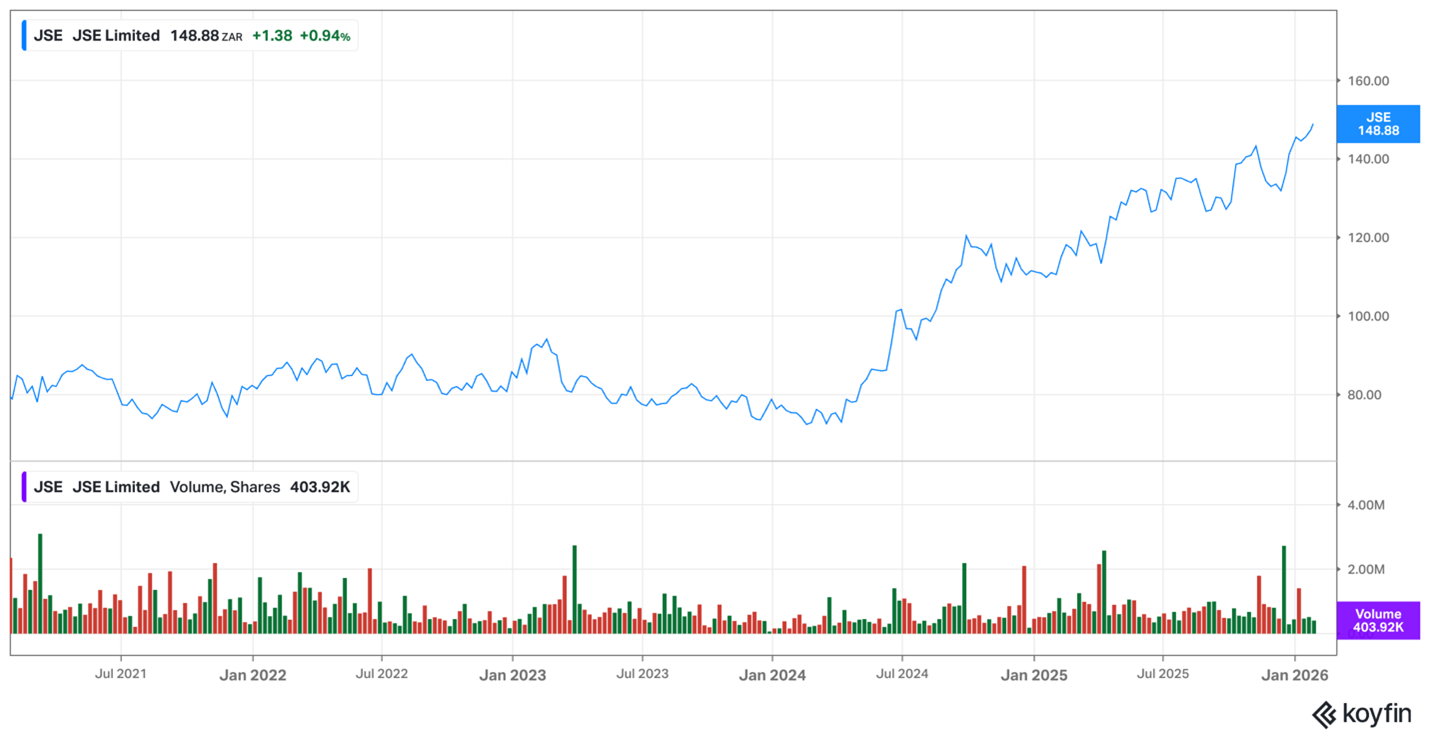
My take: The market knows, and has known for a while.
In the cockroach
No trades this week – something I will be saying a lot in future, as the trading activity on the fund is de minimis. It was gratifying to see the Yen strengthen this week, after I bought those Yen bonds. I guess you need a bit of luck now and then…
Top of mind right now is the allocation within the 25% of the fund that is dedicated to hard assets:

A few comments:
- It is overweight due to the prices of all the holdings going up strongly. As mentioned last week, I’m busy selling FRMO to rectify this, but I might be forced to do more at some point.
- We own Valterra instead of a physical platinum ETF. The collective investment scheme rules have a ridiculous limit on precious metal exposure of 10% of fund value. Given that I was already full-up on gold, I had to buy equity in a business – a much riskier proposition – to get exposure to platinum. It’s worked out well, despite not aligning with my process. But that outcome doesn’t justify the deviation; if the rules were sensible, I would have bought the physical, not Valterra.
- TPL is a business that earns royalties on oil and gas production in the Permian. A unique and low-risk way to get energy exposure.
- Speaking of energy, XLE is, as mentioned, an ETF of the leading energy companies. I always prefer index exposure over stock-specific exposure.
- St Joe is, in essence, a land-owning company in the Florida panhandle, a fast-growing area of the United States.
I am considering reducing the gold exposure in favour of more energy exposure. But if you add Yellow Cake, TPL, FRMO, and XLE together, the fund has over 10% exposure to energy-related assets. That’s probably enough, but it bears thinking about.
If anyone has other good ideas about “hard assets”, I would be interested to hear about them.
In The Media
1. Greenland
Over the past week, the media has been abuzz with solemn moralising over Trump’s apparently embarrassing messaging on Greenland. But Josh Wolfe – the co-founder of private equity firm Lux Capital – has the right take. In this post on X, he lays out his interpretation of developments around Greenland.
Trump is no fool. He is a master negotiator. You might not like him, and to be sure, I don’t. But it’s dangerous to underestimate power, especially in the hands of a good negotiator.
My take: Russia, China and the USA are engaged in an increasingly hostile cold war. Europe is collateral damage. They have emasculated themselves at the altar of “clean energy” and have been reduced to mere caretakers of a large open-air museum. They will increasingly be paying the price for this.
2. Hunting
Many people react negatively when the topic of hunting comes up. For them, even one animal killed is one too many. However, the truth is that most wild animals would have been eradicated by now if it weren’t for hunting. Hunting, including trophy hunting, creates incentives for farmers to breed and care for game. If you don’t believe me, travel to countries in Africa where hunting is banned – there are almost no wild animals left in those places.
Last week, that purveyor of propaganda and poorly articulated half-truths, Daily Maverick, published an emotive one-sided article that painted trophy hunting as an “extraction-at-scale” operation. You can read it here.
Fortunately, we do have some objective reporting in South Africa, and BizNews published an article by Ivo Vegter that demolished the weak arguments in the DM piece. You can read it here.
My take: Don’t take my word for it, as I’ve got a dog in this fight – I am a shareholder in Outdoor Investment Holdings, South Africa’s premier outdoor retailer. This includes selling hunting equipment, such as rifles, scopes, etc. Read both articles and make up your own mind.
3. The best music of 1998
My son Nic was born in 1998, so that year always holds a special place in my heart. The music wasn’t too bad either. His mother and I – for some reason – used to watch a lot of MTV when she was pregnant with him. Coincidentally, the video of one of the best songs of that year featured an embryo in utero. You can check out the video for that song, Teardrop, here. Even today, whenever I hear this song, I think of Nic and the joy that followed his transformation from an embryonic state into a living, breathing, and crying human being a few months later. And has continued for the next 27 years and counting.
Here is a list of what I consider to be the top albums of the year on Apple Music, and here is the same list on Spotify. It really was a strong line-up – peak Pearl Jam on the album Yield, as well as an album that has held up surprisingly well in Billy Bragg and Wilco’s Mermaid Avenue. Lucinda Williams Car Wheels on a Gravel Road is an all-time classic, and Gomez’s Bring it on was an unsung hero of Brit pop. Plus, the requisite trip-hop of Morcheeba and Massive Attack.
There were also many great songs released during the year. Most of the top 20 songs did not come from the albums I considered the best of the year. It’s not often that this happens.
Here is the – fairly esoteric – top 20 on Apple, and here it is on Spotify. Note the number one song (which comes last on this playlist, as I always count them down from 20 to 1. Just like David Gresham used to do (IYKYK).
It’s that time of year when everyone with a bike (and even some without) has started training for the Cape Town Cycle Tour. On Sunday, Nic and I rode the Winelands Cycle race and had a great day out. Here we are at the start, still smiling:

Not so much when we hit the pass outside Riebeek-Kasteel an hour or so later!
It really was a joy to ride with him and see how his cycling is progressing.
That’s it for this week. Remember to be careful out there, even if you’re not training for the Cycle Tour!
Piet Viljoen
RECM
29 January 2026