

Dear Fellow Investors and Friends,
Welcome to my newsletter, where I share my efforts to understand markets and the world around me.
I do appreciate you taking the time to read this. I love getting feedback; feel free to drop me a line. It’s great to start conversations.
Today is Thursday, August 13th, the 225th day of the year. There are 140 days left in the year. I’ve spent this week in the beautiful Drakensberg at the amazing Champagne Sports resort, attending (and speaking at) the 9th BizNews conference.

As a result of attending all the great sessions here, I have not had the time to write my normal missive, so I will simply repeat the talk I gave yesterday.
Here goes:
Today I am going to try to make myself the least popular person in the investment industry.
I’m going to show you parts of the industry that are superfluous. And I’m going to tell you how to get rid of those useless parts. But those same parts are also quite profitable to the investment industry, which is why what I’m about to tell you will make me so unpopular.
Investing presents us with a simple problem. We give up using our money today in the hope of having greater purchasing power tomorrow. But this creates uncertainty – giving up something today, in the hope of having more tomorrow, is not something that comes to us naturally. The marshmallow test shows that very few people can forgo eating one marshmallow to receive an uncertain number of marshmallows at some uncertain point in the future.
The investment industry’s answer to this simple problem is addition: every day we have more information, products, experts, research, intermediaries and regulation. The industry has come to resemble a Rube Goldberg machine. A Rube Goldberg machine is a deliberately over-engineered apparatus that performs a simple task in a highly complicated, multi-step chain reaction.
This is a complex machine. Complexity leads to confusion. Confusion leads to the need for advice. Advice leads to revenue for the money management industry. Is it any surprise that the investment management industry tries to complicate things as much as possible?
Bearing in mind that the investment industry’s revenue directly erodes our investment returns, let’s examine the various parts of this massive Rube Goldberg machine one by one.
A. Language complexity
The industry replaces ordinary words with professional vocabulary:
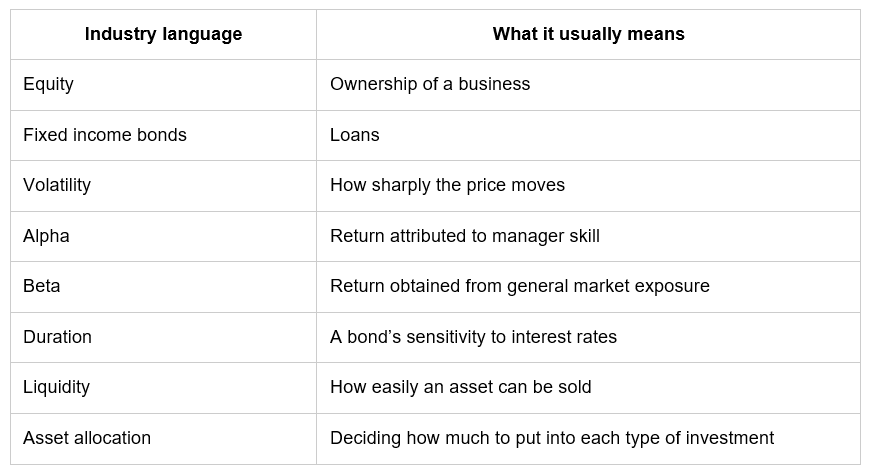
And so on, and so forth.
Technical language can improve precision among professionals. But it can also obscure straightforward ideas and establish a hierarchy between the so-called “expert” and the investor. Here’s another technical term for you: bullsh*t. Much financial jargon is pure bullsh*t, and we all know that bullsh*t baffles brains. And, in so doing, increases revenue-generating ability.
B. Product complexity
Investors no longer merely choose between a mix of cash, bonds, property and shares. They encounter:
- Collective Investment Schemes
- Exchange-traded funds
- Hedge funds
- Private-equity funds
- Balanced funds
- Absolute-return funds
- Target-date funds
- Multi-manager funds
- Funds of funds
- Structured products
- Smart-beta strategies
- Factor funds
- Thematic funds
And so on, and so forth.
Each one may have several classes, fee structures, currencies, tax treatments and minimum investment periods.
The investor is left believing that selecting the right product is a highly specialised exercise, requiring deep expertise. Yet these products are simply combinations of the same underlying assets: cash, loans, business interests and hard assets. They’re just packaged differently.
C. Measurement complexity
Once we have paid for enough help to understand what the professionals are saying, and what products they are offering, we need even more help to measure the outcomes they are achieving. This brings us face to face with:
- Multiple benchmarks
- Peer groups
- Rolling returns
- Calendar-year returns
- Sharpe ratios
- Information ratios
- Tracking error
- Maximum drawdowns
- Upside and downside capture
- Attribution analysis
- Style analysis
- Factor exposure
- Risk budgets
And so on, and so forth.
These measures may be useful, but they can divert attention from the question that matters:
Has your purchasing power increased sufficiently, after all costs, over the relevant period?
A fund can outperform its benchmark, yet still lose money in real terms. It can rank in the top quartile over an arbitrary period, but still fail to meet our simple objective. Measurement creates an appearance of precision; a precision that may not align with the investor’s actual needs. Above all, periods of “outperformance” – which all funds enjoy periodically – serve only as marketing material and have very little influence on the investor’s long-term outcome. After all, measured performance describes the past. As investors, we never get that. We only get the future.
Here’s a secret the investment industry relies on you not to understand: past investment returns have almost no bearing on future investment returns.
D. Organisational complexity
Between the saver and the underlying asset may stand any combination of the following:
- Financial adviser
- Discretionary fund manager
- Platform
- Fund manager
- Multi-manager
- Consultant
- Custodian
- Administrator
- Compliance function
And so on, and so forth.
Each may perform a legitimate role. Each may also charge directly or indirectly. The result can be a long chain in which no single fee appears excessive, but the total cost becomes substantial, paid by investors through reduced returns.
E. Forecasting complexity
The industry produces endless forecasts on:
- Interest rate movements
- Inflation outlook
- Election results
- Currency movements
- Commodity prices
- Economic growth
- Central bank actions
- Market cycles
- Technological disruption
- Geopolitics
And so on, and so forth.
These forecasts provide content, justify activity, and demonstrate apparent expertise. All of which is superfluous, because no one can predict the future. As John Kenneth Galbraith said:
“The only function of economic forecasting is to make astrology look respectable“
A better way: Via Negativa
Today, I want to propose a better way to you.
Via Negativa is a principle popularised by Nicholas Nassim Taleb. It means focusing on what not to do rather than on what to do. Taleb argues that in highly unpredictable or complex systems, we gain true knowledge and robustness primarily through subtraction – removing harm, falsehoods, or unnecessary interventions – rather than by adding new layers of complexity.
- Doctors sometimes can do more harm than good by over-prescribing or over-treating. True health is often achieved Via Negativa: through fasting, eliminating sugar, or removing toxins.
- Complex financial systems can organically heal themselves if we remove the factors that create systemic fragility: the dead hand of government, heavy debt, and rigid regulatory regimes.
- Golf is a winner’s game; whoever hits the best shots wins. By contrast, padel is a loser’s game – the one who makes the fewest mistakes wins. Here’s a tip: eliminate those fancy 50/50 “winners” from your game, and you can win Friday’s padel competition.
So, instead of asking what else an investor needs, ask what can be removed before the investment outcome deteriorates. Not all complexity is fraudulent or deliberately manufactured. Markets, taxation, regulation and individual circumstances genuinely involve complexity. But complexity can also serve the industry by making the client dependent on whoever claims to understand it. Via Negativa cuts through this Gordian knot.
Let’s examine this “complexity machine” and remove all the parts that stand between you and your returns.
The first part to be removed: the products.
Virtually all portfolios (structured products, alternative assets, etc.) consist of claims on a limited number of economic activities, each with a stable long-term expected return:
- Cash: a claim on a bank or government, offering stability but usually limited long-term growth, roughly in line with inflation.
- Bonds: loans to governments or businesses. Slightly less stable, slightly higher return of around 0.5% above inflation.
- Shares: represent an ownership interest in a business. A well-diversified collection of such claims – such as a broad index – can be volatile but can generate decent returns of around 4-6% above inflation over the long term.
- Hard assets: the ownership of physical assets that have intrinsic value due to their inherent scarcity. These offer inflation-resistant returns.
A fund is not itself the source of return; it is a container. The return comes from what the fund owns.
This is your first major act of subtraction: remove the packaging and identify the underlying economic asset.
Here are some good questions, the answers to which will guide you through this process:
- What do I actually own?
- How does it generate a return?
- How much does the package cost?
- What does the package provide that direct ownership, or a simpler fund, would not?
Don’t be misled by the product name; rather, understand the underlying economic exposure.
On to the second subtraction – the labels
Many investment categories overlap or describe minor variations of similar strategies.
“Growth,” “quality,” “value,” “momentum,” “income,” “absolute return” and “smart beta” may be meaningful descriptions, but they can also create the illusion that the investor is accessing distinct economic engines. What they do is provide the fund management business with messaging opportunities.
Again, here are some questions, the answers to which will guide you:
- Does the strategy hold cash, lend money, own businesses or hold physical assets?
- Is its return dependent on economic growth, interest income, inflation, leverage or price appreciation?
- Do we know under what conditions it will fail? Witness the recent failure of the “quality strategy” and the well-documented failure of the “value strategy” post-GFC. Most strategies start to underperform just when they become super popular. Why expose yourself to this risk?
The underlying return mechanisms matter more than the category name and are usually available at a much lower cost. Most subsets of an asset class – i.e., value, quality, or growth equities – have more variable, less reliable, and more expensive performance than the broad index.
Get rid of the labels and simply own the market cheaply via an index fund.
The third subtraction is an important one – remove the forecasts
Forecasting is attractive because uncertainty is uncomfortable. We all want an answer to the question: “What will happen next?” The investment industry loves forecasts, which create valuable marketing material. Marketing material that exploits our willingness to pay for the illusion of certainty. And make no mistake: it is just that – an illusion.
But long-term investors do not need an accurate forecast of next quarter’s inflation, the next interest-rate decision or the next election. They need a portfolio capable of withstanding a range of outcomes. As GK Chesterton said, “Life’s wildness lies in wait.” Nowhere is this truer than in financial markets.
We need to remove prediction. Instead, we should prepare for this “wildness”.
Instead of asking what inflation, interest rates or share prices will do, we should ask what would happen to my capital if my expectations were wrong?
This changes the investment process from one of optimisation to one of robustness.
A robust portfolio includes:
- Liquidity for foreseeable needs
- Diversification across genuinely different assets
- Limited dependence on borrowed money
- An allocation to productive assets that can compound over time
- The capacity to endure temporary market declines without being forced to sell
Such a portfolio could be a simple mix of an index fund and cash, or a cockroach-type portfolio. The aim is not to predict the future; it is to avoid requiring a particular future.
Subtraction number four – remove avoidable fees
Costs are among the few investment variables we know in advance.
A fee may seem small when expressed as an annual percentage, but it compounds negatively. The investor loses not only the fee, but also the future return that the deducted amount could have earned.
Fees are separated into layers:
- Adviser fee
- Platform fee
- Administration fee
- Fund-management fee
- Performance fee
- Trading costs
- Tax
For each layer, ask:
- What service is being provided?
- Do we need it?
- Could it be obtained more cheaply?
- Could it be avoided completely?
- Is the cost proportional to the value?
The argument is not that all fees are illegitimate. Skilled advice can add value through tax and estate planning, as well as behaviour management. Skilled investment management can also add value, but it is super hard to find, especially in advance. So the former is much more important to pay for than the latter.
The Via Negativa principle is to remove every fee for which the investor cannot identify a necessary service or a reasonable prospect of added value. If you simplify your investment process, you can reduce the number of services required from the investment industry, thereby lowering your costs.
The fifth subtraction – remove unnecessary activity
The industry tends to equate activity with value:
- Frequent trading
- Regular tactical allocation changes
- Continual manager replacements
- New product launches
- Constant portfolio commentary
- Immediate reactions to news and earnings reports
But activity creates costs:
- Brokerage
- Tax
- Market-impact costs
- Behavioural mistakes
A quiet portfolio may look neglected even when it is functioning exactly as intended. This creates an uncomfortable commercial problem. A fund manager who says, “We have made no changes because the long-term case remains intact,” may appear less valuable than one who is constantly active.
Via Negativa asks: What transactions can be avoided?
Minimising transactions not only reduces costs, but can also reduce errors. Every time you trade, you expose yourself to a potential mistake. As I pointed out earlier, in a losers’ game, which investing is, minimising mistakes is the way to win the game.
Fewer mistakes and lower costs put you ahead of the game.
No brilliance required.
Subtraction number six – remove the risks you should not be taking
Risk is the price you pay to earn returns. But not all risk is a necessary price to pay to earn the long-term returns you need.
Some risks are consistently rewarded:
- Owning businesses through economic cycles
- Lending to creditworthy borrowers
- Holding long-duration assets
- Owning scarce assets
Other risks are avoidable:
- Excessive leverage
- Excessive concentration
- Forecast dependance
- Excessive illiquidity
- Complexity
- Weak governance
This distinction is important. Via Negativa is not the elimination of all risk. Eliminating all risk would also eliminate the possibility of a meaningful real return. The objective is to remove risks that can permanently destroy capital, while retaining those that are necessary and reasonably compensated.
The final complication to remove is our own destructive behaviour
The industry is not solely responsible for complexity. Investors often demand the impossible or unreasonable, creating the opportunity for this industry to add complexity. These impossible and unreasonable things include:
- Certainty in an uncertain world
- High returns without temporary losses
- Explanations for every market movement
- Immediate action during crises
- A sophisticated story
- Someone to blame when outcomes disappoint
Complexity is a joint effort. The industry sells what investors want: emotional reassurance. The most damaging decisions are mostly driven by behaviour which provides short term comfort:
- Buying after strong performance
- Selling after poor performance
- Changing strategies repeatedly
- Chasing fashionable assets
- Borrowing excessively
- Confusing volatility with permanent loss
- Abandoning long-term plans in response to short-term news
Once we have removed all the external complications, the investor must address internal ones: envy, greed, impatience, fear, overconfidence and the desire for constant action. This final layer of complexity lies within the investor, not the portfolio. It’s hard to overcome but immensely rewarding to achieve.
In summary, investing is a simple problem with a simple solution:
- Spend less than you earn
- Preserve liquidity
- Own productive assets
- Diversify
- Control fees and taxes
- Avoid permanent loss
- Remain patient and rational
- Measure success by the growth of purchasing power
But doing these things is difficult because markets are volatile, the future is uncertain and human behaviour is unpredictable. The investment management industry unashamedly exploits our difficulty in these areas.
It does so through making the process more complicated than necessary. Simplification is a better way, but simplification does not eliminate the need for judgement. It does, however, force us to concentrate our judgement on the handful of decisions that matter.
Via Negativa does not promise that investing will become predictable, but offers something more useful: stripping away the products, the jargon, the forecasts, the false precision, the excessive activity and the layers of cost reveals the essential task of money management: converting present savings into future purchasing power without suffering ruin along the way.
In honour of the Nick Cave concert Amanda and I attended in Brighton 10 days ago:

I hope some of these “bad seeds” I have planted find fertile ground.
Piet Viljoen
RECM
13 August 2026