

Dear Fellow Investors and Friends,
Welcome to my newsletter, where I share my efforts to understand markets and the world around me.
I do appreciate you taking the time to read this. I love getting feedback; feel free to drop me a line. It’s great to start conversations.
Today is Thursday, July 30th, the 211th day of the year. There are 154 days left until the end of the year. Just like that, July, with its sporting bonanza, is over. Tour de France, Wimbledon and the Football World Cup; it really was a fun month.
80 years ago today, England won the Football World Cup – a feat never repeated. But it hasn’t stopped their fans from singing “It’s coming home” every four years since. Why they think England is the “home” of the World Cup is beyond me. Possibly a case of pareidolia?
Judge for yourself:
Pareidolia is the illusory perception of meaningful patterns or images of familiar things in random data. Famous examples include:
- the man in the moon
- the horse-head nebula
- the Virgin Mary on a piece of toast
- England thinking they can win the World Cup every time it comes around
Filmmakers deliberately use pareidolia by hiding face-like shapes in the background wallpaper, wood grain, or curtains of a scene to create an unconscious sense of dread and the feeling of being watched.
There are a few theories on how this tendency developed:
1. Minimising the Cost of Mistakes
Our ancestors faced a daily choice when they heard a rustle in the bushes or saw a shape in the dark. One of two things could be happening:
- A false positive, or assuming a dangerous predator is there when it is just a bush. The cost is a false alarm and a brief spike in adrenaline.
- A false negative, or assuming it is just a bush when a deadly predator is hiding there. The cost is death.
Because missing a threat was fatal, evolution heavily favoured brains that assumed a threat existed everywhere. It is far better to mistake a rock for a bear than a bear for a rock.
2. Hyperactive Agency Detection Device (HADD)
Humans evolved a cognitive trait known as HADD, which leads us to assume that ambiguous events or objects are driven by an “agent” – a conscious being with intent. If a branch snaps, your brain instantly assigns intent – “something is tracking me” – rather than assuming it was just the wind. This constant state of alertness keeps the brain scanning random geometric patterns for eyes and body shapes, i.e. pareidolia.
3. Social Connection
Humans are fundamentally social animals whose survival depends entirely on working in groups. Missing social cues can lead to exile or conflict.
- Human babies can recognise and track face-like patterns (two dots and a line) within minutes of birth, long before their general vision is fully developed.
- The brain has developed specialised hardware dedicated solely to processing faces in milliseconds. This area is so sensitive that it can be accidentally triggered by car headlights or pieces of toast.
Charlie Munger frequently emphasised that the human brain is a “pattern-seeking machine” and warned that this instinct often leads people to force patterns onto random data where no real correlation exists – a form of pareidolia. As a result, we are prone to jumping to easy conclusions. This instinctive reaction has been embedded through aeons of evolutionary necessity. So, we need to work extra hard to separate objective reality from the psychological distortions caused by our survival wiring.
The stock market is where shares in businesses are bought and sold. Most of the agents in this market make their money by facilitating the flow, not by putting capital at risk. The more flow (trading) there is, the more money they make. It should come as no surprise that they have learnt all the psychological tricks available to create flow.
Our inclination to pareidolia is one of them. Have you ever heard your broker say something like…
- This stock is just like the one that went up ten-fold. You should buy it!
- The market is about to crash, sell everything!
- Everyone else is buying this stock – you should, too!
- Look, there are lots of green and red lights flashing on the screen. It must mean something; let’s trade!
- **namecheck famous investor** just sold all his stock. You should, too!
As investors, we make our money by taking risk – by providing capital to businesses and, hopefully, enjoying the fruits of their endeavours, reflected in a higher share price over time. When we trade, we interrupt this process. To get the maximum benefit from our risk-taking, we need to learn to counter the psychological tricks of flow-driven agents.
Here are a few ways that have worked for me:
- Make your decisions on your own. Single-point responsibility is a fundamental requirement for investment success. In investing, committees invariably devolve into the lowest common denominator.
- Survivorship bias is deeply ingrained in our nature. This makes us ill-suited to investing. We need to recognise this and consciously train ourselves to think differently.
- Mr Market is there to serve you. Your HADD wants you to “do something”, but you don’t have to. Take advantage of Mr Market, not the other way round.
- Always test what is said against what actually is.
- Work hard to understand incentives.
Finally, I want to leave you with these quotes:
“Men, it has been well said, think in herds; it will be seen that they go mad in herds, while they only recover their senses slowly, and one by one.”
– Charles Mackay: Extraordinary popular delusions and the madness of crowds. (1841)
“All of humanity’s problems stem from man’s inability to sit quietly in a room alone.”
– Blaise Pascal: Pensées (1670)
As you can see from the dates on these quotes, these are not new problems to overcome. This is what makes it so hard.
In The Markets
1. Turkeys not voting for Thanksgiving
Prosus (PRX) has generated just about zero returns for its shareholders since its IPO in September 2019. Ex-Naspers/Prosus CEO Bob van Dijk told reporters on that day: “We’ve become so big that further growth of our company on the JSE would be difficult.”
Since then, Prosus has completed multiple large acquisitions, built and then partially dismantled a crossholding structure, embarked on a long-term share buyback, replaced its entire executive management team and incentivised them with an ambitious “moonshot” award.
At a market cap of $94bn today, Prosus is smaller than when van Dijk was bragging about its size. To say that Prosus has been a major disappointment is an understatement. If it didn’t negatively affect so many pensioners, it would be funny.
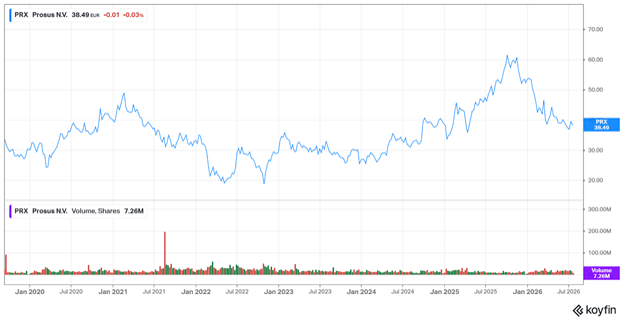
To stem this long-term torpor, new management was appointed exactly 2 years ago. In terms of their “moonshot” deal, the incoming CEO, Fabricio Bloisi, would earn $100 million(!) over a four-year term if:
- The group’s aggregate market capitalisation doubled from its baseline of US$84 billion to US$168 billion, and this level was sustained for a year.
- Prosus outperformed a basket of competitors in terms of TSR (Total Shareholder Return).
Importantly, the two conditions are binary, meaning both need to be met to earn the reward.
Let’s have a look at the report card halfway through the “moonshot” period:
- Current market value is $94bn, way behind the target
- TSR is almost exactly on the median, so this condition is being met
If Mr Bloisi were still at school, the report would read: “Tries hard but could do better”.
Current management hopes to achieve the moonshot by expanding in the food delivery service business. I share the market’s skepticism about this. According to research from Avior, since FY ’17, Prosus has invested $14 billion in these types of businesses, generating an average IRR of 6%. Delivery Hero has been the worst-performing investment in the portfolio, with a negative IRR since the initial investment.
Recent news is that Prosus has sold its remaining stake in Germany’s Delivery Hero to Uber for c.$14.8 billion. This values Prosus’ 17% stake at c.€2.2bn. That’s a lot of money, but it’s a tiny portion of Prosus’ NAV, so it doesn’t really move the needle. But they now have a much stronger competitor in Uber Eats.
Since current management took over 2 years ago, Prosus’ discount to NAV has stayed wide at around 40%, reflecting the market’s lack of confidence in their food delivery strategy.

Mr Bloisi’s best hope of earning his moonshot award lies in Tencent.
Today, Prosus’ stake in Tencent is worth $110 billion. Sell-side reports value Prosus’ non-core assets at around $40 billion. There is also a chance that Tencent could re-rate over the next two years.
Over the past 6 years, Tencent, Broadcom, Netflix and Alphabet (Google) have all more than doubled their revenue. 6 years ago, Tencent traded at a slight premium to the US companies. Today, it trades at a 30% discount:

If Tencent were to rerate to the level of its US peers, it would add another $35 billion of value to Prosus.
Voila! Unbundling Tencent, plus a possible rerating and paying out a cash dividend to shareholders from the sale of non-core assets, would realise c.$185bn for shareholders. Moonshot achieved. This strategy would also have the added benefit of not requiring any management costs at the Prosus level, thereafter, representing a huge saving for shareholders.
Of course, real life is not always this simple – the lack of an incentive for management to put themselves out of a job guarantees that. Turkeys never vote for Thanksgiving.
But for current shareholders, there are two ways to win here: either current management realises it won’t earn its “moonshot bonus,” abandons the value-destructive strategy, and sells and unbundles everything; or the controlling shareholder grows tired of the unending value destruction and appoints new management with a mandate to realise value. The downside is that the current charade continues, and the market is already discounting it, so one is unlikely to lose much money if it persists.
My take: Limited downside and strong upside make for a value investor’s dream. The MWI Value fund has significant exposure to Naspers, which offers an even cheaper way to gain exposure to Tencent, one of the world’s best companies.
2. Sisyphus Redux
Alphabet (Google) reported its first negative cash flow print since going public 20 years ago, which gave rise to this meme:

To be clear, Alphabet recently reported strong results. Revenue was up 24%, with search revenue climbing 17% and its AI-boosted cloud business jumping more than 80%. However, it reported negative free cash flow of $5.9 billion.
This cash deficit arose because capital expenditure doubled to $44.9 billion, driven by massive investments in AI infrastructure. Management doubled down, raising its full-year 2026 capital expenditure guidance to between $195 billion and $205 billion.
The market disapproved of this guidance:
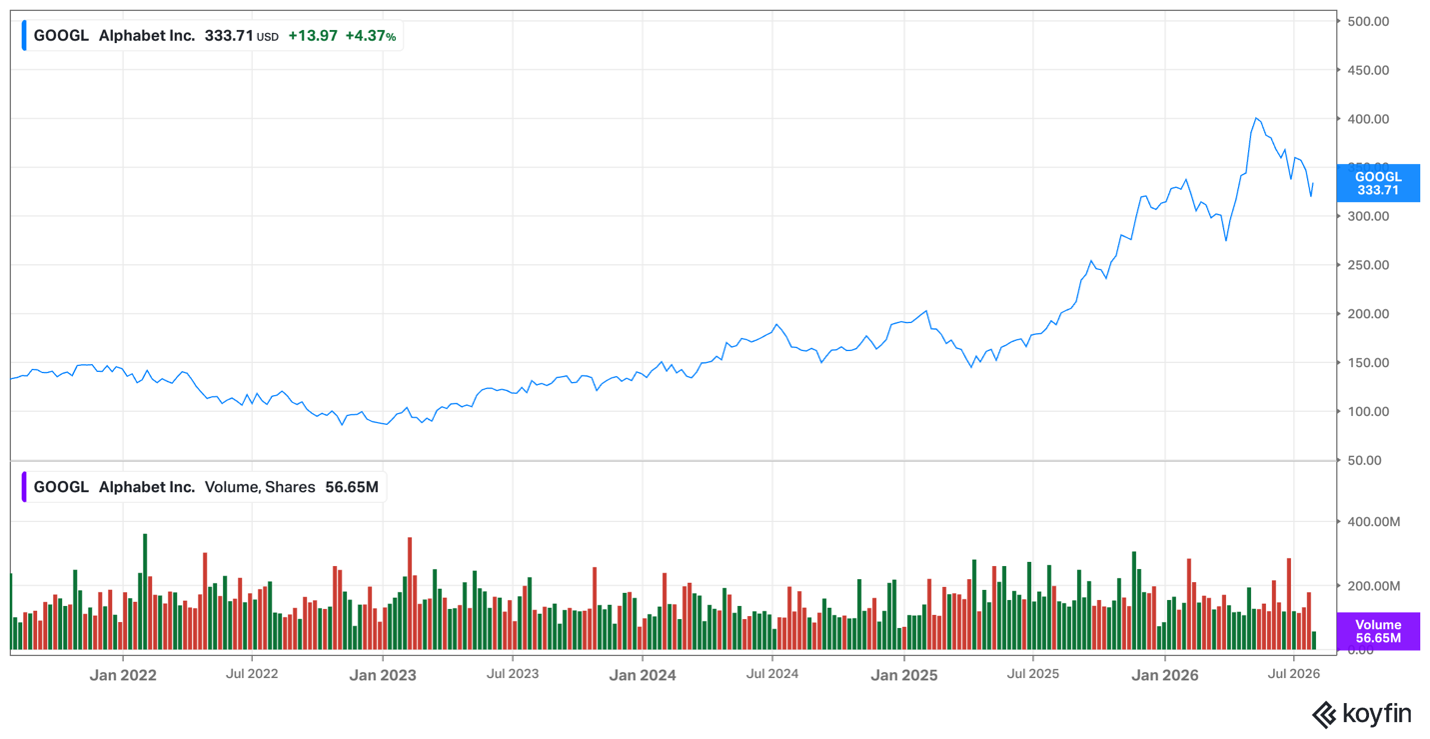
To fund this capex jamboree, Alphabet recently did a capital raise of $85bn – the biggest in market history. This was supported by $10bn from Berkshire Hathaway. The capital raise was at a share price of $351. Today’s share price? 10% lower at $320.
My take: I have many questions here. Did Berkshire Hathaway, under new management, buy at the top? Or is this just a short-term correction in Alphabet’s share price? Are the hyperscalers undertaking a Sisyphean task? This is a key question for Berkshire Hathaway shareholders, including the MWI Worldwide Flexible Fund (aka “The Cockroach”).
3. The “Toilet Bag”
A recent article by the Chinese publication Baiguan raised a few interesting points. The article described how Louis Vuitton recently won a court case in China, protecting some of its trademarks, specifically its famous “quatrefoil” pattern, which looks like this:

Apparently, a Chinese bubble tea chain, Molly Tea, used a similar pattern in its logo. The court ruled in favour of LVMH. So far, so good. But Chinese consumers didn’t agree – very few defended LVMH. Apparently, the quatrefoil pattern has deep historic significance in China. Who knew?
The pushback against LVMH is part of a rising tide of what is termed Guochao – a popular cultural movement in China in which people express strong national pride by choosing local brands and styles that blend traditional Chinese elements with modern fashion. Almost immediately, some people found pictures of Chinese restrooms, historically carved with four-petaled “quatrefoils”, and posted them alongside LVMH’s motif. Something like this:

As a result, Louis Vuitton bags have become widely known as “The Toilet Bags”, with a predictable knock-on effect on their sales:
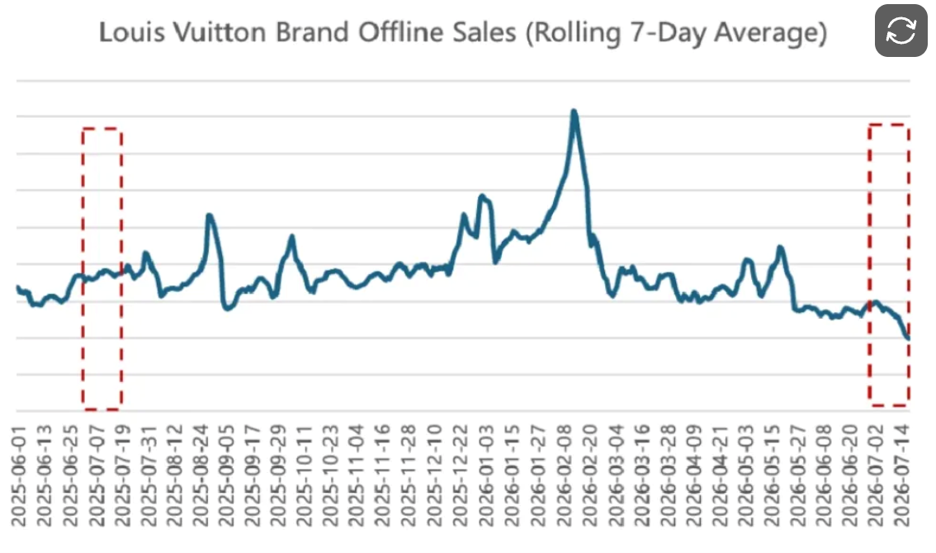
Data source: Bigone offline payment data
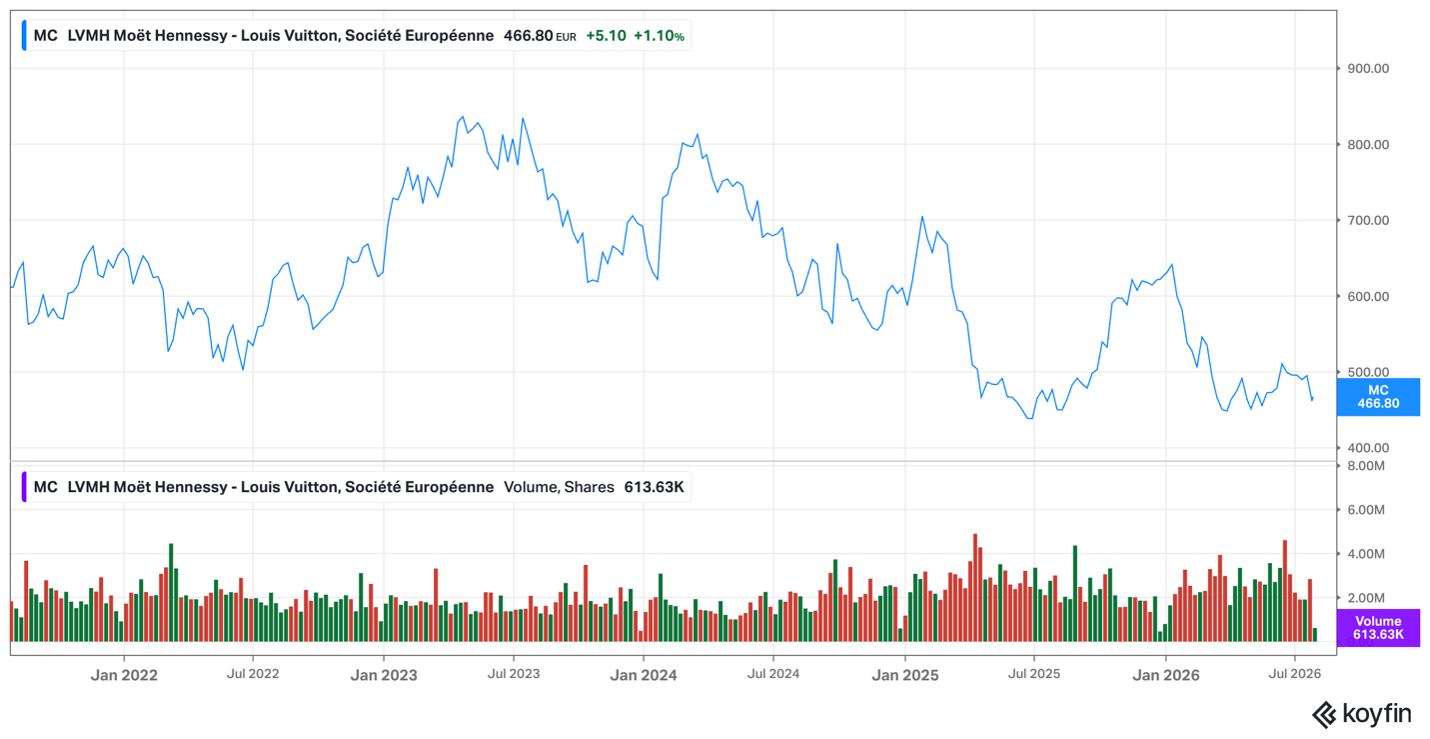
No wonder the LVMH share price remains in the “toilet”, so to speak:
My take: As I have mentioned previously, exposure to the Chinese consumer is best achieved through local brands, not international ones. It would be a major win to find the Chinese versions of Nike, Coke, or McDonald’s.
4. Home prices
Here is a map showing home-price-to-income ratios around the world. A house P/E ratio, if you will:

A few takeaways:
- South Africa has some of the cheapest housing in the world.
- The Chinese housing bubble still has a way to go before it deflates properly.
- What’s going on in Brazil?
- Europe is also pretty wild.
My take: Like our small- and mid-cap stocks, houses (outside of Cape Town) are also super cheap. I don’t think property generally makes for a good investment, but just maybe there’s an exception here.
5. Energy stocks
The energy sector has delivered the best total return performance of any US sector over the past five years. Better yet, this performance has been broadly uncorrelated with almost all other asset sectors and asset classes:


This latter point is important. As shown in the second chart above, over the past three years the weight of tech in the broader S&P 500 index has risen from 25% to almost 40%. At the same time, energy stocks have fallen from 5% to 3%.
How could energy stocks have outperformed tech stocks?
The answer lies in share counts. Energy companies have bought back shares, merged or gone private. Meanwhile, the tech sector has shifted from buybacks to massive new issuance through IPOs and private placements (SpaceX, Alphabet, etc.).
How long can this carry on?
The energy sector still has valuation support, especially relative to the tech sector. They are still not spending very much on capex, while the tech sector is accelerating its spending. The energy constraints on output, transport and refining will remain in place for quite a while to come, even though the worst of the net-zero craziness seems to be abating.
My take: The MWI Worldwide Flexible Fund (aka “The Cockroach”) continues to have significant exposure to energy within the fund’s hard-asset portion.
In the cockroach
As usual, no trades over the past week for the fund*. But there are some things I am thinking about:
- Should I buy more Japanese currency and bond exposure?
- Should I switch to inflation-linked bonds, which offer decent real yields regardless of inflation?
- Will Apple or Constellation Software be the 10th stock (out of “10, stocks forever”) in the fund’s equity allocation?
- Should I switch the TPL exposure to FRMO, which has TPL as a significant portion of its NAV and is available at a significant discount?
My default is to do nothing, but if and when I decide to make a change, I will communicate it here.
* I manage the fund on behalf of Merchant West Investments (Pty) Ltd (FSP 44508)
In The Media
1. Book review: Moby-Dick by Herman Melville (1851)
This is probably one of the books with the biggest gap between people who have heard of it and those who have actually read it. This is why I decided to give it a go – there must be something to a book so widely known.
Part adventure novel, part biological taxonomy, part psychological thriller, and part ship deconstruction, Melville takes the reader on an exciting voyage across the seven seas. In recounting the adventure of hunting the whale Moby-Dick, he also includes descriptions of the different types of whales found in the ocean, as well as a detailed breakdown of what a typical whaling ship looked like and the equipment it carried.
In the end, it is also a devastating portrait of a ship captain’s descent into madness, driven by his obsession with the whale that took his leg, and the resulting destruction of everything around him.
Parts of the book are not easy to read – the dry sections on whale taxonomy, or the descriptions of the whaling boat. But hardest of all is when he quotes Captain Ahab, the captain of the ship, to whom Melville gives a flowery Elizabethan voice. When Ahab speaks, you have to read what he says a couple of times to grasp its meaning fully.
Despite the hard parts, the book is amazing. Written almost 200 years ago, it still has much to teach us about our flaws, intellectual limitations and capacity for progress. And did you know that a famous chain of coffee shops was named after the ship’s first mate, Starbuck? Neither did I!
Despite its prolixity (I’ve always wanted to use that word) and occasional density, I can recommend this book – on the whole, it’s an entertaining read.
2. Natural Maniacs – The Morgan Housel Podcast
Some of the most brilliant people who have changed our lives for the better – Thomas Edison, Henry Ford, Elon Musk – have also had despicable sides to their personalities. It comes with the territory – it should not be surprising that someone who thinks so far outside the box in one aspect of life also thinks very differently from us in other aspects of life.
You generally can’t get one without the other.
As Housel says, he would rather live in a world where such people also lived than in one where everyone was mediocre. But in his circle of friends, he would prefer people with more moderate views.
I can’t agree more!
You can watch the podcast here.
3. Tour de France
My favourite sporting event of the year has come and gone. This year, it ended with a bang in an amazing race between yellow jersey holder Tadej Pogacar and previous world champion Mathew van der Poel on the Champs-Élysées. As the peloton closed in, Van der Poel dropped Pogačar and beat the sprinters by a nose. You can watch the thrilling last kilometer here.
Have a look at this clip to see what it took out of him to win that race.
And, finally, a couple of new ways to open that après race beer. This one is nifty. But this one is much better.
That’s it for this week from a hot, dry England – perfect weather for music concerts and bikepacking! As a consequence, there will be no letter next week.
Normal service will resume on the 13th of August. That one will come to you from the Champagne Sports Resort in the Drakensberg, where Amanda and I will be attending the BizNews conference.
Hopefully, we will see some of you there.
Wherever in the world this letter finds you this week, remember – be careful out there.
Piet Viljoen
RECM
30 July 2026