

Dear Fellow Investors and Friends,
Welcome to my newsletter, where I share my efforts to understand markets and the world around me.
I do appreciate you taking the time to read this. I love getting feedback; feel free to drop me a line. It’s great to start conversations.
Today is Thursday, July 2nd, the 183rd day of the year. There are 182 days left until the end of the year. And just like that, it’s all downhill to the end of the year. This also means it’s that time of year where we get a sports overdose: the Tour de France, Rugby Internationals and Wimbledon. On top of that, we also have the Football World Cup to deal with.
Speaking of Wimbledon, one of the most iconic Wimbledon champions was a Swede, Björn Borg. Remember his epic battles with Connors and McEnroe? Borg was considered one of the greatest in the tournament’s history, winning 5 consecutive titles from 1976 to 1980.
It just so happens that Borg was born in Stockholm, where, in August 1973, a convicted criminal named Jan-Erik Olsson took four employees hostage inside the Kreditbanken. During the six-day standoff, one hostage, Christine Enmar, famously called the Swedish Prime Minister to plead for their captor’s freedom. Following their release, the hostages even raised money for the robber’s defence and maintained they were far more afraid of the police’s aggressive tactics than those of their captor.
Stockholm syndrome is a psychological phenomenon in which victims of captivity or abuse develop emotional attachment and sympathy toward their captors or abusers, often defending them and resisting rescue efforts.
In 1974, nineteen-year-old newspaper heiress Patricia Hearst was kidnapped by a radical militant group called the Symbionese Liberation Army (SLA). After weeks of confinement and coercion, Hearst shocked the nation by appearing in security footage actively participating in a bank robbery alongside her captors. She adopted the alias “Tanya,” joined the group’s revolutionary cause, and spent 19 months underground fighting for the very people who had violently abducted her.
Stockholm syndrome is a real thing.
Investors often suffer from a similar syndrome. Between them and the returns they should get for taking the risk of providing capital to a business, we find several significant obstacles. All of them represent a leakage to “helpers” who place none of their own capital at risk. Understanding these leaks and taking steps to avoid them can significantly increase investment returns. However, this is easier said than done, as these helpers are skilled at building strong emotional ties with their victims clients. Just like the Symbionese Liberation Army.
- The first step to reducing leakage in one’s financial system is to recognise where it occurs: fees. Most people employ an investment manager to manage their capital. These fees are mostly a necessary cost, as investing is a full-time job (of course, this is my unbiased opinion). But keeping them as low as possible can contribute to meaningfully higher returns. Indexing a significant part of your equity exposure is a step in the right direction.
- The institutional imperative. The investment management business is exactly that – a business, not a charity. As such, business imperatives drive corporate behaviour. These imperatives can drive the misallocation of capital in the following ways:
- Closet indexing. To run a successful investment management business, you can never afford to underperform by much. The marketing department capitalises on short bouts of outperformance, while the inevitable long-term underperformance is never mentioned. The way to give your marketing team the best shot at what they do well is to never stray too far from the index.
- Liquidity preferences. To run a successful investment management firm, you need to increase your AuM (Assets under Management) significantly. This means you focus only on large, liquid stocks. Small and mid-caps don’t enter the picture, as even big positions in small companies won’t move the needle. Such positions are, by their very nature, also illiquid, anathema to the “risk management” department of such an institution.
- Excitement. An important principle to understand is that intermediaries earn fees from activity, not direction. The greater the excitement around an investment, the greater the activity. It follows that the intermediaries are highly skilled at creating excitement. It was in the recognition of this that Buffett once said: “Investors should remember that excitement and expenses are their enemies“. And in the spirit of Munger’s aphorism of “All I want to know is where I’m going to die, so I’ll never go there“, it’s always good to know where excitement in markets is created:
- IPOs. The bankers that earn fees on helping a company list are highly proficient at creating excitement around the prospective listing. Some would even say that fermenting a frenzy out of a set of financial accounts is their core proficiency.
- Mergers and acquisitions. Companies that grow organically are boring. Acquisitions, on the other hand, create tremendous excitement. Who doesn’t love a deal?
- Story stocks. When a stock has had a good run, the market loves creating a “story” around its success, implying that this success comes from some edge. This is sometimes true, but most often not.
These are all situations that, following Munger’s advice, are best avoided.
So, what to do?
- Use more indexing and less active investment management. Reduce the average fee you pay. Fewer trades are better than more.
- When using active management for specialist areas to which indices can’t provide exposure, don’t use large institutional managers. They are good at providing index-like exposure at a high fee – precisely what you don’t need.
- Avoid IPOs and don’t get caught up in M&A excitement. In investing, boring is good.
- Equally, avoid story stocks – by the time the story gets around to you, it’s probably reaching “The End”.
- If you are stuck in a bad investment but can’t face the CGT bill to get out, suck it up! Pay your tax and move on. Opportunity cost is a real thing.
- If you must read sell-side research, do it for information, not valuation. Do your own valuation work or leave it up to a professional – preferably one who has your interests at heart. When that 200-page report on a stock or sector hits your inbox, delete it. Immediately. Excess returns don’t hide in research bibles.
A large part of investment success stems not from being proactive, but from actively not doing certain things.
In The Markets
1. lululemon
The stock I love to hate. I love their product, but I hate their messaging and, above all, their pricing. Like most American things, their product is super expensive. I have written about them many times before, like here and here. But given recent price action – a loss of 80% of its value – it’s time to look at them again:
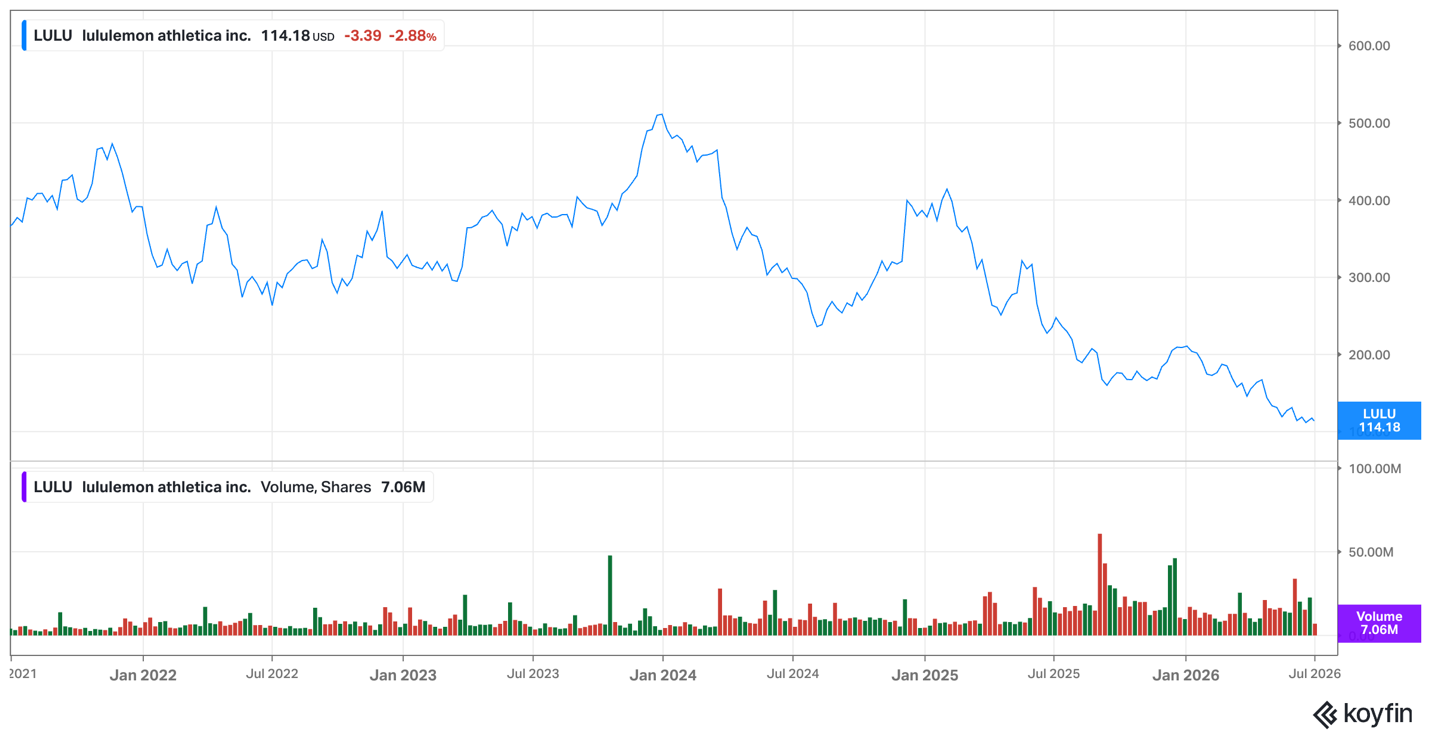
In the past, I referred to their chart action as a “Downward Dog” pose. But now the chart pose looks increasingly like a “Swan Dive”. What’s going on?
Well, it’s a business that specialises in scoring own goals – from displaying the phrase “Who is John Galt?” on their shopping bags to selling transparent yoga pants, which the then-CEO blamed on women’s bodies(!).
lululemon presently has no CEO.
China is a market where lululemon has significant growth ambitions. These have now come to a grinding halt after they used a Japanese war drum in a mass yoga event at the Great Wall. You don’t have to be a Sinophile to know that this gaffe would cause massive blowback.
Warren Buffett said you should always invest in companies that even a fool could run, as at some point, one will.
Well, here we are.
Of course, the corollary to Buffett’s aphorism is that it’s a value investor’s best friend when this happens.
My take: I think it is time to seriously have a look at this stock, if fashion retail is your kind of thing. For me, it remains in the “too hard” pile.
2. Schroder European Real Estate (JSE: SCD)
This is probably a stock you have never heard of, and hopefully never invested in. It is a REIT (Real Estate Investment Trust) that focuses on growth cities across continental Europe. Or so they say. The share price tells the real story:
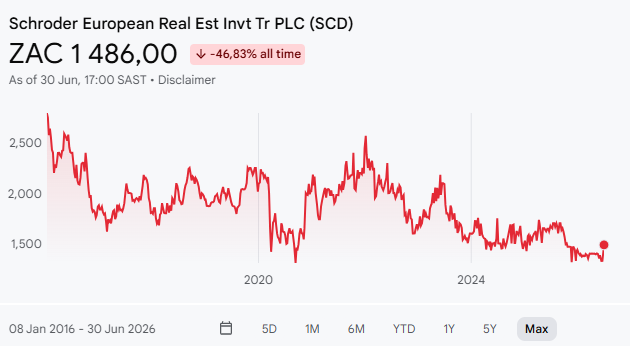
Shroders IPO’d on the JSE at the height of the REIT bubble here in South Africa. It was a two-fer, playing on the twin irrationalities of local investors:
- Anything offshore is a good investment.
- Property is a good investment.
Why would a European REIT list on the JSE? I can think of two reasons:
- Management were such good guys that they wanted to share some free money with the nice people of South Africa.
- Management were profit maximisers and wanted to take advantage of the irrationality of South Africans to raise some cheap capital.
Apparently, local investors believed option (1) – they bought the shares on listing at a premium to NAV. Unfortunately, option (2) was correct; they were simply taking advantage of us.
Today, SCD’s share price trades at a 40% discount to NAV and has never exceeded its listing price from 10 years ago. Last week, management of SCD proposed a wind-down and a return of capital to shareholders.
My take: In the spirit of Charlie Munger – who said difficult problems are often best solved by inverting them – maybe it’s time to have a look at European real estate?
3. Healthcare
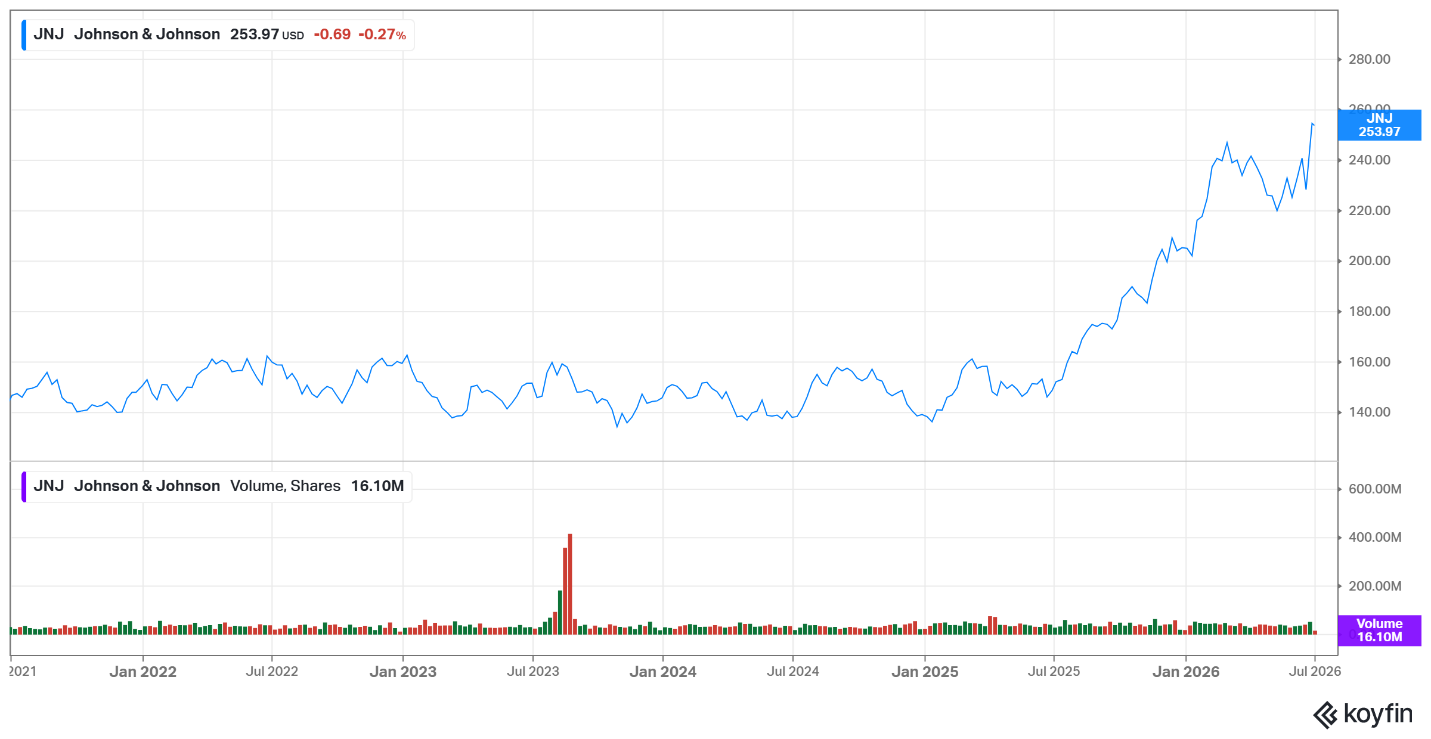
Wouldn’t it be funny that by the time analysts had put in all the hours to differentiate between DRAM, HBM, and NAND flash, and had figured out exactly how capital-intensive and cyclical these businesses are, something as mundane and defensive as healthcare stocks started outperforming?
The market is very good at making fools of even the smartest kids on the block, so it should come as no surprise that it seems to be exactly what’s happening. Hyperscaler (what an exciting word!) Microsoft is 25% below its recent high, with all the analysts on Seeking Alpha screaming buy. But boring old J&J has just hit new all-time highs:
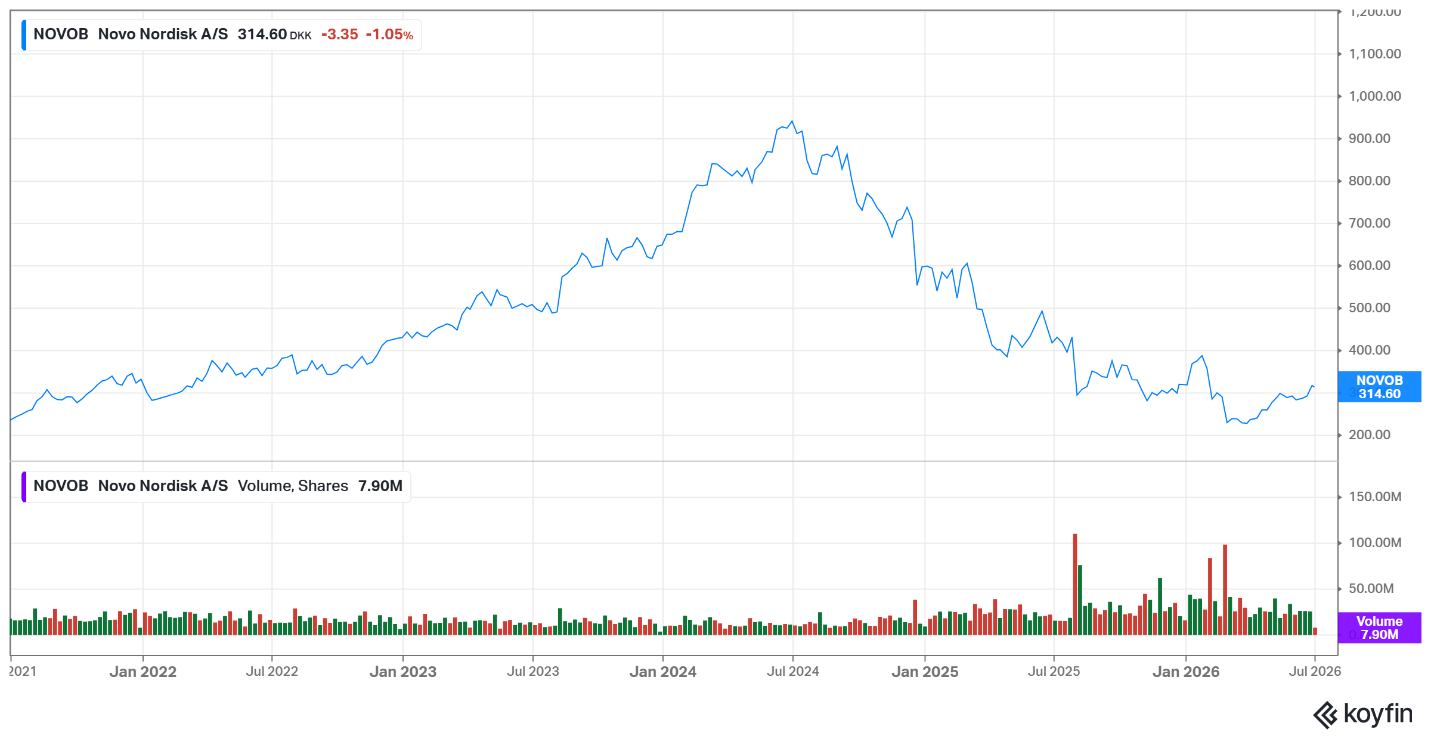
Remember Novo Nordisk, that market favourite two years ago when analysts were all burning the midnight oil on GLP1s? Well, its share price has slimmed down to an attractive size, 75% below its recent high. Today, it looks like it’s starting to pick up some much-needed weight again:
Just after analysts had spent a year figuring out what mRNA technology was (and how it worked), Moderna’s share price collapsed into a lifeless heap as if struck by a severe viral infection – down 95% from its high! Today, Moderna seems to be awakening from the dead:

My take: Like the drunk looking for his car keys under the streetlight, because that’s the only place he can see anything, investors only ever seem to look at what has most recently done the best. Meanwhile, good investments are often lurking just out of reach, in the shadows.
4. Emerging markets
I have been on record as saying that I prefer emerging markets over developed markets. I prefer them for various reasons: as a play on global growth, better national financial accounts (a fancy way of saying they have less debt) and, importantly, favourable valuations.
Turns out I was right. This is the MSCI EM index relative to the MSCI World Index:
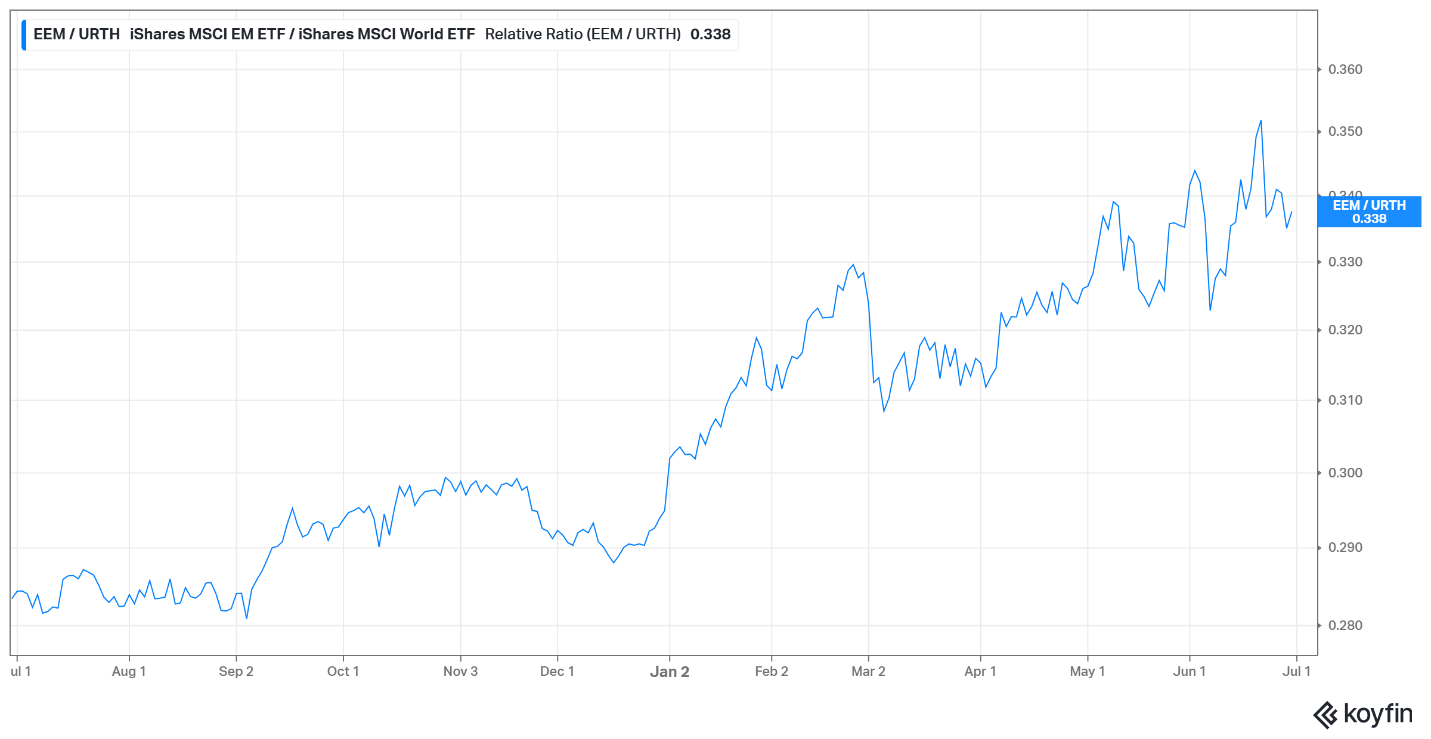
But it also turns out that I was right for the wrong reasons. The MSCI EM index has suddenly become a play on information technology. Yes, it now has over 44% exposure to semi/AI/tech. Even worse, 30% of the index is in 3 stocks.
Here are the top 5 holdings of the iShares MSCI Emerging Market ETF:

Ex-tech, emerging markets have not performed nearly as well:
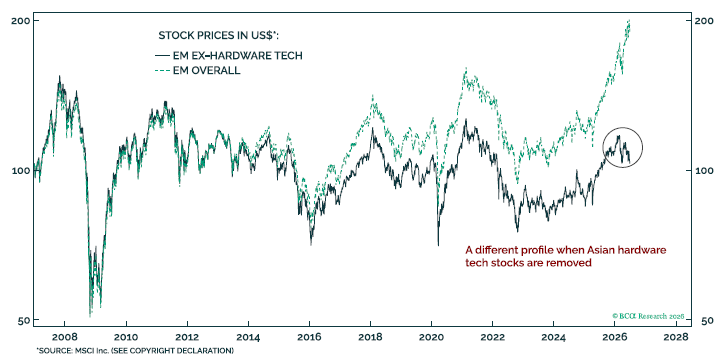
One of the very few free lunches in investing is the risk/return benefit of diversification. But diversification is not defined by how many countries or stocks you hold, but by the independence of return drivers. Those drivers are becoming much more aligned within and across countries than many investors realise.
My take: The label on the tin does not accurately describe the content. I get the impression that the same people who bought “quality” funds just before they started performing badly are now trying to “diversify” into emerging markets, for all the wrong reasons. Momentum investing can be a sensible strategy, but not if you are consistently late to the party.
5. Goldrush Holdings
I have a significant interest in this JSE-listed holding company. Its only asset is a 59.4% shareholding in Goldrush Group, a leading South African alternative gaming group.
Unfortunately for the other shareholders and me, Goldrush Holdings also has some debt against its ownership of Goldrush Group. With online gaming putting pressure on Goldrush Group’s cash-generating ability, the company is unable to pay sufficient dividends to Goldrush Holdings to reduce its debt load, turning it into something of a value trap. Its market price reflects this reality:

Not a pretty picture, down by 60% from its high just three years ago. There is, however, some light at the end of the tunnel – Goldrush is part of the consortium that won the tender to operate the National Lottery for the next 8 years. The transfer from the previous operator, which entailed setting up over 6,000 new terminals, installing brand-new software, and establishing links with all the banks, went quite smoothly.
If you want to understand more about the dynamics underlying the gaming industry generally, and Goldrush specifically, my colleague Jan van Niekerk wrote an in-depth letter to the shareholders of Goldrush Holdings, included in its annual report, which you can read here.
My take: Goldrush Holdings looks cheap, on the face of it. But I think the stock is what is called a “show me” situation. Goldrush Group’s management must show shareholders that they can get the business’ cash-generating ability to where it should be before the stock has a chance of getting re-rated.
6. Beagle Investments
The HMS Beagle was the ship Charles Darwin sailed on during his voyage around the world, during which he developed his theory of evolution. Beagle Investments is an unlisted investment holding company, managed by RECM, and has over 50% black shareholding. As such, it is structured as a BEE (Black Economic Empowerment) shareholder, a regulatory requirement for many companies in South Africa.
Beagle aims to play an evolutionary role in the local business landscape by serving as a rational empowerment shareholder of reference for companies in our group (and elsewhere) that need one. Beagle can also invest in undervalued, listed BEE shares.
So far so good. Over its 16 years of existence, it has compounded its NAV by 25% p.a., well ahead of the All-Share Index total return of just over 12%. The main beneficiary of this satisfactory return has been the RECM Foundation, Beagle’s cornerstone investor. The growth of Beagle has put the foundation in a strong financial position, where it can sustainably support its chosen beneficiaries.
You can read the latest letter to Beagle’s shareholders here and read more about Beagle here. You can also read more about the RECM Foundation here.
My take: I’m proud to be associated with Beagle and the RECM Foundation. BEE doesn’t have to be a hot mess.
In the cockroach
My investment career coincided with a great “Glasnost” – with new markets opening first in communist Eastern Europe and then in China. This came with increased global trade, giving global growth a shot of adrenaline via Ricardo’s theory of comparative advantage. This trade was also increasingly denominated in the world’s reserve currency, the US$. In turn, this led to increasingly free capital movements, again providing a fillip to global growth.
But I get the sense that things are changing. We seem to be moving from a unipolar world to a multipolar one, in which China will play an increasingly influential role. These changes unfold slowly and are only ever clearly visible in the rear-view mirror.
The US loss in the Iran war (for that is what it is, a loss, not a “Peace Treaty”) is just another step along that road. Unfortunately, we don’t have a map of this road, though we can draw some clues about the way forward from history.
I believe we are currently in a phase analogous to the 1920s and 1930s, when the world faced the financial aftermath of WW1. At the time, Europe was financially weak and tried to inflate its way out of trouble, while the USA was strong enough to endure a deep deflation, from which it emerged as a true global superpower. But it was an era of tremendously volatile markets.
As I often say, history doesn’t repeat, but it rhymes. Today, China rhymes with the USA of the 1930s, and the USA rhymes with Europe. One country can endure the pain of getting where it wants to be; the other can’t.
Just as in the 1930s, this situation will undoubtedly lead to significant market volatility from time to time. That is why the fund* always runs with 25% in cash – to take advantage of any opportunities this volatility might present. Right now, cash might feel like trash, but I think when you need it most, most don’t have it. The cockroach always has liquidity when needed.
Next week, I will discuss these holdings in more depth.
* I manage the fund on behalf of Merchant West Investments (Pty) Ltd (FSP 44508)
In The Media
1. The best music of 2003
On with my musical journey through time… I started RECM on the 1st of April 2003. Initially, the idea was to be a plain-vanilla boutique asset manager, simply trying to do it better. Back then, there weren’t many asset management boutiques, so it was a somewhat appealing concept. Of course, it was also conceit – why would my company be any better than the rest?
For the first decade, we were a cut above. But hubris inevitably set in, and I believed that a run of good luck could never be followed by bad luck. Which, of course, it immediately was. But that’s a story for another day.
The music of 2003 reminds me of the excitement and fear of those first start-up years at RECM. The excitement at finally being able to express my view of the world without the dead hand of corporate politics overriding my judgement. And the fear of not receiving a monthly payslip while having to ensure the people who trusted me and joined my start-up got paid.
I still remember Mr Aubrey Jackson coming into our office in the first month of opening with a suitcase full of cash to invest with us – those were the days before FICA, of course! He and his wife Rosalie Bloch remained clients through thick and thin. They were lovely people; it was an honour to look after their savings. May they RIP.
It was clients like them that made the hard slog worthwhile, and this year’s music makes me think of them, and the many other clients like them that we were – and still are – fortunate enough to serve.
This year’s music also reminds me of our first institutional client, Citadel. Their CEO then was Jan van Niekerk – the same guy who later joined me as a partner in the business in 2012. It’s thanks to Jan that RECM is the diversified investment business it is today, and I owe him a debt of gratitude.
But what about the music? 2003 featured Radiohead’s best album ever, Hail to the Thief, although I think I say that about every one of their albums. 2003 also featured the Kings of Leon’s debut album, which I recall blew me away at the time, and still does. This was long before they went creatively bankrupt and started making karaoke songs for the untalented. Of course, Nick Cave’s album Nocturama was one of his best, too.
Here are the ten best albums, on Apple Music and on Spotify.
And, as usual, my pick of the top 20 songs, ranked from 20 to 1. On Apple Music and on Spotify.
For me, the two songs that I remember best are Holy Roller Novocaine – a real rocker from Kings of Leon, and Hemel op die Platteland from my favourite Afrikaans band ever, Fokofpolisiekar.
Also, the long list of good songs, only on Apple Music.
I hope you find something that brings you joy in these lists!
2. The Durban July
Apart from the Tour de France Grand Départ, the start of the rugby Nations Series, the FIFA World Cup and Wimbledon, the annual Durban July horse race takes place on Saturday. This year, my stepson Zac has an interest in two horses, “Wish List” and “Note to Self”. Here is Zac with his dad, leading them into the winners’ enclosure in previous races (Zac’s the one with the big hair):


For all the punters out there, here’s an inside tip: both horses are at 5:1 and joint favourites for the big race.
What’s more, they are racing in the colours of the late Jack Mitchell’s daughter, Nancy. A very long time ago, Jack was my boss at Allan Gray. He was probably the person who taught me the most about investing; for which I am eternally grateful. On top of that, he was a true gentleman.
If only for his sake, I hope these horses come in at one and two! I might even put some money on that.
That’s it for this week. I’ll be spending the next week in Knysna, enjoying the Oyster Festival – my favourite event of the year – with my family and some friends. Pure joy!
Remember to be careful out there – it’s easy to drop your guard with so much good sport around.
Piet Viljoen
RECM
2 July 2026