

Dear Fellow Investors and Friends,
Welcome to my newsletter, where I share my efforts to understand markets and the world around me.
I do appreciate you taking the time to read this. I love getting feedback; feel free to drop me a line. It’s great to start conversations.
I do appreciate you taking the time to read this. Today is Thursday, June 11th, the 162nd day of the year. There are 203 days left until the end of the year. It’s a proper winter’s day here in Cape Town – cold, misty, but with the possibility of bright sunshine later. I really love these types of days.
Tomorrow, the much-anticipated stock market debut of SpaceX takes place – a company that combines a lot of science with a lot of fiction. Appropriately enough, 44 years ago today (can you believe it!), the science fiction film “E.T. the Extra-Terrestrial”, directed by 34-year-old Steven Spielberg, was released. I was 20 years old then and remember the otherworldly exuberance of the reception the movie received. Much like I imagine the market’s reaction to SpaceX’s listing will be.
SpaceX will list at a price of $135, which values the company at roughly $1.77 trillion. Who knows where it will trade post listing (more on that later). But the one thing we do know is that it won’t be paying any dividends soon. Quite correctly, SpaceX is not confused about its dividend “policy”. Not paying dividends is the correct decision for such a capital-hungry business.
The month of May in South Africa brings a spate of company financial results announcements, as many companies have March year-ends. One thing that stood out to me was the confusion among companies about the role of dividends in their efforts to create value for shareholders.
Galvanised by the confusion, I will, over the next two weeks, share my thoughts on this important topic with you. Importantly, these are my views and opinions, subject to my own biases and intellectual failings. But I have applied my mind as best I could, and I think I am at least directionally right.
But let’s start with someone who really knew what he was doing: Henry Singleton. He was the CEO of Teledyne Corp, which he founded in 1960. From 1966 onwards, Teledyne’s stock traded at high multiples. Singleton used the opportunity to issue expensive shares to acquire other companies. Through 1972, Teledyne’s shares outstanding quadrupled. In this process, he transformed “hot air” (an overvalued share price) into real assets.
When the equity market collapsed in 1973/74, the Teledyne share price also suffered and lost its premium valuation. By the end of 1974, Teledyne shares were 40% lower than their 1966 price, when the acquisitive activity began.
Singleton adapted – switching from issuing expensive shares to buying back cheap shares. By 1984, Singleton had bought back almost 90% of the outstanding shares in Teledyne. From 1974 to 1983, the share price gained 3,000%. Investors who had been in at the start of the journey in 1966 compounded their capital at 18% p.a. – or 53 times their money, despite the significant setback in 73/74. During this period, Teledyne paid no dividends at all, preferring to aggressively repurchase shares and invest in other assets, thereby significantly increasing earnings per share.
In the hands of skilled capital allocators, the flexibility to switch between buybacks and issuance, or to turn dividends on or off depending on the alternative uses for the capital, can create tremendous value.
The debate over whether to pay dividends isn’t new. In the 1870s, Sam Andrews, a director at Standard Oil, believed that consistently high dividends would make Standard Oil’s stock an attractive investment. J.D. Rockefeller disagreed, arguing that profits should be reinvested to fuel growth and strengthen the company’s competitive position.
This disagreement was a source of ongoing tension within Standard Oil and culminated in Andrews’s ouster from the business. Rockefeller went on to become the richest man on the planet, and Standard Oil’s subsequent enormous success vindicated his approach.
There is almost no other aspect of corporate finance that is more dysfunctional than the dividend decision, because dividends have acquired characteristics that impede rational decision-making. Dividends tend to become sticky in management’s mind.
This is because:
- Dividends can be considered a yardstick for measuring the business’s progress.
- Dividends can be regarded as a signaling mechanism for a business’s quality and reliability.
- Dividends can act as a tool to instil capital allocation discipline in a management team that might otherwise waste capital on value-destroying or vanity projects.
On the face of it, these are all good arguments, simple and easy to come to grips with. But when you really think about them, they are unhelpful or even untrue.
A firm exists because it was initially funded by equity capital. As such, the yardstick by which the firm is measured should unequivocally be the return earned on that capital. The ability to pay dividends is a derivative of earnings power, which, in turn, is a derivative of the return earned on equity capital invested. Why measure the second derivative of something that is directly measurable?
Also, do you really want to be invested in a business whose management team relies on a potentially value-destructive action as a signalling mechanism? Or needs the constraint of a dividend payout to stop them from wasting shareholders’ funds? In such cases, not clipping the coupon but voting with your feet is the correct course of action.
This “primacy of the dividend” creates several consequences for firms:
- They are too cautious to initiate dividends when there is excess cash coupled with a lack of value-creating projects.
- The compulsion to pay dividends may cause the firm to forgo an investment that could create long-term value for shareholders.
- It may have adverse tax consequences for shareholders.
Instead of occupying the hallowed ground in the minds of many boards and management teams that they do, dividends should be regarded as just one lever among many in the capital allocation process.
No more; no less.
Let’s examine the decisions management needs to make regarding a firm’s capital allocation. Here’s a schedule by Prof Aswath Damodaran setting out a (simplified) decision tree for firms:

Ignoring the financing decision for now, the investment and dividend decisions should be driven by available opportunities rather than by any fixed “policy”. I know the sticklers for “corporate governance” want a policy for everything, but good capital allocators take advantage of available opportunities, despite the policy du jour.
As with most things, investment opportunities for firms involve trade-offs. Next week, I’ll look at how to approach these inevitable trade-offs.
In The Markets
1. SpaceX
This is SpaceX week. The listing is tomorrow, and I am sure a feeding frenzy will break out. The stock has been well promoted, and Elon Musk commands an almost enraptured following. But research shows that IPOs (initial public offerings) are not good investments. I personally almost always avoid them. On average, one achieves better outcomes by waiting for the stock to get “seasoned” and move to the right hands. This takes time.
Here is some good research on the long-term expected returns from IPOs. TL;DR: not good.
My favourite finance professor, Aswath Damodaran, recently updated his valuation work on SpaceX after working through the pre-listing filing. You can read his work here. Even if you are not particularly interested in SpaceX, it is a good piece of work on how to value something that has no profits or even positive cash flows. He even provides a spreadsheet where you can input your own assumptions. TL;DR: To believe that SpaceX makes a good investment at the listing price, you have to make some heroic assumptions. Which might even prove to be correct! But the odds do not favour this outcome.
It’s also worth reading the prospectus if only for the fantastic pics of spaceships, like this one:
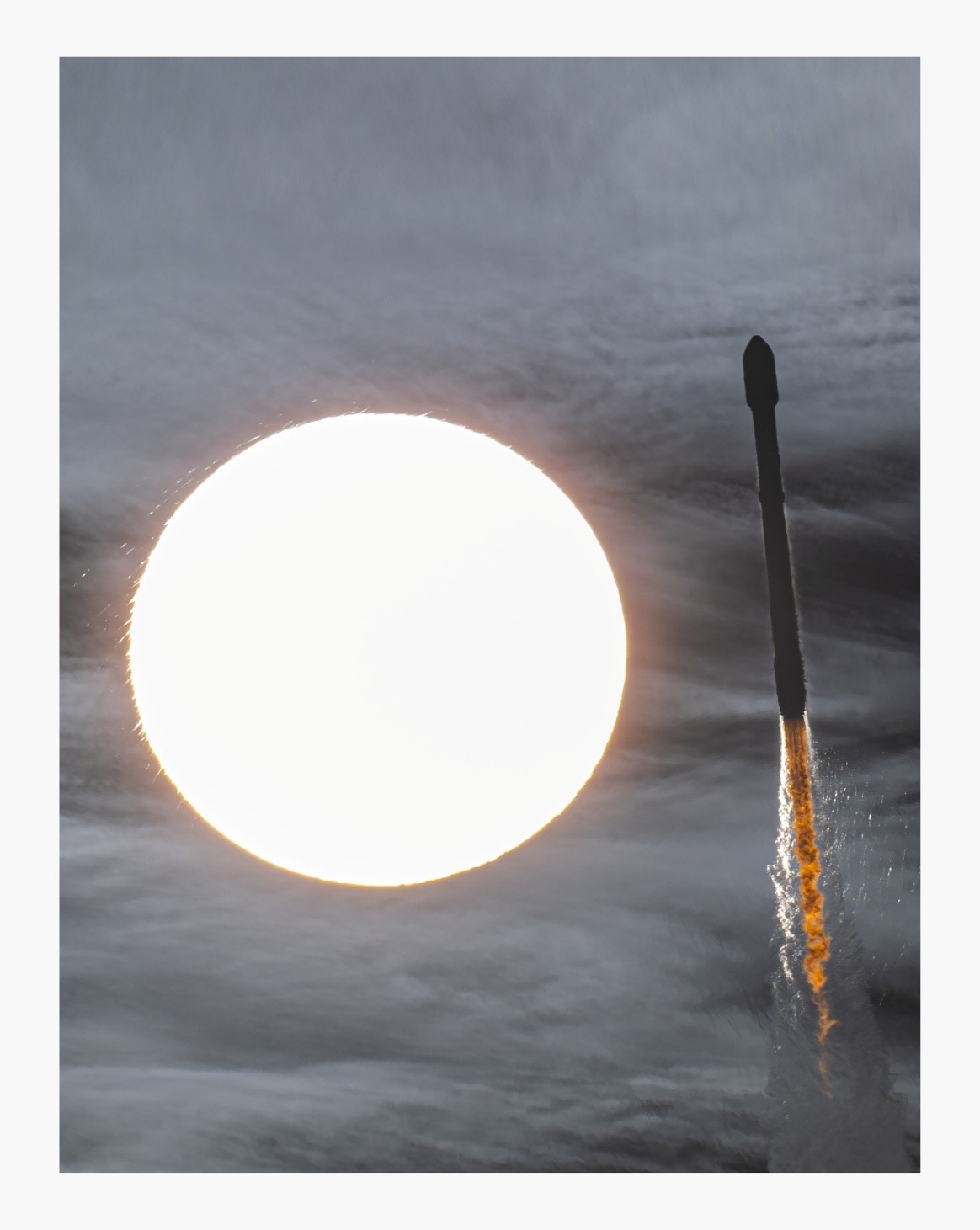
My take: Projects like this one need lots of cheap capital if they have any hope of succeeding. Cheap capital most easily comes in the form of over-hyped, over-priced share placings. In this process, the winners are the shareholders who exit via the placing (founders, management and early investors), as well as the future consumers of the economy’s products. The formal financial term for this is “exit liquidity”. The Johnny-come-lately funders subsidise these parties provide the exit liquidity. Hot tip: know where you are in the pecking order.
2. Ferrari
Ferrari launched an EV a couple of weeks ago. This is what it looks like:

This is what a real Ferrari looks like:
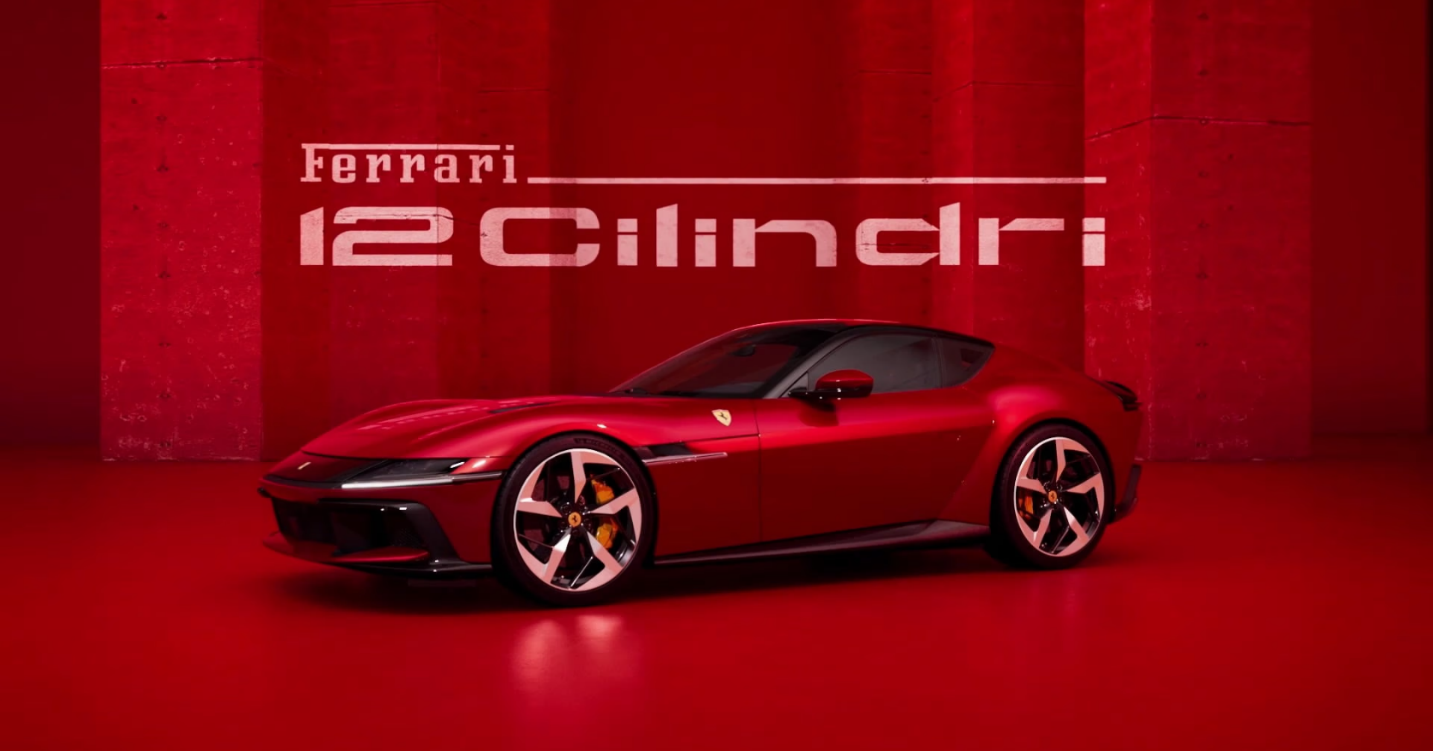
Jony Ive, the legendary designer of the iPhone, designed the blue car. It looks like a run-of-the-mill Chinese EV. Having been in Shenzhen recently, I saw many even better-looking EVs there.
I have no idea who designed the 12 Cilindri, but it’s fair to say it’s sex on wheels, like most naturally aspirated Ferrari models. I cycle past a Ferrari shop every day on my way to work, and even for a non-petrolhead like me, those cars really look amazing.
The blue one doesn’t.
The Tifosi were understandably up in arms, which led to some funny descriptions of the car:
“A milk float with comfortable seats.”
“At least the Chinese definitely won’t be copying this one.”
“A Ferrari designed entirely in airplane mode.”
“It looks like an Apple Store made a minivan and gave it trust issues.”
“This vehicle is powered by the rotational force of Enzo Ferrari spinning in his grave”
Ferrari’s share price also didn’t like it:

Of course, they might just be playing three-dimensional chess here. Last year, Porsche scaled back its EV plans and, earlier this year, Lamborghini abandoned its plans for a luxury EV. Ferrari now has an opening to test the supercar EV space with almost no competition.
My take: Shades of New Coke? Or three-dimensional chess? Who knows, but the brand will survive. Hopefully, episodes like this will drive the share price down enough to make it a good investment prospect.
3. Partners Group
Partners Group is a leading global private markets investment firm that specialises in private equity, private debt, private real estate, and private infrastructure. It is a Swiss-based company, listed on the Swiss stock exchange.
Historically, only institutions invested in private assets (i.e. unlisted assets), as this required a long-term horizon, which perfectly matched the liabilities of pension funds and life insurers. The “Yale Model,” pioneered by David Swenson, which entailed a significant shift away from traditional public stocks and bonds towards private investments, proved highly successful in the 80s and 90s.
Of course, the financial markets love nothing more than to replicate, repackage and scale up success, almost always to the point where the key determinants of future investment success – low price, under-owned assets and attractive economics – are arbitraged away. Often, the buyers of last resort, who drive this arbitrage process to its ultimate and inevitable denouement, are the public.
Partners Group is the poster child of this process. It was one of the first firms that “democratised” private equity by setting up funds that the public (i.e. retail) investors could invest in. One of the key advantages of private equity historically was that the funds had a 10+ year lifespan, and the institutions that invested in them understood this inherent illiquidity.
To make such investments accessible and palatable to retail investors, that constraint had to be relaxed. Retail investors demand liquidity, so the funds managed by Partners (and others) allowed their retail investors a 5% per quarter “liquidity window.”
Sub-par performance helped herd those retail investors towards this window. Partners has managed annual returns ranging from 0.3% to 8.3% in its main European fund over the past four years, as the MSCI World equity index of listed companies climbs ever higher. There’s nothing worse than standing still when everyone around you is making tons of money.
And it looks like things are deteriorating. As Pitchbook noted Tuesday, “a surge in loan defaults by sponsor-backed businesses would be critical for lenders. . . but potentially catastrophic for funds that hold shares in those businesses, as they are last in line to recover their money in the event of bankruptcy.”
It should come as no surprise that Partners had to gate some of its funds, as retail investors had requested liquidations exceeding the 5% quarterly allowance. As a result, Partners Group’s share price has hit the skids:
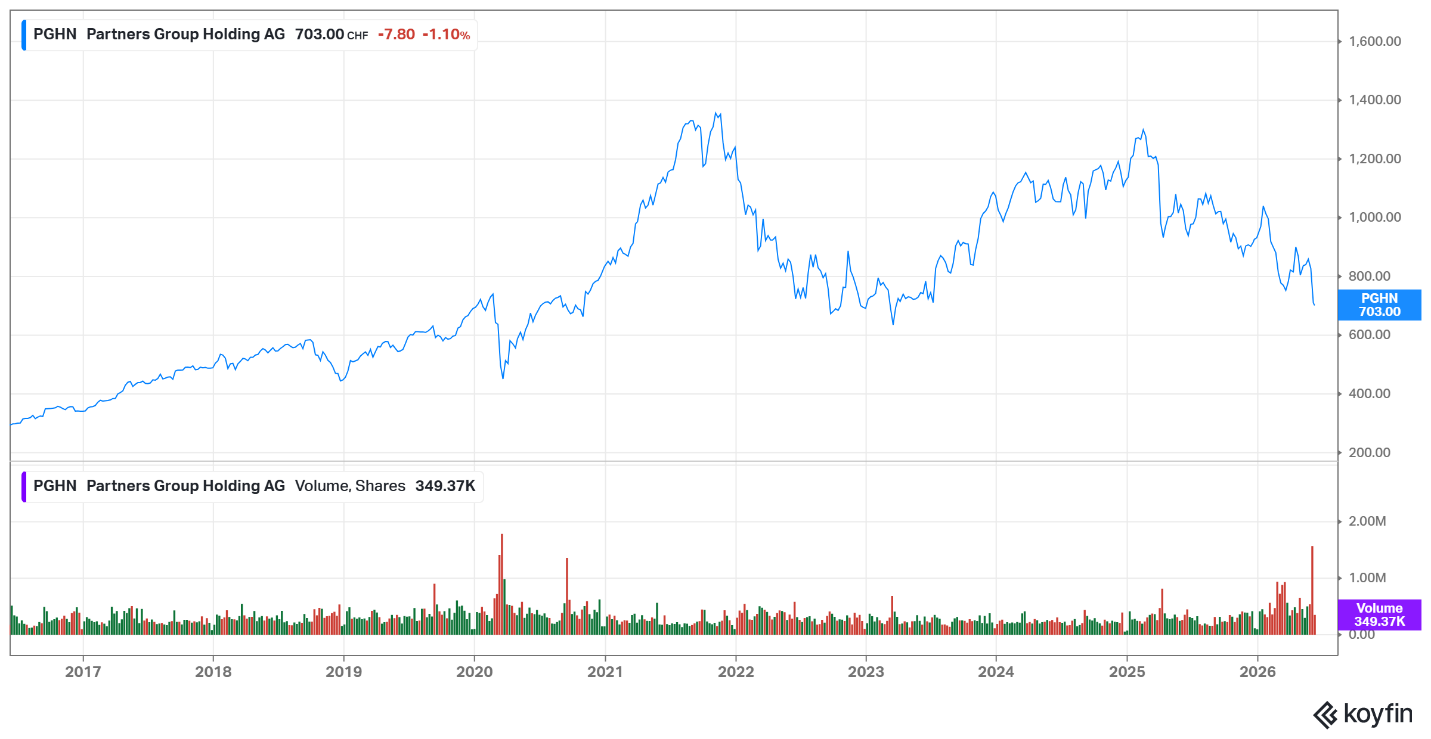
My take: When you provide investors with liquidity in structurally illiquid assets in the name of “access” or “democratisation”, it’s not a question of if it will hurt you, but rather when it will hurt you.
4. Strategy / Bitcoin
Bitcoin, along with other hard assets such as gold and platinum, is going through a tough time. Here is the price of Bitcoin, down about 50% from its most recent highs:
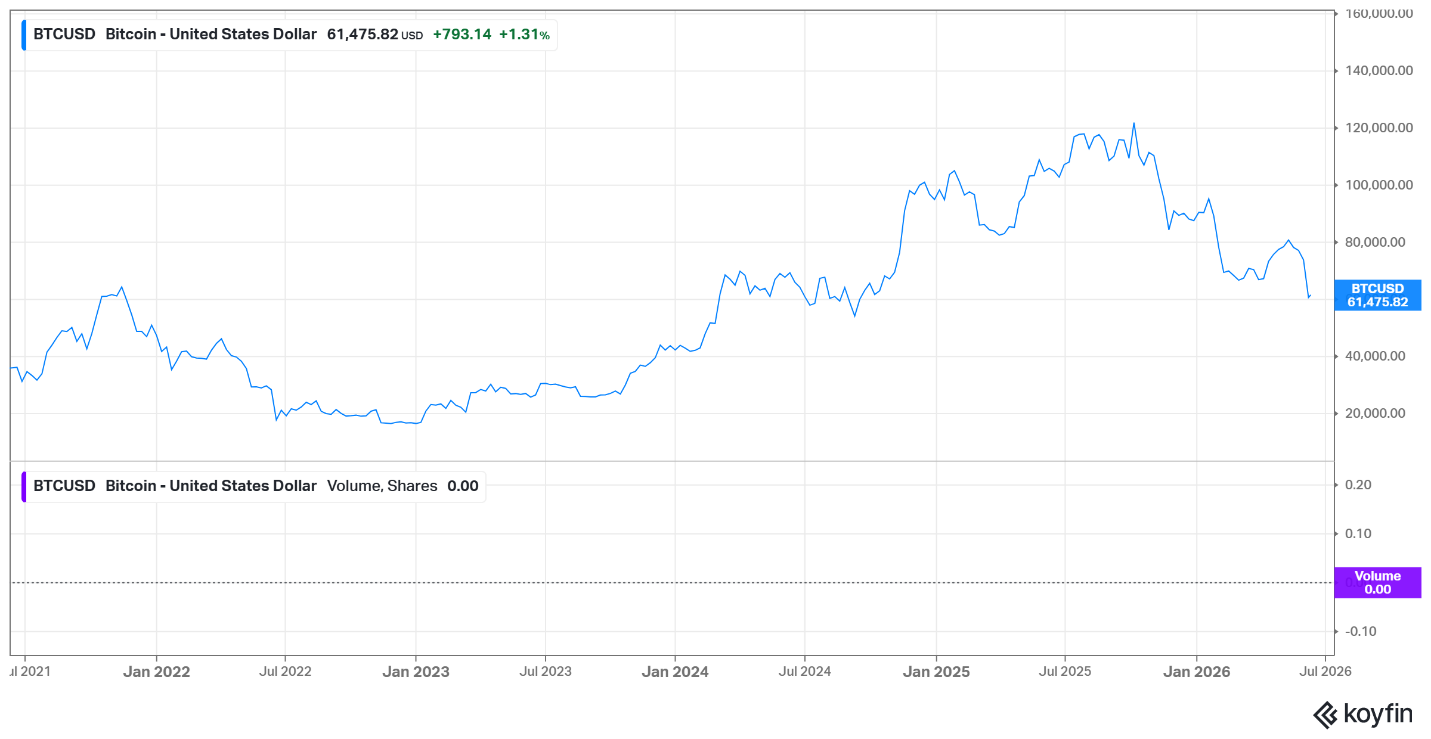
So much for it being a store of value – especially in these uncertain times! But spare a thought for leveraged owners of Bitcoin, like Michael Saylor’s Strategy (née MicroStrategy).
Strategy’s NAV is made up of
- 845,256 Bitcoins, worth around $51bn at current prices.
- Cash of c.$1bn
- Around $22bn of various kinds of interest-bearing debt.
- A loss-making tech business with around $500mn in annual revenue.
That adds up to around $30bn of net assets, or $142 per share. Today. Strategy is trading at $117 per share. The problem they have is that they funded the acquisition of their Bitcoins first by issuing shares and lately with debt. While Bitcoin is going up, and you can issue shares at a premium to NAV to fund the acquisition of more Bitcoin, things work beautifully.
But it gets ugly when the Bitcoin price starts to go down, and your shares trade at a discount to NAV. To issue shares to pay down debt is value-destroying. Like gold, Bitcoin has no cash flow, but the debt needs to be serviced. Suddenly, you may become a forced seller of Bitcoin to fund your monthly interest payments. And you start trading at a discount to your underlying NAV. Here is the Strategy share price, down about 75% from its peak:
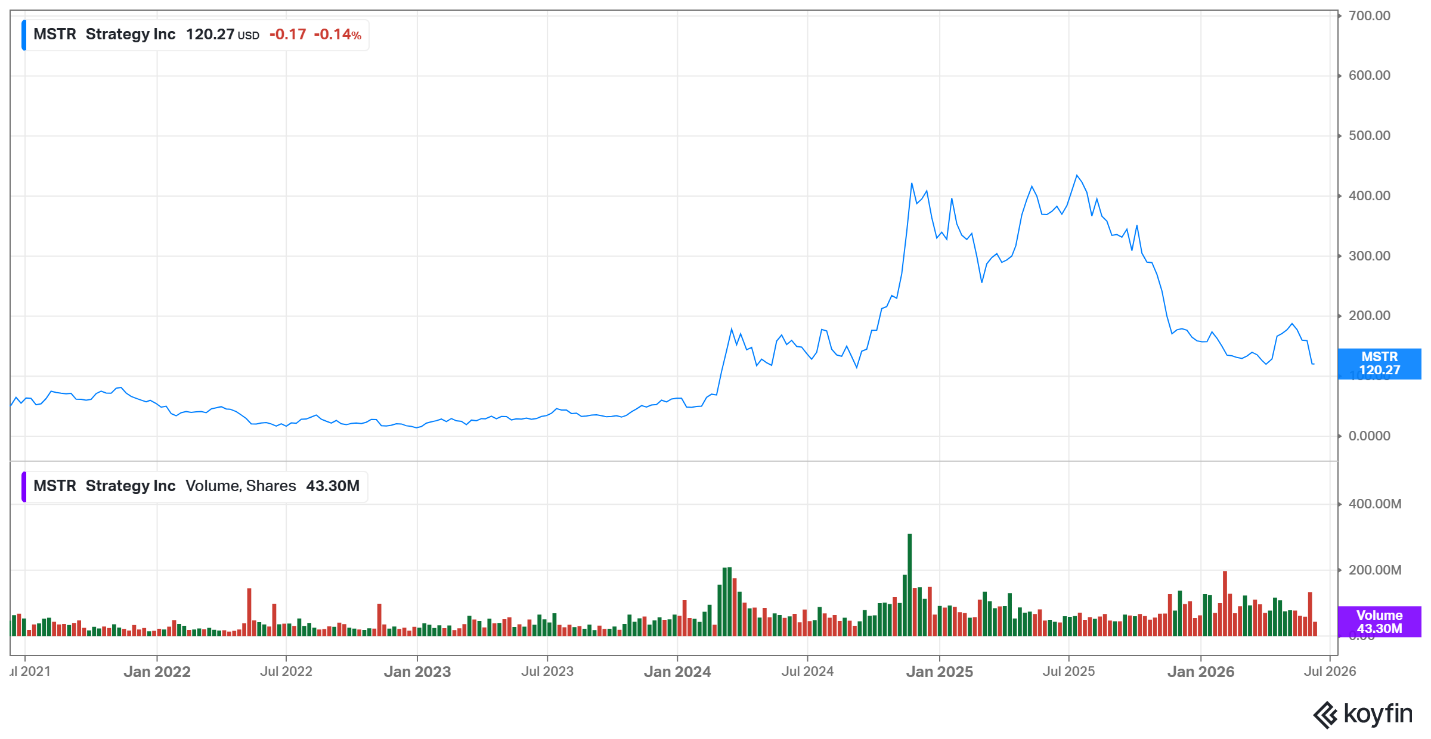
Strategy is the largest Bitcoin “Treasury” company, but during the speculative boom in Bitcoin’s price from 2023 to 2025, 175 such companies were formed, collectively owning over 1 million Bitcoin. Many of these companies are highly leveraged and have – or will – become forced sellers of Bitcoin.
My take: What we are experiencing now is the downside of the upside. More water needs to flow under the bridge before Bitcoin becomes a true “hard asset”. But I have no doubt it will. We just need to get rid of the speculative players first. The market is highly adept at eventually clearing out speculative froth in any asset – even Bitcoin.
In the cockroach
As a reminder, the MWI Worldwide Flexible fund* (aka “The Cockroach”) aims to generate returns of inflation plus around 4% in hard currency terms. Importantly, it aims to do so with low volatility and always to avoid a permanent loss of capital. The trade-off here – because there’s always a trade-off – is that it will never shoot the lights out. It is a stay-rich fund, not a get-rich fund.
To achieve its aims, it always allocates a quarter of its assets each to cash, bonds, equities, and hard assets. Last week I described the 25% of the fund allocated to hard assets, and I want to stay with the same subject this week.
A hard asset has three characteristics.
- It is scarce.
- It is not a liability of someone else’s balance sheet.
- It is portable and/or tradeable.
Scarcity is easy to recognise. For instance, here is a table showing the scarcity and prices of certain commodities. Scarcity is denoted by “ppb” (parts per billion) in the Earth’s crust, while the price is in US$/tn.
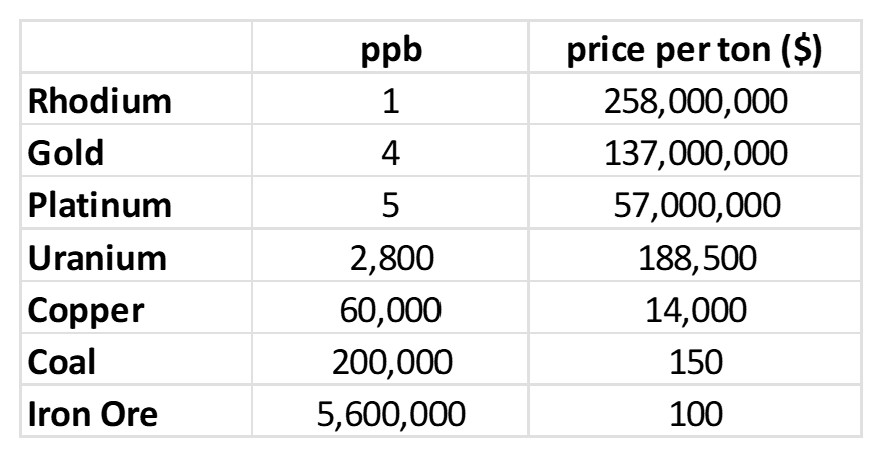
There is a direct correlation between a commodity’s price and its scarcity (or lack thereof). For instance, an ounce of gold has been able to buy a good, tailored suit for centuries. These assets generate no cash flows; their value derives purely from their inherent scarcity. Less scarce commodities like coal or iron ore derive their value from their usefulness in industrial processes and, as such, are subject to the economic cycle.
This is not to say that gold, or any other hard asset, never experiences price swings. They do, as we are experiencing right now. But despite this volatility, over time, this type of asset retains its value in real terms, unlike all fiat currencies.
That is why hard assets play such an important role in a fund that aims to maintain real purchasing power over time.
Not being a liability on someone else’s balance sheet is another key differentiator. Equities are the riskiest part of a company’s balance sheet, and when you buy a share in a business, you are beholden to the decisions of the people managing the company’s affairs. The outcomes of these decisions – good and bad – are amplified in equity prices.
Bonds are similar, albeit less risky and more contractual in nature. Yet they still generate cash flows that depend on other people’s decisions and actions.
Next week, I’ll discuss the composition of the MWI Worldwide Flexible Fund’s (aka The Cockroach’s) hard-asset category in these terms.
Oh yes – no transactions were executed in the fund this week. One way to enhance returns in a fund is to keep costs down. Trading can be very expensive.
* I manage the fund on behalf of Merchant West Investments (Pty) Ltd (FSP 44508)
In The Media
1. Book review – “Fallen Leaves” by Will Durant (2014)
When you find a writer whose style of writing you enjoy reading, and who writes on topics you enjoy reading about, it makes sense to read as much of their work as possible. Will Durant, together with his wife Ariel, was the author of one of my favourite books ever, “The Lessons of History“.
“Fallen Leaves” is Durant’s coda, a compilation of his thoughts on various topics. The subtitle of the book is “Last words on Life, Love, War and God.” In 22 concise chapters, Durant conveys his thoughts on these topics and much more.
This paragraph in the preface of the book summarises the subject matter – and raison d’être – of the book beautifully:
“Why then, should I write? I take it as a vain excuse that the letters of curious readers who have challenged me to speak my mind on the timeless questions of human life and fate. But in truth, my chief reason for writing – aside from the narcissism implicit in all authorship – is that I find myself incapable of doing anything else with continuing interest. I propose to tell, in a very informal way, without the grandeur of obscurity, how I feel, now that I have one foot in the grave, about those ultimate riddles that I dealt with recklessly some years ago in my books.”
The book was published posthumously and is a fitting finale to a lifelong search for meaning, coupled with the unique ability to convey it in succinct, sympathetic terms. In a way that highlights the all-encompassing uncertainties and vicissitudes of life, without trying to mislead the reader into thinking that he has all the answers.
This is another one of those books that I will re-read again in future. Durant’s writing style condenses so much important information (this book is less than 200 pages long) that every reading brings new revelations to the diligent reader.
Highly recommended.
2. How big is space?
Elon Musk says SpaceX’s TAM (Total Addressable Market) is roughly the size of the entire GDP of the USA. That’s big, and probably not science, but a fiction.
But how big is space itself? This article does a great job of putting the vast expanse of space in terms that make sense to us. Of course, it’s American, so they use miles and inches, but still. It’s a fascinating read.
TL;DR? Space is way bigger than you think; it even dwarfs Elon’s TAM.
3. BizNews Conference
I will once again be attending – and speaking at – the 9th BizNews Conference. It’s always a pleasure to attend these. Have a look at the line-up and judge for yourself. Personally, I think it’s the best yet.
This year, it will once again be held in the Drakensberg at the Champagne Sports Resort from 11 to 14 August. Tickets normally sell out quite quickly, so if you’re interested, book now.
That’s all for this week. It’s a joy to be back in Cape Town with its mild winter weather and beautiful mountain.
Remember: be careful out there! In space, no one can hear you screaming.
Piet Viljoen
RECM
11 June 2026