

Dear Fellow Investors and Friends,
Welcome to my newsletter, where I share my efforts to understand markets and the world around me.
I do appreciate you taking the time to read this. I love getting feedback; feel free to drop me a line. It’s great to start conversations.
Today is Thursday, May 21st, the 141st day of the year. There are 224 days left until the end of the year. Make them count.
Today, 41 years ago, Mark Cavendish was born on the Isle of Man. His nickname, “The Manx Missile”, said it all – he was an out-and-out sprinter. His edge was his small, powerful build, which he used to minimise his drag-to-speed ratio. Engineers know that drag increases by the square of your speed. Low drag at high speeds makes a huge difference. Cavendish used this edge to win the most stages in the Tour de France of any cyclist. 35 to be exact! All 35 of which were flat stages, ideally suited to Cavendish’s strengths. He completely avoided competing in the mountain stages.
Unlike cycling, which has distinct, finite races, investing has no “winner” because there is no finish line. Investing is an infinite game. Tomorrow the markets open again, and it’s “once more unto the breach”, as King Henry the 5th said at the Siege of Harfleur.
Again and again.
But you should still try to understand where your edge lies.
Fund performance is measured daily, and prizes are regularly awarded to funds for the “best” performance over arbitrary periods. Different competitions define what constitutes the “best” performance differently, but it mostly boils down to the highest return over a given period among a group of funds with similar mandates.
Fund managers know this is a ridiculous concept, but they play along because it gives them a marketing opportunity. After all, it’s about the AUM, isn’t it? Short bursts of strong performance that lead to awards can generate meaningful marketing material, boosting fund managers’ asset bases – with a commensurately positive impact on their pay. Often, risky investments are made to heighten the chances of winning such an award. Risk that only manifests after the measurement period corresponding to the award ends.
The result? A different fund wins the award next time, and the clients are left holding the bag.
And so it goes.
These competitions do not matter to clients; preserving and growing their asset base in real, inflation-adjusted terms over a long period really does. But these aspects don’t feature much in the “competitions”.
The equity market in the aggregate generates returns above inflation over the long term. A broad index is a good proxy for the equity market. It follows that a strategy of indexing your money should generate a satisfactory real return over time. You don’t need to beat the index to generate satisfactory returns. But you do need to avoid underperforming it.
Here’s the thing: Fund managers find it virtually impossible to outperform the index over any meaningful period. And if fund managers, who spend all day thinking about the market, trying to find an edge with teams of analysts and premium subscriptions to multiple AI bots find it hard, what does that mean for the lay investor?
If you are reading this because you want to be a better investor, you should start by thinking carefully about the question of where it should be possible to beat the market, and why you would be able to do so. Like Cavendish, you should know exactly where your “edge” is.
The first thing you should conclude from thinking about this for a minute is that you don’t want to compete with the professionals – if they find it almost impossible to have an edge, you have no chance.
Spending your Saturday mornings looking at share prices and investing on that basis is grist to their mill. Poker players sometimes talk about how most of the upside comes from picking the right people to play against: “If you can’t spot the sucker in the first half hour at the table, then you are the sucker.”
Don’t be the sucker. Avoid big liquid markets where the professionals dominate. Then invert and ask which areas professionals would be reluctant to focus on.
Successful fund management businesses gather AUM, right? So, one place to look is anything too small to get their attention.
In other markets, there may be more opportunities because the market in question is new, not yet recognised by institutions, and legally tricky. For instance, not too long ago, the whole crypto space was like that. Finally, avoid excitement. Excitement attracts the crowds, and any upside gets arbitraged out quite rapidly. Markets are efficient that way.
A sensible strategy would be to index/cockroach the bulk of your money. On top of that, you can overlay small allocations to situations where you are sure you understand why they are mispriced. If you like, you can also use a small portion to invest for fun – just like a visit to the casino. Don’t fool yourself into thinking you’re creating value here; it’s pure entertainment. Ask yourself again – what is it that you know that a million highly paid professionals, who spend all day thinking about the market in a highly incentivised, Darwinistic workplace, don’t know?
Another way to create an edge is by keeping costs low. Trade infrequently and avoid complicated structured investment products like the plague.
Most people find the cockroach strategy or indexing boring. Which means it is exactly the right place to be.
In The Markets
1. Aimia
Aimia is a Canadian-based investment holding company. Yes, it’s the kind of company the market loves to hate, trading at large discounts to net asset value. Many of them deserve it, especially ones with no track record like Aimia.
But well-managed investment holding companies can create tremendous value for shareholders. Think HCI and Sabvest (large holdings in the MWI Value Fund) here in South Africa, or Berkshire Hathaway or FRMO (holdings in The Cockroach) in the USA.
Aimia has no track record, but it does have Rhys Summerton as a large shareholder and CEO. Rhys has created significant value for Argent shareholders here in South Africa and is also busy engineering the turnaround of iOCO (formerly EOH). So, when he took control of Aimia, my ears pricked up. It was recently listed on the JSE by way of introduction, but I’m not aware of any shares having traded yet. It has some liquidity on the Toronto Stock Exchange.
My take: At a current discount to NAV of over 40%, of which cash makes up almost half, Aimia is one to watch.
2. Bond yields
In the upside-down world of bonds, when yields rise, prices decline. Today, most bond markets in the world are suffering significant bear markets. Here is the bellwether global bond, the USA 30-year government bond:
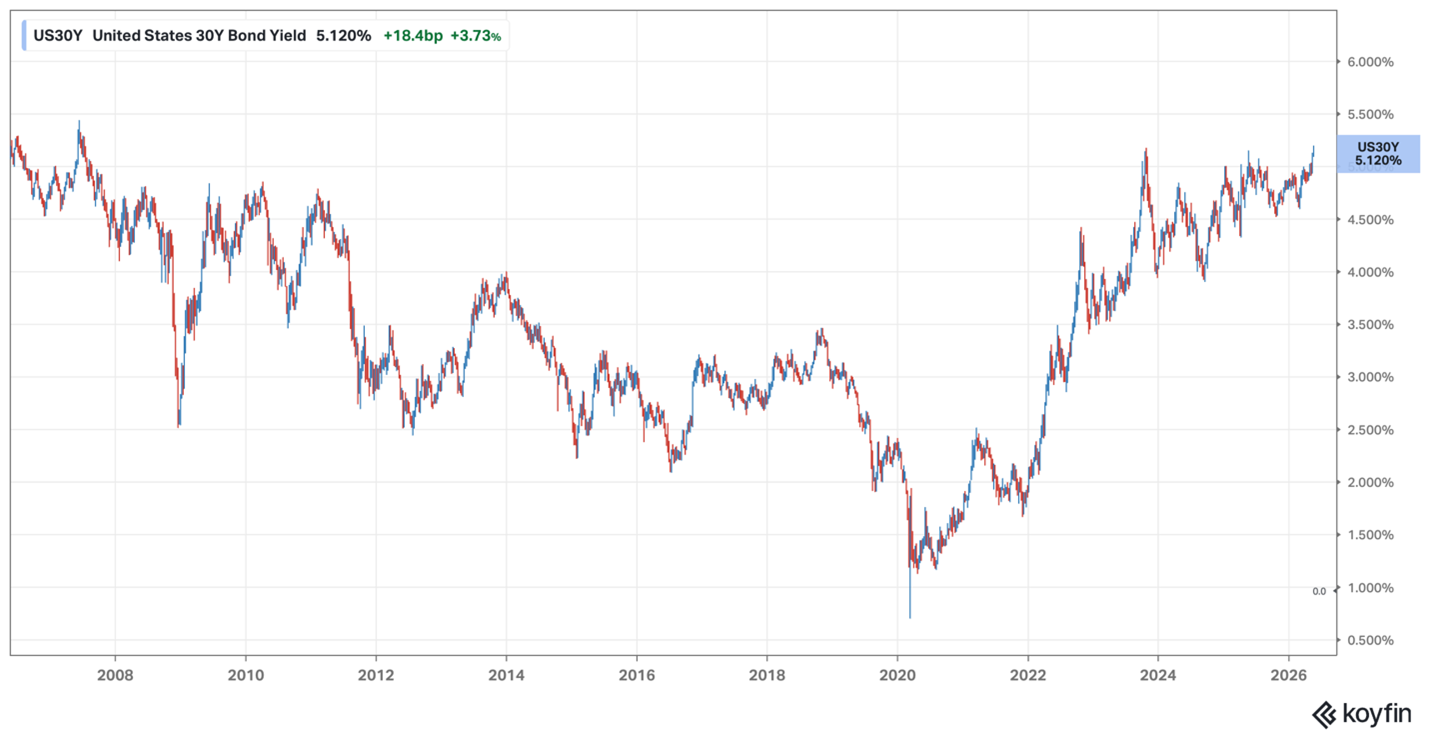
The last time US long bond yields were this high was just before the GFC in 2007. Here is the Japanese 30-year bond yield:
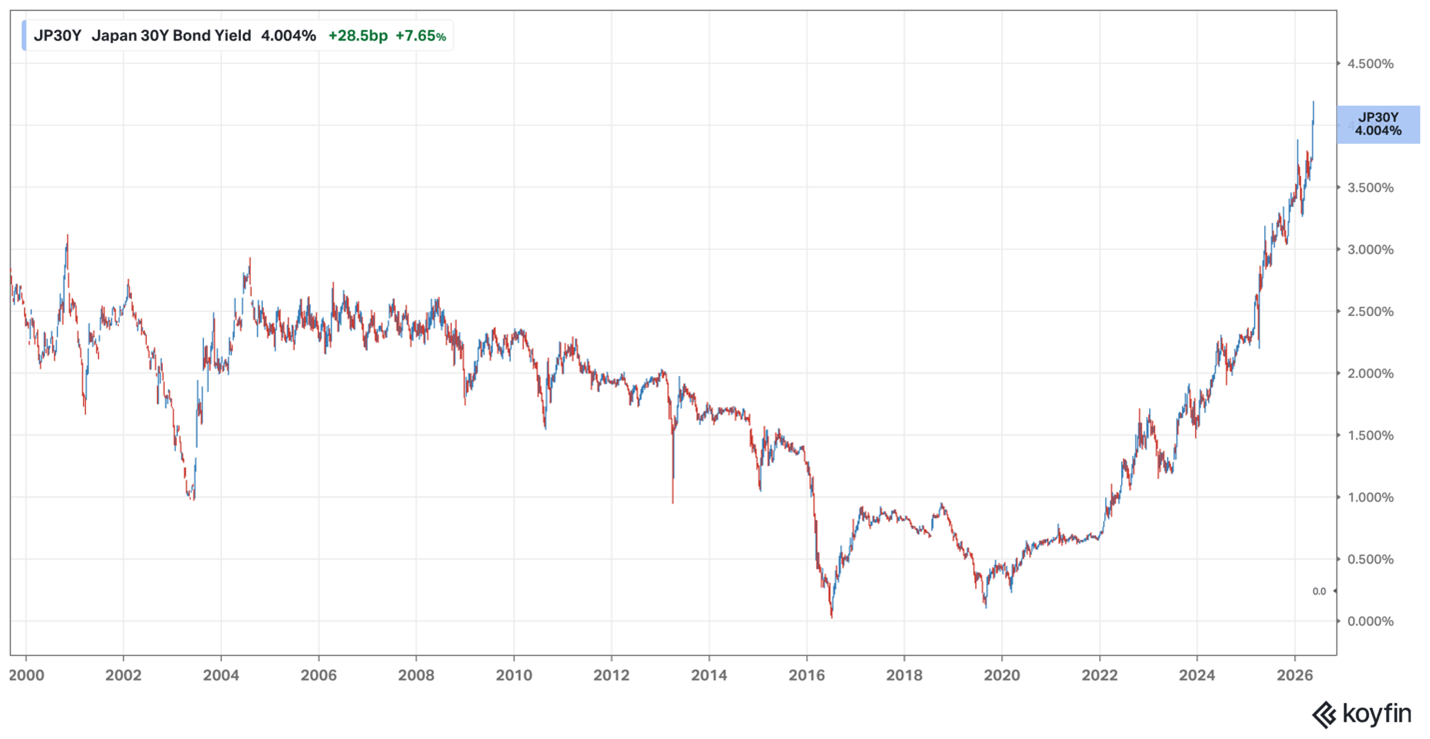
That’s a bear market if I’ve ever seen one! How about the UK long bond yield? Same story:

Developed market bond yields were last at current levels more than a generation ago. It’s safe to say that many people managing money today have no idea how to operate in a high, rising bond-yield environment.
Bond yields are important because they are the interest rates used to discount cash flows from assets to their present value. Sidestepping a lot of math, higher bond yields mean lower present values, which in turn eventually means lower asset prices. Just not always immediately and not equally across assets. But inexorably – which is the important part of the process to understand.
The picture is very different in emerging market bonds. For instance, here’s China:
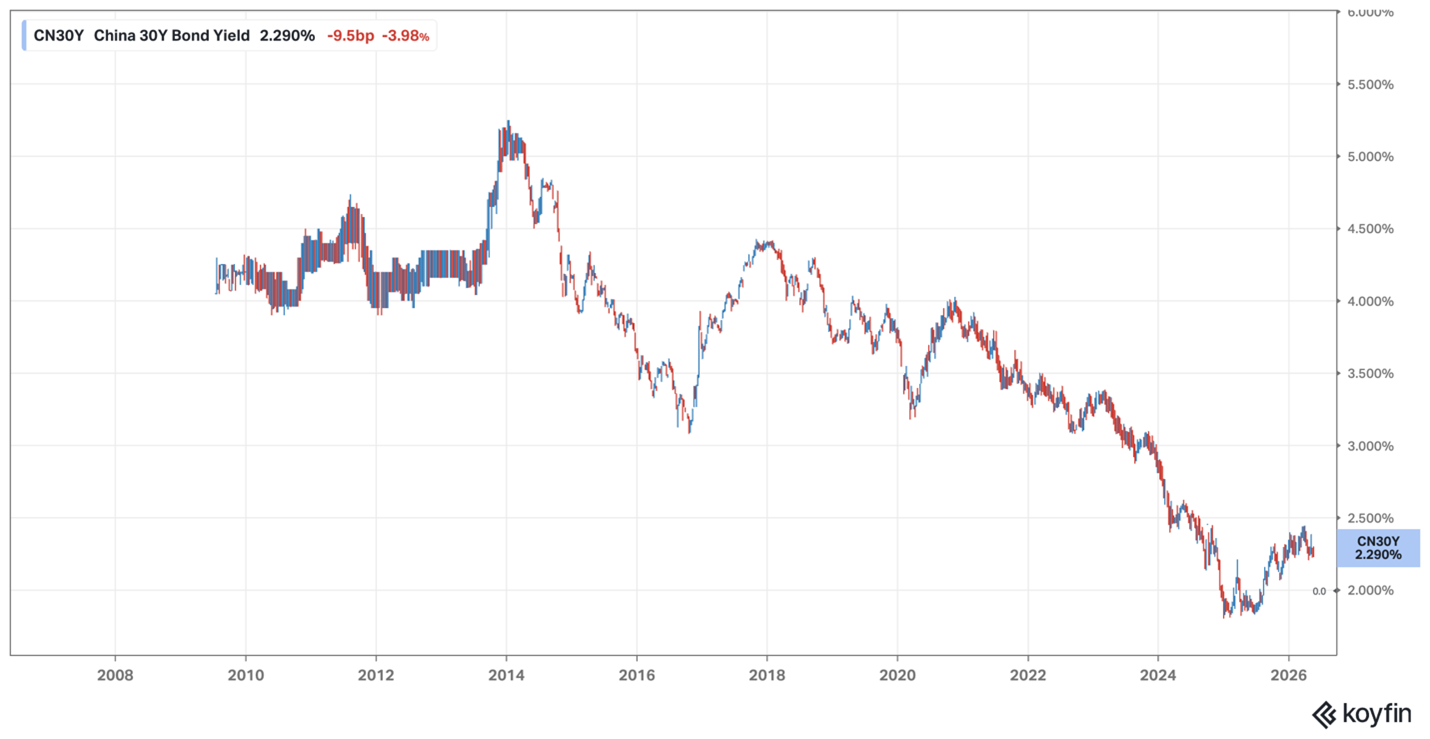
Brazil:

And South Africa:
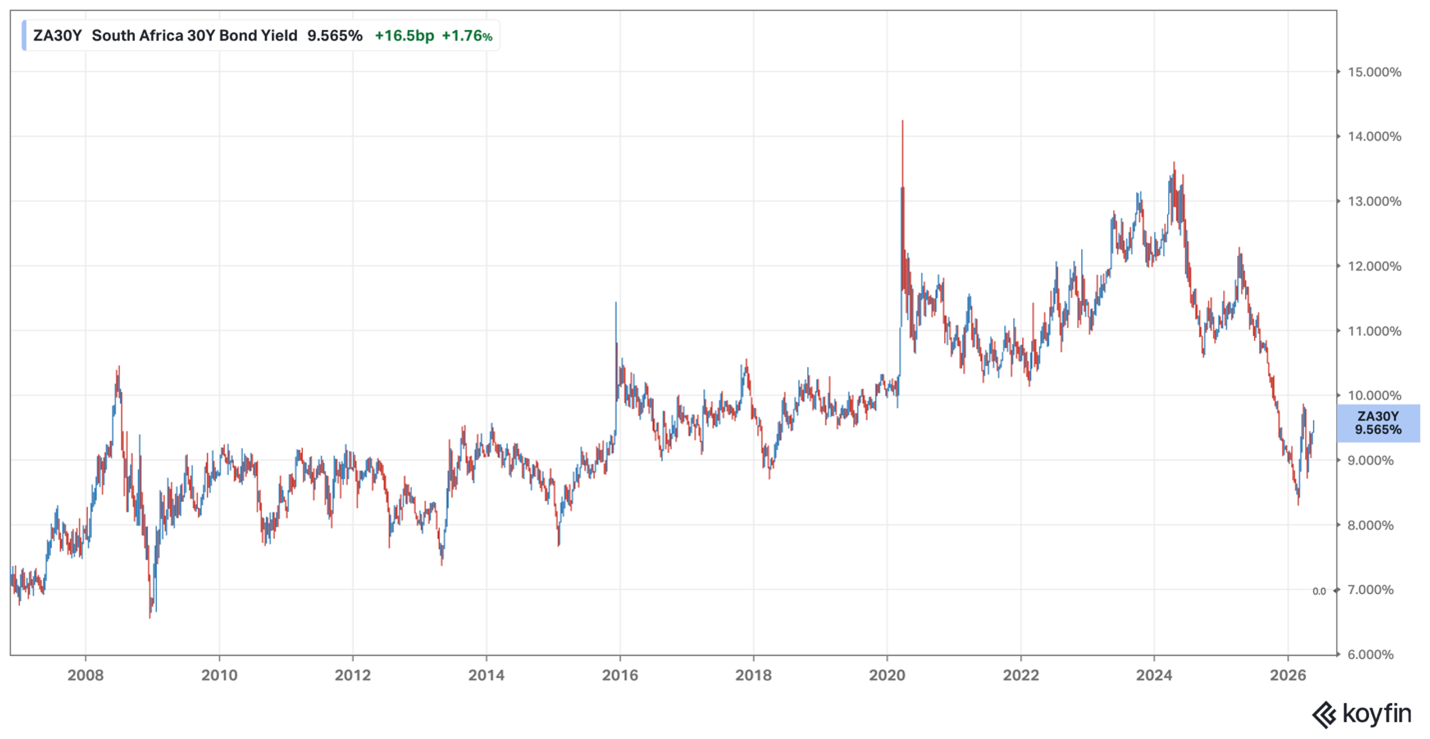
My take: The emerging market/developed market bifurcation continues to take shape. Things could get ugly in developed markets at some point. Of course, emerging markets won’t be spared, but they will be relatively better off.
3. Commodities
In contrast to the bear market in bonds, there is a big bull market in commodities. The CRB index is a good gauge of what’s happening in the commodity world:

Commodity prices have now surpassed their highs from just before the GFC. A word of caution, though. The CRB index is heavily weighted towards oil, so it’s too early to say the bullish action is broad-based. On the other hand, the copper price seems to confirm the picture:

Global fragmentation, the rebuilding of local supply chains, the expansion of AI data centres, related investment in power generation and grids, and ongoing wars are all driving higher demand for commodities. Yet the sector has been underinvested in for decades, which may constrain supply. Over time, higher prices should encourage greater production.
My take: A commodity bull market is good for emerging markets.
4. Glencore
Glencore is a diversified mining house with large interests in copper, coal and metals used in electrification, such as cobalt, zinc and nickel. We all know how bullish everyone is on copper and the other metals, but what about coal?
One of my basic theories is that all forms of energy are fungible. If the price of one source of energy, say oil, is very high, the world will start using other forms of energy that are relatively cheaper. For instance, even that paragon of “greenness”, Canada, recently approved the construction of pipelines to export more natural gas, which is cheap relative to oil.
Coal is also cheap relative to oil. This is a chart of the Brent Oil Price-to-China Qinhuangdao Spot Coal Price:
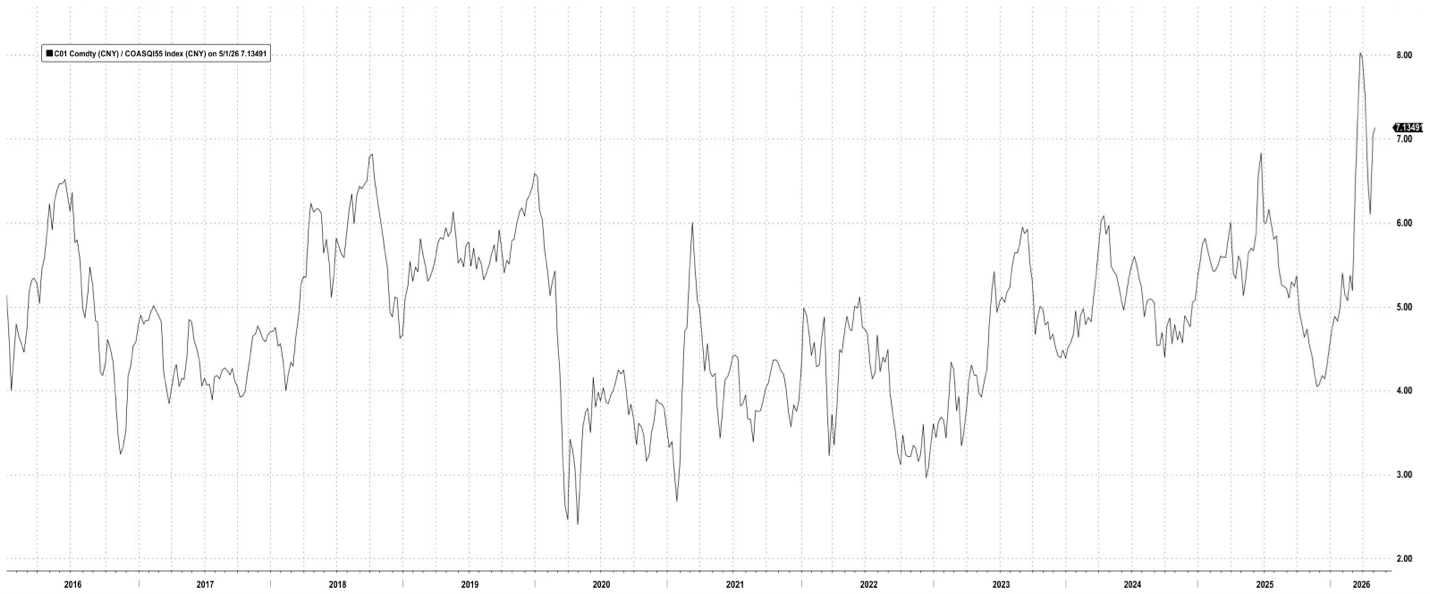
It’s no surprise that the smart money is building more coal power plants:
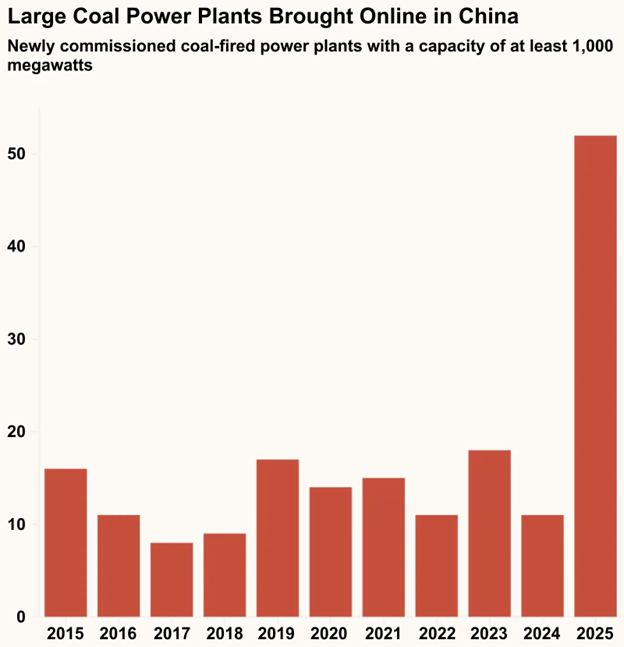
Cheap energy, which coal is, translates directly to a more competitive economy and a better life for the citizens of that country.
Glencore is also regarded as the smart money in the mining sector. It is the one major mining house that has invested in coal over the last few years. It acquired full ownership of Colombia’s Cerrejón thermal coal mine from its partners in 2021. It then executed a massive $6.9 billion takeover of Teck Resources’ Elk Valley Resources steelmaking coal business in 2024. The other major mining houses have been selling down their coal exposure, because, you know, coal’s not very green now, is it? But apparently, digging holes for copper, iron ore and PGMs is.
Go figure.
It’s no wonder the Glencore share price is on a tear:
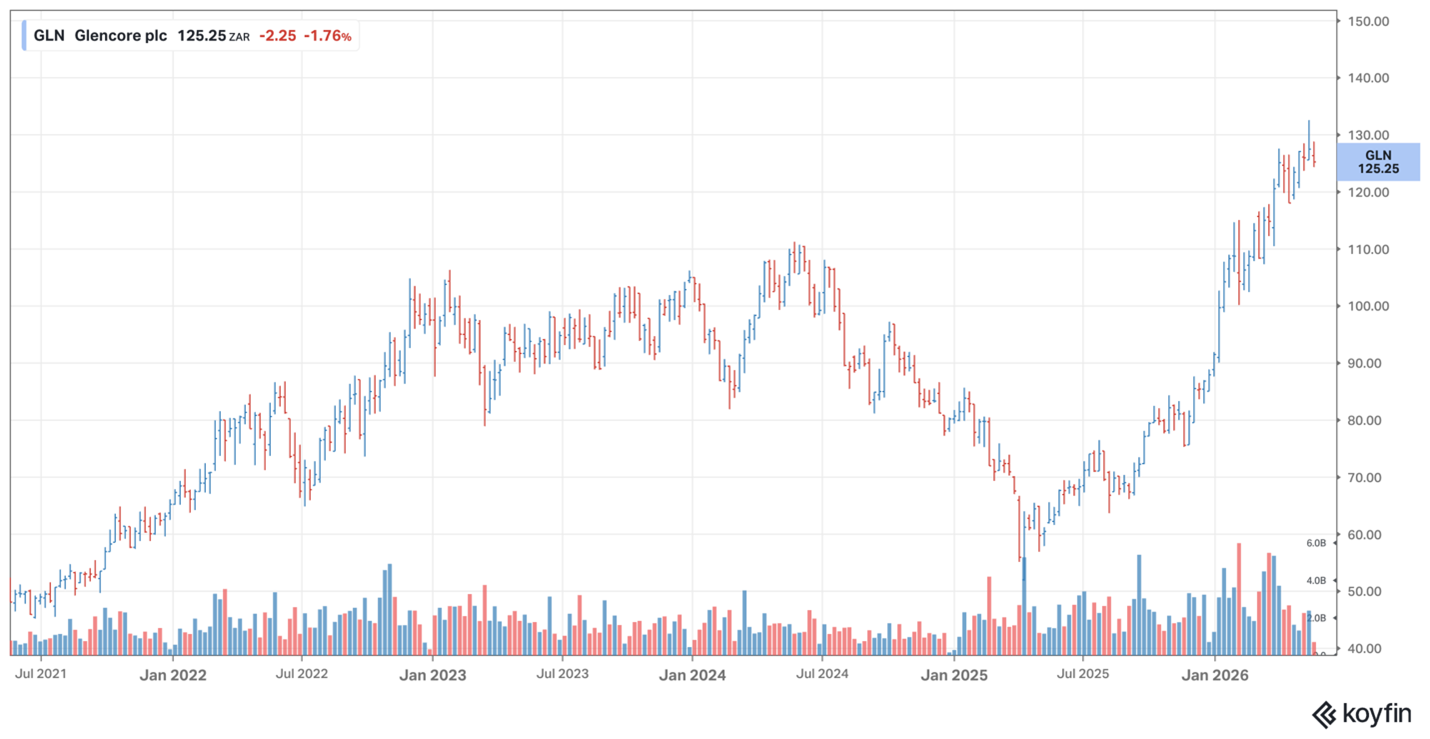
My take: It’s always a good strategy to back the smart money. Glencore is a significant position in the MWI Value Fund.
5. Sanctions don’t work
The powerful (Western) nations of the world love nothing more than to cosplay their indignation at other, weaker countries’ indiscretions through sanctions. A case in point is the EU, which, while furiously sanctioning Russian financial institutions, continues to import oil and gas from Russia.
European imports of Russian LNG by sea recently hit historic highs. Countries like France, Belgium, and Spain are the top buyers. Landlocked countries in Central Europe continue to receive piped gas from Russia.
Go figure.
I have long maintained that sanctions don’t work. If they worked, then why is the Russian Ruble so strong against the US$?
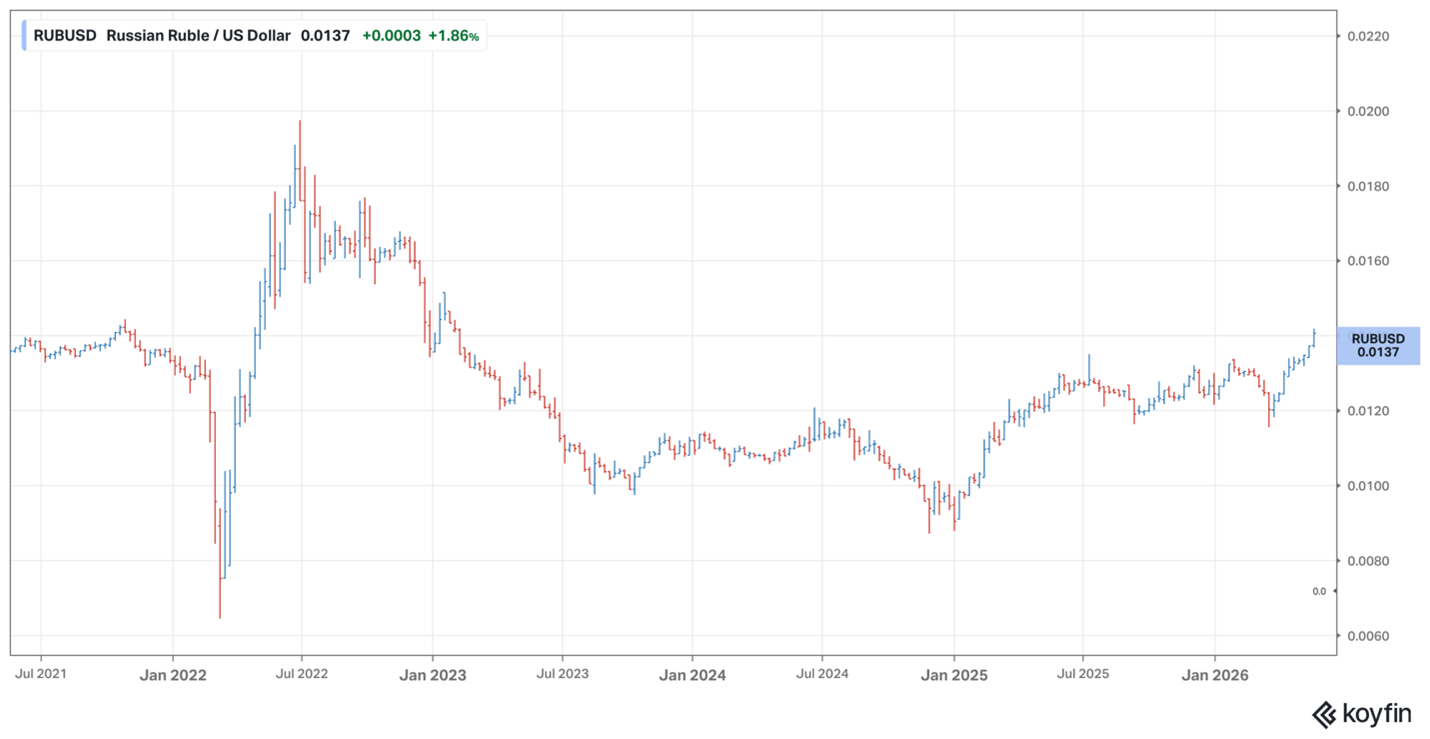
We love to be bearish on the ZAR – but here’s a country that is involved in a long, drawn-out war, sanctioned to varying extents by the West and generally despised by most. Yet its currency is quite strong.
Go figure.
My take: The determinants of a currency’s strength or weakness rely much, much more on “unseen” fundamentals than whatever is in the newspaper headlines. Or top of mind of the “Handwaving Helpers” for that matter.
6. An Identifiable Edge
I’ve mentioned the MWI Value Fund several times in this letter, so I might as well mention it again. Over the past few years, it has been one of the few actively managed funds to outperform both the local All Share Index and the MSCI World Index. How has it managed to do so?
Like Mark Cavendish, the fund has stuck to what it has identified as its edge – undervalued mid and small cap South African companies. This is a group of companies that interests large fund managers little, as they cannot scale their AUM by buying these minnows. Local investors seem much more intent on buying the latest offshore “hot thing” than on looking at these high-quality local companies. Finally, local corporates, under the spell of savvy offshore investment bankers, would rather acquire a hot mess in London than a good business in Johannesburg.
This confluence of events leaves the share prices of these quality businesses at low multiples – multiples that almost guarantee good returns, even in the absence of any growth. An easy edge to exploit.
The fund’s recent strong performance has been achieved under the stewardship of Rudi van Niekerk, the lead manager. I serve as a sounding board for Rudi – but he makes the calls.
Recently, MWI featured Rudi on a webinar to discuss how he takes advantage of the fact that the real local opportunity sits outside the top 40 large shares, in a part of the market which index trackers and big institutional funds can’t access.
You can watch Rudi van Niekerk pull back the curtain on the opportunity most investors are missing here.
In the cockroach
There have been no transactions in the fund* this week, so I will take the opportunity to discuss the portion of the fund – always around 25% – that is invested in cash. The cash portion of the fund acts like a kind of buffer – when markets are under pressure, its % weight increases, as other asset prices decline. On rebalancing back to 25%, this “excess” cash holding is then allocated to those lower-priced assets. Conversely, when asset prices are strong, the fund’s cash % automatically declines. On rebalancing, the fund sells the higher-priced assets to increase cash holdings back to 25%.
In this way, the fund is forced to buy low and sell high. Something that is psychologically very hard for most of us to do.
Right now, the fund has almost 27% in cash, slightly higher than its neutral weight of 25%. This is due to bonds, gold and some of its equity holdings all being weak over the past few months. The cash position isn’t large enough yet to warrant rebalancing into other assets, but I’m keeping a close eye on it.
This is the fund’s current cash position, compared to when I last discussed it in February:

As you can see, there has not been much change. USD has risen due to the sale of an asset a while ago and a stronger US$ over the period, while all other cash asset weightings have declined slightly due to weakness relative to the US$.
An important question is: why the significant holding of the MWI Enhanced Income Fund? The simple reason lies in this chart, which I also showed last week:

The message is clear – you end up with a lot more money by keeping your cash in South Africa and taking advantage of our relatively high interest rates than you do by running away from perceptions of a weak currency and taking your money offshore. Perceptions don’t pay interest.
It’s a graph worth spending some time on to internalise.
When the rand weakens, the fund brings cash back from offshore to invest at attractive local interest rates. In the meantime, the fund is well-positioned to take advantage of any weakness in asset prices.
* I manage the fund on behalf of Merchant West Investments (Pty) Ltd (FSP 44508)
In The Media
1. Confucius, The Analects. Annotation by Rodney Taylor, translated by James Legge (2011)
This book was the next step in my journey through Ted Gioia’s 12-month course in the humanities, which is taking me much longer than 12 months. Firstly, because I am reading a lot of other material as well, and because I seem to be a much slower reader than he is. Also – and this is an important contributor to my slow pace – some of these books are just hard to read.
This book is one of the easier ones. It contains quotes from Confucius, and on the facing page, an explanation of what they mean, as well as an expansion on the context of the quotes.
My view is that markets are simply an expression of people’s hopes, fears and desires. The question then becomes whether our hopes, fears and desires are not fundamentally determined by our history and culture. I feel that if I were to have any hope of understanding the business and markets of Asia, I would need to learn a lot more about the people.
I really looked forward to reading this book, as I believe that to understand a people, you need to understand their history and culture. Most East Asian cultures are fundamentally shaped by the teachings of Confucius. Having recently visited Japan, Korea and China, I realised how little of their history and culture we are exposed to in the West.
I had hoped this book would give me some insight into Confucian culture. Sadly, it didn’t. Yes, there were the basic principles of lifelong learning, moral leadership and respect, obedience, and care for one’s parents and ancestors. But I felt the annotations were a bit vague and wishy-washy, almost as if the translator/annotator assumed too much prior knowledge.
Despite this book topping all the lists on Confucianism, I’m afraid I can’t recommend it. One would do well to look elsewhere for better insights into the Confucian mind. Which I intend to do.
2. The Thucydides Trap
I came across this “pamphlet” when John Authers mentioned it in his Bloomberg column. Written by David Kotok in the style of famous historical “pamphleteers” such as Martin Luther, Thomas Paine and John Milton, it explores the concept of a “Thucydides Trap”. A T-Trap, as Kotok shortens it, traces its origins to Thucydides’ book on the Peloponnesian War between Athens and Sparta.
What made Thucydides’ analysis so interesting was that he was the first historian to focus on the actions of men rather than blaming everything on the gods. His thesis was that war was likely when two opposing forces – one established and one emerging – had incomplete information about each other’s strengths and weaknesses and fell into the trap of mutually destructive action (war) as a result. Information asymmetries increased the likelihood of this happening.
It never ceases to surprise me how much I learn from history. In this case, the Peloponnesian War holds many instructive lessons – and it took place 2,500 years ago! History is a much better guide to the future than CNN, Sky News, or reading the newspaper.
The pamphlet is also full of interesting references, to which I will get around when I have some more time. You can read it here.
This past week delivered two major pieces of good news. Firstly, the football team I support – Arsenal – won the English Premier League for the first time since 2003/4. It’s been a long wait, which was interspersed with the team my son Nic supports – Manchester City – winning the league more times than I care to remember. But they are still behind Arsenal in total league wins. So, there’s that.
I still remember watching Michael Thomas score the last-minute goal against Liverpool that sealed Arsenal’s league win in 1988. That goal cemented my support for them. It’s a joy to be on the winning side after such a long wait. And to be able to enjoy their last game of the season on Sunday stress-free.
The other (much) bigger news of the week was that Amanda’s son Ben got engaged to Courtney. They make such a great couple, and I am so happy for them. It’s also a joy to welcome Courtney into our family.
Here’s a pic of them just after the big moment:

It also happened to be Ben’s birthday on Monday, when he turned 27. I am so proud of the young man, making a good life for himself here in Cape Town, which means we get to see him and his fiancée (!) often.
Mazel tov Ben and Courtney!
That’s all for this doubly joyful week.
And remember – even when your cup of joy is overflowing, it always pays to be careful!
Piet Viljoen
RECM
21 May 2026