

Dear Fellow Investors and Friends,
Welcome to my newsletter, where I share my efforts to understand markets and the world around me.
I do appreciate you taking the time to read this. I love getting feedback; feel free to drop me a line. It’s great to start conversations.
Today is Thursday, March 26th, the 85th day of the year. There are 280 days until the end of the year. I’m currently in Osaka, where the cherry blossoms are yet to start. Hopefully, we’ll have the full bloom in a couple of days. I took this pic of Amanda with no blooms yesterday:

In the meantime, we’re having a blast here in Osaka, the food capital of Japan. Osaka is different to Tokyo; less structured and more relaxed. It is now my favourite city in my favourite country in the world.
On this day in 1963, Quentin Tarantino was born. Just like Osaka is my favourite city in the world, Tarantino is my favourite director. Except, of course, for the Coen brothers, Joel and Ethan. Their movies, O Brother, Where Art Thou? and The Big Lebowski are classic films amongst classics. Except, of course, for Pulp Fiction, Tarantino’s masterpiece.
Wait, let’s take a breath – I’m getting overexcited by all these classic movies.
In Pulp Fiction, Tarantino plays with time. The movie jumps between scenes, each set at a different time. Ultimately, the movie ends where it begins. Or does it begin where it ends, with Pumpkin and Hunny Bunny holding up a diner? Who knows – but Tarantino masterfully plays with our concept of time, forcing us to experience it in reverse and wonder: “Who will survive this mess?”
A famous story from World War II illustrates the power of inversion and survivor bias. During the war, American military analysts examined returning aircraft that were riddled with bullet holes, mostly in the fuselage, outer wings, and tail. To see if they could reduce casualties, their idea was to reinforce those heavily damaged areas.
However, statistician Abraham Wald pointed out a critical flaw: the data only included planes that survived and returned. The bullet holes on these surviving planes indicated areas where damage was not fatal. The planes that were shot in other areas, such as the engines or cockpit, did not return and were missing from the data.
Inverting the problem, Wald concluded that the military should reinforce the parts of the planes without bullet holes on the returning aircraft, as those were the most vulnerable spots that led to planes being lost in combat.
The great 19th-century German mathematician Carl Jacobi believed that the solution to many difficult problems could be found if the problems were expressed in inverse form; by working or thinking backwards. Popularised in the investment world by the late Charlie Munger, when he explained: “Invert. Always invert. Turn a situation or problem upside down. Look at it backwards. What happens if all our plans go wrong? Where don’t we want to go, and how do you get there? Instead of looking for success, make a list of how to fail instead – through sloth, envy, resentment, self-pity, entitlement, all the mental habits of self-defeat. Avoid these qualities, and you will succeed.”
Tarantino applied this wisdom in his movie, and it is something a lot of us in the investment world would do well to apply more often. If you have done algebra, you know that reversing an equation is the best way to check your work. Similarly, the best way to proofread is back-to-front, one painstaking sentence at a time. But it also means much more than that.
Inversion helps us improve our understanding of the problem. By forcing us to do the work necessary to form an opinion, we are forced to consider other perspectives.
A simple thing many of us lose sight of is to spend less time trying to be brilliant and more time trying to avoid obvious stupidity. I wrote about avoiding bad outcomes in Proteas: Ergodic no more back in June. In that piece, I argued that something is non-ergodic if losses have long-term consequences. Investing is non-ergodic. Cricket – I think – is ergodic, despite the Proteas’ best efforts. In any case, in investing, one of the keys to success is definitely avoiding big losses.
To apply this principle to our investment operations, step one is to define the investment problem. For instance, is our problem how to preserve our capital in real, inflation-adjusted terms?
Step two: invert the problem. What could lead to an inability of our capital to keep pace with inflation? Examples would be:
- Large drawdowns in broad asset classes.
- Discontinuities in a market, leading to an inability to price assets properly, or even transact at all.
- Unexpectedly high inflation reduces the real value of nominal assets.
- A large allocation to assets with overinflated prices, which suddenly come back down to earth.
The next step would be to think of the causes of such drawdowns and discontinuities. There are obviously nonsensical things, like setting fire to a pile of your cash to keep warm during a cold winter’s night, or lending a significant portion of your capital to your alcoholic, unemployed uncle, who promises he will turn the corner with this latest cash infusion.
Unfortunately, our investment behaviour resembles these activities more often than we care to admit.
Other causes could be:
- Concentrating your portfolio in one asset that declines sharply.
- “Diversifying” across a set of assets that are correlated, which then decline sharply simultaneously.
- Overexposure to markets that are subjected to political discontinuities – sanctions in Russia, communist takeovers in Cuba, etc.
- Regularly basing investment decisions on “hot tips” and not doing proper research.
- Owning a preponderance of nominal assets that are vulnerable to debasement via inflation.
- Allocating to financial products with exorbitantly high fees and costs embedded in them, leading to sub-par returns.
All of these are poor strategies, identified through the power of inversion. Fortunately, few investors ever go against the arrow of time and engage reverse gear, which makes the game easier for those willing to do so.
In The Markets
I am going to keep this week’s letter shorter than usual. But I do want to deal with three important issues for investors right now:
- The Iran situation
- How to invest in AI
- The resurgence of value investing
1. What would Trump do?
The short – and correct – answer is: I don’t know. Neither does he, it seems. So, for us investors, it’s better to sit back and remain non-committal about how things will develop.
If your portfolio is causing you sleepless nights, take some risk off the table. Add some diversification. How much? Do it to the point where you can sleep again; however much that means, you need to sell or diversify.
There are some surprising winners and losers from this war.
So far, US assets, including the dollar, are holding up well. That’s probably because they are fairly self-sufficient in energy. Speaking of which, the country that has invested the most in diversifying its energy sources and modernising its grid is China. It also helps that Western sanctions on Iran and Russia effectively subsidise the Chinese energy consumer. Talk about unintended consequences!
So, it should come as no surprise that the Chinese Yuan has been one of the strongest currencies in the world recently. Here is a chart put together by Luek Gromen from his newsletter Tree Rings:

How many investors own Yuan?
Not too many, I would suspect. But it is one of the cheapest currencies in the world and is now strengthening.
How about Hong Kong property, which has been going through a rough few decades? Here’s a chart of Sun Hung Kai, the biggest Hong Kong property stock.
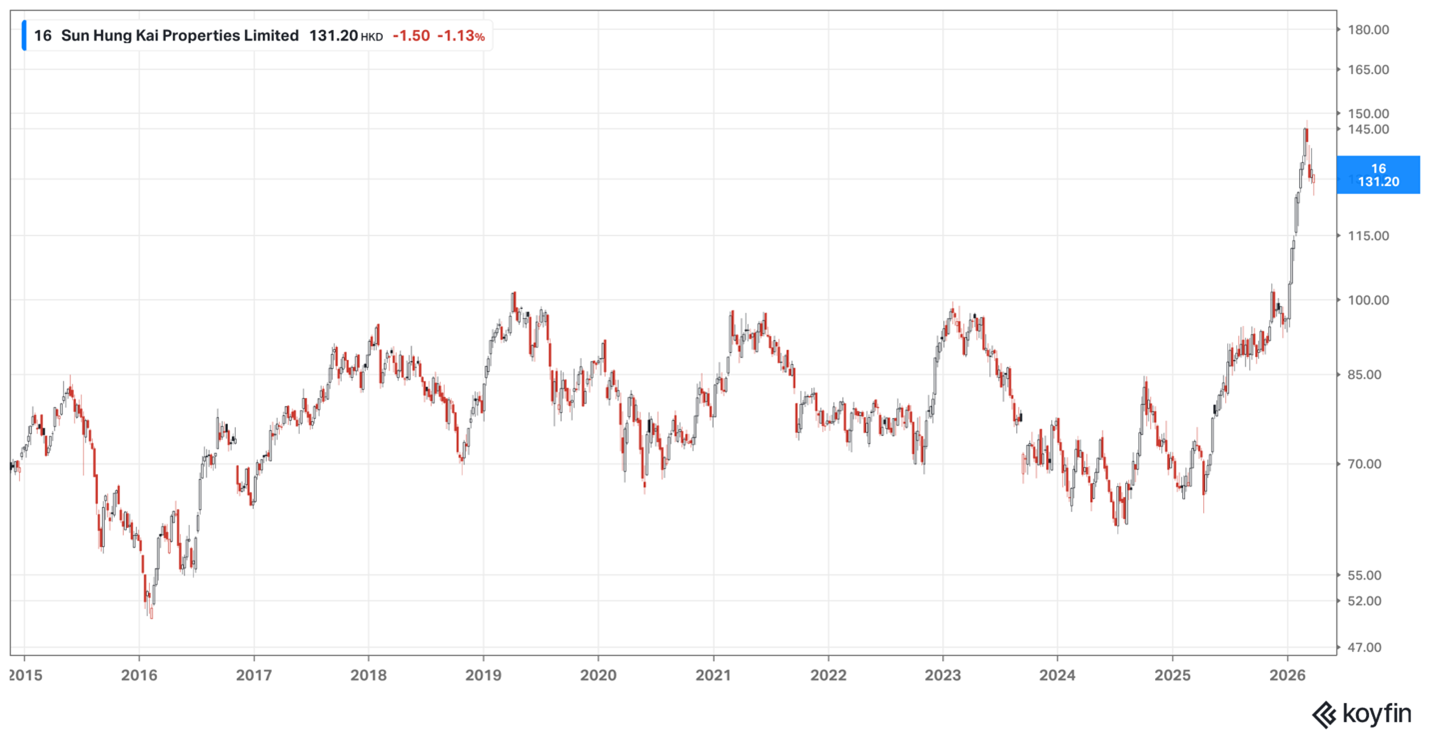
After not doing very much for 10 years, it has shot up to a new high, which looks impressively bullish. After the events of the last few weeks, it is possible that Dubai won’t be taking over as the world’s next financial centre, bringing Hong Kong back into the running.
How many investors own property in Hong Kong?
Not too many, I would think. But a real bull market could be starting, and after a 20-year bear market, property isn’t expensive there. Despite the recent run-up, Sun Hung Kai still trades at a 40% discount to book value.
Another surprising winner in the global stakes might be South Africa. Because of our incompetent government’s absolute inability to build anything, let alone maintain existing infrastructure, we are totally dependent on imports for the bulk of our energy needs. But our government also has some very strange bedfellows, which include the likes of Russia and Iran. Could we gain preferential treatment on the energy side from them? Who knows, but it’s not impossible.
Finally, how about gold? It did not act as a hedge against uncertainty when the war in Iran broke out. A few days ago, it had declined by 25% from the high of $5,600/oz it had achieved only 6 weeks ago.
My take: These examples show that global instability can throw up some surprising winners and losers. In my books, the best way to deal with this is always to be diversified, thereby giving your investment portfolio the best chance to gain exposure to future winners and avoid being all-in on a future loser.
2. The Reality of Investing in Artificial Intelligence
Here is my highly simplified view of the AI investment environment:
The three major players are as follows:
- The hyperscalers like Microsoft, Amazon, and Meta, who buy chips and build them into the big data centres where their LLMs (large language models) generate what is called AI (Artificial Intelligence). Given their high capex levels, these companies are valued at less than 3% free cash flow yields. All of them are widely owned.
- The chipmakers themselves, who design and manufacture the chips that go into the data centers. These are companies like Nvidia, Broadcom and TSMC. All of them are highly rated and widely owned.
- And then you have the energy players that generate and distribute the energy needed to run these data centres. These stocks are highly unpopular, not widely owned and cheap. They make up less than 5% of the S&P500 index, and have been starved of capital for a long time.
The hyperscalers and chip (and equipment) makers have access to virtually free capital through their highly valued stock. And they are using it – and increasing amounts of debt – to build out the physical infrastructure AI requires, all the while demanding more energy from a sector that has not been able to invest in additional capacity.
Something’s got to give.
I am no expert on the investment merits of the AI sector, but I have collected some interesting writings on it from people who are far more knowledgeable than I am.
Firstly, Derek Thompson says, “Yes, AI is a bubble. There is no question.” In the article, he examines both sides of the bubble, helping us to make up our own minds.
Then, the Substack YWR (Your Weekend Reading) has a series of articles by Pancras Beekenkamp, which describe the competitive environment in the sector and speculate about the likely winners and losers. It gets a bit technical, but if you’re interested in the space, it’s compelling reading.
For the main course, we have the latest quarterly report by asset management firm Horizon Kinetics. The lengthy first part covers the AI investment landscape and examines the energy requirements the sector will demand. Of course, being an asset management firm, they also discuss – in detail – how best to invest in the sector. You can find their report here. It really is worth your time, even if you are a passive investor. This is the sort of invaluable stuff you will never read in stockbroker reports.
Here is a small but telling excerpt:
“The bull case for the IT sector is that the companies will, in some reasonably timely fashion, achieve critical mass in AI computing capacity, allowing them to conclude their immense capital spending programs, whereupon their inherently high cash flow will be freed up, and the earnings on those data centres will bloom.
But the chip seller group – NVIDIA, Broadcom, Micron Technology, and AMD – intends that the sequential, rapid improvements in each new chip will make the previous one economically obsolete. If they are correct, then the chip buyer group – Microsoft, Alphabet, Amazon, Meta, and Oracle – will not be able to reduce their capital spending, and there will be no halcyon cash flow resurgence.
Alternatively, if the chip buyer IT contingent is correct, then the chip seller IT contingent will not continue to have rising sales and earnings. The point is, both groups of IT companies can’t be right, yet they are valued as if they are. Either way, the consequences for the S&P 500 are serious: the seller group has an 11.5% weight in the index, and the buyers an 18.3% weight.”
And finally, a meditation on what AI could/should mean for us humans by Eric Markowitz, which you can read here. The money quote: “I believe that the companies that survive the next era won’t be the ones that moved fastest. They will be the ones who move with purpose. The ones that kept their people. The ones that chose meaning over margin, long-term resilience over short-term extraction, humanity over efficiency.”
Amen to that!
3. Value is back, baby!
Guess which sector of the global market outperformed over the past 5 years? Yes, it’s value – despite Nvidia’s best efforts. Asset Management firm Verdad’s work shows that value significantly outperformed growth globally – particularly among international markets, but also in the USA, over the past 5 years.
Here’s their chart of the five-year annualised value premium (Jan 2021 – Dec 2025):
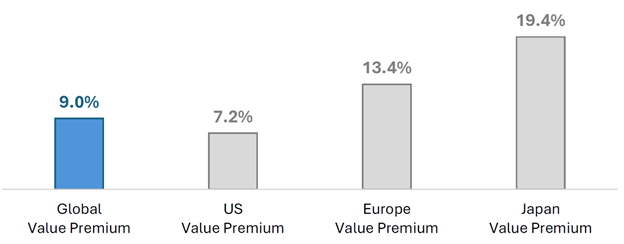
You can read the full article here. Again, this is the sort of valuable research you will never read in stockbrokers’ reports. Verdad goes on to say that, in their opinion, Value’s best days still lie ahead of it.
My take: There have been many false dawns over the last 5 years or so, but this might just be the real deal. I might add that the MWI Value Fund recently joined the party as well.
In the cockroach
Still no trading activity in the fund* this week. And seeing as I am on holiday, it’s unlikely there will be for the next few weeks either. Low trading = low cost = less chance for mistakes = sleep easy.
It’s a simple equation.
In a period when markets have taken a bit of a hit, the cockroach continues to crawl along. It’s having a nicely positive year-to-date, up c.4% in rand terms and c.2% US dollar terms. Radical diversification has helped it weather the storm so far (nicely!)
* I manage the fund on behalf of Merchant West Investments (Pty) Ltd (FSP 44508)
In The Media
1. The best music of 2000
What a year – no Y2K bug after all, the hanging chad, the dotcom bubble bursting, the Concorde crash. America Online agrees to buy Time Warner. Some of you might have to ask ChatGPT what all the fuss was about, but I remember these events like yesterday.
2000 was also the year in which my roots as a value investor took hold and grew. The tech bubble and crash vindicated my investment philosophy and process and ultimately created the platform for my narrow escape from the corporate world.
I probably would have been financially better off by toeing the corporate line, but in terms of how well I sleep, I am a much, much richer person.
In terms of music, 2000 was a bit of a bleh year. Some great albums like Radiohead’s Kid A, an all-time top 10 album, but overall the output was a bit hit-and-miss. I did, on relistening to the music, discover some gems that I never listened to at the time, like Modest Mouse’s The Moon & Antarctica, or Built to Spill Live, which was nice.
Here are my top 10 albums for the year on Apple Music and on Spotify.
And then the top 20 songs for the year, according to me! On Apple Music and on Spotify.
The number one was Pearl Jam’s Of the Girl, off their patchy album Binaural. A standout for me was Ricky Lee Jones’ cover of the classic Steely Dan song Show Biz Kids. And not forgetting Get Your Groove On by Limp Bizkit – I remember regularly playing this at full volume in my car. It’s that kind of tune! Yes, Yellow also makes the list – but only just.
I hope you find something here that you enjoy or that brings back good memories. These songs do that for me in spades!
2. Oscar’s Pleasure
My good friend Oscar Foulkes writes a blog called “Oscar’s Pleasure”. He is a food and wine connoisseur. Especially wine. He also knows a lot about horses, as he breeds them. Added to that mix, he is an above-average mountain biker with three ABSA Cape Epics under his belt. But above all, he writes damn well.
His latest missive is about a very special horse and a very special wine. You can read it here. If you like good writing, you’ll subscribe. Like I have.
3. Transformationalism
Piet Le Roux, the CEO of Sakeliga, recently spoke at the BizNews conference in Hermanus. His topic: transformationalism, the policy with which our government is undermining the social compact of this country.
In his talk, Piet warns us that this policy is fueling economic decline, state failure, and social division. He says, and I agree, that we, as businesspeople, can’t afford to stand idly by; we need to take action against this policy.
I see I have failed in my attempt to keep this letter short. No matter – there will be no letter for the next two weeks, I promise!
Here are some more pics of Osaka:
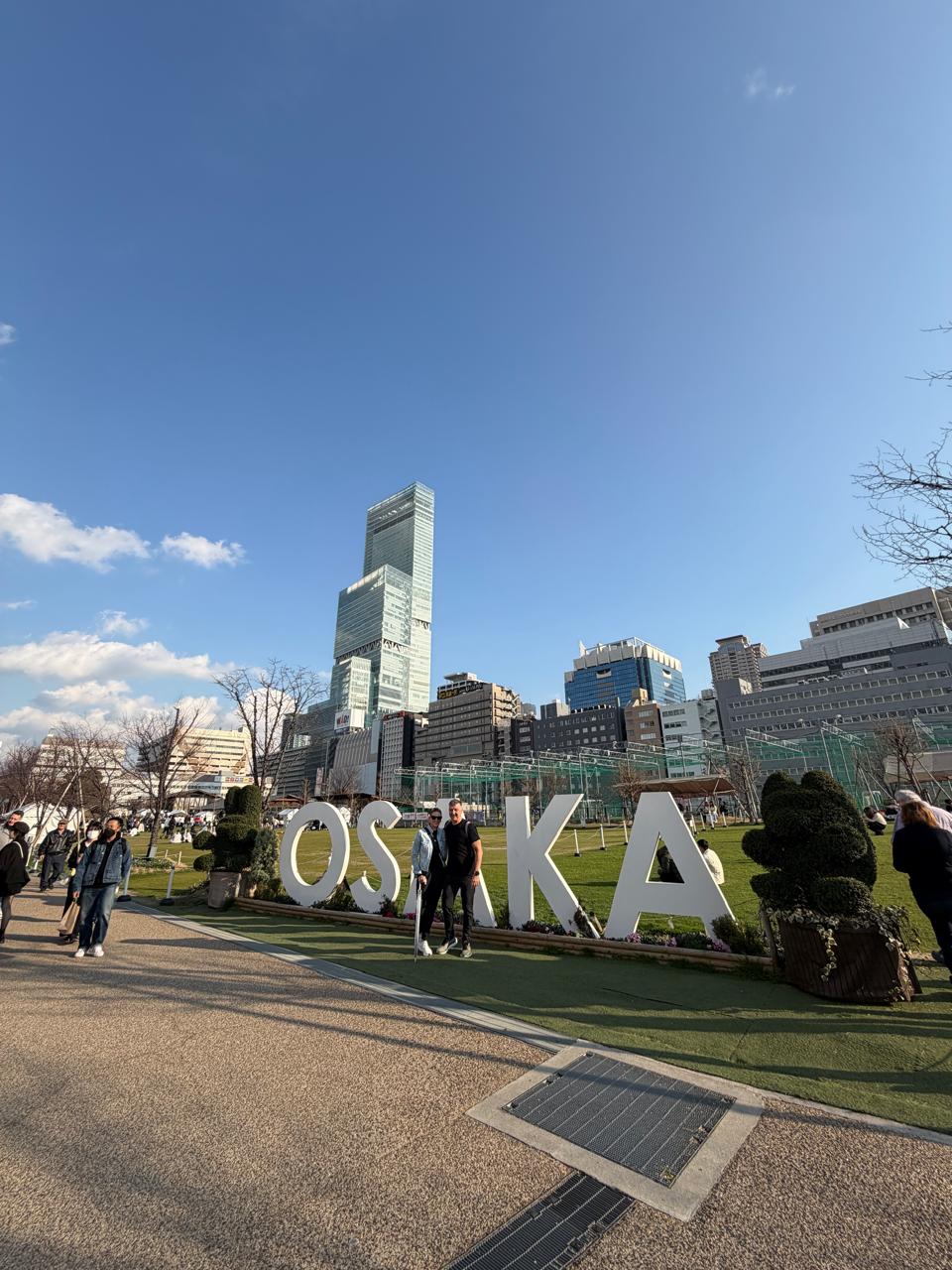


But this is my favourite pic of them all:

The rand has never been able to buy so many yen. I love this place!
Best of all, it’s so safe, you almost don’t need to be careful. But we still are. And you should be as well!
Piet Viljoen
RECM
26 March 2026