

Dear Fellow Investors and Friends,
Welcome to my newsletter, where I share my efforts to understand markets and the world around me.
I appreciate you taking the time to read this. Feedback is welcome; feel free to drop me a line. It’s great to start conversations.
Today is Thursday, December 4th, the 338th day of the year. There are only 27 days until the end of the year. And you can only use 20 of them to buy those socks for your nephew.
On this day in 1971, Switzerland’s Montreux Casino burned to the ground during a Frank Zappa concert. The incident was immortalised by Deep Purple’s classic track, “Smoke On The Water.” In a bizarre coincidence, Zappa died of prostate cancer on the same day in 1993. He was survived by his four children: Moon Unit, Dweezil, Ahmet Emuukha Rodan and Diva Thin Muffin Pigeen.
Except for the fact that they share similar levels of heightened bizarreness, Frank Zappa has absolutely nothing to do with today’s topic: corporate governance and the King Code.
“Democracy is the theory that the common people know what they want and deserve to get it good and hard.”
– H.L. Mencken
Ann Crotty recently wrote an article in “Currency” about the new corporate governance code, King V. Currency has some of the best financial journalists in the country, and Ann is one of them. But on this topic, I disagree with her.
In the article, which you can read here, she bemoans the failure of King Codes I to IV to stop frauds like Steinhoff, Oakbay, EOH, et al. Like socialists everywhere, who, when faced with the inevitable failure of their policies, say it just wasn’t implemented hard enough, she says we should do more King Code and police it more rigorously.
Ms Crotty is simply calling for “More Cowbell”, as in this famous SNL skit. I think that’s exactly the wrong approach – for the band in the skit, for socialism and for corporate governance.
This King Code is a set of principles and recommended practices for regulating and guiding corporate governance in South Africa. It was first introduced in 1994 by the King Committee, chaired by Mervyn King, and has undergone several revisions to reflect evolving standards.
To be sure, the intention behind this code of governance was good. I mean, how can you fault the aim of the code: “the exercise of ethical and effective leadership by the governing body”? Furthermore, it emphasises that good governance is not simply compliance, but the pursuit of sustainable value creation, ethical culture, effective controls, stakeholder trust, and legitimacy.
What’s not to like?
The problem lies in what happens in the space between this statement of intent and the final decisions of a board whose members respond to wrong-headed incentives.
The road to hell is paved with good intentions.
I’ve always believed markets are good at sorting the wheat from the chaff. Less rules-based governance, more needs-based. If you want to appoint your entire family to the board and hold board meetings in exotic places, go ahead. But then don’t complain if your share price fails to develop momentum. Ask Bidvest – fully King Code compliant – about how this works.
The three main criticisms I have against the King code are:
- The definition of director independence
- The costs of compliance
- The rise of stakeholder capitalism
Alexander Hamilton, as far back as 1790, anticipated the invaluable role directors with an ownership interest could play when he said:
“The keen, steady and, as it were, magnetic sense, of their own interest, as proprietors, in the Directors of a Bank, pointing invariably to its true pole, the prosperity of the institution, is the only security, that can always be relied on, for careful and prudent administration. It is therefore the only basis on which an enlightened, unqualified and permanent confidence can be expected and relied upon.”
Surprisingly, King’s concept of independence disqualifies a director if she has an ownership interest in the business. King defines independence as being independent from the company. Hamilton turns in his grave – how can one who is seemingly detached from the well-being of the business govern it well?
In my world, I would want a board that is independent of management – and can thereby offer decent oversight on behalf of shareholders. After all, the management team are generally agents appointed by the directors to run the firm for the benefit of the shareholders. Crucially, directors should be independent of these agents. If not, you could easily find yourself in a position where the firm is being run for the benefit of management.
Which is precisely where many, many firms listed on the JSE find themselves. Financial outcomes for management are overwhelmingly positive, while outcomes for shareholders consistently suck. Truworths is my poster child for this effect – see my critique of their remuneration policy, and its outcome for shareholders, in Vol 3 No 36.
Somewhere along the line, the concept of independence was twisted. Hanlon’s razor says it could simply have been the stenographer who typed up the final version of the code that got it wrong. It’s unlikely that a person as well-versed in corporate affairs as King could have intended this outcome.
Companies like Truworths – and there are many like them listed on the JSE – are packed with “independent” friends of the management team, and no one is looking after the owners’ interests.
Skin in the game is what I believe independent directors on a board should have. As a minority shareholder, I would trade the liquidity of a listed company for an illiquid private company with proper oversight by directors with a significant shareholding.
All. Day. Long.
My second criticism of the King code is the burdensome compliance costs it imposes on firms. The code requires companies to align their governance practices with laws, non-binding rules, codes, and standards, and to approve policies that mandate compliance in these areas. Like rabbits, these laws, rules, and codes multiply over time, imposing a heavy cost in both time and money.
Twenty years ago, the average annual report was 30 to 60 pages long, primarily focused on financial reporting and management’s discussion of the business environment.
Succinct and useful.
Today, annual reports can run up to 260 pages – and sometimes, in two volumes! The transition to integrated reporting, mandated by the King Code, led to broader and deeper disclosures, with sustainability, governance, risk management, and remuneration sections added to traditional financial reporting. These reports have now become almost unreadable. As an analyst, I skip through these sections wholesale. I have still to figure out who they were written for, except maybe to cover the asses of the “independent” directors.
For example, here is a link to Truworths’ annual report. Go to the remuneration section on page 46 and see if you can make out what behaviour they are trying to incentivise. Nevertheless, this part of the annual report takes up 15% of the pages, and I am 100% sure it complies with all the requirements of the King Code.
But it’s pure boilerplate.
Finally, the term “stakeholder capitalism” was introduced to South African corporate governance primarily through the development and adoption of the successive King Reports. This concept argues that companies should meet the reasonable needs, interests, and expectations of all material stakeholders in the best long-term interests of the organisation. It has now morphed into an agglomeration of DEI/ESG influences on corporate decision-making.
These influences have nothing to do with capitalism and, in many instances, stand in direct opposition to capitalism. Just another typical example of Orwell’s “doublespeak”, used so well in his book 1984 to obscure reality and make the unpleasant more acceptable. Doublespeak has now invaded corporate communication as a direct result of requirements laid down by the King Code.
I contend that this “stakeholder capitalism” has ravaged the returns shareholders of complying corporations earn, leading to worse outcomes for employees, customers, suppliers, and the economy. In a listed company, with fragmented ownership, agents as managers, and captured – albeit “independent” – boards of directors, the size of the slices of pie that go to non-shareholding constituents are gradually enlarged, leaving less for the real underwriters of economic risk and return, the shareholders.
No wonder they are deserting the market en masse.
In private businesses, this encroachment on what rightfully belongs to shareholders is handled far better by management and directors with skin in the game. Better returns for shareholders are positively correlated with more and better jobs, more satisfied customers, committed suppliers and ultimately, a growing economy.
Anthony Deden said it well:
“When every enterprise must justify itself through ‘enhanced shareholder value,’ the distinction between stewardship and exploitation collapses. The result is not creation but conversion of substance into symbols, and of permanence into liquidity.”
Let the market be the arbiter. Not some remuneration committee filled with ignoramuses.
RIP King.
In The Markets
1. Valuation anomalies in the SA market
November was a busy month for company reporting. My overall conclusion was that a tailwind is building for business in South Africa. Unfortunately, to get unadulterated exposure to this tailwind, one must venture into the mid- and small-cap space, as most large corporates have panic-bought into poorly performing offshore operations. Most likely, with the unanimous approval of their so-called “independent“ directors, who can now travel to all these wonderful offshore operations on the shareholders’ dime.
But there is a silver lining to this cloud. Small and mid-cap stocks are absolutely shunned by institutional investors, creating an outstanding investment opportunity, as I have often pointed out.
Here is a comparison between the valuation metrics and the recent growth of some small and large listed companies in South Africa:

My take: The disparities are evident, and so is the investment opportunity. Buying good growth on low multiples is a sensible way to make money. The MWI Worldwide Flexible Fund (aka The Cockroach) has a reasonable exposure to “SA Inc” via its holding in the MWI Value fund.
2. Energy and Technology
These are two sectors that offer interesting investment opportunities. But my conclusions might surprise you.
Today’s tech boom is happening in the AI space, and I have often written about this. The point I have been making is that today’s boom is just like all previous booms – energy and capex-intensive.
- Building out the railroad system in the late 19th century took a vast amount of capital.
- The motor vehicle boom in the early part of the 20th century necessitated the construction of substantial new factories.
- The internet boom at the turn of the century required a massive build-out of a fibre network.
All these booms had a few things in common:
- They needed vast amounts of energy to facilitate the build-out
- They resulted in massive positive changes to efficiencies in the economy
- Initially, wholesale bankruptcies lead to poor investment returns
- It was almost impossible to identify the eventual winners during the boom. Amazon, an ultimate internet winner, first fell by 90% when the bubble burst.
Given that this boom is even more capital-intensive and energy-hungry than previous booms, what should the right investment strategy be? Learning from history, the following makes sense:
- Invest in tech companies in areas where energy is abundant and cheap.
- Invest in energy companies in areas where tech is growing fast, and there is an energy bottleneck.
- Avoid areas with expensive energy.
China has abundant energy:

And China has cheap energy:
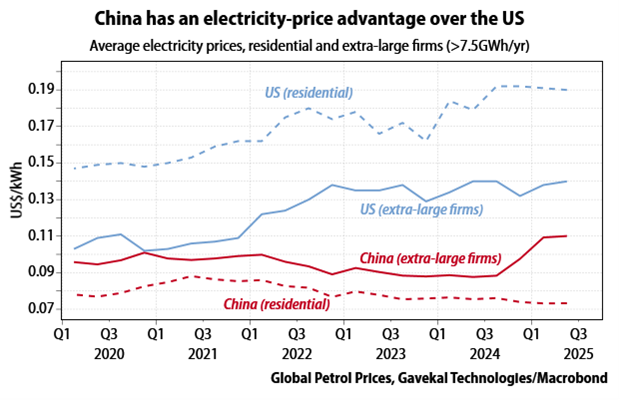
Kimi K2 – a Chinese LLM, developed by Chinese AI company, Moonshot – costs $2.50 per million output tokens — that’s 4x cheaper than GPT-5 for comparable performance. Chinese AI models from Alibaba and DeepSeek are also roughly 10x less expensive than American alternatives.
For an in-depth read on why Chinese tech will dominate US tech, at least for the foreseeable future, my friend Michael Power wrote an amazingly detailed article on the lay of the AI land. You can read it here.
Then there’s this article by Ben Thompson of Stratechery, which, in trying to defend Google et al., establishes that what’s happening in AI in the USA is simply a “Red Queen” effect. As per Lewis Carroll’s Red Queen in Through the Looking Glass, who tells Alice that “it takes all the running you can do, to keep in the same place.”
Which places to avoid? The high energy prices in Europe, a result of misguided policies, make them a likely candidate. This chart from the FT:

Finally, there’s this dystopian view on AI and how it will satisfy its enormous funding needs for the capex buildout. It’s by one of my favourite thinkers, Ben Hunt.
My take: I’m always cautious when there is a lot of excitement in a market. And when that excitement meets a bottleneck – in this case, energy – it presents an easy choice. Conversely, Chinese tech seems to be catching up very fast with US tech, aided and abetted by abundant cheap energy. There is also little or no excitement in that geography, which may present an investment opportunity.
The MWI Worldwide Flexible Fund (aka The Cockroach) is positioned accordingly.
3. Japan
Amanda and I are planning a trip to Japan and China in March of next year. There are several reasons for going:
- Seeing the cherry blossoms, which has been a bucket list trip for me for a long time

- To, once more, experience the sensual overload that Japan offers. The best food, best infrastructure and safest environment on the planet. Switzerland is like Afghanistan by comparison.
- To see first-hand how things are going in China, and to experience how the system works for a foreigner. And to have a good look at their consumer electronics, including cars. As well as their ultra-modern cities, like Shanghai:

But back to Japan. Imagine the pleasant surprise when I looked at what a Rand could buy in Japan:

30% more than it did 5 years ago!
On the Big Mac index, the Yen is almost as undervalued as the ZAR. Here is a list of the cheapest countries, based on this (somewhat flawed, but directionally correct) measure:
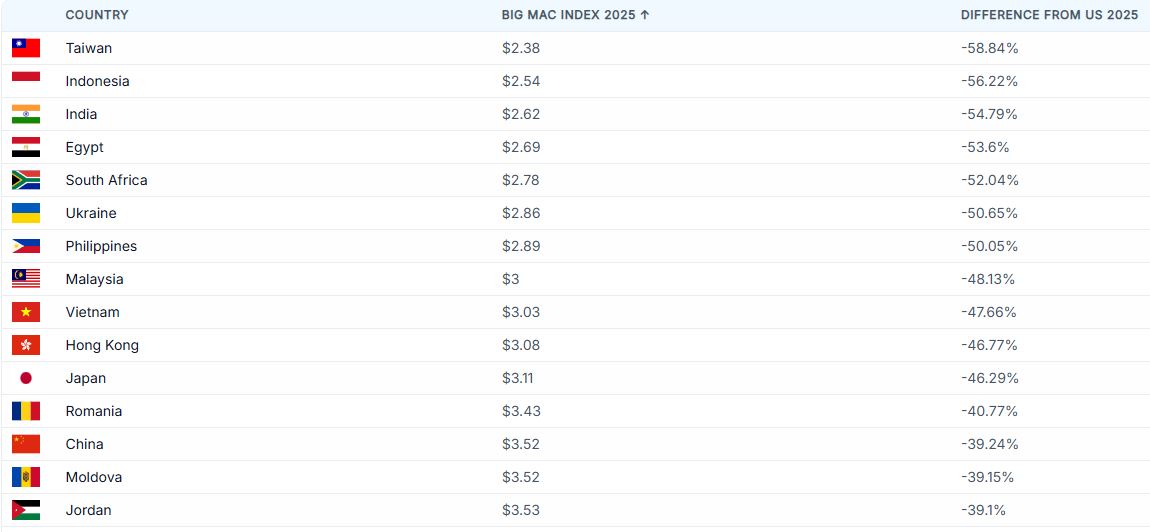
Here is a list of the most expensive countries:

That led me to looking at the Japanese bond market, and this is what has happened to the price of their long-dated government bonds over the past 5 years:

They have lost 20% of their value, while paying – until quite recently – almost no interest at all. But interest rates on bonds in Japan have increased nicely, to the point where they are now providing a nice yield:

My take: Two things. One, I can’t wait to get to Japan. Two, with a debt-to-GDP ratio over 200% (South Africa: 80%), they cannot afford high bond yields. How long before they implement severe financial repression, forcing local institutions to repatriate currency to buy bonds? This might improve yields and could strengthen the Yen.
Yen bonds, anyone?
4. Australia
I’ll keep this one short. No use spending too much time on a country so far away and so different from us. A subscriber to this letter sent me the following chart:

The chart, provided by Australian strategist Gerard Minack, shows that Australia’s total residential land valuation is now on par with Japan’s at its peak in the late 80s land bubble.
My take: I have been to Aussie a few times, and I have never come across a place so utterly obsessed with property. As with all bubbles, I don’t think it ends well. The only (unanswerable) question is when it ends. As I’ve said many times, property and investment don’t belong in the same sentence. It’s no different down under.
In The Media
Three companies in which I have an interest had newsworthy events over the past week:
1. WellsFaber podcast
WellsFaber is a financial advisory firm, with top quality advisers. If you need assistance with your financial affairs, they are the firm for you. You don’t get fancy cocktail parties or overseas trips like their competitors offer (which you pay for in any case through higher fees). What you do get is high-class personalised service.
Enough with the advertising – this week they released a podcast discussing something which lies close to my heart, and which is not talked about often enough: age-related cognitive decline. Assisted by The Finance Ghost, advisor Mike Moore chats to Cape Town’s “Memory Doc” Dr. Craige Dietrich. Together they cover all the essential aspects: how to recognise it, what to do about it and how to delay its onset for as long as possible.
You can listen to this interesting podcast here.
2. Merchant West Investments quarterly newsletter
Merchant West Investments is an institutional asset management business that arose from the amalgamation of three separate asset managers: RECM, Counterpoint, and Bridge. They have a young team who are busy making a mark for themselves.
They just released their quarterly newsletter, which is always a good read. In this edition, analyst Josh Viljoen (no relation!) provides a good account of the investment implications of the major capex boom driven by the AI euphoria.
There’s quite a bit of other good stuff as well. You can read this quarter’s edition here.
3. Outdoor Investment Holdings new store concept
Outdoor Investment Holdings is the owner of, amongst others, the retailer Safari Outdoor. They opened their first standalone apparel store in Somerset West Mall this week, called “Safari Collection”. I was there just before the opening and spent much more than I intended! If you visit them, I sincerely hope you have the same experience.
Here are a couple of pics of the shop:


4. The Beast in Me
Amanda and I watched this series on Netflix over the weekend. Initially, she wasn’t drawn to it, but eventually couldn’t stop watching. It’s an edgy thriller, featuring Claire Danes as a recently divorced author with writer’s block, and Mathew Rhys, her neighbour, about whom there is talk that he might have killed his wife.
Things escalate gradually, with, as one would ironically expect, a surprising denouement. I didn’t find it as anxiety-provoking as Black Rabbit. Here, the characters were much less out of control, though one might question some of their life choices. But then, if they didn’t do what you and I would never do, the story would be much less interesting, wouldn’t it?
My verdict – a good but not irresistible watch.
In other news, we had a good time in the Kruger last week, despite the condition of the accommodation, which was rustic at best. But the bush was great, we had good animal sightings, and it was a joy to spend quality time with my brother, Stephan, and his wife, Carolien.
That’s it for this week.
Remember to be careful out there.
Piet Viljoen
RECM
4 December 2025