

Dear Fellow Investors and Friends,
Welcome to my newsletter, where I share my efforts to understand markets and the world around me.
I appreciate you taking the time to read this. Feedback is welcome; feel free to drop me a line. It’s great to start conversations.
Today is Thursday, November 20th, the 324th day of the year. There are 41 days until the end of the year. In Cape Town, the South Easter is blowing, and in Switzerland, where our CFO, Dean Schweizer, lives, the first snow has hit the mountains. The seasons are finally showing their true colours. Let’s enjoy them.
Today, only 40 years ago, Microsoft released its first operating system, Windows 1.0, which for the first time provided a graphical user interface (GUI) as an extension of MS-DOS. At the time, the most popular investment sectors were apparel manufacturing and specialty retailing. Tech stocks did not feature, with Microsoft only IPO’ing a year later. It listed at $21 per share, which, after 9 subsequent stock splits, equals 288 shares today. At the current share price of around $500, this one share would be worth $144 000, representing a compound annual return of 25% p.a. For those who got in early, it was truly an intergenerational wealth builder.
But not something that most would have forecast at the time.
“I can’t claim to have analysed the future. In fact, I consider the phrase ‘analyse the future’ one of the great oxymorons. The future has not yet been created, and it’s subject to millions of complex, unquantifiable, and unknowable factors that will always be in flux. You can ponder the future and speculate about it, but there’s nothing to ‘analyse’.”
– Howard Marks
Over the past two weeks, I established that passive investing dominates active investing. But does that mean we should go all-in passive and spend no time thinking about opportunities to add value?
My conclusion was that we had to move our money out of the big fund houses and index the bulk of it. But I also recognised there would always be opportunities to add value. But how do we identify them?
A movie plot might help us think about it.
The movie Sliding Doors explores the concept of parallel timelines. The life of the main character, Helen Quilley, diverges based on whether she catches or misses a train.
After being fired from her PR job, Helen’s fate splits: in one scenario, she catches the train and meets James. She discovers her boyfriend Gerry’s infidelity with his ex-girlfriend Lydia, leaves him and starts fresh, building a successful PR firm. She also falls in love with James, although complications arise when she learns he is separated but not divorced. Tragically, this timeline ends when Helen dies after being hit by a van.
In the alternate scenario, Helen misses the train, gets mugged and struggles to find a job. She remains unaware of Gerry’s affair with Lydia while juggling two jobs to support him. Eventually, she does find out, and in running away from Lydia, she falls down some stairs and ends up in the hospital. She encounters James in the hospital elevator, setting the stage for a possible fresh start.
The term “path-dependent” refers to a process in which the sequence of past events or decisions significantly influences the outcome. In other words, the current state of a system or situation depends on the path it has taken to get there, rather than just on its current conditions or inputs.
In the movie, Helen’s life path depended on whether she caught the train. Once she did, other paths were closed to her. I saw a visual depiction of this recently:

Investment returns are not path-dependent. Saying that investment X returned 20% p.a. over the past 10 years and is thus a good investment for the next 10 years is like invoking alchemy. It sounds great in theory, but it is of no practical use. It doesn’t compute in the real world.
What determines the future returns of any investment is not what happened in the past, but its price today and what will happen in the future. The past is water under the bridge. There is no use in obsessing over it, or even worse, extrapolating from it. Better to focus on the future paths available today.
Investment returns are much more akin to a stochastic – or random – process. Stochastic outcomes are those whose occurrence or magnitude cannot be precisely predicted due to the presence of random variables or unpredictable factors. These processes are typically modelled using probability distributions that describe the likelihood of different possible future outcomes.
In trying to identify good investment opportunities, we have a problem: we are poor forecasters. I explained this in “You’re on your own now” earlier this year. Given our poor forecasting abilities, what can we do to improve our odds of success in our investment endeavours?
A good way to approach this problem is to ask ourselves: “What has worked in markets over time?” Fortunately, the people at Tweedy Browne wrote a piece called “What Has Worked in Investing. Studies of Investment Approaches and Characteristics Associated with Exceptional Returns.” They wrote it in 1992, and it still applies. It’s almost like a Lindy manual of the market. You can – and should – read the full document here.
It boils down to acquiring an edge where structural factors create market inefficiencies. You can find these inefficiencies where emotions are running strongly. Disgust or despair can point to promising investment opportunities, just like euphoria can highlight areas to avoid. Another area where inefficiencies occur is where investment decisions are based on technical factors – i.e. forced selling or buying. Examples include unbundling, index additions or deletions, or a fund manager losing a significant mandate to another manager.
Applying these pointers – instead of forecasting or extrapolating from past returns – leads to much better investment outcomes. Today, there are a few such areas where the path forward might look very different to the path in the past:
1. South African small and mid-caps
South Africans have been emotional sellers of local assets and buyers of offshore assets, driven by their visceral lived experience of a poorly run country. Good businesses with good management have been starved of capital, leading to high returns on the capital they do have. Today, available at knock-down prices.
2. Platinum and platinum mining stocks
Platinum mines have been starved of capital for over a decade now, leading to declining production. Over that time, demand for platinum has grown. We are now at a point where supply can’t keep up with demand. We need new mines, which will only be built in response to higher prices.
3. US Energy stocks
The AI boom requires energy. The USA has a lot, but needs higher prices to incentivise production expansion.
4. The Japanese Yen
The yen is, on a purchasing power basis, the cheapest currency in the world. It has even depreciated – a lot – against the Rand over the last 5 years. What brings it back to fair value? The same thing that is getting the Rand back to fair value: market forces taking advantage of a dislocation.
5. Emerging markets generally
EMs, as I have repeatedly pointed out, are running sensible monetary and fiscal policies. Most developed markets are not. Investors are still invested as if developed markets are the safe haven they have historically been. They are not.
6. China and Chinese tech, specifically
China has more energy-generating capacity than any other economy in the world. Economies are energy transformed. And that goes double for AI. As such, Chinese tech companies have a major competitive advantage.
All these opportunities have one thing in common – they live outside the broad indices. This means that they are generally avoided by most fund managers, even those of the so-called ‘active’ persuasion.
But we don’t have to avoid them.
In The Markets
1. Some updates on my “Forever Stocks”
Some of my forever stocks have reported results over the past few weeks. Plus, I sold Estée Lauder after realising I had made an error by including it in this select group of stocks. So, I want to share with you the stock I bought as a replacement.
a. DSM-Firmenich
This is my replacement for Estee Lauder in the “10 stocks, forever” portfolio. DSM-Firmenich is a company that resulted from the merger of the Netherlands-based DSM and Swiss Firmenich. It produces speciality ingredients, flavours, and fragrances and has been transitioning from commoditised compounds to more specialised, tailored solutions for a few years now.
The flavours and fragrances (F&F) business meets the pattern of many good businesses. It provides “the trifecta”:
- It provides a small but essential part of big things;
- It has high switching costs; and
- It is a consumable.
Firmenich was family-owned, while smart capital allocators run DSM. Firmenich merged with DSM to obtain liquidity so that family members who wanted to sell could do so. Otherwise, it would still be a private business.
It has more than 2,000 R&D scientists and engineers worldwide. This has enabled the company to amass more than 2,600 patent families and over 16,000 individual patents.
The share price has struggled since the merger, as the shareholder body effectively needs to be reconstituted:
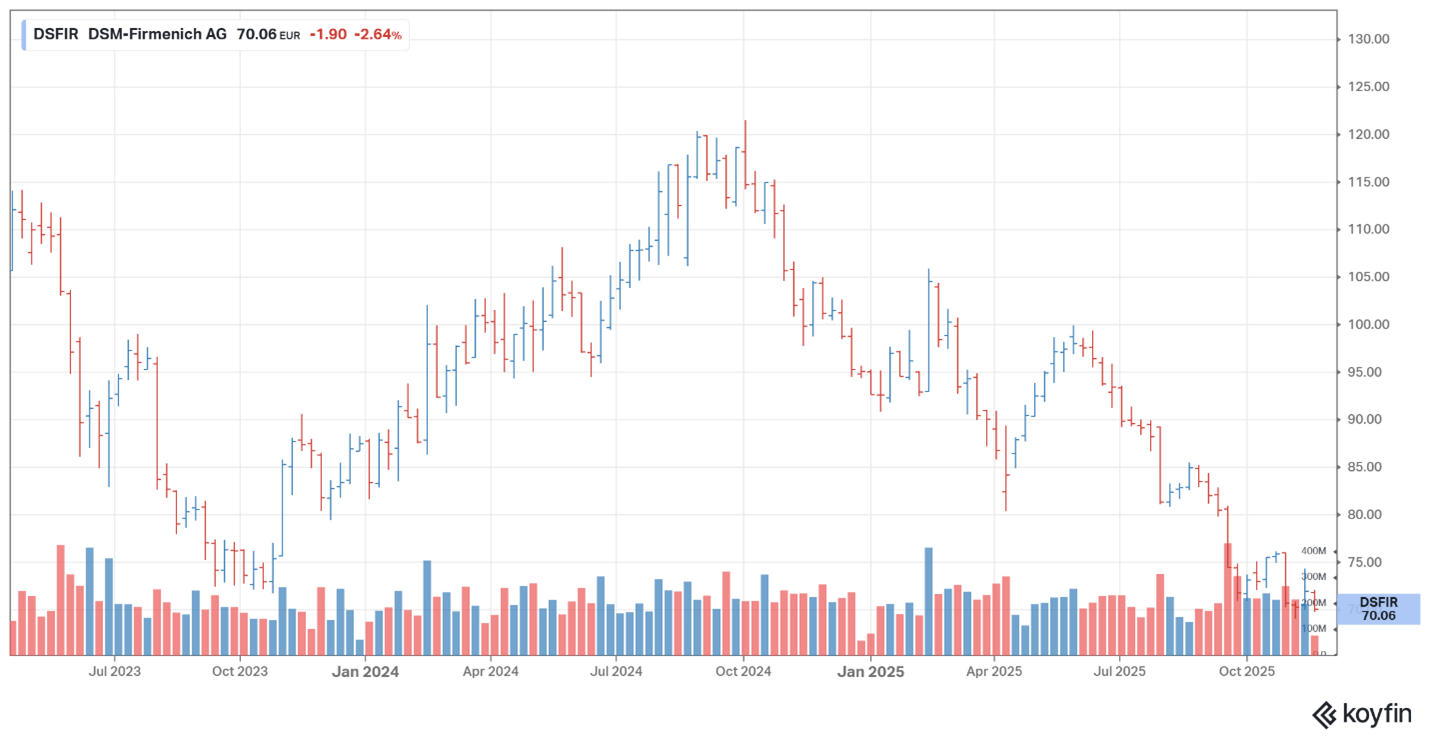
My take: The current valuation also reflects DSM’s historical status as a commodity conglomerate and does not fully reflect the quality improvements that can result from the merger with Firmenich. This is an opportunity, not a threat.
b. Walt Disney
For now, the story remains the same: the parks are fantastic, and everything else, not so much. They desperately need an inflection point in their streaming business as the streaming wars continue unabated. Despite this, they still did +19% eps. However, the market expected more, and punished the share:
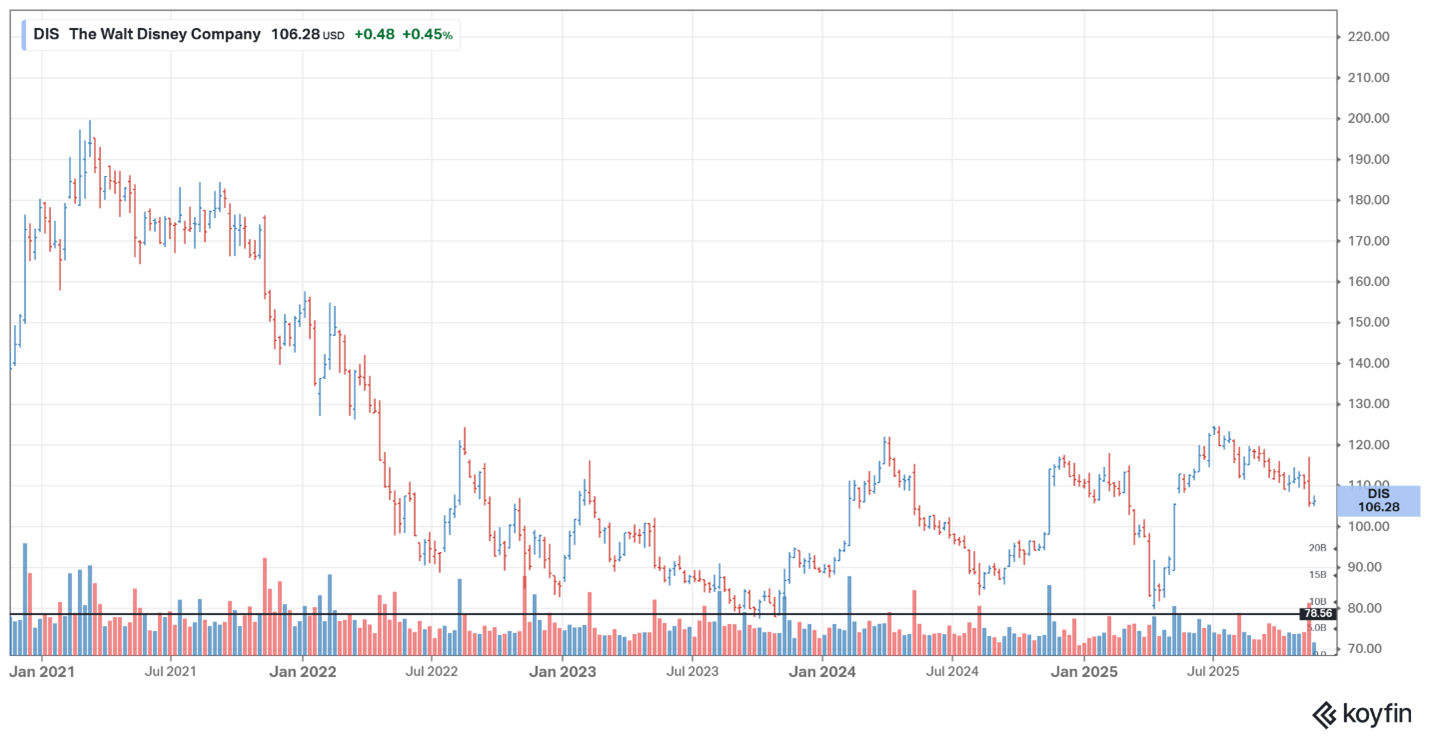
My take: Despite this short-term hiccup, things remain on track here. On a long-term timescale, this company will do well.
c. Berkshire Hathaway (BH)
BH is an investment holding company, previously run by one of the world’s best investors, Warren Buffett. He has now formally resigned, but I think the culture he has built into the business’s DNA will remain for decades to come. Greg Able has taken over as CEO and is responsible for the annual shareholders’ letter. But Warren published a “Thanksgiving letter’ which he intends to do every year from now on. You can read the letter here. If you want to understand the culture and ethos of Berkshire, this letter will give you a good idea of those things.
It’s pure coincidence, but after the release of the letter, BH’s share price enjoyed a bit of a bump:
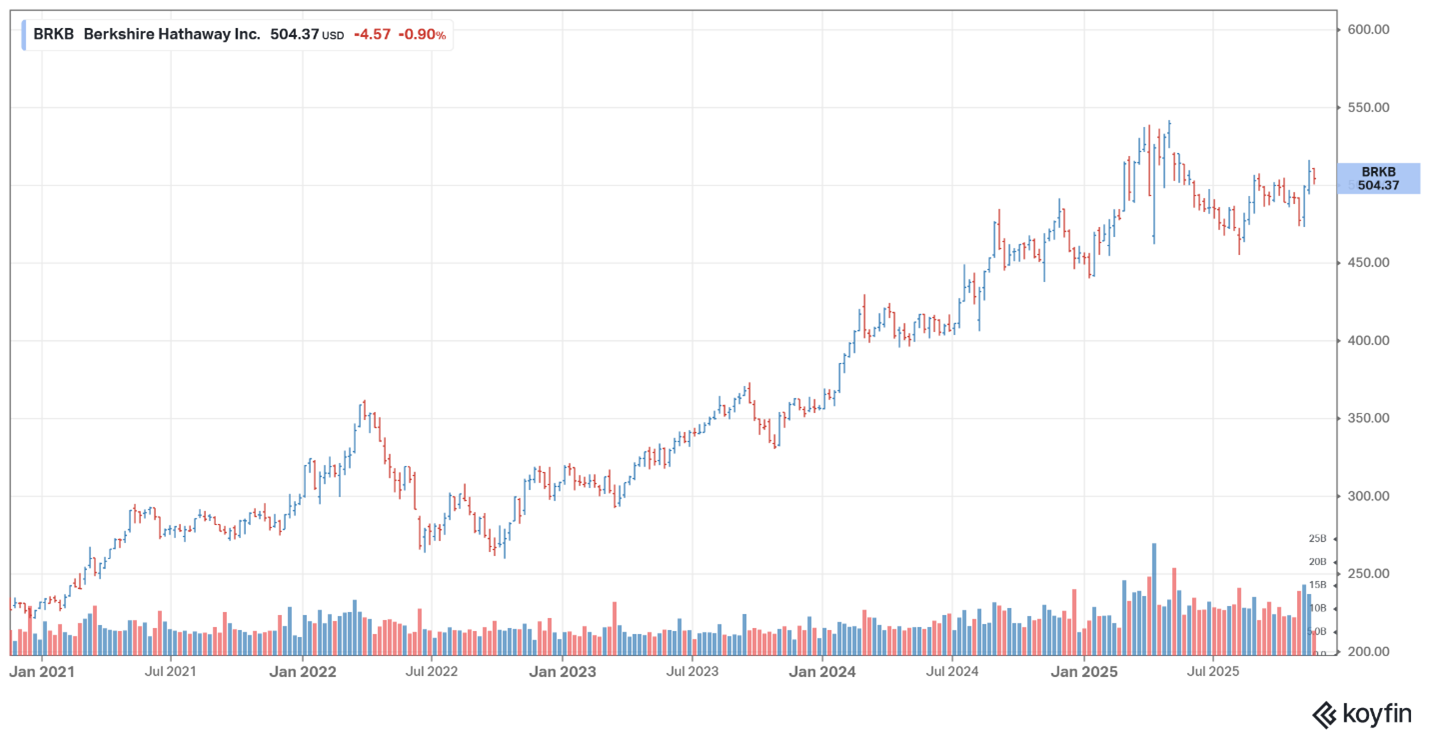
My take: I am a committed long-term shareholder, despite Mr Buffett’s retirement. The company remains in good hands.
2. WeBuyCars vs CMH
WeBuyCars is a recent listing on the JSE. It has excellent management led by the founders. It became quite a popular stock after its listing, but has recently given back some of those gains:
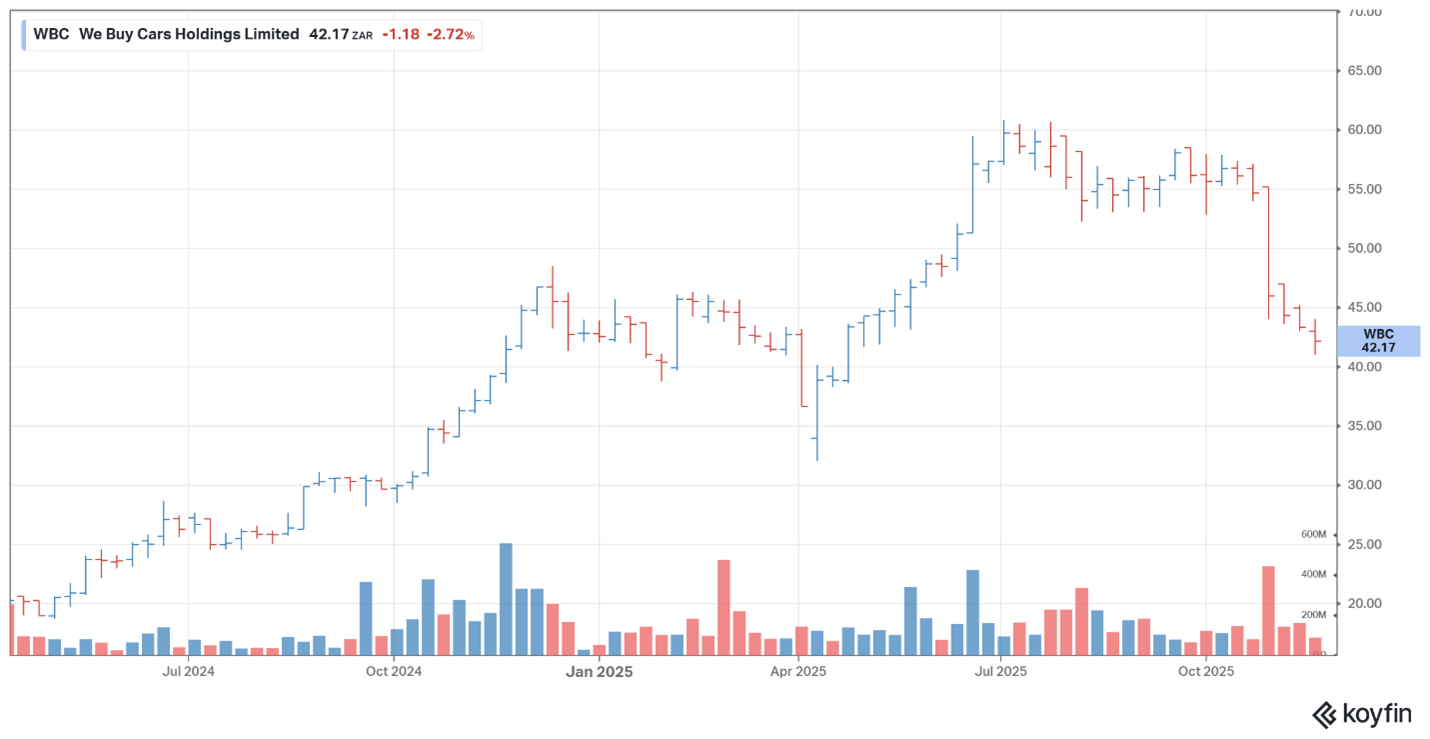
CMH is also an entrepreneurial business, led by a management team that has seen many things change over time. The CEO, Jebb McIntosh, is the longest-serving CEO of any JSE-listed company – 50 years in the saddle this year!
For a while, CMH was seen as being hurt by the large-scale switch to Chinese cars. But recent results show they have adapted well – more than half the cars they sell are now Chinese, from almost nothing a few years ago. The share price liked this:
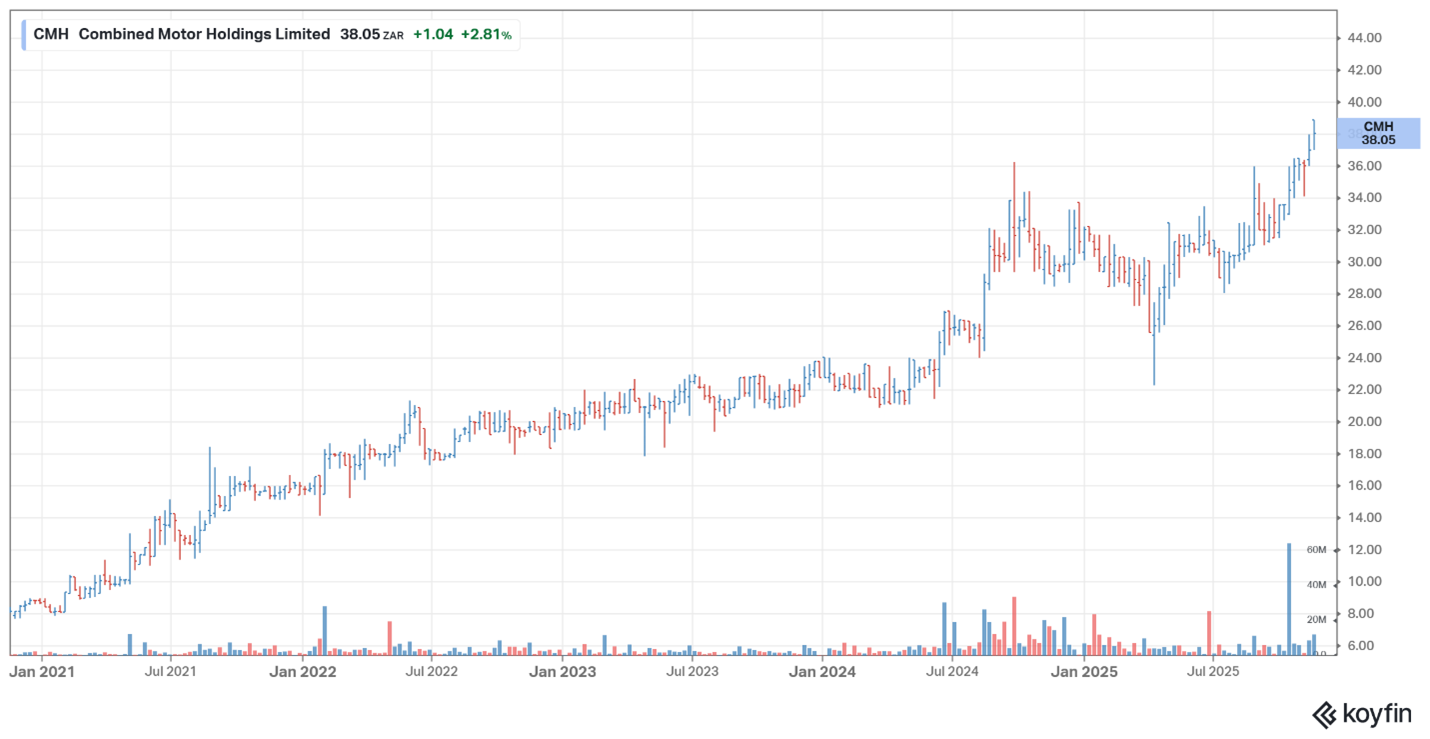
CMH is benefiting relative to WBC – consumers would rather buy a new Chinese car than a second-hand German one, at the same price. On a P/E of 7 times, even at the recent high share price, CMH is not discounting any good news at all, while WBC’s P/E of 17 is saying they will get over any problems quickly.
My take: I have no doubt WBC will weather this storm, but it will take a while, and you are not getting paid to wait here. On the other hand, the CMH share price seems to discount the risk of some intense storms. But in my view, the barometer is holding steady. CMH remains a core holding in the MWI Value fund.
3. South African government bond yield
The interest rate the South African government pays on its debt has declined precipitously over the past year. To recap bond mathematics, lower bond yields (or interest rates) mean higher bond prices. This is what has happened:
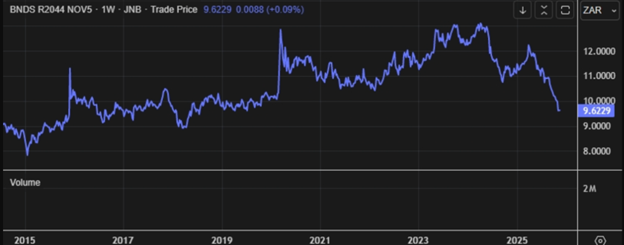
Yields are now back to where they were in 2016 and have declined by 4% from their highs of a year ago. A decline from 13.5% to 9.5% is massive in terms of its implications for financial assets in South Africa.
Here’s a simple example – but bear with me, we need to do some math here.
A company’s share price represents the market’s best estimate of the present value of its future cash flows. Cash flows which tend to grow over time. That’s called the discounted cash flow valuation (or DCF). In math terms, it looks like this:
CF1 / (i-g)
Where
– CF1 is the firm’s cash flow in the first period, and
– i is the interest rate with which one discounts the cash flows, and
– g is the growth rate of the cash flows
So, if the first cash flow is R100, the interest rate is 13.5%, and the growth rate is 5%, the formula yields a value of R1,176.47. But if the discount rate (i.e. interest rate) declines by 400 basis points to 9.5%, the firm’s DCF valuation doubles to R2,222.22.
But there’s more. My colleague Jan van Niekerk calculates that the spread between the SA ZAR 20y bond rate and the US 20y bond rate has halved over the past 5 years. It’s now basically 5%, down from close to 11% (this reflects the market’s view of BOTH credit risk and currency risk combined):

My take: SA Inc. – companies that do business mainly in South Africa – should receive a significant boost to their valuations because of declining bond yields. We have already seen it happen in the property sector; it is starting in the banking sector and will eventually flow through to the industrial sector. Meanwhile, government finances are looking healthy, removing a significant barrier to growth. According to our DCF formula, a lower i, coupled with a higher g, can lead to a potentially explosive valuation move.
4. The showdown
Four years ago, a member of the BizNews community took R1mn and gave half to me and half to Magnus Heystek of Brenthurst Wealth to invest. I put it all in a fund that only invests in locally listed businesses – the MWI Value fund. Magnus invested it in a variety of offshore funds. My investment has stayed in the Value fund, while Magnus has switched into potential future winners from time to time.
Today, I am 10% ahead in this “game” of local vs offshore. There is one year left in the competition, and the tailwinds for local investments are only now starting to pick up, as I explained in the piece above.
You can watch the latest interview by Alec Hogg on the competition here.
And if you are a foreign investor, or even a South African investor with all your money offshore, there’s a better way than an ETF to get exposure to the South Africa story (the South Africa ETF is filled with foreign stocks, including mining companies). My colleague Rudi van Niekerk runs a Delaware (USA)-incorporated fund called Desert Lion Capital. Its mandate is to invest in undervalued South African small and mid-caps. Check it out here.
My take: Although I am ahead with my 100% SA portfolio, I would never recommend having all your investments in one place, even if it is as fundamentally undervalued as South Africa. It’s just too risky. Magnus is right when he says you should have at least some of your wealth offshore. I guess what I have shown is that valuations matter, and that there is a good investment story to tell here at home. Furthermore, staying the course with a sensible investment pays off – not each and every time, but over time.
5. The US credit cycle
The top banker in the USA, Jamie Dimon, CEO of JP Morgan, recently warned of emerging risks and potential deterioration in the credit environment, particularly pointing to concerns in private credit markets and lending to non-bank financial institutions. Dimon likened hidden dangers in the system to seeing “one cockroach,” suggesting that problems uncovered in one area may signal broader systemic issues yet to be revealed. He delivered this warning after JPMorgan absorbed losses tied to auto lender Tricolor’s collapse, followed by First Brands’ meltdown weeks later.
Blue Owl Capital is a leading alternative asset management firm specialising in private capital solutions, including direct private credit. It recently imposed a 20% haircut on investors in one of its funds due to losses. The market voted with its feet:
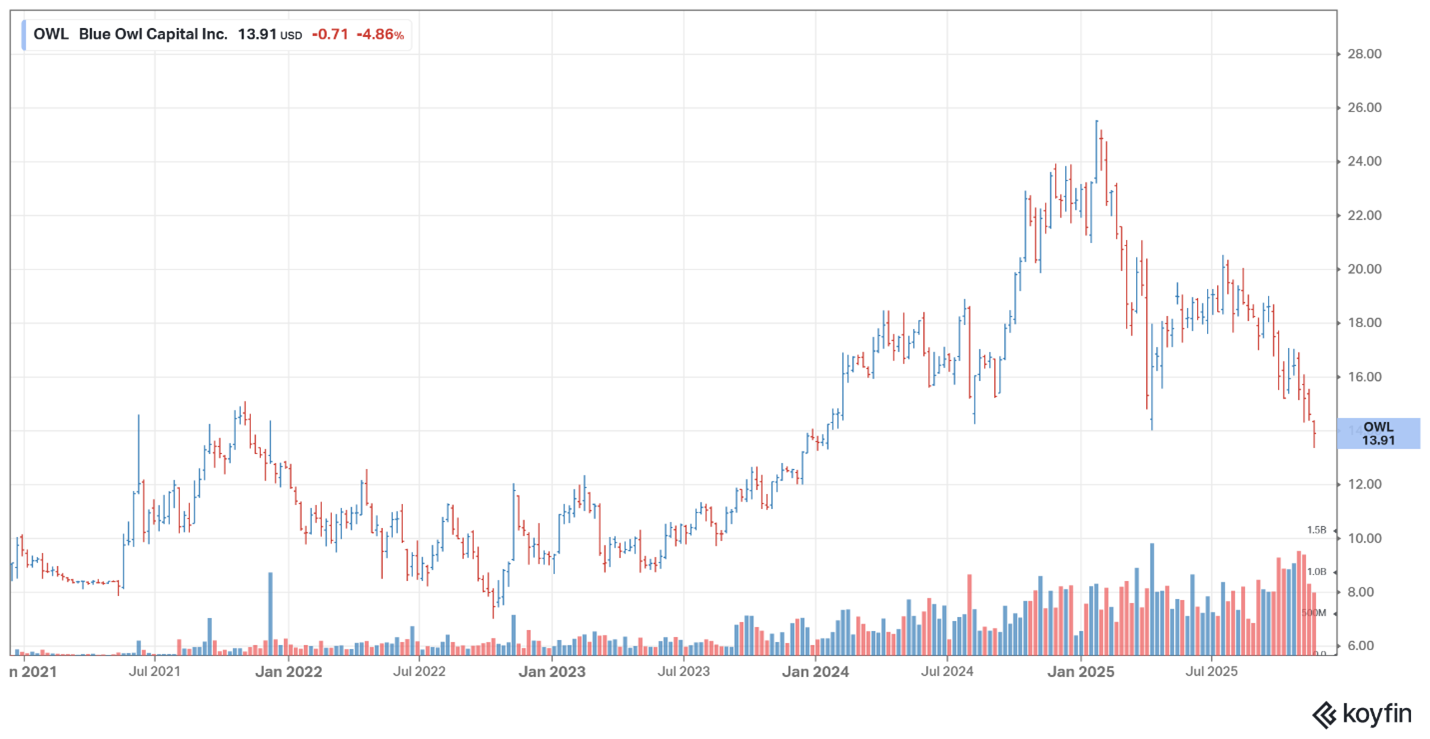
One minute they were flying high, and the next they fell out of the tree. So, what’s going on in the world of private credit (in the USA)?
To answer that question, James Grant, of Grant’s Interest Rate Observer (I am a subscriber), spoke with Dan Zwirn, CEO of Arena Investors. Dan is an old hand and has a cool head in the credit environment. It’s worth listening to this podcast more than once if you want to understand what’s going on in the credit world in the USA.
My take: I would not touch even the best credit in the USA right now. It’s either too junky or the yields are just too low. I’ll wait for the air to clear and then look at Arena for investment opportunities.
6. Urquhart Partners
The RECM SA Special Situations Prescient Retail Hedge Fund, managed by Richard Cheeseman of Urquhart Partners, launched on 1 October. I’m really excited about the future of this fund. It is unique in South Africa and provides a non-correlated set of investments.
You can read Richard’s report on his first month’s activities here.
My take: I’ll use Richard’s exact words:” The environment for special situations on the JSE can only be described as buoyant. Within the buyout space, the fund’s largest category, comprising over 40% of gross value, we are tracking more than a dozen opportunities, with new transactions being announced almost weekly. Most of these fall outside the mega-cap arena, but our nimble size allows us to take full advantage of them.
In The Media
My prolixity has kicked in again, so I am going to keep this section shorter than usual.
1. Adam Singer’s “Hot Takes”
Adam Singer is one of my favourite writers, with a site called Hot Takes. Over the past week, he has published two killer pieces.
The first is about one of my pet hates, “whataboutism”. You know, where the person you are having a debate or argument with tries to deflect attention from their weak position with a reply that references a tangential but unrelated failure. The goal is deflection, shutting down the conversation, rather than trying to find some middle ground.
I absolutely detest that kind of manipulation.
The second piece is called “Short form video is a cancer of the mind”. In this time of increasingly poor mental health, short-form video leads to higher stress and anxiety levels with predictably negative consequences.
My take: Delete the TikTok/Insta and read a book instead. Thank me (or rather Adam) later.
2. Sake-Liga
As many of you know, I serve on the board of Sake-Liga. Sake-Liga is an independent business organisation in South Africa focused on restoring economic order by resisting state failure and harmful economic policies through public-interest litigation and alternative structures.
One of their initiatives is to restore small towns that are on the verge of collapse due to poor municipal governance. Over the last three years, Sake-Liga has fought to restore order to the collapsing Ditsobotla municipality in Northwest Province.
A couple of weeks ago, the court ruled in favour of Sake-Liga when it sought to force the national council to intervene in Ditsobotla.
You can read about the implications of the court order and what lies ahead here.
My take: I am proud to serve on the board of Sake-Liga. Organisations like it make a positive difference in our country with its incompetent government. If you can support them financially, please do so. Every little bit helps.
I am pleased to report that I have a happy wife. Amanda’s son, Zac, has returned home from London for a while. And as they say in the classics – happy wife, happy life.
Next week, we will be spending a few days in the Kruger – a place I have not visited since I was a young boy, when my parents used to take us during the winter holidays. I’m really looking forward to spending some quality time there with my brother Stephan and his wife Carolien (who completed the Mossel Bay half Iron Man last weekend – chapeau Carolien!)
I’m afraid connectivity in the Northern part of the Kruger is not guaranteed, so there won’t be a letter next week. Regular service will resume on the 4th of December.
Piet Viljoen
RECM
20 November 2025