

Dear Fellow Investors and Friends,
Welcome to my newsletter, where I share my efforts to understand markets and the world around me.
I appreciate you taking the time to read this. Feedback is welcome; feel free to drop me a line. It’s great to start conversations.
Today is Thursday, November 13, the 317th day of the year. There are 48 days until the end of the year. It’s getting a bit late in the year to do those things you promised yourself you would do 316 days ago. So, if you can, just get out there and do them.
On this day in 1838, the last bull run in Britain occurred in Stamford, Lincolnshire. This was the end of a cruel practice which involved chasing a bull through the streets of a town, before slaughtering it for its meat. I like to think this is where the colloquial term for a strong stock market came from – the kind of market all investors love, whether you are a passive or an active investor.
Last week, I wrote about the distortions a large-scale adoption of indexing – or passive investing – brings to the market. Of course, as an active manager myself, I could fairly be described as biased in my arguments.
To counteract that, this week I will examine the benefits of adopting a passive investment approach. I think you will be surprised at my conclusion.
Next week, I will highlight some specific current investment opportunities and discuss how I implement them in my investment process.
“Don’t look for the needle in the haystack. Just buy the haystack!”
– Jack Bogle
As we discussed last week, passive investing is a strategy focused on buying and holding a broadly diversified portfolio of assets that replicates a particular market index.
There are several advantages to this way of investing:
- It’s cheap. Due to economies of scale and low operational costs, fees are much lower than for actively managed funds.
- Low turnover. Passive investing is precisely that – passive. There is little trading, which further reduces costs.
- Broad diversification. By tracking an index, investors gain broad exposure to sectors, industries and asset classes, reducing stock-specific risk.
- Performance. Over time, passive strategies tend to outperform active ones.
It’s very hard to argue against these advantages.
As Morgan Housel said, earning average returns for an extraordinary long period of time leads to exceptional outcomes. Passive investing is a good way to achieve this outcome.
But here in South Africa, people just do not invest this way, despite overwhelming evidence that passive investment is a superior strategy.
Here are the cold, hard facts:
According to Morningstar (as at 30 September 2025), general equity funds in South Africa performed as follows:
- Over 5 years, the average fund returned 15.7% p.a. while the All-Share Index returned 19.2%. Only 6 of 88 funds outperformed the index. In other words, if you randomly chose a fund, you had less than a 10% chance of outperforming. Only two of the big fund managers outperformed.
- Over 10 years, the average fund returned 8.5% p.a. while the All-Share Index returned 11.7%. Only 4 out of 65 funds outperformed the index. Again, you have significantly less than a 10% chance of picking an outperforming fund. None of the big fund managers outperformed.
- Over 20 years, the average fund remained more than 2% p.a. behind the index, returning 11.1% p.a. vs the All-Share Index’s 13.2%. Over this measurement period, only 2 out of 23 actively managed funds outperformed the JSE All Share Index.
This is not just happening in small, concentrated markets like South Africa; it’s also the case in the USA. Over 3 years, 89% of active funds underperform their benchmark, over 10 years, it’s 93% and over 20 years, it’s 97%.
Back here in South Africa, active managers are further hamstrung by some quite idiosyncratic forces.
Over the years, due to a stagnant economy, capital flight and political incompetence, the South African stock market has shrunk from over 700 listed companies 20 years ago to around 300 today. The JSE has become a small, concentrated, illiquid market.
What has not shown commensurate shrinkage is the amount of money available for investment. Due to “prudential” investment guidelines, the bulk of local institutional money must be invested in South Africa, creating a situation in which too much money is chasing too few stocks.
As a result, the South African market has become super concentrated. For the large active managers, it is now almost impossible to run a sensibly differentiated strategy. They all own the same stocks in various, similar combinations – not because they want to, but because they must.
Almost all the 10 large managers own Prosus/Naspers as their top stock; Standard Bank, AngloGold, and FirstRand are in just about every portfolio. MTN, AB InBev and Capitec are also all well represented. As a result, it’s no surprise that the performance of all the big funds is quite similar.
On top of that, these “active” managers are facing a self-imposed three-pronged attack on their ability to outperform:
- Liquidity. If you are managing a large fund, you will quickly realise you can’t invest meaningful sums into smaller companies without driving prices up significantly – or getting hopelessly stuck if you ever try to sell. The “risk managers” at large investment houses force their portfolio managers into the large playgrounds, pushing them toward huge, well-researched, liquid stocks. The stocks that everyone else owns, including the indices. Investing in an obscure, under-researched, and undervalued stock is actively discouraged as “too risky”.
- Career risk. If you buy Apple because everyone else is buying Apple and it tanks, you can shrug and say, “Hey, it wasn’t my fault, everyone else was doing it!” But if you buy some obscure, under-researched and undervalued stock that nobody else owns and it crashes, your clients and bosses will not look upon you favourably. As economist John Maynard Keynes once said, it’s much safer for professional managers to “fail conventionally than to succeed unconventionally.”
- Benchmark hugging. In the wild, straying too far from the herd can be life-threatening. In money management, straying too far from the benchmarks can cost you your job. We remain herd animals, huddled together in all the same stocks.
So, if the active fund managers can’t – or won’t – invest differently from the indices, there can only be one conclusion:
Indexation is the winning strategy. It’s cheap, and it performs better than most funds.
In South Africa today, too much capital is allocated to the big “active” fund managers, which are all just different shades of grey. The so-called “risk managers” – pension fund consultants, discretionary fund managers and multi-asset funds have herded your capital into the killing pens of flavourless, faceless fee-eaters. All in the name of “safety”. As a result, fund management is the exception to the rule of “you get what you pay for”.
My solution – move your equity allocations out of the big fund houses and index the bulk of it. Then allocate small portions to areas of the market where real opportunity exists. Where the true active managers operate, mainly out of smaller fund management firms.
Your returns may go up, and your costs will go down.
But where are these niche opportunities? I’ll share my views on them next week.
In The Markets
1. The JSE
A2X – a rival local stock exchange to the JSE – filed a complaint of market abuse by the JSE with the Competition Commission (CC) in October 2022. The complaint referred explicitly to the broker-dealer accounting (BDA) system.
This week, the Commission referred it to the Competition Tribunal (CT). This signals a formal escalation from investigation to adjudication, with the Tribunal empowered to assess the full merits of the case and issue remedies or penalties if warranted.
Businesses like the JSE tend to naturally evolve into monopolies or, in big markets, oligopolies. This is because investors’ strong preference for liquidity creates a self-reinforcing system. As a market becomes deeper and more liquid, it attracts more participants, making it even deeper and more liquid. The market (the JSE in this case) can then undercut competitors due to the increased volumes, attracting even more participants. And so on.
Obviously, A2X is not making sufficient headway in creating additional liquidity in its marketplace, so it is now trying to leverage the regulatory environment to its advantage. Given the CC’s and CTs’ strongly socialist leanings, they have at least a chance of success.
Although the market doesn’t seem to think so, given the minor price reaction:
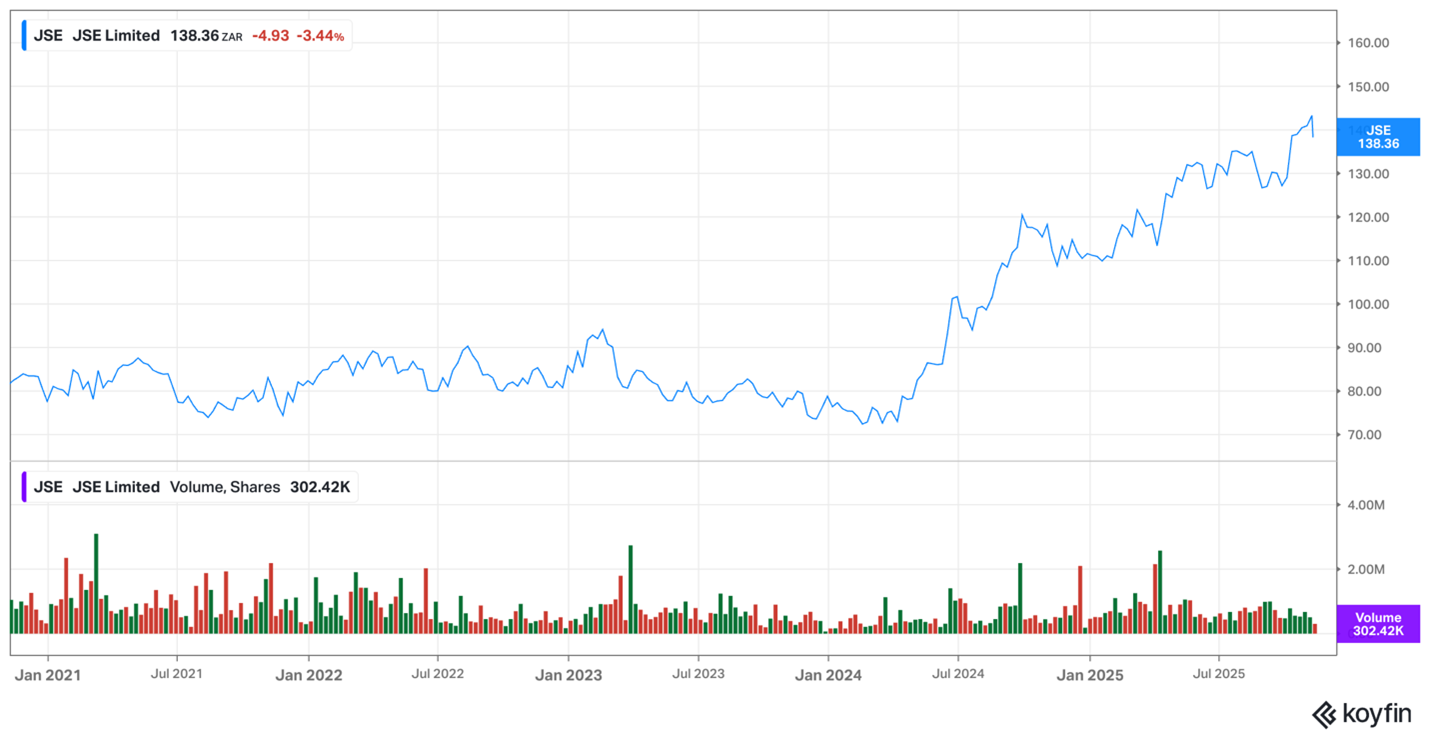
My take: If A2X is successful in its action against the JSE, it might be good for its business, but it will be bad news for investors generally. The South African equity market is small and illiquid, and spreading volumes across two markets will only worsen illiquidity. This will further reduce interest, increasing illiquidity. It will likely also become more expensive to trade on both markets, further reducing interest. And so on. Be careful what you wish for.
2. Fermi / TPL
Fermi is a recent IPO. As you probably know, I have very little interest in IPOs, as they generally represent insiders with superior knowledge of what their business is worth, selling to new shareholders who are, at best, making an educated guess.
But the Fermi IPO provided some helpful information: it placed a value on land dedicated to the build-out of data centres. Fermi’s primary asset is a 99-year ground lease on 5,236 acres. Post listing, Fermi has a market cap of $15 billion. It plans to construct the world’s largest energy and data facility, which could generate 11 gigawatts of energy – twice that currently serving New York City – by 2038, according to CEO Toby Neugebauer.
Given that nothing has been built yet, the $15 billion represents the land’s value – a $2.7 million-per-acre value.
Why is this so important? The MWI Worldwide Flexible Fund (aka The Cockroach) has an investment in Texas Pacific (TPL) in the hard asset portion of the fund. I wrote about TPL in “Dodging the Curse”. Importantly, TPL owns around 850,000 acres of land in West Texas – land that is like the land Fermi owns.
In the unlikely event that each of TPL’s acres is worth the same as Fermi’s AND Fermi’s current share price represents fair value for its land, then TPL’s land assets should be worth around $2.7 trillion. Its current market cap is $22 billion. Maybe not all TPL’s land is suitable for datacenters, and maybe Fermi is overvalued given the hype in the sector, but still…
My take: TPL is an asset-rich company, as it owns the land and all the rights attached to it. This provides them with inflation-proof, capital-light streams of income through oil and gas royalties, water management revenue and land easements. Fermi’s IPO helps us place a value on TPL’s land.
3. Crypto
The market for crypto assets is taking a bit of a breather. The price of the largest digital asset, Bitcoin, has declined over the past few weeks, but still looks to be in a bull market:
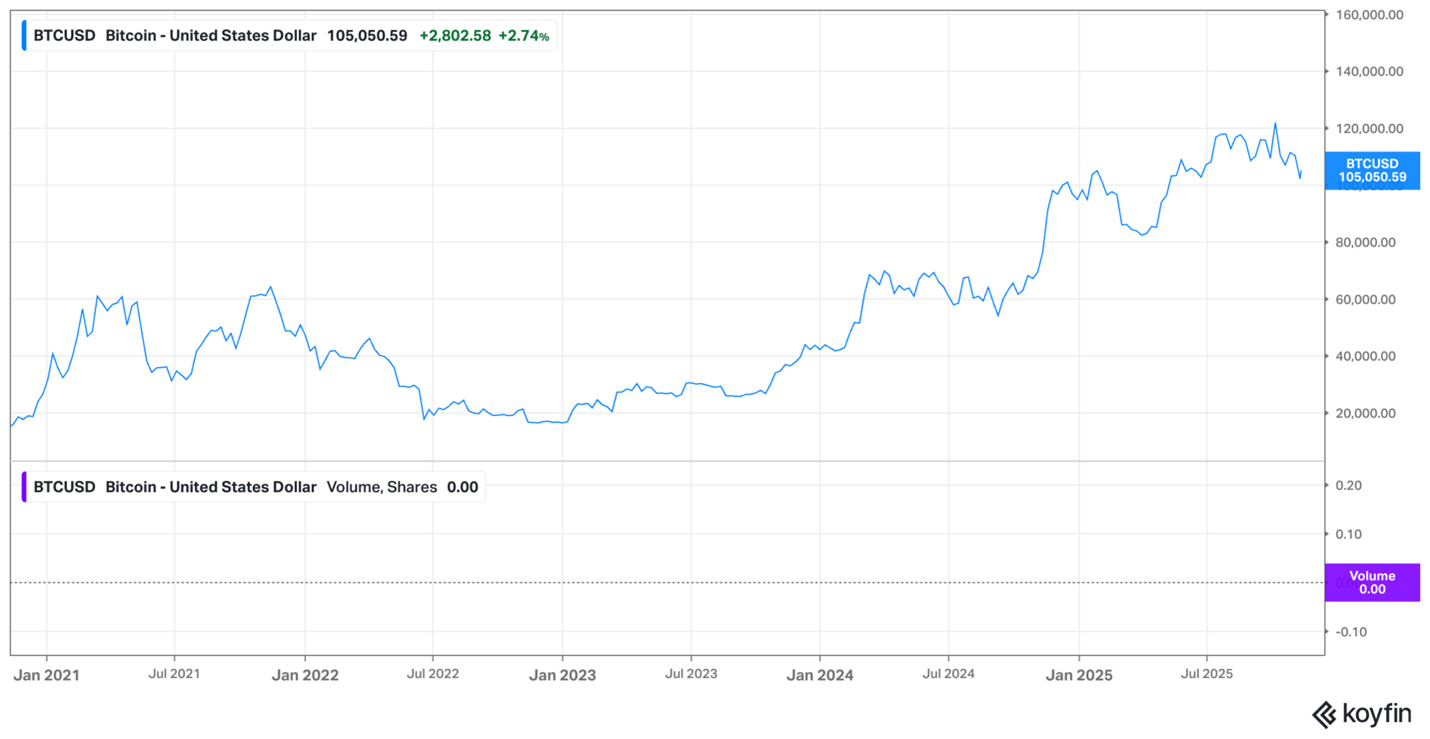
While this price action might seem disheartening to some, blockchains and their associated digital currencies are gaining increasing traction worldwide.
For instance, Western Union, which built the first transcontinental telegraph line in 1861, plans to launch a dollar-backed stablecoin to let its 100 million global customers send money internationally, detached from local currency fluctuations and risks. If widely adopted, Western Union could enhance the growth of stablecoins, which today possess a market value of more than $300 billion. Western Union processes hundreds of billions in transfers annually. I wrote about Stablecoins earlier this year in July.
A few weeks ago, leading VC firm a16z released a report called “State of Crypto 2025”. It contains many interesting facts about how the crypto market is evolving. It’s worth a read. If you don’t have time, here are the key takeaways:
- The crypto market is big, global, and growing
- Financial institutions have embraced crypto
- Stablecoins went mainstream
- Crypto is stronger than ever in the United States
- The world is coming on chain.
- Blockchain infrastructure is (almost) ready for prime time
- Crypto and AI are converging
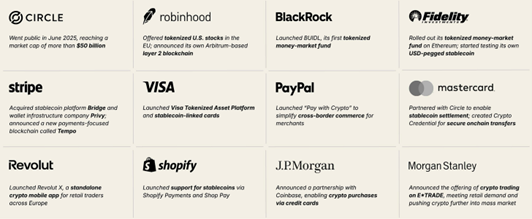
Jason Carpenter from Etherbridge – a crypto fund management business in whose fund I have personally invested – wrote a nice piece, “Adulthood and Underpants Gnomes”, describing how the market for cryptocurrencies is growing up. He says he’s bullish on crypto’s adulthood, as institutions are embracing crypto. This table highlights the point:
Also, Howard Cohen – a subscriber to this letter, and a writer on Substack – penned a piece on “Digital Dollars”. He postulates that the consensus view of the dollar losing its status as global reserve currency might just be wrong. The reason? An increased uptake in the usage of Stablecoins. His argument strikes me as being well-formed.
My take: I continue to accumulate a holding in a basket of digital coins. Unfortunately, I must do this in my own account as the regulatory authority in South Africa still doesn’t allow a unit trust such as the MWI Worldwide Flexible Fund (aka The Cockroach”) to invest in crypto. I think there is more than a 50% chance that cryptocurrencies will become a legitimate store of value in due course. If this happens, it will be at a much higher price point.
4. Lab-grown diamonds
Together with my co-shareholders in Astoria, I lost a lot of money through the company’s investment in the diamond mining business, Transhex. Astoria had to write down that particular investment to zero due to the impact lab-grown diamonds have had on the price of mined diamonds.
The Substack Chinatalk wrote a piece called “Diamonds are a Trade War’s Best Friend” which does a good job of describing the phenomenon of lab-grown diamonds. China seems to be ground zero for artificial diamonds, and as with almost everything else it produces, it exerts a massive deflationary force. A force which has negatively impacted diamond mining.
My take: After reading this piece, I am happy that we decided not to throw good money after bad in Transhex. The debacle has also finally cured me of any future involvement with mining businesses. Holes in the ground with big machines operating around them make for nice pictures, but are not to be trusted. Ever.
In The Media
1. Tyler Cowan interviewing Sam Altman
I love Tyler Cowen’s interviewing style. He gently asks probing questions – the kind you wish you could ask his guest. He obviously does some proper research before his interviews.
Which is why this interview with Sam Altman, regarded as the OG of AI, was so disappointing. Altman’s answers to Cowen’s questions were vague, deflecting and of very little substance.
My take: If Altman offered me the opportunity to invest in the build-out of yet another data centre, I would politely refuse. Of course, he couldn’t care less.
2. What people die from, and what gets reported on
I found this chart fascinating:

It’s from a piece by my favourite doctor, Peter Attia, called “Focusing on what really matters for reducing your risk of death”. The bottom line? What the media reports on really has nothing to do with what we need to focus on, to enhance the quality and prolong the quantity of our years here on earth.
My take: Regular exercise and cancer screening tests don’t exactly make for compelling reading, but that’s what we need to do.
3. Conferences
This coming Monday, I am speaking at the Gordon Institute for Business Science (GIBS) in Johannesburg. The format is a panel discussion on “Investing for the Next Era, the Art of Investing in Alternative Assets” My specific job is to discuss my approach to investing like a cockroach. Here is some more detail on the conference, which is free to attend. I think there are still a few seats available.
I am also honoured to have been asked by Alec Hogg to speak at the 8th Biznews conference next year. I always look forward to speaking there because it lets me attend the entire event, which is packed with great speakers. The conference takes place from Tuesday, March 10 to Thursday, March 12, 2026, in Hermanus. Delegates are limited to 600, and it sells out quickly.
Here is the full schedule and speaker line-up.
Apart from the great program, Hermanus is one of those towns in South Africa that is always a pleasure to visit. Beautiful, well-maintained, and packed with good restaurants, art galleries, as well as some of the best wineries in the country on its doorstep. There are also some excellent cycling routes in the area.
Finally, this Friday is the regular Merchant West Investments (MWI) webinar, featuring Ian Anderson and Richard Henwood. They manage the “Payers and Growers” strategy at MWI, which focuses on putting together funds that deliver growing streams of dividends for investors. It’s a unique strategy, and on the webinar, they will tell you all about it. If that’s your kind of thing, it’s worth spending an hour with them.
You can register to attend here. But there’s more – you earn CPD points for attending!
4. RECM Foundation
One of the pillars that defines our ethos at RECM is the notion and value of partnership. This extends to the RECM Foundation, through which we are super proud to partner with The Centre for Early Childhood Development.
Angels Daycare, located in Humansdorp, is an ECD centre that has been operating for the past 15 years. It serves the community of Kruisfontein, which is a low-income area in Humansdorp. It provides care, safety and learning opportunities to 45 children from this deeply marginalised community. For fifteen years, the centre operated from principal Petronella Ruiter’s home and an adjacent Wendy house.
Just last week, the keys to phase one of a newly built centre were handed over to Petronella and her team. The new centre brings a sense of pride and dignity to the principal and her team as well as to the pupils, their parents and the community. The RECM foundation played a key role in funding this centre.
Here are some pics:


I am proud of the work the Foundation does. It’s an absolute joy to see the effect its program of sustainable giving has on marginalised communities.
Another joy has been spending the last week in Madikwe Game Reserve with some friends. Friends that I’ve known now for over 40 years. In fact, some of us first met in primary school! We all live in different cities, so finding a time and place to get together is a real privilege.
We’ve already set dates and places to get together again for the next two years.
But to do so, we will need to stay careful out there!
Piet Viljoen
RECM
13 November 2025