

Dear Fellow Investors and Friends,
Welcome to my newsletter, where I share my efforts to understand markets and the world around me.
I appreciate you taking the time to read this. Feedback is welcome; feel free to drop me a line. It’s great to start conversations.
Today is Thursday, November 6th, the 310th day of the year. There are 55 days until the end of the year. Scarily, Christmas decorations have already started appearing.
Today, 174 years ago, Charles Dow was born. He went on to co-found the Dow Jones company and became the first editor of the Wall Street Journal. The first index to track the overall market was created by Dow Jones in 1896 and, unsurprisingly, was called the Dow Jones Industrial Average.
55 years later, a young economics student at Princeton, John Bogle, wrote a thesis arguing that mutual funds could not consistently outperform the market averages. An idea that would shape his career – and the entire fund management industry. In 1974, after being dismissed as CEO of active manager Wellington, Bogle founded The Vanguard Group. Two years later, he launched the first index mutual fund available to everyday investors, the Vanguard 500 Index Fund.
The market’s reception? Crickets…
Bogle’s strategy was widely ridiculed and nicknamed “Bogle’s Folly”. Industry professionals questioned why anyone would settle for “average” returns by simply replicating a broadly diversified market index, instead of hiring the best managers to pick “winning” stocks. But Bogle’s research proved that actively managed funds generally failed to beat the market, not helped by their high fees.
Bogle’s theory that simply earning “average” returns for a very long time would outperform most “active” strategies ultimately proved to be correct.
But the stock market is a complex adaptive system, and Bogle’s superior strategy has led to a few problems. As with most financial “innovations”, what starts out as a good idea eventually transforms into a hot mess of principal-agent conflicts, mis-selling and short-termism.
The first unintended consequence is that of excessive trading.
Financial intermediaries, scared of losing their lucrative trading commissions if everyone became long-term buy-and-hold index investors, started slicing the market into smaller and smaller indices – by sector, by geography, and by financial characteristics. These were then packaged into highly marketable, listed investment vehicles called exchange-traded funds (ETFs).
Bogle knew that an investment built to be traded, would be traded. This was Bogle’s primary concern when, as Vanguard Group’s CEO in the 1990s, he declined to offer index ETFs. He worried these would be traded too much and thus sacrifice some of the market’s long-term returns. Of course, financial markets have never come across a successful financial product that wasn’t worth replicating to the nth degree – then selling it hard, until even the ladies at the bridge club are all in.
Bogles’ fears have come true. From Grant’s Interest Rate Observer: “It’s an exchange-traded fund-pickers market in the US these days, as the domestic tally of ETFs now tops 4,300 according to Morningstar, surpassing the sum of actual stocks – currently totalling some 4,200 – for the first time. More than 640 such funds have launched so far this year, equivalent to roughly four per trading day, with June’s tally of 108 representing the busiest single month on record.”
The problem with trading in and out of the market, as well as trading increasingly narrow sets of stocks, is that you lose out on both components of a superior investment strategy: time in the market and broad diversification.
The second unintended consequence is that passive investing has become too popular.
As a result, the tail is beginning to wag the dog. As valuations rise, index funds look smarter and active managers look dumber by comparison. This attracts more money into the “passive” vehicles and pushes the prices of its constituents even higher – in turn, increasing the apparent dumbness of active managers. And so on. Soros’ theory of reflexivity in daily action. Markets become more concentrated and less diversified, negating Bogle’s original thesis.
As active managers’ assets quietly migrate away from their valuation-based strategies towards passive ones to fund these outflows, they are forced to sell their cheap stocks and become increasingly unable to step in to keep prices sensible. The risk management departments at the institutions where these managers work see this and force them to move closer to the index to avoid underperforming too much. So even the active, valuation-based managers are forced into the index stocks. All in the name of “risk management”.
In this process, the share prices of smaller, cheaper companies decline inexorably, pushing up their cost of capital, rendering them unable to tap the capital markets for funding. Eventually, they either go private or are acquired by a prominent index constituent.
At the asymptote, where everyone is an index investor, the market loses all its price-discovery power, leaving us with a couple of gargantuan companies. In turn, these giants are owned by disinterested index managers. Governance falls by the wayside, immunising these behemoths from market forces. While a whole bunch of small, private companies – to which most investors have no access – efficiently deliver the goods and services the behemoths can’t or won’t. At this point, investors’ marginal returns in public markets will have declined to zero.
All the growth – and value – will have migrated to the unlisted, private space.
The main arguments against passive investing are thus that sub-optimal outcomes for investors are created by:
- The slicing and dicing of the market, leading to excessive trading.
- Markets becoming more concentrated and fragile.
- Markets losing their ability to efficiently price assets.
- The cost of capital for businesses becoming distorted.
- Companies becoming big and inefficient.
Given this outcome, can any kind of positive case still be made for passive investing?
Next week, I will explore this issue further.
In The Markets
In this week’s issue, I want to stay away from AI as far as possible and survey a selection of global stocks to see what they are saying about the economy.
1. LVMH
Why do all the models look so sad?

It must be because they have realised the luxury goods businesses are in a bear market. These (fashion) models are ahead of the game, as investors still don’t want to believe it – the share price of LVMH has shown a bit of a recovery over the past few weeks:
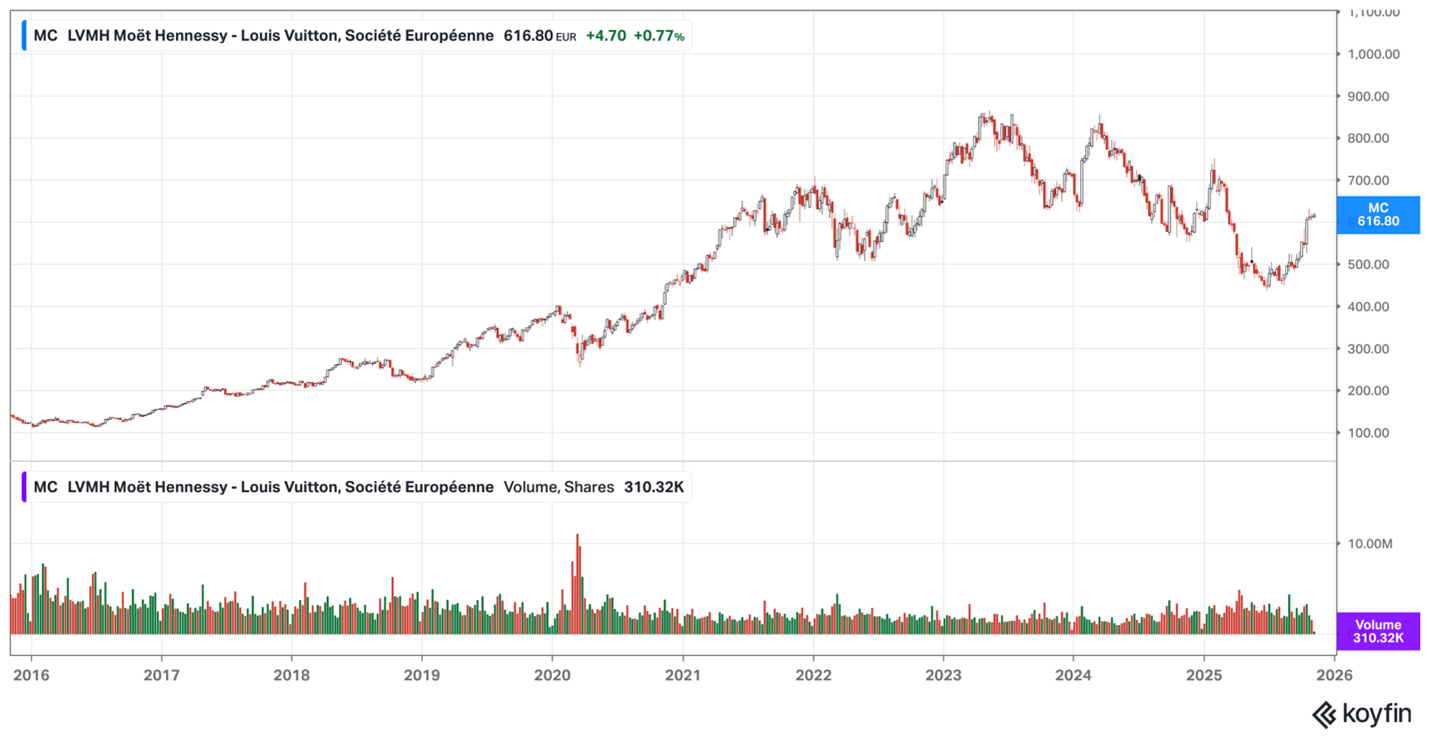
Even after this, it’s still down about 25% from its recent highs. But the reason for this latest bounce was that the most recent earnings report showed a smaller decline than the market had anticipated. On a prospective P/E of 26, this stock needs more than a “gentler-than-expected’ earnings decline, if it’s to enter a renewed bull market.
My take: Judging by the share prices of its brothers-in-arms, Hermès and Ferrari, to me, this looks like a bounce that should be sold. But, if you don’t sell, at least you’re better off owning the stock and not the product.
2. United Parcel Service (UPS)
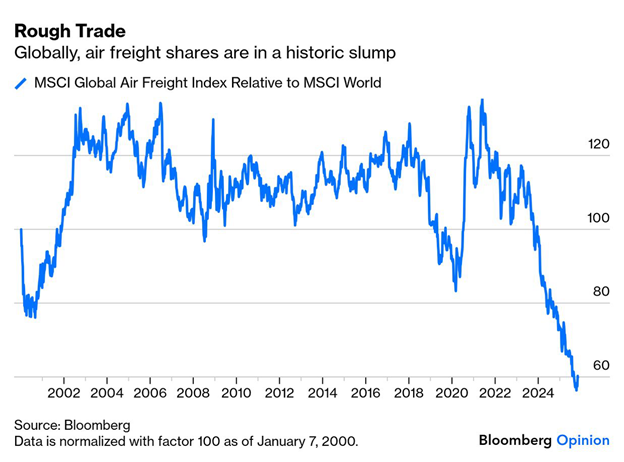
The movement of goods within and across international borders has slowed down substantially. For instance, packages sent to the US from China fell 30% year over year in the third quarter, reflecting the closure of a loophole that had allowed duty-free shipments below $800. This has exacerbated the tariff-induced slowdown, which was also mentioned by South African logistics company Santova in its recent results presentation as a reason for its own earnings slowdown.
This chart, posted by John Authers in his Bloomberg column, tells the story:
As a result, it’s no surprise that bellwether stock UPS is having a rough time:
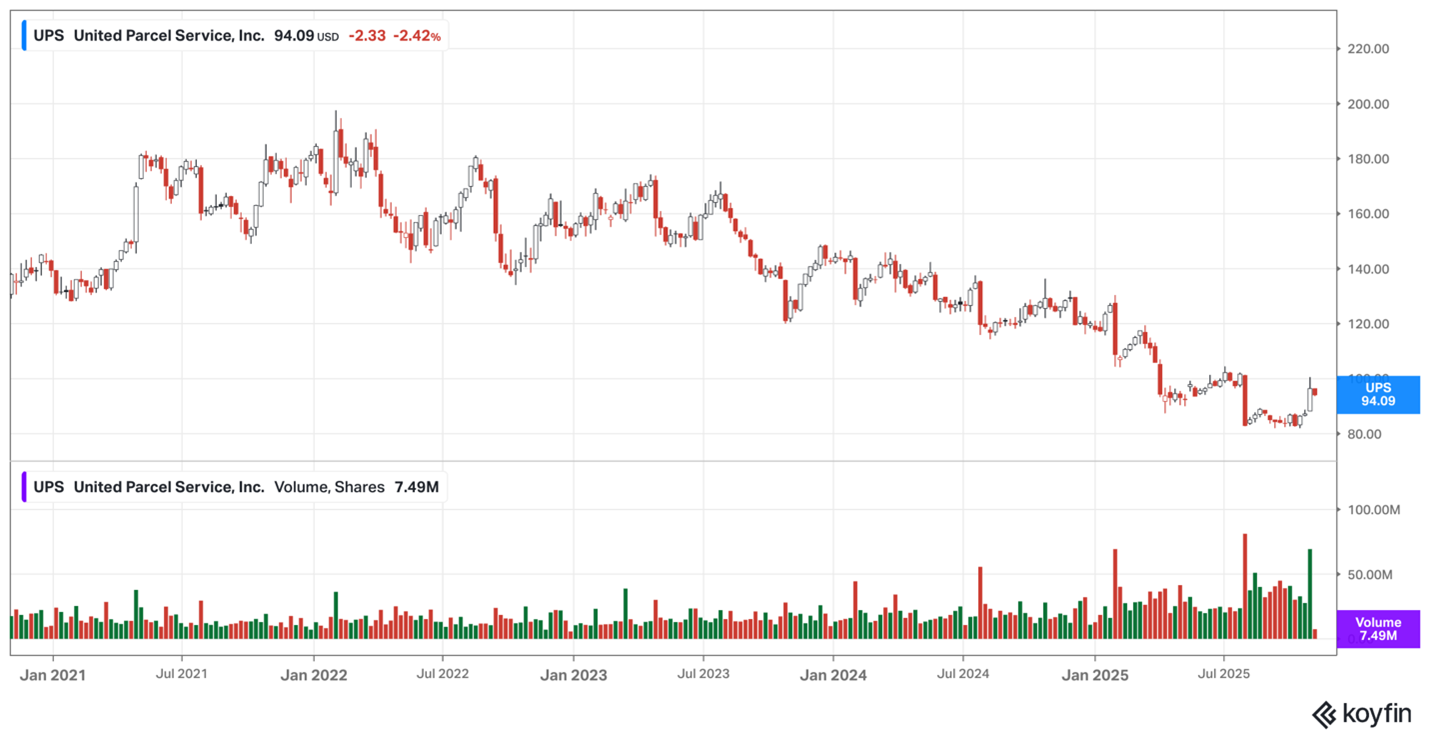
UPS has a dividend yield of 7%, which many might find attractive. But in my experience, a high dividend yield such as this is just waiting for a cut. So don’t bank on it.
My take: UPS sits at the crossroads of goods movement, retail, and industrial supply chains. As such, it doesn’t paint a rosy picture of the US or global economy. Reshoring might explain some of this, but a less-than-vibrant economy also plays a role.
3. Berkshire Hathaway (BH)
Is the Buffett premium disappearing? Was there ever one? Here is the price-to-book ratio of BH, which depicts the share price relative to the value of its underlying investments:
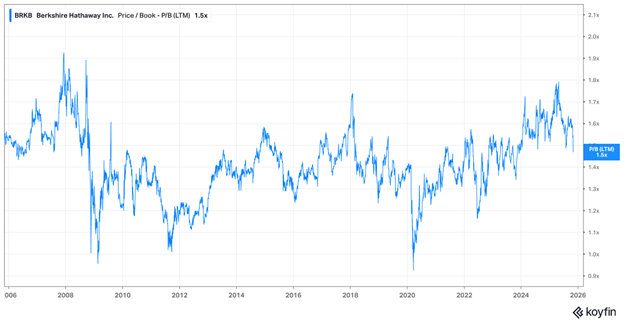
At 1.5 times, it’s about in line with its historical average. Given that most of its investments today are unlisted and therefore not marked to market, one would actually expect a higher price-to-book ratio than the historical average.
So, I would argue there is currently no Buffett premium priced in, and therefore the explanation for the poor recent share price performance is not the disappearance of the non-existent “premium”. Here is the BH share price:
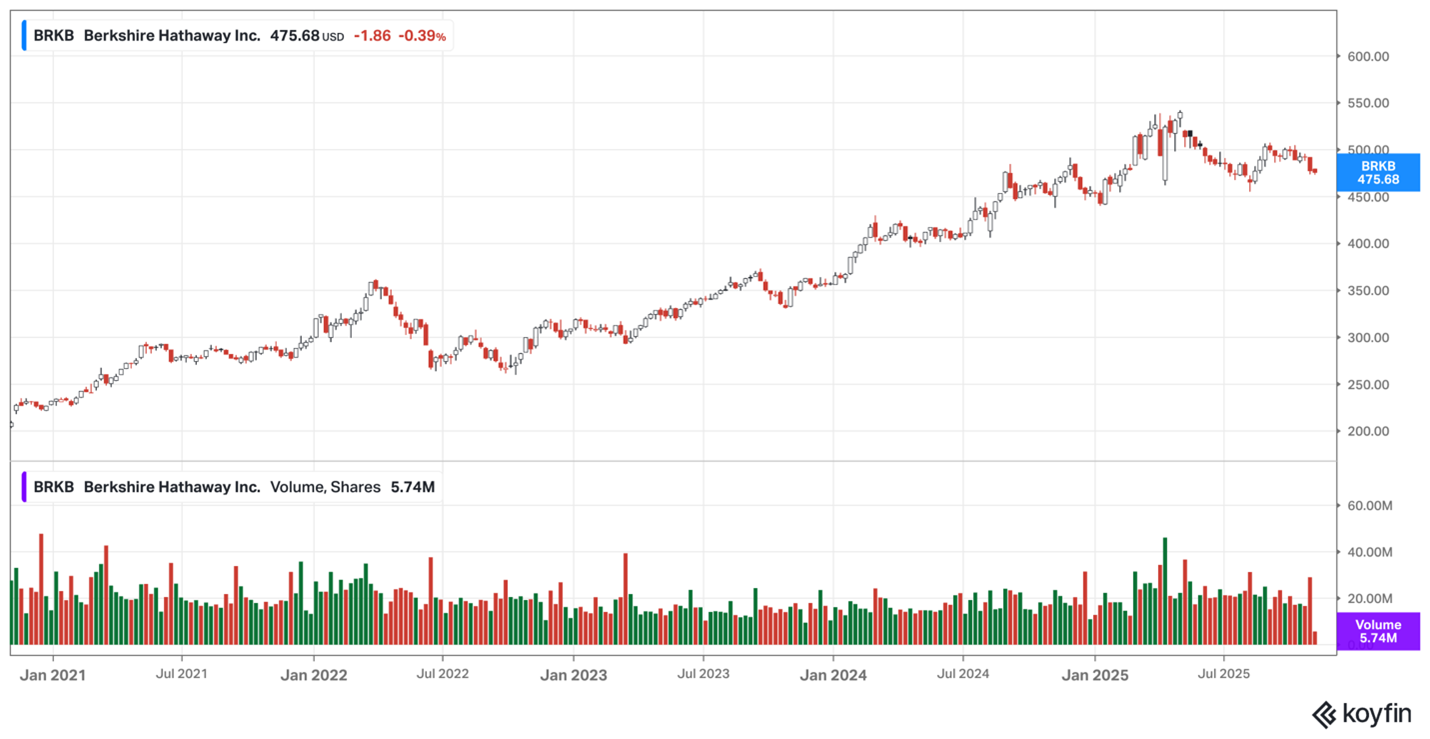
I’d like to make a few points about this situation:
- BH is down only 10% from its recent high – nothing to get worked up about.
- Buffett’s departure has been well documented and telegraphed, so it’s not a surprise.
- BH is like a tanker – given its size, its existing investments, and the actions needed to change direction, even if you put the village idiot in charge, returns would only decline after many, many years.
- Finally, Greg Able, Ajit Jain, Ted Weschler and Todd Combs are the exact opposites of a village idiot. Buffett had ample time to plan his succession. BH is his legacy. I would not take the under on his ability to have done a good job here.
I have speculated about this before, but I think we have had a “hard” insurance cycle- premiums priced well above actual risk levels – for a few years now, and the cycle might be turning. Here is a chart of one of the leading property and casualty insurers in the USA, Progressive:
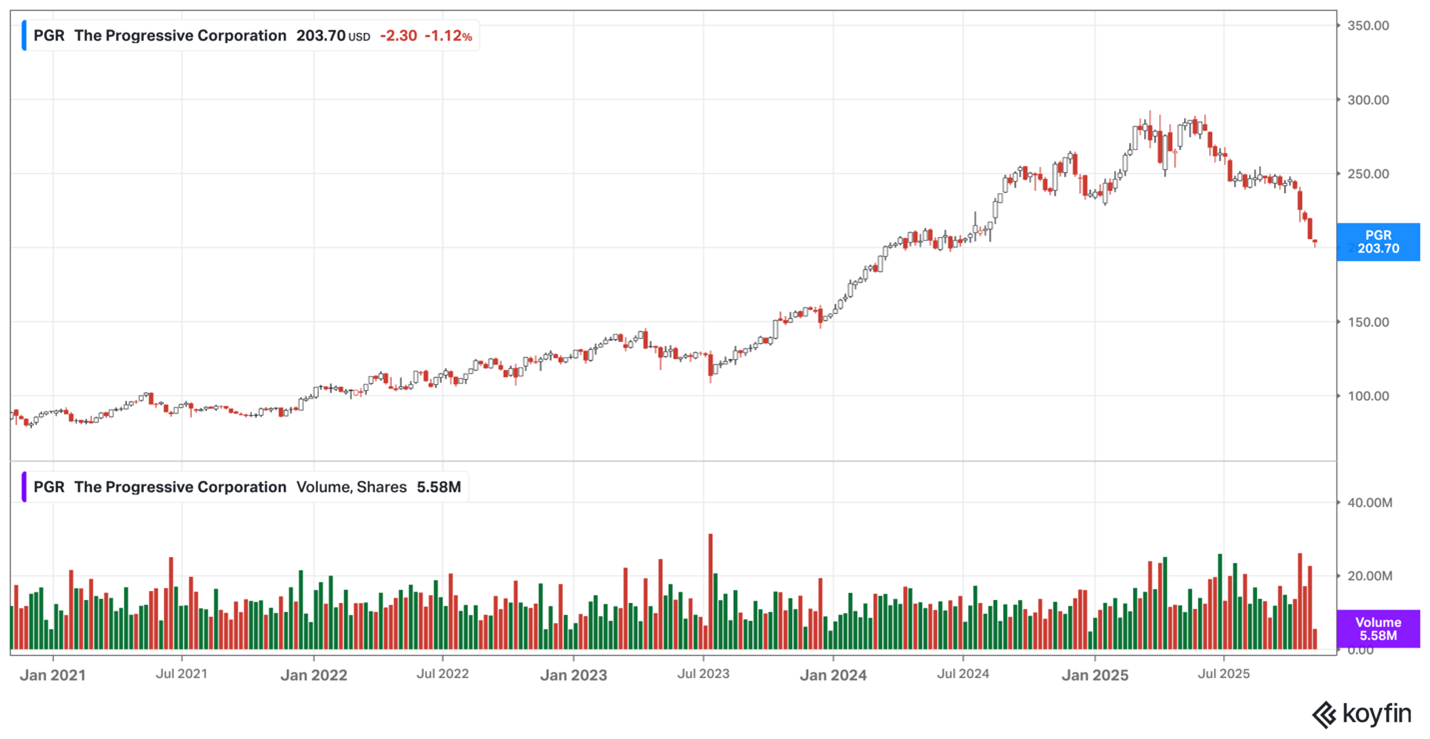
My take: BH is in good hands, and I am more worried about the insurance cycle than a so-called “Buffett premium”. Fortunately, BH has many other businesses besides insurance, so if the share price decline gets out of hand, it will present a buying opportunity. BH is one of the “10 stocks, forever” in the equity allocation of “The Cockroach”.
4. Kimberly Clark
Kimberly-Clark, the famous maker of Kleenex tissues and Huggies diapers, has been struggling to grow. Free cash flows have failed to keep pace with inflation over the past two decades. Over that time, its capital allocation has favoured share buybacks and dividends, leaving insufficient investment for organic growth or strategic transformation.
As a result, its share price has been going sideways for years:

Of course, a blockbuster acquisition is just the tonic for slow growth, isn’t it? So that is just what it did this week, acquiring Kenvue, the maker of Tylenol, in one of the biggest take-overs so far this year. This, despite the vivid examples of failed mega-mergers by Kraft-Heinz, AB Inbev, AT&T and DirecTV – all of which led to significant goodwill write-downs.
In a cash-and-stock deal, Kimberly-Clark will pay $21.01 per share, compared with Friday’s closing price of $14.37. That’s a 50% premium! What are the odds they are overpaying? Mergers generally fail to generate value due to integration challenges, an overestimation of synergy benefits and cultural clashes. Importantly, these are all challenges that are underestimated when the anxious acquirer sets the buy-out price, goaded on by its fee-earning corporate finance advisors.
Maybe it’s different this time…
My take: Maybe not. Large-scale M&A is just about always a short-term panacea for underperforming management. Inevitably, the only winners are the advisors, with shareholders footing the bill.
5. Emerging Market (EM) Stocks
So far this year, the MSCI Emerging Markets index is up 33%, while the MSCI World index (consisting only of developed market stocks) is up only 19%. What’s going on?
It used to be that when you bought an index of EM stocks, it was filled with stale, mismanaged, capital-intensive banks, telecoms companies and state-owned utilities.
Today, it’s very different. Here are the top constituents of the MSCI Emerging Markets Index:

It’s all IT, consumer discretionary and communication stocks, with little representation from the banking, energy and telecoms sectors. And almost no state-owned entities.
My take: This looks like an exciting group of companies operating in large economies in high-growth sectors with leading-edge tech. In its equity component, of the portion that is not yet in its “10 Stocks, Forever” selection, the MWI Worldwide Flexible Fund (aka The Cockroach) has 75% in EM index stocks and only 25% in developed market stocks.
6. EM bonds
Staying with Emerging Markets, their bond markets are also on a tear. Here are the ytd performance of various Latin American bond markets, as provided by Gavekal Research:
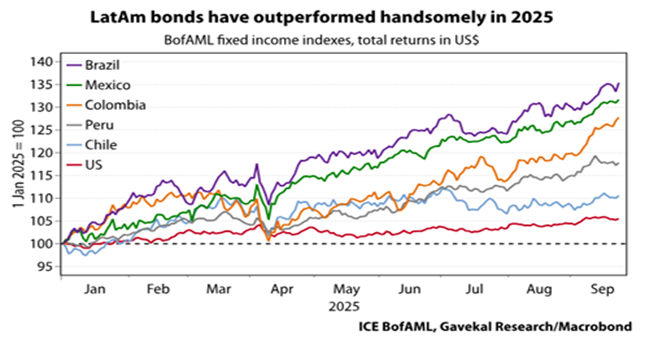
Not to be outdone, long-dated South African government bonds have returned c.27% in US$ terms so far this year. The MWI Worldwide Flexible Fund (aka The Cockroach) has a 15% exposure to these South African bonds. The next most significant bond exposure in the fund is the 8% holding of the Van Eck Local Currency Emerging Market Bond ETF. There are no developed-market bonds in the fund’s bond allocation.
Emerging markets are where it’s at. High yields relative to low and stable inflation rates, conservative monetary policies and prudent fiscal situations are all in direct contrast to conditions in developed markets. Yet, there is still very little excitement about the opportunities presented by the bond markets of emerging market economies. This, despite strong performance over the past few years.
My take: There may be a “flight to safety” in bond markets soon. But this flight to safety will be different. It will be towards Chinese, Brazilian and South African bonds, not those of the USA or Europe.
In The Media
1. Why are we drawn to low probability?
I used to smoke. Simultaneously, I knew smoking was bad for me. But my addiction trumped my understanding of reality. With smoking, the upside is a small dopamine hit; the downside is dying.
Most investors set broad stock market indices as their bogey – and then struggle to outperform them. Despite lots of evidence that very few investors can outperform the market, they will take insane risks to do so – and fail badly as a result.
As humans, we seem drawn to these high-risk/low-reward endeavours.
This article explores this cognitive dissonance we all seem to be so good at.
The money quote: “An investor will never be in control of the market. The best they can do is succumb to that reality and find a way to deal with it. Focus on the variables they do have control over. Ensure they have a process which eliminates as much undesired human behaviour as possible.”
2. Richard Thaler on The Winner’s Curse
In 2017, Richard H. Thaler received the Nobel Prize in Economics for his contributions to behavioural economics. He has also written two books on behavioural economics, Nudge: Improving Decisions About Health, Wealth, and Happiness and Misbehaving: The Making of Behavioural Economics.
Thaler is the OG of behavioural economics, and has just published his third book, The Winner’s Curse: Behavioural Economics Anomalies, Then and Now.
In this fascinating interview with Tim Ferris and Nick Kokonas, Thaler provides a wide-ranging overview of the topic he knows so well. It’s filled with gems about behavioural biases and how to avoid them. But also, how to take advantage of the predictable foibles of others.
The classic example is The Winner’s Curse, which states that in an auction comprising competitive bidders, the winner is most likely to overpay. So, if you aim to buy something, avoid auctions – and if you are a seller, try to set up a competitive bidding process.
3. Woody Allen
Woody Allen has had an illustrious career as a stand-up comedian, actor, director, and, predominantly, a writer. In this gently probing interview with Rick Rubin, he gives an overview of his career, spanning over 50 movies. Annie Hall is probably one of my favourite movies ever, so it was fascinating to hear him talk about his creative process.
As he so typically self-deprecatingly says, his career was one of “failing upward”. He says he wasn’t the most talented writer or comedian, but he worked hard at it, put in the hours and got lucky. Repeatedly.
There’s a lot of excellent stuff for everyone in this interview. At 90, Allen is still full of beans and a joy to listen to.
That’s it for this week. Amanda and I are in the middle of a two-week road trip holiday in the bush. First, we were in the Klaserie, now we’re in Welgevonden, and later we end up in Madikwe. It really is our happy place, spending the days on game drives and lazing around. The most pleasant surprise of the trip so far? The roads through Limpopo Province. All in good nick, and a pleasure to drive on.
Oh yes, that – and the pack of wild dogs that we saw just before driving out of Klaserie.
Here’s a picture of us, along with one of the Wild Dogs. To be clear – in that order.


It’s wild out there, so please be careful!
Piet Viljoen
RECM
6 November 2025