

Dear Fellow Investors and Friends,
Welcome to my newsletter, where I share my efforts to understand markets and the world around me.
I appreciate you taking the time to read this. Feedback is welcome; feel free to drop me a line. It’s great to start conversations.
Today is Thursday, October 23rd, the 289th day of the year. There are 76 days until the end of the year.
This week, two families I am close to suffered losses. Oscar and Andrea Foulkes’ mother, Pam, passed, and Franci and Nel van der Walt’s father, Llewellyn, also passed. Both Pam and Llewellyn were legends, having lived a full and active life right to the very end, deep into their eighties. You sort of expected them to be around forever.
I admired them both immensely, and they will live forever in my thoughts.
Their passing has reinforced my determination to do everything I can to not only live as long as possible, but to try to maximise my quality of life until the very end. The starting point of this journey was reading Peter Attia’s book “Outlive”, which I reviewed in “Review of 2023”. In the book, Attia made the point that we begin dying the day we are born, so we should address the issue as soon as possible. Especially seeing that dying is the one thing all of us are 100% successful at.
But living long and well can also help us invest better, too.
The world of investments likes to make what it does sound very complicated. It understands well the strong correlation between the perceived complexity of a system and the size of the fees that can be embedded within it.
However, investing is actually quite simple. It consists of only two components:
- Compound your capital.
- For as long as possible.
In investing, there is little under our control. Markets fluctuate according to the unpredictable madness of crowds. Politicians have an innate ability to devise untethered policies, bringing unanticipated volatility to markets. Economic cycles come and go with unforecastable duration and amplitude.
But we can exert control over two things:
- The consistency with which we apply our chosen investment process. In other words, how we decide to compound.
- Our health, and therefore the length and quality of our lives. In other words, for how long can we compound?
We all aspire to be like Warren Buffett, one of the world’s ten richest individuals, with a net worth of around $150bn. We study his investment methods, read all his writings to glean some kind of insight into his thinking and attend his annual shareholder meetings in Omaha to “touch the cloth”, so to speak.
But the one thing no one talks about is that 90% of his wealth was created after the age of 65. Not because he became a better investor – in fact, he only compounded by 11% p.a. in the 30 years leading up to his 95th birthday. Far lower than the 24% p.a. in the 30 years leading up to his 65th birthday. No, his great wealth was created through being able to compound over a period longer than the average human lifespan.
Yet we spend all our time trying to come up with the optimal investment process, and very little time on maximising the length of time over which we can compound – the more important of the two factors. We tend to obsess over the 1% of performance we missed out on or the extra 50 basis points of fees, while completely ignoring the extra 30kg we carry around every day, which cuts into our lifespan.
There are two ways to compound for a long time, and Buffett did both: start early and live a healthy, long life. For those of us who didn’t start early, it’s still possible to live a longer-than-average life, stretching out the period over which our capital can compound.
I’m turning 63 in a few days and am in okay shape. This wasn’t always the case. I used to smoke. A lot. Despite my smoking habit, I did do some exercise. Touch rugby on the beach was a firm favourite, plus some non-strenuous bike riding. I remember carrying a cigarette in my back pocket in what was then called the Argus cycle race, so I could smoke immediately after the finish.
Show me your habit and I’ll raise you my addiction.
But due to the smoking, I could never get properly fit and strong. I got sick often, and I acquired a smoker’s cough – that hacking cough that signifies nothing good. One day, I think it was in 2011, I came stone last in a mountain bike race in Knysna. Now, I know I’ll never win a bike race, but coming last was embarrassing. I realised I was on a slippery slope.
My health was not good.
Coming last was the catalyst to end my smoking addiction and start working hard on getting fit and strong.
Attia suggests using the “centenarian decathlon” — a set of physical and functional goals you want to achieve in your last decade of life — as a training blueprint for earlier decades. His decathlon consists of the following:
- Hike 1.5 miles on a hilly trail
- Get up off the floor using only one arm for support
- Pick up a 30-pound child from the floor and drop into a squat to do so
- Carry two five-pound grocery bags for five blocks
- Lift a 20-pound suitcase into an overhead compartment
- Balance on one leg for 30 seconds with eyes open
- Climb four flights of stairs in three minutes
- Open a jar
- Do 30 consecutive jump-rope skips
- Have regular sex
These activities all seem easy today. But working backwards, the ability to do these things when you are 90 means you need to be in the top 10% to 20% of your age cohort when you are between 40 and 60. The reason for this is that decay is non-linear: we lose muscle, balance, and aerobic capacity at a faster rate past midlife, so early and sustained surplus provides a “margin of safety.”
To give you an idea of what the top 20% look like, Attia’s standard for ages 51-60 is to be able to perform five proper pull-ups, and for ages 60+, the target drops to three.
The point is that you need to start working hard now to enjoy a high-quality, long life. Like your investments, health compounds.
But remember, sometimes longevity also means that extra glass of wine, that night out, the connections with friends that keep you human. Never neglect these; they add joy to your life. A life without joy is not worth keeping fit for.
In The Markets
1. Things you don’t see at the bottom
If you had any doubts about what kind of market the USA is experiencing, it’s of the bull market variety. These are just some recent events in that market:
- In July, AI startup Thinking Machines raised $2 billion in seed funding at a $12 billion valuation. Founded by OpenAI’s former chief technology officer Mira Murati, TechCrunch says the seven-month-old outfit “has yet to reveal what it’s working on”.
- OpenAI has reached a $500 billion valuation after employees sold $6.6 billion worth of shares to outside investors. This marks a sharp rise (+67%) from its $300 billion valuation it received only 6 months ago, when it secured a USD40bn funding round led by SoftBank.
- Nvidia recently announced $105 billion of combined investments in OpenAI and Intel. This spurred a $320 billion, three-day increase in the chipmaker’s own market capitalisation.
- The REX-Osprey DOGE ETF (‘DOJE’) was launched in September. It offers exposure not to a store of value, but to a meme: Dogecoin. In other news, the Roundhill Meme Stock ETF (‘MEME’) was launched this month and is the only ETF in the world to offer targeted exposure to a basket of meme stocks.
- The billionaire philanthropist, financier and collector Thomas S. Kaplan is in advanced discussions to fractionalise his Leiden Collection, the world’s most extensive private collection of Dutch Golden Age paintings and launch it as an IPO.
- Video game-maker Electronic Arts has agreed to go private for $55 billion in the biggest-ever buyout of a public company
My take: ridiculous IPOs, lofty valuations and record buyouts are a signal of froth. But before you short this market, bear in mind markets can stay irrational longer than you can stay solvent. I’ll just watch this from the sidelines and invest in markets where pricing is more sensible. And if you don’t know what a meme stock is, you’re on solid investing ground. Stay there
2. Oracle
Oracle’s share price exploded upwards on the announcement of a significant transaction with OpenAI:

The OpenAI – Oracle partnership, finalised in September, is one of the largest cloud infrastructure deals in history. In terms of the deal, Oracle committed to spending $300 billion on data centres for OpenAI, which in turn promised to pay Oracle $60 billion a year for 5 years. Here’s the thing: Oracle is already saddled with significant debt (4.5 times EBITDA). OpenAI is burning cash – estimated at $8 billion for this year.
Until recently, the data centre arms race was financed by the strong cash flows of the Magnificent 7. Oracle is taking us into a new, leveraged arms race.
What happens to the system if OpenAI falls over?
Then there’s Bill Miller, saying this in a recent note to clients:
“In previous notes, we have warned that unprecedented index concentration and potentially stretched valuations among trending companies benefitting from artificial intelligence could lead to heartache among index adherents, a possibility that has not materialised.
A financial news commentator recently flagged that Nvidia’s market cap of $4.5 trillion was higher than the market capitalisations of all but a few countries’ entire stock markets. Of course, this has no relevance to the intrinsic value of Nvidia, nor should this statistic have any bearing on whether Nvidia is likely to outperform or underperform the market in the future.
However, here’s something that might: a study by Bain found that the revenues required to sustainably support projected AI capex investment would need to reach $2 trillion annually by 2030, which is more than the combined annual revenue of Microsoft, Alphabet, Meta, Nvidia, Apple and Amazon; the WSJ also notes it is more than five times the size of the entire global subscription software market.
Bain still projects a stubborn $800 billion shortfall even if we assume all the following:
- 100% of all on-premises IT moves to the cloud,
- AI reduces sales/marketing/customer support costs by 20%, and
- R&D costs fall by 20% thanks to AI.
Many are more optimistic than Bain, but few have yet to quantify or contextualise the aggregate economic demand offsets required to justify today’s investment frenzy.”
3. Bucket shops are back
John Hempton wrote a great piece on bucket shops. You can read it here.
In short, bucket shops were a thing in the unregulated stock market of the 1920s, as described in the book “Reminiscences of a Stock Market Operator”. They effectively took leveraged exposure to assets for clients – for their own account, without telling the client. Today, such actions are illegal in regulated markets.
If you phone up your friendly bucket shop operator and give him an order to buy an asset, he might only buy a small position but tell you that your order is filled. Bucket shops do not buy all the shares (or coins) necessary to hedge every client position. When asset prices decline, no problem. But in a bull market, there is a problem. This is resolved by means of what is called a “bucket shop drive”, where sell orders are implemented, but buy orders are held back, causing a short-term plunge in the price of the asset. At which time, client positions are liquidated to the benefit of the bucket shop.
In the crypto world, bucket shops are not illegal. And that’s what happened last week when the prices of many of the more speculative crypto assets suffered a sharp decline.
Here’s the price of Cosmos, a shitcoin with a market cap of $1.5 billion(!):

My take: I am of the view that the crypto market – or at least a certain part of it – has a viable future as a financial asset. However, it still has a long way to go before becoming a widely accepted financial asset. Last week’s events just served to illustrate why.
4. If a tree falls in the forest with no one around, does it make a sound?
Moving on from highly speculative markets, in which everyone seems to be participating, to a market which offers rich investment pickings based on sound fundamentals, in which no one is participating: the South African small-cap market.
Here are some examples:
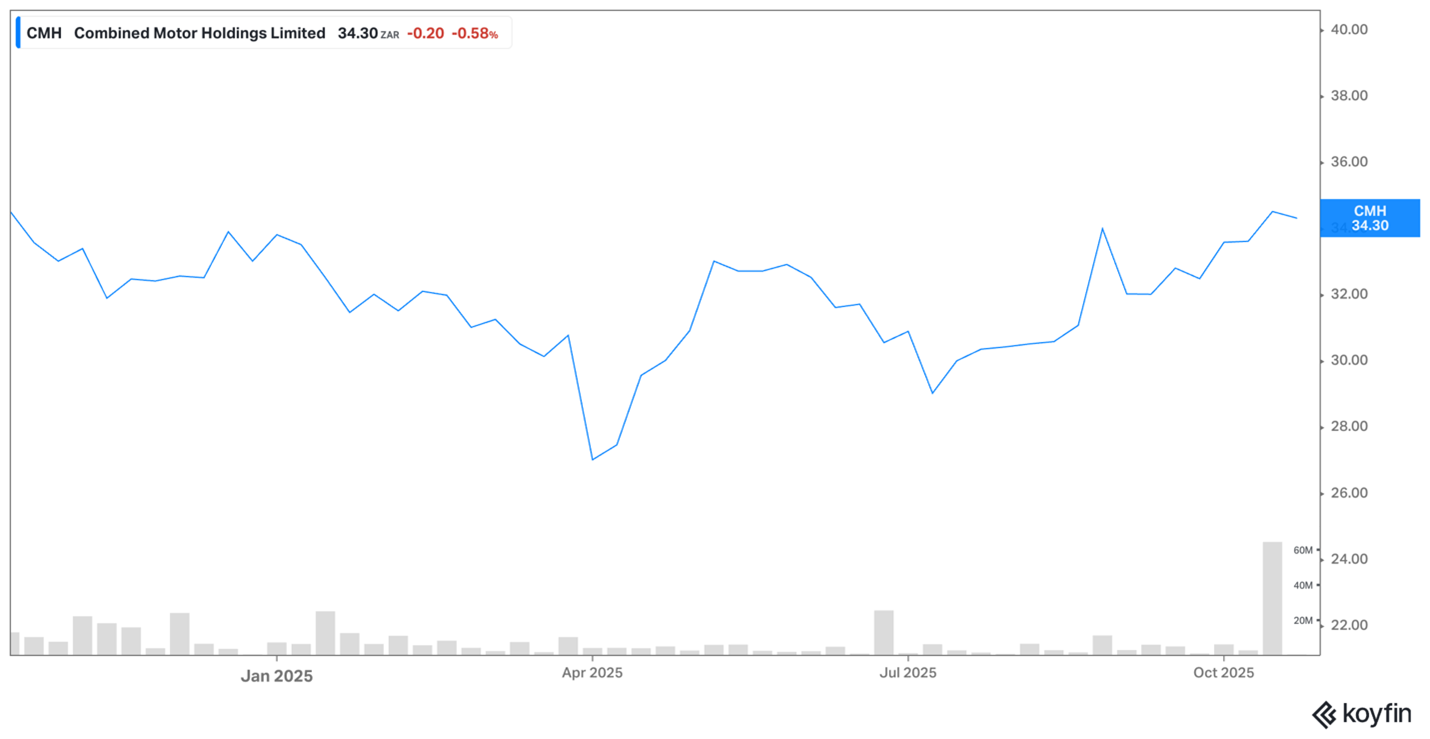
- CMH is a motor vehicle retailer with multiple geographical monopolies. This competitive advantage is evidenced by an average return on equity of 28% p.a. over the past 20 years. It recently released interim results, which once again shot the lights out: eps grew by 23%. In the results announcement, they said they would also not pay a dividend, but rather buy back up to 15% of all the shares in issue!
But no one cares:
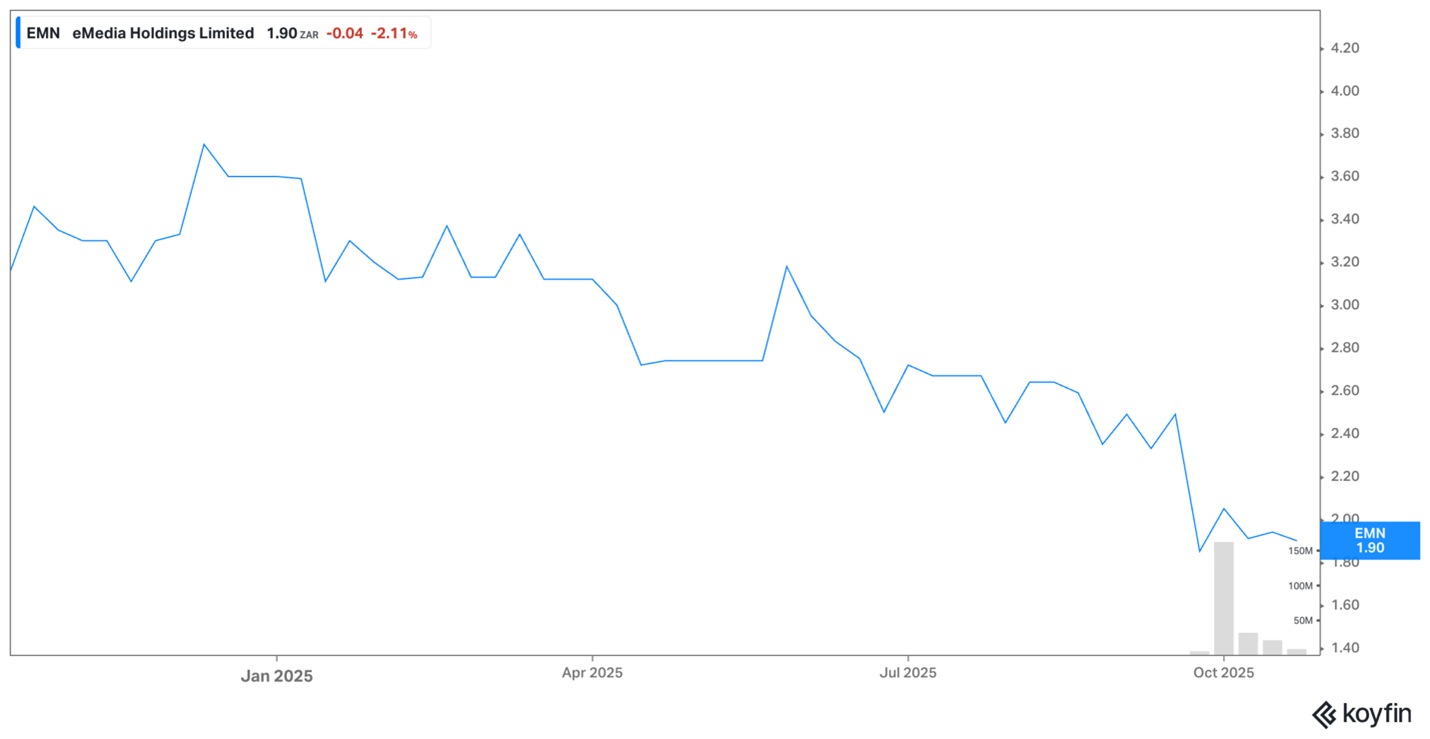
- E-Media (EMN). Remgro recently unbundled its holding of EMN. But before doing so, they bought R50mn worth of new shares, at a price of R3.25 per share. Proper money changed hands here, so I assume there was an arm’s length negotiation between controlling shareholder HCI and Remgro to decide on that price. After the unbundling, EMN is now trading at R1.90 per share, representing a P/E of less than 5, for a business with some tailwinds.
But no one cares:
-
- Accelerate Property Fund (APF). APF recently agreed to sell the Portside building, an iconic building here in Cape Town. The sales price is slightly less than the value on APF’s books. But APF trades at a massive discount to its book value – 75% to be exact. As such, the proposed sale of the Portside building is significantly value accretive to shareholders.
But no one cares:

My take: I could go on and on, but I think you get the point. Significant investment opportunities are hiding in plain sight. I own shares in all three of these companies, and in other similar situations. I don’t own anything that involves building a datacentre, designing, making chips, or trying to create “god in a box” via inferencing.
I sleep very well at night.
In The Media
1. Wells Faber Podcast
Many people ask me for investment advice. Unfortunately, by law, I am not allowed to give it. But RECM does have an ownership interest in a firm of top financial advisers, WellsFaber. I can highly recommend them if you need any advice regarding your financial affairs. And we all need advice.
Last week, WellsFaber released a podcast featuring an interview with Dr Michael Mol, on a subject quite close to my heart: practical advice on living longer and healthier lives.
You can listen to it here.
The podcast was hosted by our favourite ghost, The Finance Ghost. Check out his Ghost Mail service for a daily summary of what’s worth knowing about the SA stock market. It’s free, and I read it daily.
2. Time
We never seem to have enough time for anything. We are always running out of time. Time is always against us.
But last week, I came across this beautiful meditation on the meaning of time by the poet David Whyte. He starts it off by saying, “Time is on our side. Time is not our enemy”.
The piece really resonated with me. You can read it here.
3. The Odyssey of Homer (est. 8th century BC)
Book number 12 for the year marks a further step in my journey through the immersion course in arts and culture, as directed by Ted Gioia (from The Honest Broker Substack).
According to Gioia, The Odyssey is the first major book in the Western world that celebrates a hero for wisdom and intelligence, not just bravery and military skills. It denotes a turning point in cultural history and therefore deserves our respect as brute force is no longer the highest ideal.
It’s the story of Odysseus’s ten-year journey home after the fall of Troy. During his absence, a group of suitors overrun his palace, pursuing his wife Penelope while his son Telemachus searches for his father. On his journey, Odysseus encounters the nymph Calypso, is shipwrecked by Poseidon, escapes from the cyclops Polyphemus, evades the enchantress Circe, and circumvents the deadly Sirens. Mainly by using his brain, not his brawn – as Gioia points out, it represents an Important development in our cultural history.
It ends with Odysseus outwitting his wife’s suitors and killing them all. All in all, a rollicking good tale.
When I first picked up the book, Amanda laughed at me, as she remembered it from varsity, where it was a prescribed book and super hard to read. Maybe it was just the translation I managed to get hold of, but I found it quite readable.
Not exactly Stephen King, but still…
In the same week that The Foschini Group’s share price collapsed due to its poorly performing offshore businesses, Superbalist opened a pop-up shop in Menlyn. Superbalist is a predominantly online fashion store owned and run by my brother and sister-in-law, David and Penny Cohen. Opening a physical store is a new development for them, and I know they will make a great success of it. There’s nothing more exciting than a successful retail business, and in South Africa, we have quite a few locally grown brands that are delighting their customers in a way the big guys just can’t.
Superbalist is one of them, and I’m proud of it.
Visit their shop or website and take a look. I think they will surprise and delight you. Mazeltov, Penny and David!


That’s it for this week.
Remember: it pays to always be careful out there.
Piet Viljoen
RECM