

Dear Fellow Investors and Friends,
Welcome to my newsletter, where I share my efforts to understand markets and the world around me.
I appreciate you taking the time to read this. Feedback is welcome; feel free to drop me a line. It’s great to start conversations.
Today is Thursday, October 16th, the 282nd day of the year. There are 83 days until the end of the year.
On this day in 1793, Marie Antoinette was executed by guillotine, having failed to read the room. During the French Revolution, Marie Antoinette continued to live the high life. This angered the public and led to a show trial where she was unsurprisingly found guilty of treason and sentenced to death. These events marked the end of 1,000 years of French monarchy – a long-standing institution that, like most social constructs, ultimately proved not to be of permanent value.
The book Of Permanent Value is a comprehensive biography focused on Warren Buffett, documenting his life, investment philosophy, and impact on the financial world. The book suggests that the things, people, and ideas that are remembered as truly valuable are those whose effects persist, even as society changes.
It was published just after the tech bubble of the late 90s and early 00’s – an exciting period in the market. The internet was just being discovered, email was ubiquitous, and laptops were starting to displace PCs. But the most exciting development was a device called the Palm Pilot – a handheld digital organiser. This was basically an electronic diary, rolodex, and notepad rolled into one. Amazingly, later models could even sync wirelessly with your laptop!
I remember how excited I was when I bought my first one around 1997. It was, or so I thought, a game-changer. Within 10 years, the iPhone launched, Palm was acquired by HP and eventually it was shut down.
There’s a famous Bezos quote, where he says, “People always ask me what’s going to change. But what’s more important is what’s not going to change. You can never imagine a world in which consumers don’t want cheap prices, fast shipping, and a big selection. It’s impossible to imagine a world where people don’t want that. Because of that, you can put so much confidence into investing in those things, knowing they’ll be relevant in the future.”
What are the things that change?
- Technology
- Fashion/popular taste
- Political systems
It’s very hard to invest in these things. Very few technology companies stand the test of time:
- For every IBM, there were many RCAs, Wang Laboratorys, Kodaks, Xeroxs and Polaroids.
- For every Microsoft, there were many Netscape/AOLs, Lotus123s and Yahoos.
- For every Amazon, there were many Pets.coms and Boo.coms
- For every Apple there were many Blackberrys, Motorolas, Palms and Nokias.
And so on.
The big survivors today are the exceptions that prove the rule. Although easy to recognise their success now, to have picked them from the crowd back when they started was virtually impossible. Both Apple and Microsoft went through near-death experiences when even their most ardent fans thought they were done. And this was not that long ago.
Fashion retail is one of the most fickle markets out there – ask investors in American Apparel, Victoria’s Secret, Superdry, Lululemon, etc. Locally, erstwhile retail stalwarts like Truworths are really struggling.
And if your investment angle is to align yourself politically to gain an advantage, be prepared for wild swings in fortune. Regularly jumping into a pit of snakes will have better average outcomes.
So, what are the things that don’t change?
In short, they are determined mainly by human behaviour:
- Greed, Pride, Lust, Envy – the 4 key components of the 7 deadly sins;
- The need for certainty;
- The desire to be entertained;
- The desire for Immediate gratification;
- The preference for a wide range of choices; and
- The love of a bargain.
Another aspect to consider is the concept of “The Lindy Effect”. It’s a theory that states the longer a non-perishable thing – such as an idea, technology, book, or cultural practice – has existed, the more likely it is to continue existing into the future. The concept originated from observations at Lindy’s Deli in New York City, where people noticed that the future lifespan of Broadway shows was proportional to how long they had already run. Nicholas Nassim Taleb popularised the idea, linking it to power-law distributions, meaning potential future life expectancy increases in direct proportion to past survival.
The holy grail of investments is to identify those things that don’t change and invest in them. Some examples are:
- Hermès, Ferrari – these luxury goods companies appeal directly to our sense of pride and envy, making them exceptionally enduring.
- Estée Lauder plays on the pride we take in how we look.
- Disney provides entertainment to multiple generations.
- Stock markets like LSEG or CBOE offer entertainment, choice, and the opportunity for immediate gratification.
- Amazon provides its customers with immediate gratification, a wide range of choices and “bargains” galore.
- Nintendo is the “Lindy” of gaming companies.
- Berkshire, through its insurance subsidiaries, provides its customers with certainty.
These are just a few, but there are many more. The common denominator is that these stocks are either included or candidates for inclusion in my “10 Stocks Forever” concept.
Unfortunately, I have not identified a market inefficiency. These stocks tend to be expensive. Investors know these companies offer certainty and are willing to pay a high price for it. As they say in the classics, “A bird in the hand is worth 17 in the bush”.
But, from time to time, they do get cheap, because of some form of general market dislocation, or even sometimes a company-specific thing.
In the MWI Worldwide Flexible Fund (aka “The Cockroach”), I have gradually been building these stocks into the equity portion of the fund. 18 months after starting the process, I am halfway there. I have bought Berkshire, Disney, Nestlé, LSEG and Estée Lauder. It looks like the luxury good companies are setting up for a good buying opportunity in the next year or so. As for the tech giants like Microsoft, I’m afraid we will have to wait until their heavy capex programs catch up with them.
To build something of permanent value, patience is required.
In The Markets
1. If it bleeds, it leads
South Africans as a nation are dismissive of their currency. It’s called the “runt”, the “Zim buck” and other derogatory terms. Most people want as little as possible to do with it – it gets swapped for offshore currency ASAP.
Our rands might not buy much in the developed world, but they can buy a lot more here than Australians can buy with their dollars in Australia, or Japanese can with their yen in Japan, or Koreans can with their won in South Korea.
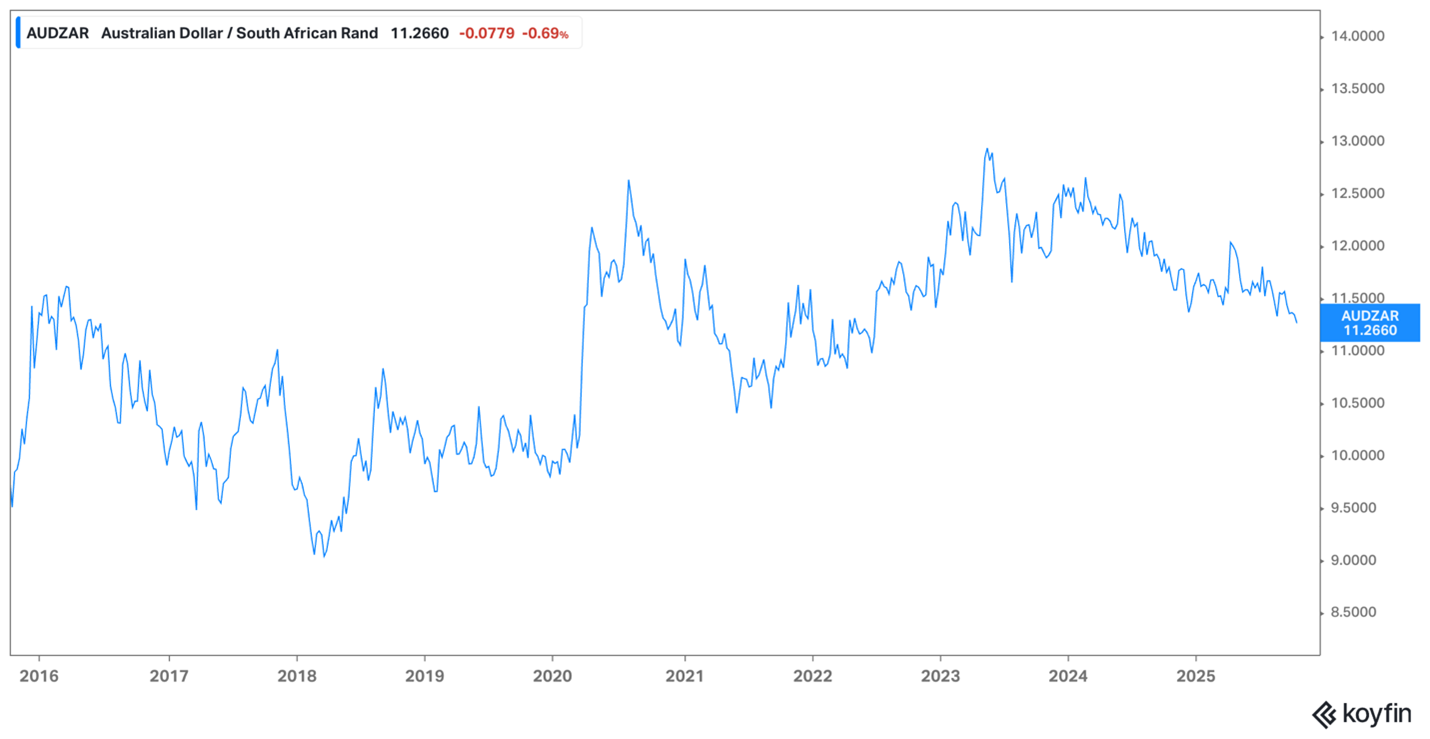
Here are some charts, starting with the rand vs. Aussie dollar:
Rand vs. Japanese yen:

Rand vs. South Korean won:

In each case, the rand buys as much of the foreign currency as it did 10 years ago! So, I have to ask, is that persistent depreciation and severe weakness here with us in the room?
Plus, if you factor in local interest rates, you would have far more buying power if you had kept your money in the bank in rands than if you had moved it to Australia, South Korea or Japan.
My take: We’re particularly fond of bad news about our economy and currency. But sometimes the news is fake. Perception is not always reality.
2. When do we sell gold?
Today, the gold price is way higher in real terms than it was in 1980. It certainly has been a more than useful store of value:
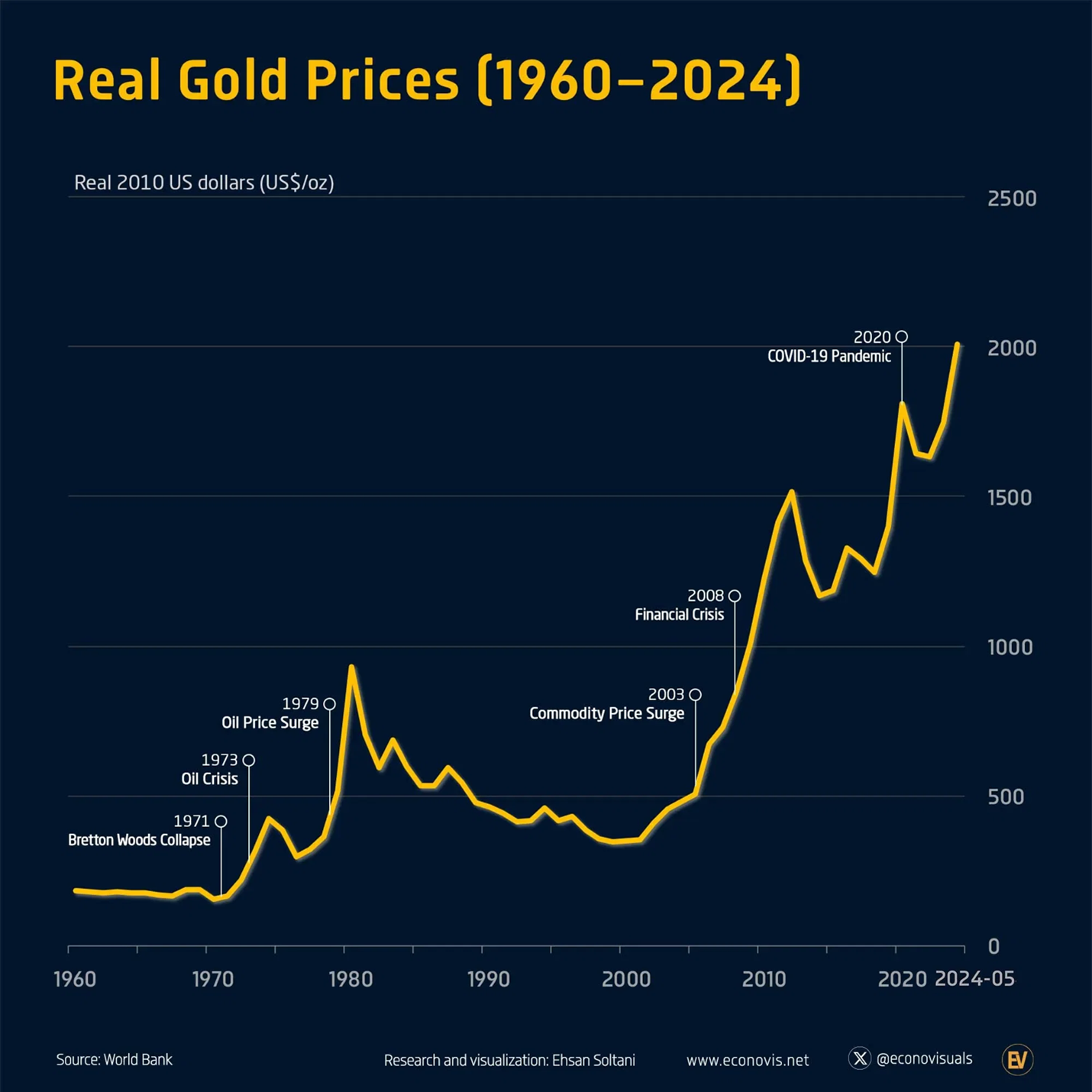
After peaking in 1980, it more than halved and took 30 (!) years to regain those levels again. By that time, it was commonly regarded as a relic, with as much value as a pet rock.
I think those perceptions are slowly changing, though. There’s nothing like a bull market to change opinions.
But should we sell now, to avoid another 30-year drawdown? After all, the cockroach has 12% of its assets allocated to gold, which is material.
In his “Tree Rings” report of October 2nd, Luke Gromen makes the point that the US debt-to-GDP ratio was only 30% in 1980, so Paul Volcker could raise interest rates to 15% without crashing the economy, thereby protecting the dollar and bringing down inflation. Today, with debt to GDP at over 130%, this is impossible. Today, the US financial system can be described as a form of capitalism with Argentinian characteristics.
When was the right time to sell gold in Argentinian pesos? Never:

Gromen makes the point that, expressed in terms of foreign-held US treasury bills and bonds, gold is way cheaper than it was in 1980:
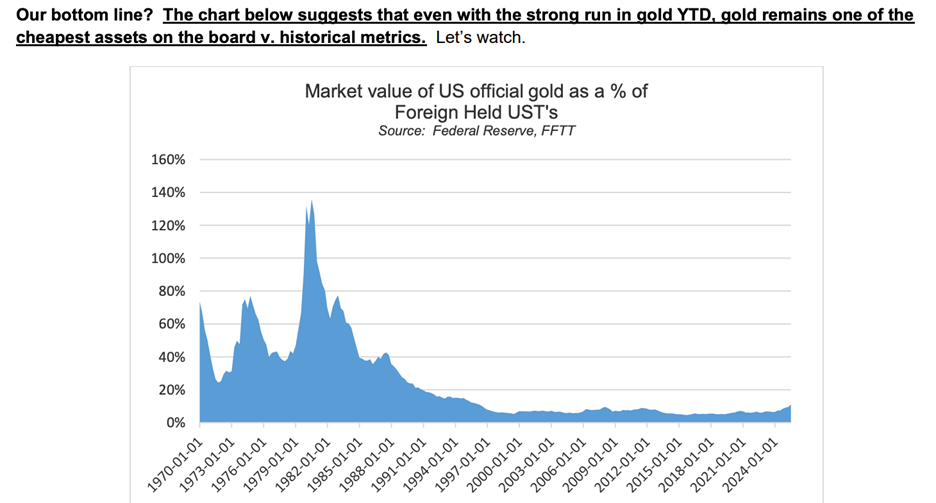
My take: Hold on, this ride could still have a lot of legs.
3. Ferrari
Ferrari disappointed many investors this week. Here’s the share price:
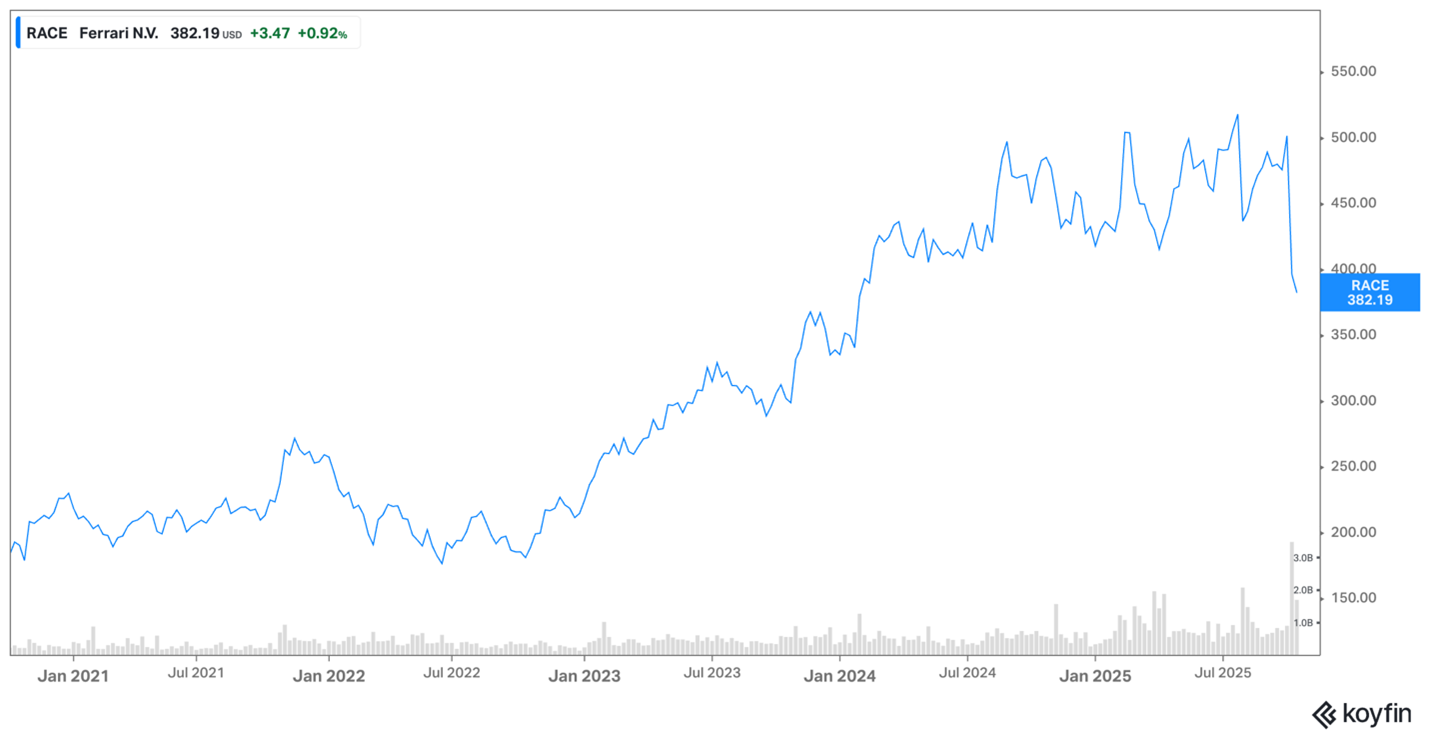
In a trading statement, Ferrari forecast 6% annual growth in earnings before interest and taxes through 2030, downshifting from the 10% pace presented during their prior capital markets event held three years ago.
I find it hard to understand the disappointment when they are just executing on their core business model, which is to sell fewer cars than the market wants to buy. In so doing, they are supremely profitable, generating nearly $500,000 of revenue per vehicle sold, compared to $313,000 a decade ago.
The market value of the business per car sold is almost $ 55 million. Here is the same stat for some other car makers:

Ferrari is valued 5 times higher than Tesla! It really is an excellent business model.
My take: Ferrari is firmly on my buy list. The stock, not the car. Now only on a P/E of 34(!), this week’s sell-off brings it one step closer to the cockroach’s portfolio.
4. The JSE
This week, the CEO of the JSE, Leila Fourie, retired after 6 years at the helm. A very long SENS announcement was highly complementary, saying “Dr Fourie has led the JSE through a transformative period marked by strategic innovation, operational resilience and inclusive leadership”. And much else, all very positive.
What it didn’t say was that the number of stocks (i.e. clients) listed on the exchange has gone from 340 in 2019 to 285 currently. Annual trading volume has declined from R4bn to around R3bn. The share price action reflects these adverse developments:

My take: There is no doubt our local political elite’s economic ignorance and absolute inability to come to terms with on-the-ground reality has made things tough for businesses in South Africa generally and for the business of the stock exchange specifically. But the regulatory and compliance burden has also increased exponentially, making it unattractive to be a listed company. And for this, the JSE and its executives need to take at least some of the blame.
5. PSG Financial Services (KST)
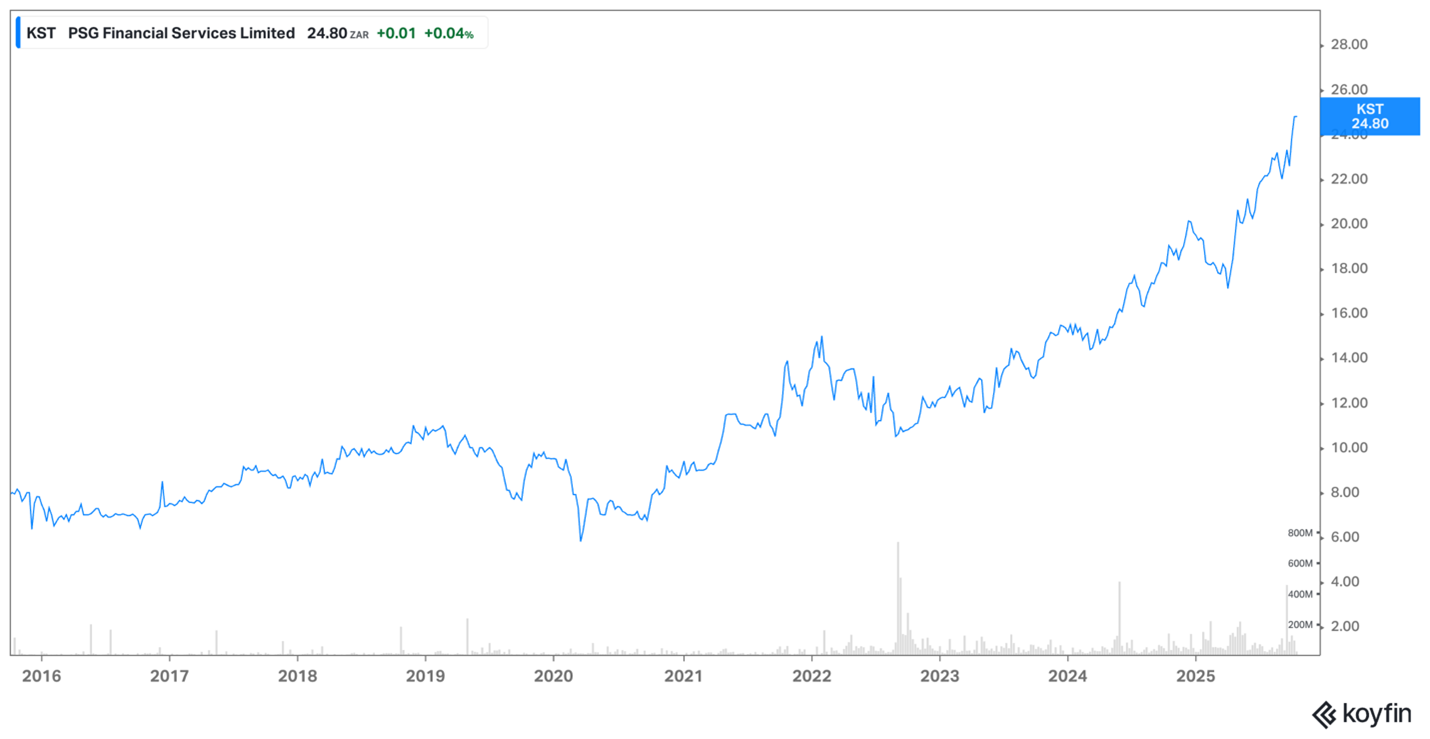
This company is one of the unsung heroes of the South African financial services market. Under the astute leadership of Francois Gouws, KST has compounded at over 25% p.a. over the past 5 years.
Today, it reported earnings for the 6 months ending August 2025, and it has once more shot the lights out. The market was slow to catch up, but has now started to reward management for a job well done:
I first met Francois when we were both students. At the time, he lived in a digs in Stellenbosch, where my girlfriend of the time also stayed. I have a faint recollection of him as a type of blond-haired surfer dude. How times have changed! He is probably one of the sharpest executives in the SA financial services sector today. Most people who have crossed his path would vouch that he gets the better end of a deal 99 times out of 100.
My take: Jannie Mouton is one of our country’s best businessmen. One of the smartest things he ever did was to appoint Francois as the CEO of KST.
In The Media
1. The Storm Before the Storm, by Mike Duncan (2017)
Book number 11 for the year is set in the period of 150 to 50 BC and is subtitled “The beginning of the end of the Roman Republic”. Given that historians cite the end of the Republic as 27BC, when Octavia (later known as Augustus) assumed power as an emperor, this book covers just about the entire history of the end of the Republic.
Of course, the Roman Republic should not be confused with the Roman Empire, which only ended around 500 years later. All in all, the Republic also lasted for 500 years, so the Romans effectively ruled the world for 1,000 years. A very similar timespan to that of the French monarchy…
This book documents the long and complex combination of social, economic, political, and military crises that eroded its institutions. There were a few key issues:
- Land. Rome’s expansion created massive wealth for the elites, while impoverishing poor farmers who could not compete with the large estates. Every now and then, the Senate would gift portions of land to its poorer citizens, only to see them immediately sell it to the wealthy elite, thereby exacerbating the problem.
- Citizenship. The expansion of Roman territory brought many allied Italian peoples and provincial subjects under Roman rule, but they could never acquire full citizenship rights – i.e. the right to vote. This created factionalism and inhibited the Republic’s ability to govern.
- Corruption. The Senate became increasingly corrupt, dominated by aristocratic factions more interested in personal gain than in the Republic’s stability. Bribery, vote-buying, and patronage eroded public trust and paralysed governance. This served to further deepen the divide between the elites and the populace.
This environment set the stage for strong personalities like Marius, Sulla and the Gracchi brothers to usurp power and change laws unilaterally, creating an unstable environment that eventually led to the destruction of the Republic.
A lot of this sounds familiar to us here in the 21st century. It just goes to show that history is made by people, and people’s emotions and behaviours remain unchanged through the ages.
The book was a challenging read, particularly for those, like me, unfamiliar with this period in history. But it tells a fascinating story of the power struggles between the different role players and offers a lot of food for thought regarding the events that we are currently living through.
If you are interested in this sort of thing, it’s worth giving the book a go.
2. Why is the world so ugly?
David Perell produced a short movie called “The Modern World”. In it, the narrator, Sheehan Quirke (who goes by the name “The Cultural Tutor” on X) asks the question “How did the world get this ugly?”
The movie is a meditation on how design has changed over the centuries, optimising for efficiency at the expense of beauty. An example of this is how company logos have become so homogenised over time:

This issue was recently highlighted in the Cracker Barrel saga, when the company was forced to rebrand back to the original logo as the public revolted against the new, homogenised version:

When I was in Ohama with my sons a couple of years ago, we had breakfast at the Cracker Barrel. Apart from Charlie Munger’s sharp and witty insights, it was the highlight of the trip. The logo of the old man leaning against a barrel drew us in. I’m not sure we would have gone if it had sported the “new” branding.
My take: Overemphasising efficiency can take the joy out of things. I prefer more joy and less efficiency.
3. Joy
Speaking of joy, this week, the remaining 20 surviving Israeli hostages were released in exchange for 2000 POWs. The pure, unadulterated joy of the moment when a father and his son are reunited can be seen in this video clip, which I got from Howard Lindzon’s newsletter. It brought tears to my eyes.
And this one also brought tears to my eyes, but from laughing, not crying!
We can only hope the ceasefire lasts, and both sides respect it. Sam Harris pointed out the imbalance in the situation when he said that if the Israelis lay down their arms unilaterally tomorrow, they will be wiped out, but if Hamas does so, nothing will happen.
Let’s hope that’s not true anymore.
My take: I am happy for all the people who have been reunited with their loved ones, and I sincerely hope we are in for a period of relative peace in the Middle East.
This week has been quite a joyous one, as Bafana Bafana, the South African football team, qualified for the World Cup for the first time since 2010, when we hosted it and thus qualified automatically. Could it be that South Africa will end up as Rugby, Cricket and Soccer World Champs? Given the right odds, I’d put a couple of rands on that.
In other happy news, my son Nic and his mates came second in the “Prison Break” triathlon last weekend. For someone who only started running and cycling this year, he’s doing well, and I’m proud of him. I’m also proud that the three of them opted to book into a hotel in Worcester that evening instead of driving back to Cape Town. The events leading up to the check-in remain a mystery, however.
Here he is in the pic, far left, obviously well before check-in time at the hotel:
Piet Viljoen
RECM

Finally, this is the 100th edition of this letter. I started writing on a whim (and a push) just over two years ago. After 100 letters, it still feels like I am only getting started. For those who send feedback, questions and observations – thank you. And for those of you who point out my (many) mistakes, thank you. And above all, for those of you who simply read it every week, thank you for your time.
I look forward to the next 100.
That’s it for this week. But be careful out there!
Piet Viljoen
RECM
16 October 2025