

Dear Fellow Investors and Friends,
Welcome to my newsletter, where I share my efforts to understand markets and the world around me.
I do appreciate you taking the time to read this. Feedback is welcome; feel free to drop me a line. It’s great to start conversations.
Today is Thursday, September 18th, the 254th day of the year. There are 111 days until the end of the year. On this day in 1924, George Walker died in poverty. Who was George Walker? Together with George Harrison, they discovered the Witwatersrand gold reef – one of the richest in the world. Being penniless prospectors, unable to explore or develop the reef further, they sold their discovery for ten pounds.
History would have been very different had they been able to adhere to their discovery!
“You don’t rise to the level of your goals. You fall to the level of your systems.”
– James Clear, author of Atomic Habits
The placebo adherence effect refers to the observation that patients in clinical trials who strictly adhere to taking their placebo tend to experience better health outcomes, including notably lower mortality, than those who are less adherent to the placebo regimen.
Discipline has a significant influence on outcome.
Dogma and ritual are the backbone of most religions. Dogma is the core principle of the belief, and rituals are its prescribed actions and ceremonies. Once one becomes aware of the “I believe this; therefore, I do that” sequencing, it becomes noticeable in many human endeavours, not only religion.
- The football player exhibits his belief when running onto the field by crossing himself and then enacting a ritual of touching the grass, hugging his teammates and then kneeling for a few seconds.
- The traveller exhibits her belief by wearing a St Christopher necklace, and enacts a ritual of touching it and repeating a mantra every time the plane takes off.
- The humanitarian demonstrates his belief by wearing a branded uniform and enacting rituals such as lighting candles, observing moments of silence, and participating in commemorative ceremonies to provide emotional support to those in need.
- The fund manager exhibits her belief by wearing formal clothing and enacting rituals of drawing seemingly arbitrary lines on charts and making forecasts by extrapolating current events into the future.
In all these cases, beliefs, dogma, and ritual serve no real purpose, except to ground the person and remind them of what they are trying to achieve. But if I cross myself, touch the grass and hug my teammates when running onto a field, I am afraid it will make no difference: I remain an untalented and unskilled football player. Dogmas and rituals are only of use if there is something of substance – belief? – behind them.
Dogma and ritual are life’s placebo effect of adherence. They are tokens that evidence hours of practice, discipline and application.
Adam Singer, in his Substack “Hot Takes“, wrote about the plague of over-optimisation: “The highest calling of many in modernity is personal optimisation. And while it’s definitely worthwhile in certain areas (such as removing a long commute), it can easily be something with diminishing returns in others.”
In a world obsessed with outcomes and optimisation, the placebo adherence effect is a kind of glitch in the matrix. It suggests that meaning emerges not from doing the optimal thing, but from doing something, anything – just with consistency and care, even if it’s arbitrary.
Balancing optimisation with flexibility, spontaneity, and an appreciation for the present moment is key to a holistic and sustainable life. Rituals come in here. Instead of trying to overoptimise everything in an unsustainable, and ultimately ineffective way, it might be better to slow down and develop a ritual that gives meaning to your dogma – whatever that may be. Once you learn to apply that ritual consistently, the placebo adherence effect says that your dogma defines the outcome.
Practical trumps optimal over time, mainly because efficiency is maintainable, whereas optimal often isn’t.
- Extreme optimisation often yields minimal incremental gains at exponentially increasing costs. Efficient processes balance cost and gain.
- Highly optimised processes can be brittle. Efficient processes are flexible and adaptable to changing circumstances.
- Optimising for maximal performance may lead to burnout. Efficient processes are easier to maintain for long periods.
- Over-optimised systems often lack slack for error correction, recovery, or innovation. An efficient process handles unforeseen events much better.
Technology is supposed to increase our productivity, thereby giving us more time to think and relax, ultimately enhancing the quality of our lives. Instead, we are just trying to cram more into the same amount of time. We have become enslaved to time. Constant acceleration has led to distraction and reduced the quality of our lives.
The concept of shokunin waza (craftsmanship or the spirit of the artisan – 職人技, しょくにんわざ) is deeply rooted in Japanese culture. It emphasises mastery through dedication to a single craft over time. In the West, we often think of mastery and endurance as the reward for big ideas or massive innovation. But shokunin waza offers a different theory. Maybe one of the secrets of endurance isn’t about doing more – but about doing one thing really well, for a really long time. It’s not flashy. And it’s not a growth strategy. It’s more of a philosophy – and it works.
How do we apply this idea to investing?
First, we must recognise that investing outcomes are highly dependent on the time over which one measures them. You can prove that just about any investment system/process works if you choose the appropriate time period.
Once we know this, it becomes easy to understand that there are many more ways to skin the cat successfully than there are cats. In investing, there isn’t one silver bullet which dominates every other possible bullet. So instead of thrashing around implementing different processes to capture each market movement optimally, it might be better to study the various strategies that have worked over time, and pick one that resonates with you.
Then, through all its ups and downs, simply stick to applying the process efficiently and consistently. Which is where ritual comes in – ritual is simplistic evidence of complicated dogma.
Ultimately, investment success comes from the sticking part, not the process part. A good process is necessary but not sufficient. It’s the sticking that makes it sufficient.
Developing your own rituals can help you stick with your chosen investment process over the long term.
In The Markets
1. HCI
An investment firm called Aktiv Investment Management has caused a stir in the market by publishing a few pieces on Substack criticising the management of HCI for their value-destructive actions. Their main points of criticism seem to be:
- They are not providing one of their minority shareholders with a sufficient income stream.
- They think that unbundling assets will eliminate the holding company discount.
- They are of the view that management’s insistence that their holdings deserve a control premium is unrealistic.
- They are of the view that there has been a decade’s worth of value destruction, pointing to the low share price as proof.
- They are of the view that the CEO’s remuneration of c R19mn p.a. is excessive.
There are other points, but these are the main ones. Let’s see if I can deal with each of them objectively. I am a shareholder in HCI, so bear that in mind.
- Why should the cash flow requirement of one minority shareholder dominate management’s strategic thinking? And why does this shareholder need such a large annual cash flow, seemingly more than R200mn per annum? I also have cash flow requirements, but I am sure HCI management will disregard my needs completely in their thinking.
- If you believe unbundling assets removes holding company discounts, I have a bridge to sell to you. The discount comes from capitalising the costs of running the business. If you unbundle important assets, costs remain; you have a smaller asset base to fund them. Arguably, the discount will widen, and you will sit with a bunch of small and mid-cap stocks which will trade at hugely discounted values – like most South African small and midcaps.
- Any businessperson understands the value of control. Enough said.
- The share price performance has been poor. But that is outside of management’s control. What management can control is growth in the NAV per share. Through astute decision-making and crafty deal-making, management has compounded NAV per share at 10,2% p.a. compared to the 9% p.a. of the JSE (including dividends) over the past 10 years. HCI’s numbers exclude its unbundling of Montauk and Niveus, as well as dividends, which would add to HCI’s NAV growth.
- Over the past 4 years, post-COVID, HCI’s NAV has compounded by 21% p.a. – well in excess of the JSE’s performance.
- R19mn p.a. is a more than satisfactory emolument for a former trade unionist. But it pales by comparison to what JSE execs at similarly sized businesses get paid by their sleepy remuneration committees. These committees, or their consultants, would laugh at what the CEO of HCI gets paid.
My take: I think the authors of these criticisms might have a different agenda than regular investors. HCI owns a collection of well-managed, valuable and unique businesses. Contrary to Aktiv’s narrative, management of HCI is in fact creating value, as evidenced by the NAV per share growth. I am sure they will not fall for these flaky, self-serving arguments.
2. Telkom
This company is an excellent example of why governments should not have interests in private companies. It leads to poor capital allocation by management, who are often appointed based on connections rather than skill.
Telkom’s share price, having gone nowhere for 20 years, albeit in a massively volatile fashion, shows the effect of the government’s dead hand on its activities:
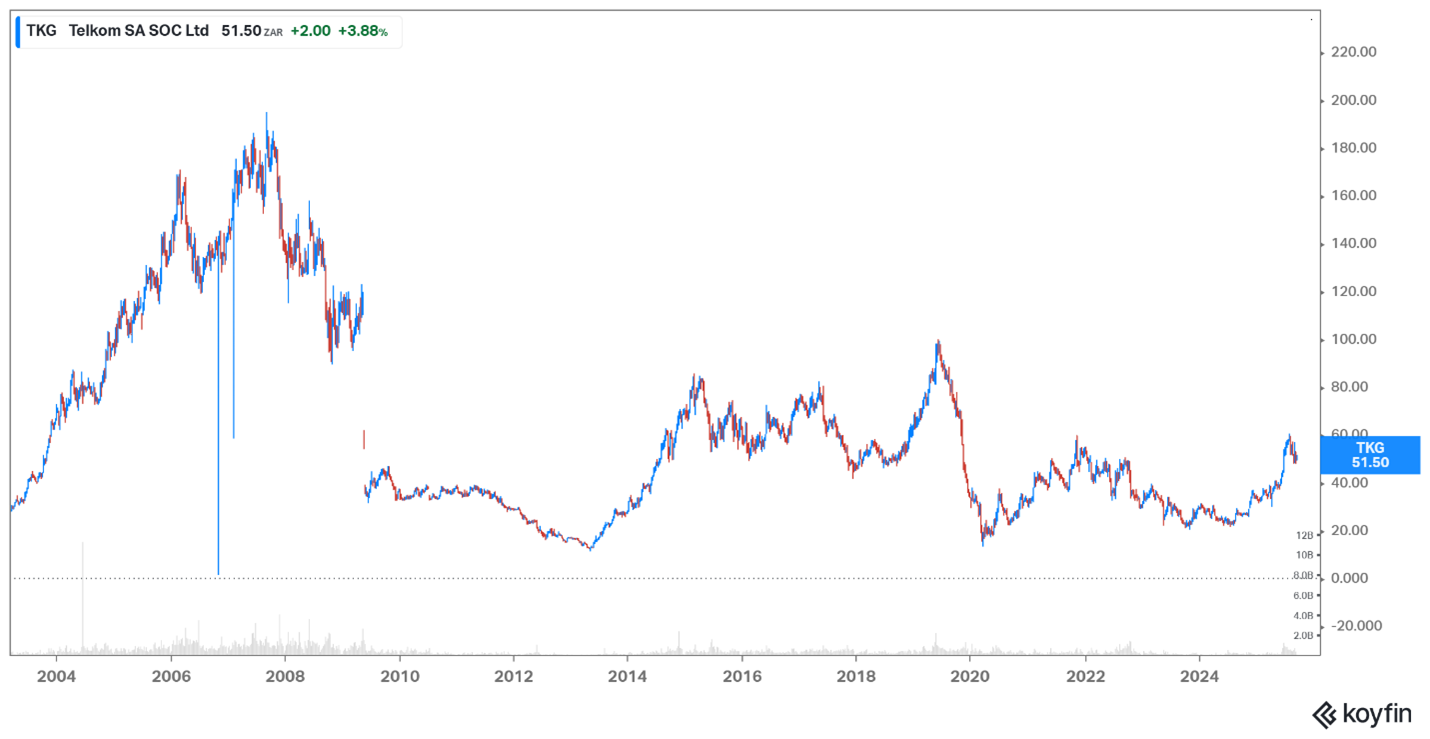
However, that does not mean it lacks valuable assets – assets which it is now in the process of monetising. The most valuable asset it owns is its fibre-to-the-home business called Openserve. At 160,000km of fibre, Openserve has the most extensive network in the country.
Recently, the Competition Commission allowed Vodacom to acquire Maziv, another local fibre provider, clearing the way for MTN to do a deal with Openserve. Placing Openserve – a better asset – on the same multiple as the Maziv means it is worth R45bn – twice the current market value of Telkom in its entirety. As a reminder, Telkom owns 100% of Openserve – and other valuable businesses.
My take: Telkom is just another hugely undervalued small and mid-sized South African company. But hey, take your money offshore. It’s much, much more attractive – the sharks there wear such nice suits.
3. The South African economy
Speaking of attractive, is there a less attractive prospect than the South African economy? Or so goes the common knowledge that all of us buy into. But what clothes is the emperor wearing?
Let’s have a look.
South Africa’s primary exports are precious metals, minerals and other ores. Combined, they make up over a third of total exports. Our most significant imports are fuels, oils, and distillates, which account for approximately 35% of total imports.
Given this background, it shouldn’t come as a surprise that the terms of trade are moving in our favour, with the price of gold and platinum going up a lot, and the price of oil coming down. My colleague Jan van Niekerk devised this chart to show what is happening:

The upward-sloping white line represents our terms of trade, indicating how much it’s improving. Right now, it is only the mining sector benefiting, as evidenced by the performance of gold and platinum shares. But it is only a matter of time before it filters through to the rest of the economy. South Africa is just one big mining town, after all.
My take: If – and this is a big if – our growth rate improves, you will see some significant share price movements in stocks like Telkom – and many others. The businesspeople who want to take Ascendis, Metrofile, and Libstar private – all announced in the last week – seem to agree.
4. American Eagle
Sydney Sweeney’s recent ad campaign for American Eagle generated substantial attention and controversy. Attention most likely due to her looks, and controversy due to thin-skinned DEI propagandists, a group characterised by its intolerance to other points of view, and its heretofore ability to shut down any voice that doesn’t agree with them.
This was the campaign:

And this was the market’s judgment, as evidenced by the share price of American Eagle:
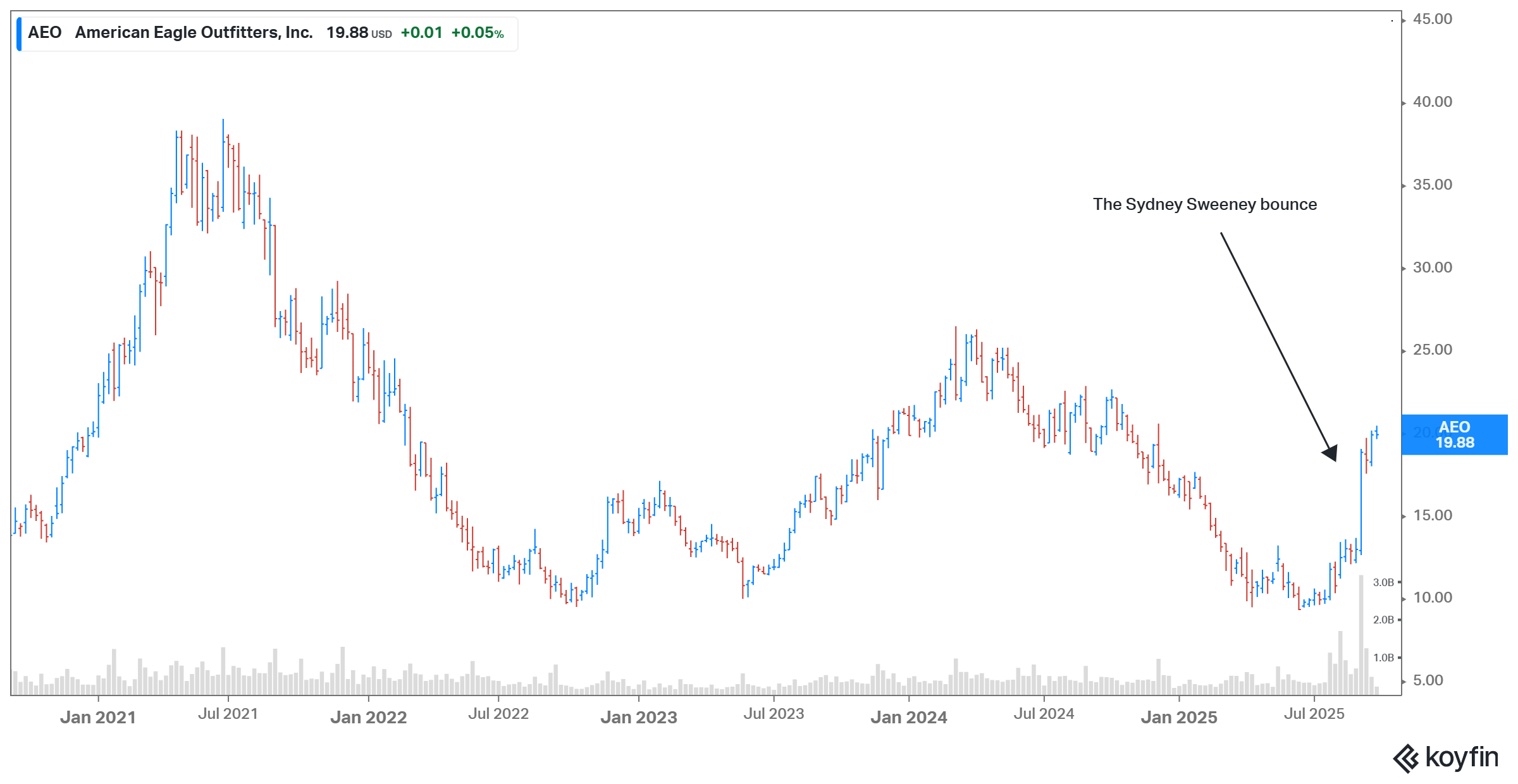
What’s that saying again? Oh, yes – go woke, go broke. American Eagle followed Charlie Munger’s advice and inverted.
Look, American Eagle isn’t a great business – but this ad did help them sell more product, which is the point of advertising, isn’t it?
My take: I think it was a brilliant ad, and as such, good for the business. To the extent that it opened debate, it was a positive development for society. I still wouldn’t buy the shares, though.
5. Anglo Teck
A dream come true for a mining business – to be called a “teck” business. The name Anglo Teck is a result of the merger between Anglo American and Teck Resources. Since BHP’s bid for Anglo failed a while ago, Anglo has been very busy restructuring. It has divested its platinum interests, prepared for the sale of its diamond interests and now effectively acquired more copper assets via this merger.
The FT published this chart shortly after the merger:

And this was the market’s judgment, as evidenced by the share price of American Eagle:
So, Anglo is now a major player in copper and no longer operates in the platinum market. Historically, they have been almost a perfect contra-indicator of capital allocation in the mining sector.
- When it was buying back its own shares in 2006, we should have been selling them.
- When it acquired its significant iron ore assets at Minas Rio in 2008, we should have been selling iron ore assets.
- When it unbundled its coal assets in 2021, we should have been buying coal assets.
- When it unbundled AngloPlats in 2024, we should have been buying platinum assets, thankfully, which we did!
Goehring and Rozencwejg are a firm of natural resource investors in New York, and as such, have in-depth knowledge of commodity markets. They are bullish on copper’s long-term fundamentals given secular supply constraints, but stress that energy market evolution and unforeseen efficiencies could moderate the “supercycle” narrative popular among copper bulls.
The bulls rest their case on renewable energy demand – solar panels, wind turbines, and EVs. But if the nuclear renaissance is real, it might slow the demand for low-efficiency energy. And, by extension, copper.
My take: The resource market is cyclical for a reason. It takes a long time to develop a mine. In that time, a lot can change on both the demand and supply sides. The best miners are those who develop and stick with a good resource through its inevitable ups and downs. Not the ones who chase the latest bright shiny thing.
In The Media
1. X (Nee Twitter)
I’ve cut the cord, gone cold turkey, kicked the habit and emancipated myself from social media – primarily, in my case, X. I don’t know if it was inadvertently seeing Charlie Kirk get shot or just realising that it had become almost like a shield between myself and the real world that did it. But the deed is done, I have deleted my account.
Sam Harris did so three years ago, and at the time I wondered why. But this last weekend, he wrote a piece called “We are losing the information war with ourselves”.
Harris believes that platforms like X and TikTok are destroying our culture. According to him, “We are poisoning ourselves and inviting others to poison us.”
I agree.
My argument for social media was always that if you curate your timeline carefully enough, you can cut out a lot of the poison. But there was always some residual poison, and it’s a huge time sink. Since I cut the cord a week ago, I have found a lot more space to read and write more.
My take: It was a lot easier to give up social media than it was to give up smoking, which I did 15 years ago. But I have already found it is as beneficial, if not more. Why let a bunch of attention seekers live rent-free in your head? There’s a lot more wisdom in old books than there is on any social media timeline.
2. Charlie Kirk
I didn’t really know much about him, except that he said certain things that I agreed with and others that I didn’t. But, to the best of my knowledge, he never said anything close to something worthy of getting shot for.
But I guess that’s the ultimate destination for cancel culture.
Vitaly Katsenelson, a fund manager out of Denver, Colorado, wrote a piece called “Charlie Kirk and the cost of courage” in honour of Charlie Kirk.
My take: It’s worth taking the two minutes it takes to read the piece.
3. Graham Obree
Not many people know who Graham Obree was. He was an idiosyncratic Scotsman (aren’t they all?) who designed and built his own bikes. These bikes gave him a unique riding position, enabling him to break the one-hour record despite having almost no outside funding and no pro team to back him up.
His story is testimony to true grit, belief in your own ability and single-minded adherence to the project.
It’s fascinating, and you can watch it here.
4. Book review
With the help of not being on X, I finished my tenth book so far this year. It’s called “A Town Like Alice” by Neville Shute, written in 1950.
A word of warning – this book is a romantic and historical classic. So, if you don’t like those two things, it won’t be for you.
It starts with the story of Jean Paget being captured by the Japanese during their invasion of Malaysia in the Second World War. What followed was a harrowing three years of being marched the length and breadth of Malaysia. Not all the women and children in the group survived.
It was just another example of going from living the country club life of an expat to a famished POW in the blink of an eye. Those who were weak – mentally or physically – didn’t make it. Disaster is always just a heartbeat away.
On this seemingly endless perambulatory tour of Malaysia, our heroine, Jean, gradually takes over the leadership of the group and even encounters a romantic interest. An interest that a sadistic Japanese warden beats to death.
However, the warden is not only sadistic, but honourable, and when he later notices his victim is still alive, gets him properly seen to. This allows the romantic flame to eventually rekindle itself after the war, despite a lot of interim trials and tribulations. When they finally get together, they start a new life – and a new town – in the outback of Australia. Despite encountering many hardships along the way, they get to live happily ever after, as happens in all good romantic novels.
The story is based on actual events, is engaging, and kept me turning the pages long after bedtime on many nights. I came for the history and stayed for the romance.
I love old books, and you can learn so much from fiction.
This one was a goodie.
5. Rate cut day
Yesterday was the hotly anticipated rate cut day in the USA. Inspired by Bloomberg columnist John Authers, I put together a playlist celebrating US monetary policy.
This week’s letter has run a bit long – next week, I’ll cut the prolixity. But I do need to congratulate my son Nick and his girlfriend Daneel, who both ran PBs – and good times – in the Gun Run. Having only really started running this year, they’ve done well. They thoroughly deserved the beer after the run!

Also, my stepson Zac passed his board admission exam and is one step closer to earning his CA qualification.
They all bring joy to my life, and I’m proud of them all.
Still – be careful out there!
Piet Viljoen
RECM